SLA Based Resource Allocation as a Service
Provider (SaaS) in Cloud Computing
Environments
K.Adithya Narayanan,
Monish Joel Singh, D.Kerana Hanirex, K.G.S. Venkatesan
Dept. of C.S.E., Bharath University, Chennai, India
Dept. of C.S.E., Bharath University, Chennai, India
Assistant Professor, Dept. of C.S.E., Bharath University, Chennai, India
Associate Professor, Dept. of C.S.E., Bharath University, Chennai, India
ABSTRACT
:
Our proposed approach tries to decrease the impact of SLA violation through a user discriminationapproach and avoid entering the complex procedure of negotiation There will be no chance to get the unknown result or loss of result. We can measure the SLA violation in long term measuring. For simulations, we considered five different user types and five classes of virtual machines with different reliability level labels. A learning automaton is an adaptive decision-making unit located in a stochastic environment and the action selection is based on a specific Probability distribution which is updated according to environment the automaton receives by employing a particular action which hence increases the efficiency by reducing the maximum cost and by improving Quality of Service (QoS).
KEYWORDS: Qos(Quality of Service), SLA( Service Level Agreement)
I. INTRODUCTION
In this project User satisfaction as a significant antecedent to user loyalty has been highlighted By many researchers in market based literatures. SLA violation as an significant factor can Decrease user’s agreement level. The amount of this reduce depends on user’s characteristics. So we have to present a new approach to reduce the impact of SLA violations on User’s satisfaction level, but not by decreasing number of SLA violations. Instead, we try to use Characteristics of users to decrease the impact of SLA violations on user satisfaction level. But Some of them are unknown to the service provider and selfish users are not interested to reveal Them truly. Most the works of literature ignore considering such characteristics and treat others Just based on SLA parameters. So, two users with dissimilar characteristics but similar SLAs have equal significance for the service provider.
II. RELATED WORK
non-interactive and transactional applications.[13] introduced two classes of learning automata based algorithms for adaptive selection of value for inertia weight and acceleration coefficients. proposed model extends existing Push-Pull-Mooring Theory of consumer switching by incorporating the influence government policy, switching intention abortion factors.[15] extend prior research by developing a conceptual framework linking all of these constructs in a business-to-business (B2B) service setting.
III.EXISTING SYSTEM
To demonstrate the usability of our approach, we provided some mathematical simulations in decisive situations. Decisive situation means a condition in which a service provider has faced with unexpected lack of resources and SLA-violation for some users is the foreseeable, Service provider has two options: neglecting the queued requests or forcing some existing VMs to discharge their resources. In the final case, service provider can assign the unconfined resources to the important queued requests. Together, cases would cause SLA violations, but the users who suffer from violations are different. Since users have different characteristics, so user satisfaction level under the two mentioned options will be different. Our approach presents a method to decide which VMs should be enforced to release their resources [12].
The branch and bound method it that is similar to the BFS method, it can be generated using the sub nodes. In some cases the time complexity is too low in a branch and bound technique, so we are using the various optimal solutions to satisfy the problem [15]. Branch and bound is a methodical system for solving optimization inconvenience B&B is relatively a general optimization technique that applies where the greedy method and dynamic programming fail. Nevertheless, it is much slower. Certainly, it frequently leads to exponential time complexity in the worst case. The drawbacks are :
(1) The service cost is more.
(2) The Quality of Service is low, because of SLAproblem.
(3) In existing system we have to use a genetic algorithm, A Genetic Algorithm (GA) is a searchheuristic that mimics
the process of natural selection, in order to find the SLA violation problem [19].
IV. PROPOSED SYSTEM
V. PROPOSED SYSTEM ARCHITECTURE
A. Finite Action-Set Learning Automaton
A learning automaton is an adaptive decision-making unit located in a stochastic environment,FALA is type of variable LA that its action-set is always considered to be finite. This type of LA has been studied extensively in many applications. The learning algorithm will be called linear reward- penalty or LR_p if (a=b). In case of a >> b (a is much greater than b) , we call it the learning reward-exponently or and finally if they are called linear reward-Inaction algorithms [26].
Algorithm: 1 Finite Action Learning Automaton Function
Input: VM_ID: ID of the VM to deploy in a high availability node MðÞ: Deployment profile function
Output: Satisfaction degree of constraint 1: host ID: ¼ M(VM_ID)
2: satisfaction: ¼ 0;
4: Satisfaction: ¼ 1:0; 5: return satisfaction; 6: end if
7: if (HostHasRAID(host_ID)) then 8: satisfaction þ ¼ 0:2;
9: end if
10: if (Host Has Redundant Power Supply (host_ID)) then 11: satisfaction þ ¼ 0:2;
12: end if
13: if (Host Has Multiple Network (host_ID)) then 14: satisfaction þ ¼ 0:2;
15: end if
16: return satisfaction;
The implementation details of the HighAvail constraint are not revealed to the consumer as they are specific to each cloud infrastructure. Whenever one or more assumptions regarding the high availability of the hardware are outdated, possibly due to major changes in the infrastructure (e.g., all hosting nodes become equipped with RAID),we have to provide new implementations for the affected utility functions [28].
Administrative constraints are also realized as utility functions. These constraints serve a dual purpose as they can introduce high-level policies and assist in administration tasks. For instance, EmptyNode relieves a hosting node of VMs. ReduceDist enforces the high-level policy of clustering VMs of the same user on hosts that may not be far apart in terms of network hops; this is done to limit major traffic to be routed over long-haul physical networks. We have realized both user and administration constraints as utility functions in similar fashion to Algorithm 1;for brevity, we omit their detailed discussion here. Such functions are expected to work in a plug-and-play fashion [29].
Advantages:
(1) The proposed system reduces the maximum cost. (2) It improves the Quality of Service (QoS).
(3) It also Improves the Quality of Service (Qos) between cloud server and client. (4)The proposed system uses complex algorithm to improve the QoS.
VI.RESULT ANALYSIS
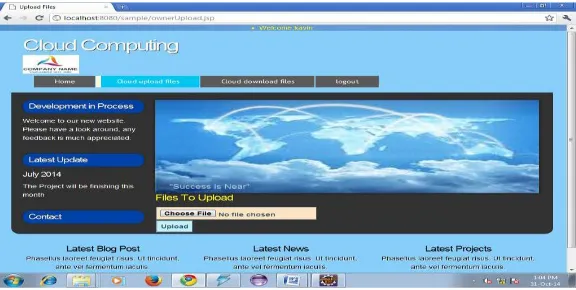
After the user selectingan plan, and after the plan is approved by the Admin, the user can start uploading the data files to the Cloud System, the below image represents the upload page where the data can be uploaded by the user.
After the user's data is uploaded to the Virtual Machine, the allocated memory is where the user's data will be stored according to the user's data storage selection. The user can download the data by merely inserting the file name and receiving the file [35].
Fig 2 : Cloud computing development in process downloading files.
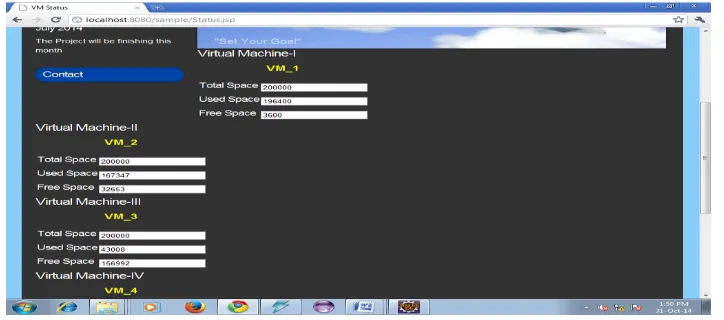
The user, after uploading the files to the Virtual Machine, they can download their data, the user can also check their capacity remaining in the Virtual Machine, according to the remaining capacity they can opt for another plan or proceed to upgrade their current plan [30].
Fig. 3 : Cloud computing the Virtual machine I & II space size is measured.
VII. CONCLUSION & FUTURE ENHANCEMENTS
In this paper we considered users satisfaction level as an important factor in profitability for cloud service providers. We tried to investigate influence of two characteristics in user satisfaction level. Since these characteristics, called willingness to pay for service and willingness to pay for certainty, are unknown for service providers, so new methods for estimation of them are provided. Also a new approach presented to reduce impact of SLA violations [40]. So we produce Interactive model, a hint-based VM scheduler that serves as a gateway to IaaS- clouds. Users are conscious of the flow of processes executed in their virtual infrastructures and the position each VM plays. This data is sent to the cloud service, as hints, and helps drive the position of VMs to hosts. Hints are also engaged by the cloud administration to state its own deployment choices. The Interactive model adds consumer and administrative hints to hold peak performance, address performance bottlenecks, and efficiently apply high-level cloud policies such as load balancing and energy savings. An event-based system allows Interactive model to rearrange VMs to adjust to differences in the workloads served. Our advance is associated with the separation of concerns IaaS-clouds introduce as the users remain uninformed of the physical cloud structure and the properties of the VM nodes. Our estimate, using simulated and real private Iaas-cloud environments, shows considerable gains for Interactive model both in terms of performance and power utilization [41]
.
In the future, we plan to: 1) inspect different constraint agreement approaches to address scalability issues present in large systems; 2) offer deployment hints that will effectively handle the deployment of virtual infrastructures in the context of real large cloud installations; 3)We investigate the mentioned advance in a resource distribution situation. The conducted experiments demonstrate that in critical situations, the estimated characteristics can help the service provider to decide about which users should be served and which ones can be discarded. This can raise user satisfaction level as much as possible and leads to more loyalty of users and higher profit for service provider.
VIII. ACKNOWLEDGEMENT
REFERENCES
1. A.J. Torkestani and M.R. Meybodi, ―Finding Minimum Weight Connected Dominating Set in Stochastic Graph Based on Learning Automata,‖ Information Sciences, vol. 200, pp. 57-77,2012.
2. G. Allon and A. Federgruen, ―Competition in Service Industries,‖ Operations Research, vol. 55, no. 1, pp. 37-55, 2007.
3. H. Beigy and M. R. Meybodi, ―An Adaptive Call Admission Algorithm for Cellular Networks,‖ Computers & Electrical Eng., vol. 31, no. 2, pp. 132-151, 2005.
4. H. Beigy and M.R. Meybodi, ―A Mathematical Framework for Cellular Learning Automata,‖ Advances in Complex Systems, vol. 7,no. 03n04, pp. 295-319, 2004.
5. H. Beigy and M.R. Meybodi, ―Asynchronous Cellular Learning Automata,‖ Automatica, vol. 44, no. 5, pp. 1350-1357, 2008.
6. H. Beigy and M.R. Meybodi, ―Cellular Learning Automata with Multiple Learning Automata in Each Cell and its Applications,‖IEEE Trans. Systems, Man, and Cybernetics, Part B: Cybernetics, vol. 40, no. 1, pp. 54-65, Feb. 2010.
7. K.G.S. Venkatesan. Dr. V. Khanna, Dr. A. Chandrasekar, ―Autonomous System( AS ) for mesh network by using packet transmission & failure detection‖, Inter. Journal of Innovative Research in computer & comm. Engineering, V o l . 2 , Is s u e 1 2 , P P . 7 2 8 9 – 7 2 9 6 , D e c e m b e r - 2014.
8. K.G.S. Venkatesan and M. Elamurugaselvam, ―Design based object oriented Metrics to measure coupling & cohesion‖, International journal of Advanced & Innovative Research, Vol. 2, Issue 5, PP. 778 – 785, 2013.
9. Teerawat Issariyakul • Ekram Hoss, ―Introduction to Network Simulator NS2‖.
10. S. Sathish Raja and K.G.S. Venkatesan, ―Email spam zombies scrutinizer in email sending network Infrastructures‖, International journal of Scientific & Engineering Research, Vol. 4, Issue 4, PP. 366 – 373, April 2013.
11. G. Bianchi, ―Performance analysis of the IEEE 802.11 distributed coordination function,‖ IEEE J. Sel. Areas Communication., Vol. 18, No. 3, PP. 535–547, Mar. 2000.
12. K.G.S. Venkatesan, ―Comparison of CDMA & GSM Mobile Technology‖, Middle-East Journal of Scientific Research, 13 (12), PP. 1590 – 1594, 2013.
13. P. Indira Priya, K.G.S.Venkatesan, ―Finding the K-Edge connectivity in MANET using DLTRT, International Journal of Applied Engineering Research, Vol. 9, Issue 22, PP. 5898 – 5904, 2014.
14. K.G.S. Venkatesan and M. Elamurugaselvam, ―Using the conceptual cohesion of classes for fault prediction in object-oriented system‖, International journal of Advanced & Innovative Research, Vol. 2, Issue 4, PP. 75 – 80, April 2013.
15. Ms. J.Praveena, K.G.S. Venkatesan, ―Advanced Auto Adaptive edge-detection algorithm for flame monitoring & fire image processing‖, International Journal of Applied Engineering Research, Vol. 9, Issue 22, PP. 5797 – 5802, 2014.
16. K.G.S. Venkatesan. Dr. V. Khanna, ―Inclusion of flow management for Automatic & dynamic route discovery system by ARS‖, International Journal of Advanced Research in computer science & software Engg., Vol.2, Issue 12, PP. 1 – 9, December – 2012.
17. Needhu. C, K.G.S. Venkatesan, ―A System for Retrieving Information directly from online social network user Link ‖, International Journal of Applied Engineering Research, Vol. 9, Issue 22, PP. 6023 – 6028, 2014.
18. K.G.S. Venkatesan, R. Resmi, R. Remya, ―Anonymizimg Geographic routing for preserving location privacy using unlinkability and unobservability‖, International Journal of Advanced Research in computer science & software Engg., Vol. 4, Issue 3, PP. 523 – 528, March – 2014.
19. Selvakumari. P, K.G.S. Venkatesan, ―Vehicular communication using Fvmr Technique‖, International Journal of Applied Engineering Research, Vol. 9, Issue 22, PP. 6133 – 6139, 2014.
20. K.G.S. Venkatesan, G. Julin Leeya, G. Dayalin Leena, ―Efficient colour image watermarking using factor Entrenching method‖, International Journal of Advanced Research in computer science & software Engg., Vol. 4, Issue 3, PP. 529 – 538, March – 2014.
21. K.G.S. Venkatesan. Kausik Mondal, Abhishek Kumar, ―Enhancement of social network security by Third party application‖, International Journal of Advanced Research in computer science & software Engg., Vol. 3, Issue 3, PP. 230 – 237, March – 2013.
22. Annapurna Vemparala, Venkatesan.K.G., ―Routing Misbehavior detection in MANET’S using an ACK based scheme‖, International Journal of Advanced & Innovative Research, Vol. 2, Issue 5, PP. 261 – 268, 2013.
23. K.G.S. Venkatesan. Kishore, Mukthar Hussain, ―SAT : A Security Architecture in wireless mesh networks‖, International Journal of Advanced Research in computer science & software Engineering, Vol. 3, Issue 3, PP. 325 – 331, April – 2013.
24. Annapurna Vemparala, Venkatesan.K.G., ―A Reputation based scheme for routing misbehavior detection in MANET‖S ‖, International Journal of computer science & Management Research, Vol. 2, Issue 6, June - 2013.
25. K.G.S. Venkatesan, ―Planning in FARS by dynamic multipath reconfiguration system failure recovery in wireless mesh network‖, International Journal of Innovative Research in computer & comm. Engineering, V o l . 2 , I s s u e 8 , A u g u s t - 2014.
26. K.G.S. Venkatesan, AR. Arunachalam, S. Vijayalakshmi, V. Vinotha, ―Implementation of optimized cost, Load & service monitoring for grid computing‖, International Journal of Innovative Research in computer & comm. Engineering, V o l. 3 , Is s u e 2 , P P . 8 6 4 – 8 7 0 , F e b r u a r y - 2015.
27. R. Karthikeyan, K.G.S. Venkatesan, M.L. Ambikha, S. Asha, ―Assist Autism spectrum, Data Acquisition method using Spatio-temporal Model‖, International Journal of Innovative Research in computer & communication Engineering, V o l. 3 , Is s u e 2 , P P. 8 7 1 – 8 7 7 , F e b r u a r y - 2015.
28. K.G.S. Venkatesan, B. Sundar Raj, V. Keerthiga, M. Aishwarya, ―Transmission of data between sensors by devolved Recognition‖, International Journal of Innovative Research in computer & comm. Engineering, V o l . 3 , Is s u e 2 , P P . 8 7 8 – 8 8 6 , F e b r u a r y - 2015.
29. K.G.S. Venkatesan, N.G. Vijitha, R. Karthikeyan, ―Secure data transaction in Multi cloud using Two-phase validation‖, International Journal of Innovative Research in computer & comm. Engineering, V o l . 3 , I s s u e 2 , P P . 8 4 5 – 8 5 3 , F e b r u a r y - 2015.
30. K.G.S. Venkatesan, ―Automatic Detection and control of Malware spread in decentralized peer to peer network‖, International Journal of Innovative Research in computer & comm. Engineering, V o l . 1 , Is s u e 7 , P P . 1 5 1 5 7 – 1 5 1 5 9 , S e p t e m b e r - 2013.
32. K.G.S. Venkatesan. Dr. V. Khanna, S.B. Amarnath Reddy, ―Providing Security for social Networks from Inference Attack‖, International Journal of Computer Science Engineering & Scientific Technology, March – 2015.
33. K.G.S. Venkatesan, Dr. Kathir. Viswalingam, N.G. Vijitha, ― Associate Adaptable Transactions Information store in the cloud using Distributed storage and meta data manager‖, International Journal of Innovative Research in computer & communication Engineering, V o l. 3 , Is s u e 3 , P P . 1 5 4 8 – 1 5 5 5 , M a r c h - 2015.
34. A. Cuomo, G. Di Modica, S. Distefano, A. Puliafito, M. Rak, O.Tomarchio, S. Venticinque, and U. Villano, ―An SLA-Based Broker for Cloud Infrastructures,‖ J. Grid Computing, vol. 11, pp. 1-25, 2013.
35. J. Xu, M. Zhao, J. Fortes, R. Carpenter, and M. Yousif, ―On the Use of Fuzzy Modeling in Virtualized Data Center Management,‖Proc. Fourth Int’l Conf. Autonomic Computing (ICAC’07), pp. 25-25,2007.
36. M. Esnaashari and M.R. Meybodi, ―Data Aggregation in Sensor Networks Using Learning Automata,‖ Wireless Networks, vol. 16,no. 3, pp. 687-699, 2010.
37. M. Esnaashari and M.R. Meybodi, ―Dynamic Point Coverage Problem in Wireless Sensor Networks: A Cellular Learning Automata Approach,‖ Ad Hoc & Sensor Wireless Networks, vol. 10,nos. 2/3, pp. 193-234, 2010.
38. A. Gafni, ―Willingness to Pay,‖ Pharmacoeconomics, vol. 14.5,pp. 465-470, 1998.
39. S.K. Garg, S.K. Gopalaiyengar, and R. Buyya, ―SLA-Based Resource Provisioning for Heterogeneous Workloads in a Virtualized Cloud Datacenter,‖ Algorithms and Architectures for Parallel Processing, pp. 371-384, Springer, 2011.
40. A.B. Hashemi and M.R. Meybodi, ―A Note on the Learning Automata Based Algorithms for Adaptive Parameter Selection in PSO,‖ Applied Soft Computing, vol. 11, no. 1, pp. 689-705, 2011.
41. S.M. Keaveney, ―Customer Switching Behavior in Service Industries: An Exploratory Study,‖ The J. Marketing, vol. 59, pp. 71-82,1995. 42. S.Y. Lam, V. Shankar, M.K. Erramilli, and B. Murthy, ―Customer Value, Satisfaction, Loyalty, and Switching Costs: an Illustration from a