Computer Generated Energy Effects on Users
and Shielding Interference
Jagdev Singh, Dr. Tripatdeep Singh Dua
PhD Research Scholar, Dept. of CSE, Career Point University, Kota, Rajasthan, India
Assistant Professor, Dept of Computer Science & Application, GNIMT, Model Town, Ludhiana, Punjab, India
ABSTRACT: Today’s computers have changed the lives of human being of all ages. Computer technology can be an amazing thing to enjoy and use for learning and entertainment. It can also have sometimes unseen effects on our health or users health with the awareness and caution we can help computer user health from computer and computer radiation
A computer is a general purpose modern machine used in every field of industry and even in the home also. Computer generated electromagnetic effects is a real health hazard. Many of us spend many hours in front of computer or computer display units such as LCD, CRT etc. or other surrounding computer devices. All the computer devices produce Extremely Low Frequency (ELF). ELF also emitted from power lines, electrical substation, TV and other electrical & electronic appliances. Another type of electromagnetic radiation found near computer is microwave radiation. Microwaves are used to provide radio communication between wireless networked equipment including Computer, Printers, Modems, Routers and other cordless or Wi-Fi devices. ELF produces around 3-6 mill gauss and Microwaves from Wi-Fi devices produces 100-200 micro W/m2
Electronic manufacturers are seeking a conductive coating for thermoplastics that delivers the equivalent shielding performance of electro less plating without the safety, environmental, and cost issues inherent in the plating process. To meet this demand, new highly conductive epoxy coatings are entering the market. Moreover, these coatings overcome the tradeoff of shielding effectiveness and performance properties that are commonly seen with traditional high-density coatings. The new coatings, based on a novel combination of epoxy resin, curative, and conductive fillers, are capable of self-assembling into a unique structure during curing.
This paper describes electromagnetic effects especially generated by the computers and peripherals on the users and also shows some useful tips the users, how to reduce the effects of EMF or EMR and also discuss the EMF Shielding interface. Shielding is typically applied to enclosures to isolate electrical devices from the 'outside world', and to cables to isolate wires from the environment through which the cable runs.
KEYWORDS: EMR, EMF, Hz, mG, Gy, Tesla, Gauss, ELF, VLF, LWR, LHWP, LSRP, LC, LACP, LVDS, EMI, PAN, NCRP, TEM, dB, epoxy
I. INTRODUCTION
A computer is a general purpose machine that can be programmed to carry out a set of arithmetic or logical operations automatically. Since a sequence of operations can be readily changed, the computer can solve more than one or many kind of problem. But in any case computer requires Electricity to run or in other word electricity is the basic or essential requirement to run a computer (Till date) and electricity produce electromagnetic field / radiation in the surrounding area depending on the distance from the source.
The Magnetic fields can be quantified in mill gauss (mG) or microTesla (1 micro Tesla = 10 milliguass). The atomic energy or ionized radiation is often quantified in electron Volts (eV) but the absorbed radiation dose is measured in grays (Gy)
II. RELATED WORK
1) “Electromagnetic Radiation from Video Display Units: An Eavesdropping Risk?
Wim van Eck, PTT Dr. Neher St Paulusstroat 4, 2264 Xz Leidschendam the Netherlands - 1985 Elseveir Science Publishers B.V (North Holland)
2) Mitigating EMI in High Speed Digital Transmission Networks
The research describes the results of research in to the possibility of “eavesdropping” on Video display units, by picking up and decoding the electromagnetic interface produced by this type of equipment. During the research it becomes more and clearer that information theft can be committed very easily using a normal TV receiver. P.S. Neelkanta and Jesada Sivaraks 2003 – Compliance Engineering – www.ce-mag.com.
3) Exposure to electromagnetic fields from laptop use of "laptop" computers.
In the lap top computer (LTC) LTCs analyzed, EMF values (range 1.8-6 μT) are within International Commission on Non-Ionizing Radiation (NIR) Protection (ICNIRP) guidelines, but are considerably higher than the values recommended by 2 recent guidelines for computer monitors magnetic field emissions, MPR II (Swedish Board for Technical Accreditation) and TCO (Swedish Confederation of Professional Employees), and those considered risky for tumor development. When close to the body, the laptop induces currents that are within 34.2% to 49.8% ICNIRP recommendations, but not negligible, to the adult's body and to the fetus (in pregnant women). On the contrary, the power supply induces strong intra corporal electric current densities in the fetus and in the adult subject, which are respectively 182-263% and 71-483% higher than ICNIRP 98 basic restriction recommended to prevent adverse health effects. Laptop is paradoxically an improper site for the use of a LTC, which consequently should be renamed to not induce customers towards an improper use.
Department of Pediatrics, Obstetrics and Reproduction Medicine, University of Siena, Italy.
III.PROPOSED WORK
Computer Generated Electromagnetic Fields (Experiment shows effects on computer users)
Computer generated electromagnetic radiation is a real health hazard. Many of us spend our working days in front of computer monitors, surrounded by electromagnetic equipment, each item emitting radiation because of duration of exposure – many hours every days (As shown in practical)
During the practical following observations are founds in Computer
Lab:-Sr. No.
No. of P-IV Computers
EMF Produced CRT Monitor 18” in micro
gauss
EMF Produced by LCD Monitor in 18”
in micro gauss
1 1 700 - 900 200 – 250
2 30 1800 - 2000 550 – 700
3 60 2200 - 2800 800 – 900
4 100 2800 - 3500 900 – 1000
Table 1 : Showing EMF produced by the Computers in Micro Gauss
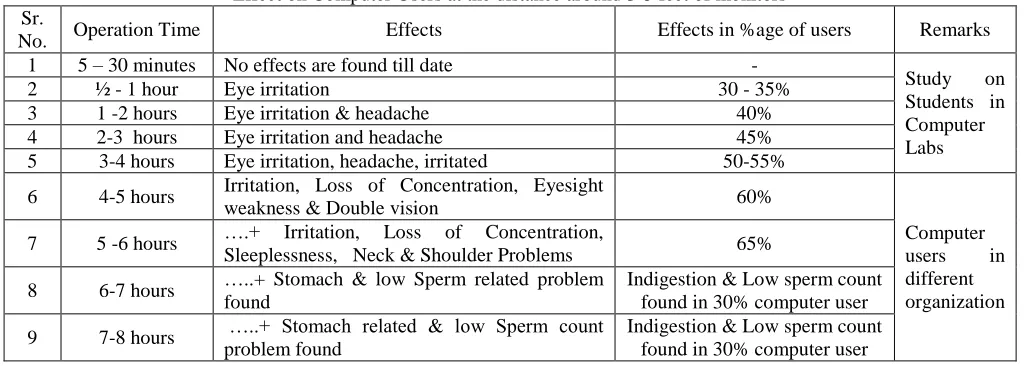
The Health Dangers to Computer User
Effect on Computer Users at the distance around 3-5 feet of monitors Sr.
No. Operation Time Effects Effects in %age of users Remarks 1 5 – 30 minutes No effects are found till date -
Study on Students in Computer Labs
2 ½ - 1 hour Eye irritation 30 - 35%
3 1 -2 hours Eye irritation & headache 40% 4 2-3 hours Eye irritation and headache 45% 5 3-4 hours Eye irritation, headache, irritated 50-55%
6 4-5 hours Irritation, Loss of Concentration, Eyesight
weakness & Double vision 60%
Computer users in different organization 7 5 -6 hours ….+ Irritation, Loss of Concentration,
Sleeplessness, Neck & Shoulder Problems 65%
8 6-7 hours …..+ Stomach & low Sperm related problem found
Indigestion & Low sperm count found in 30% computer user
9 7-8 hours …..+ Stomach related & low Sperm count problem found
Indigestion & Low sperm count found in 30% computer user
Table 2: Shows study on Students / employee in different organization
Every year almost 15-20% IVF centers are increasing in India. Best example of rate of increasing of IVF centers is Jalandhar city of Punjab (India) where almost every hospital started the IVF center. It is also observed that in every 100 IVF almost 40-45% male / female patients are frequently users of laptop computer in most of the time. (Study is going on……)
Proposed Work on Electromagnetic Interference Shielding
Electromagnetic Interface Shielding is the practice of reducing the electromagnetic field in a space by blocking the field with barriers made of conductive or magnetic materials. Shielding is typically applied to enclosures to isolate electrical devices from the 'outside world', and to cables to isolate wires from the environment through which the cable runs. Electromagnetic shielding that blocks radio frequency electromagnetic radiation is also known as RF shielding.
There has been an increase in number of developing materials that could shield against electromagnetic radiation to prevent interference. The current material options that provide effective shielding effectiveness are metals, metal powder, metal fiber filled plastic polyacrylonitrile(PAN), Nickel Coated Reinforced Polymers (NCRP), Coating nickels and copper metalized fabrics and nano –reinforced polymers composites. NCRP like carbon nanofiber, carbon nanotube and nanowire reinforced polymer materials seems to overcome some of these limitations because they are lightweight materials with design flexibility, corrosion resistance and suitable for mass production through conventional plastic manufacturing technologies such as extrusion and injection molding. Measuring EMI shielding effects at a broad frequency range for newly developed materials is crucial to determine their properties and potential applications. Shielding effectiveness is defined for incident waves that are in transverse electromagnetic mode (TEM) i.e similar to plane waves caused by distant source.
electrostatic fields. A conductive enclosure used to block electrostatic fields is also known as a Faraday Cage. The amount of reduction depends very much upon the material used, its thickness, the size of the shielded volume and the frequency of the fields of interest and the size, shape and orientation of apertures in a shield to an incident electromagnetic field.
Highly Conductive Epoxy Coatings
Electronic manufacturers are seeking a conductive coating for thermoplastics that delivers the equivalent shielding performance of electro less plating without the safety, environmental, and cost issues inherent in the plating process. To meet this demand, new highly conductive epoxy coatings are entering the market. Moreover, these coatings overcome the tradeoff of shielding effectiveness and performance properties that are commonly seen with traditional high-density coatings. The new coatings, based on a novel combination of epoxy resin, curative, and conductive fillers, are capable of self-assembling into a unique structure during curing. This structure inherently is very conductive, yet still is largely polymeric in nature. Ultimately, this leads to a lightweight coating with very high levels of EMI shielding. Specifically, the self-assembling coatings offer 85+ dB of shielding at 25 micron (1 mil) thickness over a broad range of frequencies. Because of its polymeric nature, the coatings can also achieve higher levels of adhesion and flexibility. In addition, they are resistant to high temperature, humidity, and salty environments to which electronic applications are often exposed.
IV - RESULTS
Some General effects of Computer Generated Radiation or computer generated EMF effects on computer users are as follows:-
1 Loss of Concentration
2 Loss of spelling remembering Power
3 Loss of Writing Power
4 Loss of manual arithmetic calculation Power
Harmful Health Effects of EMF radiation (as published in various journals)
1 Low Sperm Count found in Laptop Users (Journal of Human Reproduction 2014)
2 Miscarriage (Epidemiology January 2012 )
3 Asthma (15% asthma cases are found who living near to the high power transmission than others. (Achieves of
Pediatrics and Adolescent Medicine August 2011
4 Salivary Gland Cancer (The Health 19th February 2008)
5 Protein Changes in Skin (New Scientist 23rd February 2008)
6 Brain Tumor (The News 3rd October 2007)
7 Excited Brain Cells (The Health 24th June 2006)
8 DNA Damage (USA Today 21st December 2004)
9 Brain Cell Damaged (Environmental Health Prospective June 2003)
10 Aggressive Growth in Leukemia Cells (New Scientist 24th October 2002)
Computer Generated EMF effects are easily avoidable / controlled.
1 The distance between monitor and users eyes must around 3 to 4 feet.
2 CPU / Cabinet must be on the floor or floor level.
3 Display unit must be LCD / LED.
4 Avoid wireless mouse and any wireless internet connection.
5 Use wired internet connection.
6 Computer and printer must be connected through wired only.
7 Position your UPS at least 1.5 meter away from your working chair.
9 If you can’t avoid the EMF exposure try to keep it short.
10 Keep distance at least 400 meter from high power transmission & cell phone Tower for living near to power lines
11 Keep distance about 10 meter from electrical transformer.
12 Today cell phone is the need of hours please use for short time as possible as it is too harmful than any other EMF
exposure because it is near to the brain and heart always.
13 The most important recommendation to all the computer users is take break of 5 – 10 minutes after every one hour
use of computer.
Some major step taken by France Govt:
Wi-Fi has recently been banned in childcare facilities in France in order to protect children against exposure to electromagnetic waves
V- CONCLUSION & FUTURE SCOPE
The objective of this paper / research is to identify the electromagnetic effects on computer user’s health and how to reduce these effects and how to reduce the radiation effects of the electronic devices such as display units and other peripherals. The basic idea behind this research is to identify the effects of EMF on computing and computer users. In computing the parallel computing shows high effects of EMF rather than the sequential computing. EMF also effects on video data processing at extremely low frequency of electromagnetic fields and how to reduce the effects of EMF on Video Data Processing especially of parallel Processing or distributed Processing by using the shielding effectiveness.
With every real danger posed by EMI, the advantage of LVDS over the data transmission schemes may be useful information for anyone designing data interfaces. To reduce power consumption, Cost and data transmission rate make sure you add reduced emissions to the speed power, EMI benefits. New composition of EMI materials offers an excellent way to mitigate the EMI that will be an inevitable part of new materials offers tremendous potential of dealing with EMI problems that will become ever more critical in an increasingly cellular world.
Future work consists on researching the EMI characteristics of numerous nano reinforced materials and developing an understanding of the SE mechanism involved in nano reinforced materials. I suggest the following research topics:
Use of light through Fiber optics instead of Electricity.
In-depth analysis of RF signals emitted by typical computers and their peripherals, including keyboards. Determination of likely interception ranges for various classes of attackers.
Development of new protective counter-measures, both hardware and software.
Development of any type to system which would reduce the energy gap of the semiconductor used in the development of Integrated Circuits.
Testing of existing counter-measures together with development of offensive tools (unfortunately you need a gun to test bullet-proof glazing).
Development of free, open-source software, protocols and modulation schemes for using plain computer equipment for wireless communications.
Propagation of compromising emanations in power and telephone lines.
The possibility that various electronic devices might pickup and retransmit (possibly modulating) compromising emanations. Emanation techniques could even contaminate digital transmissions and be digitally relayed.
Vulnerability and protection of equipment against active electromagnetic attacks.
REFERENCES
1 ASTM standard designation D-4935 -99 (1999), “Standard rest method for measuring the electromagnetic shielding effectiveness of planner materials”
2 Lozano,K.Files, B. and Rodriguez, F.J. (1999), Purification and fictionalization of vapor grown carbon fibers and single wall nanotubes” TMS publication, Pennsylvania
3 Texa instrumentation June -2002, Reducing EMI with LVDS”.
4 WIPO (WO/025708/2008), Arrangement for Serial Data Transmission Services.
5 Haracio N (2003), “Development of predictive shielding effectiveness for carbon fiber / nylon based compositors”, Master Thesis of Chemical engineering, Michigan Technological University.
6 Hong, Y. Lee, c., Jeog, C Lee (2003) “Method and apparatus to measure electromagnetic interference shielding efficiency and its shielding characteristics in broadband frequency ranges,” Review of scientific instrument Vol., 1098-1102
7 Horacio Vasquez, Laura Espinoza, Karen Lozano and Shuying Yang (2009), IEEE
8 R.Malaric, D.llie, K. Malaric “ electromagnetic Interference in the Primary Electromagnetic Laboratory” Measurement Sciences Review, Volume 8, Section 3, No 1, 2008
9 ISO/IEC – 17025 :2005, General Requirements for the Competence of testing and calibration laboratories
10 S.Braun, A.Frech and P.Russer “ Measurement of Electromagnetic Interference in Time – domain” Advances in Radio Science -2008 Munchen, Germany
11 ASTM standard designation D-4935-99, “ Standard rest method for measuring the electromagnetic shielding effectiveness of planar materials “ 1999
12 Guidelines for limiting Exposure to Time – Varying electric , Magnetic and electromagnetic Fields – “ International Commission on Nonionizing Radiation Protection (ICNIRP) Health physics 1998
13 Ministry of Public Health of Croatia -2003 “ Regulation for Protection from electromagnetic fields, Norodne Novine Vol 204 available at www.nn.hr/clanci/slubeno/2003/3306.htm
14 Horacio Vasquez, Laura Espinoza, Karen Lozano, Heinrich Foltz and Shuying yang -2009, IEEE
15 Chung, DDL 2000, “Materials for electromagnetic interference shielding” Journals of materials Engineering and performance, Vol.9 no -3, pp 350-35.
16 Janda N. 2003, “Development of predictive shielding effectiveness for carbon fiber / nylon based compositors” Master thesis of chemical engineering Michigan Technological University.
17 The New Scientist 23rd February 2008
18 The Health – 24th June 2006
19 USA Today 21st December 2004
20 Environmental Health Prospective June – 2003 21 New Scientist 24th October 2002
22 Dainik Bhaskar 26th October & 7th November 2014.
BIOGRAPHY
Jagdev Singh is PhD(CSE) Scholar, Department of Computer Science & Engineering , Career Point University, Kota, Rajasthan, India