Trajectory Tracking of a Near-Surface
Torpedo using Numerical Methods
Anties K. Martin, Anubhav C.A., Balu J., Manu Vijayan, and Sheeja Janardhanan
SCMS School of Engineering and Technology, Karukkuty, Angamaly, Ernakulam, India
ABSTRACT: Prediction of ship‟s and underwater body‟s‟ (submarines, torpedoes and missiles) trajectory is a very important job as far as defense and engineering are concerned. From the defense point of view, details of the trajectory would provide necessary information to the commander for the controllability of the vessel and the armaments it houses, in case of an emergency pertaining to the nation‟s safety. On the other hand for an engineer, the trajectory of the vessel and the armaments would provide a lot of information about aspects related to its controllability. This information can be very effective in the successful design, launch and navigation of the vessel and the armaments. Present work focuses on the trajectory prediction of a torpedo using numerical methods. A Japanese type 91 torpedo has been considered here. Computational Fluid Dynamics (CFD) simulations have been carried out in order to estimate the forces and moments acting on the torpedo by inducing harmonic motions. Two cases have been considered here viz. pure sway and pure yaw. The forces and moments have been subjected to harmonic analysis using Fourier series and the hydrodynamic derivatives have been calculated. The derivatives have been used in the Equations of motion and the trajectory of the torpedo at any instant of time has been calculated using an in-house developed MATLAB code.
KEYWORDS: CFD simulations, harmonic motions, pure sway, pure yaw, trajectory prediction detection
I. INTRODUCTION
Prediction of ships‟ and underwater body‟s trajectory is a very important job as far as defense and engineering are concerned, as its trajectory would provide a lot of information about aspects related to its controllability. The modern torpedo is an Autonomous Unmanned Underwater Vehicle (AUV) with an explosive warhead, launched above or below the water surface, propelled underwater towards the target and designed to detonate either on contact with its target or in proximity to it. The hydrodynamic performance of AUV is an area of interest having implication for control, launch, navigation, energy requirements and payload. Thus understanding the hydrodynamic performance of an AUV is essential to determine its capability to perform a successful mission. Present work focuses on the trajectory prediction of a torpedo using numerical methods.
Initial work on CFD simulations of ship-like bodies in maneuvering motion was carried out by [7]. More realistic quasi-steady state simulations were successfully accomplished in [3], [4], [6] and [11]. [10] carried out the CFD simulations on under water ellipsoids with prescribed sinusoidal motions. Same method with non-linear mathematical modeling has been adopted by [8] to a container ship. In [9] better meshing strategies for enhancing the results were presented. In the present work the afore developed methods and meshing techniques have been applied to a torpedo for the prediction of its trajectory.
II. HYDRODYNAMICDESIGNANDANALYSIS
surfaces on the vehicle due to hydrodynamic effects. Thus the vehicle acquires components of translational velocity u, v and w in x, y and z axes respectively. Also it acquires angular velocities p, q and r about x, y and z axes respectively. The linear and angular velocities are obtained by differentiating the corresponding linear and angular displacements. Differentiating the corresponding linear and angular velocities we get the respective linear and angular accelerations. In the real scenario the hydrodynamic forces and moments acting on all six degrees of freedom are important, but here we are considering the surfacing motion of an underwater body which involves only horizontal forces and moment s. All vertical forces and moments are balanced by buoyancy. Therefore only surge, sway and yaw motion need to be considered. The equations of motion are hence given by Eq. 1 through 3.
𝑋 = 𝑋𝑢 𝑢 + 𝑋𝑢2𝑢2 (1)
𝑌 = 𝑌𝑣 𝑣 + 𝑌𝑣𝑣 + 𝑌𝑟 𝑟 + 𝑌𝑟𝑟 (2) 𝑁 = 𝑁𝑣 𝑣 + 𝑁𝑣𝑣 + 𝑁𝑟 𝑟 + 𝑁𝑟𝑟 (3)
Where 𝑋𝑢 , 𝑋𝑢2 are the hydrodynamic coefficients or hydrodynamic derivatives for surge motion, 𝑌𝑣 , 𝑌𝑣 , 𝑌𝑟 , 𝑌𝑟 are the hydrodynamic coefficients for sway motion and 𝑁𝑣 , 𝑁𝑣 , 𝑁𝑟 , 𝑁𝑟 are the hydrodynamic coefficients for yaw motion. The equation for pure sway and yaw is comparable with Fourier series expansion up to 1𝑠𝑡 harmonic; and the Fourier constants are determined by numerically integrating the results of computer simulations. Forward velocity test is used to find damping coefficient 𝑋𝑢2 acting in x direction. The added mass coefficient 𝑋𝑢 acting in x direction is obtained from some empirical relations. Thus we obtain all the hydrodynamic coefficients for surfacing motion of the given underwater vehicle.
III.DESCRIPTIONOFMODELANDSPECIFICATIONS
Here the Japanese type 91 torpedo is chosen for analysis with slight modification in the length and tail geometry to make it simplified with Length of model (𝐿) = 5.094 𝑚 and mass of material 𝑚 = 4428.97 𝑘𝑔
Fig. 1: Actual and Modified Dimensions (in mm)
Fig. 2: Co-ordinate system for simulations [5]
IV.SIMULATIONS
Table 1 Motion Parameters
Motion Parameters Values
Forward Velocity, U 2 𝑚/𝑠
Angular Velocity of Oscillation , 𝜔 0.5 𝑟𝑎𝑑/𝑠
Amplitude of Pure Sway Motion ,𝑦0 0.3 𝑚
Amplitude of Pure Yaw Motion , Ψ0 0.0873 𝑟𝑎𝑑
Time histories of sway force and yaw moment in pure sway and yaw simulations have been shown in Fig. 3 and 4.
(a) Sway Force (b) Yaw Moment
Fig. 3: Time histories of forces and moments in pure sway simulation
(a) Sway Force (b) Yaw Moment
Fig. 4: Time histories of forces and moments in pure yaw simulation
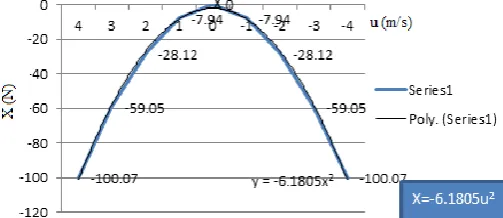
Resistance versus forward velocity has also been plotted to get the derivatives dependent on forward velocity.
V. RESULTSANDDISCUSSIONS
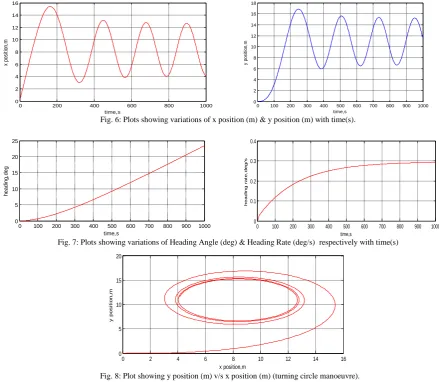
Results of CFD simulations have been subjected to harmonic analysis and hydrodynamic derivatives have been determined. A Program has been written in MATLAB to plot the trajectory of torpedo which takes the hydrodynamic derivatives as well as the specifications of torpedo as input. The forward velocity of torpedo is 12 𝑚/𝑠. Rudder angle is incremented uniformly from 0° to 5° through 10 seconds after which a constant rudder angle of 5° is maintained and obtained the turning circle manoeuvre plot of torpedo. Using the MATLAB results we study the behaviour of torpedo.
Fig. 6: Plots showing variations of x position (m) & y position (m) with time(s).
Fig. 7: Plots showing variations of Heading Angle (deg) & Heading Rate (deg/s) respectively with time(s)
Fig. 8: Plot showing y position (m) v/s x position (m) (turning circle manoeuvre).
VI.CONCLUSION
The results obtained after simulations are found to be satisfactory and it gives the standard manoeuvre of a particular torpedo. Hence it is seen that using this numerical technique we can predict the path of torpedo in standard and desired manoeuvres. The method can be also be used to predict the trajectory of an enemy submarine if its dimensions are known. Now that we have assessed the maneuverability of the torpedo and also the done the prediction of its path, guidance of the torpedo to hit its target can be achieved through an autopilot.
0 200 400 600 800 1000
0 2 4 6 8 10 12 14 16 time,s x po si tio n, m
0 100 200 300 400 500 600 700 800 900 1000 0 2 4 6 8 10 12 14 16 18 time,s y p o s it io n ,m
0 100 200 300 400 500 600 700 800 900 1000
0 5 10 15 20 25 time,s h e a d in g ,d e g
0 100 200 300 400 500 600 700 800 900 1000
0 0.1 0.2 0.3 0.4 time,s h e a d in g r a te ,d e g /s
0 2 4 6 8 10 12 14 16
REFERENCES
[1] Bertram, V., Practical ship hydrodynamics, Butterworth Publications, 2000.
[2] Crane, C.L., Eda, H. and Landsburg, A. „Controllability‟, Principles of Naval Architecture, vol.3, pp. 200-258, 1989.
[3] Cura-Hochbaum, A., „Prediction of hydrodynamic coefficients for a passenger ship model‟, International Conference in Marine
Hydrodynamics, pp. 933-942, 2006.
[4] Cura-Hochbaum, A., Vogt, M. and Gatchell, S., „Maneuvering prediction for two tankers based on RANS simulations‟, SIMMAN Workshop
on Verification and Validation of Ship Maneuvering Simulation Methods, pp. F 23-28, 2008.
[5] Fossen, T.I., “Guidance and Control of Ocean Vehicles”, Published by John Wiley & Sons Ltd, pp no: 93-161, 1998.
[6] Nonaka, K., MiyazakI, H., Nimura, T., Ueno, M., Hino, T. and Kodama, Y., „Calculation of hydrodynamic forces acting on a ship in
maneuvering motion‟, Research Paper, Ship Research Institute, Japan, pp. 307-317, 2007.
[7] Ohmori, T., Finite-volume simulation of flows about a ship in maneuvering motion, Journal of Marine Science and Technology, vol.3,
pp.82-93, 1998.
[8] Sheeja, J. and Krishnankutty P., „Prediction of ship maneuvering hydrodynamic coefficients using numerical towing tank model tests‟, 12th
Numerical Towing Tank Symposium, Tuscany, Italy, 4-7th October, 2009.
[9] Sheeja, J, Rudra UARVR, Elangovan, M and Ram Kumar J, (2011) “Maneuverability Assessment of a Container Ship Using CFD,”
International Conference on Developments in Marine CFD, Chennai.
[10] Sulficker, N., „RANSE based estimation of hydrodynamic forces acting on Ships in dynamic conditions‟, M.S. Thesis, Department of Ocean
Engineering, IIT Madras, pp.50-82, 2007.
[11] Toxopeus, S.L., „Deriving mathematical maneuvering models for bare ship hulls using viscous flow calculations‟, Journal of Marine Science
![Fig. 2: Co-ordinate system for simulations [5]](https://thumb-us.123doks.com/thumbv2/123dok_us/1525002.1186931/2.595.64.495.451.723/fig-co-ordinate-system-for-simulations.webp)