ABSTRACT
PAYNTER, SHARON RENEE. Judicial Performance Evaluation: Policy Diffusion Across the American States. (Under the direction of Richard C. Kearney.)
Tensions between independence and accountability, two hallmarks of the
American judicial branch, create a responsibility, perhaps even an obligation, for officers of the court to perform efficiently, effectively, and to undergo periodic performance review. Creating performance evaluation programs holding courts accountable from both individual and organizational perspectives is challenging. It is difficult to evaluate judges and preserve the critical independence needed to decide cases freely, based only on the law. An innovative program called judicial performance evaluation (JPE) may change that. Despite its promise, the program has only been adopted by twenty states. Why those states? What forces compel actors to pursue JPE programs?
The characteristics leading to policy diffusion in the American states are evaluated by considering how and when JPE programs have been adopted by state institutional bodies. The effects of legislative professionalization and method of judicial selection have the greatest impact on increasing the likelihood of the policy adoption. However, despite anecdotal evidence and findings from extant studies in other policy areas, political ideology, and geographic proximity are variables not significantly related to JPE diffusion.
This study blends extant literature from social science including work from
Judicial Performance Evaluation: Policy Diffusion across the American States
by
Sharon R. Paynter
A dissertation submitted to the Graduate Faculty of North Carolina State University
in partial fulfillment of the requirements for the Degree of
Doctor of Philosophy
Public Administration
Raleigh, North Carolina 2008
APPROVED BY:
Dedication
Biography
Sharon Paynter earned an undergraduate degree in biology from the University of
North Carolina at Chapel Hill in 1994. After college, she was employed as a social worker,
teacher, and executive director of a human service non-profit in Henderson, North Carolina.
In 2001 she began graduate studies at UNC-CH where she received a Master of Public
Administration from its School of Government. She earned a Master of Legal
Administration from the Sturm College of Law at the University of Denver in 2004.
Ms. Paynter began doctoral studies at North Carolina State University in 2005. She
worked as a Teaching Assistant in the Department of Political Science and Public
Administration from 2005 until 2008, taught research methods and introduction to
nonprofits courses for undergraduate students, and worked as a Research Assistant for the
North Carolina Bar Association Pilot Project on Judicial Performance Evaluation and for the
Better Courts Project sponsored by the North Carolina Center for Voter Education. With
Maureen Berner, she was a co-principal investigator on funded research including the North
Carolina Hunger Project, work focused on understanding the characteristics of hunger in an
effort to inform stakeholders in the policy community about issues of poverty. In the fall of
2008, she began a postdoctoral fellowship at the Taubman Center for Public Policy at Brown
University.
Her research interests are especially focused on inter-sectorial and intergovernmental
interactions including state comparative policy using legislative and judicial institutions. She
Acknowledgements
I am humbled by the number of people who contributed their time, energy, and thoughtfulness toward my PhD. Thinking back over this past year causes me to remember moments – both funny and poignant – when committee members, other faculty, friends, or family helped me stay on track, uncover solutions, or realize that I should just take a day off. Finding the right words to express my gratitude is unusually difficult.
My committee members have most influenced the substance and organization of my dissertation. Dr. Maureen Berner, Dr. Dennis Daley, Dr. David Garson, and Dr. Richard Kearney have inspired me to follow in their footsteps of productive, careful scholarship. Their comments and subject matter expertise contributed to a better product. Together they challenged me to think critically and in ways that will benefit my
professional life for many years. However, their individual contributions are equally important.
Dr. Berner debated variables, literature, and modeling with me. She also helped me stay focused with random, though frequent, e-mail reminders to work on the
Because of her I always think three times before using “that” in a sentence! More importantly, Dr. Berner has been a supportive role model, mentor, and friend.
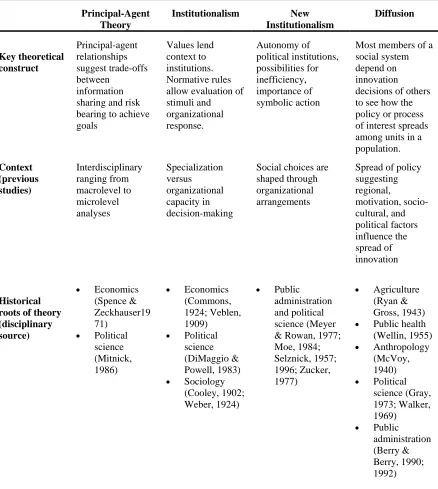
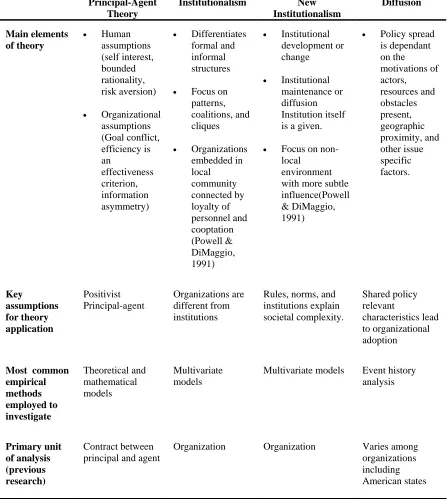
Through Dr. Daley’s class I gained confidence, knowledge, and an understanding of the theoretical foundation on which my dissertation lies. In the dissertation process, Dr. Daley challenged me to think critically and comprehensively. Though I resisted, I am grateful he asked me to create a table comparing the major theories I considered for this research. That was one of the single most difficult, and rewarding, experiences of the process.
Dr. Garson taught me to think like an academic. Without his methods classes and StatNotes I would have been lost. I especially appreciate the patience with which Dr. Garson led me through learning event history analysis.
Many other people helped me in the process of studying state policy. I will not attempt to name each individually but want to highlight a few whose efforts were above the call of duty. Jordan Singer at the Institute for the Advancement of the American Legal System at the University of Denver gave me invaluable background on judicial performance evaluation and the “state of things” in various JPE states. State JPE leaders such as Larry Cohn, Aaron Conklin, Jane Howell, and William Raftery at the National Center for State Courts, tolerated many questions whose answers expanded my
knowledge on the subject of JPE. Michele Hayslett, the data librarian at NCSU, is an unbelievable resource for graduate students. Her meticulous explanation of the U.S. Census data and willingness to help me find the data for this dissertation helped ensure I could complete my study.
Without my friends and classmates I would have never gotten through this who awed and inspired me. They also made me laugh. I also appreciate Kristin, who helped with finalizing the theory chapter. I could have never finished without the spot edits Stephanie contributed over instant messenger. Thanks Rob, Todd, Chris, and Stan for all the study sessions (and the nonsense that sometimes came out of them!).
reminds me that change is stressful – even good change. She, Tom, Marshall, and Chad made me laugh and reminded me to play. Thanks guys!
My family has supported me through all the projects, school, and other events of my life. My parents, Arthur and Sandra, believed in me, gave me the resources and confidence to pursue big goals, and made sure that I had every opportunity to be successful. My brother, Brian, and his family, Sarah and Kaitlin, have been equally supportive, loving, and committed my happiness. You are all very special parts of my life. And, on this last day I worked on my dissertation, I’m thankful for Jack who interjected some excitement into the monotony of formatting (and reformatting) page numbers by being born!
Table of Contents
List of Tables ...xi
List of Figures ...xii
List of Equations ...xiii
CHAPTER I: Introduction ... 1
Overview of Study Design and Research Questions... 2
Judicial Branch Accountability ... 6
Research Problem ... 10
Variables Included in the Study...11
Overview of Judicial Performance Evaluation ...15
Organization of the Study ... 18
Chapter II: Setting the stage ... 21
Why We Should Study Courts in Public Administration... 22
The Relationship between the Judiciary and the Creation of Public Policy... 24
JPE as a Policy Tool... 28
Court Reform and Public Administration ... 29
The Need for Court Reform...32
Overview of American Court Systems ... 34
Jurisdiction ...35
State courts ...36
Judicial Selection Systems ... 40
History of Judicial Selection...42
Purpose and Process of Judicial Selection ...44
Judicial campaigns, partisanship, and elections...51
State budgets and the courts ... 54
Chapter III: Theoretical Considerations... 58
Principal-Agent Theory ... 61
Application of Principal-Agent Theory to JPE: No Clear Principal or Agent……….64
Institutionalism... 67
Old Institutionalism ...69
Old Institutionalism Applied to JPE ...71
Neo-institutionalism ...72
Diffusion ... 86
Illustrations of the Diffusion Process...90
Critiques of Diffusion ...93
Diffusion Applied to JPE...97
CHAPTER IV: Literature Review ... 102
Literature Review Methodology ... 103
Components of the Diffusion Model ... 107
Motivation ...107
Resources/Obstacles ...111
Other/policies...129
External...130
CHAPTER V: Research Design and Methodology... 133
Research Design ... 133
Data Collection ...133
Data Screening...134
Validity ... 136
Internal Validity...136
Threats to Internal Validity...138
External Validity...139
Reliability ... 141
States as the Unit of Analysis ... 142
Overview of Event History Analysis... 143
Conception of the EHA Model and Data Distribution... 153
EHA and Cox Proportional Hazard (CPH) Models... 159
CHAPTER VI: RESULTS and CONCLUSION ... 161
Adoption of JPE (Dependent Variable) ... 161
Descriptive Statistics and Correlations ... 164
Survival Estimates... 171
Hypothesis Testing for Cox Proportional Hazard Models ... 179
Model Fit ... 180
The Diffusion Model ... 186
Motivation for Policy Diffusion ... 186
Resources and Obstacles to Policy Diffusion ... 188
Other Policies Related to Diffusion ... 193
Diffusion and JPE: Does it Matter?... 199
Limitations ... 203
REFERENCES... 205
APPENDICES... 226
Appendix A Court Jurisdiction... 227
Appendix B Types of Court Systems ... 228
Appendix C Native American Courts... 230
Appendix D Interview Notes ... 232
Appendix E Statistical Results ... 240
List
of
Tables
Table 1 Comparison of State and Federal Court Systems... 35
Table 2 Organization of State Court Systems (2006) ... 39
Table 3 Theoretical and Empirical Dimensions of Institutional Theory... 58
Table 4 Comparison of Institutional Theories... 78
Table 5 The JPE Diffusion Model... 106
Table 6 Log-Likelihood & Akaike Information Criterion for a JPEAdoption Model..150
Table 7 Official Adoption Mechanisms for State JPE Programs... 163
Table 8 Frequency Distribution of Independent Variables ... 166
Table 9 Geographic Regions of the United States ... 168
Table 10 Percentage of JPE Programs by Geographic Region (1976 to 2006) ... 169
Table 11 Hazard Rates and Cumulative Proportion of States Adopting JPE... 172
Table 12 Simultaneous JPE Adoptions ... 175
Table 13 Wald Chi Square ... 180
Table 14 Model Fit Statistics ... 181
Table 15 Cox Proportional Hazard Models for State JPE Adoptions, 1976-2006... 182
Table E-1 Missing Values Analysis ... 239
Table E-2 Crosstabulation of JPE Programs & Geographic Region (1976-2006)... 239
Table E-3 Correlation of Citizen Variables ... 247
Table E-4 Correlation of Ideology Variables ... 247
Table E-5 Correlation of State Government Variables ... 247
Table E-6 Correlation of Types of Judicial Selection System Variables………248
List of Figures
Figure 1 Adoption of JPE Programs ... 15
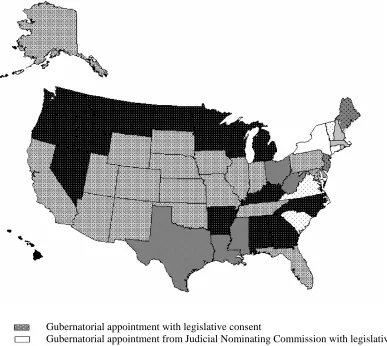
Figure 2 Selection Systems for State Courts of Last Resort ... 45
Figure 3 Selection Systems for General Jurisdiction Trial Courts... 47
Figure 4 Retention Systems for General Jurisdiction Trial Courts ... 48
Figure 5 The Diffusion Process... 87
Figure 6 Cumulative Percentage of JPE States ... 98
Figure 7 Cross-Sectional Sample ... 144
Figure 8 Panel Sample... 145
Figure 9 Event History Sample ... 147
Figure 10 Typical Diffusion Graph ... 152
Figure 11 Adoption Mechanisms ... 162
Figure 12 Chronological Adoption of JPE Programs... 164
Figure 13 Hazard Probabilities for State Policy Adoption... 177
Figure 14 Kaplan-Meier Survival Estimate ... 179
Figure 15 Smoothed Hazard Estimate... 185
Figure 16 Comparison of Actual versus Random Samples of Clustered States ... 197
Figure E-1 State Population Histogram ... 242
Figure E-2 Urbanization Histogram ... 242
Figure E-3 Violent Crime Rate Histogram ... 243
Figure E-4 Property Crime Rate Histogram... 243
Figure E-5 Legislative Professionalization Histogram ... 244
Figure E-6 BRFH Citizen Ideology Histogram... 244
Figure E-7 BRFH Elite Ideology Histogram... 245
Figure E-8 EWM Ideology Histogram... 245
Figure E-9 Distance between JPE States Histogram... 246
Figure F-1 Random Sample 1 ... 249
Figure F-2 Random Sample 2 ... 249
Figure F-3 Random Sample 3 ... 249
Figure F-4 Random Sample 4 ... 250
Figure F-5 Random Sample 5 ... 250
Figure F-6 Random Sample 6 ... 250
Figure F-7 Random Sample 7 ... 251
Figure F-8 Random Sample 8 ... 251
Figure F-9 Random Sample 9 ... 251
List of Equations
Equation 1 General Diffusion Equation... 105
Equation 2 Change of Event State... 155
Equation 3 Baseline Hazard Function... 159
CHAPTER I: Introduction
At least since early in the first century ancient Greek philosophers have pondered fundamental questions about morality and the responsibilities of government. Following the teachings of Socrates and Plato, Juvenal, a first century Roman poet, penned the phrase “Quis custodiet ipsos custodes” translated most often as “Who watches the watchmen?” (Winstedt, 1899; Sosin, 2000). Juvenal raises an interesting question about whose responsibility it is to hold public officials accountable.
Academics often study accountability in the United States by looking at different practices found in states across the nation. Comparative state policy studies analyze motivation, communication, time, tendencies toward emulation, and even spatial
characteristics in an effort to shed light on why actors in the public realm behave the way they do. As a result of these studies, we know that policies are implemented differently according to issue area, geography, stakeholder, available resources, and a myriad of other factors. However, the process of adoption generally results from of a narrower set of characteristics including the identifiable and controllable factors contributing to state policy decisions that have emerged from both theory and empirical study (Berry & Berry, 1990; Mintrom, 1997; Moe, 1990; Ostrum, 1990; Sabatier, 1988). My study focuses on this process known as “diffusion of innovation.”
court reform and administration literature as well as that of public administration and policy, I consider state policy adoption within the context of the judicial administration. By examining the many factors affecting state court systems, I identify the characteristics that positively influence whether state legislators will mandate performance evaluations for judges. In the process, I contribute to our understanding of the dynamics of cross-state policy diffusion.
Overview of Study Design and Research Questions
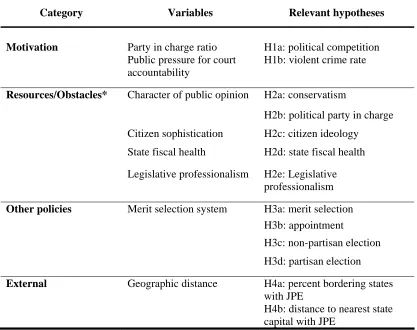
Ten hypotheses, divided into four categories, are included in this study. I consider how legislators are motivated by public opinion, electoral competition, and citizen ideology. My models also incorporate the effects of resource availability and constraint through variables like state fiscal health and court system budgets, as well as institutional variables like legislative professionalization.
life tenure may have no other legal remedy for and less investment in evaluating judges. Because only legislators can vote for merit selection laws, the presence of this policy may positively correlate with the likelihood that a state will adopt Judicial Performance
Evaluation (JPE).
Finally, to consider whether distance matters, as some literature suggests (e.g., Berry & Berry, 1990; Mintrom, 1997; Walker, 1969), I include variables that measure geographic proximity between states with JPE programs and those that have yet to adopt them. There appears to be a regional diffusion pattern with JPE programs. After a few years of existence a pattern of adoption begins to emerge linking programs in states with new JPE programs to neighboring states which also have JPE programs. However, to date no one has tested this variable to determine whether this is anecdotal or if geography has a significant effect on adoption of the program.
Using diffusion research applied in other policy and public administration venues as guides for my theoretical and methodological approach, I contribute to the body of existing literature on comparative state policy and expand the scope of the field to include the judiciary. Because decisions to adopt public policies are often generated as a
response to some stimulus, or to use a phrase familiar to scholars of public policy, as the result of a focusing event (Baumgartner & Jones, 1993), I complement diffusion theory with ideas from neo-institutional scholars. The norms and values that describe the court system become context for how and why diffusion occurs, and for explaining how actors within both the legislative and judicial branches perceive the issue. Finally, like the many diffusion studies that precede this, I include the effects of time.
My study is about policy-making at the state level. A thorough grounding in the issues, rules in use, pressures exerted by key stakeholder groups, and context of state judiciaries is critical to encapsulate the environmental factors contributing to legislative action regulating some functions of court administration. However, the reader is cautioned to remember that the hypotheses investigated here are devoted to uncovering characteristics that trigger legislative adoption. I include illustrations of the process in state court systems as a new venue to apply diffusion theory. Nonetheless, my research is not about policy adoption by individual courts or state judiciaries. Those are questions for future research.
Given that this diffusion study is about state policies, and not specifically about court reform, the reader might inquire why I spend so much time explaining and
study. Though districts in the federal judiciary are generally homogenized, the state court systems vary widely in organizational structure, rules in use, resources available, and in other practical administrative areas. So the courts can provide a way to study how actors in a public policy environment work to serve citizens. Political scientists and public administration scholars often write about state judiciaries through the lens of state supreme courts or judicial selection systems (Bonneau, 2003; 2004; 2005; Bonneau & Gann-Hall, 2003; Brace & Gann-Hall, 1995; Crowe, 2007; Graber, 1998; Hall, 1987; 2006; Hall & Bonneau, 2006;). Few write about lower level state courts. These increasingly complex bodies are excellent venues for organizational studies (Boyum & Hudzik, 1991). Failing to extend the analysis beyond state appellate courts leaves a hole in our understanding of how courts affect citizens including constitutionally guaranteed rights of access and equality. Furthermore, public administration scholars, and especially scholars of policy diffusion, have yet to till this fertile ground.
Judicial Branch Accountability
More than 200 years ago in Federalist 78, Alexander Hamilton wrote “There is no liberty if the power of judging be not separated from the legislative and executive
powers.” Still today, judicial independence is a critical component of the American court system. The three branches are inexorably linked and judges must be able to do their jobs without undue interference from citizens, politicians, or other bureaucratic actors.
By design each branch of government is a check and balance for the other two. Through this relationship, American courts bolster the authority of both state and federal government by protecting individual rights while simultaneously assuring the common good. However, relegating the judicial branch solely to the role of guardian is an unfair characterization of the responsibility of the system.
Courts have many roles including the duties to administer justice, decide disputes, maintain peace and stability, assure liberty, infer social order, afford equal protection, and guarantee due process of law. For 30 or more years, courts have been on the radar
screens of bureaucrats and politicians because increasing case loads lead to larger requests for facilities, personnel, and fiscal resources (Boyum & Hudzik, 1991). The resulting growth in budgets and court management systems challenge judicial
Public perception of the judicial branch often reflects on legislators – and their ability to remain in office. So, courts matter both practically and ideologically.
Judges are not supervised like other employees in state government. Their
position is unique in that traditional performance appraisal tools are inadequate to address the complexity of the job. Naturally, one might wonder to whom they are accountable. How can their performance be effectively measured? Like ancient Greek and Roman philosophers and poets (e.g., Socrates, Plato, Juvenal) we are left to wonder who “watches the watchmen” (Winstedt, 1899; Sosin, 2000). Officers of public trust have a responsibility to deliver high quality service, and if we believe that, then we must decide how, and by whom, they should be held accountable. How should states decide when, or even if, judges should undergo performance appraisal? Some states use judicial
performance evaluation (JPE) systems to accomplish these tasks. Anecdotal evidence suggests that JPE programs can increase the effectiveness of state court systems.
American courts are tasked with walking the tightrope between independence and accountability but understanding exactly what those terms encompass is a point of
in public opinion.”
To accomplish the things mentioned in Reddick’s definition, judges must have responsibilities beyond the courtroom as well. These public servants serve as de facto court managers and administrators. The literature describes a clear distinction between “court management” and “judicial administration” (Hoffman, 1991; Stott, 1982), acknowledging that the former is a focus on structure and function while the latter is driven by values and system design (Boyum & Hudzik, 1991). Though a judge’s management responsibilities may impact his or her ability to be an effective
administrator, JPE programs are aimed more at values and system design than simple workload measures. Following the literature, I make the choice to study judges as administrators within the context of JPE programs.
States may be motivated to adopt JPE programs because of the interrelatedness of independence and accountability. These dueling functions of the court system create a responsibility, even an obligation, for officers of the court to perform efficiently,
effectively, and to undergo periodic performance review. Public cries for accountability extend into all branches of government, including the judiciary. State legislators, other politicians, and even bureaucrats are tasked with creating strategies to fulfill the
whereas the latter focuses on evaluating individuals. JPE may be a way to measure performance of both the system and individuals judges; however, evaluating the merit of the program is outside the scope of this study of policy adoption.
Adopting performance measurement programs is a policy choice; a clear decision to increase monitoring and oversight activities of the judiciary. Performance
measurement can have the consequence, whether intended or not, of increasing
accountability of the judicial branch. But it can also infringe on the way judges conduct the business of the courts. Though judges often have wide latitude to make case
decisions, they already do so with considerable constraint including three very important checks: the job is too big for one person to undertake alone; other judges may review case decisions (using the appeal process); and the political process is an overriding force guiding judges (Kozinski, 1997).
Nonetheless, if considered from an individual perspective, performance
evaluations can threaten the independence judges so fiercely defend. Judges are critical stakeholders in the court system. Often support from key court administrators, for example, the chief justice of the state supreme court, may act as a signaling mechanism for others. Therefore, when judges balk at performance evaluations other institutional actors may attempt to avoid making a policy adoption decision. Judges have traditionally avoided performance evaluation and when state legislators choose to adopt a JPE
JPE illustrates the intricacies of policy adoption and offers an innovative setting for diffusion research. Characteristics of one state are not necessarily replicated in others. The scope and tenor of the programs varies across the American states. However, there are some characteristics of JPE programs that are homogenous across all states. Those ubiquitous characteristics make it possible to study the different environmental traits and resources available in different states so that the variation can help shed light on state policy adoption decisions. That is, some things are more important for a policy to be adopted in one state than others given specific environmental characteristics.
Research Problem
Using state level data, this research seeks to answer two specific questions, both centered on the characteristics leading to the increased likelihood of adopting a JPE program.
• Is JPE a significant reform for state court systems?
• What factors make policy adoption more likely in American states?
In addition, the research focuses on an innovative court reform framed with an eye toward administrative implications of the programs.
perceived and actual court management practices complement the descriptions of the policy diffusion process and lend context to how or why certain characteristics (for example, selection systems) impact JPE adoptions.
Variables Included in the Study
The characteristics related to state policy and found in previous research guide the choice of variables included in this study. From existing research we know state
policymaking is inherently political. Few subjects are more integral to understanding the process than the composition of the ideological leanings of citizens (Berry et al, 2007). Early policy scholars attributed changes in state policies to socioeconomic conditions but Erikson, Wright, and McIver (1993) altered the way we conceptualize political ideology with their book Statehouse Democracy. In this work, the authors establish and
empirically support the relationship between opinion liberalism and policy decisions. They find that policies adopted by states are strongly correlated with majority opinions of citizens across the states and change infrequently, if at all, through time (Erikson, Wright, & McIver, 1993). Erikson, Wright, and McIver’s look at institutionalism creates the foundation for the political ideology variable included in this study. Liberalism typically results in an increased willingness to undertake new policies requiring fiscal support. Hence, as liberalism scores increase, I suspect the likelihood of adopting a JPE program will also increase.
and dependent on changing socioeconomic conditions (Berggren, 2001). The decision to become politically savvy is expensive in terms of resource exchange. Individuals at the upper end of the socioeconomic spectrum are more capable of engaging in educational activities that lead to higher levels of citizen sophistication (Berggren, 2001). Many voters making judicial selection and retention decisions may not be prepared to digest the levels of information provided by comprehensive evaluation processes like JPE. To investigate the impact of sociodemographic characteristics I ask whether higher
socioeconomic status among a state’s citizenry leads to the increased probability that a state will adopt a JPE program. Coupling motivational variables with other explanatory information such as resources, geographical proximity, and characteristics specific to the judiciary is more robust than looking at any of these categories alone.
Variables such as political climate or voter sophistication may also influence the decision to adopt a JPE program (e.g., see Roberts, 2000). For example, in 2007, while campaigning for president, former governor of Massachusetts, Mitt Romney, called for the resignation of a judge he had personally appointed less than two years earlier. He criticized the judge for releasing a convicted murderer without bail because the criminal killed someone after being released (Levenson, 2007). Political aspiration probably played into Romney’s decision to highlight this case and this judge. However, this incident drives home the point that single events can affect individual judges.
case on judicial independence can be evaluated as well. Romney critiqued the judge because of a bad outcome, not because of his overall performance on the bench. Public pressure, the media, and political posturing may have an effect on how the judge rules in the future; there may be a ripple effect throughout the Massachusetts judiciary as other judges take note of the fate of the judge Romney condemned. However, if JPE was offered in Massachusetts, Romney, and others who judge judges, would have more reliable data on which to base retention and selection recommendations. JPE may help manage and minimize the sensationalism that can be inserted into the judicial process with extreme cases or highly publicized crimes, criminals, or victims. In the absence of an objective process, the influence of politics and public opinion can be
disproportionately considered and judicial independence is at risk.1
Given JPE is a performance appraisal tool it may be adopted more readily when judicial selection comes from a merit based process. Selection system becomes an independent variable in my models implying the type of selection system is related to when a state adopts JPE. Even programs designed to focus on merit as the main criterion determining the selection of judges can be very subjective. What makes a “good” judge? Who decides? How can we objectively capture a concept so ripe for bias? Through formal JPE systems some states have developed a way to measure judicial performance based on objective criteria anchored in language, behaviors, and outcomes recognized by professionals within the court system as well as participants that interact through it. In the process, merit based performance becomes an important part of decreasing the
make marked contributions to whether JPE is adopted. The implication is that elections may depress adoption of JPE programs.
A culture accepting and encouraging performance measurement systems may also offer a critical clue in determining whether a state will adopt judicial performance
policies. JPE subjects judges to the kind of performance evaluation that most other public employees experience. This tool holds judges accountable and preserves the integrity of the court system by providing information to those who select judicial officers. According to the traits of effective performance appraisal outlined by human resources scholars (Brett &Atwater 2001; Daley 1985; Dorfman, Stephan, & Loveland 1986; Levy & Williams 1998; Murphy & Cleveland 1995 Roberts 1992; 1995), JPE is an effective performance appraisal device (Kearney & Paynter, 2007). States exhibiting performance cultures may be more likely to gravitate toward JPE.
Developing standards for government performance received more attention after Osborne and Gaebler (1992) reignited the notion of a transformational entrepreneurial spirit in government. This and subsequent work by public administration scholars (e.g., Ingraham, Joyce, and Donahue, 2003) pushed things such as the National Performance Review that in turn drove efforts at the federal level an also transcended boundaries in terms of management practice to state and local government. As such a number of states became very good at elements that are identified as critical elements of performance culture. Ingraham, Joyce and Donahue (2003) highlight the need to consider
effective government programs such as efficiency, process, systems and capacity, Ingraham, Joyce and Donahue (2003) argue that one quality above all is crucial to the overall performance of government: effective management. JPE is a tool that can be used to further effectiveness.2
Overview of Judicial Performance Evaluation
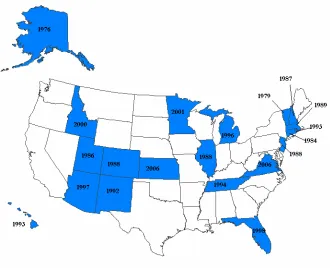
As seen in Figure 1, Alaska3 pioneered JPE in 1976 and now 20 states have now implemented official JPE programs. Therefore, 20 states are included as “adopters” in my models. Regionalism and geographic proximity seem to play a role in which states are official JPE states and those that are not. However, as my model shows, these factors alone insufficiently explain why some states adopted JPE programs while others did not.
Figure 1: Adoption of JPE Programs
The most comprehensive resource describing JPE programs is a 2006 report by the Institute for the Advancement of the American Legal System (IAALS) at the University of Denver. In this work, official JPE programs are defined as those run by, sponsored by, or approved by state government (IAALS, 2006). This definition of an “official” JPE program has been adopted for this study. Its reliability is bolstered by research compiled the Bureau of Justice also listing “official” JPE programs and including the same states as “official JPE” states.4
JPE is intended to be a politically neutral process designed to analyze a judge’s performance on multiple levels including: how they interact with people in the
courtroom, interpret existing law, and manages his or her workload. A clear and easy parallel can be drawn between JPE in the judicial context with efforts and research by public administration scholars that focus on similar human resource management and performance measurement questions in alternative public settings. As such, JPE offers the potential to contribute, through analytic generalizability, to these broader categories of research.
JPE gives citizens and politicians a tool to evaluate judicial competence. It provides accountability for merit selection processes and gives individual judges
information about improving their own performance. Research can be used to aggregate the overall performance of the judicial system (Esterling, 1999). Stakeholders, including voters, can use JPE to evaluate the procedural and administrative performance of judges rather than using case decisions as a proxy for a measurement device. This tool
contributes to the preservation of judicial independence by separating adjudication from administrative and management processes. In turn, this offers more validity and
confidence in the process as ratings can be systematically determined.
The program adopted by the Alaska state legislature in 1975 was designed to hold judges accountable and also to ensure judicial independence (the freedom to make case decisions based on the law not politics). However, no other program was adopted until 1979 when a statute passed in Vermont authorizing the formation of a joint committee on judicial retention. Though these states are far apart –culturally, geographically and ideologically –Vermont adopted a program similar to the one Alaska had been running for six years. Perhaps culture and ideology mattered: both states have smaller
populations in comparison to other American states which may lead to more “friends and neighbors politics” where individuality is valued. I test ideas such as these in my
dissertation.
level. Demands for JPE programs can come from public cries for reform of the judiciary after noxious behavior by an individual judge or as the result of displeasure with heavily publicized, emotionally charged cases (see Roberts, 2000). On the other hand, elites may call for JPE programs to quell complaints of judicial abuse, to justify requests for
additional resources, or to monitor the behavior of the judges themselves.
Though the debate over what characteristics make a “good” judge has not been settled, anecdotal evidence suggests results from judicial performance evaluations guide voters in decisions. For example, six Colorado judges have not been re-elected by voters following recommendations of the local5 Judicial Evaluation Commission not to retain them (personal communication, Jane Howell, August 9, 2007).
Judicial performance is increasingly a part of the political and administrative landscape of state and local governments. The basic tenets associated with the American justice system are fairness, efficiency, and equity. Citizens demand access to the courts and have expectations about how court administration will occur. Judges play a critical role in the administration of justice from making case decisions to serving in leadership roles within the court system.
Organization of the Study
I just reviewed the structure, history, and importance of American courts as a way to acquaint readers with the intricacies of the judicial system and place JPE in an
is provided for a deeper understanding of technicalities like court structure, idiosyncrasies relative to state courts, and the interactions between the federal judicial branch and state court systems. In Chapter Three diffusion theory and institutionalism are given thorough treatment and principal-agent theory is briefly reviewed. Chapter Four presents a review of the literature on diffusion and innovation studies building toward methodological choices that I make. Chapter Five discusses the theory behind the models and Chapter Five provides a detailed explanation of my research methodology including how my dependent and independent variables are constructed. In Chapter Six I test my models and discuss the association between the variables. Using the results generated from my analyses, Chapter Seven applies theoretical explanation to the models.
Through this process, I connect diffusion of innovation to court reform literature and innovation theory, as well as to public administration studies. I conclude by
Chapter 1 Notes
1
California Supreme Court Justice Rose Bird was removed from office during an especially contentious political contest. This race is one example of how politics can effect judicial selection outcomes. 2
One way to measure a performance culture would be to compare the overall performance scores assigned to states in the Government Performance Project. However, because the methodology and ranking criteria have changed substantially since 2005, scores across years are not comparable. Collecting longitudinal data over 30 years to incorporate the updated measures is not feasible within the scope of this dissertation. 3
Though Alaska adopted JPE in 1975, the program was not started – or implemented – until the following year. In the EHA model, time begins in 1976 since it is the first year after adoption. When I describe the implementation process in Alaska I will refer to 1976 as the initial year. When I note the adoption of JPE in Alaska I use 1975 as the first year of the program. This issue underscores the difference in adoption and implementation as well as the importance of clearly delineating between the two processes.
4
Other JPE programs are sponsored by private groups such as state or city bar associations. For example, the cities of Chicago and Los Angeles and the bar association in New Hampshire have JPE programs. A complete listing of unofficial JPE programs appears in Appendix C.
5
Chapter II: Setting the Stage
Understanding of public policy adoption is premised on a comprehensive knowledge of the context and of the system, subsystems, and relationships between the actors crucial to the policy adoption process. According to Paul Sabatier, “The process of public policymaking includes the manner in which problems get conceptualized and brought to government for solution; governmental institutions formulate alternatives and select policy solutions; and those solutions get implemented, evaluated, and revised (p. 3).” Chapter Two describes state court systems so readers have a thorough understanding of the resources, players, and constraints affecting adoption of JPE programs. The policy process can be illuminated through understanding how JPE programs have been
implemented to date. By discussing the interactions between stakeholders in the court system I contribute to our understanding of public policy.
Though none of these purposes is explicitly related to explaining the characteristics leading to the diffusion of JPE programs in the American states, understanding processes, resources, and actors in state court systems provides context through which variables in my diffusion models make sense. Furthermore, my contribution to the body of research on state court systems is a valuable
Why We Should Study Courts in Public Administration
Courts differ in management practice and structure from many legislative and executive branch agencies. In addition, courts offer a different perspective on topics germane to public administration. David Rosenbloom put emphasis on this area of research through examining the role of public law in public administration (e.g., Rosenbloom, 1987; 1989; 2000). Through this lens, scholars can study management practices, effects of technology, performance measurement, human resources
management and even policy diffusion. Though courts should be an important facet of public administration study, scholars have given this branch of government little attention.
Scholars of state judiciaries have made a number of important findings on subjects such as dissent rates (Brace & Hall, 1990; Hall & Brace, 1989; Jaros & Canon, 1971), litigation decision making processes (Emmert, 1992; Songer & Tabriski, 1999), court dockets (Atkins & Glick, 1974), impact of the judiciary and implementation of programs (Canon, 1973; Tarr, 1977), internal operating rules and procedures (Hall, 1990; Slotnick, 1977). Even with these studies, research on state courts has focused on
supreme courts, has been largely descriptive, and has not been able to establish the micro-level causes relative to macro-micro-level patterns (Brace, Hall, & Langer, 2001).
Wise & O’Leary, 1992; 1997); or on resource deployment issues like strategic planning (Boyum, 1999), judicial modernization (Flango, 1975), technology and information management (Rottman et al., 2007), or budgeting (Douglas & Hartley, 2001). However, these represent the few extant studies on courts found in mainstream public
administration literature.
Recent publications (Savchak & Barghoti, 2007) suggest that trend is beginning to change. One relevant example (Kearney, 1999) provides a descriptive overview of the JPE process, state programs, and the performance measurement movement but stops short of conducting an empirical analysis that would aid in explaining why states consider adopting a JPE program in the first place.
With its foundation in English common law and the U.S. Constitution, the American system constantly compares the past and present. Precedent guides lawyers and judges in constructing their arguments. The system depends on individuals
understand mitigating factors or other parameters of cases. Their rulings illuminate policy choices and, by extension, the judiciary at all levels affects how the legislative and executive branches conduct business.
Administrative decisions or strategies can also affect court decisions. Political scientists have amassed a distinctive body of literature on judicial voting behaviors, especially at the appellate court level (Beiser, 1973; Brace & Hall, 1993, 1995, 1997; Dubois, 1988; Glick & Vines, 1973; Hall, 1985, 1987, 1992; Traut & Elmert, 1998). Also, judges who self-identify as “administrators” tend to emphasize procedural goals and precedent only to expedite case resolution (Boyum, 1979; Ungs & Bass, 1972). When asked if case management practices, such as a push for settlements to reduce the time a case is active, impact the judicial decisions, some judges responded affirmatively noting the judge’s need to control both proceedings and attorneys sometimes results in advocating for settlement to speed resolution rather than trials (Neubauer, 1978; Winters, 2002). Accepting settlements because of administrative burdens and case management pressure represents threats to both independence and accountability because judges acting to control external stimuli are overriding case decisions based on law, precedent, and the judge’s unbiased opinion.
The Relationship between the Judiciary and Public Policy Creation
environmental management (Bacot & Dawes, 1997), and social programs (Gray, 1973) provides a way to understand the complexities of these issues as well as the motivations of the actors who create public policy to address them. Often though, policies regulating judicial administration are not studied.
Judicial decisions can affect public policy (Feeley & Rubin, 1998). Public policy decisions are not made in isolation; in fact, a single decision can have a ripple effect through American society. For example, consider the passage of the Americans with Disabilities Act of 1990 (ADA). Though the ADA was officially adopted in 1990, it was preceded by decades of work including passage of related legislation such as the
Rehabilitation Act of 1973. The ADA encompasses a broad range of issues that fall under the purview of civil rights laws prohibiting discrimination based on disability. Though legislators made the public policy decision to adopt the ADA, the courts
determined its policy impact by interpreting the legislation through rulings in ADA cases. Subjectivity can easily creep into implementation of the ADA since the
determination of what “disability” means is made on a case by case basis. The courts grant deference to expert medical opinion in individual cases, but even so the definition of disability is neither easily described nor agreed upon. Because of this the courts are frequently asked to settle disputes over interpretation of the Act and related issues. Over time, rulings in these cases have changed the scope of the ADA.
disputes over wills, trusts and estates, labor relations or consumer rights are resolved (Glick & Vine, 1973). These “outcomes” have long range social and economic effects on the attitudes of Americans and their confidence in the judicial system (Glick & Vine, 1973). Judges are passionate in their defense of independent case decisions (Nelson, 1981 in Hudzik, 1991) as well as of their role as policy makers (Hudzik, 1991).
Pundits and scholars debate about whether courts are policymakers.
Conservatives and liberals alike often criticize judges for being “activists”. Even so, the courts are rarely seen as active policymakers. Notable decisions rendered in judicial chambers shape the fabric of American society. Political scientists have long argued that judges are motivated by their own policy preferences (Pritchett, 1948). Since the 1940s many scholars have contributed to the attitudinal explanation of court decisions (Smith, 1988; Segal & Spaeth, 1993; Gillman, 1997; Baum, 1997). However, researchers have also found that more than judicial attitudes affect rulings and, by extension, court
administration (Epstein & Knight, 1998). The manner in which case decisions are made affects the way that judges manage their courtrooms and courthouses as well. Judges look to peers in other courts, other states, and to the federal judiciary for cues on how to manage the legal process most effectively. Learning from the experiences of other judges can become a reason to undertake innovative programs in court administration.
Advancements in this setting are noteworthy because of the potential for systemic, intergovernmental impact.
paperless court environment. The pilot tested both the capacity of court personnel to deal with technological tools as well as the possibility that increasing efficiency through use of electronic records would have a significant impact on processing and the time that a case remained active in the system. Judges had to learn to use new technology, to
communicate differently with court participants and staff, and to enter judgments in new ways. These changes increased availability of files and records for court staff but decreased efficiency as employees (including judges) had to grapple with the new technology. Judges in other districts were interestedly watching the pilot. However, the Seventeenth District returned to a traditional, paper record system because of the
difficulties inherent in the paperless environment. Though electronic record formats work in other environments, the paperless court experiment failed in Colorado. But that does not preclude the possibility that other management reforms might succeed.
JPE as a Policy Tool
In most cases the decision to adopt a JPE program resulted after years of
discussion between interested groups such as the state bar association, court officials, and citizen groups. Interest groups play a powerful role in policy making. They move actors from one side of a debate to another, from conflict toward agreement. Mobilization of a group or policy community can result in power shift. The history of state adoption decisions chronicles power shifts, rallying policy communities, and interest group politics.
Developing a deeper knowledge about the characteristics leading to adoption of this innovation by American states gives researchers, policy makers, politicians, and other actors a way to operationalize how effectively the program meets broader accountability and performance goals required by the Government Performance and Review Act of 1993(GPRA) and legislative bodies. GPRA assesses various results of a program relative to its intended results and is a strategic planning and performance measurement program required for some federally funded programs. Though some scholars (e.g, Radin, 2000) have suggested GPRA amounts to little more than exercises in program compliance, programs that incorporate performance information into the
decision making process have gained credibility. Effective leadership, including
Adoption of state policies typically seems incremental; however, if traced back far enough, there is a point that each policy, newly bursting onto the scene, was an
innovation that changed the arena in which it was adopted. Researchers have worked to define the subtle differences in innovation, invention, adoption, and diffusion of policies (Eyestone, 1977). For example, the policy literature describes innovation as “a program that is new to the government adopting it” (Walker, 1969; Gray, 1973; Rogers, 1995). Policy invention is “the process through which original policy ideas are conceived” (Berry and Berry, 1999). Invention can spur innovation. Creativity, discovery, and new ways to deliver public goods can both involve adoption decisions and include movement of policies across subsystems and geographic borders. Studies attempting to explain both invention and innovation have provided a rich body of literature from a variety of
disciplines that describe the processes as distinct but complementary.
Court Reform and Public Administration
Despite the rich array of potential subjects, articles featuring judicial
Hays & Douglas, 2006), giving them unique perspectives on both the need for reform and the ability to visualize how those reforms should look.
Whether we realize it or not, courts are ever present in daily life. Citizens are likely to encounter a courtroom in run of the mill transactions like traffic citations, jury duty, transactions of wills, trusts, or estates, or in other similarly mundane matters. Rulings from court cases like the ADA example previously discussed have sweeping effects that govern how we conduct business, travel, work, shop, and live. Television and print news sources report on trials, both civil and criminal, that have some effect on the public. Public opinion is shaped by the tenor and frequency of these headlines. Often the media are critical of the judiciary in general, and of judicial elections specifically (Bell, 2001; Campbell, 2002; Wohl, 2000). Public administration scholars have a responsibility to study connections between court activities and daily life.
Many public administration studies benefit from using stakeholders in systems to shed light on phenomena present there. Managers and leaders are often featured subjects in research projects. Following the lead of other public administration studies, judges should be likely candidates for studies of the state court system.
Thus, there is a potential for general system compromise. Following such scenarios, scholars often question the impact interest groups have on policy formation, the effect of voters, and what influence cultural norms and values have on public policies.
To assess whether courts have been featured recently in the top public
administration journals I searched the Social Sciences Citation Index (SSCI). The SSCI is a measure of a journal’s impact on a specific academic discipline. The measure is a combination of the number of annual citations in all ISI indexed journals and the number of citations for a specific journal. The category “public administration” has 24 indexed journals in every year since 1998 except when even more journals were featured (2004 (n=26), 2005 (n=25), and 2006 (n=25)). Over the course of the past 10 years of public administration journal articles, a scant few specifically about state trial courts or state court management and administration have been published. One about the representation of women on state trial and appellate court benches appeared in Social Science Quarterly (Williams ,2007) and another devoted to court security was featured in the Annals of the American Academy of Political and Social Science (Greacen & Klein, 2001). State appellate courts have been written about prolifically by some political science scholars (e.g., Bonneau, 2003; Hall, 2006) but the public administration academy has yet to tap into studies of state courts.
administration persuasion (Hartley & Bates, 2005). As with other subjects incorporating aspects of both political science and public administration, the split of the two disciplines has affected judicial administration scholarship. The division caused public law scholars to look for other avenues to showcase their work and limited collaboration between those academicians and public administration scholars (Hays & Douglas, 2006). The
combination of all these issues makes the judiciary a topic ripe for future research.
The Need for Court Reform
In a 2003 article featured in Spectrum: the Journal of State Government, Alfred Carlton, then president of the American Bar Association, highlighted several issues to support his position that state court reform is necessary (Carlton, 2003). Those points include:
• The patterns and effects of campaigns on the judiciary can be negative, and even
harmful.
• Partisanship in campaigns is causing the judicial branch to lose its independence
and join the ranks of politicians in the legislative and executive branch.
• There can be a “trickle-down” effect from state budgets to court budgets when
resources are strained.
• American society is more diverse; courts must reflect and embrace this diversity
to maintain the public’s trust and confidence in the system.
explain how, why, and when these issues affect the administrative capacity of state courts most. And, in turn, diffusion may be a way to understand how, why, and when state policies related to the courts are adopted.
For example, campaign elections and finance might be described as motivations or resources linked to judges. Certainly concerns about budget appropriations can be resources or obstacles. Public administration scholars have written extensively on state budgets and the impact of surpluses and shortfalls (Albritton & Dran, 1987; Bozza, 1998; MacManus & Groethe, 1989; Poister & McGowan, 1984; Premchand, 1981; Rubin, 2005). Court budgets have a place in state budgets. Increasing scholarship on court budgets can contribute to a greater understanding of states’ fiscal policy decisions.
The words “motivation”, “resources”, and “obstacles” appear repeatedly through my discussion of policy diffusion and the courts. The repetition is not accidental. These ideas encapsulate the variables in diffusion models and are things that should concern judicial administrators, judges, citizens, and the scholars that study them. Because these are important concerns in the court reform movement and literature, each will be
Overview of American Court Systems
The United States is governed through a federalist structure created by its Constitution. Through this document, certain powers are granted to the federal government while the rest are reserved for the states. Powers granted to the federal government fall under the jurisdiction of federal courts; likewise, activities regulated by state authority are under state court jurisdiction. Therefore, the American judiciary is made up of separate court systems for federal and state issues.
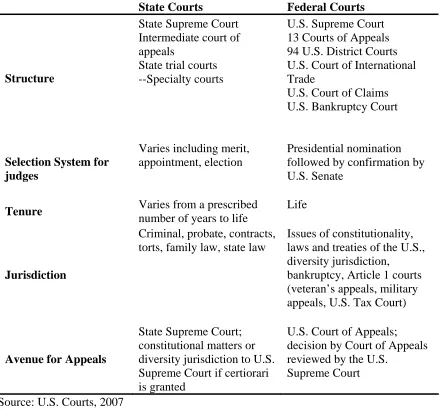
Table 1. Comparison of State and Federal Court Systems
State Courts Federal Courts
Structure
State Supreme Court Intermediate court of appeals
State trial courts --Specialty courts
U.S. Supreme Court 13 Courts of Appeals 94 U.S. District Courts U.S. Court of International Trade
U.S. Court of Claims U.S. Bankruptcy Court
Selection System for judges
Varies including merit, appointment, election
Presidential nomination followed by confirmation by U.S. Senate
Tenure Varies from a prescribed
number of years to life
Life
Jurisdiction
Criminal, probate, contracts, torts, family law, state law
Issues of constitutionality, laws and treaties of the U.S., diversity jurisdiction,
bankruptcy, Article 1 courts (veteran’s appeals, military appeals, U.S. Tax Court)
Avenue for Appeals
State Supreme Court; constitutional matters or diversity jurisdiction to U.S. Supreme Court if certiorari is granted
U.S. Court of Appeals; decision by Court of Appeals reviewed by the U.S.
Supreme Court
Source: U.S. Courts, 2007
Jurisdiction
make rulings on legal matters and work to administer justice within the confines of the systems through their respective jurisdictional capacities.
Jurisdiction is further subdivided into matters of original jurisdiction and those of an appellate nature. With original jurisdiction, courts hear cases first initiated by
plaintiffs while appellate jurisdiction refers to the capacity of the court to act only after an action is contested after a ruling from a court of original jurisdiction. There are notable exceptions to this rule: when two or more states are involved in a case, actions are between the federal government and state government(s), if one of the 50 states sues the federal government, or if cases involve foreign states or citizens and American states or citizens, federal courts have original jurisdiction.
Despite very basic similarities, American courts are very different. These differences,
first highlighted in Table 1, are discussed in the following sections on state judiciaries.
Because a full description of the American courts should include an overview of all the
components of the system, a description of the federal courts and the evolution and
practices of the special case of Native American courts is provided in Appendix C.
State Courts
preventive measures such as injunctions or restraining orders and typically hear matters involving private parties rather than those of public interest. Most often, courts of equity have jurisdiction over corporations, trusts, estates, and other fiduciary matters, including disputes over sale or purchase of land, questions of real estate title, or commercial and contractual agreements. Most states have no chancery courts and handle these matters in courts of law. Another example of a departure from the norm is the separation of
criminal and civil appeal processes. Texas and Oklahoma have separate courts of last resort for criminal and civil matters. One final illustration, the Louisiana court system, is organized by a civil model. All other American states draw from English common law.
Disputes involving some relationship to an American state are heard within its state court system. Courts of general jurisdiction are usually the entry point for cases in the state legal system; however, courts of lesser jurisdiction, such as magistrate courts or justices of the peace sometimes handle petty offenses or arraignments. If a litigant is not satisfied with the outcome in a court of general jurisdiction, he or she may appeal to a higher court. Usually, these intermediate appellate courts review only mistakes of law and do not review the factual evidence of a case. Finally, if the parties are still
unsatisfied with the way the case has been handled, the highest court in the state, usually referred to as the state supreme court, can be petitioned to hear the case to review
decisions of lower courts.
guidance is ambivalent or unavailable. Following examples from other states is a demonstration of how actors use communication networks within a policy subsystem in the decision-making process. Communication networks found in professional
associations (e.g., the American Bar Association, the National Center for State Courts, or the National Association of Attorneys General) give stakeholders a way to shape
administrative practices. Judges may also look to their “social system” for information on best practices in court management or administration. Geo-political similarities and differences may shape the method and frequency of communication. Judges and administrators may use normative filters to determine how or when to use information gained through their networks. Thus, innovations like JPE may resonate more or less strongly given constraints within a particular state court system.
Even though terminology, management practice, funding streams, jurisdiction and standard operating procedures vary, the basic structures for state court systems are
Table 2. Organization of State Court Systems (2006)
Type of court Description and Number of Courts in the States
Supreme Court All states have one supreme court
Intermediate Appellate Courts 38 states have intermediate courts of appeal. Alabama, Indiana, Pennsylvania, and Tennessee have 2 intermediate courts of appeal. Intermediate appellate courts have various names including: Superior Court, Court of Appeals, Appellate Division of Supreme Court or Superior Court, Superior Court
Trial Courts of General Jurisdiction
40 states have 1 type of trial court of general jurisdiction, 5 states have 2, 3 states have 3, and 2 states have 4. The names of these courts vary: Circuit Court, Superior Court, District Court, Common Pleas, and in New York, the Supreme Court.
Type of court Description and Number of Courts in the States
Trial Courts of Limited Jurisdiction
24 states have only 1 or 2 of these kinds of trial courts; 12 states have 3 different kinds; 6 states have 4 or 5 kinds; 4 states have 6 or more different kinds. The names and functions of these courts vary widely. Some examples include Courts of Oyer and Terminer, Drug Courts, Justice Courts, Juvenile Courts, Probate Courts, and Small Claims Courts
Source: Bureau of Justice Statistics (2006); table format adapted from Glick & Vine (1974).
judges that hear most of the cases in the state judicial system. Evaluating the
performance of such a large workforce is important to a well-functioning judiciary and to public administration in the states.
States adopting JPE have chosen to implement the programs differently. Some states evaluate only appellate court judges (e.g., Tennessee) while others have an elaborate comprehensive review process (e.g., Colorado). In part, these differences in implementation may be driven by the ways that judges get “hired”. Judicial selection systems differ between and within states. The following section on judicial selection illuminates the features of these systems.2
Judicial Selection Systems
American judicial scholars have written much about the judicial selection process in law review articles and other publications (Atkins, et al., 1984; Baum, 1983; Dubois, 1980, 1984, 1985; Hall, 1984; Reddick, 2002; Slotnick, 1988). Most focus on the tension between judicial independence and judicial accountability (White, 1976; Carbon, 1980; Flango & Ducat, 1979; Seis, 1982; Dubois, 1986; Caulfield, 2004). However, much of the judicial selection literature, found in publications from the 1970s and 1980s, was generated as a result of 14 states moving to merit selection systems (Glick & Emmert, 1987).
Despite recent trends toward merit systems, methods of judicial selection have been hotly debated throughout American history (Schneider & Maughan, 1980).
coming to any resolution. Early skeptics (Flango & Ducat, 1979) and suggested that selection procedures had little relevance to the type or quality of judge ultimately chosen. Interestingly, in more recent work judicial reform advocates disagree about the
effectiveness of partisan and nonpartisan elections (Brace, Hall, & Langer, 2001). Some indicate that these systems are ineffective means for selecting judges because voters are uninformed about candidates and races while others disagree (Baum, 1987; Hojnacki & Baum, 1992; Lovrich & Sheldon, 1984, 1985).
The history of the topic is colorful and provides context for the importance of selection method in the 21st century. There are many examples of disputes over judicial selection found throughout accounts of the judiciary in the 1800s. For example, in 1813 ideological differences drove the New Hampshire legislature, with a Federalist majority, to expel all Democratic judges from the state’s courts (American Bar Association, 2000).
Much of the existing research searches for correlations between social
History of Judicial Selection
Before the Revolutionary War judges were appointed by colonial governors. For about 50 years following the colonial period, legislative and gubernatorial appointment was the normal course of judicial selection (Hanssen, 2004). Of the original 13 states, eight used legislative appointment, two allowed the governor and his council to do the job together, and three gave appointment authority to the governor alone but required consent of his council (Escovitz, 1975). The upper class controlled government in the early years (Caulfield, 2004). Many political figures, including judges, reached office through the spoils system in the late 1800s.
The 1800s were a period of change. In the early 1800s Georgia became a trend-setter and was among the first to adopt popular elections (Caulfield, 2004; Hall, 1984). By 1856 more than half of the states in the Union used this method (Schneider &
Maughan, 1980). The democratic principle of judicial accountability was advanced with elections. By the end of the Jacksonian era the spoils system had been phased out for more democratic forms of selection and governance that were taking root. From 1812 when Georgia adopted it until Alaska broke the tradition in 1959, all states admitted to the Union adopted popular election for some or all of their judges (Caulfield, 2004).