Data Security in IoT Environment
M.Suresh
1, P.Saravana Kumar
2, Dr.T.V.P.Sundararajan
3PG scholar, Department of ECE, Bannari Amman Institute of Technology, Sathyamangalam, TamilNadu, India1.
Assistant Professor (Sr. Grade), Department of ECE, Bannari Amman Institute of Technology, Sathyamangalam,
TamilNadu, India2.
Professor, Department of ECE, Bannari Amman Institute of Technology, Sathyamangalam, TamilNadu, India3.
ABSTRACT: The proliferation of technology paves way to new kind of devices that can communicate with other devices to produce output mostly on wireless communication. Wirelessly communicating embedded devices are brought to one another in a single link over Internet called IoT (Internet of Things). If all objects and people in daily life were equipped with identifiers, computers could manage and inventory them. Besides using RFID, the tagging of things may be achieved through such technologies as near field communication, barcodes, QR codes and digital watermarking. Here new method of using embedded technology to provide such application, Arduino is used as an embedded controller to interface Ethernet shield with a PC/Laptop to provide IoT over Ethernet. A user can use this parking service in the airport scenario provided by airport authority with user ID and password. Whenever a user need to check the vehicle in the parking lot, uses the ID and password to logon into the airport web link and view the status of the car in the parking lot using IoT. IoT Based Airport Parking System is discussed here to implement Arduino environment as IoT application.
KEYWORDS: IoT (Internet of Things), QR code (Quick Response Code), RFID (Radio-Frequency IDentification).
I. INTRODUCTION
The Internet of Things (IoT) is the interconnection of uniquely identifiable embedded computing devices within the existing Internet infrastructure. Typically, IoT is expected to offer advanced connectivity of devices, systems, and services that goes beyond Machine-To-Machine communications (M2M) [2] and covers a variety of protocols, domains, and applications. The interconnection of these embedded devices is expected to user in automation in nearly all fields, while also enabling advanced applications like a Smart Grid. Things, in the IoT, can refer to a wide variety of devices such as heart monitoring implants, biochip transponders on farm animals, electric clams in coastal waters, automobiles with built-in sensors, or field operation devices that assist fire-fighters in search and rescue. Current market examples include smart thermostat systems and washer/dryers that utilize Wi-Fi for remote monitoring. One of the things that make it special and different is that the Internet of Things allows objects to communicate directly or indirectly to Internet.
II. SYSTEM ARCHITECTURE
Arduino UNO board with ATmega328 is used as an embedded controller to interact with the Ethernet shield along with PC.
A. Embedded System Platform
The key elements in this system contains embedded system platform which includes Arduino Board with ATmega 328 and Ethernet Shield [3].
B. Arduino Board
The project is based on a family of microcontroller board designs manufactured primarily by Smart Projects in Italy, and also by several other vendors, using various 8-bit Atmel AVR microcontrollers or 32-bit Atmel ARM processors. These systems provide sets of digital and analog I/O pins that can be interfaced to various extension boards and other circuits. The boards feature serial communications interfaces, including USB on some models, for loading programs from personal computers. For programming the microcontrollers, the Arduino platform provides an integrated development environment (IDE) based on the Processing project, which includes support for C and C++ programming languages.
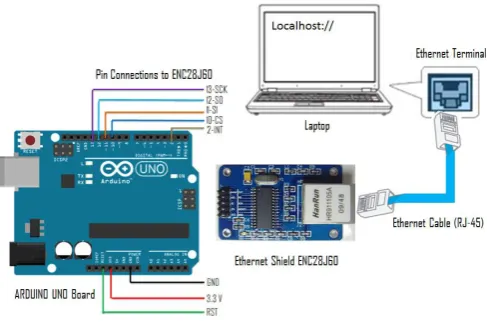
Fig. 1. Block diagram of Arduino Based parking as an IoT Application
C. Ethernet Shield
The Arduino Ethernet Shield allows an Arduino board to connect to the internet. It is based on the Wiz net W5100 Ethernet chip. The Wiz net W5100 provides a network (IP) stack capable of both TCP and UDP. It supports up to four simultaneous socket connections. Use the Ethernet library to write sketches which connect to the internet using the shield. The Ethernet shield connects to an Arduino board using long wire-wrap headers which extend through the shield. This keeps the pin layout intact and allows another shield to be stacked on top. The most recent revision of the board exposes the 1.0 pin out on rev 3 of the Arduino UNO board. The Ethernet Shield has a standard RJ-45 connection, with an integrated line transformer and Power over Ethernet enabled. There is an onboard micro-SD card slot, which can be used to store files for serving over the network. It is compatible with the Arduino Uno and Mega. The onboard micro SD card reader is accessible through the SD Library. When working with this library, SS is on Pin 4. The original revision of the shield contained a full-size SD card slot; this is not supported. The shield also includes a reset controller, to ensure that the W5100 Ethernet module is properly reset on power-up. Previous revisions of the shield were not compatible with the Mega and need to be manually reset after power-up. Microchip's ENC28J60 is a 28-pin, 10BASE-T standalone Ethernet Controller with on board MAC & PHY, 8 Kbytes of Buffer RAM and an SPI serial interface. With a small foot print package size the ENC28J60 minimizes complexity, board space and cost. Target applications include VoIP, Industrial Automation, Building Automation, Home Control, Security and Instrumentation. Ethernet Application Design Center. The Ethernet Controller (ENC28J60) is a so called SPI device and uses the SPI pins (10, 11, 12, and 13) of Arduino. SS stands for Slave Select, used to enable or disable the slave device. MOSI stands for Master Output Slave Input, or in other words: Arduino OUTPUT (data from Arduino to Ethernet Controller). MISO stands for the opposite, Master Input Slave Output, or: Arduino INPUT (data from Ethernet Controller to Arduino). SCK is the clock used for SPI timing.
III.INTERNET OF THINGS
existing internet infrastructure. Typically, IoT is expected to offer advanced connectivity of devices, systems, and services that goes beyond Machine-To-Machine communications (M2M) and covers a variety of protocols, domains, and applications. The interconnection of these embedded devices is expected to user in automation in nearly all fields, while also enabling advanced applications like a Smart Grid.
IV.SYSTEM IMPLEMENTATION
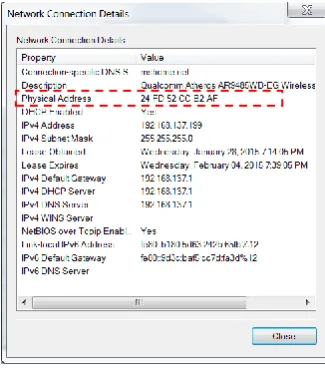
In order to connect Arduino board with Ethernet shield and PC the configurations of IP address, MAC is mandatory. In the details window of network settings MAC address will be seen as,
Fig. 4. MAC address identification
IP address is user defined for the Ethernet shield. If both the IP and MAC configured correctly for the Arduino code means the hardware module is ready to interact with the PC.
The normal user can login with user ID and Password and that particular user can view his/her parking location in the airport. The master who can access all the user details will be the administrator.
Fig. 5. User Login authorization Control
Fig. 6. Admin Login authorization Control
link communicated via wireless communication along with Arduino in the vehicle. It shows the each user details, arrival and departure. Finally provide link to the vehicle location in the parking lot consists of latitude and longitude position of the vehicle marked by GPS.
V. RESULTS AND DISCUSSIONS
Fig. 7. Displays user login page.
Present paper is designed using ATmega328 microcontroller in the Arduino environment. It is proposed to design an embedded system which is used for IoT applications. Arduino UNO is interfaced with the ENC28j60 shield and connected to PC via RJ-45 cable. After uploading the code into the Arduino the browser window shows the results by using the configured IP to the Ethernet shield.
Fig. 8. Displays Vehicle Parking Location page.
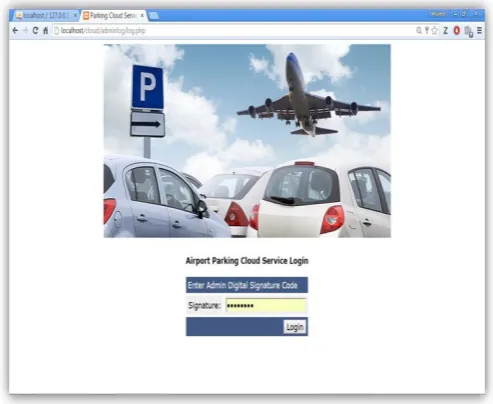
Fig. 9. Displays Admin login page.
Fig. 9 shows admin web page login allows admin to enter the secret login details.
Fig. 10. Displays security by Digital signature code authentication
SQL injection occurs when user input is not filtered for escape characters and is then passed into a SQL statement. This result in the potential manipulation of the statements performed on the database by the end-user of the application.
This SQL code is designed to pull up the records of the specified username from its table of users. However, if the "userName" variable is crafted in a specific way by a malicious user, the SQL statement may do more than the code author intended. For example, setting the "userName" variable as: ' or '1'='1.
Fig. 11. Displays Admin page.
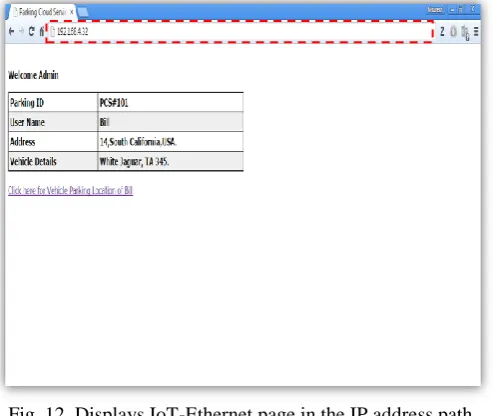
Fig. 11 shows admin web page consists of all the users registered with parking cloud service. PCS (Parking Cloud Service) ID is different for different user. Details show the IP address of different vehicle Ethernet shield. This IP link can directs the admin to view particular user details and vehicle position in the parking lot consists of latitude and longitude position of the vehicle marked by GPS, if any faults or errors in viewing that page means the admin can ensure that unauthorized access of the vehicle.
Fig. 12. Displays IoT-Ethernet page in the IP address path.
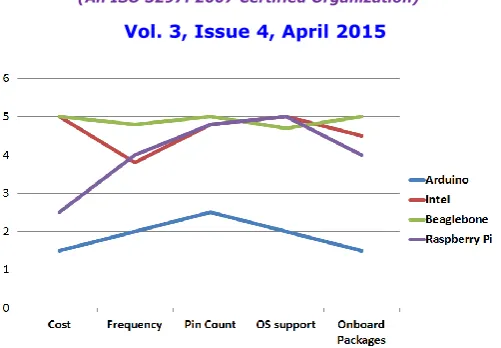
Fig. 13. Performance analysis of various IoT based boards.
Among various distributions mostly for Internet of Things applications Raspberry Pi, Beagle bone black, Intel Edison, Arduino UNO, DUE are used. Fig. 13. Shows various performance parameters of various IoT based boards. Based on cost perspective Arduino is best, in case of frequency of operation and pin counts usage Intel, Beagle bone, Raspberry pi are good. Arduino doesn’t require any on board OS but other boards possess this facility user must configure a separate OS for the application. Various on board packages includes SD card slot, inbuilt Ethernet, HDMI port, etc are available but not in Arduino boards. Of these Arduino possess used friendly, easy to program, cost wise cheaper hence IoT based airport parking system uses Arduino as embedded controller.
The results show that, it will work well for all kinds of IoT applications and responds immediately to the user’s commands. Web pages are designed by using html and php. The database configurations are carried out by MySQL along with XAMPP server as local host.
VI.CONCLUSION AND FUTURE WORK
From the proposed IoT Based Airport Parking System, an efficient parking service can be implemented. It will display all user details only to the administrator. Every passenger can view the parking location details in the smartphone via cloud server in the airport. This ensures security to the vehicles in the parking lots. Only SQL injection can be prevented by using digital signature authentication. Future enhancements include provide cyber security to the parking cloud service because many security risks involved in cloud computing and IoT for real time implementations.
REFERENCES
1. Wu He, Gongjun Yan, and Li Da Xu,Senior Member, IEEE “Developing Vehicular Data Cloud Services in the iot Environment” IEEE
TRANSACTIONS ON INDUSTRIAL INFORMATICS, VOL. 10, NO. 2, MAY 2014.
2. S. Li, L. Xu, and X. Wang,“Compressed sensing signal and data acquisition in wireless sensor networks and internet of things,” IEEE Trans. Ind. Informat., vol. 9, no. 4, pp. 2177–2186, Nov. 2013.
3. Boyi Xu, Li Da Xu,Senior Member, IEEE, Hongming Cai, Cheng Xie, Jingyuan Hu, and Fenglin Bu “Ubiquitous Data Accessing
Method in IoT-Based Information System for Emergency Medical Services” IEEE TRANSACTIONS ON INDUSTRIAL INFORMATICS, VOL. 10, NO. 2, MAY 2014.
4. W. Lumpkins, “The internet of things meets cloud computing,” IEEE Consum. Electron. Mag., vol. 2, no. 2, pp. 47–51, Apr. 2013
5. Md Whaiduzzamana,n, Mehdi Sookhak , Abdullah Gani , Rajkumar Buyya “A survey on vehicular cloud computing”,
ELSEVIER-Journal of Network and Computer Applications 40 (2014) 325–344.
6. M. A. Feki, F. Kawsar, M. Boussard, and L. Trappeniers,“The Internet of Things: The next technological revolution,” Computer, VOL. 46, NO. 2, pp. 24–25, 2013.
7. Aijaz, A., Aghvami, A.H. “Cognitive Machine-to-Machine Communications for Internet-of-Things: A Protocol Stack Perspective” Internet of Things Journal, IEEE, JAN 2015.
8. Charalampos Doukas and Ilias Maglogiannis “Bringing IoT and Cloud Computing towards Pervasive Healthcare”, Sixth International Conference on Innovative Mobile and Internet Services in Ubiquitous Computing, 2012.
9. Weili Han, Yun Gu, Yin Zhang, Lirong Zheng,“Data driven quantitative trust model for the Internet of Agricultural Things”, International Conference On Internet of Things (IOT),OCT.2014.
BIOGRAPHY
M.Suresh1 received the UG degree in Electronics and Communication Engineering in 2013, from TamilNadu College of Engineering, Coimbatore, Tamil Nadu.
He is currently pursuing his PG degree in Embedded Systems at Bannari Amman Institute of Technology, Sathyamangalam, Tamil Nadu.
P.Saravana Kumar2 received the UG degree inElectronics and Communication Engineering in 2001, from Bharathiyar University, Coimbatore and received the PG degree in Information Technology in 2003 from CEG, Anna University, Chennai. He is currently pursuing his doctorate degree.
He is currently working as an Assistant Professor (Senior Grade) of Electronics and Communication Engineering at Bannari Amman Institute of Technology, Sathyamangalam, Tamil Nadu.
Dr. T.V.P. Sundararajan3 has received BE degree in Electronics and Communication from Kongu Engineering College, Bharathiar University, Coimbatore, Tamil Nadu (1993). He received his ME Degree in Applied Electronics from GCT, Bharathiar University, Coimbatore, Tamil Nadu (1999).