Rate Control Framework For SIFT/SURF
Feature Preservation in H.264/AVC Video
Compression
Nandhini R [1], Raj Bharath S M [2]
PG Scholar, Department of ECE, Kingston Engineering College, Vellore, Tamil Nadu, India [1]
Assistant Professor, Department of ECE, Kingston Engineering College, Vellore, Tamil Nadu, India [2]
ABSTRACT: A rate control framework for H.264/AVC based video coding is used to improve the gradient based features to increase Scale-Invariant Features Transform (SIFT) and Speeded up Robust Feature (SURF). In this, increased performance according to the Bag-of-features (BoFs) concept and also an improves Macro block (MB) categorization approach is carried out. First different QP values for each group is calculated and then the matching scores are collected as a function of the quantization parameters (QP) and an heuristic QP assignment approach for different groups used for I frames. Next part the rate control algorithm tests different numbers of features to be preserved, considers the human observer and conducts many experiments that shows the performance preserving the rate control framework. The proposed approach improves feature preservation and improvement in a real image retrieval system. It is fully standard compatible using the rate control framework.
I. INTRODUCTION
In video communication the compressed videos are transmitted over capacity-constraint communication channels under the target of bit rate and size of buffer and rate control strategies that have been studied in some of the context of videos coding standards as for MPEG-4 standards, JVT-G012 and JVT-W042 for Advanced Video Coding standard. The visual quality for given target rate have been improved with many strategies. The rate control scheme in which the similar characteristics are collected from basic unit of the macro blocks (MBs) where the optimization model is proposed for better subjective and quality of object. A rate control algorithm on structural similarity (SSIM) in which SSIM index achieves up to a 32% bit rate reduction comparing with the JM reference software with the same quality and also proposes high definition videos for two-pass control scheme.
II. RELATED WORK
This presents a novel rate control framework for H.264/Advanced Video Coding-based video coding that improves the preservation of gradient-based features like scale-invariant feature transform or speeded up robust feature compared with the default rate control algorithm in the JM reference software. In this, a novel rate control approach is proposed aiming at preserving the important local image features, such as SIFT and SURF. First analyze the characteristics of features and propose a novel method to categorize the MBs into different groups for video frames. Then, calculate different QP values for each group according to their importance for feature extraction.
The results show that our approach preserves more features while still achieving the target bit rate. Then the matching scores are collected as a function of the quantization parameters, and a heuristic QP assignment approach for different groups is used for I frames.
III. PROPOSED ALGORITHM
A. Design Considerations:
MB categorization
QP Assignment for Different MB Groups
Rate Control
MAD and QP Models
GOP Level Rate Control
B.Description of the Proposed Algorithm
Video to Frame conversion
Frames can be obtained from a video and converted into images. To convert a video frame into an image
the MATLAB function ‘frame2im’ is used. To read a video in avi format, the function ‘aviread’ is used. The original format of the video that I am using as an example is .gif file format.
Video encoding
Video encoding is the process of converting digital video files from one format to another. Encoding is also known as “transcoding” or “video conversion”. At the time of recording, the device gives the video file a particular format and other specifications.
Macroblock classifications
During the compression process, each frame is divided in blocks of a fixed size (16x16 for example) or one of the possible sizes (based on the codec standard), which is called a Macroblock. Each macroblock is encoded separately with the aim of removing the above-mentioned redundancies. Based on the type of redundancies within a macroblock, the encoder may choose to encode it using Inter-coding, or intra-coding or not to code it at all (if the region is non-changing).
H.264 Based Video Compression
HEVC stands for high-efficiency video coding. Also known as H.264, this new video codec will compress video files to half the size possible using the most-efficient current encoding format, MPEG-4.
That will be one-quarter the size of files compressed using the MPEG 2 codec that most cable-TV companies still employ. More importantly, HEVC is used to compress video with 4K resolution and possibly even 8K resolution in the future so it can be efficiently delivered.
Motion Compensation
Motion compensation is an algorithmic technique used to predict a frame in a video, given the previous and/or
future frames by accounting for motion of the camera and/or objects in the video. It is employed in the encoding of
video data for video compression. Motion compensation describes a picture in terms of the transformation of a
reference picture to the current picture
H.264 based Video Compression
BLOCK DIAGRAM
Figure 1.Block diagram for H.264/AVC video compression
IV. PSEUDO CODE
Step 1: Load the input video.
Step 2: The input videos must be converted in to frames.
Step 3: Frames that are separated are used for motion compensation. Step 4: Macroblock classification is done.
Step 5: The H.264/AVC video conversion is made for the frame separated video.
Step 6: The compressed video is saved and can be viewed with velar quality and less storage in disc.
V. SIMULATION RESULTS
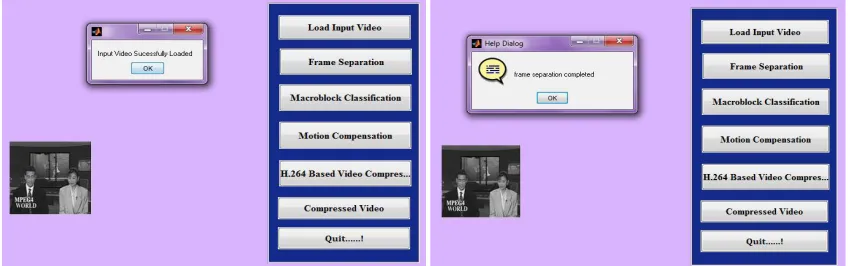
The input video is loaded first as shown in figure 2. When the input video is loaded the next step is frame separation for video loaded is done as shown in figure 3. respectively. The next process is macroblock classification. The classification of each frame is considered according to their bit rate. The motion compensation is as shown in figure 4. Histogram representation for the movement in the video taking place at certain portion as shown in figure 6.H.264/AVC based video compression is taken place as in figure 7 for the total compression of video.
Figure 4.Macroblock classification is carried out Figure 5.Motion compensation for certain frame
Figure 6.Histogram representation for video Figure 7.H.264 video conversion is taken place
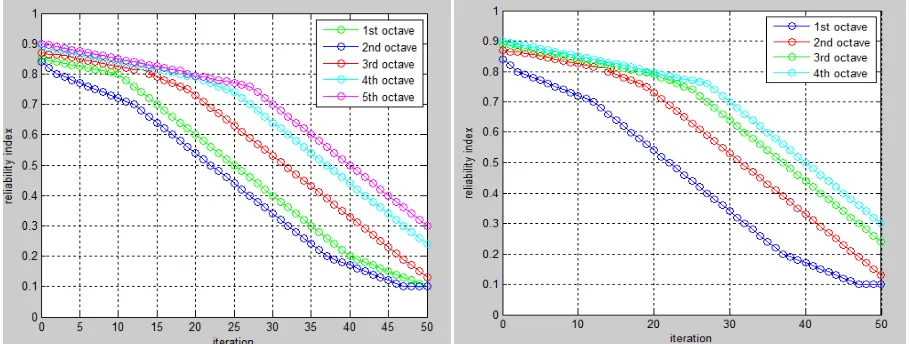
Figure 8. SIFT and SURF feature-matching scores as a function of QP value
VI. CONCLUSION AND FUTURE WORK
The timeliness and importance of this work arises from the recent finalization of the H.265 standard, which will herald the development of a new generation of consumer device video applications. The results and observations made in this paper will act as drivers for the development of QoE driven streaming solutions for H.265 in challenging network scenarios. Future work in this area may take this study further by using the insights gained to design an H.265 decoder that is more robust to packet loss and incorporates error concealment methods. The outputs from this work may also be explored to help shape the design of reduced reference or no reference metrics for H.265.
REFERENCES
[1] H.-M. Hu, B. Li, W.Li, and M.-T. Sun, “Region-based rate control for H.264/AVC for low bit-rate applications,” IEEE Transactions Circuit System Video Technology, vol. 22, no. 11, pp. 1564-1576, Nov. 2012
[2] T. S. Ou, Y.-H. Huang, and H. H. Chen, “SSIM-based perceptual rate control for video coding,” IEEE Transactions Circuits System Video Technology, vol. 21, no. 5, pp. 682-691, May 2011
[3] Z. Wang, A. C. Bovik, H. R. Sheikh, and E. P. Simoncelli, “Image quality assessment: From error visibility to structural similarity,” IEEE Transactions Image Process., vol.13, no. 4, pp. 600-612, Apr. 2004
[4] J.-C. Chiang, C.-S. Hsieh, G. Chang, F.-D. Jou, and W.-N. Lie, “Region-of-interest based rate control scheme with flexible quality on demand,” in Processing IEEE Int. Conf. Multimedia Expo, Jul.2010, pp. 238-242
[5] L. Baroffio, M. Cesana, A. Redondi, M. Tagliasacchi, and S. Tubaro, “Coding visual features extracted from video sequences,” IEEE Trans. Image Processing, vol.23, no. 5, pp.2262-2276, May 2014
[6] M. Makar, C.-L. Chang, D. Chen, and B. Girod, “Compression of image patches for local feature extraction,” in Proc. IEEE Int. Conf. Acoust., Speech, Signal Processing, Taipet, Taiwan, Apr. 2009,pp. 821-824
[7] M. Makar, S. S. Tsai, V. Chandrasekhar, D. Chen, and B. Girod,”Inter-frame coding of canonical patches for low bit-rate mobile
augmented reality,”Int. J. Semantic Computers., vol. 7, no. 1, pp. 5-24, 2013
[8] L. Duan, X. Liu, J. Chen, T. Huang, and W. Gao, “Optimizing JPEG quantization table for low bit rate mobile visual search,” in
Processing Visual Communications Image Processing, San Diego, CA, USA, Nov. 2012, pp. 1-6
[9] J. Chao, H. Chen, and E. Steinbach, “On the design of a novel JPEG quantization table for improved feature detection
performance,” in Processing 20th IEEE International Conference, Image Processing, Melbourne, VIC, Australia, Sep. 2013, pp.
167-1679
[10] J. Chao and E. Steinbach, “SIFT feature-preserving bit allocation for H.264/AVC video compression,” in 19th IEEE International Confernce Image Processing., Oralndo, FL, USA, Sep./Oct. 2012, pp.709-712
BIOGRAPHY
Nandhini R [1] pursuing Master of Engineering (AE) in the Department of Electronics and Communication, Kingston Engineering College, Anna University, Chennai, India. She received her Bachelor of Engineering (ECE) degree in 2014 from Anna University, Chennai, India.
Rajbharath S M M.Tech., [2] is an Assistant Professor in the Department of Electronics and Communication,
Kingston Engineering College, Vellore, Tamil Nadu, India. He received his BE (ECE) degree in 2002 from National Institute of Technology, Surat, India and he received his M.Tech degree in 2005 from bharath University,Chennai,India.