University of Windsor University of Windsor
Scholarship at UWindsor
Scholarship at UWindsor
Electronic Theses and Dissertations Theses, Dissertations, and Major Papers
2009
Heuristic assignment of CPDs for probabilistic inference in
Heuristic assignment of CPDs for probabilistic inference in
junction trees
junction trees
Mirza Tania Nasreen University of Windsor
Follow this and additional works at: https://scholar.uwindsor.ca/etd
Recommended Citation Recommended Citation
Nasreen, Mirza Tania, "Heuristic assignment of CPDs for probabilistic inference in junction trees" (2009). Electronic Theses and Dissertations. 7900.
https://scholar.uwindsor.ca/etd/7900
Heuristic Assignment of CPDs for Probabilistic Inference in
Junction Trees
By
Mirza Tania Nasreen
A Thesis
Submitted to the Faculty of Graduate Studies
Through Computer Science
In Partial Fulfillment of the Requirements for
The Degree of Master of Science at the
University of Windsor.
Windsor, Ontario, Canada
2009
1*1
Library and Archives CanadaPublished Heritage Branch
395 Wellington Street OttawaONK1A0N4 Canada
Bibliotheque et Archives Canada
Direction du
Patrimoine de I'edition
395, rue Wellington OttawaONK1A0N4 Canada
Vour file Votre reference ISBN: 978-0-494-57625-0 Our file Notre r6f6rence ISBN: 978-0-494-57625-0
NOTICE: AVIS:
The author has granted a
non-exclusive license allowing Library and Archives Canada to reproduce, publish, archive, preserve, conserve, communicate to the public by
telecommunication or on the Internet, loan, distribute and sell theses
worldwide, for commercial or non-commercial purposes, in microform, paper, electronic and/or any other formats.
L'auteur a accorde une licence non exclusive permettant a la Bibliotheque et Archives Canada de reproduire, publier, archiver, sauvegarder, conserver, transmettre au public par telecommunication ou par I'lnternet, preter, distribuer et vendre des theses partout dans le monde, a des fins commerciales ou autres, sur support microforme, papier, electronique et/ou autres formats.
The author retains copyright ownership and moral rights in this thesis. Neither the thesis nor substantial extracts from it may be printed or otherwise reproduced without the author's permission.
L'auteur conserve la propriete du droit d'auteur et des droits moraux qui protege cette these. Ni la these ni des extraits substantiels de celle-ci ne doivent etre imprimes ou autrement
reproduits sans son autorisation.
In compliance with the Canadian Privacy Act some supporting forms may have been removed from this thesis.
Conformement a la lot canadienne sur la protection de la vie privee, quelques
formulaires secondaires ont ete enleves de cette these.
While these forms may be included in the document page count, their removal does not represent any loss of content from the thesis.
Bien que ces formulaires aient inclus dans la pagination, il n'y aura aucun contenu manquant.
AUTHOR'S DECLARATION OF ORIGINALITY
I hereby certify that I am the sole author of this thesis and that no part of this
thesis has been published or submitted for publication.
I certify that, to the best of my knowledge, my thesis does not infringe upon
anyone's copyright nor violate any proprietary rights and that any ideas, techniques,
quotations, or any other material from the work of other people included in my thesis,
published or otherwise, are fully acknowledged in accordance with the standard
referencing practices. Furthermore, to the extent that I have included copyrighted
material that surpasses the bounds of fair dealing within the meaning of the Canada
Copyright Act, 1 certify that I have obtained a written permission from the copyright
owner(s) to include such material(s) in my thesis and have included copies of such
copyright clearances to my appendix.
I declare that this is a true copy of my thesis, including any final revisions, as
approved by my thesis committee and the Graduate Studies office, and that this thesis has
ABSTRACT
Many researches have been done for efficient computation of probabilistic queries posed
to Bayesian networks (BN). One of the popular architectures for exact inference on BNs
is the Junction Tree (JT) based architecture. Among all the different architectures
developed, HUG1N is the most efficient JT-based architecture. The Global Propagation
(GP) method used in the HUGIN architecture is arguably one of the best methods for
probabilistic inference in BNs. Before the propagation, initialization is done to obtain the
potential for each cluster in the JT. Then with the GP method, each cluster potential
becomes cluster marginal through passing messages with its neighboring clusters.
Improvements have been proposed by many researchers to make this message
propagation more efficient. Still the GP method can be very slow for dense networks. As
BNs are applied to larger, more complex, and realistic applications, developing more
efficient inference algorithm has become increasingly important. Towards this goal, in
this paper, we present some heuristics for initialization that avoids unnecessary message
passing among clusters of the JT and therefore it improves the performance of the
architecture by passing lesser messages.
Keywords: Artificial intelligence, Bayesian network, Probabilistic inference, Junction
DEDICATION
This thesis is dedicated to my parents who have supported me all the way since
the beginning of my student life.
This thesis is dedicated to the people of my country Bangladesh who have always
dreamt to get a foreign degree but couldn't make it because of not having enough
financial support.
Also, this thesis is dedicated to my husband Muhammad N Hasan who has been a
great source of motivation and inspiration.
Finally, this thesis is dedicated to all my friends who were always there when I
ACKNOWLEDGEMENTS
1 would like to give my sincere gratitude to my supervisor Dr. Dan Wu, for his
excellent supervision, guidance, and encouragement through out this research work.
Without his help and his great patience to me, this work presented here would not have
been possible.
I would also like to thank my internal reader, Dr. Robin Gras and my external
reader, Dr. Xiang Chen for participation as my thesis committee and spending their
precious time to review this thesis and putting down their comments, suggestions on the
thesis work. Their confidence in my abilities has been unwavering, and has helped to
make this thesis a solid work.
I would like to acknowledge my husband Muhammad N Hasan for his patience,
love, support and encouragement. His wisdom and guidance helped me solve many
difficult problems during my research.
Finally, I am very grateful to all my family and friends for being supportive and
TABLE OF CONTENTS
AUTHOR'S DECLARATION OF ORIGINALITY , iii
ABSTRACT iv DEDICATION v ACKNOWLEDGEMENTS vi
TABLE OF CONTENTS vii TABLE OF FIGURES ix LIST OF TABLES x 1. INTRODUCTION 1
1.1 Motivation 4
1.2 Thesis Contribution 7
1.3 Thesis Layout 8
2. BACKGROUND 10
2.1 Reasoning under Uncertainty / Inference 10
2.1.1 Probabilistic inference with Bayesian networks 11
2.1.2 Methods of Probabilistic Inference 11
2.13 Algorithms for Inference using Bayesian network 12
2.2 Bayesian network (BN) 16
2.3 Notations 18
2.4 Junction tree (JT) 18
2.5 Junction tree based Propagation Algorithm 20
2.5.1 Junction tree from Bayesian network 22
2.5.2 Initialization on the Junction tree ...24
2.5.3 Message Propagation on the Junction tree 26
2.6 Message Propagation Schemas 27
2.6.1 HUGIN Architecture 28
2.6.2 Allocate Separator Marginal (ASM) Procedure 30
2.7 Marginality of Clusters 33
3. RELATED WORKS 35 4. PROBLEM SPECIFICATION AND SOLUTION 41
4.1 Limitation of the Existing Method 41
4.1.1 Large Number of Message Passing Required 41
4.2.1 Total Number of Message Passes by HUGIN 46
4.2.2 Total Number of Message Passes by HUGIN with ASM 47
4.2.3 Observations 49
4.2.4 Conclusion 52
4.3 Basis of the Proposed Heuristics 53
4.4 The Proposed Heuristics 57
4.3.1 Proposed Heuristic 1 58
4.3.2 Proposed Heuristic 2 60
4.3.3 Proposed Heuristic 3 63
4.3.4 Complexity Analysis for Proposed Heuristics 65
4.3.5 Passing Lesser Messages for Inference 66
4.4 Conclusion 67
5. IMPLEMENTATION AND EXPERIMENTS 69
5.1 Experimental Setup 69
5.2 Frequency of the Occurrence of the Multiple Assignment Options for a CPD 70
5.3 Comparisons 71
5.3.1 Number of Message Passing Required 72
5.3.2 Number of Operations 73
5.3.3 Execution Time 75
5.4 Conclusion 77
6. CONCLUSION AND FUTURE WORKS 78
TABLE OF FIGURES
FIGURE 2-1 CATEGORIES OF EXACT INFERENCE ALGORITHMS [GH2002] 14 FIGURE 2-2 CATEGORIES OF APPROXIMATE INFERENCE ALGORITHMS [GH2002] 14
FIGURE 2-3 DIFFERENT KINDS OF NETWORKS 15 FIGURE 2-4 A BAYESIAN NETWORK (BN) 17 FIGURE 2-5 (A) A BN. (B) CORRESPONDING JUNCTION TREE 19
FIGURE 2-6 BLOCK DIAGRAM OF JT ALGORITHM 21 FIGURE 2-7 (A) A SIMPLE BN. (B) THE MORAL GRAPH, (C) THE TRIANGULATED GRAPH. 23
FIGURE 2-8 (A) THE BN. (B) CORRESPONDING JT WITH INITIALIZED C P D S 25
FIGURE 2-9 JT WITH INITIALIZED C P D S 26 FIGURE 2-10 SINGLE MESSAGE PASS BY HUGIN ARCHITECTURE 29
FIGURE 2-11 (A) A BN. (B) JT WITH INITIALIZED C P D S 32 FIGURE 4-1 SCENARIO OF A SINGLE MESSAGE PASS 42 FIGURE 4-2 (A) A BN. (B) A JUNCTION TREE CONVERTED FORM THE BN IN (A) 45
FIGURE 4-3 ASM PROCEDURE BEFORE PROPAGATION 48 FIGURE 4-4 ASM PROCEDURE AFTER INFORMED INITIALIZATION 51
FIGURE 4-5 (A) THE BN. (B) CORRESPONDING JT WITH INITIALIZED C P D S 53
FIGURE 4-6 (A) A BN. (B) JUNCTION TREE 55 FIGURE 4-7 SUB TREE OF THE GIVEN BAYESIAN NETWORK IN FIGURE 4 - 6 ( A ) 55
LIST OF TABLES
TABLE 4-1 TOTAL NUMBER OF ARITHMETIC OPERATIONS REQUIRED BY HUGIN 42
TABLE 4-2 MULTIPLE ASSIGNMENTS OPTIONS FOR NODE a AND e 46 TABLE 4-3 SUMMERY OF THE MOTIVATION EXAMPLE PRESENTED IN SECTION 4.2 52
TABLE 4-4 INDEXING OF CLUSTERS BASED ON THEIR NUMBER OF NODES 64 TABLE 5-1 FREQUENCY OF THE OCCURRENCE OF THE MULTIPLE ASSIGNMENT OPTIONS FOR
A C P D 70 TABLE 5-2 COMPARISON OF THE PERFORMANCE IN TERMS OF NUMBERS OF MESSAGES
PASS 72 TABLE 5-3 COMPARISON OF THE PERFORMANCE IN TERMS OF NUMBERS OF OPERATIONS. 74
1. INTRODUCTION
Most of the real-world problem domains are almost always incomplete because not all
the relevant variables and relationships are known. For this reason the models that most
accurately reflect available knowledge are often probabilistic. In the early days of
rule-based programming, the most common methods used variants on probability calculus to
combine certainty factors associated with applicable rules [Go 1961], [HM1989],
[Chi 991]. Although it was recognized that certainty factors did not conform to the
well-established theory of probability and also the probabilistic techniques available at that
time required specifying either an intractable number of parameters, or an unrealistic set
of independence relationships, these probabilistic techniques were nevertheless favored.
Thus real-world domains quite naturally lead to partial dependency graph models that are
probabilistic [Chrl998], [SDLC1993].
'Graphical modeling language for representing uncertain relationships' is the
"breakthrough" for which methods firmly based on probability theory have begun to gain
acceptance in the computer-science and uncertain-reasoning communities. The graphical
representation of probabilistic relationships among events has been the subject of
considerable research [KJ1999], [Je2001]. A primary advantage of using a graphical
representation of probabilistic relationships is the efficiency that results. Belief updating
in dependence graphs has been studied in an axiomatic way within the frame of local
computation in graphical structures, developed by Shafer and Shenoy [SSI988],
[SSI990]. A particular type of probabilistic graphical representation, called Bayesian
Networks (BN) [Pel986a], which is by far one of the most popular probabilistic graphical
models. This knowledge representation has been termed differently in the literature. In
addition to being called bayes-belief net [Pel986a]; they have been termed causal nets
[Go 1961], [Go 1983], causal network [LSI988], probabilistic cause-effect models
[Rol968], probabilistic causal networks [Col984], and influence diagrams [Shal986],
Bayesian Networks (BNs) are currently the dominant uncertainty knowledge
representation and reasoning frame work in artificial intelligence (AI) [GH02]. Many
methodologies have been proposed as the solution for reasoning with uncertainty,
including certainty factor, fuzzy sets, dempster-shafer theory, and probability theory. The
probabilistic approach of Bayesian network is now by far the most popular among all
those alternatives, mainly due to a knowledge representation framework. The success of
BNs relies on its capability of acquiring and representing conditional independency. The
representation rigorously describes these relationships, yet includes a human-oriented
qualitative structure that facilitates communication between a user and a system
incorporating the probabilistic model.
Probabilistic inference with BN is the task of computing the posterior probability
distribution of each value of a node in BNs when values of other variables are known. A
typical application of probabilistic inference involves constructing a probabilistic model,
such as a BN, and then applying algorithms to the model to compute answers to
probabilistic queries. Probabilistic queries are answers that are augmented with
probabilistic estimates of the validity of the answers. Probabilistic answers to queries
over uncertain data have been well studied in the literature [BH1986], [ChG1989].
[Col990]. There are two kinds of probabilistic inference presented in the literature.
'Exact inference' means computing the exact posterior probability distribution and
'Approximate inference' produces an inexact, but within small distance of the correct
answer. Many researches have been done for efficient computation of exact probabilistic
queries posed to BNs [LiD1994], [ZP1994], [Nel990], [Ne2003]. One of the well known
techniques for exact inference for multiply connected BNs is clustering [ZY1998],
[Le2000]. Among many inference algorithms, the most popular and commonly used
exact BN inference algorithm is the Jensen's version [JLO1990] of the Lauritzen and
Spiegelhalter's clique-tree propagation algorithm [LSI988]. In this algorithm, a BN is
first converted into a secondary structure (called join tree or junction tree) and
computations are done on that junction tree (JT) for probabilistic inference. The key step
of the JT. There are two main architectures for propagating messages in a JT: the
Shenoy-Shafer architecture [SS1986] and the HUGIN [JLO1990], [AOJJ1989] architecture.
Among all the well known architectures implementing the idea for propagating
messages on JT, HUGIN architecture is probably one of the most efficient architectures
in the field of uncertain reasoning [ParDar2003], [SalJ1997]. This architecture allows
propagation of messages through the clusters of the JT. This message propagation is
termed as the global propagation (GP) method by many researchers [SAS1994] [Hdar96],
as this architecture performs probabilistic inference by propagating local information but
maintaining the global properties (i.e. probability density over all the variables) of the
original BN. Among various algorithms developed, the GP method used in the HUGIN
architecture for performing message passing is well received and implemented [LSI988],
[JLO1990], [LeShl998]. This propagation method of HUGIN works efficiently in terms
of inference under uncertainty, but its performance degrades quickly for dense networks
[PPGH1994]. Its complexity is exponential in the size of the largest cluster of the
junction tree [Dar2003]. Thus, computationally exact inference can be extremely
expensive.
HUGIN architecture consists of four sequential steps: (1) transforming the BN
into JT, (2) initialization on the JT, (3) propagating potentials on the JT, and (4)
answering queries. Efficiency of the HUGIN architecture largely depends on the GP
method [ParDar2003], [Dar2003]. In order to improve the efficiency of the HUGIN
architecture, many modifications on the HUGIN architecture have been done by
researchers [Dawl992], [SchS1998], [ParDar2003], [BZKPC2006]. All those existing
modifications for faster inference mostly focus on the efficiency of the propagation
phase. And in those works the initialization phase follows the same classical approach
used in the HUGIN architecture. As the initialization is concerned with the formation of
cluster potentials which are the main participants later in GP, this phase has a potentially
significant impact on the subsequent propagation phase which consists of a lot of
message passing. Thus, the improvement of the initialization can possibly also improve
Recently, by utilizing the semantic meaning of message propagation, Wu and Jin
[WuJ2006] were able to propagate lesser number of messages that needed to be passed by
HUG1N. Based on the appropriate initialization of the cluster potentials, the number of
message passing can be lowered and the performance of the propagation method can be
improved further by passing even lesser messages on the JT. Along with that, appropriate
assignment of the cluster potentials will requires less computation by avoiding
unnecessary messages exchange. This will eventually increase the computational
efficiency of the algorithm and will lead towards faster inference. Towards the goal of
faster inference, in this thesis, we present new heuristics for initialization that avoids
unnecessary message passing between clusters of the JT, therefore it improves the
performance of the architecture by passing lesser messages than the classical HUGIN
approach and the Wu and Jin's method as well.
In the following, the motivation of the thesis is first presented, after that the
contribution of the thesis is highlighted, and the structures of the remaining chapters are
outlined.
1.1 Motivation
Why bother with Uncertainty?
An observation is a piece of knowledge about the exact state of the world.
However, we usually do not have complete knowledge about the state of the world.
Uncertainty is the lack of certainty, 'A state of having limited knowledge', where it is
impossible to exactly describe existing state or future outcome, more than one possible
outcome. Uncertainty arises in a variety of situations when our knowledge of the world is
incomplete because of
• not having enough information,
• having unreliable information,
But to act in spite of this, we need to draw conclusions under uncertainty. Because
of the incomplete information, the models that most accurately reflect available
knowledge are often probabilistic. That is why 'reasoning with uncertain knowledge' and
'belief have long been recognized as important research areas in artificial intelligence
[Pel988], [Nel990], [Wal991], [ShPel998].
Why Bayesian network?
Bayesian network (BN) is a graphical model that encodes probabilistic
relationships among variables of interest. When used in conjunction with statistical
techniques, the graphical model of BNs has several advantages for data analysis. One,
because the model encodes dependencies among all variables, it readily handles
situations where some data entries are missing. Two, a BN can be used to learn causal
relationships, and hence can be used to gain understanding about a problem domain and
to predict the consequences of intervention. Three, because the model has both a causal
and probabilistic semantics, it is an ideal representation for combining prior knowledge
(which often comes in causal form) and data. Four, Bayesian statistical methods in
conjunction with BNs offer an efficient and principled approach for avoiding the over
fitting of data. That is why BNs are becoming an increasingly important area for research
and application in the entire field of artificial intelligence especially for reasoning under
uncertainty [Pel988], [LiD1994], [ZP1994], [Ne2003]. A BN is a compact model
representation for reasoning under uncertainty. The compactness and efficiency of BN
models have been exploited to develop efficient algorithms for solving queries that
require complex multi-factor analysis, such as:
What position should a commodity trader take on frozen concentrated orange
juice futures based on weather forecast predictions regarding the upcoming
crop?.,
or
What is the probability that a person applying for a loan will repay this loan
Although there exists polynomial time inference algorithms for specific classes of
BNs, i.e., trees and singly connected networks, in general both exact belief update and
belief revision are hard [Col997]. Furthermore, approximations of them are also
NP-hard [DL1993]. Given the NP-NP-hard complexity results, one of the major challenges in
applying BNs into real-world applications is the design of efficient inference algorithms
working under time constraints for large probabilistic models [GH2002]. As
real-world BNs continue to grow larger and more complex, research efforts should be made
towards investigating the possibilities to improve the performance of existing algorithms
of probabilistic inference.
Why HUGIN?
Among many architectures that have been proposed for exact inference in the
uncertain reasoning literature, junction-tree based architectures [LS1988], [J1988],
[JLO1990] are the pioneer ones. Among all the architectures for propagating or passing
messages on junction trees (JT), HUGIN architecture [LSI988], [JLO1990] is the most
computationally efficient architecture for inferencing with Bayesian networks
[LeShl998], [GH2002]. Also Dawid [Dawl992] and Cowell [CD1992] showed that
HUGIN architecture certainly has a generalization beyond standard probability
calculation. That is why it has been considered as one of the pioneer architectures for
message propagation on JT in the uncertain reasoning literature.
The computational cost of the JT based algorithms is in fact the cost of
performing the message propagation in that tree, i.e. the efficiency of the algorithm
largely depends on the efficiency of the propagation method [ParDar2003], [Dar2003].
Before the propagation method, initialization is done to compute the cluster potential of
the clusters of the JT. Then, with the propagation method, each cluster potential becomes
cluster marginal. In order to improve the efficiency of the JT based algorithm, many
modifications on the HUGIN architecture have been done by researchers [Dawl992],
[SchS1998], [ParDar2003], [BZKPC2006]. By utilizing the semantic meaning of the
message passed, recently Wu and Jin [ WuJ2006] proved to avoid at most half number of
for faster inference mostly focus on the efficiency of the propagation phase. And in those
works the initialization phase follows the same classical approach used in the HUGIN
architecture. But from our observation, as the initialization phase is concerned with the
formation of cluster potentials and those potentials actively participate in the propagation
phase through message passing, this initialization phase has a potentially significant
impact on the subsequent propagation phase to obtain the marginal probabilities of
clusters. Thus, the improvement of the initialization can possibly also improve the
performance of the GP method of HUGIN architecture. This presents both challenge and
opportunity to develop efficient initialization heuristic that can lead towards better
propagation and faster inference.
1.2 Thesis Contribution
This thesis is mainly concerned about improving the performance of the propagation
method of the HUGIN architecture for exact inference using Bayesian network. The
contributions of this thesis are as follows:
The primary contribution of this thesis is that we have developed new heuristics
for initialization of a cluster of JT of the renowned HUGIN architecture. From our
observations and experiments, we reveal that HUGIN do not need to pass huge number of
messages to achieve the marginality of the variables of a cluster. Marginality of clusters
is dependent upon the CPDs of that cluster, and with the initialization phase CPDs are
assigned to a cluster to form cluster potentials and therefore appropriate assignment of
CPDs during the initialization phase will have a significant impact for calculation of
marginality of clusters. Thus by informed initialization, our heuristics avoid unnecessary
information exchange between clusters of the JT to achieve marginality which leads
towards faster inference. Experimental results, carried out with all possible different data
demonstrate that our heuristics can reduce the number of messages and time required to
The second important contribution of this thesis is that, with the informed
initialization heuristics, we have implemented the 'allocate separator marginals' (ASM)
procedure proposed by Wu and Jin [WuJ2006]. Applying ASM before the propagation
phase Wu and Jin had already proved to save at most half of the message passing than
HUGIN. With this procedure, towards the goal of faster inference, our presented
heuristics for initialization passes even lesser messages than using only ASM [WuJ2006]
procedure in HUGIN and improves the performance of the HUGIN architecture more.
At the end of our research, we have compared our heuristics with HUGIN
architecture and ASM procedure, to find out the performance of HUGIN architecture
with our proposed heuristics for initialization. The comparison is done in terms of time of
initialization and propagation; number of message passing required, and number of
operation needed for initialization. The experimental results obtained through this
application indicate the effectiveness of our heuristics to improve the performance of the
HUGIN architecture.
1.3 Thesis Layout
This thesis is organized as follows:
Chapter 2: Background: This chapter provides an introduction to the area that the
proposed method builds upon. After giving the idea of reasoning under uncertainty and
Bayesian network, the architecture of the junction tree based algorithms for exact
inference on BN's is briefly explained. For this thesis, we focused on the HUGIN
architecture and ASM approach [WuJ2006], for message propagations and therefore
these two methods are explained in details in this chapter. Among all the steps injunction
tree based algorithm, the initialization phase is specially emphasized, as this is the core
Chapter 3: Related Works: This chapter gives brief history of junction tree based
algorithms. Among all the different architectures, researches done with HUGIN
architecture have only been highlighted in this chapter.
Chapter 4: Proposed Approach: The proposed heuristics for efficient initialization are
presented in details in this chapter. After defining the limitations with the conventional
HUGIN architecture, the proposed heuristics are described briefly with a motivative
example.
Chapter 5: Implementation and Experiment: The details of all the implementations
and experiments with results are presented in this chapter. Finally, these results are
compared with the HUGIN architecture and the ASM procedure and the evaluations are
obtained.
Chapter 6: Conclusion and Future Works: This final chapter highlights our
2. BACKGROUND
This chapter provides the background knowledge of which the proposed heuristics are
based on. After explaining the idea of reasoning under uncertainty, brief notation and
definition of Bayesian network and its probabilistic model to represent the reasoning
under uncertainty are provided. After giving the general idea of junction tree based
algorithms for Bayesian network, one of the most important propagation architecture for
exact inference with Bayesian networks namely HUGIN is explained (in step by step
manner). As an improvement on HUGIN, the allocate separator marginal (ASM)
procedure for lesser message propagation in JT is also explained, as these two are the
core area on which our proposed heuristics are built and proved.
2.1 Reasoning under Uncertainty / Inference
Reasoning is the cognitive process of looking for reasons for beliefs, conclusions or
actions. An observation is a piece of knowledge about the exact state of the world.
However, we usually do not have complete knowledge about the state of the world. There
are some things we do not know for certain. When we make observations, or in some
other way obtain additional knowledge about the state of the world, we use this
knowledge to update our belief about the state of the world. This is a typical example of
reasoning under uncertainty.
Inference means "computing the answer for particular queries about the domain".
It is the act or process of deriving a conclusion based solely on what one already knows.
Bayesian Networks (BNs) are currently the dominant uncertainty knowledge
2.1.1 Probabilistic inference with Bayesian networks
Probabilistic inference is an area of artificial intelligence that applies probability theory to
inform the decision-making process in the presence of uncertainty. A typical application
of probabilistic inference involves constructing a probabilistic model, such as a Bayesian
network, and then applying algorithms to the model to compute answers to probabilistic
queries. Probabilistic inference consists of computing probabilities that are not explicitly
stored by the reasoning system, such as computing marginal and conditional probabilities
from the joint probability distribution.
A BN can be considered as a probabilistic expert system in which the
probabilistic knowledge base is represented by the topology of the network and the
conditional probability distributions (CPDs) at each node. The main purpose of building a
knowledge base is to use it for inference, i.e. computing the answer for particular queries
about the domain. 'Probabilistic inference' or 'Belief updating' is one of the major tasks
of BN inference. Probabilistic inference with BN is the task of computing the probability
of each value of a node in BNs when other values are known.
2.1.2 Methods of Probabilistic Inference
Within BN there are two kinds of probabilistic inference presented in the literature:
'Exact inference' and 'Approximate inference'.
Exact inference means computing the exact posterior probability distribution.
Exact inference is possible with singly connected network (polytree) and also with
multiply connected network where it has to turn into an equivalent singly connected
network (clustering is one of the ways to do so [AOJJ1989], [JOA1990], [JLO1990],
[LeShl998]). Its complexity depends on the network type, for example, singly connected
network can be efficiently solved than multiply connected network. Researchers
Approximate inference produces an inexact, bounded solution, but guarantees
that the exact solution is within those bounds, i.e. not exact, but within small distance of
the correct answer.
Both exact and approximate inference can be performed on Bayesian network.
Efficient computation of probabilistic queries posed on Bayesian networks has been one
of the major concerns in the research area of Bayesian network [Pel988], [LiD1994],
[ZP1994], [Nel990], [Ne2003]. All networks rely on inference algorithms to compute
beliefs in the context of observed evidence.
2.1.3 Algorithms for Inference using Bayesian network
The algorithms for inference using BN can be categorized in terms of
• Type of representation of BN (conditioning, variable eliminations, tree clustering)
• Type of inference (exact and approximate) and
• Type of network connections (single and multiple).
2.1.3.1 Type of Representation of BN
Based of the representation type, the algorithms for inference using BN are
divided into three classes.
The first class of algorithms is 'conditioning algorithms', as these algorithms are
based on the notation of conditioning, or case analysis. The basic idea is when the value
of a network variable is observed, the topology of the network can be simplified by
deleting edges that are outgoing from that variable. To improve conditioning algorithm,
researchers attempted to reduce the network into a tree structure and make it tractable.
This is named as cutset conditioning [Pel988]. Conditioning algorithms like dynamic
conditioning [Darl995], recursive conditioning [Dar2001] attempt to decompose the
Based on the notion of 'variable elimination' [ZP1994], the second class of
algorithms for inference in Bayesian networks is defined. Variable elimination computes
the marginal probability for some specified set of variables in a network. It eliminates (by
integration or summation) the non-observed and non-query variables one by one by
distributing the sum over the JPD, while maintaining the ability of the model to answer
queries of interest. Many researches [SP1990], [Decl996], [ZP1996], [Coz2000] have
been done to reduce the complexity of the algorithm by reducing the amount of work it
takes to eliminate a variable, and modifying the order in which variables are eliminated.
The third class of algorithms for inference in Bayesian networks is based on the
notion of 'tree clustering' where the original Bayesian network is first converted into a
cluster tree structure, known as a join tree or junction tree, and then tree-based inference
is performed on the resulting junction tree. This class of algorithms gives more
tractability of inference with respect to tree structures [SS1986], [Pel986a], [JLO1990].
Using this class many variables can be queried at one time and new evidence can be
propagated quickly.
2.1.3.2 Type of Inference
Among the three classes of algorithms stated in the previous sub-section, the most
common 'exact inference' methods are variable eliminations, cluster tree propagations
and recursive conditioning. One of the most popular exact inference algorithms is the
junction tree or clustering algorithm [LS1988], [JLO1990]. Neapolitan [Ne2003]
provides a discussion on many Bayesian propagation algorithms. Although Cooper
[Co 1987] showed that "exact belief propagation in Bayesian networks can be NP-hard",
exact computation is practical for many problems of practical interest. Other exact
methods include cutset conditioning [Pel986b], [Pel988], [SP1991] and symbolic
probabilistic inference (SPI) [DAml990], [ShaD1990], etc. There exists many other
classes of exact inference algorithms. Figure 2-1 illustrates the categories for exact BN
Polytree Algorithm
Clustering
Conditioning
Arc Reversal
Elimination
Symbolic
Differential Method
Figure 2-1 Categories of Exact Inference Algorithms [GH2002].
Some complex applications are too challenging for exact inference, and require
approximate solutions. Though Dagum and Luby [DL1993] proved that approximating
probabilistic inference in BNs is NP-hard, many computationally efficient inference
algorithms have been developed for approximate inference [DY2003], [FF1994],
[Hen 1988]. Categories for approximate algorithms are shown in figure 2-2.
Stochastic Sampling
Model Simplification
Search-based
Loopy Propagation
Probabilistic logic sampling is the first and simplest forward sampling algorithm
for approximate inference, developed by Henrion [Henl988]. Other algorithms include
likelihood weighting [SP1990], backward sampling [FF1994], adaptive importance
sampling [CheD2000], and approximate posterior importance sampling [DY2003]. A
review of approximate methods can be found in [DH1993].
2.1.3.3 Type of Networks
©
of
x
©
Singly connected network Multiply connected network
Figure 2-3 Different kinds of networks.
Figure 2-3 shows two types of networks on which the message passing schema of
JT based algorithms varies. When the network is singly connected (i.e. at most one
distinct directed path between any two nodes), Kim and Pearl [KP1983] gives a
conceptually simple scheme for passing messages along links between nodes in the
causal probabilistic network. Unfortunately, not all real world problems can be modeled
as a singly connected network, and a multiply connected network (i.e. more than one path
between any two nodes may exist) is required in order to catch the facets of the domain.
Several schemes are proposed in the literature such as reasoning by assumption
[Pel986b], value preserving arc-reversing [Shal986], cut-set conditioning [Pel988] and
bucket elimination [Decl996]. These algorithms allow the impact of evidence about one
node to propagate to other nodes in multiply-connected trees which make Bayesian
For more information about the algorithms of BNs, the prospective reader can
find comprehensive coverage in a large and growing literature, such as [Pel988],
[Nel990], [Ne2003], [Chl991], [Jel996], [Je2001], or [KN2003].
2.2 Bayesian network (BN)
Informally, a Bayesian network consists of a graphical structure, i.e. a directed acyclic
graph (DAG) representing conditional independencies and a set of conditional probability
distributions (CPDs), whose product yields a joint probability distribution (JPD).
Traditionally, a Bayesian network (BN) defined over a set U = {x,,...,x„} of
variables is a directed acyclic graph (DAG) augmented with a set of conditional
probability distributions (CPDs). More precisely, each variable x, in U is represented as
a node in the DAG and is associated with a CPD p(xi | Fx) and where Fx denotes
parents (also called Family) of node x, in the DAG of the BN.
The numerical component of BNs is a set of CPDs i.e. for each variable x, e U,
there exists a conditional probability distribution (CPD) p(xt \FX), where Fx, denotes
parents (also called Family) of node x, in the DAG of the BN. These CPDs in BN will
participate in the local computation for probabilistic inference. The product of the CPDs
in a BN defines joint probability distributions (JPD) for that BN as:
n
p(U) = p(xt,..., x„) = Yl P(x, I FXi),
where n is the total number of nodes present in the BN and p(xi \ Fx) is the CPD for
variable x, (x eU) in the BN. We also call this factorization (in terms of CPDs) a
Bayesian factorization. A Bayesian factorization can be considered as a JPD being
Example of Bayesian Network:
p(a) Pid\ a)
p(b\a) p(c\b,d)
Figure 2-4 A Bayesian network (BN).
Figure 2-4 shows an example of a Bayesian network with 4 nodes U = {a,b,c,d},
where each node is associated with a CPD to form the numerical component of the BN.
For example, CPD for node a is p(a) and for node c is p(c\ b,d), as node b and d
are the parents (family) of node c. So the JPD for the BN presented in figure 2-4 will be:
p(abcd) = p(a).p(b \ a).p{c | b,d).p(d | a).
Application of Bayesian networks:
Bayesian networks provide "an overarching graphical framework" that brings together
diverse elements of AI and increases the range of its likely applications to the real world.
One of the most important features of Bayesian networks is the fact that they provide an
elegant mathematical structure for modeling complicated relationships among random
variables while keeping a relatively simple visualization of these relationships. Because
of this feature, BN has been successfully applied to create consistent probabilistic
representations of uncertain knowledge in diverse fields such as medical diagnosis
[SFB1989], image recognition [BH1986], language understanding [ChG1989], search
algorithms [KM 1989], and many others. Heckerman [HMW1995] and Chrisman
[Chrl996] provides a detailed list of recent applications and research areas of Bayesian
2.3 Notations
In this thesis, we use upper case letters (U,V,W) to represent a set of discrete variables
and lower case letters (x,y,z) to represent one discrete variable. p(x\Fx) is used to
represent conditional probability distribution (CPD) of x given Fx, where Fx denotes
parents (also called Family) of a node. p(U) is used to represent joint probability
distribution (JPD) for a set of variable C/ = {x,,...,x„}. A potential (non negative
function) over a set of variables U is denoted by <$v .
Each node of a BN represents a variable in the directed acyclic graph of BN and
thus the terms nodes and variables are often used interchangeably.
2.4 Junction tree (JT)
In graph theory, tree decomposition is a mapping of a graph into a tree that can be used to
speed up solving certain problems on the original graph. In machine learning, tree
decompositions are also called junction trees, cluster trees, or join trees [SalJ97],
[SchS98].
A junction tree (or join tree) (JT) is an undirected tree constructed from a BN
[HDarl996] whose nodes are clusters (also called cliques) of variables (from the original
BN). A cluster is a maximal subgraph of the BN. Given two clusters injunction tree (JT),
C, and Cj, every node on the path between them contains their intersection(Ci n C.). A
Separator S(. in JT is associated with each edge and contains the variables in the
intersection between neighbouring nodes. A JT must satisfy the following three
properties.
Junction tree properties:
(2) Each network variable x and its parents Fx (family of x) must appear together in
at least one cluster C,;
(3) For each pair of clusters (C, andCV) in JT that containx, all clusters on the path
between C, and C. must contain x, (this property ensures that evidence
propagate correctly; also because of this property a cluster tree becomes a
junction tree. This property is known as running intersection property).
Example Junction tree:
(a)
p{a)
P(b\a)( b
p(d | bj
c V(c|fl)
GMD
p(e | c, d)(b)
( a, b, c V .
Sn
b.c -f b, c, d \ _
C2
^ 2 3
c.d~h
c, d, e jC3
Figure 2-5 (a) A BN. (b) Corresponding Junction tree.
Figure 2-5(b) shows an example of a junction tree with 3 clusters and 5 nodes
from the BN shown in figure 2-5(a), where the oval shape boxes represent the clusters of
the junction tree and the rectangle boxes represent the separators. Each clusters contains 3
edge connecting the two nodes contains the separator (common nodes) of the neighboring
clusters. For example, the edge between the two neighboring clusters, Cl = {a,b,c} and
C2 ={b,c,d) contains the separatorSn = (C, r\C2) = {b,c}. If we consider the
properties of JT, this example satisfies all of them.
In JT based algorithms, each cluster of a junction tree is associated with CPDs of
nodes from the original BN and by multiplying these CPDs of a particular cluster we get
the potential defined over the cluster or its subset. The next section addresses conversion
of the conditional probability distributions of a BN into potentials in a junction tree
model and how to perform belief updating (refers to the computation carried out to
update the belief before any observation is made i.e. prior belief to posterior belief i.e.
belief after the observation) by passing potentials as concise messages in a junction tree.
2.5 Junction tree based Propagation Algorithm
A probabilistic expert system (PES) provides an efficient method for specifying and
handling the joint probability distribution of finite random variables [LS1988]. Such a
PES is typically specified as probabilistic network, relating properties of conditional
independence among the variables to a DAG with vertex set. A process of compilation,
involving various specialized manipulations (moralization, triangulation, etc.) is then
performed on this structure in order to render it amenable to the application of simple
algorithms [LS1988]. The overall effect of compilation is to produce a new, higher-level
BeliefNetwork
Graphical ^ Transformation
Join/Junction Tree Structure
• Moralization
Triangulation
Initialization
Inconsistent Join Tree
Global Propagation
Consistent Join Tree
Marginalization
Probability of Interest
Figure 2-6 Block Diagram of JT Algorithm.
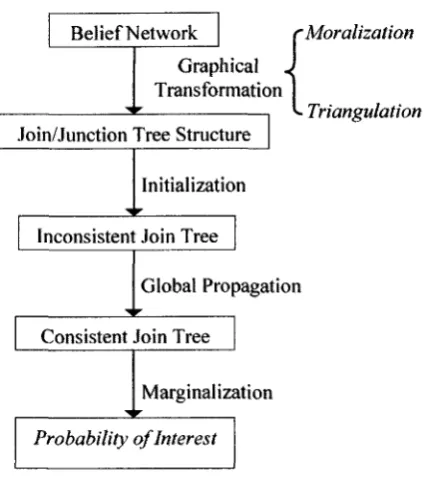
Figure 2.6 shows the block diagram of the JT algorithms. The first step of this
algorithm is to construct the JT from the original Bayesian network. The premises
underlying the construction of JT is that, while the overall problem is too large for
calculating and updating probabilities, the individual clusters are of manageable size. The
general idea behind this is that because of the representation, the propagation of evidence
through the network can be carried out more efficiently. JT based propagation algorithm
is also referred to as the fastest algorithm for most applications in the literature [Chl991].
JT based propagation algorithm consists of four steps: (1) transforming a BN into
a junction tree, (2) initializing the clusters of the JT to from cluster potential, (3)
propagating potentials in the network, and (4) answering a query. These steps are
2.5.1 Junction tree from Bayesian network
1. Moralization
In the moralization step, a directed acyclic graph (or DAG) is converted into an
undirected graph, so a uniform treatment of directed and undirected graphs is possible. A
moral graph is obtained by linking the parents of each node and dropping the
directionality of the edges in DAG.
2. Triangulation
The triangulation step determines the "elimination" order of the graph.
Triangulation means looking at the undirected graph for cycles from a variable to itself
going through a sequence of other variables. Triangulating a graph means there should be
no cycle in that graph with length greater than three. It is done by adding undirected
edges so that there are no such cycles. Triangulation is essential to producing clusters of
variables that are trees. Finding the "best" triangulation is NP-hard [MR2006].
3. Construct the junction tree
Given a triangulated graph, a junction tree is constructed by forming a maximal
spanning tree (a tree of a connected graph composed of maximal set of edges but contains
no cycle) from the clusters in that triangulated graph. A cluster tree (is a tree where nodes
are cluster and there is a single path between every pair of clusters) is constructed with
separators. A cluster tree is a junction tree if and only if it has the running intersection
property of the junction tree properties.
fd) Sl2
\ s I \~s T V_^ -j
Figure 2-7 (a) A simple BN. (b) The Moral Graph, (c) The Triangulated Graph.
(d) JT is constructed.
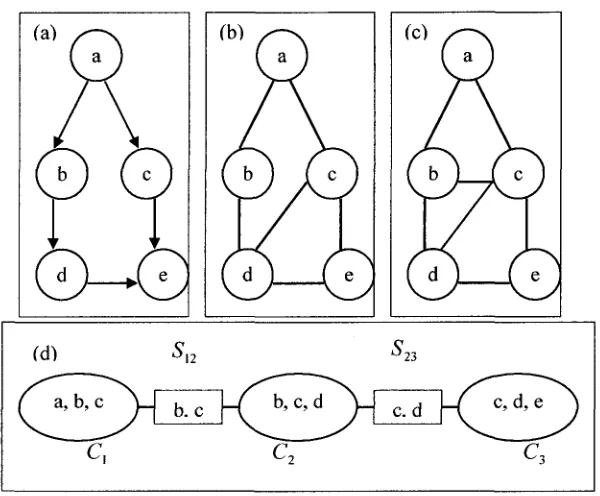
Figure 2-7 shows all the steps of construction of the JT from a simple BN i.e.
figure 2-7(a). As of first step, during the moralization shown in figure 2-7(b), the BN is
first converted into an undirected graph (by removing arrow heads) and then the parents
of node e is joined as they are not joined before. The next step is triangulation which is a
representation based on a number of maximally connected subgraphs (figure 2-7(c)),
which formed the basis of the local representation, and are connected such that the global
properties (parent-child relationships and the potential of the BN) are preserved.
After the triangulation is done, clusters are formed as
C, =(a,b,c),
C2=(b,c,d),
C3 = (c,d,e).
The ordering of edges is achieved by considering their position in the original DAG,
cluster and connects this to the predecessor cluster which shares the largest number of
common nodes and so on. If two clusters share some variables, then the edge connecting
them carries that variable, called separator. Hence the JT is formed as in figure 2-7(d).
After the construction of the DAG, each cluster in this representation is associated
with a cluster potential and this step is known as initialization in the JT algorithm.
2.5.2 Initialization on the Junction tree
After the JT is built, the initialization phase of the HUGIN architecture sets up the initial
potentials for the clusters of the JT. In particular, the CPD of each node from the original
BN is assigned to a cluster that possesses the node itself and its parents. Then, within
each cluster, these CPDs assigned are multiplied together to form one single potential for
the cluster i.e. the set of CPDs p(x | Fx) associated with a cluster C, are in standard JT
architectures combined to form the initial cluster potential <I>, as:
The potentials of separators are initialized to unity.
The initialization step proceeds as follows [HDarl996]:
• For each separator Si, assign potential with values equal to 1: Ons7 <- 1.
• For each random variable x in U, perform the following:
o Assign to a cluster C, that contains x and family of x; call Ft (also call
the parent ofx). The potential of the cluster will be:
OT<-^f''.p(.x\F
x).
o If x and Fx is a subset of two or more clusters, then arbitrarily assign the
CPD ofx, i.e. p(x | Fx)to one of the clusters.
EXAMPLE of Initialization in JT:
p(h) p{c I h) p{t | c)
C,
c,h
pic | h).pih)
C-,
t,c
(a) (b)
Figure 2-8 (a) The BN. (b) Corresponding JT with initialized CPDs.
Figure 2-8 (a) shows a simple BN and the corresponding JT for this BN is
presented in figure 2-8 (b). The JPD of the given BN is:
pic,h,t) = pic | h).pih).pit | c). (1)
In the JT, each cluster {C^C2} has two nodes from the original BN i.e.
C, = {c,h} and C2 = {t,c}, and the edge between them contains the common node of the
two clusters i.e. Su = {c}. According to initialization procedure, CPD for node h, i.e.
pih) is assigned to cluster C, where it is itself present and CPD for node c i.e. pic \ h)
is also assigned to cluster C, as the node itself and its parent (i.e. node h from the
original BN in figure 2-8(a)) both are present in cluster C,. Following the same
procedure CPD for node / i.e. pit \ c) is assigned to cluster C2. So the potentials for
cluster C, and C2 are
<J>, <- pic | h).pih) and
<D2 < - / ? ( c / | c ) .
And the potential for the separator Sn is assigned to 1, i.e. 012 <—1 . The joint probability distribution over all the variables is simply the product of cluster potentials,
i.e.
which is exactly the global property i.e. JPD which is obtained (equation (1)) from the
original Bayesian network given in figure 2-8(a).
After the initialization step, message propagation step transforms the cluster
potentials into cluster marginals. One of the prime applications of the propagation
algorithms in Bayesian networks is to evaluate marginal distributions of variables,
perhaps conditional on values (evidence, findings) of some other variables in the
network.
2.5.3 Message Propagation on the Junction tree
A cluster from which propagation starts is called as root cluster. The JT based algorithm
can be regarded as proceeding by the propagation of messages through the junction tree,
involving only two adjacent edges. The core step is message propagation which consists
of two phases of operation. Computations are done by each cluster and by each separator
in the junction tree [LeShl998] where each cluster and each separator in the junction tree
stores a potential. At all times the joint potential is equal to the product of the potentials
at the clusters divided by the product of the potentials at the separators. The basic
operation for message propagation between clusters in a JT is called absorption.
c,
(
a
V
v y
p(c | h).p(h)
Sn
c
1
c,
- r i o
pit | c)
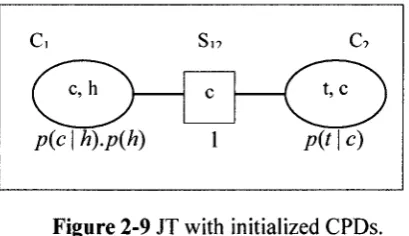
Figure 2-9 JT with initialized CPDs.
For example, in figure 2-9, the cluster C2 absorbs from the cluster C, as follows:
The potential p(c \ h).p(h) at C, is reduced (through the marginal operation) to a
which updates its own potential to the product/?(/1 c).p{c). Note that, before the
absorption, neither p(c) nor p{t) can be obtained at the cluster C2. However, after the
absorption, both of them can be computed locally atC2.
With the propagation phases the junction becomes consistent with each cluster
containing the joint probability distribution for the variables it contains. In JT based
probabilistic model, we make inferences by computing the marginal of the joint
probability distribution for the variables of interest.
2.6 Message Propagation Schemas
A message propagation scheme is used to compute the marginals. Queries can then be
answered very fast. By using junction trees as the computational structure, in the
uncertain reasoning literature, there are three well known architectures for message
passing on the junction tree. They are:
o The Shenoy-Shafer Architecture [SS1990],
o The Lauritzen-Spiegelhalter Architecture [LSI988],
o The HUG1N Architecture [JOL1990].
Each of these architectures has a junction tree as underlying computational
structure. There is no big difference between the Lauritzen-Spiegelhalter Architecture
and the HUGIN Architecture. On the other hand, Lauritzen-Spiegelhalter showed that
HUGIN is more computationally efficient than Lauritzen-Spiegelhalter's architecture
[LeShl998]. Thus the HUGIN and Shenoy-Shafer architectures are the two variations for
message passing on the junction tree based algorithm, which exhibit different tradeoffs
with respect to efficiency and query answering power. Lauritzen et al. [LSI988] and
Jensen [JLO1990] described HUGIN as one of the efficient inference engine for
computing posterior probability based on observed evidence. Park and Darwiche
[ParDar2003] also claimed that HUGIN architecture is more time-efficient than the
In order to improve the efficiency of the HUGIN architecture, many modifications
have been done by researchers [Dawl992], [SchS1998], [ParDar2003], [BZKPC2006].
Recently, by utilizing the semantic meaning of message passing, with allocate separator
marginal (ASM) procedure; Wu and Jin [WuJ2006] were able to pass much lesser
number of messages than that of by HUGIN. They investigated the message passed
algebraically, and by using the semantics of the messages they revealed that the messages
passed are not mere potentials, but in fact separator marginals or factors in their
factorizations.
For this thesis, we have taken HUGIN architecture as our basis to improve the
performance of the junction tree based propagation algorithms, as this architecture is
considered as the efficient architecture for computing belief in JT. As ASM procedure
improves the performance of HUGIN architecture by lowering the number of message
passing required by HUGIN, HUGIN architecture and ASM procedure are the grounds
on which this thesis is focused. These two approaches are explained in the following
subsections.
2.6.1 HUGIN Architecture
After the construction of the JT and initialization phase, in the HUGIN architecture each
separator holds a single potential over the separator variables which initially is a unity
potential. During propagation phase the separator and cluster potentials are updated.
The HUGIN architecture performs probabilistic inference by passing messages
around JT and propagating the global effects of local information. Because the clusters
share nodes with its neighbors, consistent probability measures must be obtained. Thus
global properties (for example, JPD of the original BN) are preserved while computation
can proceed on local subgraphs (i.e. clusters of JT). Thus the propagation method for
(GP) method [SAS1994], [HDarl996]. The GP method used in the HUGIN architecture
is arguably one of the best methods for probabilistic inference in Bayesian networks
[HDarl996].
Then the GP method begins by choosing an arbitrary cluster as root. A root
cluster is the one with which propagation starts. A JT with n clusters performs 2 x (n -1)
message passes starting from the leaves, divided into two phases. When a cluster receives
messages from all its neighbors except that one towards the root, it is allowed to send a
message upwards, and so on until the root cluster has received messages from all its
neighbors. This is called the COLLECT-EVIDENCE. Now the root cluster sends a
message to all its neighbors, and every cluster receiving a message itself, sends another
one to all its neighbors except the one from which received the message, and so on until
the leaves are reached. This last phase is called DISTRIBUTE-EVIDENCE. When a
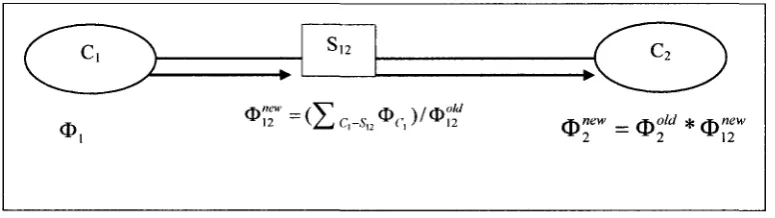
cluster C, passes a message to cluster C2 (or C2 absorbs the message from C,) it means a two-step computation:
(1) Updating the separator cluster On by setting 0>"2CT' = ( £ Q_Su 0C | )/q>£ ; (2) Updating the cluster potential Q™ = <Df * O™".
The potential <DI2 is the so-called "message" passed from cluster C, to cluster C2
in the JT. Obviously, <bn in general is just a non-negative function. The sequence of the
single message pass is shown in figure 2-10.
r^^
\ l )
S12
°i,2'"=(Zc1-.s-,2<l>r,)/<
(
A
^new
v2 ^ 1 2
The result of global propagation is that each cluster passes its information to all
other clusters in the cluster tree. A cluster can only pass a message to a neighbor after the
cluster has received messages from all of its other neighbors [Dawl992]. This ensures
consistency of the cluster tree when global propagation is completed. Marginal
probabilities for individual variables can then be obtained from the clusters.
HUGIN architecture needs to send 2 x (n -1) (where n is the number of clusters
in the JT) number of messages to achieve the consistency of the JT. But by utilizing the
semantics of the messages with allocate separator marginals (ASM) procedure Wu and
Jin [WuJ2006] successfully avoided passing up to half of the messages that could have
had to be passed by the GP method. This procedure is explained in the next section.
2.6.2 Allocate Separator Marginal (ASM) Procedure
By studying the factorizations of a JPD defined by a BN before and after the GP method
is performed, Dan Wu and Karen Jin [WuJ2006] investigated the messages passed
algebraically, and revealed that the messages passed are separator marginals or factors in
their factorizations. By utilizing the revealed semantics of the messages they successfully
avoided passing up to half of the messages that could have had to be passed by the GP
method. They named the procedure as 'Allocate Separator Marginals' (ASM)
[WuJ2006].
For any random variable x, in U = {x,,..., xn} in a BN,
Step 1. Suppose the CPD of x, i.e. /?(x, \ Fx) is assigned to a cluster Ck to form <Dt. If the variable x, appears in a separator Skj between Ck and Cy, then draw a small arrow originating from xt in the separator Skj pointing to the cluster C.. If variable x, also
separators and point to the neighboring cluster away from cluster Ck 's direction. Repeat
this for each CPD p{x, \ Fx) where /' = {l,...,n} of the given BN.
Step 2. Examine each separator Stl in the junction tree, if the variables in Stj all pointing
to one neighboring cluster, then the separator marginal piS^) will be allocated to that
neighboring cluster otherwise, p(St/) has to be factorized so that the factors in the
factorization can be assigned to appropriate cluster indicated by the arrows in the
separator.
The Result of applying the ASM procedure to the junction tree will be:
> If all variables in the same separator are pointing to the same neighboring cluster,
that means the separator marginal as a whole (without being factorized) will be
allocated to the neighboring cluster. And during the propagation phase if p{Stj)
as a whole is allocated to C., then message mi_yj = p(Sy) and m(<_y = 1.
> If the variables in the separator are pointing to different neighboring clusters, that
means the separator marginal has to be factorized before the factors in the
factorization can be allocated according to the arrow, i.e. if p(Sy) has to be
factorized (following a topological ordering of variables in Stj), then ml^j = the
product of factors allocated to Cj and /w, . = the product of factors allocated
toC,.
Thus one cluster only needs to multiply the originally assigned CPDs of a cluster
with the allocated separator marginal(s) or the factors in its (their) factorization(s)
suggested by the procedure ASM, in order to obtain the cluster marginal. The other
messages passed by the GP method are identity as function 1, which has no effect on the
receiving clusters. This approach of ASM helps to save at most half number of messages
EXAMPLE ASM Procedure:
p(ajQ { b )
p(b)
p{e\b)
P(h\f) P(f\c,d) Pfert'f)
p(a), p(c | a) p{d), p(d \ b), p(e \ b)
Mr.
P(c\
P(f\cdji
crlf
P(f}
df
P(f\d)
J I
de \p(de)
d e f
P(h\£L
fh
e f > ( e / )
1 efp j p ( g | e / )
fa) fb) Figure 2-11 (a) A BN. (b) JT with initialized CPDs.
Figure 11(a) shows a simple BN and the corresponding JT is given in figure
2-11(b). The procedure ASM is illustrated using Figure 2-2-11(b).
During the initialization phase, the CPD of c i.e. p(c \ a) is assigned to a cluster
Cac to form <I>C (ac). The variable c appears in a separator between Cac and Ccdf, so by
following the ASM procedure, a small arrow is drawn originating from Cac in the
separator Sc pointing to the cluster Ccdf. Following the same rule, CPD for variable /
will be assigned to Cfh. As variable / appears in more than one separators in the
junction tree, so a small arrow will be drawn from those separators and point to the
neighboring cluster away from cluster CJh 's direction.
Now if all variables in the same separator are pointing to the same neighboring
cluster, that means the separator marginal as a whole (without being factorized) will be
p(ef) (figure 2-11(b)) will be allocated to cluster C{cdf),C{def) and C(efg) respectively.
But if the variables in the separator are pointing to different neighboring clusters, that
means the separator marginal has to be factorized before the factors in the factorization
can be allocated according to the arrow. For example, the separator marginal p(df) has
to be factorized so that the factor p(d) is allocated to cluster C(cdf) and p(f \ d) will be
allocated to cluster C(def).
The separator marginal p(df) is decomposed as p(df) = p(d).p(f \d). It is
important to note that the factorization p(df) = p(d).p(f \ d) does not follow the
topological ordering of the variables d and f (d should precede / in the ordering)
with respect to the original DAG, in which / is a descendant of d.
Now from the figure 2-11(b) (arrows indicates the direction of the messages) we
can see that after only 8 message passes the cluster potential will become cluster
marginal, on the other hand with the GP method of HUGIN, 2 x (6-1) = 10 message
passes were needed to achieve the marginality of cluster. Thus ASM procedure saves 4
message passes that needed to be passed by the HUGIN architecture.
2.7 Marginality of Clusters
A typical application of probabilistic inference involves constructing a probabilistic
model, such as a Bayesian network, and then applying algorithms to the model to
compute answers to probabilistic queries. Probabilistic inference consists of computing
probabilities that are not explicitly stored by the reasoning system, such as computing
marginal and conditional probabilities from the joint probability distribution.
The main goal of message passing is to transform the cluster potentials into
cluster marginals after assigning all the CPDs from the original BN to an appropriate
Bayesian factorization into a marginal factorization [WWu2004]. Also in probability
theory and statistics, the marginal distribution of a subset of a collection of random
variables is the probability distribution of the variables contained in that subset. .
According to the Global Propagation (GP) method in the traditional HUGIN
architecture, during the time of initialization, with the assignment of CPDs, every cluster
in the junction tree is associated with a cluster potential. During the course of
propagation, after receiving all messages from its neighbors, these cluster potentials
transform into cluster marginals. Thus HUGIN architecture needs 2 x (n -1) messages to
obtain the marginality of a cluster. . But with the ASM procedure, Wu and Jin revealed
that, the product of the messages received by every cluster in the GP method equals to the
product of all separator marginals. Thus one cluster only needs to multiply the originally
assigned CPDs of a cluster with the allocated separator marginal(s) or the factors in its
(their) factorization(s) suggested by the procedure ASM in order to obtain the cluster
marginal. This approach of ASM helps to save at most half number of messages that

![Figure 2-2 Categories of Approximate Inference Algorithms [GH2002].](https://thumb-us.123doks.com/thumbv2/123dok_us/1463147.1179266/25.595.183.383.74.308/figure-categories-approximate-inference-algorithms-gh.webp)