DIFRANCESCA, DANIELL. The Impact of Writing Prompts on Learning During Ill-Structured Problem Solving. (Under the direction of John L. Nietfeld).
Ill-structured problem solving requires a variety of skills and strategies that K-12
students often lack due to limited exposure to these problems and a reliance on superficial
problem-solving strategies (Greiff et al., 2013; Jonassen, 1997, 2000; Mayer & Wittrock,
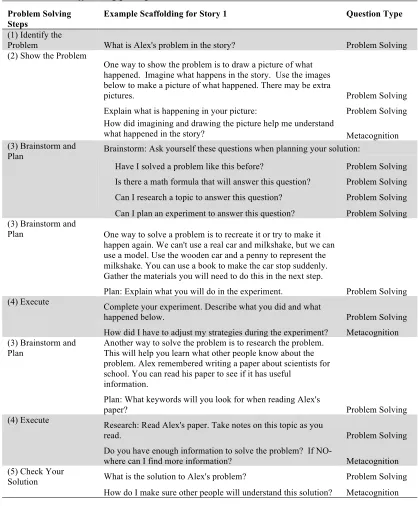
2006). This study employed a computer-based problem-solving program called Solve It!, which scaffolds students through a general problem-solving process to identify and support
solutions to ill-structured physics problems. Using a sequential explanatory mixed methods
design, this study examined the impact of the prompt response and narrative writing tasks on
seventh grade students’ (N = 117) physics content knowledge and problem-solving strategy acquisition while solving ill-structured problems in Solve It!. Students were randomly assigned to one of four conditions, which varied in the type of writing tasks students
completed. Findings from this study revealed a significant increase in physics knowledge and
problem-solving strategies across conditions. Due to the small sample size and several
limitations with the study design, condition effects did not emerge. However, students in the
narrative writing condition with low physics prior knowledge did benefit from the narrative
writing task. Implications for this research include the use of computer-based environments
to teach both content and problem-solving strategies simultaneously and the potential to use
© Copyright 2015 by Daniell DiFrancesca
The Impact of Writing Prompts on Learning During Ill-Structured Problem Solving
by
Daniell DiFrancesca
A dissertation submitted to the Graduate Faculty of North Carolina State University
in partial fulfillment of the requirements for the Degree of
Doctor of Philosophy
Curriculum & Instruction
Raleigh, North Carolina
2015
APPROVED BY:
______________________________ ______________________________
Dr. John L. Nietfeld Dr. Kristin Conradi
Committee Chair
______________________________ ______________________________
BIOGRAPHY
Daniell DiFrancesca was born in Pittsburgh, Pennsylvania in 1979. She attended
Plum Borough Senior High School and graduated in 1998. Daniell received her Bachelor of
Science degree in Biology from the University of Pittsburgh in Pittsburgh, Pennsylvania in
2002 and began working as a medical research technician in the Department of Pathology, in
the School of Medicine at the University of Pittsburgh.
In 2004, Daniell began teaching middle school science while completing her Masters
of Arts in Teaching at the University of Pittsburgh. After completing her MAT in science in
2005, Daniell moved to Annandale, Virginia to teach middle school biology.
In 2007, Daniell moved to Youngsville, North Carolina to teach middle school
science. In 2008 Daniell began a Kenan Fellowship through North Carolina State University
while continuing to teach. While completing the two-year fellowship, Daniell created middle
school science curriculum that incorporated important critical thinking skills. This experience
lead Daniell to seek additional opportunities to improve learning in K-12 schools, eventually
leading her to pursue a doctorate in educational psychology at North Carolina State
ACKNOWLEDGEMENTS
I would like to thank the members of my committee, Dr. Kristin Conradi, Dr. Margareta Pop,
and Dr. Jason Allaire for their constructive feedback and support.
I would also like to thank my advisor and friend, Dr. John Nietfeld, for his continual
support and encouragement over the past four years. He has been an outstanding mentor and
has provided me with countless professional opportunities. I look forward to future
collaborations and travel.
A special thank you to Dr. Tim Bleiler for all of his time and dedication to this
project.
My best friend and husband, Chris, has been a constant source of encouragement and
support. He is always there to help, lend an ear, or add some much needed humor into my
day. I will always appreciate everything he does for me.
Thank you to:
Dan and Ondra for making 746A a fun place to be
Eileen for providing a welcoming and supportive family for Chris and I
My sister, Stephanie, for always keeping me up to speed
Rebecca for your words of wisdom and support
And of course my pets (Daisy, Elmo, Gus, Fluffy, Bailey, Taffy, Emmy, Sophie, and
TABLE OF CONTENTS
LIST OF TABLES ... vi
LIST OF FIGURES ... vii
CHAPTER ONE. Introduction ... 1
Study Purpose ... 3
CHAPTER TWO. Review of the Literature ... 5
Problem Solving ... 5
Understanding Problem Solving ... 8
Solving Problems ... 11
Transfer of Problem-Solving Skills ... 19
Examining Problem Solving ... 25
Problem-Solving Skills in Elementary and Middle School Students ... 27
Writing-to-Learn ... 31
Writing and Learning ... 32
Measuring Learning from Writing ... 37
Writing and Learning in Science ... 41
Creative Writing in Science Learning ... 45
Metacognition ... 46
Developing Metacognition in Children ... 48
Metacognition in Problem Solving ... 49
Metacognitive Prompting to Improve Metacognition and Learning ... 51
Metacognition and Writing ... 56
Overview of Current Study ... 58
CHAPTER THREE. Methods ... 65
Participants ... 65
Time Frame and Conditions ... 66
Measures and Materials ... 67
Procedures ... 73
CHAPTER FOUR. Results ... 82
What is the impact of narrative and prompt response writing on seventh grade students’ physics knowledge, problem-solving strategies, efficacy, and metacognition? ... 85
Is there a significant interaction between condition and prior knowledge, writing ability, or writing effort with respect to final knowledge or final problem solving knowledge? ... 88
Final Physics Knowledge ... 89
Final Problem-Solving Strategies (Scenario) ... 93
How do students with high and low final physics knowledge feel about
learning from the problem-solving program? ... 97
CHAPTER FIVE. Discussion ... 104
Overview of Findings ... 104
Limitations of the Current Study ... 109
Recommendations for Future Research ... 111
REFERENCES ... 113
APPENDICES ... 128
Appendix A. Study Method Diagram ... 129
Appendix B. Study Measures ... 130
Appendix C. Solve It! Screen Shots ... 138
Appendix D. Example Problem Story 1 ... 140
LIST OF TABLES
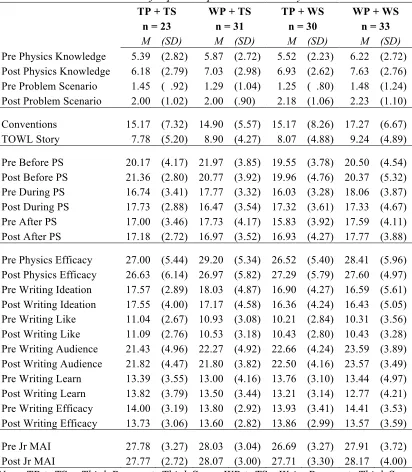
Table 2.1. Well-structured problem-solving heuristics ... 13 Table 2.2. Ill-structured problem-solving processes (Ge & Land, 2003, 2004) ... 17 Table 3.1. Intervention scaffolding prompts ... 75 Table 4.1. Means and standard deviations for pre and post assessments by
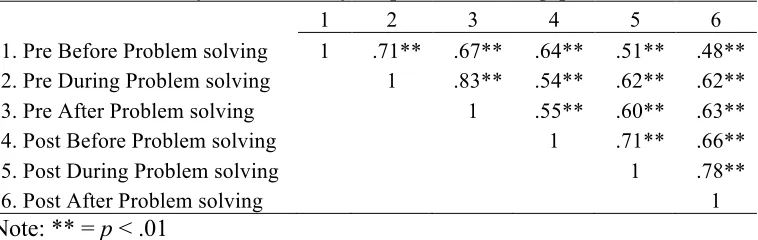
condition and group ... 84 Table 4.2. Pearson correlations for the subscales of the problem-solving
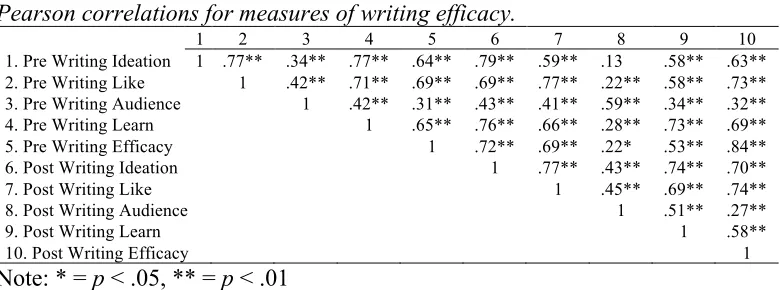
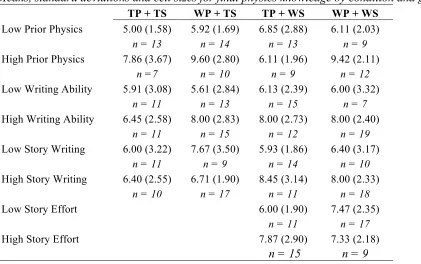
questionnaire ... 86 Table 4.3. Pearson correlations for measures of writing efficacy ... 88 Table 4.4. Means, standard deviations and cell sizes for final physics
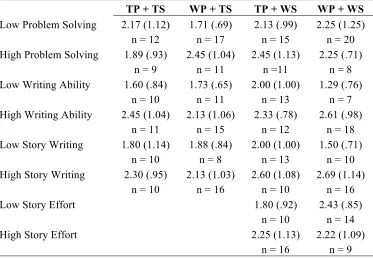
knowledge by condition and group ... 93 Table 4.5. Means, standard deviations and cell sizes for final problem-solving
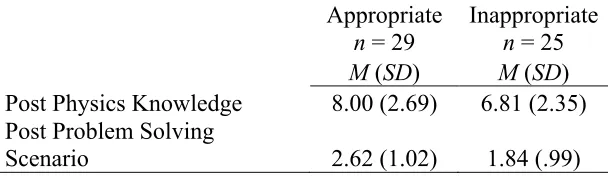
knowledge by condition and group ... 95 Table 4.6. Means and standard deviations for final physics and final problem-
LIST OF FIGURES
CHAPTER ONE
Introduction
Learners often lack the skills and strategies needed to be successful when solving
ill-structured problems due to limited exposure to these problems and reliance on superficial
problem-solving strategies (Greiff, et al., 2013; Jonassen, 1997, 2000; Mayer & Wittrock,
2006). An overreliance on guess-and-check methods is prevalent (Johanning, 2004), with
little reflection on the problem design or strategies that were successful in order to promote
future success (Fortunato et al., 1991). Further, many learners resist engaging with problems
that do not have a clear, direct path to reach an explicitly stated goal.
Ill-structured problem solving skills can be improved with instruction focusing on
general problem-solving strategies and the development of integrated problem
representations (Ge & Land, 2004; Jonassen, 1997). Problem-solving instruction also
benefits from the inclusion of metacognitive processes such as planning, monitoring, and
reflection to assist learners in applying strategies and transferring the strategies to new
situations (Bernardi-Coletta, 1995; Delclos & Harrington, 1991; Fortunato et al., 1991; King,
1991; Swanson, 1990). In an attempt to address skill deficits in students, the new Common
Core Standards and the Next Generation Science Standards emphasize higher order thinking
skills, such as problem solving and critical thinking (National Governors Assn., 2010; NGSS,
2013). Educators across disciplines are expected to improve student’s cognitive and
Unfortunately, limited tools have been provided to help teachers and students achieve
these goals. Further, school curricula are dense with content, limiting teachers’ ability to
include concepts or skills that are not essential to their instructional goals. The emphasis on
high stakes testing results exacerbates this problem, as teachers are pressured to prepare
students for tests rather than develop them as learners. In order to address problem-solving
skill deficits in students while also meeting the curricular demands, problem-solving skill
instruction is best suited to be integrated with regular classroom instruction. The
incorporation of problem-solving skill instruction into existing curriculum is critical for
improving students’ ability to solve complex problems. Cohesive lessons that integrate
problem-solving skills within different content areas will also alleviate some of the time
constraints that prevent teachers from developing problem-solving skills in their students.
Importantly, complex problem-solving opportunities may lead to deeper learning than
traditional lessons, benefiting students’ conceptual understanding and skill development
(Greiff et al., 2013). Furthermore, with appropriate instructional support across multiple
content areas, students can even be taught to transfer these skills to new situations.
A successful problem-solving experience requires learners to be actively engaged
with the problem-solving process, relevant domain knowledge, and their own metacognitive
processes. Writing is a powerful learning tool that aligns well with ill-structured problem
solving (Jonassen, 1997) and facilitates the transformation of knowledge to build more
complex knowledge structures (Scardamalia & Bereiter, 1984). Writing-to-learn tasks can
metacognitive knowledge (Hand, Wallace, & Yang, 2004), and even cognitive skills (Rivard,
1994). While writing is frequently a component of ill-structured problem solving, limited
research exists on the impact of writing on learning during ill-structured problem solving.
The diverse nature of ill-structured problems allows multiple types of writing tasks to
be included in the problem solving process and solution justification. Multiple research
studies have investigated the use of question prompts during problem solving that scaffold
students through the problem-solving process (Bulu & Pederson, 2010; Chen & Bradshaw,
2007; Kauffman et al., 2008). Learners are required to write responses to these prompts
whose purpose can be procedural, elaborative, or reflective (Ge & Land, 2004).
Additionally, ill-structured problems can be presented as cases or narratives to provide
context for the problem. This creates opportunities for students to present their solutions in
various formats. Narrative writing, for instance, can be easier for some students and more
motivating and also provide students with audiences beyond their teachers. However, little
research has investigated narrative writing as a writing-to-learn task.
Study Purpose
The purpose of this study is to investigate the ability of narrative writing tasks to
induce content learning and skill acquisition during ill-structured problem solving. The study
utilizes a computer-based program, Solve It!, that presents students with ill-structured physics problems embedded in short narrative stories to provide context and increase engagement.
supports their solution identification and justification. Students are then asked to finish
writing the story to describe the solution and how the characters solve the problem. The
program’s goals include both physics content learning and problem-solving strategy
CHAPTER TWO
Review of the Literature
Problem Solving
Problem solving, as defined by Mayer and Wittrock (2006), is the goal directed
cognitive process individuals engage in when they have no obvious solution to an
encountered problem. According to Chi and Glaser (1985), two main factors affect problem
solving, the nature of the problem-solving task and the knowledge of the problem solver.
Individual differences such as prior problem solving experience, domain knowledge,
metacognitive knowledge, and motivation for problem solving play an important role in
problem-solving processes and success (Mayer, 2013).
Researchers define problems as scenarios that consist of an initial state, a goal state,
and constraints, or obstacles, that prevent easily moving from the initial to goal state (Chi &
Glaser, 1985; Davies, 2005; Jonassen, 1997, 2000; Mayer, 2013; Newell & Simon, 1972).
Problems also consist of operators, which are the procedures or steps that move the problem
from the initial to goal state (Chi & Glaser, 1985; Mayer, 2013). This broad definition
encompasses a wide array of problems varying on multiple characteristics. In order to
advance our understanding of problems and how they are solved, researchers classify
problems into groups based on major characteristics and examine the solution processes for
Problems have been categorized into three major groups, puzzle problems,
well-structured problems, and ill-well-structured problems, depending on several factors including how
well defined the problems’ characteristics are, the number of available solutions and solution
paths, and the problems’ context (Jonassen, 1997). Psychological research into
problem-solving processes has relied heavily on puzzle problems (i.e. Tower of Hanoi, Nine Dots,
Missionaries and Cannibals). Puzzles are context-free problems with a single correct answer
and usually a single preferred solution path. Puzzle problems generally have a well-defined
initial state, goal state, and set of constraints, allowing the solver to focus on the operators.
While these problems have been useful in understanding how people search for solutions to
problems and produce generalizable results, they are not tied to school or real world practices
(Chi & Glaser, 1985; Jonassen, 1997). Further, examining problem-solving processes without
considering the role of prior knowledge does not fully represent the processes that occur
during well and ill-structured problem solving. This limits the applicability of research
results from these studies, especially in instructional fields looking to improve students’
problem-solving skills.
The more realistic problems that represent what students and adults actually
encounter are categorized as either well- structured or ill- structured problems (Chi & Glaser,
1985; Jonassen, 1997; Mayer, 2013; Mayer & Wittrock, 2006). Well- structured problems
have clearly defined initial states, goal states, and operators that move the problem to its
solution. Well- structured problems are often encountered in math classes where students
problems are more context-dependent than puzzles because their solution typically requires
the problem solver to have domain specific knowledge, such as knowledge of mathematical
formulas and operations. Ill-structured problems, on the other hand, have poorly defined
components, making the solution more difficult to reach. Ill-structured problems are more
representative of real-world scenarios that are encountered on a daily basis since they are
heavily context dependent and have multiple possible solutions.
Well and ill-structured problem categories are not discrete. Depending on the
information provided about the problem, the number of solutions, the number of solution
paths, and the context, problems fall somewhere on a continuum between well and
ill-structured (Jonassen, 1997). For example, well-ill-structured problems tend to have a single
correct answer, while ill-structured problems can have multiple solutions that need to be
weighed against one another to determine the best course of action. The initial state, goal
state, and constraints can be defined in varying levels, changing the problem from one with a
prescribed set of operators to move from the initial to goal state (well-defined), to one with
no established procedures for reaching the vague goal (ill-defined). Some problems do not
clearly fit into a single category, as discussed by Jonassen, and instead possess features
characteristic of both sides of the continuum (For a more detailed classification of problem
types see Jonassen, 2000). Buying a car, for instance, can have a specific goal with defined
parameters, but the methods for making the final selection are unclear.
Mayer and Wittrock (2006) also classified problems as routine or non-routine based
how to solve a particular problem it is considered routine. If the problem solver does not
have a previously learned solution procedure to apply, the problem is considered non-routine
for that problem solver. For instance, students often find physics problems to be very routine
because they practice the same problem types repeatedly. Physicists, however, encounter
completely original, non-routine problems in their field that require them to devise new
methods for finding a solution. Because well-structured problem-solving procedures can be
taught and applied to all similarly structured problems, these problems often become routine,
especially in school. On the contrary, ill-structured problems are often non-routine because
no set procedure or formula exists to find the solution and they are less common in school
curriculums.
Understanding Problem Solving
Historically, widespread interest in human problem solving began in Gestalt
psychology with seminal works by Duncker (1945), Polya (1945) and Wertheimer (1945)
(Novick & Bassok, 2005). The Gestalt perspective on problem solving emphasized the
importance of problem representations rather than solution processes. Problem
representations consist of an individual’s interpretation of the problem, integration of prior
knowledge, and organization of information, and can determine how easily a problem will be
solved (Chi & Glaser, 1985; Novick & Bassok, 2005). According to the Gestalt perspective,
problem solvers’ success relies on the quality of the problem representation, especially in
The rise of behavioral psychology pushed problem-solving research to the side for
almost thirty years because behavioral psychologists believed that understanding individuals’
mental processes was impractical. However, with the rise of cognitive psychology and the
publication of Newell and Simon’s Human Problem Solving in 1972, interest in solving research was re-ignited. Newell and Simon’s seminal work examined
problem-solving processes using puzzle problems to identify strategies and steps individuals applied
to find solutions. This research was not interested in the representation of problems and
instead focused on the search for a problem solution, explaining the reliance on context free
puzzle problems. Participants completed think aloud protocols while solving the problems,
which were analyzed to identify common problem-solving approaches. By choosing
context-free problems, Newell and Simon were able to make generalizations about human problem
solving processes that were tested using a computer-based problem-solving program, the
General Problem Solver. In the late 1970’s, research into the importance of background
knowledge combined with the popularity of Newell and Simon’s work renewed interest in
problem representation (Novick & Bassok, 2005). Today’s problem-solving research tends to
focus on problem-solving processes, problem representation, or a mix of both representation
and processes.
The focus on either problem representation or problem-solving processes leads
researchers to apply different learning theories when designing studies and interpreting
results. Generally, research into problem representation relies on a constructivist approach to
information, integrate their own knowledge, and build a mental representation of the
problem, this research naturally follows constructivist principles. Research into
problem-solving processes, on the other hand, searches for generalizable skills and strategies, aligning
with information processing theories of learning (Chi & Glaser, 1985; Jonassen, 1997;
Novick & Bassok, 2005). Identifying common skills and strategies directs both future
research and instructional practices in hopes of generalizing skills across various content
areas and problem types.
Problem representation research and problem-solving process research also align with
different types of problems. While information-processing theories generally rely on puzzle
problems and well-structured problems, research applying constructivist principles to
understand problem representation gravitates towards ill-structured problems and context
dependent well-structured problems (Jonassen, 1997). To illustrate, Fuchs et al. (2003) used
explicit instruction of problem-solving procedures and problem structure analyses to help
third graders generalize problem-solving processes to new, similarly structured problems.
This research aligns with Newell and Simon’s (1972) attempt to find processes that could be
generalized between problems and between problem solvers, following an
information-processing approach to learning. Chen and Bradshaw (2007) also wanted students to transfer
skills between problems, but instead of applying practiced procedures students followed
scaffolded question prompts to integrate their prior knowledge into an ill-structured problem
representation. The scaffolding helped participants construct an understanding of the
These studies illustrate how the problem type impacts design and theory selection in
problem-solving research.
Solving Problems
As discussed, puzzle problems are context-free problems that can be solved with the
application of general heuristics such as means-ends analysis. While a great deal of literature
focuses on solving puzzle problems, these problems and the processes used to solve them are
not representative of school and real world problems (Chi & Glaser, 1985). One of the major
goals of this review is to identify ways to improve students’ ill-structured problem-solving
skills, therefore puzzle problem solving will not be included in the following sections.
Knowledge for problem solving. Problem solving relies on domain knowledge, structural knowledge, and metacognitive knowledge (Chi & Glaser, 1985; Ge & Land, 2004;
Jonassen, 1997; Mayer, 2013). As discussed earlier, problems that are contextualized rely on
the solver’s relevant domain knowledge for a solution to be reached. Domain knowledge
consists of facts, concepts, and principals in a specific content area. The amount of domain
knowledge that is required to solve a problem varies by problem type and difficulty.
Research in expertise has shown that individuals with high levels of domain knowledge are
better able to represent problems (Novick & Bassok, 2005; Voss et al., 1983), organize
information from the problem and integrate their own knowledge (Chase & Simon, 1973;
Larkin et al., 1980), categorize problems according to previously solved problems (Novick &
Bassok), and select and apply appropriate problem-solving strategies (Larkin et al.; Schunn,
Simply possessing relevant domain knowledge is not sufficient for improved problem
solving. Structural knowledge, or how knowledge is organized and represented, makes
relevant domain knowledge accessible to problem solvers (Chi & Glaser, 1985; Jonassen ,
1997). The concept of a schema is useful in understanding how the organization of relevant
knowledge can impact its retrieval and application. Schemas contain not only facts and
concepts, but also how they are related to one another. These connections between concepts
build a structured knowledge base that allows problem solvers to relate the problem to their
prior knowledge and experiences to make the appropriate problem solving decisions (Ge &
Land, 2004). Experts, for instance, have well organized knowledge structures allowing them
to categorize problems, select appropriate strategies, and solve problems more efficiently
than novices (Voss et al., 1983).
Metacognitive knowledge, the third type of problem-solving knowledge, consists of
knowledge of cognition and regulation of cognition (Brown, 1987), which is necessary for
problem solvers to set goals, select strategies, monitor progress, make adjustments when
needed, and reflect on their process to improve future problem solving (Ge & Land, 2004;
Kauffman, 2004). Problem solvers’ metacognitive knowledge plays an important role in
problem solving and will be discussed in greater detail in the metacognition section.
Well-structured problem solving. Research into well-structured problem solving relies on seminal studies in solving puzzle problems. Based on their research into
problem-solving processes, Newell and Simon (1972) proposed the concept of a problem space, which
constraints, operators, and all possible intermediate steps that could be encountered while
solving a problem. According to Newell and Simon’s model, problem solving is the search
through the problem space to select the best operators and procedures to reach the goal state.
While examining problem-solving processes using puzzle problems, several common
heuristics were discovered and generalized between individuals. As Table 2.1 shows, there
are three common heuristics that are well represented in research examining puzzle problems
and well-structured problems. When problem solvers are taught these heuristics and how to
apply them, there are improvements in individuals’ ability to solve problems (Barak, 2013).
Heuristics, however, do not provide much insight into the role of knowledge in domain
relevant problem solving and do not provide sufficient insight to understand how complex
problems are solved.
Table 2.1
Well-structured problem solving heuristics
Heuristic Description Studies
Means-ends Analysis
Identify differences between the initial and goal state and select operators that will eliminate or reduce the differences
Chi & Glaser, 1985; Newell & Simon, 1972; Novick & Bassok, 2006;
Sub-Goaling Decompose problems into sub-goals and select intermediate solution paths to smaller goals until the goal state is reached
Chi & Glaser, 1985; Jonassen, 1997;
Generate and Test Select possible solutions and evaluate their utility in solving the problem
Research related to well-structured problem solving has expanded beyond heuristics
rooted in puzzle problem research to include context dependent problems that rely on the
solver’s relevant domain knowledge. General problem-solving processes, such as the
four-step model presented by Polya (1945), provide a framework for approaching problems and
finding a solution. Polya’s model teaches students to understand the problem, devise a plan,
implement the plan, and then look back at their work. An individual’s ability to apply these
general steps is reliant on them possessing the appropriate domain and structural knowledge
for the problem. Polya and others’ research into mathematical problem solving has focused
on first developing domain and structural knowledge by teaching students about problem
structures and methods for solving them, and then helping students identify similarly
structured problems using analogical reasoning. Once students understand the problem
structure, they are able to apply previously learned procedures to solve the problem (Fuchs et
al., 2003; Mayer, 2013). These general problem-solving steps prompt students to approach
new problems systematically in hopes of cueing the transfer of their problem-solving
knowledge to new problems.
Domain knowledge and structural knowledge play a key role in solving many
well-defined problems. Cooper and Sweller (1987)’s research with middle and high school math
students found that helping students automatize problem-solving procedures and develop
schemas for classifying problems improved their problem solving and transfer of skills to
new problems. This research focused on improving students’ domain and structural
(2003) used a similar approach with third graders, focusing first on developing their domain
and structural knowledge in mathematics problem solving and then helping them analyze
problem structures to transfer skills.
Ill-structured problem solving. With puzzle problems and well-structured problems, the necessary information has been provided to the solver and there is a single correct answer
they are working to reach. This allows problem solvers to apply heuristics or follow a general
strategy that cues them to categorize problems and apply learned operations. Ill-structured
problems, however, are not clearly defined for solvers and their interpretations and solutions
rely heavily on the problem solver’s prior knowledge and experiences. There are no
prototypic cases for ill-structured problems, nor are there formulas or algorithms that can be
applied to reach a definite answer. Additionally, numerous possible approaches and solutions
often exist and must be weighed against one another to select a solution and support its
utility. Due to these differences, research into ill-structured problem solving generally
focuses on problem representation and solution argumentation rather than solution processes
(Novick & Bassok, 2005).
Ill-structured problems are vaguely defined problems that are usually situated in the
real world and rarely have a single correct solution (Jonassen, 1997). In contrast to Newell &
Simon’s (1972) proposal of problem solving as a search through a problem space, solving
ill-structured problems can be considered a design process. According to Jonassen, “the
problem solver must frame the design problem, recognize divergent perspectives, collect
understanding of the situation rather than find a solution for a prescribed problem” (1997, pp.
79).
Using think-aloud protocols while adults solved ill-structured problems, Sinnott
(1989) identified general steps for solving ill-structured everyday problems that align with
this design process. Jonassen (1997) condensed Sinnott’s eleven steps into seven steps, which
were further reduced to four general processes by Ge and Land (2003, 2004) as shown in
Table 2.2. Ill-structured problem solving generally requires the problem solver to represent
the problem, develop solutions, construct arguments to support solutions, and monitor and
evaluate the problem-solving process, solution effectiveness, and the learners’ own cognitive
processes. Similar to the design process, problem solvers are creating solutions that fit the
problem constraints and meet the end goals of the problem. After comparing the solution
options, the most appropriate solution is selected and applied to the problem.
Ill-structured problem solving processes (Ge & Land, 2003, 2004)
Process Description Other Models
1. Problem Representation
Consists of the problem information, contextual constraints, relevant domain knowledge, relevant structural knowledge;
Can potentially be multiple problem representations once alternative opinions and perspectives are considered
Sinnott- steps 1 through 7
Jonassen- Steps 1 and 2
2. Developing Solutions
Activate prior knowledge and connect the problem to existing problem schemas; Consider the problem goals and constraints when developing solutions; Consider alternative solutions;
Sinnott- Step 8? Jonassen- Step 3
3. Making Justifications
Solution choices are justified by developing an argument; Support with facts, supportive statements or conjectures;
Sinnott- Step 9? Jonassen- Step 4
4. Monitoring and Evaluations
Monitor the solutions to evaluate their utility in solving the problem; Monitor and reflect on their own processes, checking for errors and making adjustments; Evaluate the effectiveness of the solution if implemented;
Sinnott- Step 10 and 11
Jonassen- Step 5, 6, and 7
While heuristics are not particularly well suited for solving ill-structured problems as
a primary strategy, they can be helpful when developing solution ideas. For instance,
sub-goals are often used in ill-structured problems to create manageable sub-goals and address
different problem constraints (Chi & Glaser, 1985). If the problem has multiple constraints,
the solver can create sub-goals to deal with groups of constraints rather than accounting for
everything at once. The generate-and-test heuristic is useful when designing and comparing
problem solutions to select the best option (Ge & Land, 2004; Jonassen, 1997). This process
As in design theories, problem solvers create and test solutions to determine their utility in
solving the ill-structured problem.
Having or developing appropriate domain knowledge to help in creating a solution is
essential for solving ill-defined problems. Voss et al. (1991) compared ill-structured problem
solving between experts and novices using social science problems. Experts in these studies
used their extensive relevant domain knowledge to clearly define the problem and problem
constraints. Additionally, the experts’ knowledge helped them group constraints into
manageable sub-goals while the novices considered every constraint as a separate sub-goal.
Larkin et al. (1980) also found that physics experts’ structural knowledge helped them define
the problem and work towards the solution, rather than working backwards like the novices
approached problems.
Along with applying relevant domain knowledge to construct a detailed problem
representation and identify potential solutions, solving ill-structured problems requires
solutions to be compared and evaluated. Careful comparison of the solution options to the
problem constraints helps the solver select a solution and develop an argument to support this
solution. Because ill-structured problems do not have a single defined goal state, it is
important for the solver to consider and compare alternative solutions to construct a solid
argument for the chosen path (Jonassen, 1997). By comparing alterative solutions, the
problem solver considers multiple perspectives and collects evidence to justify their solution.
This process also forces them to evaluate potential consequences for each solution, which is
Transfer of Problem-Solving Skills
Transfer refers to the application of previously learned material to new situations
(Mayer, 2013; Ritchhart & Perkins, 2005). The transfer of problem-solving skills involves
taking already acquired problem solving skills or strategies and applying them to a new
problem. The transfer of problem-solving skills is studied in relation to the difference
between the problems solved during skill acquisition and the new problems that need to be
solved. In immediate transfer the problems solved are very similar to the training problems,
therefore the skills easily transfer to the new problems (Fuchs et al., 2003). In near transfer
the problems being solved are similar to the training problems, but may differ on a few
superficial characteristics. Far transfer, however, requires the problem solver to apply skills
to contexts that are quite different from the original training contexts, often in different
domains (Ritchhart & Perkins, 2005). Immediate, near, and far transfer represent three points
on a continuum moving from common (immediate) to rarely achieved (far). Influencing far
transfer is quite difficult, even though transforming learners into productive thinkers who
spontaneously transfer skills between domains is a common goal in education.
While some studies have assumed that simply practicing problem- skills is sufficient
for transfer, practice alone is not enough to cause transfer (Phye, 2011). The transfer of
problem-solving skills relies on several factors including the problem solver’s ability to
recognize the problem’s structure and relate it to previously solved problems. In order to
identify analogous problems, individuals must first examine problem structures to create
instruction on identifying problem structures and categorizing problems based on previously
solved problems (Cooper & Sweller, 1987; Fuchs et al., 2003). Students’ self-developed
categories tend to be quite narrow (Fuchs et al.) and even limited by superficial quantity
labels (Bassok, 1990). Appropriate problem-solving instruction should assist students in
broadening their categories in order to see past superficial problem details. Additionally,
Schwartz et al. (2011) found that transfer of problem-solving strategies improved when
learners were given the opportunity to develop formulas on their own to solve problems
rather than simply being given the formulas. These students spent more time analyzing the
problem’s structure and were able to identify similar structures in new problems which
facilitated the transfer of skills.
Even instruction on problem identification and categorization is not enough to
guarantee transfer of problem-solving skills. Fuchs et al. (2003) found that in addition to
broadening third graders’ math problem categories, they also needed to be explicitly taught to
examine new problems’ structures. Without prompting or cueing students to identify problem
structures they are not likely to spontaneously transfer skills to novel problems (Bassok,
1990; Cooper & Sweller 1987; Fuchs et al., 2003). Many studies have used question prompts
to scaffold learners through problem solving, reminding them to examine problem structures
and apply previously learned strategies where possible. These prompts form a general
problem-solving procedure, similar to those suggested by Polya (1945) and Ge and Land
Research into the transfer of problem-solving skills is hindered by the importance of
domain knowledge for problem solving. As Richhart and Perkins (2005) explain, the role of
knowledge in problem solving and the limitations associated with situated cognition pose
challenges for instilling transfer. Experts, for instance, are superior problem solvers in their
domains due to the extensive domain knowledge and experience they possess (Chi & Glaser,
1985; Novick & Bassok, 2005 Ritchhart & Perkins, 2005). In a comparison of experts and
novices solving problems in the experts’ domains, relevant domain knowledge was vital for
analyzing problems and identifying the best solution path (Larkin, 1980). In spite of experts’
domain specific problem-solving expertise, these skills do not transfer to different contexts
(Ritchhart & Perkins, 2005). While domain knowledge is important in problem solving, it is
possible that general problem-solving strategies can be transferred between domains.
Transfer of ill-structured problem-solving skills. Real world, ill-structured problems are diverse, non-routine problems, decreasing the likelihood of expertise
development in solving these problems (Mayer, 2013; Ritchhart & Perkins, 2005). The
diversity in ill-structured problems and their solutions does not open them up to simple
structure identification and formula application like well-structured problems. Instead,
ill-structured problem solving benefits from a general pattern of processing that can be applied
to all problems. Rather than providing instruction on problem structure and formulas for
solution, ill-structured problem solving benefits from thinking procedures or guidelines that
Numerous studies use question prompts as scaffolds for students’ problem-solving
processes and to instill general processing skills that are important in solving ill-structured
problems (Bulu & Pederson, 2010; Chen & Bradshaw, 2007; Chen & Ge, 2006; Davis, 2000;
Delclos & Harrington, 1991; Ge & Land, 2003, 2004; Kauffman, 2004; Kauffman et al.,
2008; King, 1991; King & Rosenshine, 1993). Question prompts are instructional supports
that can focus the problem solver’s attention on the appropriate features of the
problem-solving process to help them develop skills and integrate knowledge (Davis, 2000; King,
1991; King & Rosenshine, 1993; Scardamalia & Bereiter, 1994). Problem-solving scaffolds
aid students in solving problems that might be too difficult for them without support. As
discussed by Vygotsky (1978), support provided from a more knowledgeable person aids
students in moving from their current level of understanding to the next level. Question
prompts can scaffold students working in the zone of proximal development (ZPD) by
providing the necessary support for students to learn to solve the problems independently.
These scaffolds can potentially improve students’ problem-solving skill acquisition and
transfer.
While not many studies have examined the effectiveness of scaffolding prompts for
transferring problem-solving skills between ill-structured problems, their success in helping
students work through these processes is promising. Ge and Land (2004) classified question
prompts into three categories: procedural prompts, elaboration prompts, and reflection
prompts. Procedural prompts are aimed at students completing specific tasks, while
2004, pp. 10).” Procedural prompts can help students learn cognitive strategies like problem
solving, compared to elaboration prompts, which are geared towards knowledge
construction. Reflection prompts, on the other hand, are metacognitive prompts that ask
learners to plan monitor, and evaluate their progress and their processes.
Research examining the use of problem-solving scaffolds in computer based learning
environments (CBLE) has grown in recent years (Bulu & Pederson, 2010; Dabbagh &
Kitstansis, 2005; Graesser, McNamara, & VanLehn, 2005; El Saadawi et al., 2010; Roll et
al., 2011; Ward & Clark, 1989; White & Frederiksen, 1998) and provides opportunities for
examining the impact of prompts on problem-solving skill transfer. Bulu & Pederson (2010)
examined the impact of continuous and faded question prompts with either domain-specific
or domain-general content. Results of their study with sixth graders playing Alien Rescue, a problem-based CBLE, indicated that continuous domain-specific scaffolds improved content
knowledge and problem representation. However, when faded, the domain-specific scaffolds
were not transferred to new problem scenarios. The domain-general prompts helped
participants develop solutions, make justifications, and monitor and evaluate their problem
solving. Importantly, the domain-general scaffolds transferred to new problems when faded.
Additional studies have shown benefits of scaffolding in problem solving, but have not
examined transfer of these skills (Chen & Bradshaw, 2007; Davis, 2003; Ge & Land, 2003;
Ge, Chen, & Davis, 2005; Kauffman, 2004; Kauffman et al., 2008).
Research in the use of scaffolds generally shows positive results for applying these
shown in Bulu & Pederson’s (2010) study, fading scaffolds can be detrimental depending on
the purpose of the supports. In order to show learners have internalized and transferred
problem-solving processes the scaffolds must be removed, but the specific timing for
removing scaffolds is unknown. Some CBLEs aim to develop real-time learning diagnoses
and adaptive scaffolding, but this is quite complex and still in development (Azevedo et al.,
2010). Greene and Land (2000) also found that over burdening learners with excessive
prompts is detrimental to their learning and engagement. Finally, the type of question prompt
(e.g. cognitive, metacognitive, content focused) results in different learning outcomes (Chen
& Bradshaw, 2007; Davis, 2003; Ge & Land, 2003; Ge, Chen, & Davis, 2005), but the best
mix of each type without overburdening the learner is yet to be determined.
A review of problem solving research suggests that the transfer of cognitive skills is
rarely attainable. However, studies examining transfer often expect participants to make large
leaps between both content areas, learning activities, and even problem types without explicit
instruction on how cognitive skills can be used in different ways (Richhart & Perkins, 2005;
Singley, 1989). A more pedagogically sound approach to transfer research might be to first
consider the difficulty of the transfer task and then customize supports for participants.
Studies that carefully analyze transfer tasks to determine the necessary knowledge to transfer
skills from one task to another and explicitly train participants with this knowledge will add
significantly to the literature.
Some research also suggests that teaching for the transfer of cognitive skills will not
2001). Bereiter (1995) argued that the transfer of cognitive skills is actually a disposition or
behavioral tendency. The transfer of cognitive skills relies on additional training to improve
the disposition towards thinking and application of thinking skills. Additional metacognitive
instruction can improve the transfer of skills by helping students understand when and why
these skills are used (Delclos & Harrington, 1991). If students see the value and purpose of
transferring skills, they may be more inclined to do so in new situations. While it may take a
long time to develop behavioral tendencies, helping individuals see the value and purpose of
transfer is an important first step.
Examining Problem Solving
Early solving research was largely descriptive in order to identify
problem-solving strategies and processes. For example, Newell and Simon (1972) and Sinnott (1989)
used think aloud protocols to identify common problem-solving strategies. These studies
provided valuable data that was used to design further research and experimentation. The
majority of current research studies are experimental, often testing the impact of a
problem-solving intervention.
In problem-solving research, the design and measurement tools are based on the type
of problem being studied and whether the researcher is interested in the problem
representation or problem-solving process. An additional factor in selecting designs and
measurement is whether problem-solving transfer is being examined.
Measuring problem solving. Think aloud protocols are commonly used for
protocols while solving puzzle problems to identify commonly used heuristics. Sinnott
(1989) also used think aloud protocols to examine adults’ problem-solving skills on slightly
altered versions of Piaget’s formal operational problems. Analyzing the think aloud protocols
helped Sinnott identify general processes that problem solvers used during ill-structured
problem solving. Many studies still use think alouds to capture online processing while
participants complete a problem-solving task. There are concerns with think aloud protocols,
however, including interference with thinking processes, participants’ selection of what to
report, the think aloud protocol’s influence on the behaviors of the participants, and their
difficultly in capturing high-level metacognitive activities that direct problem-solving
processes. Many problem-solving studies also use question prompts to scaffold participants
through the problem-solving process. Participants’ responses to these question prompts can
be examined to identify the steps taken and reasons for these steps.
Studies aimed at teaching participants to solve a particular type of problem can use
pre and post problem-solving assessments to find changes in problem-solving performance.
These assessments are usually researcher designed since they must align specifically with the
intervention. Fortunato et al. (1991) also created a metacognitive problem-solving checklist
that allowed students to report the metacognitive strategies that used before, during, and after
solving mathematics problems. This checklist can be used to assess students’ self-reported
problem-solving processes.
Studies examining the transfer of skills, especially far transfer, can also design a
of skill transfer and success. Fuchs et al. (2003) designed transfer tasks that assessed
immediate, near, and far transfer in mathematics problems by varying the problems’ cover
stories, superficial problem features, problem structures, and by adding novel problem
characteristics. Problem-solving transfer can also be assessed immediately after the
intervention or after a delay. Phye (2001), for instance, measured problem-solving transfer
after a two-day delay. The context of the transfer task can also be altered from the training
context. For instance, if the intervention occurred within a computer program the transfer
task can be moved from the computer to a paper and pencil assessment.
Problem-Solving Skills in Elementary and Middle School Students
The development of problem-solving skills is both a challenging and critical area of
research in education. While the ultimate goal of education is to help students retain
information and transfer this information to new situations (Mayer & Wittrock, 2006; Phye,
2001), traditional instruction and assessment appears, all too often, to emphasize rote
memorization rather than application and problem solving (Anderson, 2012; Taconis et al.,
2002). The importance of problem solving in education has been highlighted by the recent
release of the Common Core Standards in K-12 language arts, mathematics, and the Next
Generation Science Standards (NGSS; NGSS, 2013; National Governors Assn., 2010). These
standards emphasize the need for students to understand problems, reason through them, and
persevere in finding solutions (NGSS, 2013; National Governors Assn., 2010).
Students will benefit from solving ill-structured problems that are more representative
however, lack experiences that develop students’ real world problem-solving skills (Greiff et
al., 2013; Jonassen, 1997, 2000; Mayer & Wittrock, 2006). Students are rarely exposed to
meaningful, complex problem solving in schools, and instead spend their time repeatedly
solving well-structured mathematical problems (Anderson, 2012; Chi & Glaser, 1985;
Taconis et al., 2001). The NGSS (2013) emphasize the importance of learning through
inquiry and using the engineering design process to solve everyday problems. Both inquiry
learning and design processes provide students opportunities to struggle with ill-structured
problems in order to learn and improve their problem-solving skills. These approaches have
been underutilized, however, as teachers primarily base their instruction on state tests
(Anderson, 2012).
Problem-solving skills often suffer because students are not taught the proper domain,
structural, and metacognitive knowledge to improve their skills. Current models of
instruction emphasize problem solving during learning and assessment, (Jonassen &
Hernandez-Serrano, 2002), but many instructors expect students to independently apply
content knowledge to problem solving without instruction on how to do so. Direct instruction
and modeling of problem-solving skills is necessary for students to acquire problem-solving
skills (Mayer & Wittrock, 2006). King’s (1991) research shows that teaching students
problem-solving strategies, such as guided questioning, leads to an increased ability to solve
problems. Fifth grade students who received problem-solving training outperformed their
peers on new problem-solving tasks, more effectively communicated through questioning
Physics problem solving in K-12 learning environments. One domain in particular that lacks rich problem-solving instruction and experiences for K-12 students is physics.
When compared to previous generations and students in other countries, students in our
school system are underperforming in physics (Sinatra & Taasoobshirazi, 2011). The practice
and study of physics relies on high level models, abstract concepts, and high level
mathematical calculations in order to move the field forward (Briscoe & Prayaga, 2004).
Physics education in K-12 schools attempts to mimic these practices, often to the disservice
of learning and conceptual understanding of physics concepts. High school physics classes
typically focus on quantitative, well-structured problem solving with a single correct answer
and solution path (Sinatra & Taasoobshirazi). However, this quantitative problem solving
does not translate to conceptual understanding or conceptual problem solving (Mualem &
Eylon, 2010).
Physics is often regarded as a difficult subject in K-12 schools. Many core concepts
that are taught in physics are relevant and helpful when learning about other sciences like
biology and chemistry (Sinatra & Taasoobshirazi, 2011). However, students often possess
misconceptions about even basic physics concepts, such as force and motion (Geary, 2008;
Mayer, 2013). Force and motion science lessons generally ask students to memorize
Newton’s laws and then solve well-structured, math-based physics problems. These low
quality lessons do not ask students to apply concepts, but instead use memorized formulas to
An alternative to the low quality physics problem solving is to allow students to
engage in meaningful problem solving which can help students discover errors in their
knowledge, address misconceptions and engage in conceptual change (Mayer, 2013).
Meaningful, challenging problem solving will not only improve students’ physics content
knowledge (Sinatra & Taasoobshirazi, 2011), but will also improve their problem-solving
skills for the future (Hartman, 2001b). Chen, Hand, and McDowell (2013) engaged
elementary students in a letter writing activity to communicate their physics knowledge to
high school physics students. Elementary students completed experiments and researched
topics to discover answers to the high school students’ questions, improving their conceptual
understanding, writing, and argumentation skills. This meaningful, ill-structured problem
task improved physics knowledge and cognitive skills. Hein (1999) also used writing to
improve college students’ physics knowledge by asking them to write about conceptual
physics problems.
Computer based physics programs have been designed that engage students in
well-structured (Cheema & LaViola, 2012; Wolff, 2009) and ill-well-structured (Myneni et al., 2013;
Shute, Ventura, & Kim, 2013; White & Fredericksen, 1998) problem solving tasks. Newton’s
Playground, for instance, develops students’ knowledge of simple machines by drawing and
applying simple machines to basic motion problems (Shute et al., 2013). Each problem in
Newton’s Playground asks students to reach the same goal state, but alters the constraints to
the problem. Simple machines are applied to the problems to overcome the obstacles. Shute
the game. ThinkerTools Inquiry Curriculum is another computer-based game that was
designed to improve students’ knowledge of inquiry practices as well as force and motion
concepts (White & Frederiksen, 1998). Both of these programs aim to improve students’
conceptual knowledge of force and motion using ill-structured problems. ThinkerTools,
however, explicitly focuses on the inquiry processes, which can improve their future
problem-solving approaches. While both of these programs were designed for middle school
students, their general principals would also be useful with both younger and older students
learning physics concepts.
It is important for K-12 students to engage in meaningful physics problem solving
that extends beyond basic math problems. Computer-based programs that use complex
ill-structured problems to engage learners with real-world physics problems could be useful in
helping students advance both their physics conceptual understanding and problem-solving
skills. These programs can scaffold students through a general problem-solving process and
provide additional support and resources to identify a solution to the problem. With repeated
exposure to the general problem-solving process, students will hopefully internalize the
strategy and apply it to future problems.
Writing-to-Learn
Writing-to-learn is an instructional strategy based on the belief that learning occurs
during and as a result of writing (Klein, 1999). Writing-to-learn became popular when the
area writing became an important part of content instruction (Ackerman, 1993). Writing
serves as an opportunity for learners to organize ideas, make connections, reflect, explore
new ideas, and construct knowledge (Baker et al., 2008; Chen, Hand, & McDowell, 2013;
Newell, 2006). As Emig (1977) explained, “writing serves learning uniquely because writing
as a process-and-product possesses a cluster of attributes that correspond to certain powerful
learning strategies” (pp. 122). She further explained that writing integrates multiple
representations of information, produces powerful self-provided feedback, aids in making
connections between concepts, and is an active, engaging process. Since Emig’s initial
description of how writing aligns with learning, research has continued to explore how
writing can be used to learn.
There are several theories used to explain learning from writing. Some researchers
suggest that learning occurs with any language, verbal or written, because language organizes
and assigns meaning to thoughts and ideas (Britton, 1970). Other researchers hypothesize
that writing causes learning by actually preserving ideas so they can be expanded upon and
grown, which is known as the forward-search hypothesis (Klein, 1999). A third hypothesis
that will be the basis for this review indicates that writing leads to the construction and
transformation of knowledge (Scardamalia & Bereiter, 1984).
Writing and Learning
Writing is a complex cognitive process requiring the writer to create a physical
product that accurately represents their understanding. Writers engage in active cognitive
processes are simultaneously engaged to plan, monitor, and evaluate the writing process and
products (Hacker, Keener, Kircher, 2009). Bereiter and Scardamalia (1987) hypothesized
that during this active processing of old and new information in relation to the writing goal,
individuals construct a new, deeper understanding of the concepts. Interactions occur
between content space and rhetorical space as the writer attempts to meet writing goals,
leading to a change in the content and organization of the writer’s knowledge (Bereiter &
Scardamalia, 1987). Knowledge transformation is a valuable by-product of the writing
process and a desirable goal in learning situations.
Bereiter and Scardamalia (1987) categorized writing tasks as either knowledge-telling
or knowledge-transforming. While some writing assignments simply allow the author to state
what they know, other writing tasks demand a higher level of cognitive processing that leads
to changes in the structure of knowledge. Schumacher and Nash (1991) describe three types
of learning that can occur: accretion, tuning, or restructuring. Accretion, or the assimilation
of knowledge, results from adding new knowledge to existing structures. Tuning is simply
making slight adjustments to knowledge structures to accommodate new information such as
transferring one problem strategy to a similar problem. Truly transformative learning, on the
other hand, causes a restructuring of knowledge and potentially a completely different
understanding. Writing has the potential to lead to knowledge restructuring, but is highly
dependent upon the context and nature of the writing task itself.
A variety of writing tasks exist that may or may not result in learning. The extent of
(Durst & Newell, 1989; Newell, 2006). In order to understand how writing can lead to
learning, researchers classified writing tasks into three categories: restricted writing,
summary writing, and analytic writing (Newell, 2006). Restricted writing represents tasks
with very little if any actual composition such as answering study questions. Learners simply
identify the factual answer and respond to the question, requiring no additional processing of
the information. During summary writing tasks, learners survey a larger body of information
to combine and integrate ideas. While this requires more processing than a restricted writing
task, summaries still result in superficial learning because the contents tend to focus on major
ideas presented linearly.
Analytic writing tasks require learners to examine the relationships between ideas,
often leading the writer to formulate and support an argument (Newell, 2006). This task
demands extensive manipulation of ideas, and therefore provides opportunities for learners to
restructure and transform their understanding of the topic. Argumentative writing
assignments improve learning beyond restricted and summary tasks and are powerful
learning tools for content areas (Chen et al., 2013).
School based writing assignments are often non-transformative, especially in the
more challenging, abstract classes that could benefit from writing-to-learn activities (Honig,
2010; Lerner, 2007; Reynolds et al., 2012). Science classes, for instance, often consider
knowledge-telling assignments such as note-taking, fill in the blank worksheets, and chapter
summaries to be appropriate writing tasks (Bereiter & Scardamalia, 1987; Yore, Bisanz, &
rather than active, constructive knowledge processing. Writing assignments that require
analysis and argumentation are much better suited for both learning and practicing science
(Rivard, 1994). Writing to learn using argumentation and analysis is a great way to not only
improve learners’ understanding in content areas, but also to show learners that writing is a
versatile, necessary tool.
Contextual factors beyond task selection influence learning from writing (Ackerman,
1993; Bangert-Drowns et al., 2004; Langer & Applebee, 1987). Engaging students in
meaningful learning processes during writing requires authentic writing tasks (Chen et al.,
2013). Assignments completed solely for a grade do not provide a purpose for learners
beyond reproducing the required facts. Authentic writing tasks, such as letters or learning
reflections, have an inherent purpose that appeals to learners. These tasks also require
learners to manipulate their ideas in order to clearly communicate their understanding.
Likewise, writing tasks with audiences other than teachers encourage learners to make
connections between the real world and course content (Chen et al., 2013; Yore et al., 1999).
Writing to other audiences also requires students to translate content area vocabulary to
general terms and elaborate on their ideas by providing examples. Finally, contextual features
that encourage revisions and redrafts benefit learning, especially if feedback is provided to
encourage learners to provide additional details and explanations (Chen et al., 2013; Hein,
1999; Yore et al., 1999). Careful analysis of writing tasks’ contextual factors is important to
As noted before, the writing to learn movement was influenced by the need to
increase writing across the curriculum. Many of the initial studies were completed at the high
school and college level, where writing skills were not thought to interfere with learning
from writing (Rivard, 1994). Bangert-Drowns et al.’s (2004) meta-analysis of
writing-to-learn research revealed that writing studies completed with middle school students had
negative effects on learning, suggesting that writing may not benefit young learners.
However, research has shown that young students can benefit from writing to learn,
particularly when the proper support is provided and the selected tasks provide the
appropriate cognitive demands (Chen et al., 2013; Klein, 1999; Klein & Yu, 2013; Peasley,
Rosaen, & Roth 1992). Bangert-Drowns et al.’s (2004) results were based on a small sample
of studies (six) and do not account for important factors such as students’ recent transition to
subject-specific writing in middle school or features of traditional classroom instruction and
assessment that impact the results. Further, only two of the six studies were based in science
writing. A more updated meta-analysis would likely include a greater number of studies and
potentially have different results for middle school aged children.
The use of computers and word processing software is quite common and beneficial
for writing. The cognitive processes that occur during writing do not change when writing is
completed on the computer (Hartley & Tynjala, 2001). Meta-analyses of the literature also
indicates that elementary and adolescent students actually benefit from using computers for
Measuring Learning from Writing
Measuring learning from writing requires making inferences and assumptions about
the writer’s prior knowledge, current knowledge, the strategic processes that were used to get
there, and what is being measured with the assessment tools. Thus far, results from
writing-to-learn research have been mixed (Bangert-Drowns et al., 2004; Klein & Yu, 2013),
bringing the utility of writing into question. Often, the mixed results in the writing-to-learn
literature are a result of inappropriate measurement tools. In order to measure learning from
writing, research must first select measurement tools that are specific to the writing task and
expected learning outcomes.
According to Ackerman (1993), the lack of contextual information in the writing to
learn research contributes to the ambiguous results. Writing research that lacks details about
the type of writing task and the type of learning expected (content, metacognitive, strategic)
limits the interpretability of the results. In order to measure learning from writing, the writing
task itself must first be selected carefully and analyzed to determine the cognitive processes
required of the writer during composition (Schumacher & Nash, 1991). As discussed above,
analytic writing assignments are more likely to lead to learning because they require the
writer to restructure their knowledge to meet the demands of the task. However, even
analytic essay writing has not shown consistent gains in knowledge because additional
factors such as the context of the writing task, its purpose, and the writer’s interpretation of
the task influence the amount of learning that occurs. (Ackerman, 1993). Writing to learn