Innovative Technology for Smart Roads by
Using IOT Devices
Sheela. S 1, Shivaram. K.R 2,Sunil Gowda.R 3, Shrinidhi.L 4, Sahana.S 5, Pavithra.H.S 6
Asst. Professor, Department of Telecommunication, Don Bosco Institute of Technology, Bangalore, Karnataka, India1
Co- Founder of Skobotics, Bangalore, Karnataka, India2
UG Scholar, Department of Telecommunication, Don Bosco Institute of Technology, Bangalore, Karnataka, India. 3456
ABSTRACT: Traffic congestion is a growing problem worldwide causing time / fuel waste, pollution and even stress. In Indian road-traffic, the problems like congestion, unpredictable travel time are taking a serious shape which is also chaotic and noisy. In order to prevent the loss of electricity in street lights which is unnecessarily used, we deploy light sensors and motion sensors which can minimize the wastage of electricity.
Various approaches have been proposed to reduce traffic jams. Recently, researchers have started to employ connected vehicle technology which is difficult to implement on roads. In this project, we present a low cost innovative technology for smart roads. We are implementing “Smart traffic” by using ultrasonic sensors, light sensors, motion sensors, camera and IOT devices.
KEYWORDS: Traffic congestion, IOT devices, Raspberry Pi 2, Ultrasonic sensors, Light sensors, PIR sensors,
Camera.
I. INTRODUCTION
The Internet Of Things(IOT) is the network of physical objects-devices, vehicles, buildings and other items-embedded with electronics, software, sensors and network connectivity that enables these objects to collect and exchange data.[1]The IOT allows objects to be sensed and controlled remotely across existing network infrastructure,[2]creating opportunities for more direct integration of the physical world into computer-based systems, and resulting in improved efficiency, accuracy and economic benefit;[3][4][5][6][7][8]When IOT is augmented with sensors and actuators, the technology becomes an instance of the more general class of cyber-physical systems, which also encompasses technologies such as smart grids, smart homes and smart cities. Each thing is uniquely identifiable through its embedded computing system but is able to interoperate between the existing internet infrastructures.
Raspberry pi camera module can be used to take high definition video, as well as stills photographs. Its easy to use for beginners but has plenty to offer advanced users if we are looking to expand our knowledge. There are lots of examples online of people using it for time-lapse, slow-motion and other video cleverness. We can also use the libraries we bundle with the camera to create effects.
II. LITERATURE SURVEY
camera will be installed alongside the traffic light. It will capture image sequences. The image sequence will then be analyzed using digital image processing for vehicle detection, and according to traffic conditions on the road traffic light can be controlled.
III. PROBLEM DEFINITION
In traffic junction, we can see red, orange and green lights along with the displaying timer. The traffic as to wait for a fixed period of time to make a move. For example, one as to wait for a fixed period of time even though the traffic is more in that particular lane. This leads to “TRAFFIC JAM” which is a major problem – the society is facing.
Along with, another added problem that our country is facing is “SCARCE OF ELECTRICITY”. Street lights are always switched ON at midnights. For example, even if there are no vehicles moving at midnight, street lights are glowing which is not actually necessary. Improper utilization of street light, electricity is used unnecessarily which is a “NATIONAL WASTE”.
IV. EXISTING SYSTEM
Traffic-signal control systems coordinate individual traffic signals to achieve network-wide traffic operations objectives. These systems consist of intersection traffic signals, a communications network to tie them together, and a central computer or network of computers to manage the system. Coordination can be implemented through a number of techniques including time-base and hardwired interconnection methods. Coordination of traffic signals across agencies requires the development of data sharing and traffic signal control agreements. Therefore, a critical institutional component of Traffic Signal Control is the establishment of formal or informal arrangements to share traffic control information as well as actual control of traffic signal operation across jurisdictions. Signal coordination systems are installed to provide access. A traffic-signal system has no other purpose than to deliver favourable signal timings to motorists. The system provides features that improve the traffic engineer’s ability to achieve this goal. These are primarily access features. They provide access to the intersection signal controller for maintenance and operations. The more complete and convenient the access, the more efficient the operator will be and the more effective the system. In addition to control of traffic signals, modern systems also provide wide-ranging surveillance capabilities, including various kinds of traffic detection and video surveillance. They also provide more powerful traffic-control algorithms, including the potential for adaptive control and predictive surveillance.
V. PROPOSED SYSTEM
Fig 1: Block Diagram for Smart Roads using Raspberry Pi 2
In this system, sensors are used to prevent loss of energy by the unnecessary usage of street lights at midnight. At nights street lights are switched ON even if there are no travelling vehicles. So, in order to overcome this, sensors are used for street lights and when a vehicle pass through the sensors, the street light is switched ‘ON’ and when the vehicle passes the particular street light, the next street light will be switched ‘ON’ automatically and the previous lights are switched ‘OFF’. This is continued throughout the street thereby saving the energy. Ultrasonic sensors are used to detect the traffic intensity which gives a signal to RASPBERRY PI 2 about the traffic intensity and this will be able to clear the traffic. Camera module is used to identify the vehicles which are violating the traffic rules.
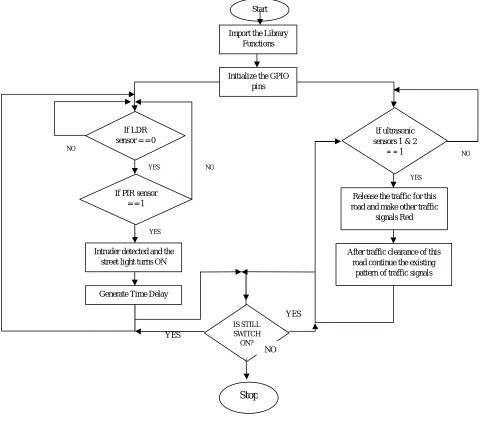
Fig 2. Flowchart for Smart Roads Start
Import the Library Functions
Initialize the GPIO pins
If ultrasonic sensors 1 & 2
= = 1 If LDR
sensor = = 0
If PIR sensor = = 1
Intruder detected and the street light turns ON
Generate Time Delay
Release the traffic for this road and make other traffic
signals Red
After traffic clearance of this road continue the existing
pattern of traffic signals
YES
YES NO
NO
YES
NO
Stop
IS STILL SWITCH ON?
YES
VI. EXPERIMENTAL RESULTS
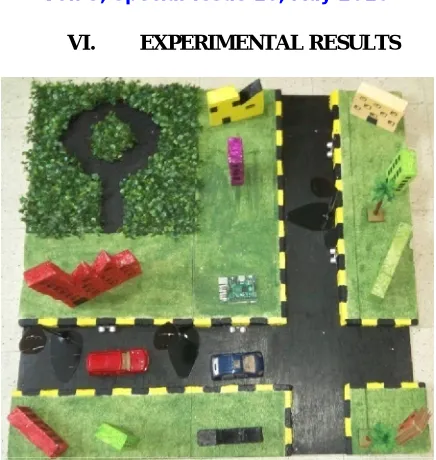
Fig 3. Top view of Model with Raspberry Pi 2 and ultrasonic sensors
Fig 3 shows the top view of the model with its components such as Raspberry Pi 2, Ultrasonic Sensors, LDR sensors, PIR sensors, LED lights.
Fig 4. Interfacing of Raspberry Pi 2 with Traffic signals
VII. CONCLUSION
Road traffic congestion is a central problem in most developing countries. Most urban areas have poorly managed traffic networks with several traffic hot-spots or potential congestion areas. In this paper, we study the problem of road traffic congestion in high congestion hot-spots in developing regions.
Ultrasonic sensors are used to detect the intensity of the vehicles which sends the signal to RASPBERRY PI 2 about the traffic congestion. Our hope is that localized de-congestion mechanisms are potentially easier to deploy in real-world settings and can enhance the traffic flow at critical hot-spots in road traffic networks. We believe that this represents only a first step in the development of low-cost, deployable strategies for alleviating congestion in developing regions. The future work lies towards generating electricity by developing smart speed breakers in roads. We can also implement charging system for electric vehicles in traffic signals by deploying induction coil. The paper discussed a means to detect and curb congestion in a localized setting. Although, the solution is feasible to affect local congestion, it is still not able to curb the congestion extending for miles due to the localized focus of the approach.
ACKNOWLEDGEMENT
The authors are grateful to Mr. Venkatesh P, Head Of The Department, Telecommunication Engineering, Don Bosco Institute Of Technology, Bangalore, Karnataka, India for his valuable support throughout the project.
REFERENCES
[1] Shabbir Bhusari, “Traffic control system using Raspberry-pi”, Global Journal of Advanced Engineering Technologies ISSN (Online), Volume 4, Issue 4- 2015, pp 413-415.
[2] K.Vidhya, A.Bazila Banu, “Density Based Traffic Signal System”, International Journal of Innovative Research in Science, Engineering and Technology, Volume 3, Special Issue 3, March 2014, pp 2218 – 2223.
[3] S.Lokesh, “An Adaptive Traffic Control System Using Raspberry PI”, International journal of engineering sciences & research Technology, IEEE conference June 2014, pp 831-835.
[4] Dietmar P. F. Möller, “Cyber-Physical Smart Traffic Light System”, Clausthal University of Technology, Institute of Applied Stochastics and Operations Research, IEEE 2015, pp 546-551
[5] Soufiene Djahel, “Reducing Emergency Services Response Time in Smart Cities: An Advanced Adaptive and Fuzzy Approach”, IEEE 2015, pp 978-986
[6] Artur Ziarmand, “Smart Road Infrastructure”, IEEE 2013, pp 13-17.
[7] Fahri Soylemezgiller, “A Traffic Congestion Avoidance Algorithm with Dynamic Road Pricing for Smart Cities”, 2013 IEEE 24th International Symposium on Personal, Indoor and Mobile Radio Communications: Mobile and Wireless Networks, pp 2571-2575.
[8] George Kiokes, “Development of an Integrated Wireless Communication System for Connecting Electric Vehicles to the Power Grid”, IEEE conf. 2015, pp 296-301.