20th International Conference on Structural Mechanics in Reactor Technology (SMiRT 20) Espoo, Finland, August 9-14, 2009 SMiRT 20-Division 6, Paper 1969
Implementation of High-Performance Concrete in the
ACR-1000
TMContainment Structure for 100 year Design Life
Homayoun H. Abrishami
1, Medhat Elgohary
1, Denis Mitchell
2,
John A. Bickley
3, R. Doug Hooton
4and William D. Cook
21
Atomic Energy of Canada Ltd ([email protected]) 2
Department of Civil Engineering and Applied Mechanics, McGill University, Montreal, Canada 3
John A. Bickley and Associates, Toronto, Canada 4
Department of Civil Engineering, University of Toronto, Canada
Keywords: High-performance concrete, Containment structure, Mix design, Construction procedure, Durability criteria, Early-age characteristics, Thermal gradients.
1
ABSTRACT
This paper provides the results of the research and development program for the concrete performance for the containment wall and dome, particularly at early ages. Performance criteria for a 100-year design life and the type of specification required to meet the performance criteria have been established.
Due to the significant thickness of the walls and dome of the containment structure, significant temperature gradients, can occur during hydration and the resulting tensile stresses may cause cracking. The long-term performance of the containment walls and dome is strongly influenced by crack development, particularly at early ages. A research and development program has been carried out in order to implement a comprehensive approach, including studies on mix design, analysis techniques, and construction procedures to reduce the early-age risk of cracking and implement the use of more durable concrete. Successful implementation of the program recommendations will enable time-effective and reliable construction of the reactor building containment structure.
Laboratory and field-trial tests for the probable range of concrete mixes have been carried out in order to predict the mechanical properties, temperature variations and risk of cracking for jump-form construction of the thick pour concrete walls and dome.
2
INTRODUCTION
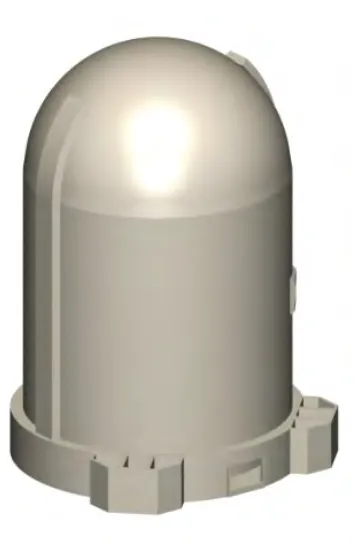
In the planning for the ACR1 (Advanced CANDU Reactor1) design, particular attention is paid to design, structural performance and constructability. The containment structure, being one of the major safety components of the plant, involves extensive design, analysis and documentation efforts. The containment structure is part of the containment system and constitutes the exterior structure of the ACR reactor building. It consists of a vertical cylindrical perimeter wall, founded on a continuous-cast concrete base, together with a hemispherical roof dome (see Fig. 1). The inside surfaces of the containment structure are lined with a carbon steel liner. During the construction the steel liner is utilized as formwork for the inner walls and dome of the containment structure.
The perimeter wall and dome are prestressed with greased post-tensioning tendons in the horizontal and vertical directions as well as reinforcing bars in both directions. The base slab for ACR-1000 containment structure is a one-piece reinforced concrete slab, approximately 64.0 m in diameter and 3.0 m thick.
The ACR-10001 reactor (Advanced CANDU Reactor) is designed for a 100-year plant life including a 60-year operating life and an additional 40-year decommissioning period. It is evident that the service life performance relies not only on the Ageing Management Program (AMP), but is also strongly influenced by the design strategy and material characteristics, Abrishami et al. (2008). It is believed that improved performance during the design life of a structure can be achieved by implementing durability design criteria and improving material characteristics.
Modern building codes are increasingly based on performance specifications for durability (Performance Based Design), Bickley et al. (2006). In the development of the ACR-1000, particular attention is paid to specifying structural and long-term durability performance as part of the technical requirements. Many recent innovations in advanced concrete materials technology have made it possible to produce modern concrete with exceptional performance characteristics. The concrete performance strongly relies on four key factors a) material ingredients, b) mix design, c) concrete production and (d) placement and curing.
Figure 1. ACR-1000 containment structure
3
ACR RESEARCH AND DEVELOPMENT PROGRAM
In the ACR project development, an R&D program was established in order to implement this new approach, including studies on mix design, analysis techniques, and construction procedures to reduce the risk of cracking at early ages. The long-term performance of the containment structure is strongly influenced by crack control, particularly at early ages. Successful implementation of the program recommendations will enable high performance and time-effective construction of the reactor building base slab, containment wall and dome. Implementation of a continuous-cast concrete base slab has already been addressed in an earlier phase of the research program, Abrishami et al (2007).
4
GUIDANCE, ACCEPTANCE CRITERIA AND DESIGN REQUIREMENTS FOR
100-YEAR DESIGN LIFE
The ACR containment structure is designed utilizing High-Performance Concrete (HPC) in order to achieve 100-year service life. In order to achieve this, each of the specific durability concerns needs to be addressed in the design. These include taking the following special measures:
• minimising cracking and leakage due to early-age temperature gradients during hydration, • minimising shrinkage,
• enhancing resistance to freezing and thawing,
• ensuring that no amount of deleterious alkali-aggregate reaction is allowed, and, • achieving low permeability.
These and other issues are addressed in the following sections. A number of stated goals can be addressed by using significant levels of cement replacement by supplementary cementing materials, such as fly ash or slag, and by paying special attention to mix proportioning, placement, and curing methods. The design compressive strength for the walls and dome of the containment structure is 50 MPa at an age of 91 days. This age would permit the use of a concrete mix with a high Supplementary Cementing Material (SCM) content.
A combination of a normal or mid-range water reducer combined with a high-range water reducer (superplasticiser) and an air-entraining agent is used to optimise the water content to reduce shrinkage and creep. The air content and hardened air-void system requirements of the CSA-A23.1 (2004) standard are used as targets to achieve high resistance to freeze-thaw attack.
5
EARLY-AGE CHARACTERISTICS OF CONCRETE
5.1 Laboratory Trials
The key in choosing a suitable concrete mix is to achieve the desired design compressive strengths at both form release and at the specified age, while minimizing the heat rise, the maximum concrete temperature and the thermal gradient in the containment structure. For the concrete casting process, the mix must be pumpable. Due to winter exposure conditions, during and after construction of the walls and dome, an air entrained mix is recommended. To achieve the 100 -year plant life a durable concrete is required.
Preliminary testing of the design mixes was carried out to finalize the probable range of concrete mixes for further testing. The preliminary design mixes involve a wide range of concrete mixes made with blended hydraulic cements similar to practical experiences on a number of constructed projects.
5.2 Field Trials
supplementary cementing materials. Mixes 2 (slag concrete) and 3 (fly-ash concrete), however, represent a family of mixes that can be formulated by replacing significant percentages of Portland cement with Supplementary Cementing Materials (SCMs). The mixes tested confirm the beneficial effects on temperature effects achieved by using SCMs. They are critical to achieving minimal heat rise (and fall) and limiting temperature gradients. By these measures even mass concrete placements can be made without any significant cracking.
TC4
TC3
TC2 TC1 - Ambient
TC5
250
250
1000 mm
50 mm foam board 13 mm plywood
~15 mm
Figure 2. Thermocouple locations in one-meter field trial cubes of concrete
15 25 35 45 55 65 75
0.0 1.0 2.0 3.0 4.0 5.0 6.0 7.0 8.0
Time, days
T
e
m
p
e
ra
tu
re
,
o C
Mix 1 - Reference Concrete
Mix 2 - 50% Slag Concrete
Mix 3 - 50% Fly Ash Concrete
Figure 3. Measured temperatures near center of insulated cubes for different concrete mixes.
The results from the temperature measurements are summarized in Table 1. The maximum values of the peak temperatures, temperature rise and temperature gradients are given in this Table.
temperature and the maximum concrete internal temperature is limited to 20oC, CSA A23.1 (2004). In a practical sense all the mixes meet this requirement.
It is noted that in the field trials only two layers of polyethylene sheets were provided on the top surface. In an actual project, the maximum gradient could be reduced by increasing the insulation on the top surface.
Table 1. Summary of measured temperatures Mix 1 Reference Concrete
Mix 2 Slag Concrete
Mix 3 Fly-Ash Concrete Initial Temperature
after casting
31.4 oC 26.8 oC 28.4 oC
Peak “Adiabatic” Temperature
68.5 oC @ 0.77 days 61.0 oC @ 1.56 days 62.0 oC @ 4.40 days
Maximum Temperature Rise
37.1 oC 34.2 oC 33.6 oC
Maximum Gradient 19.0 oC 20.7 oC 16.8 oC
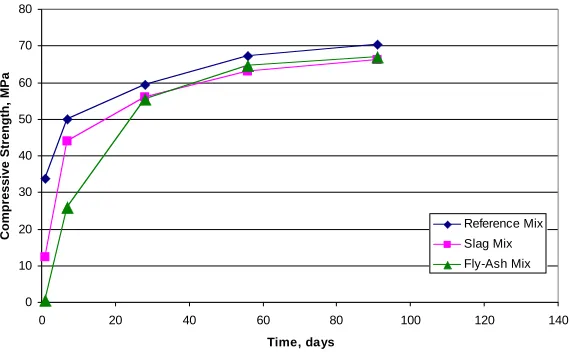
Figure 4 shows the variations of the compressive strength gain versus time in days for the three field trial mixes. It is noted that the Fly-Ash mix has a very low compressive strength at early ages and hence would not be suitable for early form removal. Figure 5 shows the average values of shrinkage (in percent) versus time in days for the three field trial mixes. It is noted that CSA A23.1-04 gives an optional limit for low shrinkage concrete of 0.04% at 28 days. While all of the mixes meet this requirement at 28 days, it is clear that the Slag mix has lower shrinkage values at early ages.
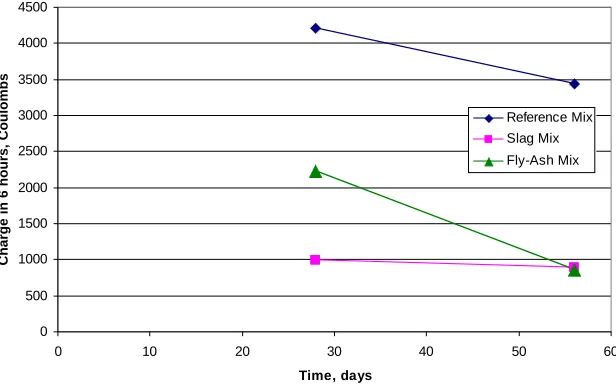
Figure 6 shows the average values of rapid chloride permeability versus time in days for the three field trial mixes. As expected, the measured coulomb values decreased with increasing age, due to continued hydration. It is noted that both the Slag and Fly-Ash mixes have values less than 1000 Coulomb charge in 6 hours at an age of 56 days. For concrete exposed to chlorides or other extreme environments (exposure class C-XL), CSA A23.1-04 requires that the chloride penetrability test results be less than 1000 coulomb at an age of 56 days.
0 10 20 30 40 50 60 70 80
0 20 40 60 80 100 120 140
Time, days
C
o
m
p
re
s
s
iv
e
S
tr
e
n
g
th
,
M
P
a
Reference Mix Slag Mix Fly-Ash Mix
0.000 0.010 0.020 0.030 0.040 0.050 0.060 0.070
0 25 50 75 100 125 150 175 200 225
Time, days S h ri n k a g e , % Reference Mix Slag Mix Fly-Ash Mix
Figure 5. Comparison of average values of shrinkage versus time for the three mixes.
0 500 1000 1500 2000 2500 3000 3500 4000 4500
0 10 20 30 40 50 60
Time, days C h a rg e i n 6 h o u rs , C o u lo m b s Reference Mix Slag Mix Fly-Ash Mix
Figure 6. Comparison of average values of rapid chloride permeability versus time for the three mixes.
6
CONSTRUCTION PROCEDURE
6.1 Execution plan
The containment structure execution plan will consider both prescriptive and performance-based specifications. The performance criteria for durability to achieve a 100-year service life of the ACR containment structure will be specified. Material selection and concrete properties shall meet desirable thermal characteristics and still meet the strength specified. The two SCMs that would be considered for the walls and dome concrete mix are granular slag and fly ash. As stated earlier, the use of either fly ash or slag reduces the temperatures and temperature gradients.
Construction issues
For a project of this magnitude, involving the first construction of an ACR reactor, only prequalified contractors with successful previous experience with large-scale heavy industrial construction and large-pour concrete projects will be allowed to bid. The selected concrete supplier shall ensure continuous production with a backup plant available at all times in case of a breakdown or maintenance. A high efficiency pre-mix plant arrangement with the required production capacity shall be used. Criteria for Quality Control (QC)/ Quality assurance (QA) shall be specified in the quality control plan for site testing facilities, concrete production, qualification of site engineers, operators and other required personnel.
6.2 Concrete placing
The most efficient way of placing this volume of concrete and delivering it to the changing locations required to keep all vertical and horizontal surfaces from setting prematurely is by the use of pumps and truck mounted booms. These can be obtained with a 33-m reach and with a boom that can cover a large area of the base overlapping each other. Three such pumps, stationed at 120o intervals around the perimeter of the reactor building would be required to cover the area.
6.3 Instrumentation
Thermocouples will be installed in the walls and dome to determine temperatures and temperature gradients. At each location a thermocouple will be placed 50 mm from the outer surface, at mid-thickness and 50 mm from the inner surface. Sets of these thermocouples will be installed in the centre of the slab and at four locations around the perimeter at 90o intervals. Ambient temperatures inside and outside the containment structure will also be measured. Data loggers will take readings at 10 minute intervals so that the progress of the thermal history can be followed.
6.4 Special requirements for formwork due to extended set time of low temperature mix
It is estimated that concrete head will rise about 150 mm /hour and the setting time of the concrete will be at least 10 hours. Formwork will need to be designed to resist the resulting pressures taking into account the actual setting time decided by the construction team.
6.5 special requirements for hot-weather and cold-weather concreting
Special requirements for both hot-weather and cold-weather concreting are given for permissible concrete temperatures, concrete protection, curing and additional requirements for mass concrete given in CSA A23.1 (2004).
6.6 Inspection
Despite all the measures to avoid concrete cracking, the complexity of the material/construction process, thermal stresses and autogenous and other types of shrinkage, may result in some cracking. Therefore, after form removal, the wall and dome shall be closely inspected for any cracks and defects. The location and size of any cracks and defects will be logged and the need for any remedial action will be determined by the Engineer.
6.7 Quality Assurance (QA)
7
CONCLUSION
This paper provides the results of the research and development program for the concreting of the containment wall and dome. The mixes tested confirm the beneficial effects on temperature effects achieved by using SCMs. The use of SCMs is critical to achieving minimal heat rise (and fall) and limiting temperature gradients. Field trial tests and analytical studies showed that it is possible to minimise the risk of cracking during hydration.
Based on the results of these field trials it is clear that the Slag Mix is superior to the Reference Mix and the Fly Ash Mix. The Slag Mix has improved thermal characteristics than the other two mixes and a better early strength gain than the Fly Ash Mix (for jump form construction). The Slag Mix meets the rapid chloride ion permeability requirement (< 1000 Coulombs) at the earliest age compared to the other two mixes and has lower shrinkage values than the Reference and Fly Ash Mixes at early ages.
The development program provides the necessary recommendations and guidance on mix design ranges and construction techniques to build the containment structure including the wall and dome of the ACR-1000 reactor building.
REFERENCES
Abrishami, H.H., Ricciuti, R., and Elgohary M. (2008). “Plant Life Management of the ACR-1000 Concrete Containment Structure”, CSNI Workshop on Ageing Management of Thick-Walled Concrete Structures, Including In-service Inspections, Maintenance and Repair, Instrumentation Methods and safety assessment in View of Long-Term Operation., NEA/SEN/SIN/IAGE(2008)7, Nuclear Energy Agency, OECD, Prague, Czech Republic, October 1-3, 2008.
Abrishami, H. H., Elgohary, M., Mitchell, D., Bickley J. A., Hooton, R. D., and Cook W. D. (2007). “Implementation of Continuous-Cast Concrete Base Slab for Future CANDU NPP”, SMiRT 19, International Conference on Structural Mechanics in Reactor Technology, August 12-17, 2007, Toronto, Canada.
Bickley, J.A., Hooton, R.D., and Hover, K.C. (2006). “Performance Specifications for Durable Concrete”, Concrete International, September 2006, pp. 51-57.
CSA-A23.1-04 (2004). “Concrete Materials and Methods of Concrete Construction”, Canadian Standards Association, Mississauga, ON.