Cloud Computing and Agile Organization Development
Bogdan GHILIC-MICU, Marian STOICA, Cristian Răzvan USCATU The Bucharest University of Economic Studies
[email protected], [email protected], [email protected]
In the 3rd millennium economy, defined by globalization and continuous reduction of natural resources, the economic organization becomes the main actor in the phenomenon of transfor-mation and adaptation to new conditions. Even more, the economic environment, which is closely related to the social environment, undergoes complex metamorphoses, especially in the management area. In this dynamic and complex social and environmental context, the eco-nomic organization must possess the ability to adapt, becoming a flexible and agile answer to new market opportunities. Considering the spectacular evolution of information and communi-cations technology, one of the solutions to ensure organization agility is cloud computing. Just like the development of any science requires adaptation to theories and instruments specific to other fields, a cloud computing paradigm for the agile organization must appeal to models from management, cybernetics, mathematics, structuralism and information theory (or information systems theory).
Keywords: Cloud Computing, Agile Development, Enterprise Architecture, Project Manage-ment, Agile Methodologies, Information and Communications Technology (ICT)
Objectives
This analytical-methodological and theo-retical-practical endeavour constitutes an original scientific incursion into the philoso-phy and theory of cloud computing from the perspective of turning it into a real framework for ensuring agility in the development of eco-nomic organizations. Also, theoretical ap-proach is supported by highlighting practical aspects regarding cloud computing market and the influence big actors of this market may have on the success of a cloud computing paradigm for organization development. The original approach brings forth the emergent production factors of the knowledge society, digital economy and globalization phenome-non. They include information, organization culture, and enterprise architecture in terms of business, information and technology.
2 Cloud computing philosophy
In the spring of 2001, in Claremont, Califor-nia, Peter F. Drucker – considered one of the founders of modern science of management by business specialists and academics – talk-ing about the “challenge ahead”, said “we may almost certainly say that the challenges we will have to face in the tomorrow’s condi-tions are of management nature and concern
the individuals. … those tasks cannot be per-formed by the state, but only by individual or-ganizations – lucrative enterprises and non-governmental non-lucrative organizations – and individuals” [1]
Tomorrow’s economic conditions invoked by Drucker are visible even today and the social-economic entities mentioned are indeed the economic organizations and the individuals. The management philosophy of the contem-porary organization includes both global mar-ket agility and modern paradigms that target directly the human resource (as primary pro-duction factor), like the anthropocentric model. Even more, when the agility approach is supported by the use of information and communications technology instruments, cloud computing becomes its structural foun-dation.
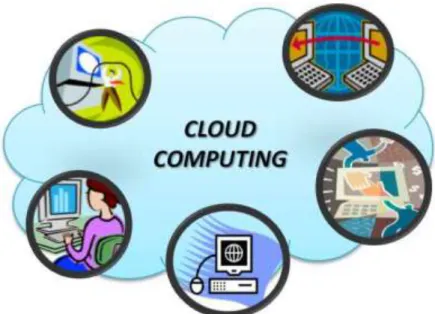
Cloud computing is a relatively modern ICT concept and represents an aggregation of dis-tributed services for computation, applica-tions, data access and storage. The cloud com-puting philosophy assumes that the entire en-semble is hidden to the user, which does not know the location and physical configuration of the systems that provide the services. Ter-minologically, cloud computing derives from a symbolic graphical representation of the
1
global network as a cloud, used when tech-nical details of the internet may be ignored (Figure 1).
In other words, cloud computing represents one of the significant tendencies of ICT evo-lution, bringing a new model for provision, management and security within the organiza-tion. Currently, there is no universally ac-cepted definition of cloud computing. The na-tional Institute of Standards and Technology
(NIST) and Cloud Security Alliance (CSA) present a base for the definition, describing cloud computing as a model that provides ac-cess on demand, through a network to an array of shared configurable information resources (like networks, servers, storage space, appli-cations and services). These are available im-mediately and with little management effort or involvement from the service provider. [2]
Fig. 1. Cloud computing concept The main attributes that support cloud
compu-ting concept and philosophy from the perspec-tive of using it as an infrastructure for agile organization development [3] are:
abstract computation and information technology service oriented approach; virtual, dynamic, scalable and massive
in-frastructure;
shared, configurable, flexible and dy-namic resources;
access via internet to all devices;
platform with little or no management at all (self-managed);
employment model based on self-service; billing based on consumption
(meas-ured/metered service).
The latest professional studies available high-light that over 70% of the economic organiza-tions consider cloud computing a real techno-logical option, while about 70% consider adopting it will lead to the flexibility of the
business. Even more, over 60% of the organi-zations consider the cloud computing para-digm will lead to increased reaction speed of the business to the new market conditions, while 65% estimate that it will lead to in-creased focus on the main aspects of the busi-ness. [4]
Although there is a real growth trend, we may say that currently very few organizations use cloud computing, mainly due to lack of cor-rect understanding of the architecture, pay-ment model, different business environpay-ment and specific elements of each organization. [5]
3 Cloud computing technology
Built on the attributes supporting its philoso-phy, cloud computing technology consists of the convergence of five main vectors [6]: on demand service (the client may unilaterally re-serve cloud resources); remote network access (heterogeneous clients access cloud resources
through global internet); shared resources (cloud provider dynamically (re)allocates re-sources to clients according to their demands); capacity to scale resources (rapid scaling in both directions of cloud resources available to clients); service metering (implementation of a pay-per-use system).
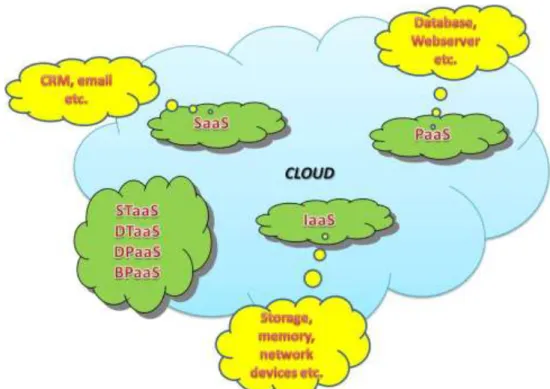
From the technological perspective of the pro-vided service, NIST defines three main mod-els of specific cloud computing services (this approach is unanimously accepted): software as service (SaaS), platform as service (PaaS) and infrastructure as service (IaaS) – Figure 2. Saas – Software as a service – is a model that allows the use of applications through a cloud infrastructure; the applica-tions are available through heterogeneous de-vices, using a web-based interface (for exam-ple webmail); users cannot control or manage the infrastructure offered by the cloud pro-vider.
Being one of the most used cloud services, the list of applications that may work in SaaS re-gime includes enterprise services (ERP), digi-tal signature, CRM applications, management applications (specific to agile organizations – financial, human resources, sales, project management), search instruments etc. This model is recommended when the data is con-fidential to the organization.
PaaS – Platform as a Service – is a model that allows users to develop or use ap-plications using programming languages pro-vided by the cloud or created by the user; ac-cess to existing or created applications as well as platform configuration elements/services (session management, device integration, test-ing environments, content management etc.) can be controlled.
In this model the applicability is limited con-sidering application portability or the need to adjust the hardware-software combination to improve application performance. The model
is useful for developing collaborative solu-tions by using cloud shared resources.
IaaS – Infrastructure as a Service – is a model that provides clients the possibility to reserve processing, storage, network re-sources (which may be used to run any soft-ware, including operating systems).
Cloud clients/consumers do not control or manage the cloud infrastructure but control the operating system, storage space, installed applications and some network components (like computer-level firewalls). Services available in this model include: server host-ing, web server, operating systems, bandwidth reservation etc. Generally, IaaS is employed when the organization does not want to invest in infrastructure and the growing business needs require significant ICT resources. Beyond the NIST standard, with certain limi-tations and on a smaller scale, considering the rendered service, there are four sub-types of cloud computing:
STaaS – STorage as a Service; DTaaS – DeskTop as a Service; DPaaS – Data Protection as a Service; BPaaS – Business Process as a Service. Considering the type of infrastructure hosting, there are four ways cloud computing is imple-mented: public cloud (infrastructure is pro-vided to the clients, but it is owned by the cloud service provider); community cloud
(shared infrastructure between several organi-zations and supports a community with com-mon interests; managements is carried out by the community or an external entity); private cloud (the infrastructure is exclusively used by a single organization, management being provided internally or by an external organi-zation); hybrid cloud (the infrastructure is composed by two or more public, community or private clouds interconnected to ensure the portability of data and applications).
Fig. 2. Types of services provided by cloud computing Each organization chooses from the diversity
of cloud solutions available today the one that suits best its interests. From the point of view of economic organization agility, main choices are private or hybrid cloud (in spite of significantly higher costs).
The factors that significantly influence the de-cision to adopt cloud on a large scale, and im-plicitly the ripening of this concept, which is bound to revolutionize business environment in the near future, are security concerns, en-suring conformity with current accepted in-teroperability standards, integration of cloud service with internal organization systems. 4 Cloud computing market
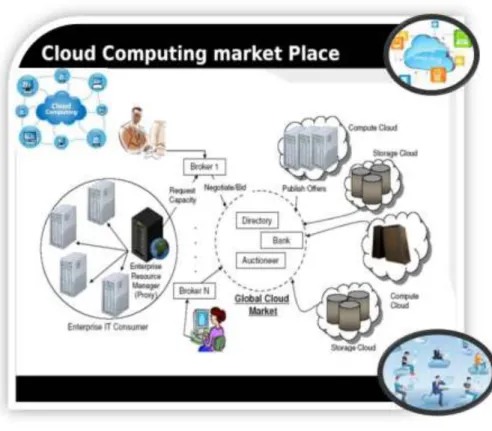
Initially, cloud computing solutions were de-signed for small and medium organizations, providing them with a way to increase agility with low costs. Lately, more and more large organizations analyze the possibility of quick integration of new solutions and use of cloud
computing. Still, cloud computing remains best suited for small and medium organiza-tions (Figure 3).
According to statistics provided by independ-ent consultants ( http://talkin- cloud.com/talkin039-cloud-top-100-cloud- services-providers/top-100-cloud-services-providers-list-2013-ranked-0, by Joe Pantieri, July 30th, 2013) top ten cloud computing ser-vice providers (by sales) are:
1. SalesForce
2. Amazon (Amazon Web Services – AWS) 3. Microsoft 4. Oracle 5. Google 6. SAP 7. IBM 8. Terremark 9. Rackspace 10.NetSuite
Fig. 3. Cloud computing market Remarkably, 9 of the first 10 providers are
from USA (with a global operation space) and only 1 (SAP) is from Europe. Regarding the type of services provided, these companies rank higher or lower, in a dynamically chang-ing hierarchy. Romanian market has a slow evolution. The state of “Romanian cloud” is presented in a study regarding the adoption of cloud computing in Romania (http://www.clubitc.ro/cloud-solutions/de-ce- e-important-studiul-cio-council-pentru-ana-liza-adoptiri-cloudului-in-romania/, by Radu Crahmaliuc, IT analyst, July 2013):
39% of organizations don’t use any type of cloud application or service;
7% use public cloud (due to very low costs);
36% use private cloud solutions (due to high security);
18% use hybrid services.
One of the key findings is that over 60% of the organizations use cloud services and the growth rate is about 10%.
5 Organization agility: limits of cloud com-puting model
In a continuously changing global market, or-ganization agility is a key element in gaining strategic advantage. This may be ensured by achieving an agile architecture of the organi-zation, lowering the time for development of new processed and increasing flexibility of existing processes. The need for agility and ensuring the versatile character of the organi-zation are premises for lowering the time to answer client requests and extend the client pool. Thus, the organization may account lower costs for adaptation to market changes and therefore increased revenue.
Agile organization requires agile architec-tures, techniques, methods and instruments in order to react fast to change requirements. The path towards an agile business requires con-tinuous control of own business process dy-namics, human resources and informational system. The literature and economic practice records three main approaches (still in use to-day) for achieving organization agility:
Business Process Management (BPM) to orchestrate independent functionalities; Service Oriented Architecture (SOA) for
the architecture of design and implemen-tation of these functionalities;
Decision Management (DM) for manage-ment of organization decisions.
In the context of cloud computing paradigm – as an original element of scientific research – the enterprise architecture must be perceived as a rigorous description of its structure, de-composition in subsystems, relations between
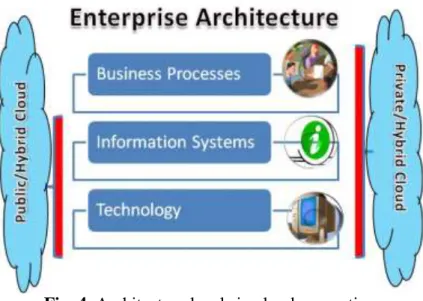
systems, relations with the external environ-ment, and principles that must be observed during design and evolution of the organiza-tion. There are three architectural levels for a level 21st economic organization: business ar-chitecture, information architecture and tec-hnological architecture. Considering the mea-ning of each architectural level, we can fiind significant elements of the cloud computing paradigm at least in the informational and tec-hnological levels (Figure 4).
Fig. 4. Architecture levels in cloud computing Thus, the business architecture will
exhaust-ively and systematically describe the main business processes of the organization and the information architecture will describe the ap-plications, data and the way they integrate. Technological architecture concerns technol-ogies accepted for operating platforms, net-works, various applications, collaboration, data representation and manipulation, integra-tion, security and systems management. Beyond the positive aspects of the cloud com-puting paradigm for agile organization devel-opment, we must consider the limitations of this model. They are mainly related to confi-dentiality issues. Once the data and applica-tions are placed in a cloud, there is a risk that the parties that have access (cloud computing providers for example – software, hosting, and communications) will easily monitor every operation (unfortunately there are persons with malicious intents). Even more, there are legal risks: for example, not knowing where
the business data is physically stored may lead in involuntary export/import of data or soft-ware. What is legal in a country (national leg-islation) may be illegal where the data is stored.
Also, the organization that adopts cloud com-puting may be exposed to security risks - there is a significant number of risks assumed when the business data are “somewhere”, on a hard disk in an unknown country, where per-sons beyond control may access them. There are also availability problems: to a certain ex-tent, redundancy may prevent it and ensure ac-cess to data at any moment, but there may be cases when the cloud computing provider can be forced to fully stop the operations (bank-ruptcy, official inquire etc.) completely cut-ting the organization from accessing its own data and applications. Maybe future solutions will erase these limitations and concerns.
6 Organization agility through cloud com-puting
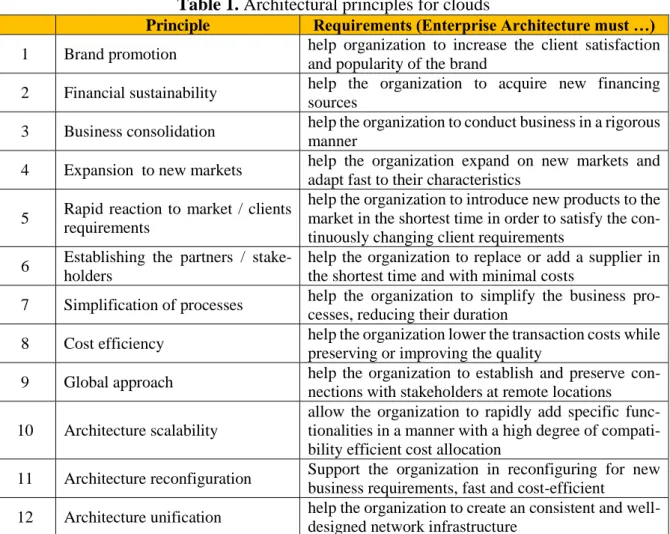
Implementation/adoption of the proposed cloud computing paradigm to achieve eco-nomic organization agility must be carried out within the boundaries of the architecture prin-ciples (table 1), which concern mainly the quality standards (for management, hardware, software etc.). Also, an important role belongs to the specific frameworks – descriptions of the architecture components as well as exter-nal components belonging to the environment where the architecture is designed, developed and implemented (clients, market, industry, opportunities, competition, authorities).
Cloud service models (as form of implemen-tation) must be tuned to the specifics of archi-tecture models, in terms of principles, ser-vices, standards, concepts, components, visu-alising models and configurations). Among the architectural models the following stand out: Zachman model as taxonomy for business information systems (patented model); TO-GAF (The Open Group Architecture Frame-work) as model for organization/owner; FEAF (Federal Enterprise Architecture Framework) and DoDTRM (Department of Defense Technical Reference Model) for de-fense industry [7].
Table 1. Architectural principles for clouds
Principle Requirements (Enterprise Architecture must …)
1 Brand promotion help organization to increase the client satisfaction and popularity of the brand
2 Financial sustainability help the organization to acquire new financing sources
3 Business consolidation help the organization to conduct business in a rigorous manner
4 Expansion to new markets help the organization expand on new markets and adapt fast to their characteristics
5 Rapid reaction to market / clients requirements
help the organization to introduce new products to the market in the shortest time in order to satisfy the con-tinuously changing client requirements
6 Establishing the partners / stake-holders
help the organization to replace or add a supplier in the shortest time and with minimal costs
7 Simplification of processes help the organization to simplify the business pro-cesses, reducing their duration
8 Cost efficiency help the organization lower the transaction costs while preserving or improving the quality
9 Global approach help the organization to establish and preserve con-nections with stakeholders at remote locations 10 Architecture scalability
allow the organization to rapidly add specific func-tionalities in a manner with a high degree of compati-bility efficient cost allocation
11 Architecture reconfiguration Support the organization in reconfiguring for new business requirements, fast and cost-efficient
12 Architecture unification help the organization to create an consistent and well-designed network infrastructure
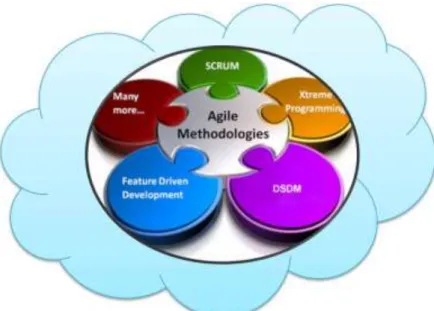
Adoption of / migration to cloud computing must be attuned to the business development tools. Among them, in the context of agile de-velopment, an important role belongs to the agile application development and economic project management (Figure 5). Most popular methodologies are:
Scrum
eXtreme Programming (XP) Crystal methodologies
Dynamic Software Development Model (DSDM)
Feature Driven Development (FDD) Lean Software Development (LSD)
Fig. 5. Agile methodologies under cloud computing No matter what cloud implementation is
cho-sen (public, private, hybrid), application of agile methodologies may be managed through specific open source software. There are a lot of available such software, among some are based on cloud computing, like OnTime from AxoSoft (www.axosoft.com), which imple-ments Scrum under Windows, MacOs, Linux and ensures functional web in IE7, FireFox2, Safari3 and Chrome.
Another solution that implements Scrum and XP agile project management is provided by www.sprintometer.com as freeware (devel-oped by practitioners in agile projects); it is simple, fast and user friendly. The features of this software make it easy to maintain an up-dated Sprint Backlog (features to be achieved in the current sprint/iteration/step), while providing a better vision on the team progress. 7 Conclusions
This paper is an original approach to the adop-tion of cloud computing paradigm in order to achieve economic organization agility in a continuously changing global market. In the hostile environment of the information and knowledge society the economic organiza-tion, as main actor of the global economic play, must adapt on the fly by flexibility/agil-ity/versatility both for development and, mostly, for survival. The theory proposed and
applied through the means of agile instru-ments, architectures and methodologies joins consecrated solutions for business intelligence mentioned in the paper: BPM, SOA and DM. beyond theoretical aspects, we highlight con-crete directions for analysis, design and im-plantation of the cloud framework as support for business stimulation and gaining strategic advantage on the market. The proposed model highlights the limitations of the cloud compu-ting, which the authors believe will be over-come in the near future.
References
[1] The Essential Drucker - Selecție din lu-crările de management ale lui Peter F. Drucker, Ed.Meteor Press 2010, ISBN 978-973-728-488-4
[2] W. Jansen, T. Grance, NIST Guidelines on Security and Privacy in Public Cloud Computing, January 2011, https://cloudsecurityalli ance.org/down- load/nist-guidelines-on-security-and-pri-vacy-in-public-cloud-computing/, accesat oct. 2014
[3] M. Mircea, B. Ghilic-Micu, M. Stoica, Combining Business Intelligence with Cloud Computing to Delivery Agility in Actual Economy, Journal of Economic Computation and Economic Cybernetics Studies and Research, Vol. 45, nr. 1/2011, pp. 39-54, ISSN 0424-267X
[4] Avanade, 2009 Global Survey of Cloud Computing, http://www.avanade.com/up- loaded/pdf/thoughtleadership/cloudsur-veyexecsum, mary810844.pdf, 2009, ac-cesat oct. 2014
[5] S.C. Misra, A. Mondal, Identification of a company’s suitability for the adoption of cloud computing and modelling its corre-sponding return on investment, Mathe-matical and Computer Modelling 2010
[6] D.E.Y. Sarna, Implementing and Develop-ing Cloud ComputDevelop-ing Applications, Auer-bach Publications, 2010
[7] M. Stoica, C.N. Bodea, B. Ghilic-Micu, M. Mircea, Managementul sistemelor in-formaționale, ASE Bucharest, 2012 [8] R. Buyya, C. Vecchiola, S.T. Selvi,
Mas-tering Cloud Computing Foundations and Applications Programming, Waltham: Elsevier Inc., 2013
Bogdan GHILIC-MICU received his degree on Informatics in Economy from the Academy of Economic Studies Bucharest in 1984 and his doctoral degree in economics in 1996. Between 1984 and 1990 he worked in Computer Technology Institute from Bucharest as a researcher. Since 1990 he teaches in Academy of Economic Studies from Bucharest, at Informatics and Cybernetics Economy Department. His research activity, started in 1984 includes many themes, like computers programming, software integration and hardware test-ing. The main domain of his last research activity is the new economy – digital economy in information and knowledge society. Since 1998 he managed over 25 research projects like Sys-tem methodology of distance learning and permanent education, The change and modernize of the economy and society in Romania, E-Romania – an information society for all, Social and environmental impact of new forms of work and activities in information society.
Marian STOICA received his degree on Informatics in Economy from the Academy of Economic Studies, Bucharest in 1997 and his doctoral degree in economics in 2002. Since 1998 he is teaching in Academy of Economic Stud-ies from Bucharest, at Informatics and Cybernetics Economy Department. His research activity, started in 1996 and includes many themes, focused on man-agement information systems, computer programming and information soci-ety. The main domains of research activity are Information Society, E-Activi-ties, Tele-Working, and Computer Science. The finality of research activity still today is repre-sented by over 70 articles published, 20 books and over 30 scientific papers prerepre-sented at na-tional and internana-tional conferences. Since 1998, he is member of the research teams in over 20 research contracts with Romanian National Education Ministry and project manager in 5 na-tional research projects.
Cristian Răzvan USCATU received his degree on Informatics in Economy from the Academy of Economic Studies, Bucharest in 1997 and his doctoral degree in economics in 2007. In the present he is Associated Professor, PhD, currently working with the Academy of Economic Studies, Faculty of Cyber-netics, Statistics and Informatics, Department of Informatics and Cybernetics in Economy. Competence areas: computer programming, data structures. Au-thor/co-author of more than 10 books and 40 papers published in national and international journals.