Developing a Business Case for
an enhanced practice nurse
role under the Practice Nurse
Incentive Program (PNIP)
A Guide for General
Practices on Business
Case Development
Developing a Business Case for an enhanced practice nurse
role under the Practice Nurse Incentive Program (PNIP)
A Guide for General Practices on Business Case Development4 November 2011
Prepared for: Australian Practice Nurses Association Prepared by: Julian King, Ian Watts, Rita Brewerton
This publication was funded by the Australian Government, Department of Health and Ageing under the Practice Nurse Incentive Program Change Management Support Project.
The information contained in this document is provided as a guide only and is not intended to be a substitute for independent professional advice. References to any websites are provided for the user’s convenience only and do not constitute endorsement of material at those websites, or any associated organisation, product or service. The Australian Government as represented by the Department of Health and Ageing does not accept any liability for any loss or damage incurred by use of or reliance on the information contained in this document.
Any content reproduced from this report should be cited as follows:
King J, Watts I, Brewerton R. (2011). Developing a Business Case for an enhanced Practice Nurse role under the Practice Nurse Incentive Program (PNIP). Prepared for the Australian Practice Nurse Association (APNA) by Julian King & Associates Limited, Auckland.
Contents
Disclaimer: The information in this report is presented in good faith using the information available to us at the time of preparation. It is provided on the basis that neither APNA, nor the authors of the report, are liable to any person or organisation for any damage or loss which may occur in relation to taking or not taking action in respect of any information or advice within this report.
1. Introduction 3
Background 3
2. How will the PNIP directly affect my practice revenues? 5
‘Old’ practice revenues associated with the outgoing items 5 ‘New’ practice revenues under the PNIP 5 Conclusion 6
3. What opportunities does the PNIP present for our practice 7
to work differently?
Taking advantage of opportunities under the PNIP 8
Appendix A – Business case template 15
Introduction 15
Detail of proposed practice improvements 15
Implementation 16
Financial analysis 16
Supporting information (if required) 16
Appendix B – Business case scenarios 17
Introduction 17
Detail of proposed practice improvements 18
Implementation 19
Glossary
Acronym Description
AHP Allied Health Professional AHW Aboriginal Health Worker
APNA Australian Practice Nurses Association
ASGC-RA Australian Standard Geographical Classification – Remoteness Areas
BB Bulk Billing
CDM Chronic Disease Management CVD Cardio-Vascular Disease DVA Department of Veterans’ Affairs ECGs Electrocardiograms
GP General Practitioner
GPMP General Practitioner Management Plan LSL Long Service Leave
MBS Medicare Benefits Schedule
No Number
PDSA Plan Do Study Act
PIP Practice Incentive Program PM Practice Manager
PN Practice Nurse
PNIP Practice Nurse Incentive Program SWPE Standardised Whole Patient Equivalent TCA Team Care Arrangements
1. Introduction
This Guide has been developed by the Australian Practice Nurses Association (APNA), following consultation with sector experts. Its primary purpose is to assist any
member of the general practice team – whether a Practice Nurse, General Practitioner, Practice Manager or others – to understand the impact of the PNIP on their practice and develop the business case for any related practice improvements.
The Guide provides a framework for the practice to address two key questions:
• How will the PNIP directly affect my practice revenues?
Section 2 provides a framework for assessing the implications of the funding change for practice income, when the practice nurse role and associated costs remain constant.
• What opportunities does the PNIP present for our practice to work differently? Section 3provides a framework for considering options for the practice team to work in different ways that improve health services and the financial position and sustainability of the practice.
Background
The following background information was drawn from APNA member advice prepared in 2010.1 Further information, including PNIP guidelines, can be found on
the Medicare website.2
The Australian Government has recently announced a revamp to the way in which nursing in general practice is funded. This initiative will support an expanded and enhanced role for practice nurses with a new, simplified and streamlined financing arrangement.
Current funding for practice nurses through the Practice Incentives Program (PIP) Practice Nurse Incentive and six of the Medicare Benefits Schedule (MBS) practice nurse items (10993, 10994, 10995, 10996, 10998, 10999) will be redirected to this simplified, single funding stream to be administered by Medicare Australia from 1 January 2012.
General practices across Australia, accredited under the general practice standards of the Royal Australian College of General Practitioners, including those in urban areas, as well as Aboriginal Medical Services and Aboriginal Community Controlled Health Services, will be eligible for an incentive to offset the costs of employing a practice nurse, Aboriginal Health Worker or allied health professional where applicable. The incentives will be $25,000 per 1,000 SWPE3 for a Registered Nurse (who works at
least 12 hours 40 minutes per week) and $12,500 per 1,000 SWPE for an Enrolled Nurse (who works at least 12 hours 40 minutes per week) in recognition of the different skills of Registered Nurses and Enrolled Nurses.
The program will be capped at five incentives, meaning that practices will be eligible to receive up to $125,000 to support their practice nurse workforce.
1 APNA (2010) New general practice nursing funding announcement – implications for general practice nurses
2 http://www.medicareaustralia.gov.au/pnip
3 PNIP payments are based on a measure of the practice size known as the Standardised Whole Patient Equivalent (SWPE) value. The SWPE value of a practice is the sum of the fractions of care provided to practice patients, weighted for the age and gender of each patient. As a guide, the average full time GP has 1000 SWPEs per year. For more information visit http://www.medicareaustralia.gov.au/pnip
1. Introduction
The new arrangements will also include:
• Support for all accredited practices to employ an Aboriginal Health Worker (AHW) instead of, or in addition to, a practice nurse (Registered Nurse or Enrolled Nurse) • Support for practices in urban areas where an area of workforce shortage is
identified by Medicare, and Aboriginal Medical Services and Aboriginal Community Controlled Health Services to employ an allied health professional (AHP) such as physiotherapists, dietitians and occupational therapists, instead of, or in addition to a practice nurse and/or Aboriginal Health Worker
• A rural loading based on Australian Standard Geographical Classification – Remoteness Areas (ASGC-RA)
– RA 1 Major City 0% – RA 2 Inner Regional 20% – RA 3 Outer Regional 30% – RA 4 Remote 40% – RA 5 Very Remote 50%
• A one-off $5,000 incentive to support eligible non-accredited practices to become accredited
• A loading for Aboriginal Medical Services and Aboriginal Community Controlled Health Services
• Grandparenting arrangements for the first three years of the program to ensure that practices are not financially disadvantaged by the restructure of the PIP Practice Nurse Incentive and the removal of six of the MBS practice nurse items. The PNIP incentive amounts are summarised in the following table.
SWPE Minimum number of practice nurse hours per week required for full incentive payment
Incentive Amount for a Registered Nurse (or allied health professional, where applicable) Incentive Amount for an Enrolled Nurse or Aboriginal Health Worker 1,000 12 hours 40 minutes $25,000 $12,500 2,000 25 hours 20 minutes $50,000 $25,000 3,000 38 hours $75,000 $37,500 4,000 50 hours 40 minutes $100,000 $50,000 5,000 63 hours 20 minutes $125,000 $62,500
Practice nurses can play a key role in proactively supporting patients in the optimal management of their health conditions. The new arrangements will support practice nurses to undertake a broad range of activities which are not well funded under the current financing arrangements including:
• Preventative health programs and education programs • Quality chronic disease management and care coordination • Supported self-management
2. How will the PNIP directly affect my
practice revenues?
The funding change raises an immediate question for practices: How will our revenues change from 1 January 2012?
There are several layers to this question. The first step is to understand the impact of the funding change on your practice, when the practice nurse role and associated costs stay the same. To do this, you need to calculate the difference between:
1. ‘Old’ practice revenuesassociated with the PIP practice nurse incentive (if applicable) and the six MBS practice nurse items to be discontinued; and
2. ‘New’ practice revenuesassociated with the PNIP from 1 January 2012.
For the moment, we are assuming the practice configuration is remaining unchanged, so you don’t need to look at other practice revenues, or costs.
‘Old’ practice revenues associated with the outgoing items
To calculate your practice revenues from the PIP practice nurse incentive and the six MBS items to be discontinued, complete the following template.4
Item Done by Calculation4 Item no. Income
PIP Practice Nurse Incentive Payment $ Immunisations PN No/year x $11.55 10993 $ Wound care PN No/year x $11.55 10996 $ Pap smears PN No/year x $23.10 10994 $ PN No/year x $23.10 10995 $ PN No/year x $11.55 10998 $ PN No/year x $11.55 10999 $ Bulk Billing Incentive No/year x $6.75 10990 $ Bulk Billing Incentive No/year x $10.25 10991 $
TOTAL discontinued PN items $ Write the calculated amount in Box A on the next page.
‘New’ practice revenues under the PNIP
From 1 January 2012, the PNIP will consolidate funding arrangements under the PIP Practice Nurse Incentive and six of the Medicare Benefits Schedule (MBS) practice nurse items into a simplified, single funding stream. The Department of Health and Ageing and Medicare have provided a ready reckoner to estimate the incentive amount a practice may be entitled to. To access the ready reckoner, visit the following website:
http://www.medicareaustralia.gov.au/pnip
4 The annual number can either be worked out from accounting software or by estimating the number of items in an average or typical week and multiplying by 47 weeks (being the average number of weeks a nurse works over a 12-month period).
2. How will the PNIP directly affect my practice revenues?
Write the calculated amount in Box B below.
Change in practice revenues if we ‘do nothing’ Calculate the change in practice revenues as follows:
A. ‘Old’ revenues from outgoing items $
B. ‘New’ revenues under PNIP $
C. Change in practice revenues (B –A) $
Please note that these figures are annual amounts, and represent the practice nurse derived component of revenues, not total practice revenues.
If your practice’s future revenues shown in Box B are greater than current revenues in Box A, then your practice revenues will increase under the PNIP.
Additionally, grandparenting and top-up arrangements are in place to ensure no practice will be financially disadvantaged for the next three years.5 If your practice’s
future revenues shown in Box B are less than current revenues in Box A, then your current practice revenues should remain at current levels for the next three years (i.e., the amount shown in Box A). To receive grandparenting and top up payments at the current level, practices must maintain their GP and practice nurse workforce and the practice nurse/s must continue to work at least the same number of hours as are recorded in the relevant quarter of the historical period.6
If this applies to your practice, you can use section 3 of this guide to identify ways the practice can improve financial sustainability within the three-year time frame. Also, if this applies to your practice, APNA is interested in hearing from you and understanding the reasons for any reductions, as this will assist us in our efforts to monitor the impact of the PNIP.7
Conclusion
The figure you have just calculated represents the direct financial impact of the PNIP. There are many more potential benefits to the PNIP including financial and non-financial benefits of new ways of working.
The move to block funding allows the practice to more effectively utilise the practice nurse’s skills, aligned with the needs of the practice and its population rather than the availability of particular PIP and MBS items.
This, in turn, enables the whole practice team to work in different ways, to improve health services as well as the financial position and sustainability of the practice. Practices that do not review their current models of activity could miss out on these opportunities.
Section 3 provides a framework for your practice team to consider new ways of working under the new PNIP.
5 Grandparenting payments will be available for non-accredited practices that are not eligible for the incentive payment, for the first three years of the program (from 1 January 2012 to 31 December 2014) to make sure practices are not financially disadvantaged by the removal of the six MBS practice nurse items. Top-up payments will be available for accredited practices receiving the incentive payment for the first three years of the program (from 1 January 2012 to 31 December 2014) to make sure that practices that join the PNIP are not financially disadvantaged by the end of the PIP PNI and/or the six removed MBS practice nurse items.
For more information visit: http://www.medicareaustralia.gov.au/pnip
6 For more information on the historical period, please refer to the PNIP guidelines at: http://www.medicareaustralia.gov.au/pnip
3. What opportunities does the
PNIP present for our practice
to work differently?
The funding change offers a number of advantages for the practice, general practitioners and practice nurses. For example, it provides the opportunity for the practice to receive funding for aspects of the practice nurse role that have not previously been directly recognised.
A recent study8 recognised that nurses in general practice perform a number of
roles, including:
• Patient carer(e.g., immunisation, wound management, health checks, pap smears, chronic disease management, diabetes, advocacy)
• Organiser (e.g., stock management, policies, procedures, nurse-led clinics, case management, patient needs, referrals)
• Problem solver (e.g., triage, emergency care, chronic disease management, community services including allied health)
• Quality controller (e.g., accreditation, recall and reminder, PDSA9, occupational
health and safety, clinical governance)
• Educator (e.g., patient, undergraduate nursing, medical, GP registrars, GPs, peers, community, general public)
• Agent of connectivity (e.g., mentoring, partnerships, local resources, networks, patients, practice staff).
Whilst nurses as patient carer, organiser and quality controller are well established and readily recognised, the important roles such as educator and problem solver are often under-recognised. The same study identified that only 21% of the clinical activities undertaken by nurses in general practice were directly funded through Medicare.10
The PNIP provides opportunities to enhance the practice nurse role in any or all of these areas, which in turn can lead to improved:
• Health services (e.g., access and choice for patients, flexibility within the practice team, care coordination, health promotion, disease prevention, patient education)
• Health outcomes (e.g., identifying women who have missed cervical smear recalls, support for diabetes and chronic disease management)
• Practice revenues (e.g., potential to perform more clinical work)
• Professional satisfaction (e.g., working in emergent practice areas).
8 Phillips C, Pearce C, Hall S, Kljacovic M, Sibbald B, Dwan K, Porritt J, Yates R. (2009). Enhancing care, improving quality: the six roles of the general practice nurse. MJA Vol 191, No 2, 20 July 2009 http://www.mja.com.au/public/issues/191_02_200709/phi10417_fm.pdf
9 PDSA stands for Plan-Do-Study-Act, a cyclical quality improvement model based around the concept of ‘testing small changes’. www.ihi.org.
3. What opportunities does the PNIP present
for our practice to work differently?
Taking advantage of opportunities under the PNIP
When considering the opportunities presented under the PNIP, you will need to address the following overarching questions:
1. What are the opportunities for our practice to work differently and more effectively?
2. Which changes are the highest priority for our practice? 3. How will we implement the changes?
4. How will the changes affect our practice financially?
The paragraphs below expand on these four questions and provide a template for working through the steps.
Step 1: What are the opportunities for our practice to work differently and more effectively?
When considering the specific opportunities for your practice, think about the aspects of the practice nurse role that can be developed, as well as the flow-on opportunities this creates for other team members to improve the effectiveness of the general practice team overall, as well as the patient experience.
Ideally, the whole practice team should be encouraged to identify opportunities. This way, you are more likely to identify the full range of possibilities. By including all team members in discussing and prioritising opportunities, you will also increase the likelihood of the team owning the changes, leading to more effective implementation and collaboration.
The practice could also ask patients for feedback on areas for practice improvement, e.g., through a survey.
As the PNIP opens up opportunities that may not have been considered feasible before, an initial step to identify opportunities would be a brainstorming exercise. This will help to ensure no possibilities are missed.
Follow these rules for effective brainstorming:11
• Focus on quantity– generate as many ideas as possible
• Withhold criticism– suspend judgement and provide an environment where participants feel safe making suggestions
• Welcome unusual ideas– encourage the group to look from new perspectives and suspend assumptions
• Combine and improve ideas– extend or add to the ideas suggested by others.
11 Osborn, A.F. (1963). Applied imagination: Principles and procedures of creative problem solving (Third Revised Edition). New York: Charles Scribner’s Sons
3. What opportunities does the PNIP present
for our practice to work differently?
The following table provides some conversation starters.
Brainstorming questions Potential opportunities
What are the opportunities to better meet the needs of patients – e.g., access, choice?
•
What are the opportunities for the practice nurses to help the team to work more efficiently or increase the number of patients seen?
•
What are the opportunities for the practice nurses to make a greater contribution to enhancing service quality and safety?
•
What other opportunities are there to improve health outcomes, practice income or job satisfaction?
•
Step 2: Which changes are the highest priority for our practice?
Most practices won’t be able to seize all of these opportunities simultaneously – so part of developing the business case is to look at the choices and decide which are the highest priority for your practice.
Prioritising opportunities involves identifying the ‘low hanging fruit’ or applying the ‘80/20 rule’ (i.e., 80% of the effects come from 20% of the causes). The right initiative might be obvious and simple.
The most promising opportunities may need to be analysed further, to: • Clarify the specific objectives and goals of the improvement
• Describe what the new ways of working will look like – e.g., how services will be provided, by whom, where and when
• Identify the benefits of the improvement – e.g., improved access or outcomes for patients, benefits for the practice population as a whole, benefits for the practice and/or practice team
• Scope the need for the improvement – this may include considerations of: – Epidemiology (the incidence and prevalence of particular diseases in your
practice population if they are a focus of the proposed improvement, e.g., diabetes or asthma)
– Current access to relevant services, utilisation of those services
– Future demand for the services – e.g., due to population growth and/or ageing – Current service capacity and the level of capacity needed to service unmet and/or
future demand
• Outline relevant trends in best practice and policy – e.g., where the sector is heading • Outline the direction of the practice and aligning to practice goals and strategy • Outline how you will use routinely collected data to assess how the practice
Complete the following table for each of the proposed practice improvements.
Make as many copies of this table as you need: Title of potential practice
improvement • Objectives/goals • Description of proposed new model • Benefits • Assessment of need: • Epidemiology • Access/utilisation • Future demand • Current capacity • Relevant trends in practice and policy – where the sector is heading
•
Alignment to practice strategy, directions and goals
•
Monitoring and evaluation
•
Step 3: How will we implement the changes?
After prioritising your identified opportunities, it is a good idea to develop a high level implementation plan. Doing this now will help to ensure the business case is practical and affordable.
A detailed implementation plan is not necessary for a business case. However, it is a good idea to canvass the following issues at a broad level:
• What are the key (big picture) implementation stages and tasks? • Who will be responsible for implementing the changes?
• Over what time frame?
• What supporting changes will be required to practice systems/processes?
• What other activities will be needed to support the practice change – e.g., how will we communicate the changes to patients?
• What staff time and other resources will be required to support implementation? You will probably need to develop a more detailed implementation plan after the business case has been approved.
3. What opportunities does the PNIP present
for our practice to work differently?
High level implementation plan Key stages of
implementation Implementation tasks at each stage People responsible Indicative time frame
• • • • • • • • • • • • • • • • • • • • • • • •
Step 4: How will the changes affect our practice financially?
When the practice changes its configuration or the services it offers, the revenues
and costs of the practice may also change. It is important to consider these impacts to ensure the ongoing sustainability of the practice and the potential attractiveness of the proposed changes to the practice owners.
The business case should detail:
Whether, and how, the proposed practice changes will affect ongoing revenues – e.g., if enhanced practice nurse activity frees up GP time, it also reduces patient waiting times and may enable GPs to see other patients. This also generates additional revenues Whether, and how, the proposed practice changes will affect costs
The net financial impact of the proposed practice improvement costs and revenues, taking into account the funding change to the PNIP.
Impact on practice revenues
Complete the following table to estimate the impact of the changes on practice revenues. This includes any additional revenuesto the practice, and any revenue reduction associated with the changes.
Please note that the total ongoing costs are an estimate of the changein revenues (not total practice revenues) and represent an annualamount.
3. What opportunities does the PNIP present
for our practice to work differently?
3. What opportunities does the PNIP present
for our practice to work differently?
Item Done by Calculate change
in revenues12 Item no Income
Direct change in revenues due to introduction of the PNIP (as calculated in section 2, Box C): $ Additional PNIP revenues from employing additional RNs, ENs, AHWs or AHPs
(calculate at: http://www.medicareaustralia.gov.au/pnip)
Direct change in MBS derived revenue/income $ Brief Health assessments – not more than 30 mins GP & PN No/year x $56.00 701 $ Standard Health assessments – 30 mins < 45 mins GP & PN No/year x $130.10 703 $ Long Health assessments – 45 mins < 60 mins GP & PN No/year x $179.45 705 $ Prolonged Health assessments 60 mins+ GP & PN No/year x $253.60 707 $ PN Chronic disease check PN No/year x $11.55 + No.
x 10990/1 ($5.75/$8.75) 10997 $ Antenatal check GP & PN No/year x $26.25 + No.
x 10990/1 ($5.75/$8.75) 16400 $ 4 year old health checks PN No/year x $56.00 + No.
x 10990/1 ($5.75/$8.75)
10986 $
4 year old health checks GP & PN No/year x $179.45 705 $ 40 - 49 yrs at risk of Type II diabetes as identified
by Aus risk tool GP & PN No/year x $179.45 705 $ 45 - 49 at risk of CDM GP & PN No/year x $179.45 705 $
↑ 75 yrs Health Assessments GP & PN No/year x $253.60 707 $ Aboriginal and Torres Strait Islander Health Check
Follow Up PN No/year x $26.25 + No. x 10990/1 ($5.75/$8.75) 10987 $ Aboriginal Health Check GP & PN No/year x $200.20 715 $ GPMP GP & PN No/year x $133.65 721 $
TCA GP & PN No/year x $105.90 723 $
GPMP Review GP & PN No/year x $66.80 732 $ TCA Review GP & PN No/year x $66.80 732 $
Spirometry PN No/year x $19.75 11506 $
ECGs PN No/year x $30.05 11700 $
Other consultations and MBS rebateable services13 Whole of
practice various $
Direct change in PIP derived revenue/income14 $
Direct change in SIP derived revenue/income15 $
Direct change in other non MBS/SIP/PIP derived revenue/income16 $
Sum of the above = Net impact on practice revenues associated with the proposed
new ways of working $
12131415 16
12 For example, as a result of PN undertaking education activities, GPs may have time to see a greater number of patients leading to an increase in standard GP short consultations which are MBS rebateable.
13 For example, practice nurses may focus more on diabetes management and recalls for pap smears, leading to an increase in PIP income for these services.
14 For example, practice nurses may focus more on screening women aged between 20 and 69 years who have not had a cervical smear within four years, leading to an increase in SIP income.
15 For example, as a result of PN undertaking education activities, GPs may have time to see a greater number of patients leading to an increase in standard GP short consultations which are MBS rebateable.
16 Examples could include DVA income, workers compensation, charging for services and charging for products. Some practices bill patients for consumables, the utilisation of which may increase with nurse clinics. Practices may also choose to bill a non-rebateable fee for the practice nurse.
Impact on practice costs
Depending on the practice improvements proposed, there might be an impact on practice costs. Use the following templates to itemise and calculate:
Any one-off, start-up coststhat may be required – e.g., staff time required for
implementing changes; capital investments such as modifications to practice rooms, equipment, computers
How the proposed practice changes will affect ongoing operating costs– the most significant item is likely to be staff salaries/wages but you should also consider impacts on other costs such as consumables, transport, telecommunications, IT support, etc.
One-off implementation costs
Copy the stages and tasks from the implementation plan on page 11, and develop a budget for time and costs of implementation as follows.
Key stages of implemen tation
Implemen tation tasks at each stage
Capital costs (e.g., rooms,
equipment purchase)
Cost of staff time for implemen tation (e.g., hours x rates)
Other costs (e.g., consultants, travel, etc) Total one-off implementation costs • $ $ $ $ • $ $ $ $ • $ $ $ $ • $ $ $ $ • $ $ $ $ • $ $ $ $ • $ $ $ $
Total one-off implementation costs $
3. What opportunities does the PNIP present
for our practice to work differently?
Impact on the practice’s ongoing costs
Complete the following table to estimate the impact of the changes on practice costs. This includes any additional coststo the practice, and any cost savingsassociated with the changes.
Please note that the total ongoing costs are an estimate of the changein costs (not total practice costs) and represent an annualamount.
Item Calculate change in costs Estimated cost/saving
Additional costs • • • • • Cost savings • • • • •
Net impact of additional costs and any cost savings $
Change in net practice income
Complete the following table.
Totals from above Amount
A. Change in practice revenues $ B. Change in ongoing costs $
C. Change in net practice income (A–B) $
If the amount shown in Box A is greater than the amount in Box B, then the amount in Box C is the expected increase in net practice income from the changes.
If the amount in Box A is less than Box B, the amount in Box C is the expected
reduction in net practice income from the changes.
3. What opportunities does the PNIP present
for our practice to work differently?
Purpose of this template
If you need to prepare a written business case for practice improvements, this template suggests a structure of headings and the general content that should be included. This template can be modified to suit the individual circumstances of your practice and business case.
Introduction
This document presents a business case for XYZ Practice to develop its services and configuration in response to the Practice Nurse Incentive Program (PNIP).
It has been estimated that for XYZ Practice, the funding change will increase our practice nurse derived revenues by $xxx per annum. In addition, further net revenues of $xxx may be achieved if we reconfigure our services as outlined in this business case. Furthermore, reconfiguring our services as outlined in this business case leads to improved patient outcomes as well as non-financial benefits such as improved use of the general practice team overall and professional satisfaction, not to mention improved patient outcomes.
The Practice Nurse Incentive Program (PNIP)
From 1 January 2012, the PNIP will replace the current practice revenues associated with the PIP practice nurse incentive and the six MBS practice nurse items with a simplified, single funding stream.
This funding change supports practice nurses to continue to undertake activities such as immunisation, wound care and cervical screening as well as a broad range of activities such as providing preventative health programs, care coordination and monitoring of acute and chronic disease. It also provides increased flexibility within the practice to use the particular skills of the nurse for the needs of the practice population.
Proposed practice improvements
The following opportunities have been identified as priority areas for practice improvements that are desirable and feasible under the new funding system. Details of these proposed improvements are provided within the business case.
Table 1: Proposed practice improvements
Proposed improvement Overview of rationale
Detail of proposed practice improvements
Generic headings – delete any that don’t apply to the specific service improvement:
Description of the proposed service improvement Objectives and goals
Protocols and standards
Intended outcomes/benefits
Outcomes for patients
Benefits for practice population – e.g. access to services, choice of practice team member Benefits for the practice – e.g. professional satisfaction; recruitment and retention rates; training and development of staff
Service utilisation Epidemiology Access Current utilisation Future demand Service capacity
Best practice and policy context
Relevant trends in best practice/practice configuration Relevant policy trends/where the sector is heading Alignment with practice strategy, directions and goals
Monitoring and evaluation
How the practice will use routinely collected data to assess how the improvements are going
Implementation
The following table presents a proposed timeline for the implementation of the practice improvements.
A more detailed implementation plan will be developed once the business case has been approved.
Table 2: High Level Implementation Plan
Task Completion date
Financial analysis
Summarise key details of financial analysis:
• Impact on ongoing revenues (including direct change due to PNIP and any indirect effects of the proposed changes)
• Start up costs (e.g., capital investments, staff time for implementation) • Impact on ongoing operating costs
• Net financial impact of the proposed practice improvements and the PNIP.
Supporting information (if required)
Supporting analysis may include (but is not limited to): • Population demographics/epidemiology/service utilisation • Detail of financial calculations.
Purpose of this Appendix
This Appendix provides worked examples of practice improvements. It presents these improvements for a hypothetical practice, using the template format as shown in Appendix A.
Introduction
This document presents a business case for the XYZ Family Practice to develop its services and configuration in response to the Practice Nurse Incentive Program (PNIP). The funding change will increase our practice nurse derived revenues by $9,299 per annum if we continue to operate in the same way. However, net practice income can be increased by $61,000 if we reconfigure our services as outlined in this business case. Additionally, non-financial benefits will be derived in the long-term as a result of reconfiguring our services as outlined in this business case including, improved use of the general practice team overall, professional satisfaction and improved patient outcomes.
The Practice Nurse Incentive Program (PNIP)
From 1 January 2012, the PNIP will replace the current practice revenues associated with the PIP practice nurse incentive and six MBS practice nurse items with a simplified, single funding stream.
This funding change supports practice nurses to continue to undertake activities such as immunisation, wound care and cervical screening as well as a broad range of activities such as providing preventative health programs, care coordination and monitoring of acute and chronic disease. It also provides increased flexibility within the practice to use the particular skills of the nurse for the needs of their practice population.
Proposed practice improvements
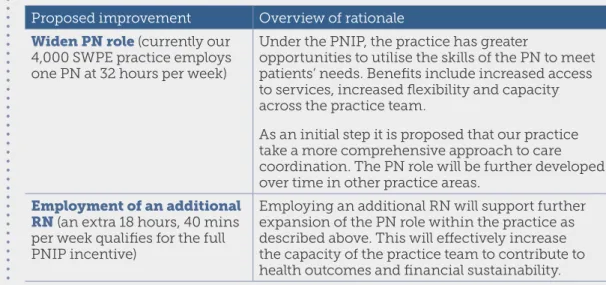
The following opportunities have been identified as priority areas for practice improvements that are desirable and feasible under the new funding system. Details of these proposed improvements are provided within the business case.
Table 3: Proposed practice improvements
Proposed improvement Overview of rationale Widen PN role(currently our
4,000 SWPE practice employs one PN at 32 hours per week)
Under the PNIP, the practice has greater
opportunities to utilise the skills of the PN to meet patients’ needs. Benefits include increased access to services, increased flexibility and capacity across the practice team.
As an initial step it is proposed that our practice take a more comprehensive approach to care coordination. The PN role will be further developed over time in other practice areas.
Employment of an additional RN(an extra 18 hours, 40 mins per week qualifies for the full PNIP incentive)
Employing an additional RN will support further expansion of the PN role within the practice as described above. This will effectively increase the capacity of the practice team to contribute to health outcomes and financial sustainability.
Detail of proposed practice improvements
1. Expansion of the practice nurse roleA recent study17 recognised that nurses in general practice perform a number of roles
(patient carer, organiser, problem solver, quality controller, educator, and agent of connectivity). These roles overlap and a PN can fulfill all of these roles in an average day. Under the PNIP, the practice has greater opportunities to utilise the particular skills of the PN to meet patients’ needs, contributing to greater flexibility and capacity across the practice team.
It is proposed that our practice also take a more comprehensive approach to care coordination. As a first step this will include the introduction of:
• Nurse-led clinics; and
• Streaming of patients (e.g. acute (GP) vs chronic (nurse)).
The primary objective of these changes is to improve the ability of our practice to respond to the specific needs of patients. The change may also contribute to improved practice efficiency and revenues.
The PN role will be further developed over time in areas such as health promotion, disease prevention and quality improvement.
All team members will work within their scope of practice. Implementation of nurse-led clinics may be guided by the 2007 Nurse-Led Clinics18resource and delivered in
accordance with clinical guidelines for nurse-led chronic disease clinics as identified in that resource.
2. Employment of an additional practice nurse
Employing an additional RN will support further expansion of the PN role within the practice as described above. This will effectively increase the capacity of the practice team to contribute to health outcomes and will help improve the financial position of the practice.
Intended outcomes/benefits
Through more flexible working within the practice team, it is intended that patients will have increased access (e.g. ability to make an appointment at the time they need) and greater choice in which member of the practice team they can see.
This increased flexibility also offers benefits for the practice. The PNIP effectively removes constraints on flexible practice that existed under the previous funding system, and should lead to increased job satisfaction for the PN and other team members. Potentially, it can also improve the financial position of the practice by freeing up GP time that can be spent seeing additional patients.
The proposed nurse-led clinics will contribute to improved health outcomes through more intensive, coordinated and proactive chronic disease management. Streaming of patients will improve our ability to identify aspects of care where the PN can work with patients and GPs as part of a multidisciplinary team and at the same time reduce GP workloads.
17 Phillips C, Pearce C, Hall S, Kljacovic M, Sibbald B, Dwan K, Porritt J, Yates R. (2009). Enhancing care, improving quality: the six roles of the general practice nurse. MJA Vol 191, No 2, 20 July 2009 http:// www.mja.com.au/public/issues/191_02_200709/phi10417_fm.pdf
18 Melbourne East GP Network. (2007). Nurse-Led Clinics – Chronic Disease Management in General Practice. Resource funded by the Australian Government Department of Health & Ageing.
Service utilisation
Our region is experiencing strong population growth, which is projected to continue over the next 20-30 years. This, coupled with the ageing of our population, means demand for primary care services in the area will continue to increase. By more efficiently utilising our existing team and infrastructure, the practice will be better placed to respond to the needs of our practice population.
Practice data shows there is high prevalence of cardiovascular disease (CVD) and diabetes in our region, and so these two areas have been identified as the primary focus for care coordination in the first instance. Further chronic disease areas may be added in the future.
Best practice and policy context
In Australia and many other Western countries there is a general trend toward increased flexibility in practice teams, and more specifically, growth in nurse-led chronic disease clinics and care coordination. The design of the PNIP represents a move by the Australian Government to encourage increased flexibility in the roles of PNs and AHWs in general practice and to enable areas of practice such as care coordination to grow.
Monitoring and evaluation
We will evaluate impacts for patients through our ongoing satisfaction surveys. Financial impacts for the practice will also be evaluated at 12 and 24 months. Care coordination will improve our ability to track the health status of our chronic disease patients over time. This data can also be used for monitoring and evaluation of the practice changes.
We will also monitor other impacts, such as professional satisfaction, through regular performance appraisals and business review processes that can lead to greater retention rates and improved sustainability of the practice.
Implementation
Implementation will be led by the Practice Manager and existing PNs and GPs reporting to the practice owners. The new PN will also be involved once recruited. All staff will be briefed on the implementation of the changes and will have appropriate opportunities to have input.
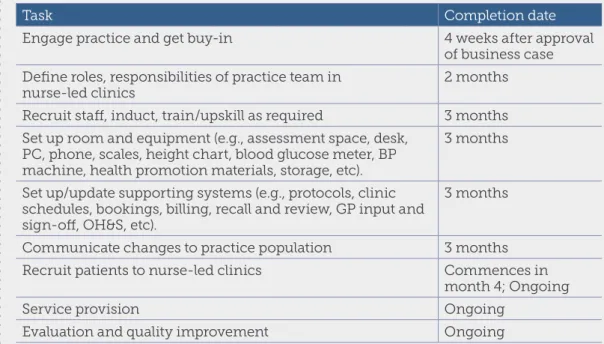
Table 4 presents a proposed timetable for implementation.
A more detailed implementation plan will be developed once the business case has been approved.
Table 4: High Level Implementation Plan
Task Completion date
Engage practice and get buy-in 4 weeks after approval of business case Define roles, responsibilities of practice team in
nurse-led clinics 2 months
Recruit staff, induct, train/upskill as required 3 months Set up room and equipment (e.g., assessment space, desk,
PC, phone, scales, height chart, blood glucose meter, BP machine, health promotion materials, storage, etc).
3 months
Set up/update supporting systems (e.g., protocols, clinic schedules, bookings, billing, recall and review, GP input and sign-off, OH&S, etc).
3 months
Communicate changes to practice population 3 months Recruit patients to nurse-led clinics Commences in
month 4; Ongoing
Service provision Ongoing
Evaluation and quality improvement Ongoing
Financial analysis
Note: This is an example only. Each practice should undertake its own financial calculations using the tables provided in this guide.
Our practice has 4,000 SWPE and currently employs a RN at 32 hours a week. If we leave everything the same, our practice income will increase by $9,299 (based on the calculations from Section 2 of this Guide) per year under the PNIP.
However, as summarised in the table below:
• Employing an additional RN for 18 hours, 40 minutes per week will attract further PNIP payments of $36,842
• It is estimated that the expanded PN role could enable the practice to increase total MBS billing (including GP and PN items) by $60,000
• After deducting the additional costs of the proposed new arrangements (new RN salary, oncosts and other operating costs), the practice will be approximately $61,000 better off.
• Additionally, there are potential non-financial benefits for the practice. The expanded PN role should give the existing PN greater job satisfaction and ability to undertake work in new areas, which includes training and professional
improvement activities. This can contribute to improved retention and stability in the practice.
• Employment of a new PN should also lead to more effective utilisation of GPs’ and other team members’ skills and mean that patients have greater access to practice members. This in turn can contribute to improved delivery of health services and enhanced job satisfaction for all team members.
Appendix B – Business case scenarios
Supporting information
Further details of the financial analysis are summarised below. 19
Analysis Annual amount Refer to the following sections of this Guide for basis of calculations
Income changes
‘Old’ revenues from discontinued payments (PIP PN incentive payment and MBS PN items)
$53,859.20 Section 2: ‘Old’ practice revenues associated with the outgoing items
‘New’ PNIP revenues for existing RN $63,157.89 Section 2: ‘New’ practice revenues if we ‘do nothing’ Subtotal: Increased practice income
if we do nothing $9,298.69 Section 2: Change in practice revenues if we ‘do nothing’
Additional PNIP incentive if we employ an additional RN at 18 hours 40 mins per week
$36,842.11 Section 3: Impact on practice revenues
Estimated increase in MBS billing $60,000.00 Section 3: Impact on practice revenues Total increase in practice income $106,140.80 Section 3: Impact on
practice revenues
Cost changes
Additional RN at $30.47 per hour19
plus 13% oncosts (9% super, 1.6% leave loading 5 weeks, 1.5% LSL, 0.8% WC)
$33,427.09 Section 3: Impact on the practice’s ongoing costs
Other operating costs $12,000.00 Section 3: Impact on the practice’s ongoing costs Total increase in practice costs $45,427.09 Section 3: Impact on the practice’s ongoing costs NET increase in practice income
(extra income less extra costs) $60,713.71 Section 3: Change in net practice income
Implementation costs
In addition to the ongoing costs above, a one-off investment is required to set up rooms, equipment and systems.
Estimated implementation cost: $25,000.00 Section 3: One-off implementation costs