Damage Assessment Manual by www.GreenAlert.net
Update 6/2/2004 8:51 AMSPECIAL NOTE:
All Forms in Appendix A can be downloaded from our Web
Site at:
Damage Assessment Manual by www.GreenAlert.net
Update 6/2/2004 8:51 AMTable of Contents—Appendix A Forms
Business & Residential Value Worksheet...A-5
Windshield Survey Form DA-1 ...A-6
Damage Levels and Conditions for Windshield Survey...A-7
Program Referenced Damage Levels ...A-8
Structure Habitability and Percent of Value Charts...A-9
Windshield Survey-Individual Assistance (IA) Form IAF-1 ...A-9
Individual Assistance Reporting Worksheet ...A-10
Site Housing Losses ...A-11
Instructions for Site Housing Losses...A-12
Site Estimate Business Losses...A-13
Instructions Site Estimate Business Losses ...A-14
Project Worksheet...A-15
Instructions for the Project Worksheet ...A-16
Public Assistance Damage Assessment Summary Sheet ...A-17
State of Texas Public Assistance Forms (Example)...A-18
Damage Assessment General Items Checklist 1 ... A-19 to A-20
Damage Assessment Private Residences Checklist 2...A-21
Damage Assessment Checklist 3 ...A-22
Agriculture Natural Disaster Damage Assessment Report Form DA-BIZ-AD-1...A-23
Damage Assessment Situation Report Form INT-92-108... A-24 to A-31
Right of Entry Agreement (Sample Form) ...A-32
Authorization for Removal of Buildings ...A-33
Damage Assessment Team Databases... A-34 to A-37
Force Account Labor Summary Record ... A-38 to A-39
Force Account Equipment Summary Record ... A-40 to A-41
Force Account Equipment Summary Record ...A-42
Contract Work Summary Record...A-43
Applicant’s Benefits Calculation Sheet ... A-44 to A-45
FEMA Schedule of Equipment Rates ... A-46 to A-52
Cost Summary Sheet...A-53
Damage Assessment Manual by www.GreenAlert.net
Update 6/2/2004 8:51 AMWhen an emergency or disaster occurs, a need exists to determine the damages
that were caused by the disaster. This information is required to determine the
severity of the disaster, but more important to determine what kinds of disaster
assistance may be required. Some of the most frequent types of damages are those
to residential structures, including, business structures, single family residences,
duplexes or townhomes, apartment complexes, mobile homes, and vacation or
resort cabins.
The value of residential structures varies considerably because of a number of
factors, including size, age, condition, and location. Because of these factors,
particularly the location, this worksheet cannot pre-determine residential structure
values and should only be used as an estimate. Those having the most knowledge
about such values include, local building assessors, local appraisers, local real
estate agents, and insurance adjusters. The Business & Residential Structure Value
Worksheet below should be filled in with the aid of such knowledgeable persons.
Business & Residential Structural Value Worksheet
Business & Residential Structural Value
Worksheet
Location or Grid #
Typical Structure Value
Type of Structure
Average Value
Businesses (each unit)
$ ________
Small homes or cottages two bedrooms
or less and 1,000 square feet or less
$ ________
Average home — two to four bedrooms
and 1,000 to 2,000 square feet
$ ________
Large home — four or more bedrooms
and over 2,000 square feet
$ ________
Apartments (each unit)
$ ________
Single wide mobile homes
$ ________
Double wide mobile homes
$ ________
Duplexes or townhomes (each unit priced
the same as similar sized homes)
$ ________
Condominiums (each unit priced the
Wi
n
d
shi
e
ld
S
u
rve
y
Form D
A
-1 GRI
D
_________
C
o
u
n
ty
:
_____________
C
ity
:
_________
______
S
ub-d
iv
is
ion:
_____________
___
Di
sast
er Descri
p
ti
o
n
________
______
______
______
S
u
rvey A
rea B
ounda
ri
e
s
:
N
o
rt
h S
tr
e
e
t
_________
________
______
______
_
S
out
h S
tr
e
e
t:
__________
________
______
______
______
E
ast
S
treet
:
__________
________
______
______
W
est
S
treet
:
___________
________
______
______
_____
S
u
rveyed
By:
_______________
______
____
Ti
tl
e
: _
________
______
______
_
Ph
o
n
e
:
_______________
_
D
a
te
:
____________
______
__
Ty pe D est ro y e d Ma jo r Min o r A ffe c te d Si ngl e F a m ily St ru c tur e Mu lt ip le F a m ily St ru c tur e Oth e r B u si nesse s TO TA LS Mo b ile H o m es D est ro y e d Tot al Min o r Tot al Ma jo r Tot al No t H a bi ta bl e % In sur a nce Tot al W indshi e ld Sur vey Fo rm D A -1Damage Assessment Manual by www.GreenAlert.net
Update 6/2/2004 8:51 AMDamage Levels and Conditions for Windshield Survey
Damage
Level
Conditions Present in Residential
& Business Assessment
Destroyed
80%
•
Water above the first-floor doorknob
•
Two or more basement walls collapsed
•
Structure leveled above foundation
•
Second floor is gone
•
Two exterior walls collapsed
•
Moved off foundation
Major
30%
•
Water on first floor 6 inches to doorknob
•
Water on main floor more than 24 hours
•
Foundation damaged (bowed or collapsed wall)
•
One exterior wall collapsed, exterior frame damage (bowed walls-non cosmetic), roof
off or collapsed, 6 inches or less of water in a mobile home
•
Exits blocked in addition to other damage
•
One room destroyed (pertains to apartment renters)
•
Accessory/service/outbuildings damaged (business)
•
Production equipment/office equipment (business)
•
Utilities damaged to include well, septic system, electrical service, and gas
Minor
5%
•
Carpets soaked on first floor
•
Damage to the home’s mechanicals such as furnace, water heater, baseboard heat,
and air conditioner in need of repair or replacement
•
Sewer backup or flood water in unfinished basement
•
Insulation damage in crawl space or mobile home belly board
•
Interior floor, walls; minor structural damage to exterior walls
•
Trees fallen on structure, minor damage to exterior walls and interior floor
•
Shingles/roofing removed or damaged exposing the sheathing
•
Business inventory destroyed (business), fire escape not usable (pertains to
busi-nesses and multi-family units), fleet/vehicle damage (business)
Affected
but
Habitable
•
Less than 6 inches of water in unfinished basement
•
Cosmetic damages to shutters, gutters, shingles, and siding
•
Porch damage/deck damage
•
Downed trees in yard that do not impede access to home
•
Fireplace/wood burner chimney damage
•
Broken windows, parking lot damage (business), business signs damaged
(business), damage to landscaping (business)
Inaccessible
•
Damage to public or private roads/culverts that impede normal access to primary
residence
•
House surrounded by water and only accessible by boat
•
Only access is by driving through farm field
Insurance
•
In estimating insurance coverage, renters are less likely to have insurance. Low
income residents are less likely to have insurance. Homeowners who are still paying
off their mortgage normally have the appropriate type of insurance. Residents who
are flooded and reside in an area that does not participate in the NFIP or in an area
that has been sanctioned for NFIP code enforcement violations will not have flood
insurance. Residents who are flooded but whose property is not located in the
Special Flood Hazard Area (SFHA) will probably not have flood insurance.
Program-Referenced Damage Levels
Local/State
FEMA
SBA
Red Cross
Destroyed
Destroyed
Major
Destroyed
Major
Major
Major
Minor
Minor
Minor
Minor
Affected
but
Habitable
Affected
but
Habitable
Affected
but
Habitable
Inaccessible
Inaccessible
Inaccessible
Inaccessible
The above chart titled "Program-Referenced Damage Levels" provides a
general indication of the damage designation that various assistance
programs and agencies assign to damage conditions.
Damage Assessment Manual by www.GreenAlert.net
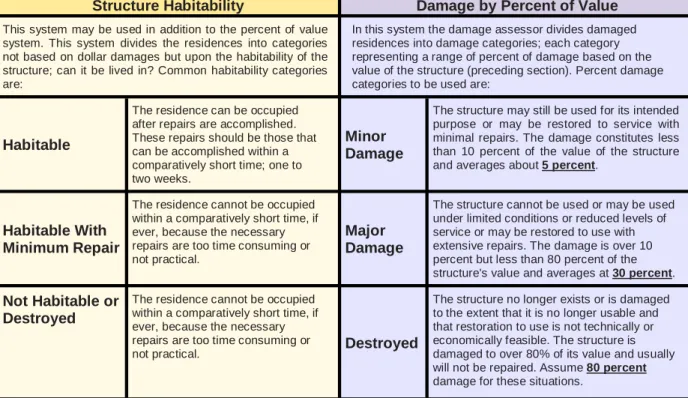
Update 6/2/2004 8:51 AMStructure Habitability
Damage by Percent of Value
In this system the damage assessor divides damaged residences into damage categories; each category representing a range of percent of damage based on the value of the structure (preceding section). Percent damage categories to be used are:
Habitable
The residence can be occupied after repairs are accomplished. These repairs should be those that can be accomplished within a comparatively short time; one to two weeks.
Minor
Damage
The structure may still be used for its intended purpose or may be restored to service with minimal repairs. The damage constitutes less than 10 percent of the value of the structure and averages about 5 percent.
Habitable With
Minimum Repair
The residence cannot be occupied within a comparatively short time, if ever, because the necessary repairs are too time consuming or not practical.
Major
Damage
The structure cannot be used or may be used under limited conditions or reduced levels of service or may be restored to use with extensive repairs. The damage is over 10 percent but less than 80 percent of the structure's value and averages at 30 percent.
Not Habitable or
Destroyed
The residence cannot be occupied within a comparatively short time, if ever, because the necessary repairs are too time consuming or
not practical.
Destroyed
The structure no longer exists or is damaged to the extent that it is no longer usable and that restoration to use is not technically or economically feasible. The structure is damaged to over 80% of its value and usually will not be repaired. Assume 80 percent damage for these situations.
This system may be used in addition to the percent of value system. This system divides the residences into categories not based on dollar damages but upon the habitability of the structure; can it be lived in? Common habitability categories are:
Figure 3.8 — Structure Habitability and Percent of Value Charts
Individual
Assistance
Assessment
Average Property Value (1) Number Destroyed 80% (2) Destroyed Repair Cost (3) Number Major Damage 30% (4) Major Repair Cost (5) Number Minor Damage 5% (6) Minor Repair Cost (7) Total Damage Costs (8) Low-Cost Homes (9) Medium-Cost Homes (10) High-Cost Homes (11) Mobile Homes (12) Businesses (13) Multiple-Dwelling Homes (14) Other - (15) Other - (15) Other - (15) TOTAL DAMAGES (16)Figure 3.10 - Windshield Survey—Individual Assistance Form IAF-1
Windshield Survey—Individual Assistance Team GRID AREA -_____
Individual Assistance Reporting Worksheet
City/County State Person Filing Report (Name Title)
PEOPLE AFFECTED
ASSISTANCE PROVIDED
Deaths Injuries Missing Persons Evacuated Persons in Public Shelters
RESIDENTIAL HOUSING Primary Secondary
Number Value (if Known) Number Value (if Known)
Houses destroyed (ARC)3 $
$
Houses with major damage (ARC)2 $
$
Houses with Minor Damage (ARC)1 $ $
Houses Affected $ $
Mobile Homes Destroyed (ARC)3 $ $
Mobile Homes Severely Damaged (ARC)2 $ $
Mobile Homes Moderately Damaged (ARC)1 $ $
Mobile Homes Affected $ $
TOTAL
$ $Total Residential (primary plus secondary)
$BUSINESS
Businesses Affected $ Number Now Unemployed
Estimated Duration of Unemployment (weeks)
TOTAL BUSINESS $
AGRICULTURE (from
Form DA-BIZ-AG-1Farm Buildings and Equipment $ Crop Land (all crops) $ Livestock $
TOTAL AGRICULTURE
$INDIVIDUAL DAMAGE TOTAL
$Damage Assessment Manual by www.GreenAlert.net
Update 6/2/2004 8:51 AMS
ite E
s
tim
a
te
H
o
u
s
in
g L
o
sses
(1
) C
o
u
n
ty
:
____________
______ (
2
)
C
ity
:
________
________
______
__ (
3
) S
tat
e _______ (
4
)
Damag
e
A
ssessmen
t
T
eam ___________
(5
) I
n
c
id
e
n
t Pe
ri
o
d
:
_______________
______
______
_
(6
) Dat
e
o
f S
u
rvey ___________
______
______
___
_ (
7
) P
a
g
e
_____ o
f ______.
(8 ) (9 ) (10) (11 (1 2 ) (13) (14) (1 5 ) (16) (17) (1 8 ) (1 9 ) (2 0 ) (2 1 ) Re f # Na m e A ddr es s Ph o n e Ty p e o f Stru c tu re SF MP MH Da m a g e Ca te g o ry D e s tr oyed M aj or M ino r Wa te r Le v e l in Stru c tu re (I n F eet ) Es ti -m a ted In c o m e H igh M ed iu m L ow Stru c tu re O c c u pi ed Y es No Sta tu s O wn R en t R e s id enc e P ri m a ry or S e c ond ar y Fa ir R e p la c em ent Va lu e E s ti m a ted Lo ss $ An ti c ip a te d In s u ranc e $ A m ou nt o f In s u re d Lo ss Pe rc e n t of In s u re d Lo ss __ __ __ __ _ Stru c tu re __ __ __ __ _ C o nt en ts __ __ __ __ _ Stru c tu re __ __ __ __ _ C o nt en ts __ __ __ __ _ Stru c tu re __ __ __ __ _ C o nt en ts __ __ __ __ _ Stru c tu re __ __ __ __ _ C o nt en ts __ __ __ __ _ Stru c tu re __ __ __ __ _ C o nt en ts S F __ __ M F _ ___ MH __ __ D E S T ___ MA J _ __ __ M IN _ __ __ H_ _ _ _ M_ __ __ L_ __ __ Y __ __ _ N __ __ _ Y _ __ N __ _ P __ __ _ S __ __ _ __ __ __ __ _ Stru c tu re __ __ __ __ _ C o nt en ts$
$
$
TO
T
A
LS
__ __ __ __ _ Stru c tu re __ __ __ __ _ C o nt en tsInstructions for Site Assessment Housing Losses
(1)
County where the damage is located
(2)
City if in the corporate limits
(3)
Note the type of incident
(4)
Identity the team members
(5)
Date(s) of the incident
(6)
Date(s) of the survey
(7)
Page number
(8)
Locally established reference number - 1,2,3. ..etc.
(9)
Name of occupant, street address, phone
(10) Type of Structure ( SF - Single Family, MH - Mobile Home, MF - Multi-Family)
(11) Damage Category - Destroyed, Major, Minor
(12) Water Level in Structure (in feet)
(13) Estimated income (High, Medium, Low)
(14) Is structure occupied?
(15) Own/rent
(16) Primary/Secondary Residence — secondary structure is occupied; evaluate extent of
damage and % of uninsured loss to the tenant's property and evaluate extent of
damage and % of uninsured loss to the owner's property)
(17) Fair Replacement Value (structure and contents)
(18) Estimated dollar loss
(19) Anticipated
insurance
(20) Amount of uninsured loss (subtract the anticipated insurance from the estimated loss)
(21) Percent of uninsured loss (divide the amount of uninsured loss by the fair replacement
Damage Assessment Manual by www.GreenAlert.net
Update 6/2/2004 8:51 AMS
ite E
s
tim
a
te B
u
sin
ess L
o
sse
s
(1
) C
o
u
n
ty
:
____________
______ (
2
)
C
ity
:
________
________
______
__ (
4
)
Damag
e
A
ssessm
en
t
T
eam _
________
______
______
___
(5
) I
n
c
id
e
n
t Pe
ri
o
d
:
_______________
______
______
_
(6
) Dat
e
o
f S
u
rvey ___________
______
______
___
_ (
7
) P
a
g
e
_____ o
f ______.
RE F NO. (8 ) N a me o f B u si ne ss N a m e o f T e n a n t/O w n e r T y pe o f B u si ne ss S tr eet A d d re s s Ph o n e N o . ( 9 ) Es ti m a te d Da ys out o f O p e rat ion (1 0 ) E m pl oy ees F a ir R epl a c em en t V a lu e (13) E s ti m a ted Do lla r Lo ss (14) Am o u n t o f An ti c ip a te d In s u ra n c e (1 5 ) % Un in s u re d Lo ss (1 6 ) IF C o lu m n 16 is : No . (11) UI (12) < 4 0 % M IN (1 7 ) > 4 0 % M A J (18) C o n te n ts $_ __ __ __ ___ __ __ S tr u ct u re $_ __ __ __ __ __ __ L and: $ _ _ _ _ _ _ _ _ _ _ _ _ _ _ _ _$_______
_____
$_______
_____
$_______
_____
$_______
____
$_______
____
$_______
____
C o n te n ts $_ __ __ __ ___ __ __ S tr u ct u re $_ __ __ __ __ __ __ L and: $ _ _ _ _ _ _ _ _ _ _ _ _ _ _ _ _$_______
_____
$_______
_____
$_______
_____
$_______
____
$_______
____
$_______
____
C o n te n ts $_ __ __ __ ___ __ __ S tr u ct u re $_ __ __ __ __ __ __ L and: $ _ _ _ _ _ _ _ _ _ _ _ _ _ _ _ _$_______
_____
$_______
_____
$_______
_____
$_______
____
$_______
____
$_______
____
C o n te n ts $_ __ __ __ ___ __ __ S tr u ct u re $_ __ __ __ __ __ __ L and: $ _ _ _ _ _ _ _ _ _ _ _ _ _ _ _ _$_______
_____
$_______
_____
$_______
_____
$_______
____
$_______
____
$_______
____
C o n te n ts $_ __ __ __ ___ __ __ S tr u ct u re $_ __ __ __ __ __ __ L and: $ _ _ _ _ _ _ _ _ _ _ _ _ _ _ _ _$_______
_____
$_______
_____
$_______
_____
$_______
____
$_______
____
$_______
____
C o n te n ts $_ __ __ __ ___ __ __ S tr u ct u re $_ __ __ __ __ __ __ L and: $ _ _ _ _ _ _ _ _ _ _ _ _ _ _ _ _$_______
_____
$_______
_____
$_______
_____
$_______
____
$_______
____
$_______
____
C o n te n ts $_ __ __ __ ___ __ __ S tr u ct u re $_ __ __ __ __ __ __ L and: $ _ _ _ _ _ _ _ _ _ _ _ _ _ _ _ _$_______
_____
$_______
_____
$_______
_____
$_______
____
$_______
____
$_______
____
Instructions for Site Assessment Business Losses
(1)
County where the business is located
(2)
City, if in the corporate limits
(3)
Note the type of incident
(4)
Identify the team members
(5)
Date(s) of the incident
(6)
Date(s) of the survey
(7) Page
number
(8)
Reference number (for local use)
(9)
Name of business, tenant/owner, street address and phone number and type of
business; note that if the business is renting building space, the building owner will
need to be contacted to determine the extent of structure damage and percent of
uninsured loss.
(10)
Estimated days business will be out of operation
(11)
Total number of employees
(12)
Number of employees in which unemployment insurance is carried
(13)
Fair replacement value, for this purpose, is the cost to replace equivalent real/
personal property, or the fair market value of the pre-disaster property, whichever is
less for each potential applicant.
(14)
Estimated dollar loss
(15)
The amount of anticipated insurance. Anticipated insurance is normally calculated by
subtracting any deductible, depreciation or unrecoverable loss from the estimated
repair cost.
(16)
Percentage of uninsured loss. Uninsured loss for this purpose, is the dollar amount of
damage less any insurance received to repair that damage.
Dollar value of uninsured loss = Percent of uninsured loss fair replacement
value
(17)
If column 16 is less than 40 percent, it is considered minor damage
(18)
If column 16 is greater than 40 percent, it is considered major damage
Damage Assessment Manual by www.GreenAlert.net
Update 6/2/2004 8:51 AMProject Worksheet
Special Location Information
Declaration # Project # FIPS # Date Category
Damaged Facility Work Complete as of:
Date Percent
Applicant County
Location Latitude Longitude
Damage Description and Dimensions
Scope of Work
Does the Scope of Work change the pre-disaster conditions at the site? Yes or No Special Considerations issues included? Yes or No Hazard Mitigation proposal included? Yes or No Is there insurance coverage on this facility? Yes or No
Project Cost
Item Code Narrative Quantity/
Unit
Unit Price Cost
Total Cost Prepared by:
Declaration No: Indicate the disaster declaration number as established by FEMA (i.e. "FEMA 1136-DR-TN", etc.). Project No: Indicate the project designation number you established to track the project in your system (i.e. 1, 2, 3, etc.).
FIPS No: Indicate your FIRS number within this space. This is optional.
Date: Indicate the date the worksheet was prepared in MM/DD/YY format.
Category: Indicate the category of the project according to FEMA specified work categories. This is optional.
Applicant: Name of the governmental or other legal entity to which the funds will be awarded.
County: Name of the county where the damage is located. If located in multiple counties, indicate '~Multi-County."
Damage facility: Identify the facility and describe its basic function.
Work Complete as of: Indicate the date that the work was examined in the format of MM/DD/YY and the percentage of work completed to that date.
Location: This item can range anywhere from an "address," "intersection of..."" 1 mile south of ...on to "county wide." If damages are in different locations or different counties please list each location. Include latitude and longitude of the project if known.
Damage Description and Dimensions: Describe the disaster-related damage to the facility, including the cause of the damage and the area or components affected. Scope of Work: List work that has been completed, and work to be completed, which is necessary to repair disaster-related damage. Include items recorded on the preliminary damage assessment.
Does the Scope of Work change the pre-disaster conditions of the site: If the work described under the Scope of Work changes the facilities conditions (i.e. increases I decreases the size or function of the facility or does not replace damaged components in kind with like materials), check Yes. If the Scope of Work returns the site to its pre-disaster configuration, capacity and dimensions check no.
Special Considerations: If the project includes insurable work, and/or is affected by environmental (NEPA) or historic concerns, check either the Yes or No box so that appropriate action can be initiated to avoid delays in funding. Refer to Applicant Guidelines for further information.
Hazard Mitigation: If the pro-disaster conditions at the
site can be changed to prevent the disaster-related damage, check Yes. If no opportunities for hazard mitigation exist check No. Appropriate action will be initiated and avoid delays in funding. Refer to the FEMA
Applicant Handbook for further information.
Is there insurance coverage on this facility: Federal law requires that FEMA be notified of any entitlement for proceeds to repair disaster-related damages, from insurance or any other source. Check Yes if any funding or proceeds can be received for the work within the Scope of Work from any source besides FEMA.
Project Cost
Item: Indicate the item number on the column (i.e. 1, 2, 3, etc.). Use additional forms as necessary to include all items.
Code: If using the FEMA cost codes, place the appropriate number here.
Narrative: Indicate the work, material or service that best describes the work (i.e. 'force account labor overtime", "42 in. Dia. RCP". "sheet rock replacement", etc.).
Quantity Unit: List the amount of units and the unit of measure ("48/cy", "32/If, "6/ea", etc.). Unit Price: Indicate the price per unit.
Cost: This item can be developed from cost to date, contracts, bids, applicant's experience in that particular repair work, books that lend themselves to work estimates, such as RS Means, or by using cost codes supplied by FEMA.
Total Cost: Record total cost of the project.
Prepared By: Record the name and title of the person completing the Project Worksheet.
Record Requirements
Please review the Applicant Handbook for detailed instructions and examples. For all completed work, the applicant must keep the following records:•
Force account labor documentation sheets identifying the employee, hours worked, date and location;•
Force account equipment documentation sheetsidentifying specific equipment, operator, usage by hour/mile and cost used;
•
Material documentation sheets identifying the type of material, quantity used and cost;•
Copies of all contracts for work and any lease/rental equipment costs.For all estimated work, keep calculations, quantity esti-mates, pricing information, etc. as part of the records to PROJECT WORKSHEET – INSTRUCTIONS (FEMA Based)
The Project Worksheet must be completed for each identified damaged project. Projects with estimated or actual cost of damage greater than $47,100 are large projects. Projects with estimated or actual cost of damage less than $47,100 are small projects.
Damage Assessment Manual by www.GreenAlert.net
Update 6/2/2004 8:51 AMPublic Assistance Damage Assessment Summary Worksheet
Original Revision Date:Type of Disaster: Date (s) of Occurrence
Jurisdiction (town, county, agency, etc.): County:
Information Provided By:
Name: Title:
Address: Day Phone:
Evening Phone:
CATEGORY
PUBLIC INFRASTRUCTURE DAMAGE
A
Debris Removal: - Trees, building wreckage, sand, mud, silt, gravel, vehi-cles, and other disaster-related material.$
B
Emergency Protective Measures: - Sandbagging, barricades, signs, ex-tra police and fire, and emergency health measures.C
Roads and Bridges: - Roads, culverts, bridges, and associated facilities.D
Water Control Facilities: - Dams, reservoirs, shore protective devices, pumping and irrigation facilities, drainage channels, and levees.E
Buildings and Equipment: Buildings, supplies, inventory, vehicles, and equipment.F
Utilities: - Water treatment plants and delivery systems, power generation and distribution facilities, sewerage collection systems and treatment plants.
G
Parks, Recreational, and Others: - Playground equipment, swimming pools, bath houses, tennis courts, boat docks, piers, picnic tables, ceme-teries, and golf courses.
TOTAL
$
Private Nonprofit: - Educational, medical, custodial care, emergency (Fire departments, search and rescue, and ambulances), utility, and other (museums, community centers, li-braries, homeless shelters, senior citizen centers, health and safety services).
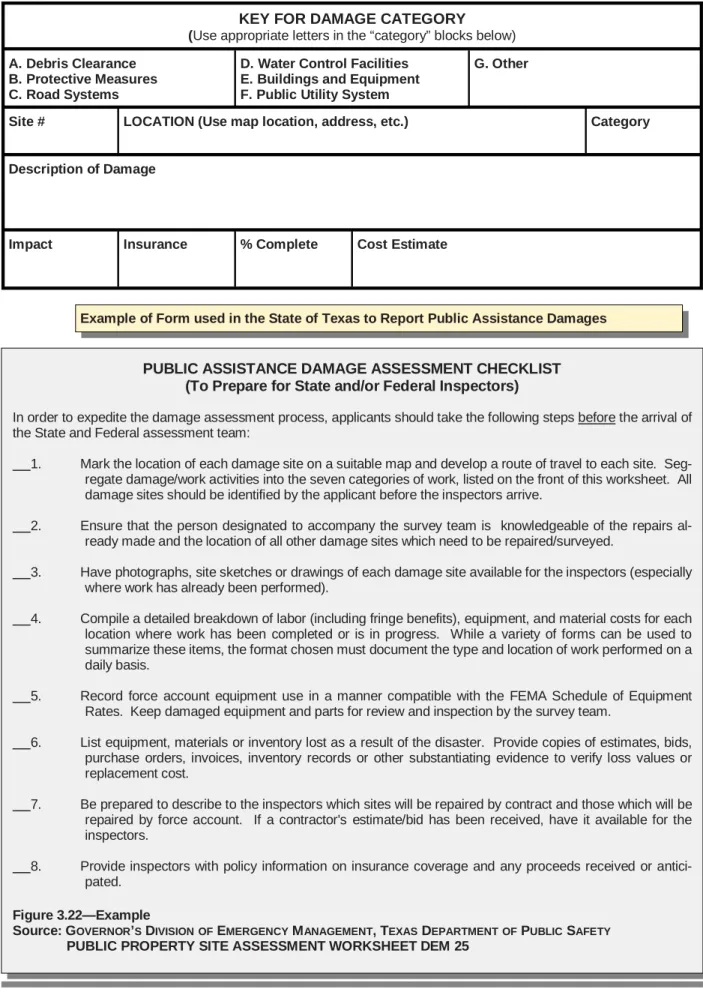
PUBLIC ASSISTANCE DAMAGE ASSESSMENT CHECKLIST
(To Prepare for State and/or Federal Inspectors)
In order to expedite the damage assessment process, applicants should take the following steps before the arrival of the State and Federal assessment team:
1. Mark the location of each damage site on a suitable map and develop a route of travel to each site. Seg-regate damage/work activities into the seven categories of work, listed on the front of this worksheet. All damage sites should be identified by the applicant before the inspectors arrive.
2. Ensure that the person designated to accompany the survey team is knowledgeable of the repairs al-ready made and the location of all other damage sites which need to be repaired/surveyed.
3. Have photographs, site sketches or drawings of each damage site available for the inspectors (especially where work has already been performed).
4. Compile a detailed breakdown of labor (including fringe benefits), equipment, and material costs for each location where work has been completed or is in progress. While a variety of forms can be used to summarize these items, the format chosen must document the type and location of work performed on a daily basis.
5. Record force account equipment use in a manner compatible with the FEMA Schedule of Equipment Rates. Keep damaged equipment and parts for review and inspection by the survey team.
6. List equipment, materials or inventory lost as a result of the disaster. Provide copies of estimates, bids, purchase orders, invoices, inventory records or other substantiating evidence to verify loss values or replacement cost.
7. Be prepared to describe to the inspectors which sites will be repaired by contract and those which will be repaired by force account. If a contractor's estimate/bid has been received, have it available for the inspectors.
8. Provide inspectors with policy information on insurance coverage and any proceeds received or antici-pated.
Figure 3.22—Example
Source: GOVERNOR’S DIVISIONOF EMERGENCY MANAGEMENT, TEXAS DEPARTMENTOF PUBLIC SAFETY
PUBLIC PROPERTY SITE ASSESSMENT WORKSHEET DEM 25
KEY FOR DAMAGE CATEGORY
(Use appropriate letters in the “category” blocks below) A. Debris Clearance
B. Protective Measures C. Road Systems
D. Water Control Facilities E. Buildings and Equipment F. Public Utility System
G. Other
Site # LOCATION (Use map location, address, etc.) Category
Description of Damage
Impact Insurance % Complete Cost Estimate
Damage Assessment Manual by www.GreenAlert.net
Update 6/2/2004 8:51 AMIn conducting the damage assessment, you will be gathering information needed to point out
an accurate mental picture of the damage, and of its impact on the people and their
communities. The subjects listed below represent important aspects of assessments, which
may be applicable to the situation you are assessing.
In each of your basic areas of damage assessment, it is assumed that you will obtain basic
information on numbers and dollars (the number of people unemployed by the disaster, and
number of homes destroyed, the number of businesses damaged, etc.). In addition to these
basic measures, however, you should consider the following subjects, determine whether they
are applicable to your situation, and if they are, include them in your description of the impact
of the damage on the area.
1. Area
________________________________________________________
_____________________________________________________________
_____________________________________________________________
(whether it's primarily rural, suburban, or urban, or a combination of the three may be important)
2.
Debris _______________________________________________________
_____________________________________________________________
_____________________________________________________________
_____________________________________________________________
_____________________________________________________________
_____________________________________________________________
(It may pose a health hazard, prevent access to homes, or block roads.
3. Type
of
Incident _______________________________________________
_____________________________________________________________
_____________________________________________________________
_____________________________________________________________
(earthquake, flooding, tornado, hurricane, etc. describe) -(Consider such things as depth of water, length of time the area was flooded, whether the flood water was fast moving, whether it contained harmful chemicals).
4. Transportation
Need ___________________________________________
_____________________________________________________________
_____________________________________________________________
_____________________________________________________________
(An estimate of the need for transportation by either public or private means).
5. Death/Injury
Impact ____________________________________________
_____________________________________________________________
_____________________________________________________________
_____________________________________________________________
_____________________________________________________________
_____________________________________________________________
(The incidence of death and injury is important and should be reported especially where it results in special needs emergency medical care, pubic health assistance, etc.).
6.
Personal Property Loss_________________________________________
_____________________________________________________________
_____________________________________________________________
(An estimate of the extent of personal property loss).
7.
Economic Description _________________________________________
_____________________________________________________________
_____________________________________________________________
8.
Availability of Local Resources __________________________________
_____________________________________________________________
9. Emergency
Food/Shelter________________________________________
_____________________________________________________________
(If there is a significant number of displaced people, identify where they are and if mass feeding is re-quired).
10.
Nature of the Threat ___________________________________________
_____________________________________________________________
_____________________________________________________________
(Note the condition which threatens public health, safety, and/or property, and describe the threat).
11.
Nature of Protective Work ______________________________________
_____________________________________________________________
_____________________________________________________________
(Include such measures as pumping, sandbagging, vector control, stream clearance, etc. Describe what needs to be done).
12. Impact _______________________________________________________
_____________________________________________________________
_____________________________________________________________
(Determine what essential services, if any, are affected by the threatening situation).
13. Local
Response _______________________________________________
_____________________________________________________________
_____________________________________________________________
(Describe what the local and state governments and or private volunteer groups are doing to deal with the problem, and the need, if any, for additional resources to combat it).
Damage Assessment Manual by www.GreenAlert.net
Update 6/2/2004 8:51 AM1. Transient
Accommodations ____________________________________
____________________________________________________________
___________________________________________________________
(Their availability, in terms of hotel/motel rooms, etc.)
2. Rental
Housing _______________________________________________
____________________________________________________________
____________________________________________________________
(Its availability in such categories as single family, attached, multi-family, etc)
3. Mobile
Homes ________________________________________________
____________________________________________________________
____________________________________________________________
(Their acceptability and extent of their use in the area. Also, the extent of pad vacancy in local mobile home parks)
4. Utilities _____________________________________________________
____________________________________________________________
____________________________________________________________
( Their operational status. If out of commission, for how long? Are service outages widespread or concentrated?)5.
Construction Types ___________________________________________
____________________________________________________________
____________________________________________________________
(Prevalent types used in the area (brick, wood frame, concrete block, basement, or on a slab, etc.)
6.
Dwelling Types _______________________________________________
____________________________________________________________
____________________________________________________________
(A general description of the types of housing damaged by the disaster (single family homes, apart-ments, mobile homes, etc.)
7.
Dwelling Values _______________________________________________
_____________________________________________________________
(Damaged homes may be low, medium or high cost homes for the area.)
8.
Insurance Coverage ____________________________________________
_____________________________________________________________
(
A general estimate of the percentage of damaged homes and personal
property covered by insurance. Identify your source of information)
Note: This form should accompany the Damage
Assessment Residences Form INT-92-102
1.
Types of Businesses __________________________________________
_____________________________________________________________
_____________________________________________________________
_____________________________________________________________
(A description of the types of businesses and business inventories affected and the impact on the community)
2. Recovery
Time ________________________________________________
_____________________________________________________________
_____________________________________________________________
_____________________________________________________________
_____________________________________________________________
(
An estimate of how long it will be before businesses will be restored and back in operation again)3. Construction
Types ____________________________________________
_____________________________________________________________
_____________________________________________________________
_____________________________________________________________
_____________________________________________________________
(Prevalent types used in the area (brick, wood frame, concrete block, basement, or on a slab, etc)
4.
Available Business Rentals _____________________________________
_____________________________________________________________
_____________________________________________________________
_____________________________________________________________
_____________________________________________________________
(Their availability and location)
5. Insurance
Coverage ___________________________________________
_____________________________________________________________
_____________________________________________________________
_____________________________________________________________
(A general estimate of the percentage of damaged businesses covered by insurance. Identify your source of information)
Damage Assessment Private Business Checklist 3
Note: This form should accompany the Damage Assessment Businesses
Form INT-103
Damage Assessment Manual by www.GreenAlert.net
Update 6/2/2004 8:51 AMA
g
ri
cu
lt
u
re Nat
u
ral
Di
sast
er
Damag
e
A
sses
smen
t Rep
o
rt
F
o
rm
D
A
-B
IZ
-A
G
-1
Sta te (1 ) C ount y ( 2 ) N u mb e r of F a rm e rs in C o u n ty In B u s in e s s a s a n O w n e r-O p e ra tor or T e na nt – O pe ra to r ( 3 ) D isa st er D a te ( 4 ) B ri e f D e sc ri p ti o n o f D isa st e r (5 ) C onc ur re nc e w it h R e por te d D a ta ( 6 ) CE B SE B Y es/ N o Nu m b e r Y es/ N o Nu m b e r C rops (7) A c re s N o rm a lly G ro w n in C ount y (8 ) A c re s N o rm a lly G ro w n in C ount y i n D is a s te r Y e a r (8 ) D isa st er Y ear Y ie ld P e r Ac re f o r Ac re s Gro w n i n D isa st er Y ear (10) A c re s n o t P lan te d i n th e D is ast er Y ear (1 1 ) N u mb er o f F a rm er s w it h P rodu c ti on Los s e s ( 1 4 ) Nu m b e r (1 4 a ) 10 0 % L o ss es 90 to 10 0 % L o ss es 80 to 89 % L o s s e s 70 to 79 % L o s s e s 60 to 69 % L o s s e s 50 to 59 % L o s s e s 40 to 49 % L o s s e s 30 to 39 % L o s s e s 20 to 29 % L o s s e s 10 to 19 % L o s s e s L e ss t h an 20 % L o ss es # w it h P h y s ic al L o ss es Ma jo r M inor L iv est o c k & Poult ry N u mb er an d K in d D e s tr o ye d ( 1 5) L o s s D o ll ar s (1 6 ) Fa rm B u il di ng s a n d E q ui pm e n t # D e st ro y e d (17) # M a jo r Da m a g e # M inor Da m a g e Los s ( D oll a rs ) (1 8 ) Ca ttl e H o m es She e p M obile H o me s Ho g s Se rv ic e B u ildi n g s Poult ry M ach in er y an d E q u ip m e n t Aq u a c u l-tu re Ot h e r R e m a rk s ( 19) For m D A -B IZ-A G -1Damage Assessment Situation Report
Form INT-92-105, Page 1 of 2
4. Persons Affected
(insert numbers in spaces provided)A. Killed B. Injured C. Sick D. Displaced E. Missing F. Hospitalized
6. Damage to
Public Property (indicate capacity lost and estimated dollar loss)A. Roads % $ E. Water Treatment % $ B. Bridges % $ F. Sewage Plants % $ C. Schools % $ G. Distribution Lines % $ D. Irrigation Districts % $ H. Airports % $
7. Damage to
Private Property (indicate capacity lost and estimated dollar loss)A. Dwelling Units % $ C. Farms & Ranches % $ B. Commercial Facilities % $ F. Livestock % $
8. Are there large accumulations of debris? Yes No (if yes, explain in remarks). 9. Is the reporting government intact enough to fulfill its governing functions? Yes No.
10. Dollar amount of government resources
spent to date for eventEmergency Services Personnel Materials Equipment
Roads and Bridges $ $ $
Law Enforcement $ $ $
Fire and Rescue $ $ $
Other Services $ $ $ Contractual Services $ $ $ Sub Total $ $ $ TOTAL RESOURCES $
1. Reporting location ________________________________________________________
2. Cause of Damage_________________________________________________________
3. Area Affected ____________________________________________________________
NOTE: If this is a county report but does not include affected cities and towns in the county, spec-ify the city or towns excluded. (Example Arapahoe County in Colorado has Englewood).
5. Damage to Essential Facilities
(indicate capacity lost and estimated dollar loss)A. Hospital % $ D. Communications % $ B. Power Plants % $ E. Railroads % $
Damage Assessment Manual by www.GreenAlert.net
Update 6/2/2004 8:51 AMDamage Assessment Situation Report
Form INT-92-105, Page 2 of 2
11. Assistance required to cope with the disaster or emergency (check ( ) requirement
PUBLIC NEEDS WATER SUPPLY FLOOD
FIGHT-ING VICTIM NEEDS ADMINISTRATION Restore Power Drinking Dike Building Search & Rescue Activate EOC
Communications Sanitary Sewers, Etc. Sandbagging Evacuation Public Announcements Transportation Fire Fighting Pumps Food
Secure Area Other Other (specify Shelter General Disaster Area Debris Clearance Clothing Specific Damage Sites Medical Location EOC, DAC Other (Specify) Field Offices
Maps Available for:
12. Location of EOC _________________________________________________________________________________ Telephone Number at EOC ( ) _ _ _ - __ __ __ __
Other Communications Available ____________________________________________________________________ 13. Amount of local government funding available for this disaster and expected to be appropriated?
________________________________________________________________________________________ _______________________________ ________________________________________________________________ _______________________________________________________________________________________________ _______________________________________________________________________________________________
14.
Remarks: ______________________________________________________________________________________15.
Name and title of person filling out this report _______________________________ ________________________ Date and Time _________________ _________________________ .Windshield Survey for Socio-Economic Impact Assessment,
Page 1 of 6I. Death and Injuries
I. Death and Injuries
I. Death and Injuries
Death & Injuries # Do You Require Outside Assistance For: (Check As Required)
A. Dead Body Search Hospitalization
B. Injured Requiring
Hospitalization Body Evacuation Specialized Treatment
Mortuary Services Supplies
Identification Personnel
Other (specify Other (specify
Other (specify Other (specify
Other (specify Other (specify
Explain All Boxes Checked:
II. Emergency Protective Measures:
1. Are there any conditions threatening public health and safety or any which pose a threat of further dam-ages to public or private property ( ) yes, ( ) no.
2. Do you require outside assistance for: _______ Equipment
_______ Manpower
_______ Technical Assistance _______ Other
Explain all Items Checked _________________________________________________________________________ _______________________________
________________________________________________________________
_______________________________________________________________________________________________ _______________________________________________________________________________________________
III. Human Needs::
1. Estimated number of persons who will require additional funds to cover necessary expenses or serious needs which are covered by insurance or by state, federal, or volunteer agency disaster relief pro-grams.
2.
Do you require mass feeding ( ) yes, ( ) no.A. Total number of persons requiring mass feeding _____________________________________ .
B.
Total Number of persons presently being fed ________________________________________ .C.
Number of persons still requiring feeding ___________________________________________ . D. Outside assistance needed (food, preparation, storage, etc.): ___________________________ . 3. Food Stamps—Estimated number of persons who may be eligible for food stamps ______________ .IV. Shelter and Housing:
1. Is there a requirement for shelter and housing? ( )yes, ( )no.
2.
Estimated number of persons needing short term (up to 30 days) shelter _____________________ . A. Available local shelter capacity _____________ _____________________________________ .Damage Assessment Manual by www.GreenAlert.net
Update 6/2/2004 8:51 AMWindshield Survey for Socio-Economic Impact Assessment,
Page 2 of 6IV. Shelter and Housing:
1. Is there a requirement for shelter and housing? ( )yes, ( )no.
2. Estimated number of persons needing short term (up to 30 days) shelter _____________________ . A. Available local shelter capacity _____________ _____________________________________ . B. Outside shelter spaces needed __________________________________________________ . 3. Number of families needing long-term (over 30 days) housing ______________________________ . A. Available housing units _________________________________________________________ . B. Outside housing assistance needed _______________________________________________ . C. Local mobile home pads available ________________________________________________ . D. Can space and utility services be prepared for additional mobile homes within 30 days?
( ) yes, ( ) no. How many? _________________________________________________ .
V. Health
&
Sanitation
1. Is there a health/sanitation problem? ( )yes, ( )no. 2. Do you require outside help for:
A. Immunization ___________________________ _____________________________________ . B. Potable Water _____________ __________________________________________________ . C. Sewage Disposal _____________________________________________________________ . D. Vector/Rodent Control _________________________________________________________ . E. Crisis Counseling _____________________________________________________________ . F. Hazardous Material Cleanup ____________________________________________________ .
V. Debris
1. Is there a debris problem? ( ) yes, ( ) no. 2. Does debris threaten:
A. Public Health _________________________________________________________________ . B. Safety ______________________________________________________________________ . C. Additional Property Damage _____________________________________________________ . 3. Does debris prevent access by:
Public Safety Forces Homeowners Business Customers Recovery Teams
4. Is outside assistance required for debris removal? ( ) yes, ( ) no. If yes, explain need for special equipment or manpower ____________________________________________________________ .
Windshield Survey for Socio-Economic Impact Assessment,
Page 3 of 6VII. Utilities:
1. Has there been damage to any private, public or private nonprofit utilities (including electric, gas, water, sewer, drainage, telephone, or broadcast media? ( )yes, ( )no.
VIII.
Water
Control
Facilities:
1. Has there been damage to water control facilities? ( ) yes, ( ) no. 2. Does the damage threaten:
3. Can the facility withstand additional damage? ( ) yes, ( ) no.
4. Will the damage require evacuation? ( ) yes, ( ) no. If yes, estimated number of people _________ . 5. Do you require outside assistance for:
Phase II Utility Information
Number Of Persons Affected Duration Of Disruption Health & Safety Hazards
Outside Assistance Required
Manpower Equip-ment Supplies Technical Assistance Electric Gas Water Storage Water Distribution Water Supply Sewer Collection Sewer Treatment Telephone Transportation Phase II Utilities Irrigation Communications
Dikes and Levees Irrigation Work Dams Drainage Cannels Debris Basins
Irrigation Power Flood Control Farmland Urban Areas Transportation Other
Damage Assessment Manual by www.GreenAlert.net
Update 6/2/2004 8:51 AMWindshield Survey for Socio-Economic Impact Assessment,
Page 4 of 6IX. Buildings and Appurtenances:
1. Has there been damage to any public buildings and their importance to the community ? ( )yes, ( ) no.
________________________________________________________________________________ .
IX. Buildings and Appurtenances:
1. Has there been damage to roads and bridges? ( )yes, ( )no.
___________________________________________________________________________
IX. Buildings & Appurtenances
Type Damage To ( ) yes Critical to Public Health & Safety Duration Of Disrup-tion
Outside Assistance Required
Manpower Material Technical Assis-tance Facility Public Buildings Hospitals Schools Commercial Structures Transport Facilities Prisons Other Equip-ment
X. Roads and Bridges
Type Damage To ( ) yes Critical to Public Health & Safety Duration Of Disrup-tion
Outside Assistance Required
Man-power Material Technical Assis-tance Facility
School Bus Route Mail Routes Fire Protection Hospital Access Residential Access Commerce Public Safety/Security Equip-ment Major Employer Others