CHAPTER 4
DATA INTERPRETATION & ANALYSIS
FROM CASE STUDIES
In this chapter, data for each of the six case studies is discussed under two main headings and a number of subheadings. The two main headings are: Responding to the changed environment and Leaders’ response to change. The name of the universities and the name of the participants have been protected. In Thailand, many of Rajabhat Universities have been named for the names of queens or princesses of the Royal families. In keeping with this tradition, in this thesis each case study has been called by the name of a princess as follows: Rajabhat Antoinette (RA), Rajabhat Beatrice (RB), Rajabhat Christabel (RC), Rajabhat Danielle (RD), Rajabhat Elizabeth (RE) and Rajabhat Fran (RF).
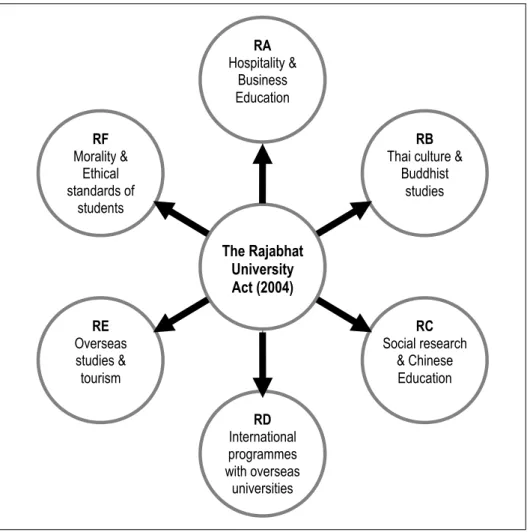
Figure 4.1 The major focus of six Rajabhat Universities after they responded to the RF Morality & Ethical standards of students RE Overseas studies & tourism RD International programmes with overseas universities RC Social research & Chinese Education RB Thai culture &
Buddhist studies RA Hospitality & Business Education The Rajabhat University Act (2004)
Facing and accepting the environmental changes were the most important processes for leaders in the six Rajabhat Universities. Different Rajabhat Universities interpreted and implemented change in a different ways. Figure 4.1 shows each Rajabhat University and their major focus into the future. Detail of each Rajabhat University will be discussed after this section.
When six Rajabhat Institutes changed to become Rajabhat Universities, it was hard to forecast that the six of them would become the particular institutions they are today. Every Rajabhat University was a teachers college. They had the same organisational structure, social values and beliefs.
They had the same curricula, standard of teaching, equipment, styles of building and landscape. Staff and students experienced the same environment when they moved from one Rajabhat Institute to another. It is unpredictable that after they have an opportunity to create their own style of management and became autonomous from the Office of the Rajabhat Institute Council (ORIC), each Rajabhat University has found a unique way to respond to the new challenges.
It could be said that the six former Rajabhat Institutes were a uniform sextuplet prior to 2004. Now it seems they do not want this and are growing up to be individuals who look at the world from different perspectives. The six Rajabhat Universities have gradually developed different characters, which they believe are suitable for their survival. The background knowledge and attitudes of the six Presidents are other significant factors which have supported the transformation of the universities. Rajabhat Antoinette (RA) has developed to become acknowledged as the best in hospitality teaching in Thailand. Every project has been concerned about cost and quality. RA wants to compete with other universities and wants to be independent from the government. Financial management is not a problem for RA. Business education is the main concept used to manage the university and staff. The President was born into a business family and graduated with a masters degree from business school. The objective of RA is to provide the best quality of teaching so that students can get reasonable jobs after they graduate.
Rajabhat Beatrice (RB) was the first teachers training college in Thailand. The reputation for high quality teacher education has been accepted by Thai educators.
museum of teachers’ training, which provides information and history about Thai education from 1892. The significance of teachers’ training can be seen by the Faculty of Education which had been upgraded from the college of Teacher Education. It now has greater authority and a higher budget than other faculties. The college of Buddhism Studies and Philosophy has been founded to complete the objectives of the Rajabhat University Act (2004).
Rajabhat Christabel (RC) has aimed to support social research and Chinese studies. The President believes that local development and conservative Thai culture are important strategies to be a successful university. All the students who study postgraduate programmes have to conduct research, which is compulsory by the university’s policies before graduation. Cooperation with Chinese universities has been developed for more than 10 years. Chinese traditional medicine became one of the most popular programmes and graduating students can work in both China and Thailand. The standard of teaching and the quality of Information and Communication Technology (ICT) are the same as for other public universities in Thailand.
Rajabhat Danielle (RD) aims to become the best university for international programmes. English language teaching and ICT systems have been improved to be the same standard as overseas universities. Thai traditional dancing, drama, fashion and film production are taught in cooperation with the best companies in Thailand. Students have more choices and opportunities to work and achieve a reasonable income after they graduate. Business education has been started as an alternative way to generate income for the future.
Rajabhat Elizabeth (RE) has the best reputation for overseas studies and exchange student programmes. The President has provided strong support for students to study abroad. Staff and students have to participate in an exchange experience at an overseas university. RE believes that tourism and hospitality programmes are the best way to increase the numbers of students and income. The teaching of local languages provides a supportive and friendly environment around the campus. Rajabhat Fran (RF) has different policies from other Rajabhat Universities. The
important disciplines for everyone. In every faculty, staff need to combine moral and ethical standards into their subjects. Students have to behave following Thai ethical ways and maintain the reputation of university after they graduate. Staff have to initiate Thai culture in their everyday lives and be good examples for students. Six Rajabhat Universities have each found their own survival strategies. Since Western knowledge was established in Thailand in 1892, King Chulalongkorn confirmed that Thai people have to adopt some Western ideas and understanding of Western cultures in order to be independent. In South East Asia, Thailand was the only country not to be colonised by other countries. Thai education adopted and adapted part of Western education. English and other Western languages have been taught for more than 100 years. The foundation of higher education has duplicated that of Western countries, especially America and Europe. The future of the six Rajabhat Universities is following and adopting many concepts and experiences of Western style education. However, the universities have maintained Thai culture as the core value during the time of change.
Case study 1: Rajabhat Antoinette (RA)
Responding to the Changed EnvironmentThe data will be discussed under the following subheadings: Human Resource Management and Development, Introducing New degree programmes, Developing International Relationships, and Financial Considerations.
Human Resource Management and Development
The most popular phrase in this university is ‘team work.’ The University Council and all administrators agree that they have to work as a team. They believe that the success of all projects depends on the performance of their teams. In every faculty, they set up teams to manage each department and programme. If they want to create a new project, they have to organise a new team and everyone who works in that team has to take full responsibility for the success of the project. The President confirms that team work is very important strategically for RA’s successful management.
We believe in team work and believe in the value of our human resources, so we think that if our staff are competent and more capable, our university will survive. It is not only our administrators that can help our university. Everyone has to work for the same team and toward the same goals.
Salaries and benefits paid to staff are different from other Rajabhat Universities because remuneration depends on performance and not academic qualifications and the length of time they have worked for the university. Other Rajabhat Universities pay their staff at standard rates set by the Thai Government.
The President says:
RA has a different human resources management policy from other universities. Staff who start working at the same time with the same degree and experiences they might receive different salary and benefits from each other. It is depended on their performance and their capability.
RA was prepared and keen to become an autonomous university before the other Rajabhat Universities. RA implemented a business structure to evaluate their staff performance. If staff perform well, such as designing successful programmes and generating income for RA; they get higher salaries than others. If they cannot achieve the objectives of their job descriptions, they will lose their jobs. This management style has not been applied in other Rajabhat Universities at this stage. Staff who work at RA have realised that they have to compete with each other and they have to show their capabilities to the administrators in order to maintain their positions. In Thai society, this management style is hard to adjust to and to accept. Staff who have not been able to accept this management style have transferred to work for other Rajabhat Universities or other organisations.
All who were interviewed (the President and the Vice-Presidents), emphasised human resources development as a major priority in the strategic plan of the university. Many projects focus on improving and developing staff. In comparison with other Rajabhat Universities, the President has introduced many programmes for human resources management and invested a substantial amount of money to
staff: by supporting them to write textbooks, by motivating them to conduct research, by assisting them to get higher academic positions, by providing material and equipment for their teaching processes, and finally, by encouraging them to get doctoral degrees. The five major plans had been implemented for more than 10 years before they became a university. Currently, RA has been successful in implementing every plan. However, the President has focused on continuous development of the qualifications of staff as a part of the strategic plan of the university. He explains that he has continued every project that has provided advantages to his staff and the most important plan is that scholarships for everyone will be increased every year.
The President has invested a large amount of money developing the higher levels of staff skills. The amount of funding for the scholarships, which are offered to all staff to study and train both in Thailand and abroad, is a policy that other Rajabhat Universities cannot offer to their staff. In 2006, all staff had at least a masters degree and most of them are continuing study toward their doctoral degrees. The university administrators have very flexible conditions associated with the award of the scholarships so that every staff member can have the opportunity to go and study in whatever countries suit them. If staff who want to study can explain what they want to do when they graduate, and show that they will generate benefits for the university, they will get a full scholarship.
The Vice-President (Academic) says:
Now a doctoral scholarship is offered for everyone who wants to study, they can select any field to study and make a decision to study in Thailand or go to other countries where we give them full scholarships. We are the first Rajabhat University that supports 100 percent scholarships for all of our staff. Every organisation considers that human resources are important for their successful operation. However, the allocation of a large of budget for the development of staff is not a major concern in every organisation. Budgets are always limited and organisations have to set priorities for using their money. RA provides more than half of their budget for staff development. It was confirmed that RA focuses on developing human resources and supports every plan that will increase the quality of staff to compete with other universities.
The President suggested that if we depended on the Office of the Rajabhat Institute Council (ORIC) to share the budget to develop our staff, it would have been too late and our university would not survive in the future. Thus our administrators set up the extra scholarships which are not related to the ORIC and gave them to everyone who wanted to study and develop themselves.
The President suggests that in the near future, all the Rajabhat Universities will compete with each other and only the best quality universities will continue to exist. He wants the name of RA to be known by everyone in Thailand and he thinks that RA has the right strategies to gain a high reputation.
Introducing New Degree Programmes
The National Education Act (1999) legislated to provide life long education and the preservation and promotion of Thai wisdom for all Thais. The Rajabhat University Act (2004) is based on local development and local wisdom. The new degree programmes, which have been designed in each Rajabhat University will depend on the demand of the local market and focus on meeting the requirements of local communities. They offer only degree programmes which are a response to market demand. RA believes that every project or programme that is taught over the next four years (2007-2010) will have employment opportunities for all of their students after they graduate. Each faculty has to focus on local knowledge and integrate academic and professional curricula to meet this requirement. Students have to understand their local communities. Every subject has to be able to be applied in real workplace situations.
The President says:
RA cannot excel in academia like established universities, but we can supply thousands of students who work in the local community and help to develop our country in the same way as the established universities do.
RA has the best reputation in hotel management and hospitality fields. If any Rajabhat Universities want to compete with the established universities, they know
universities have. Therefore Rajabhat Universities have to establish their own fields of excellence in education and find niche markets in which they can excel.
The Vice-President (Academic) says:
We know that Thailand has a lack of doctors, and people who work in pure science, but our university does not have the resources to compete with the established universities to teach in these areas. Therefore we have made a decision to offer degree programmes that we have special knowledge in, such as vocational education, and we will make a reputation for our university in these areas of expertise. Our administrators agree that our university should not teach or copy everything that Chulalongkorn University does, but should be excellent in our own fields of expertise.
The administrators have closely evaluated their strengths and weaknesses, which is important to become a successful university. The President knows that RA has a good or better capability than other universities in vocational education and he suggests that all the new degree programmes will be successful if RA focuses on their strengths. In the future, RA will maintain its focus on hotel management, cooking, bakery products and many vocational education programmes that prepare graduates for careers that are in high demand in the labour market. Moreover, in 2006, RA wants to become a centre of teaching and producing Thai food, and has international programmes that encompass Thai food and hospitality. From their success over the past ten years, it is likely that RA will gain a sound reputation with their new degree programmes and their name will become more highly esteemed than in the past.
The curriculum of RA has an emphasis on vocational education rather than on professional education and is a trainer and partner of the tourism industry, which is a very important industry that has provided a large income to the country for many years. However, RA is not only based on vocational education, but also creates added value for their students. Since gaining university status, RA has reformed its curriculum. New degree programmes have been added, but only if these programmes were considered to be financially viable with graduates able to gain immediate employment. Some of the programmes developed were in computer technologies, foreign languages, personal skills, and fashion design. The ability to use the latest
faculties.
The Vice-President (Management) says:
In 2006 every first year student who enrols in this semester will get a complimentary notebook computer. The notebook computer belongs to the university but the students can carry it around and use it at home. It will become their computer when they graduate. If any students cannot graduate from the university, their notebooks will have been returned to their faculties. Moreover, all the students will receive free textbooks for every subject that is required for their studies. These textbooks have been written by our staff. Computers have become an important technological tool for work and private life. Students have to know how to use computers during their study and will need to have well developed skills when they graduate. Most companies prefer employees who know how to use computers more than people who do not. The university administrators think that if they provide notebook computers for all of the new students, these students will have a greater likelihood of developing their skills than if they do not have their own computers. Students can use computers for their assignments and search for information on the Internet. It will increase the opportunities for students and staff to contact each other. They can discuss questions by electronic mail and there can be a two-way transference of individual and collective information. It is more efficient than using only discussion time in their classrooms.
RA offers notebook computers and free text books for the new students to use until they graduate. This project has never been undertaken by any other Rajabhat Universities. The President explains that he wants to admit only students with higher academic standards. Thus RA has to offer more attractive choices to prospective students than other universities. This year (2006) the President wants to accept a maximum of 5,500 new students, in the past all Rajabhat Universities were not allowed by legal requirements to reject any students who wanted to study. This is the first year (in 2006) that RA has limited the number of new students because of the availability of suitable classrooms and facilities. RA believes with the
years time (in 2010) will generate a better reputation for RA as an educational provider and that the quality of graduates will gain acceptance from every organisation.
RA has invested a considerable sum of money to improve technology and classrooms. In 2007, every faculty used the new curricula and focused on skills that meet the demands of the Thai labour market. Information and communication technology (ICT) and modern computer software have been modified to enhance staff and student teaching and learning processes. Every faculty has been provided with electronic classrooms, which students can access from anywhere in Thailand. If students cannot come to the campus, they can study at home or at their work places. Moreover, many students prefer to review or listen to their lessons more than one time. It is more convenient for them and staff to manage all subjects online and to contact each other by electronic mail in case there are problems.
The skill base of every student is now broadened by the compulsory study of at least one foreign language, regardless of the faculty in which they are enrolled or the main focus of their degree programme. Most students study either English or Mandarin, although they may select other languages. It is thought that workers of the future need to possess intercultural communication skills.
Last is a compulsory personal development programme. The Vice-President (Management) says:
We have designed an additional programme that we have introduced to our students before they graduate. It is called personal development. This programme will help them to improve their personal skills before they go out to find a job, how to dress on certain occasions, such as going to work and interview, going to a party or giving a speech in front of people.
To find a good job today is very competitive in Thailand. There are a many students who get jobs that are rated as being of a lower standard than their degrees. RA realised that students have found it difficult to get good jobs. They have addressed this by providing other knowledge that complements the knowledge in their academic areas.
We envisage that in the next four years everyone who graduates from RA can use computers and a certain number of software (programmes) that are necessary for work, can speak and write a second language apart from Thai, and have good personal skills and professional etiquette.
Apart from new degree programmes in computer technologies, foreign languages and personal skills, the last new degree programme is fashion design, which is different from other universities.
The Vice-President (Academic) says:
All the new degree programmes will respond to the demands of our country. Fashion design in 2007 will have a different curriculum than that offered by other universities. Our fashion design programme will focus on both Thai fashion and Western fashion. This programme will use materials from our country and we will send our students to stay with people in rural areas to learn about local wisdom, develop local products to sell in other countries, and help them to promote local knowledge. Local wisdom is valuable, and Thai higher education has ignored it for a long time. This programme will maintain and develop our local wisdom to be accepted in the international markets. This will introduce Thai designers to be well known in other countries.
Fashion design will be taught in 2007 by many staff who are professionals in this field. The President confirms that this new programme is compatible with the strategic policies of the University and the government. The Thai Government wants to assist Bangkok to become a city with a new generation of designers and fashion, who are internationally highly regarded. The specialty of the fashion design programme is that it combines Thai and Western fashion ideas. While RA makes their decisions based on a business model, they also try to pay attention to Thai knowledge and Thai culture when they create new degree programmes.
The President has explained that RA understands that Thai culture and local knowledge are important for Thai people. All the Rajabhat Universities have to
RA wants from the new curricula; they also want to create a reputation for the provision and conservation of Thai knowledge and Thai culture. The fashion design programme may also assist Thai exports of fashion garments so it may be a positive development for Thailand’s economic future as well as being beneficial for RA.
Developing International Relationships
Since the economic crisis in 1997, the government learned that Thailand has to build a good relationship with developed countries. This concept has been transferred to higher educational institutions with many good relationships being developed with universities in developed and neighbouring countries. Australia and USA are the most popular countries for Rajabhat Universities to search for joint business ventures and combined degrees. Since 2004, all the Rajabhat Universities in Thailand have signed Memoranda of Understanding (MOUs) with many established universities in both countries. RA believes that to become a successful university, there is a need to provide a variety of degree programmes and joint venture with overseas universities. These kinds of degrees will create new opportunities for their students and new sources of income to RA.
RA established an international culinary school with support from the Thai Government and Thai companies in the hotel and tourism industries in 2003. The President and the Vice-President see the opportunity to develop their culinary school from bakery products to international food and to focus on foreign students.
The President says:
RA International Culinary School has an outstanding programme for food enthusiasts. With our Thai Cooking programme, you will learn both theoretical and practical Thai cuisine. Our master Chefs will expertly teach and demonstrate the practice of Thai cooking in international standard kitchens. We provide accommodation and pick up from the airport. The tuition fee has been set in US dollars and all the staff who teach in this programme have to speak English.
Before 2004, RA developed more than 20 degree programmes with universities in China to teach both Thai and Mandarin. Students and staff who enrol in these degree programmes have to spend at least one semester in Thailand and at least one
cooperating with Thai temples in many countries around the world, especially in America and Europe.
The Vice-President (Strategic plans and Research) says:
It is not easy to provide a variety of programmes in English, but we never give up and we agree that foreign students will become an important source of income for the future. The good thing is our President and our staff are ready to support every project that will be generating income to RA. We think fast and make it happen immediately. We created a learning culture in our organisation. Staff are likely to develop themselves and cooperate with the administrators to generate more income for to the university.
Many Rajabhat Universities want to offer their degree programmes in English, but most of them cannot find staff who can teach in English. Some Rajabhat Universities have solved this problem by inviting foreign staff to stay in Bangkok and work for them. However, it is difficult to find any foreign staff to accept the same salary as that for Thai staff. RA did not have this problem because they had invested and developed their human resources through the study of English in English speaking countries for a long time.
Financial Considerations
Most public universities in Thailand have a budget that is dependent on government funding. If the government reduces the funding, these universities have to wait until funding becomes available to finish their projects. Thai universities are not accustomed to the idea that universities are like businesses that can make money. Many academics still disagree that higher educational institutions and business management have to go together. It can be assumed that the key concepts of business education are based on sound financial management of the universities. RA’s President agrees with the concept of business education and tries to put this theme of sound financial management into every project that is done in his university.
Each new project has to be financially viable. RA’s management style is similar to a private company. All staff have to consider financial management outcomes as a
in higher educational management, especially for a publicly funded university, but it has been done and succeeds at a level with which everyone in this university is satisfied.
The President says:
Money is not a problem. Our university can borrow money from any bank or finance company in Thailand or overseas financial institutions. We checked from the Acts and we can do it. It is a legal way, but other Rajabhat Universities do not want to do this.
When the President started to improve RA, he borrowed money from banks. The other Presidents thought that it was an illegal thing because it had never been done before. Other Presidents do not want to take any risk in financial management and they believe that the government should take responsibility for their financial need. The President says:
We use the money to invest in any project that we are sure will pay back a good profit. A team of professional staff in finance and accounting in our university consider all the factors and probabilities that will happen, before we invest. I can say that every project that we do is successful.
RA has a considerable sum of money available to support staff to improve themselves and they invest in many projects that will generate significant income for the university. When the University Council and administrators have to make financial decisions, they base their decisions on the analysis of business criteria. They position themselves as a commercial enterprise and believe that financial success will support strong educational outcomes. In the future if the government reduces funding to the higher education sector, RA has enough money to manage and maintain their university and has adequate funds to invest in future opportunities as well.
Leaders’ Response to Change
Under this heading two aspects will be considered: Leadership Dimensions and Underpinning Philosophy. The section on Leadership Dimensions uses the literature
each university has led during a time of great change. Leadership Dimensions
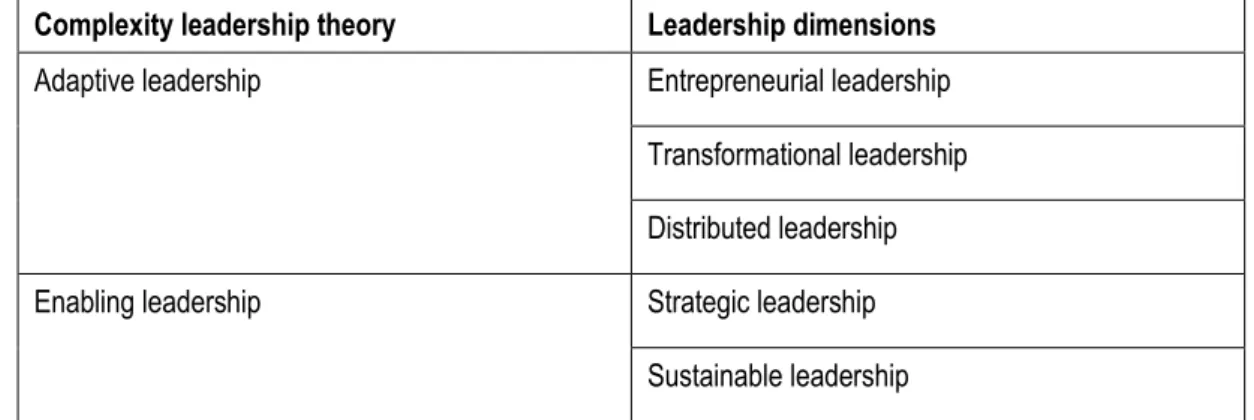
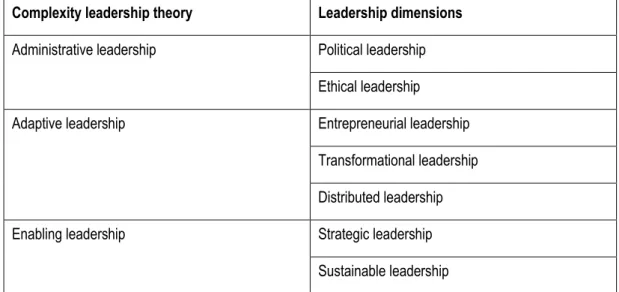
The most important factor in becoming a successful university for RA is leadership. The President and all the Vice-Presidents agree that they have to work as a team. The concept of complexity leadership theory (Uhl-Bien et al., 2007) and some of the seven leadership dimensions (Davies, 2005) have been strongly applied in RA. It can be observed from the interview with the President and the Vice-Presidents that there are two types of complexity leadership (Uhl-Bien et al., 2007) that have been introduced in RA. Firstly is adaptive leadership and secondly is enabling leadership (Uhl-Bien et al., 2007). Adaptive leadership has been implemented through entrepreneurial leadership (Hentschke & Caldwell, 2005), transformational leadership (Leithwood & Jantzi, 2005) and distributed leadership dimensions (Harris, 2005). Enabling leadership (Uhl-Bien et al., 2007) has been adopted by strategic leadership (Davies & Davies, 2005) and sustainable leadership dimensions (Hargreaves, 2005b).
At the beginning of change processes, the President focuses on the distributed leadership dimension (Harris, 2005) as a major technique to transform RA. Staff are encouraged to participate and everyone plays an important role in writing the strategic plans of the university. Staff are trained to work as a team and the President does not have to control or act as a leader in every project. It can be seen that the President trusts his staff and he respects human capabilities, especially the abilities of his team. Qualities associated with transformational leadership (Leithwood & Jantzi, 2005) have been used to train young executive managers to replace the higher administrative staff who will retire in a short period of time. (It should be noted that the President is unaware of the theory. This is an interpretation of the researcher.) Table 4.1 shows the two major ideas of complexity leadership theory (Uhl-Bien et al., 2007) that have been implemented with the five of seven leadership dimensions (Davies, 2005) to change the behaviour of staff in RA.
Table 4.1 Complexity leadership theory and seven leadership dimensions that have been introduced in RA.
Complexity leadership theory Leadership dimensions
Adaptive leadership Entrepreneurial leadership Transformational leadership Distributed leadership Enabling leadership Strategic leadership
Sustainable leadership
Because the President believes in the abilities of everyone and supports competition among staff, RA has become the most popular Rajabhat University in Thailand and the number of students who want to study is increasing every year. It is surprising that the new culture that encourages staff to compete with each other and a focus on the university has been accepted, as this is not common in Thai culture. Especially in government organisations, staff are more concerned about maintaining good personal relationships and avoiding conflict or argument.
The President says:
If anyone wants to suggest any idea to improve and develop our university, they are all welcome to see me every time and I always support every project that will bring benefits to RA. We have a strong policy to encourage everyone to think and submit their plans that will create advantages for their work and for RA. No matter what level or position you are in, if you have a good idea, please come to see me. I will give you full authority to manage it and you will benefit from your ideas also.
This policy has encouraged staff to develop their own special projects. Although these projects must be approved by the President first, a person, group or team who proposed a project becomes responsible for its management and its success. This is a strong type of entrepreneurial leadership dimension (Hentschke & Caldwell, 2005), which only RA has adopted. The President believes in the idea of entrepreneurial management. He confirms that if staff take full responsibility for their work, the result is always better than if they follow the President’s orders. Especially in RA, not only do staff have full power and authority to manage their projects, but the
than 15 years. Staff have an equal right to be involved and participate in the processes of running RA. Everyone is equal rather than divided by the level of their positions or their degrees. A strategic leadership dimension (Davies & Davies, 2005) has been created since the President wanted to change the university to become a business oriented educational institution. The strategic plans have been written with the cooperation of staff and every one of them has been committed to their plans. Because staff have created their own plans, they are obliged to put more effort into their work and share their experiences with each other. The overall performance of RA is better than it was previously and staff are continually improving their knowledge and capabilities.
The strength of RA’s leadership is that leaders create a good network, which supports the process of cooperation and all members in the organisation pool their expertise to establish a successful university. The President and the Vice-Presidents agree that change is important and all facets of higher educational management have to change in order to be compatible with the new educational environment. During the time of change, RA has been developing a sustainable leadership (Hargreaves, 2005b) for their future. The President wants to transfer his authority and power and his ideas to the new leaders who can bring RA to be the number one vocational university in Thailand.
The university not only has a major duty to provide knowledge for people but the knowledge that has been provided also has to be responsive to the demands of the country. RA started making changes before the Rajabhat University Act (2004) was enacted. By 2006, RA had its own income stream, which could be used to provide a modern technology for teaching and a commitment to develop projects for the future.
Underpinning Philosophy
The interviews with the President and the Vice-Presidents of RA show that this university has a business focus in providing education and the management of their university. Every strategic plan that has been made for the last decade was dependent on business principles. The most important factor used to make decisions is the demand of the labour market and the possibility of employment success for
project they undertake. Profit gives them resources to enhance their reputation by providing quality.
This university has a different philosophy from other Rajabhat Universities in their provision of education. They perceive that a university is similar to a company and believe that using a business management style to manage a university is appropriate. Every plan has to be evaluated and the best way to evaluate strategic plans is by using cost and benefit analysis. RA’s administration teams have been training in business education. They agree that investment in the university is similar to investment in a business. The President and the Vice-Presidents (Academic), (Management), and (Planning and Budgeting) give the same opinions confirming that RA is a university whose main purposes are business and education.
The President has a strong belief that business can help the university to survive. He suggests that RA should use a business oriented style to manage their curricula and academics, because it will become a profitable university and have enough money to invest in their staff. The performance and financial security over the past ten years has shown that the President and RA administrators have made sound financial decisions.
The Vice-President (Strategic plans and Research) says:
In reality when people think about RA, they think more about our business activities than our academic professionals. We have used the money that we get from our business to support our academic activities for a long time and this is the image of our university that the public sees.
Thai people remember the name of RA from its reputation in making and selling a variety of bakery products, and teaching and operating hospitality businesses such as hotel management, Thai restaurants and the most popular business is from conducting and publishing opinion polls. (The results of these opinion polls are highly influential in Thai society and bring in a generous income to the university.)
Another example that we are proud of are our polls, everyone in this country knows our polls and accepts that our polls can predict many situations and can be trusted.
The Vice-President, who is the head of Polls Centre at RA, has a very strong background in research. He is a former President of RA and he predicted that it will become a famous university by conducting polls and research. He is a good business man and he uses data from research before he makes any decisions for RA.
The Vice-President (Management) says:
Our university is the first university who thinks that business and academia should come together and we believe that universities should transfer theoretical knowledge to the real world to enhance the communities and for RA to survive. Every project that we have designed and implemented we have had to prove that it was successful. Are they profitable? We have to evaluate our projects using business models, not only say that it is a good project or it is successful.
All the administrators agree and accept that they want to change their university to become a business which provides education and make profit from their activities to sustain ongoing operations and quality. All the Vice-Presidents confirm that the President is the most influential person who can persuade all staff to focus on making a profit for the university. The President offers higher salaries and incentives for every staff member who can generate extra income for the university. If anyone works harder and generates more income, the President will pay them more in higher salaries and benefits than their colleagues.
The Vice-President (Management) says:
For example, we teach how to cook; we have to show our students that it can be sold, it is delicious and it is well known, so we opened a restaurant on our campus and use our staff, who teach how to cook to make food for our restaurant. You can see we make a lot of profit from our restaurant and our
customers come from outside the campus and we cater for many external organisations.
Apart from bakery products, a Thai restaurant and opinion polls, RA has a very well known hotel in Bangkok. This hotel is independently rated as a four-star hotel and has a high occupancy rate all year. The major customers are members of the Thai Parliament and tourists from Western countries. The Vice-President explains that many of the students who apply to study in RA do not remember any other programmes that they teach, but most of them hear about their reputation for bakery products, Thai restaurant, polls and the four-star hotel.
Aiming to become a university that is based on business management principles is different to other Rajabhat Universities. All administrators at RA have similar opinions and agree to manage the university in this way. However, other Thai educators think the opposite. Most of them believe that the first objective that Thai people want from all higher educational institutions is not to make a lot of money and pay huge profits to the stakeholders, or pay a large amount of taxes to the government. Many Thai educators suggest that the main role of higher educational institutions is providing important knowledge and skills for students in order to develop the country. The concepts that the administrators use to manage RA is different from the original objectives of universities. However, the higher education environment in Thailand has changed and the new concept, which focuses on a business orientation may be more suitable for RA than the more traditional higher education institution.
Responding to the Changed Environment
Human Resource Management and Development
The human resource management techniques that have been used at RB focus on a friendly approach. There is no punishment or pressure placed on staff who cannot follow the university’s policies. The President and the administrators never apply any techniques that will generate conflict or problems between staff and administrators. This is a common behaviour of Thai value and culture that everyone aims to avoid any argument or conflict as much as they can. Thai people prefer a friendly, fun and entertaining environment in their work places. They do not like to make direct comments in a face to face manner. They want to maintain good relationships and smile to each other all the time.
The President and the administrators want to achieve four main objectives in regards to human resources. Firstly, they want their staff to conduct research and increase the number of research projects. Secondly, they want their staff to achieve higher academic positions through conducting research or writing textbooks and thus gain promotions. Thirdly, they want their staff to get higher degrees, especially doctoral degrees. Finally, they want their staff to use computers and information technology in their teaching and administrative work.
The concept of changing the organisational system from a bureaucracy to a business has not progressed very much at RB, because the administrators of RB thought that it was not a good time and staff who work for RB would reject this idea. The President and the administrators believe that they can survive with the bureaucratic system that existed prior to the change to university status. Staff and administrators feel satisfied with the idea of a bureaucratic organisation. The President explains that managing the university is different from other organisations and most academic staff have different characters and attitudes from other people. If the new environments that have impacted upon RB and the only technique for survival is by changing the organisational structure, the President says that he will consider this topic again:
have chosen not to change quickly, we have to change carefully and minimise conflict between our employees and the University’s administrators.
The administrators agree with the President that a low conflict and gradual approach to change is appropriate. Many administrators agree that change is important but the satisfaction and security of staff who work at RB is more important than other factors in the process of change.
The Vice-President (Planning and Budgeting) says:
If I was an employee who was used to working in this structure, I would be mistrusting of new ideas. I want a secure job and less pressure. I would not trust any evaluative system or any kinds of measurements. Many people have done a good job, but they did not get a good performance appraisal. It is hard to believe that every employer has integrity when they evaluate their employees.
Evaluating staff performance by using business standards is not accepted at RB. The administrators disagree with this idea. They believe that the traditional system is suitable for RB and in the future, they still want to use the old system. The President respects all staff feelings and listens to them. He realised that most staff do not want to change their status from government officers to employees of the university. The security of their jobs is more important than the salaries that will increase if they change to become employees of the university.
Staff enjoy a relaxed workplace. The President and the Vice-Presidents are their friends more than their bosses. All policies that have been announced by the President are negotiable. For example, after RB became a university, the President wanted to increase the number of research projects and promote the quality of teaching and learning so that these could be acknowledged as strengths of RB. Unfortunately after the President set up this plan, staff felt unhappy and worried that they could not achieve this. The President understood and tried to motivate them in other ways rather than force them or punish anyone who could not follow his policy.
I cannot punish anyone who did not follow my policies. We are the same family and I know them for a long time, many of them were my teachers who supported me to become the President today. I can use only motivation techniques offering the best rewards to change their behaviour.
The first objective of human resource development is persuading staff to increase the number of research projects. The President explains that it is not easy to change the behaviour of staff who had never conducted research before. The President tries to motivate and allocate financial support for staff who want to conduct research. However, the quantity of research that has been conducted in 2006 was very small and RB needed a large numbers of research projects in order to meet the requirements of the Office of the Higher Education Commission.
Staff need money to pay for living expenses and the only way they can increase their income is by teaching as many hours as they can. Even then, the quality of teaching is a second priority for them. The President realised all these problems, but he does not want to create any anger with his staff. He motivates staff by giving them the same amount of money if they swap to conduct research instead. He expects that staff will conduct more quality research than is currently performed. It is a slow process at the beginning but after many years, the President believes that RB can increase the number of research projects as well as the quality of teaching.
The second objective is supporting staff to get higher academic positions. The President and the administrators want to increase the number of academic positions in order to gain a reputation from local communities and be accepted as having the same quality of staff as other universities.
The Vice-President (Strategic plans and Research) says:
We have many projects to encourage our staff to write textbooks and submit these to gain higher academic positions. Because the numbers of staff with high status academic positions in our university is lower than the standard of the Office of the Higher Education Commission, we need to increase those numbers as soon as possible.
Every year RB has organised many workshops to support staff in every faculty to increase their skills and knowledge and to write textbooks. However, most staff do not have enough time to participate in these workshops. The President accepts that this is a problem for RB in developing their human resources.
It is known that the salaries of staff at Rajabhat Universities are quite low relative to other careers. Staff who live in Bangkok have a higher cost of living than in other provinces. Normally, staff who work at RB have to teach more than 30 hours per week and have to do at least 20 hours of administrative work. It is understandable that they do not have enough time to improve their knowledge. Owing to the low salaries that they get from their positions, staff have to work as much overtime as they can to increase their income. If the President wants to encourage staff to join the training workshops to improve their knowledge, it may be necessary to increase their salaries and benefit systems which will give them time to develop their skills and knowledge.
The President argues that in the future, RB may not have as many students as they have today. Thus, the teaching hours and administrative work of every staff member will be decreased. The problem whereby they do not have enough time to study and conduct research will be solved. The President does not worry about the problems in the future. He believes that everything will be going well in the future. Every problem has its own solutions and he is waiting to find those solutions.
The third objective of human resources development is supporting staff to get a higher degree. The President and the Vice-Presidents agree that it is important to increase the numbers of staff who have doctoral degrees to meet the standard requirement of the Office of the Higher Education Commission. RB has provided some scholarships for continuing higher education. However, those scholarships are not sufficient to allow staff to go to study in overseas universities. If any staff member wants to study for a master’s or doctoral degree, and they do not have enough money to pay for themselves, they have to study in Thailand or study with RB instead.
It is a sensitive topic to explain why we cannot send our staff to study doctoral degrees abroad. The truth is we do not have enough money to provide scholarships. However, most of our staff are working too much. It is harder for them to get any offer from overseas universities, especially as their English has not reached the standard of overseas universities. I guess it is realistic for them to study in Thailand where we provide scholarships and continue working full time to get money and balance their life.
In the future, the President confirms that RB will become a high information technology university. Staff will have to learn how to use the Internet and a number of software packages in their teaching processes.
The Vice-Presidents are among the first groups who had changed their behaviour by using electronic mail to inform personnel about meetings and information among the administrators. All the Vice-Presidents have to check their electronic mail every day. The next stage in this project is for the President to motivate all staff to use computers and the Internet in their routine jobs. Most of the staff at RB feel uncomfortable using computers. The average age of staff at RB (in 2005) is 50 and many of them have never used computers in their work before.
The President says:
I know that a number of human resources development projects are still being developed. The transformation is not yet complete but in a couple of years we will become a higher quality university. We have invested a lot of money to improve our staff, such as Internet provision and on-line learning. We have tried to improve the technology available to staff and students with on-line data and services.
Compared with other Rajabhat Universities in Bangkok, RB introduced improvements to their computer technology later than the others. The President explains that RB does not have enough money to invest in technology and training their staff. In 2007, the President believes that the Internet provision and on-line learning will be completed.
Staff and students can use e-learning in every programme that will be taught at RB. The Vice-President (Academic) suggested (in 2006) that RB should use on-line enrolment for every faculty, and students should not have to come to university to enrol. Staff will have their own computers to use in their jobs.
Technology will become a very important tool for administration, teaching and learning. It has been accepted that information technology has become an important factor for the success of the higher education institutions. The President has spent more than 100 million baht (~ 3.33 million AUD) to improve information technology over the past year. However, the computer systems still have some problems. He stated that if RB does not have enough money for improving these systems, he will subcontract this project to private companies, and when RB has enough money he will buy back the control of the project.
The human resources management and development policies of RB focus on negotiable techniques. Every plan that the President wants to achieve is not a short term plan. The President explains that there is a lack of money to invest in staff. Thus, it is better that everything is changing gradually.
Introducing New Degree Programmes
Two new degree programmes were introduced in 2007, Buddhist Studies and Thai Traditional Culture. The President and the administrators are proud of these new degree programmes and believe that these will help create a high reputation from local communities. RB’s administrators believe that Buddhist Studies is an academic area for them to become well known as a university in the future. RB will rent the land from the local Thai temple and build new offices and teaching space for this new programme.
The President and the Vice-Presidents have a good relationship with the chief monk in this temple. The President had been a monk for more than 10 years before he became a teacher and started working at RB. In Thailand, there are two Buddhist universities and everyone who studies and teaches in these universities is a monk. At present the two universities teach different approaches to Buddhism, one focuses on Theravada and the other on Mahayana. RB will combine the two different concepts and offer degrees at three levels: bachelors, masters and doctoral.
Most Thai people and Buddhist study are part of each other. We cannot survive if we do not have our religion to lead us. I think it is important to teach and learn the core of our lives. This programme is unique and only RB can teach and manage it. We have staff that are professionals in Buddhist study. We have strong support from the government. We are filling a gap in our society. People look for the meaning of their lives and this programme will help them.
The second new programme is Thai Traditional Culture, which was introduced in 2007. RB has invested more than 180 million baht (~ 6 million AUD) in the construction of a Thai traditional home for teaching purposes and tourism. The President and the Vice-Presidents believe that RB will attract many tourists to the Thai traditional home. This home will be used to arrange many ceremonies showcasing Thai traditions, such as engagements, weddings, and funerals. Students who study Thai culture and tradition will provide food and decorate the home for these functions. Staff that teach Thai culture and Thai tradition will organise all the programmes and the curriculum that will be studied in the Thai traditional home. This Thai traditional home offers a simulation for students and people who want to learn about Thai tradition and the daily lives of Thai people in the past century. RB believes that the Thai traditional home will make a lot of money for the university. People who want to get married in the old Thai style will be able to rent this home for their ceremonies. Staff and students who know about Thai tradition will manage the processes of weddings and provide all the materials that have been used in wedding ceremonies in the past. The administrators think that this project will encourage Thai people who are ignorant of Thai culture and do not know much about their history to become interested in their culture and conserve Thai traditions for the next generation.
The President says:
In 2006 we have invested more than 180 million baht to build a new Thai traditional home. This home will be constructed with Thai knowledge and use
the same materials as in the past when Thai people made their homes. This is a big home; more than 400 people can stay in this home.
The Thai traditional home is a major project for RB and the administrators expect that the university will make a lot of money from this project. The President has a strong relationship with the leaders of local communities and the monks. He believes that local people will use this home to organise their functions and promote it to tourists, and that monks will advise people to visit and conserve Thai tradition and Thai culture. This is the major strategy to conserve Thai culture and follow the Rajabhat University Act (2004).
Developing International Relationships
Like other Rajabhat Universities, RB focuses on international relationships with foreign universities. The President believes that it is important to create many MOUs with other universities in developed countries, especially in the United States, England and Australia. The President and the Vice-Presidents always encourage staff to visit and participate in short training programmes that have been arranged in those countries.
The President says:
I want to support all staff to go abroad and study in any field that they want in order to improve their capability and knowledge. I accepted that we need to learn from other universities especially universities in developed countries. In order to improve our quality and technology, the easiest way is to learn from successful universities. However, we do not have enough money to support every training programme that will benefit RB. I have to choose only some programmes and only some staff who are most suitable to attend those programmes.
The most successful programme that has been done after RB became a university is a joint venture programme between one well known university in Australia and a doctoral degree programme of RB. Students who study in this programme not only get opportunities to go to Australia and spend several semesters studying with Australian students, but many staff from the Australian university have visited Bangkok to give lectures for RB’s students also. It is working well between both
other universities in Australia.
The Vice-President (Management) says:
We have good relationships with many universities in Australia such as in Western Australia, New South Wales and Victoria. In 2004 we developed the doctoral degree programme with a university in New South Wales. Actually, we share our resources such as library databases and technology with them for more than 20 years. It was a small project in the past and after we became a university our relationship has become more important. Next year, in 2007, we plan to go to America to open some programmes with universities located in areas that have many Thai people living in them such as California or Los Angeles.
Joint venture programmes are becoming a more common feature in the offerings of Rajabhat Universities. Some, as in the case of RB, are with foreign universities. Others are developed in conjunction with government authorities or private companies.
The President and the Vice-Presidents believe that there is a lot of demand by Thai people who were born in other countries to study Thai culture and Thai tradition. These programmes will create a reputation for RB in the future. One of the problems to create a training programme or joint programmes with other universities is the lack of fluency in the English language of RB’s staff. There are many programmes that overseas universities offered for free but no staff can apply because those programmes required an English test (for example International English Language Testing System (IELTS) 6.5 or more) which is higher than most staff can achieve. The Vice-President (Academic) says:
English language is a big problem when we want to send someone to go overseas. There are some programmes we do not have to pay for tuition fees but we have to show their English test score before they can apply to those programmes and unfortunately we cannot find any staff who get that score. If we can improve our English to get the same standard with other universities,
it will be easier to create many relationships with other universities than in the past.
The problem preventing RB from increasing their international relationships is insufficient fluency in the English language by staff. The President and the Vice-Presidents try to solve this problem by arranging many English programmes for their staff every semester. RB has a new policy for anyone who wants to join or attend any programmes in other countries; they have to show that they can pass the English test before they go. This policy might be helpful to motivate staff at all levels to improve their English. In the past the old policy provided opportunities for senior staff and administrators to go first, even though their English language fluency did not reach the standard requirement.
Financial Considerations
RB does not have as much money to improve their facilities and equipment in teaching and learning processes as they would like. Most of their budget comes from the Thai Government. After RB became a university, the government reduced funding and RB has had to become a more independent university. It is difficult for RB to increase its income because administrators have not prepared themselves for this situation. The President and Vice-Presidents agree that one of their major problems is how to increase their income. Up until now, they have not found any effective solutions to increase their income. The President believes that the tuition fees of RB are lower than at other universities. RB planned to increase the tuition fees in the second semester in 2006. However, this idea has been rejected by many staff who know that most students who study at RB come from families who do not have much money. If the President increases the tuition fees, it may decrease the number of new students.
Since 2006, students who want to study in the universities can borrow money from the government. When they graduate and get a job, students have to repay this money back to the government. This project will help everyone who wants to study, but does not address any increase in funds to go to the university. Students who come from low income families will have the same opportunities as other students. In the future, this project may affect the numbers of new students. When the tuition fees
equipment than RB became preferred choices for prospective RB students. The Vice-President (Planning and Budgeting) says:
This year (2006) due to the new loan scheme the expense for tuition fees is not a problem for the students. They can select to study at any private or public university they want. Some private universities have better reputations and better technology than Rajabhat Universities.
The President stated that the numbers of new students is important in terms of the income that RB receives and he suggested that RB has to improve the quality of teaching to meet the demands of new students and offer degree programmes that students want to study. However, some of the Vice-Presidents believe that RB does not have to improve and pursue new students. They know that RB has gained a high reputation for teacher education and believe that RB will generate income from this programme as they have done in the past. On the other hand, the President thinks that it may be a better idea to prepare to adapt the current programmes to be compatible with the demand of the students and the labour market. The main source of revenue of RB is derived from tuition fees and if the government reduces funding in the future, the tuition fees will be the only source of RB’s income.
If RB can increase the number of research projects that they undertake and these gain approval, RB will get another source of income from the government. The money for research is a large proportion of the budget. RB has a plan to motivate their staff and students to conduct more research. However, to increase research output takes a considerable amount of time and effort and is difficult to implement.
The President and the Vice-Presidents do not appear to be as concerned about RB’s financial management as many of the other administrators from other Rajabhat Universities in Bangkok. However, they have a strong belief that RB will survive no matter what happens and that things change all the time. They do not want to worry too much and try to think in an optimistic way regarding RB’s future.
Leaders’ Response to Change Leadership Dimensions
In comparison with other Rajabhat Universities, the administrators of RB are optimistic people. The President is a positive thinker. He always says that whatever will be will be, he does not want to forecast what will happen in the future, and he will wait and see. The President will not implement any plans that will make staff feel uncomfortable. He wants to maintain a friendly environment in the university. This demonstrates how ‘saving face’ is an important aspect of Thai culture. Qualities that mirror those of complexity leadership theory (Uhl-Bien et al., 2007) and a number of the seven leadership dimensions (Davies, 2005) have been introduced to change staff behaviour. It is important to reiterate that although the researcher has identified these elements of theory that the President is unaware of it.
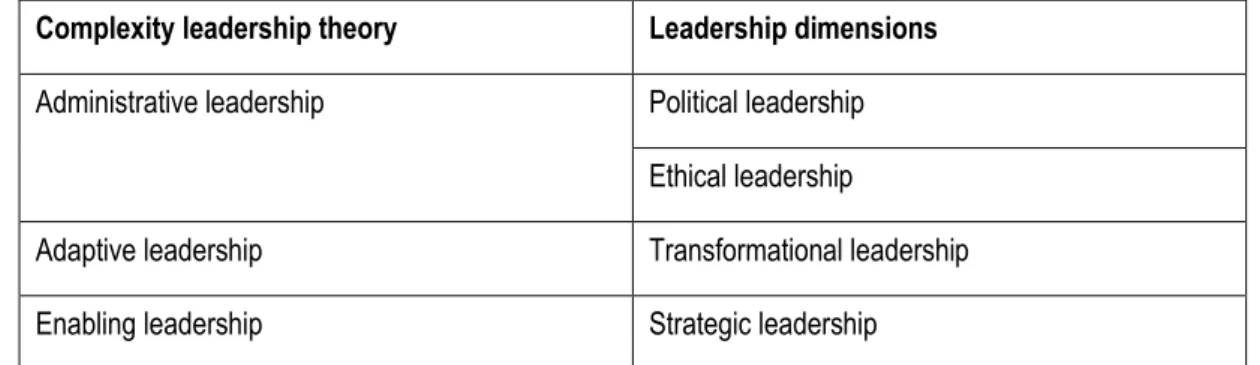
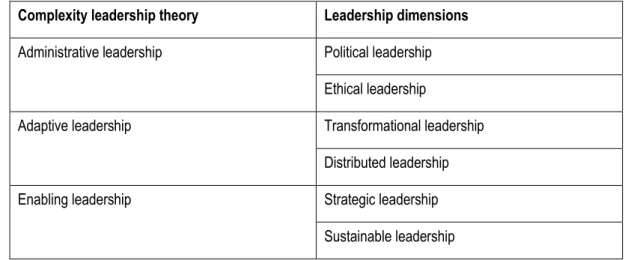
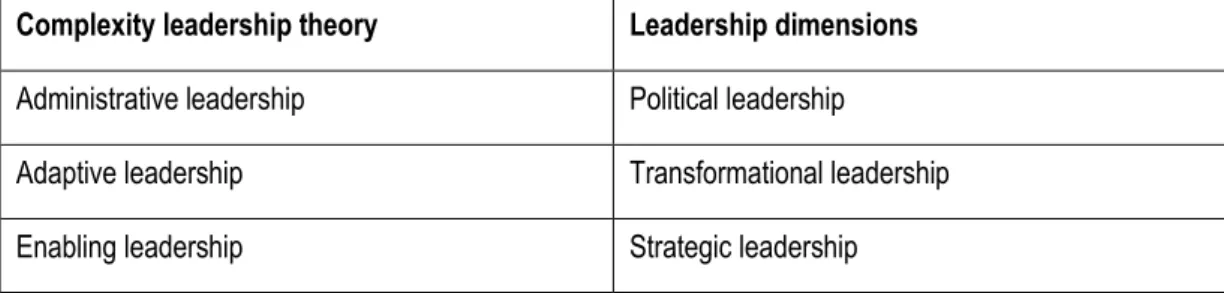
The most important complexity leadership theory concepts that have been used in RB are administrative leadership and adaptive leadership (Uhl-Bien et al., 2007). It can be seen that the President has used administrative leadership through political leadership (Deal, 2005), ethical leadership (Starratt, 2005) and adaptive leadership through transformational leadership (Leithwood & Jantzi, 2005). Enabling leadership (Uhl-Bien et al., 2007) has been used with senior administrators although still at an early stage through strategic leadership (Davies & Davies, 2005). Table 4.2 shows the concept of complexity leadership theory (Uhl-Bien et al., 2007) with three major forms and seven leadership dimensions (Davies, 2005) that have been implemented by the President.
Table 4.2 Complexity leadership theory and seven leadership dimensions that have been introduced in RB.
Complexity leadership theory Leadership dimensions
Administrative leadership Political leadership Ethical leadership
Adaptive leadership Transformational leadership Enabling leadership Strategic leadership
The President believes that political leadership (Deal, 2005) and ethical leadership dimensions (Starratt, 2005) are the key characters for successful leaders. It is suitable