44
EVALUATION OF MAIZE HYBRIDS UNDER LOCAL CONDITIONS OF
CRAIOVA, OLTENIA REGION
1BONEA DORINA, URECHEAN VIORICA2
1University of Craiova, Faculty of Agronomy, Libertatii Str., no. 19, Dolj County, Romania, [email protected] 2Agricultural Research and Development Station Simnic – Craiova, Balcesti Str., no. 54, Dolj County, Romania, [email protected]
Keywords: days to anthesis, days to silking, ear height, grain yield, plant height
ABSTRACT
A field experiment with twelve maize hybrids was conducted at Agricultural Research and Development Station (ARDS) Simnic – Craiova during the cropping season 2015-2016. The results of present study revealed significant differences for grain yield and for all the traits except anthesis - silking interval that exhibited non-significant difference among the studied hybrids. The hybrids HSF 787-13 and HSF 825-13 took more days to anthesis (82 days) and silking (84 days), while hybrid HSF1098-13 was found early maturing, which took 74 days, to anthesis and 75 days to silking. The highest plant height of 214 cm was noted in hybrid HSF 1098-13, and the highest ear height of 81 cm was noted in HSF 787-13. The studied hybrids had a wide genetic background, thus showing grain yield ranges from 7.70 to 12.09 t/ha. The hybrids HSF 711-13 (12.09 t/ha), HSF 1223-13 (11.06 t/ha), HSF 1098-13 (10.20 t/ha) and HSF 825-13 (9.82 t/ha) had the highest grain yield, and these hybrids were found most promising, which have the potential to increase the average yield of maize in local condition of Craiova and similar growing areas.
INTRODUCTION
Oltenia region is a dry area where only two years out of ten are favourable to agricultural crops. Drought and heat is abiotic stresses that lead always to different yield losses levels depending on the constrainer length, its intensity and crop stage (Bonea and Urechean, 2019; Urechean et al., 2019).
Maize is third most important cereal crop after rice and wheat and it plays an important role in world economy. At present, climate change affects the yield potential of maize, so the selection of good hybrids with tolerance to abiotic stresses is highly essential.
The identification of hybrids with a high yield potential, coupled with wide adaptability, is a key target of any maize-breeding program (Mendes et al., 2012).
The yield of a agricultural crop is the result of a combination of the genetic
potential of the cultivar, the management of the crop and the environmental conditions of the cultivation area (Dobre, 2015; Osiceanu et al., 2018; Rufino et al., 2018).
Biotechnology is already involved at modern genetic breeding of crop plants but she can be a very important approach to increasing food production in the near future as well as for the protection of the environment and the health of consumers (Bonciu, 2012; 2015; 2017; 2018).
Maize cultivars produce
significantly different yields at different locations depending up on fertilizer use, rainfall pattern, plant density and the like (Prioteasa et al., 2006; 2007).
45 cultivars for cultivation on farmers’ fields (Olakajo and Iken, 2001).
Keeping this in view, the present study was conducted to evaluation the
performance of maize hybrids for their adaptability and stability.
MATERIAL AND METHODS
Three Romanian commercial hybrids (F376, F423 and Iezer) and ten newly bred single cross hybrids of maize (HSF56-11, HSF 2845-13, HSF 386-12, HSF 711-13, HSF 1098-13, HSF 65-12, HSF 1223-13, HSF 787-13 and HSF 825-13) were used in this study.
The experiment was conducted under rain fed conditions in the cropping season 2015-2016, and was planted at Agricultural Research and Development Station (ARDS) Şimnic – Craiova in a randomized block with three replications.
This Station is located at 44019' N,
23048' E, and 182 m altitude. Fertilization
was done with 250 kg/ha (N20P20K0)
complex fertilizers before sowing and in vegetation (phase 8-10 leaves) with ammonium nitrate 250 kg/ha. Planting was done on April 22th – 2016. The crop
was raised following all the recommended agronomic practices.
The year 2016 was a favourable year for maize. The maximum temperature during the growing period (April to September) was found in the month of July and August recording 36°C. The highest rainfall was recorded during the month of May and June (over the multiannual average), and the rainfall deficiency was largely pronounced in July and August.
For Oltenia region, the rainfall during sowing to anthesis period, had a decisive role in defining the production capacity of maize (Bonea and Urechean, 2019).
Grain yield per hectare was adjusted to 15.5% moisture. In each plot, days to anthesis and days to silking were recorded as the number of days from sowing to when 75% of the plants had shed pollen and emerged silks, respectively.
Plant and ear heights were measured in centimetre as the distance from the base of the plant to the height of the first tassel branch and the node bearing the upper ear, respectively.
The data collected were subjected to ANOVA: single factor and differences between mean values were tested by F-test and separated using the Least Significant Differences (LSD) at 5% level of probability. The variability presence in the hybrids was estimated by coefficient of variations (CV) using the procedure suggested by Săulescu and Săulescu (1967).
RESULTS AND DISCUSSIONS
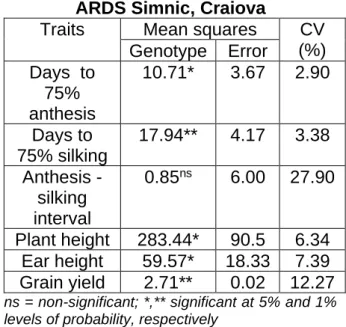
Maize genotypes responded significantly to grain yield and to phenological (days to anthesis and silking) and morfological growth traits (plant height, ear height) under local conditions of Craiova (Table 1)
Table 1 Mean square (MS) values and coefficient of variation (CV) for grain yield and traits of 12 maize hybrids at
ARDS Simnic, Craiova
Traits Mean squares CV
(%) Genotype Error
Days to 75% anthesis
10.71* 3.67 2.90
Days to 75% silking
17.94** 4.17 3.38
Anthesis - silking interval
0.85ns 6.00 27.90
46
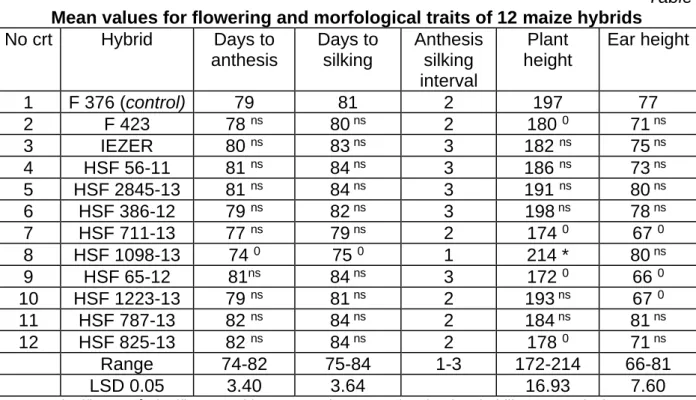
Table 2 Mean values for flowering and morfological traits of 12 maize hybrids
No crt Hybrid Days to
anthesis
Days to silking
Anthesis silking interval
Plant height
Ear height
1 F 376 (control) 79 81 2 197 77
2 F 423 78 ns 80 ns 2 180 0 71 ns
3 IEZER 80 ns 83 ns 3 182 ns 75 ns
4 HSF 56-11 81 ns 84 ns 3 186 ns 73 ns
5 HSF 2845-13 81 ns 84 ns 3 191 ns 80 ns
6 HSF 386-12 79 ns 82 ns 3 198 ns 78 ns
7 HSF 711-13 77 ns 79 ns 2 174 0 67 0
8 HSF 1098-13 74 0 75 0 1 214 * 80 ns
9 HSF 65-12 81ns 84 ns 3 172 0 66 0
10 HSF 1223-13 79 ns 81 ns 2 193 ns 67 0
11 HSF 787-13 82 ns 84 ns 2 184 ns 81 ns
12 HSF 825-13 82 ns 84 ns 2 178 0 71 ns
Range 74-82 75-84 1-3 172-214 66-81
LSD 0.05 3.40 3.64 16.93 7.60
ns = non-significant; *,0 significant positive or negative at 5% levels of probability, respectively
Days to 75% anthesis
Analysis of variance for days to anthesis trait revealed significant (P ≤ 0.05) differences among the hybrids. Coefficient of variation (CV) was 2.90% (Table1). Data for days to 75% anthesis ranged from 74 to 82. Minimum days to 75% anthesis (74) were observed for HSF 1098-13 and the maximum days to 75% anthesis (82) were observed for the hybrids HSF 787-13 and HSF 825-13 (Table 2).
Olaoye (2009) showed that days to anthesis trait reveal differences in maturity among genotypes due to reflection of weather pattern i.e. temperature, available soil moisture etc.
Days to 75% silking
Days to 75% silking are commonly used by maize breeders for determining maturity duration in maize crop. According to Lu et al. (2010), earliness in maize used mostly in screening genotypes for tolerance to drought stress. Statistical analysis revealed highly significant (P ≤ 0.01) differences among
the hybrids studied for days to silking. Coefficient of variation (CV) was 3.38% (Table 1). Range for 75% silking was 75 to 84 days. Minimum days to 75% silking (75) were observed for HSF 1098-13, while the hybrids HSF 56-11, HSF 2845-13, HSF 65-12, HSF 787-13 and HSF 825-13 needed maximum days to 75% silking (84) (Table 2).
Anthesis-silking interval
Statistical analysis revealed non-significant differences among the hybrids studied for anthesis-silking interval (ASI). Coefficient of variation (CV) was 27.90% (Table 1). Range for anthesis-silking was 1 to 3 days (Table 2). This was due to the fact that in the 2016 year, there was no severe drought during the flowering period.
47 only revealed 2 to 3 months later (Araus et al., 2012).
Plant height (cm)
Plant height is an important agronomic trait in maize breeding.
Analysis of variance revealed significant (P ≤ 0.05) differences for plant height among the hybrids tested. Coefficient of variation (CV) was 6.34% (Table 1). Range for plant height was 172 to 214 cm. Short plants (172 cm) were observed for HSF 65-12, and maximum plant height of 214 cm was observed in hybrid HSF 1098-13 (Table 2).
Ullah et al. (2017) reported that semi-dwarf plants are desired, because such plants are more resistant to lodging and are fertilizer responsive as well.
Ear height (cm)
Many authors consider that ear height is a important trait for machine harvesting and should not below a meter (Kizilgeci et al., 2018)
Results obtained during the study indicate significant (P ≤ 0.05) differences for ear height among hybrids studied. Coefficient of variation (CV) was 7.39% (Table 1). Range for ear height was 66 to 81 cm. The maximum ear height was
recorded in HSF 787-13 (81 cm) and the shortest was found in HSF 65-12 (66 cm) (Table 2).
Grain yield
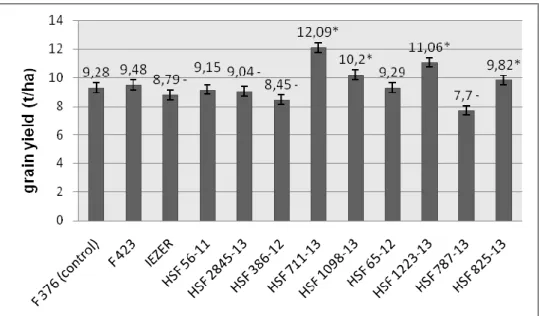
Statistical analysis showed highly significant (P ≤ 0.01) differences for grain yield among the studied hybrids. Coefficient of variation (CV) was 12.27% (Table 1). The grain yield ranged between 7.70 to 12.09 t/ha. The hybrid HSF 787-13 had the lowest grain yield (7.70 t/ha), and HSF711-13 had the highest grain yield (12.09 t/ha). The hybrids HSF 711-13, HSF 1223-711-13, HSF 1098-13 and SF 825-13 produced significantly (LSD 5%) grain yield than the control (F376). However, the lowest grain yield, than the control, was produced by hybrids HSF 787-13, HSF 386-12, Iezer and HSF 2845-13P (Figure 1).
Our results are in accordance with the results of many authors who also reported significant differences for grain yield and other traits in different hybrids, depending on the local conditions and applied technology (Cotuna et al., 2018; Pandia et al., 2013; Prioteasa et al., 2006).
48
CONCLUSIONS
Evaluation of maize genotypes is important task for maize breeding program. The highest grain yield was one of the basic criteria for identifying superior hybrids. The unpredictable environmental conditions are one of the major factors in selecting superior and widely adapted maize genotypes. Hybrid HSF 1098-13
was manifested as the early maturing hybrid.
Based on the performance, four hybrids: HSF 711-13, HSF 1223-13, HSF 1098-13 and HSF 825-13, were showed above performance of the control (F376) in the local conditions of Craiova. So, these maize hybrids were found suitable hybrids for Oltenia region and similar growing areas.
Bibliography
Araus, J.L., Serret, M.D., Edmeades, G.O. 2012 - Phenotyping maize for adaptation to drought. Front. Physiol. 3: 305(1–20).
Bolaños, J., Edmeades, G.O., 1996 -
The importance of the anthesis-silking interval in breeding for drought tolerance in tropical maize. Field Crops Res. 48: 65–80.
Bonciu, E., 2012 - Agricultural biotechnologies, balance factor for the sustainable development of the socio-economic system. Annals of the University of Craiova, Series Biology, Horticulture, Food Produce Processing Technology, vol. XVII (LIII)/1: 69-74.
BonciuE., 2015 - Resources, elements of
quality and prices for some assortment of ecological products. Annals of the
University of Craiova-Agriculture,
Montanology, Cadastre Series, vol. 45(1): 39-44.
Bonciu, E., 2017 - Food processing, a necessity for the modern world in the context of food safety: a Review. Annals of the University of Craiova - Agriculture, Montanology, Cadastre Series, Vol. 47(1): 391-398.
Bonciu, E., 2018 - Evaluation of cytotoxicity of the herbicide Galigan 240 EC to plants. Scientific Papers, Series A. Agronomy, Vol. LXI(1): 175-178.
Bonea, D., Urechean, V., 2019 -
Response of maize yield to variation in rainfall and average temperature in central part of Oltenia. Romanian
Agricultural Research, no. 37, First Online: August, 2019. pp.1-8
Cotuna, O., Paraschivu, M., Sărățeanu, V., Durău, C., Borcean, A., 2018
-Study regarding the reaction of some maize hybrids from Italy to the attack of the fungi Ustilago zeae (Beckm) and Helminthosporium turcicum (Pass.) in the climatic conditions from Banatʹs plain. Research Journal of Agricultural Science, vol. 50(3): 75-83.
Dobre M., 2015 - The role of the mulch layer in the success of no-till technology. ProEnvironment, 8: 216-221.
Kizilgeci, F., Yildirim, M., Albayrak, O., Bicer, B.T., Hossain, A., Sabagh, A., Akinci, C., 2018 - Evaluation of Turkish maize landraces through observing their yield and agro-morphological traits for genetic improvement of new maize cultivars. Acta fytotechn zootechn, 21(2): 31–43.
Lu, Y., Zhang, S., Shah, T., Xie, C., Hao, Z., Li, X.H., Farkhari, M., Ribaut, J.M., Cao, M., Rong, T., Xu, Y.B., 2010 - Joint linkage disequilibrium mapping is a powerful approach to detecting quantitative trait loci underlying drought tolerance in maize. Proc Natl Acad Sci. USA, 107: 19585– 19590.
49 Breeding and Applied Biotechnology, 12: 111–117.
Olaoye, G., 2009 - Evaluation of new generations of maize streak virus (MSV) resistant varieties for grain yield, agronomic potential and adaptation to southern guinea savanna ecology of Nigeria. J. Trop. Agric. Food, Environ. & Ext., 8(2): 104-109.
Olakojo, S.A., Iken, J.E., 2001 - Yield performance and stability of some improved maize varieties. Moor J. Agric. Res. 2: 21-24.
Osiceanu, M., Osiceanu S., Dobre M., 2018 - The influence of no tillage technology on plant height, soil moisture and yield of corn. Annals of the University of Craiova - Agriculture, Montanology, Cadastre Series, Vol. XLVIII: 235-240.
Pandia, O., Sărăcin, I., Bozgă, I., Marin, G.H., 2013 - The modification of phisyological processes at the Partizan crop hybrid depending on the doses of nitrogen and phosphorus applied to the irrigated and un-irrigated system. Annals of the University of Craiova - Agriculture, Montanology, Cadastre Series, 43(1): 267-271.
Prioteasa, M.A., Iancu, S., Pătru, I., 2006 - Noi rezultate experimentale privind cultura porumbului pentru boabe pe psamosolurile nivelate şi
nenivelate de la Tâmbureşti - Dolj. Analele Universităţii din Craiova, seria Agricultură, Montanologie - Cadastru vol. XXXV/A: 416-419.
Prioteasa, M.A., Iancu S., Prioteasa I.A., Pătru I., 2007 - Researches on the maize crop on the leveled and not leveled sandy soils from Tamburesti Dolj (2002-2004). Analele Universității
din Craiova, seria Agricultură-Montanologie - Cadastru vol. XXXVII/A: 326–330.
Rufino, C.A., Fernandes-Vieira, J., Martín-Gil, J., Júnior, J.S.A., Tavares, L.C., Fernandes-Correa M., Martín-Ramos, P., 2018 - Water stress influence on the vegetative period yield components of different maize genotypes. Agronomy, 8(8): 151.
Ullah, Z., Rahman, H., Muhammad, N.,
2017 - Evaluation of maize hybrids for maturity and related traits. Sarhad Journal of Agriculture, 33(4): 624-629.
Urechean, V., Borleanu, C.I., Colă, F., 2019 - Response of some corn hybrids to drought stress. Scientific Papers. Series A. Agronomy, Vol. LXII(1)1:480-486.
Săulescu, N.A., Săulescu, N.N., 1967 -