VOLUME 17 ISSUE 2 (2019), Page 352 – 360
QUALITY OF LIFE ASSESSMENT BASED ON ECONOMIC WELL-BEING PERSPECTIVE: A CASE STUDY OF JOHOR BAHRU AND
PETALING, SELANGOR
Mariana Mohamed Osman1, Nur Farhanah Rosli2 & Noor Suzilawati Rabe3
1,2,3
Kuliyyah of Architecture and Environmental Design
INTERNATIONAL ISLAMIC UNIVERSITY MALAYSIA
Abstract
The definition of quality of life is varied. Different individuals may perceive the quality of life in a different form of other individuals. Over more than four decades, Malaysia has made remarkable achievements regarding its economic growth as well as its socio-economic development. Numerous factors have been identified that may influence the quality of life of the people according to their personal preferences. This article assessed the perception of 100 respondent's lives in two major cities in Malaysia namely Johor Bharu and Petaling. These cities are also the major district in Johor Darul Takzim and Selangor Darul Ehsan. These study also would be focusing on the economic well-being of the individual. The economic individual is economic capacity, transportation, living condition and educational satisfaction.
INTRODUCTION
Improving the quality of life (QOL) of the itizen has always been the main focus of the Malaysian government and it has been one of the main agendas in the 11th Malaysia Plan 2016-2020. Generally, QOL is about the extent to which human needs are fulfilled concerning their perception of subjective well-being. Thus, it is the role of policymakers and professionals to provide opportunities for people to be able to meet their desired well-being (Costanza et al., 2005). The World Health Organization Quality of Life group define QOL as ‘individual’s perception of their position in life in the context of the culture and value systems in which they live and with their goals, expectations, standards and concerns’ (Phillips, 2006, p.23). Similarly, several authors (Zainal et al., 2012; Gilgeous, 1998) see QOL as the satisfaction of people over various dimensions including material, education, security, physical and living environment that affected by their perception on what they refer as the ideal life. Serag El-Din et. al (2012), described the quality of life as a complex concept that might be defined by various disciplinary. The term ‘quality of life’ is used solely to describe some physical features, but it describes all types of relationship, dynamics and the reticular relationship that relates to physical features.
LITERATURE REVIEW
people in a country where all population should have an equal opportunity to enjoy the amenities provided by their government.
Generally, Malaysia Quality of Life (MQLI) report was first produced in 1999 until the year 2011. Throughout these years, the major changes in the indicators are including the growing of 10 measurements (in 1999) to 11 major measurements in 2011. Meanwhile, in 2013, the quality of life measurement report was rebranded and introduced as Malaysia Well-Being Index Report consisting of 14 major quality of life measurements. The latest report was more organized with the classification of both economic and social well-being. Components in Economic well-being namely transportation, communications, education, income and distribution and working life.
RESEARCH METHODOLOGY
This study involves the economic well-being sectors in two major districts in Malaysia namely Petaling Jaya district and Johor Bahru district. Petaling is one of the major districts in Selangor meanwhile Johor Bahru is the capital city of Johor. Both Johor and Selangor are among the states in Malaysia that experienced rapid development progress. According to the Department of Statistic Malaysia (2016), Johor hold the highest GDP in Malaysia as compared to the other states. In terms of population number, the population in Johor Bahru was 1,345,191 whilst Petaling was 1,782,375 (DOSM, 2016).
In this research, the method used was quantitative and qualitative. For qualitative research, review of literature, journals, published data from various secondary sources was employed. Driven by the objective formulated based on qualitative analysis, a quantitative method was used to answer the research question. Through questionnaire survey form, the questions were designed to measure respondents’ scale of preferences on how they perceived their current economic well-being quality. Random sampling was adopted in selecting the number of respondents from both districts. However, due to the low number of participation from the target population, a convenient sampling method was used that was based on the availability and willingness of respondents. A total of 100 respondents were chosen from both districts and a scale using of 0-10 weas used to measure their perception towards the quality of life.
FINDINGS AND ANALYSIS
Socio-Demographic Result
Table 1 Socio-demographic in Johor Bharu and Petaling, Selangor Socio-demographic JB (%) Petaling (%)
Gender Female 58 58
Male 42 42
Race
Malay 26 79
Chinese 71 16
Indian 2 5
Others 1 0
Age
Less than 20 y/o 3 0
21-40 y/o 46 81
41-60 y/o 40 17
61 y/o and above 11 2
Marital status
Single 3 41
Married 33 57
Divorced 41 2
Widowed 19 0
Others 4 0
Household income
RM 1,000 and below 0 2
RM 1,001- 2,000 13 15
RM 2,001-3,000 17 31
RM 3,001-4,000 4 12
RM 4,001-5,000 13 9
RM 5,001-6,000 12 12
RM 6,001-7,000 13 2
RM 7,001-8,000 20 1
RM 8,001-9,000 4 0
RM 9,001-10,000 1 6
RM 10,000 and above 10
Educational level
Primary school 68 3
Secondary school 26 20
STPM/ Certificate/ diploma 5 35
Degree 1 37
Master 0 5
Source: Study survey
group of 21 to 40 years old (46% Johor Bharu district and 81% Petaling district). Meanwhile, the second-highest age group for both districts were 41-60 years old with a percentage of 40% and 17% respectively. Majority of the respondents in Johor Bharu were divorced meanwhile 57% out of 100 respondents from Petaling are married. Out of 100 respondents, 68% of respondents in Johor Bharu attended primary school. Meanwhile, for Petaling, the highest percentage with 37% claimed they had a bachelor degree.
Comparison on Relative Importance Index (RII): Johor Bharu vs Petaling
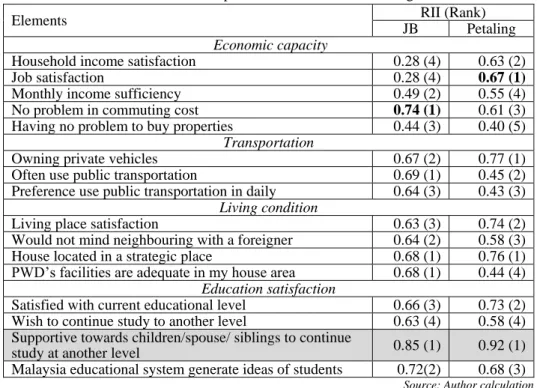
Table 2 RII comparison of economic well-being
Elements RII (Rank)
JB Petaling
Economic capacity
Household income satisfaction 0.28 (4) 0.63 (2)
Job satisfaction 0.28 (4) 0.67 (1)
Monthly income sufficiency 0.49 (2) 0.55 (4)
No problem in commuting cost 0.74 (1) 0.61 (3) Having no problem to buy properties 0.44 (3) 0.40 (5)
Transportation
Owning private vehicles 0.67 (2) 0.77 (1)
Often use public transportation 0.69 (1) 0.45 (2) Preference use public transportation in daily 0.64 (3) 0.43 (3)
Living condition
Living place satisfaction 0.63 (3) 0.74 (2)
Would not mind neighbouring with a foreigner 0.64 (2) 0.58 (3) House located in a strategic place 0.68 (1) 0.76 (1) PWD’s facilities are adequate in my house area 0.68 (1) 0.44 (4)
Education satisfaction
Satisfied with current educational level 0.66 (3) 0.73 (2) Wish to continue study to another level 0.63 (4) 0.58 (4) Supportive towards children/spouse/ siblings to continue
study at another level 0.85 (1) 0.92 (1)
Malaysia educational system generate ideas of students 0.72(2) 0.68 (3)
Source: Author calculation
Meanwhile, the least preferred or representing the highest dissatisfaction on economic well being is the satisfaction on buying properties with 0.40 for Petaling, while household income and job satisfaction are ranked as the least favoured indicators with RII values of 0.28 by respondents from Johor Bahru.
Economic well-being against household income of the respondents
Table 3 Economic capacity against household income
Economic capacity
Household income
JB Petaling
CC P-value CC P-value Household income satisfaction -.152 .131 .238* .017
Job satisfaction -.170 .090 .262** .009
Monthly income sufficiency .009 .927 .270** .007 No problem in commuting cost .044 .663 .369** .000 Having no problem to buy properties .028 .784 .345** .000
Table 3 indicates the Pearson correlation result between the household income of the respondents against the economic capacity of 100 respondents in both Petaling and Johor Bahru. There is no relationship involved between the two variables mentioned in Johor Bharu as the P-Value more than 0.05. Whilst, the P-value in all economic capacity variables in Petaling district resulted in less than 0.05 which the null hypothesis stated no relationship between the variables cannot be rejected. Referring to Guildford’s rules of thumb, household income satisfaction (0.262**), job satisfaction (0.262**) and monthly income sufficiency (0.270**) having a very low positive relationship with the household income variable. On the other hand, having no problem with commuting cost (0.369**) and having no problem to buy properties (0.345**) resulted in a low positive relationship with household income. Hence, it can assume that the higher the respondents' income, the higher the preference on household income satisfaction, job satisfaction, monthly income sufficiency, having no problem in commuting cost and buying additional properties by the respondents in Petaling district.
Table 4 Household income against transportation
Transportation
Household income
JB Petaling
CC P-value CC P-value
Owning private vehicles .109 .370 .058 .566 Often use public transportation .047 .702 -.129 .200 Preference use public
0.05 which indicate the null hypothesis stated there is no relationship between variable cannot be accepted.
Table 5 Household income against the living condition
Living condition
Household income
JB Petaling
CC P-value CC P-value Living place satisfaction .015 .902 .136 .177 Would not mind neighbouring with
foreigner .138 .255 .219* .028
House located in strategic place .031 .802 .039 .702 PWD’s facilities are adequate in my
house area .021 .863 .294** .003
Table 5 shows the Pearson correlation result for living condition against household income. Generally, P-value for living condition elements against household income in Johor Bharu is more than 0.05 which the null hypothesis stated there is no relationship between variables can be accepted. Similar result shared by the living place satisfaction and strategic house location for Petaling District. On the other hand, the P-value of having a foreigner as a neighbour (P-value: 0.028) and PWDs’ facilities adequacy (P-(P-value: 0.003) in Petaling district are less than 0.05 which the null hypothesis stated there is no relationship between variables can be rejected. Regarding Guilford’s rules of thumb, the relationship classified as very low positive relating. It can be assumed that the lower the household income, lower the living condition preferences.
Table 6 Household income against educational satisfaction
Educational satisfaction
Household income
JB Petaling
CC P-value CC P-value Satisfied with current educational level .114 .349 .071 .480 Wish to continue study to another level .124 .306 .036 .719 Supportive towards children/spouse/
siblings to continue study in another level
.286* .017 .141 .161
Malaysia educational system generate
ideas of students .346** .003 -.141 .163
that the null hypothesis stated that there is no relationship between these variables can e rejected.
On the other hand, p-value in all educational satisfaction variables in Petaling is more than 0.05 which the null hypothesis stated there is no relationship between variables can be accepted.
CONCLUSION
In conclusion, from the RII result, it shows that the respondents in both major cities in Malaysia perceiving their quality of life in terms of economic well-being. It can be seen that both cities perceiving the quality of life in their form which resulted in the different result for both cities. From the result also, it can be assumed that even though respondents in Johor Bharu least satisfied with the household income and their job, respondents in Petaling perceiving both of these elements as the most satisfying elements in economic capacity. Meanwhile, when the respondents in Johor Bharu satisfied with their monthly commuting cost, respondents in Petaling perceive it the other way around.
Hence, it can be concluded that to distinguish the quality of life in any terms it is based on the individual or the community itself since the quality of life contains border concept which affects the individual in terms of surrounding, the economy as well as the community. Quality of life study should be focusing on cross-cultural and regional differences or similarities in different parts of the world (Mohit, 2014). While economic growth leads to improvements in the quality of life, a better quality of life enables the population to participate more fully in economic development (Holdstock & Rowson, 2005).
REFERENCES
Costanza, R. et al. (2005). Quality of life: An approach integrating opportunities, human needs, and subjective well-being. Ecological Economics, 61(1), 267-276. Economic Planning Unit (2004). Malaysia Quality of Life Report, 2004.
Garcia-Mira, R., Uzzell, D. L., Real, J. E., & Romay, J. (2005). Housing, space and quality of life.
Gilgeous, V. (1998). The quality of work life. Integrated Manufacturing System, 9(1), 173-181.
Holdstock, D., & Rowson, M. (2005). Malaysia: Achieving the Millennium Development
Goals: Successes and challenges. United Nations Country Team, Malaysia.
Lora, E. et al. (2010). The quality of life in Latin American cities: Markets and perception. The Inter-American Development Bank.
Mohit, M. A. (2014). Present trends and future directions of quality-of-life. Procedia - Social and Behavioral Sciences, 153, 655–665.
Serag el din, H. et al. (2013). Principles of urban quality of life for a neighborhood. HBRC Journal, 9(1), 86-92.
WHO. (2012). WHOQOL. Retrieved from
http://www.who.int/healthinfo/
global_burden_disease/estimates/en/index1.html
Yahaya, A. S., & Selvaratnam, D. P. (2015). Relationship between Malaysian quality of life and gross domestic product. Kuala Lumpur International Business,
Economics and Law Conference 6, 3, 978-967-11350-4-4.
Zainal, N. R., Kaur, G., Ahmad, N. A., & Khalili, J. M. (2012). Housing conditions and quality of life of the urban poor in Malaysia. Procedia - Social and Behavioral Sciences, 50, 827-838