*Correspondence to Author:
Xuan Hau Nguyena
aResearch Centre of Multimedia Information Security Detection and Intelligent Processing, School of Electronic and Information Engi-neering, South China University of Technology, Guangzhou 510640, P.R.China
How to cite this article:
Xuan Hau Nguyen, Yongjian HU, Khan Gohar Hayat, Van Thinh Le, Tu D. Truong. Detecting Video In-ter-Frame Forgeries Based on Con-volutional Neural Network Models. American Journal of Computer Sci-ences and Applications, 2020; 3:25.
eSciPub LLC, Houston, TX USA. Website: https://escipub.com/ Xuan Hau Nguyen et al., AJCSA, 2020; 3:25
American Journal of Computer Sciences and Applications
(ISSN:2575-775X)
Research Article AJCSA (2020) 3:25
Detecting Video Inter-Frame Forgeries Based on Convolutional
Neural Network Models
In the era of information explosion today, videos are easily cap-tured and made viral in a short time and tampering videos have become easier due to editing software. So, the authenticity of videos become very essential. Video inter-frame forgeries are the most common type of video forgery methods. Until now some algorithms have been suggested for detecting inter-frame forger-ies based on handicraft features but the accuracy and speed in processing of suggested algorithms are still challenging. In this paper, we are going to put forward a video forgeries detection method for detecting video inter-frame forgeries based on con-volutional neural network (CNN) models by retraining the avail-able CNN models trained on ImageNet dataset. The proposed methods based on CNN models which have been retrained to exploit spatial-temporal relationships in a video to robustly detect inter-frame forgeries. And in order to eliminate the errors due by the network, we have proposed a confidence score instead of the raw output score from networks. Through the results of
ex-periments, we have proven that the proposed method has signifi
-cantly higher efficiency and accuracy than recent methods.
Keywords: Video forensic, video forgery detection, video in-ter-frame forgery detection, convolutional neural network, video authenticity, passive forensic.
Xuan Hau Nguyena, Yongjian HUb, Khan Gohar Hayatc, Van Thinh Led, Tu D. Truonge
a,cResearch Centre of Multimedia Information Security Detection and Intelligent Processing, School of Electronic and Information Engineering, South China University of Technology, Guangzhou 510640, P.R.China. a,dFaculty of Information Technology Central Industrial and Commercial College, Phu Yen 620000, VietNam, eFaculty of Information Technology Ton Duc Thang University, Ho Chi Minh 700000, VietNam
ABSTRACT
Https://escipub.com/american-journal-of-computer-sciences-and-applications/ 1
Https://escipub.com/american-journal-of-computer-sciences-and-applications/ 2 INTRODUCTION
Nowadays, smartphone, camcorder and security camera are explosively used in many areas of daily life. Especially, traffic lights, offices, houses, dormitories and lot more which are monitored by cameras. Besides that, video content editing software like Video Editor, Adobe Photoshop, Window Movie Maker and Adobe After Effect also are easily utilized. They support a lot of methods for editing video content easily, and anyone can edit video content at their will, even edited content contrast with original content, which leads to "seeing is no longer believing". In addition, an authentic video gives strong evidence more than an authentic image in court. Therefore, video forensic proves that video authenticity becomes an urgent requirement today. So, nowadays video forensic has become a hot topic of interest amongst the researchers in the world.
The video forensic methods are divided into active and passive methods. Active methods use given information such as Watermarking or Signature which is inserted into videos, then this information is checked. If it does not change, that video is authentic otherwise forged. Meanwhile, the passive methods only analyze video content to find traces of forgeries. Now, most of the videos do not usually insert given information, so the passive methods have become an interesting topic that has attracted researchers.
In reality, Manipulations of a video at frame level conceal or imitate an event/content in the video, these manipulations are simple skills in editing content of the video but they would create forgery videos hard to detect especially by naked eyes. In addition, manipulations tamper videos at the frame level, which were strongly supported by video content editing applications such as After Effect, Movie Maker or Photoshop visually. Anyone can perform deletion, duplication or insertion a frames sequence easily by one or two actions on these applications. As shown in Fig. 1 a frame sequence (pictures from 1’ to 4’) was copied and pasted to create a forged video. This action is
intended to fake a man's presence in the video. And similarly, the same action is shown in Fig. 2 to hide a baby in a video.
Though the state-of-the-art methods have suggested many methods for detecting inter-frame forgery but most of them are based on handicraft features analysis of frames inside videos[1-7]. These features are Color histogram, Optical flow, Motion energy, texture, noise, SVD or correlation coefficients of grey values. Because analysis of these features is based on a large number of frames in a video, so all of them have consumed a lot of time and it has become a great challenge. Through recent researches [8-15],deep learning has outstanding results, particularly the convolutional neural network (CNN) has achieved outstanding results in solving many challenging vision problems such as object detection, self-driving car, visual captioning and especially in large-scale image recognition which has motivated us to research how to apply recently efficient CNN models for detecting video forgeries.
confidence score to enhance the effectiveness of the models. The detail of the proposed method is in section III. Through experiments results and comparison with recent methods on the same dataset. It proved our proposed method is really more efficacy and accuracy than recent methods.
To summarize, this paper makes the following contributions:
- We propose a method for fine-tuning and retraining the state-of-the-art CNN models to detect some video inter-frame forgeries. In
addition, the confidence score is defined based on classification scores from the model over a short frame sequence. And through many experiments, we have proven that the proposed method is efficiency.
- We propose methods for building train datasets from original videos based on residual and optical flow features between adjacent/non-adjacent frames inside videos. Through experiments, we have suggested two methods which were suitably used to create datasets for training the state-of-the-art models to detect video inter-frame forgeries.
Figure 1: Four left pictures are taken from an original video and four right pictures are taken a forged video tampered from the original one at the same position. In the forged video, there is the appearance of a man.
Https://escipub.com/american-journal-of-computer-sciences-and-applications/ 4
The rest of the paper is organized as follow. In section II, there is related works. In section III, we present the proposed method. Experimental results are given in section IV. Result analysis is given in section V, and Section VI contains conclusions and future directions.
RELATED WORK
Our method is related to some types of research such as video inter-frame forgery detection, convolutional neural network, transfer learning and optical flow which were briefly discussed below:
Video inter-frame forgery detection: Because
most of the videos were not inserted given information such as Watermarking or Fingerprint. So, many researchers have been interested in passive methods for detecting video forgeries. Through most of the recent methods. The passive methods can be divided into two categories, viz, Video Inter-Frame Forgery and Region Tampering. The methods for detecting Video Inter-Frame Forgery have gotten the most attention and recently have many studies. Video inter-frame forgeries manipulated totally frames, including as Frame Insertion, Frame Deletion, and Frame Duplication. In the recent decade had many studies about this kind of forgery. As examples, in [4] the authors used differences of correlation coefficients of grey values between sequential frames to detect frame deletion and frame insertion. In [17], the authors calculated spatial and temporal correlation to detect duplication of frame sequences. In [2] used the correlation of SVD features of frame sequences to detect duplication of frame sequences. In [3], the authors used the correlation coefficient of frame DCT mean sequences. In [18] used optical flow to detect frame insertion and frame deletion. In [19], the authors proposed to used histogram difference as the detection features. And in [20], the first time the detection of a frame sequence duplication based on deep convolutional neural network.
Convolutional Neural Network: In the latest years with the fast development of hardware, the CNN has become a crucial technique for visual
recognition. CNN with the deep structure was trained on a large-scale database such as ImageNet database. Recently many researches have been done for proposing advanced structures of CNN and some of them have given breakthrough results of visual recognition on the ImageNet database such as AlexNet and VGG are two models which proofed deep CNN have strong learning capacity from small kernels. GoogleNet and InceptionV3 used Inception modules which increased the depth and width of the model while the computational budget was constant. DenseNet, ResNet and DualPathNet presented a topology which used more connections from preceded layers to an output of the current layer, these connections have demonstrated increase training speed and accuracy of these models. MobileNetV2 and SuffleNet used depth wise separable convolution to decrease parameters but the performance of the models is still high and the near study in [21] proposed a model architecture learned directly from a real dataset, which may be a trend of building architectures of CNN efficiently.
Transfer Learning: For overcoming the lack of
big training dataset. Transfer learning aims to transfer related knowledge which was learned before from source dataset to target [22]. Transfer learning was applied in many scopes that got potential results [23]. Because of the shortage of large dataset of forgery video detection, so we fine-tuned recently models [8, 9, 11, 13, 21, 24, 25] which were pre-trained on ImageNet database then they were retrained with target video dataset for detecting video inter-frame forgeries.
gotten potential results. So, in this study, we proposed a method that would get optical flow features in videos and train them by the advance deep learning models for detecting video inter-frame forgeries and it has given potential results which would be shown in section IV.
PROPOSED METHOD
Problem formulation
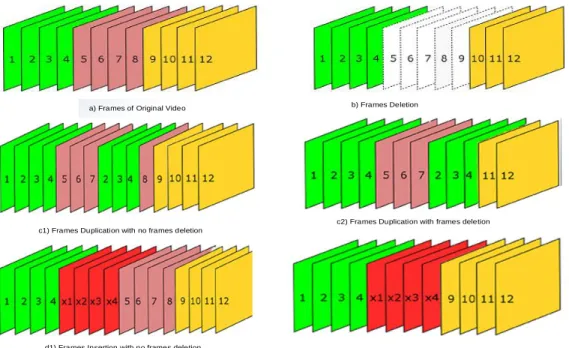
The video inter-frame forgeries can include three types of forgery shown in Fig. 3 as follow:
a) Deletion of a frames sequence shown in Fig.3b, frames from 5th to 9th with dashed
border line were deleted to hide events inside a video.
b) Duplication of a frames sequence shown in Fig.3c1 and c2; In the Fig.3c1 copied frames from 2th to 4th then pasted at after 7th frame in the
same video with no frame deletion. This forgery
is usually used to duplicate events in a video. Similarly, in the Fig.3c2 copied frames from 2th
to 4th then pasted at after 7th but frames 8th to
10th were deleted. This forgery is usually used to
duplicate an event while hiding another an event in a video.
c) Insertion of a frames sequence shown in Fig.3d1 and d2; In the Fig.3d1 a frames sequence from x1th to x4th copied from a different
video then pasted at after 4th frame with no frame
deletion. This forgery is often used to add events from a different video into the video. Similarly, in the Fig.3d2 a frames sequence from x1th to x4th
copied from a different video then pasted at after 4th frame but frames from 5th to 8th were deleted.
This forgery is often used to add an event from another video while hiding an event inside the video.
a) Frames of Original Video
d2) Frames Insertion with frames deletion b) Frames Deletion
c2) Frames Duplication with frames deletion c1) Frames Duplication with no frames deletion
d1) Frames Insertion with no frames deletion
Figure 3. Video inter-frame forgeries
All forgeries above can easily manipulate on videos by one of video content editing software like Adobe Photoshop, Adobe After Effect, Video Editor and Window Movie Maker, etc. And those forged videos would present fingerprints which are inconsistency pixel values of temporal dimension between two consecutive frames at the manipulated position and shown in Fig. 4. These inconsistency pixel values are very hard
Https://escipub.com/american-journal-of-computer-sciences-and-applications/ 6
a) Frames of original video
a) Frames duplication with no frames deletion and
the positions at are manupulated positions b) Frames deletion and the position at is manipulated position
Figure 4. The manipulated positions in video inter-frame forgeries
Proposed method
Pipeline of the proposed method
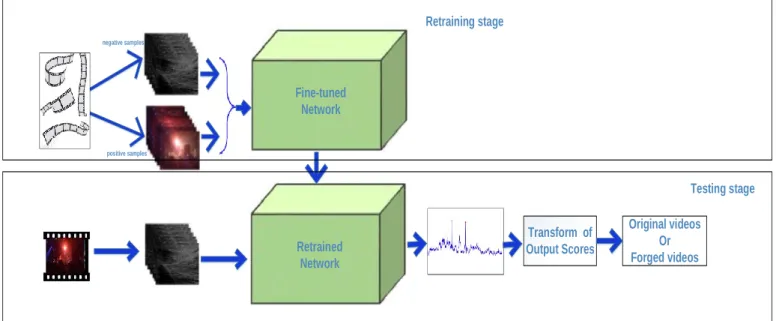
We proposed a method which can detect video manipulated inter-frame forgeries based on
advance CNN models to detect the fingerprints at the manipulated position in videos. The pipeline of the proposed models as shown in Fig. 5.
Fine-tuned Network
Retrained Network
Retraining stage
Testing stage
Transform of Output Scores
Original videos Or Forged videos
negative samples
positive samples
Figure 5. The pipeline of the proposed method.
We used recently the state-of-the-art CNN models such as GoogleNet, ResNet, DenseNet, Inceptionv3, InceptionResnetv2, MobileNetv2 and NasNet which were pre-trained on more than a million images from ImageNet database [16]. These models were fine-tuned then retrained again on target dataset. The target
addition, From the results of retrained models, we would compare each other to find out which architecture model is suitable for detecting video inter-frame forgeries.
The pipeline of the proposed method is shown in Fig. 5, which have two fine-tunings on the available models. Firstly, the available models were fine-tuned for classifying two categories (negative sample and positive sample) then retrained again on target dataset. Secondly, we have transformed the output scores of models to a confidence score by temporal scaling to increase testing efficiency of models as Eq (1). In the testing stage, firstly videos for testing is separated into samples by following steps creating negative samples in next subsection 2.2, then each sample is classified by retrained models and give an output score f(i) which is in [0:1]. This score value is nearly ‘0’ that means this sample is identified negative sample otherwise nearly ‘1’ identified positive sample by retrained models. But to improve the classification result of the proposed models, the output score is transformed to the confidence score as follows:
𝑓𝑐𝑜𝑛(𝑖) = min ( 𝑓(𝑖) − ∑
1 𝑙 10
𝑙=1 𝑓(𝑙), 𝑓(𝑖) −
∑ 1
𝑟 10
𝑟=1 𝑓(𝑟)) (1)
Where l and r are the order of left and right sides respectively of i.
Finally, a video is original if max (𝑓𝑐𝑜𝑛(𝑖)) <
Threshold, where 𝑖 ∈
1: 𝑇, 𝑇 is number of samples in a video, otherwise
forged. And in all of experiments below, we have selected this Threshold equally 0.5.
Creating train dataset
Because training models for detecting video forgeries need a large number of videos including original videos and forged videos. So, to overcome the shortage of large video dataset for training models and to get advantage from the pre-trained model on ImageNet database in the-state-of-the-art. In addition, we have also proposed four methods to build datasets for retraining stage of the proposed models based
on the residual and optical flow of adjacent/non-adjacent frames in videos. With purpose here is to detect whether inconsistency pixels values of temporal dimension between adjacent frames in videos. In particular, the four methods create some datasets for retraining the models as follow: residual of two adjacent/non- adjacent frames, three residuals of grey value on four adjacent/non-adjacent frames, optical flow of two adjacent/non-adjacent frames, and three magnitude of optical-flow on four adjacent/non-adjacent frames.
Let X = {xt} is an original video. Where,
𝑡 ∈ [1, 𝑇], T is the number of frames in the
video.
𝑥𝑡 is the tth frame in the video.
a. Creating a dataset from the residuals of two adjacent/non-adjacent frames–Dataset_1.
From videos in an original video dataset, negative samples were created by subtracting two adjacent frames and positive samples were created by subtracting two non-adjacent frames, particularly in the following steps:
For creating negative samples.
Calculate 𝑅 = {𝑟𝑡}, negative samples. (2)
for t = 1 : T-1 do
𝑟𝑡 = 𝑥𝑡+1− 𝑥𝑡;
end;// for Where,
𝑥𝑡 is the tth frame in the video.
𝑟𝑡 are residuals of two adjacent frames as
the difference between two adjacent frames, considered negative samples.
- For creating positive samples:
Step 1: Calculate 𝑅′ = { 𝑟𝑡′}, positive samples.
(3)
for i = 1 : T do
k = random(1:T);
Https://escipub.com/american-journal-of-computer-sciences-and-applications/ 8
while abs(k - i) <= 15 do k = random(1:T); end; //while
if k==0 // avoid k equal 0 k=2;
end; //if
if if k%2<>0
𝑟𝑡′ = 𝑥𝑖− 𝑥𝑘
𝒆𝒍𝒔𝒆
𝑟𝑡′ = 𝑥𝑘− 𝑥𝑖
end; //if
end; //for
Where, 𝑟𝑡′ are residuals of two non-adjacent
frames as the difference between two non-adjacent frames, considered positive samples. Notably, in all experiments, we chose the distance between two non-adjacent frames inside the video at least 15 frames because in reality forgery manipulations at inter-frame usually tamper on length of frames sequence at least 15 frames.
b. Creating a dataset from three residuals of grey values on four adjacent/non-adjacent frames – Dataset_2.
- For creating negative samples.
Step 1: Calculate 𝑅 = {𝑟𝑡}, negative
samples. (4)
for t = 1 : T-3 do
𝑟𝑡(: , : ,1) = 𝑔𝑟𝑒𝑦𝑖𝑚𝑎𝑔𝑒(𝑥𝑡+1)
− 𝑔𝑟𝑒𝑦𝑖𝑚𝑎𝑔𝑒(𝑥𝑡);
𝑟𝑡(: , : ,2) = 𝑔𝑟𝑒𝑦𝑖𝑚𝑎𝑔𝑒(𝑥𝑡+2)
− 𝑔𝑟𝑒𝑦𝑖𝑚𝑎𝑔𝑒(𝑥𝑡+1);
𝑟𝑡(: , : ,3) = 𝑔𝑟𝑒𝑦𝑖𝑚𝑎𝑔𝑒(𝑥𝑡+3)
− 𝑔𝑟𝑒𝑦𝑖𝑚𝑎𝑔𝑒( 𝑥𝑡+2);
end; //for Where,
𝑥𝑡 is the tth frame in the video.
𝑟𝑡 are three residuals of grey values on
four adjacent frames, considered negative samples.
- For creating positive samples:
Step 1: Calculate 𝑅′ = { 𝑟𝑡′}, positive
samples. (5)
for i = 2 : T do
k = random(1:T);
// random k until absolute of k greater than i-15
while abs(k-i) <= 15 do k = random (1:T); end; //while
if k==0 k=2;
end; // if if k%2 <>0
𝑟′𝑡(: , : ,1) = 𝑔𝑟𝑒𝑦𝑖𝑚𝑎𝑔𝑒(𝑥𝑖) −
𝑔𝑟𝑒𝑦𝑖𝑚𝑎𝑔𝑒( 𝑥𝑖−1);
𝑟′𝑡(: , : ,2) = 𝑔𝑟𝑒𝑦𝑖𝑚𝑎𝑔𝑒(𝑥𝑘) −
𝑔𝑟𝑒𝑦𝑖𝑚𝑎𝑔𝑒( 𝑥𝑖);
𝑟′𝑡(: , : ,3) = 𝑔𝑟𝑒𝑦𝑖𝑚𝑎𝑔𝑒(𝑥𝑘+1)
− 𝑔𝑟𝑒𝑦𝑖𝑚𝑎𝑔𝑒( 𝑥𝑘);
else
𝑟′𝑡(: , : ,1) = 𝑔𝑟𝑒𝑦𝑖𝑚𝑎𝑔𝑒(𝑥𝑘) −
𝑔𝑟𝑒𝑦𝑖𝑚𝑎𝑔𝑒( 𝑥𝑘−1);
𝑟′𝑡(: , : ,2) = 𝑔𝑟𝑒𝑦𝑖𝑚𝑎𝑔𝑒(𝑥𝑖) −
𝑔𝑟𝑒𝑦𝑖𝑚𝑎𝑔𝑒( 𝑥𝑘);
𝑟′𝑡(: , : ,3) = 𝑔𝑟𝑒𝑦𝑖𝑚𝑎𝑔𝑒(𝑥𝑖+1) −
𝑔𝑟𝑒𝑦𝑖𝑚𝑎𝑔𝑒( 𝑥𝑖)
end; //if
end; // for
Where, 𝑟𝑡′ are three residuals of grey values on
four non-adjacent frames considered positive samples. Similarly, the distance between two non-adjacent frames inside videos is at least 15 frames.
c. Creating a dataset from optical flow of two adjacent/non-adjacent frames–Dataset_3.
Creating Dataset_3 from the optical flow of two adjacent/non-adjacent frames is similar to creating the Dataset_1 by changing residuals to the optical flow of two adjacent/non-adjacent frames.
d. Creating a dataset from three magnitudes of optical flow on four adjacent/non-adjacent frames – Dataset_4.
EXPERIMENTS
In this section, we present how to fine-tuning available CNN models, configuration for retraining models on target dataset, the testing results of the models and data preparation which we have collected and built to utilize in experiments. Besides that, we also compared the results with some latest researches which were performed on the same dataset.
Data preparation
Because of the shortage of video inter-frame forgery dataset for training proposed CNN models, we had collected a dataset with 300 original videos from five surveillant cameras of
VFDD dataset [29] which was taken from surveillant cameras in real life by our laboratory. This dataset was captured with diverse environments such as inside or outside school, offices, dormitories, streets, buildings at the different light condition in days such as at night, daytime, with light, and without light. The average length of videos is 10 seconds
For training models, we randomly selected 270 videos from this dataset and followed steps of creating datasets in section III to build train datasets. Finally, we have gotten four datasets and each of them has about 143000 negative and positive samples. The summary of the training dataset was shown in Table 1.
Table 1: The summary of the train dataset.
Number of original videos 270
Average of videos length 10 seconds
Number of negative samples 71782
Number of positive samples 72026
Number of cameras were used for taking videos
5
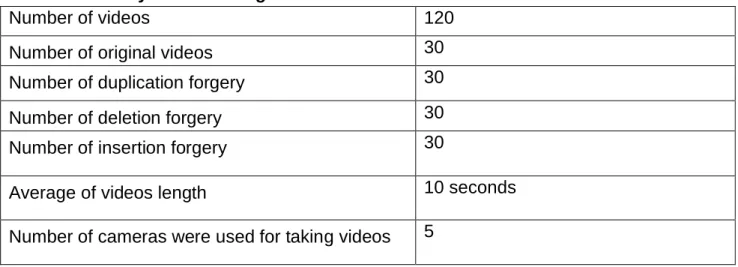
Dataset for testing, 30 original videos the rest of 30 original videos dataset. We tampered these videos by manual in different ways as following Fig. 3. By that way, we have 120 videos including 30 original videos and 90 forged videos including three above kinds of forgeries. An
important note here, all the forged videos that we tampered are not easily detectable with the naked eye. The summary of the testing dataset was shown in Table 2. All datasets are available online1.
Table 2: The summary of the testing dataset.
Number of videos 120
Number of original videos 30
Number of duplication forgery 30
Number of deletion forgery 30
Number of insertion forgery 30
Average of videos length 10 seconds
Number of cameras were used for taking videos 5
1https://drive.google.com/drive/u/0/folders/1P03dkp3xVMUta4fDDAhYBS59
Https://escipub.com/american-journal-of-computer-sciences-and-applications/ 10 Fine-tuning and retraining models
To retrain models on the target datasets, we have done fine-tuning the state-of-the-art models by deleting the last three layers of these networks because these three layers contain information on how to combine the features that the network extracts into class probabilities and original labels. Then add three new layers to the layer graph including a Fully Connected Layer, a SoftMax layer, and a Classification Output Layer. Set the Final Fully Connected Layer to have the same size as the number of classes in the target datasets (this case is 2). To learn faster in the new layer than in the transferred layers set the learning rate of the Fully Connected Layer is set 5. Besides that, the rest of the training options were set as follow: Randomly select 90% the training dataset for retraining, 10% for validation. We used SGD optimization method which has Momentum-Contribution of the previous step is 0.9. Initial Learning Rate is 0.001 and the learning rate would drop 0.1 after 10 epochs; Mini_Batch_Size is 10, Max_Epochs is 20 and shuffle at every epoch, L2 Regularization is 0.0001.
Test results
For testing, each video in testing dataset part would be followed the steps of creating negative samples in section III. From that, we would have a set of samples from each video. This set of the samples are classified by the retrained models above. Finally, each video is concluded to be a
forgery or original video, it depends on the maximum of fconvalues of that video. The video
is original if max (𝑓𝑐𝑜𝑛(𝑖)) < Threshold, where 𝑖 ∈
1: 𝑇 − 1, otherwise forged. And in all
experiments, we set the Threshold equally 0.5.
For performance measure, we depended on the following measures:
Measures are used in this paper as follow True Positive (TP): forged video declared forged; False Positive (FP): original video declared forged; True Negative (TN): original video declared genuine; False Negative (FN): forged video declared genuine. Sensitivity or True Positive Rate (TPR); False Positive Rate (FPR) and Detection Accuracy (DA) as follow:
- True Positive Rate:
𝑇𝑃𝑅 = 𝑇𝑃
𝑃 =
𝑇𝑃 𝑇𝑃+𝐹𝑁
- False Positive Rate:
𝐹𝑃𝑅 =𝐹𝑃
𝑁 =
𝐹𝑃 𝑇𝑁+𝐹𝑃
- Detection Accuracy:
𝐷𝐴 =𝑇𝑃+𝑇𝑁
𝑁+𝑃
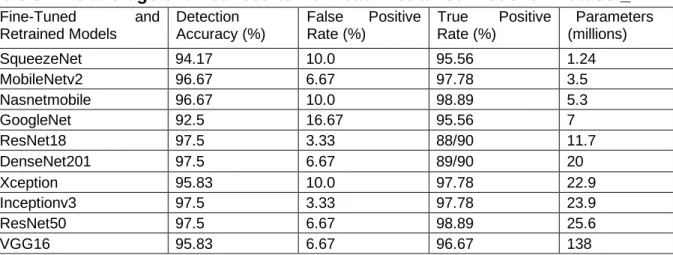
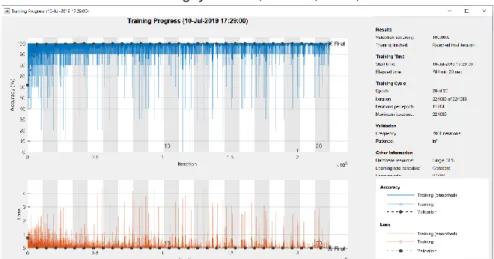
In the experiments, to find out which architecture of CNN models in the-state-of the-art models is suitable when detecting video inter-frame forgeries, we have fine-tuned then retrained all of them on the target Dataset_1. The average of three results from each the model as shown in Table 3. And Fig.6,7 are examples show the progressing when training models.
Table 3: The average of three results from each retrained model on Dataset_1.
Fine-Tuned and
Retrained Models
Detection Accuracy (%)
False Positive Rate (%)
True Positive Rate (%)
Parameters (millions)
SqueezeNet 94.17 10.0 95.56 1.24
MobileNetv2 96.67 6.67 97.78 3.5
Nasnetmobile 96.67 10.0 98.89 5.3
GoogleNet 92.5 16.67 95.56 7
ResNet18 97.5 3.33 88/90 11.7
DenseNet201 97.5 6.67 89/90 20
Xception 95.83 10.0 97.78 22.9
Inceptionv3 97.5 3.33 97.78 23.9
ResNet50 97.5 6.67 98.89 25.6
Figure 6: Progress of training the model based on Resnet18 model.
Figure 7: Progress of training the model based on DenseNet201 model.
To compare the efficiency of the features in 2.2 of section III which were used to create train dataset. We have conducted some experiments on individual feature and combination of features.
All of the results were performed by the proposed method based on the pre-trained MobileNetv2 model and shown in Table 4.
Table 4: The results of the proposed method based on MobileNetv2 when retrained on datasets built on different features.
Datasets Detection Accuracy (%) False Positive Rate (%) True Positive Rate (%)
Dataset_1
(residuals of two adjacent/non-adjacent frames)
96.67 6.67 97.78
Dataset_2
(three residuals of grey values on four adjacent/non-adjacent frames)
84.17 36.67 91.11
Dataset_3
(optical flow of two adjacent/non-adjacent frames)
83.33 13.33 82.22
Dataset_4
(three magnitudes of optical flow on four adjacent/non-adjacent frames)
95.0 13.33 97.78
Https://escipub.com/american-journal-of-computer-sciences-and-applications/ 12
To compare the efficiency between the transfer-leaning models and the models trained from scratch. Whether it has an efficiency of transfer-learning on ImageNet database when detecting video inter-frame forgeries. We have
experimented on two models MobileNetv2 and Resnet18 by training from scratch and retraining of pre-trained models on the target dataset. The results are shown in Table 5.
Table 5: Comparing the results between transfer learning and training from scratch on MobileNetv2 and ResNet18 models on Dataset_1.
Methods Detection
Accuracy (%)
False Positive Rate (%)
True Positive Rate (%)
Mobilenetv2 (transfer learning) 96.67 6.67 97.78
Mobilenetv2 (trained from scratch) 84.17 33.33 90.0
ResNet18 (transfer learning) 97.5 3.33 97.78
ResNet18 (trained from the scratch) 93.33 16.67 96.67
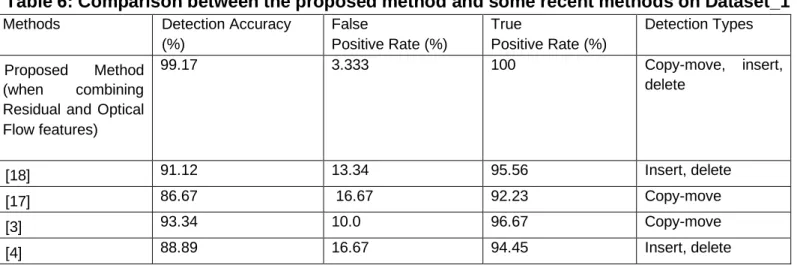
To compare the efficiency between the proposed method and some recent methods. We have performed some experiments which
simulated some recent methods on the target dataset and the results were shown in Table 6.
Table 6: Comparison between the proposed method and some recent methods on Dataset_1
Methods Detection Accuracy
(%)
False
Positive Rate (%)
True
Positive Rate (%)
Detection Types
Proposed Method (when combining Residual and Optical Flow features)
99.17 3.333 100 Copy-move, insert,
delete
[18] 91.12 13.34 95.56 Insert, delete
[17] 86.67 16.67 92.23 Copy-move
[3] 93.34 10.0 96.67 Copy-move
[4] 88.89 16.67 94.45 Insert, delete
RESULTS ANALYSIS
The results in Table 3 show that usually the more parameters of models, the more accuracy of detecting video inter-frame forgeries. But besides that, there are exceptions that the models based on MobileNetv2 and Resnet18 have given quite good results as 96.67% and 97.5% respectively while number of parameters is quite small. It equals some models with more parameters such as DenseNet201 or Inceptionv3. So, the proposed methods based on MobileNetv2 or ResNet18 may be suitable for applying to detect video inter-frame forgeries in
situations that need speedy or slow hardware in processing.
Because of lacking big database to train models for detecting video inter-frame forgeries, we have conducted some experiments to compare the model’s efficiency between trained from transfer learning and from scratch. The results in Table 5 have proven transfer learning from models which were pre-trained by ImageNet are more efficient in detecting video inter-frame forgeries. Particularly, the accuracy of MobileNetv2 increased from 84.17% (when trained from scratch) to 96.67% and ResNet18 increased from 93.33% (when trained from scratch) to 97.5% when trained from transfer learning models.
In Table 6 show that the proposed methods for detecting video inter-frame forgeries have accuracy 99.17% which is significantly better than of the recent methods. It really proves that the proposed method that is significantly efficient in detecting video inter-frame forgeries.
CONCLUSIONS AND FUTURE DIRECTIONS
Nowadays with rapidly developing hardware industry, especially the development of cameras, which were used for surveilling everywhere such as traffics, home, school, office, etc. In addition, most of the people use smartphones which are also equipped with cameras. So, videos could be captured anywhere, anytime and spread quickly over the internet. The authentic video has great value evidence. But until now although there are some methods for authenticating videos, they are either inefficient or very slow. In this study, we have proposed the method based on the state-of-the-art CNN models for detecting video inter-frame forgeries, which have gotten the potential results, the accuracies are 97.5% and 99.17% shown in Table 4. Through experiments, it is proven that the proposed method has achieved significantly higher accuracy than the recent methods on the same dataset and the results were shown in Table 6.
In the future, we will conduct in-depth research to proposed the CNN architecture suitable for detecting and classifying the type of video forgeries.
References
1. Milani, S., et al., An overview on video forensics. APSIPA Transactions on Signal and Information Processing, 2012. 1. 2. Yang, J., T. Huang, and L. Su, Using
similarity analysis to detect frame duplication forgery in videos. Multimedia Tools and Applications, 2016. 75(4): p. 1793-1811. 3. Singh, G. and K. Singh, Video frame and
region duplication forgery detection based on correlation coefficient and coefficient of variation. Multimedia Tools and Applications, 2018: p. 1-36.
4. Wang, Q., et al., Video inter-frame forgery identification based on consistency of correlation coefficients of gray values.
Journal of Computer and Communications, 2014. 2(04): p. 51.
5. Subramanyam, A. and S. Emmanuel. Video forgery detection using HOG features and compression properties. in 2012 IEEE 14th International Workshop on Multimedia Signal Processing (MMSP). 2012. IEEE.
6. Kobayashi, M., T. Okabe, and Y. Sato,
Detecting forgery from static-scene video based on inconsistency in noise level functions. IEEE Transactions on Information Forensics and Security, 2010. 5(4): p. 883-892.
7. Yu, L., et al., Exposing frame deletion by detecting abrupt changes in video streams.
Neurocomputing, 2016. 205: p. 84-91. 8. He, K., et al. Deep residual learning for image
recognition. in Proceedings of the IEEE conference on computer vision and pattern recognition. 2016.
9. Huang, G., et al. Densely connected convolutional networks. in Proceedings of the IEEE conference on computer vision and pattern recognition. 2017.
10. Chen, Y., et al. Dual path networks. in
Advances in Neural Information Processing Systems. 2017.
11. Szegedy, C., et al. Going deeper with convolutions. in Proceedings of the IEEE conference on computer vision and pattern recognition. 2015.
12. Krizhevsky, A., I. Sutskever, and G.E. Hinton.
Imagenet classification with deep convolutional neural networks. in Advances in neural information processing systems. 2012.
Https://escipub.com/american-journal-of-computer-sciences-and-applications/ 14 14. Zoph, B. and Q.V. Le, Neural architecture
search with reinforcement learning. arXiv preprint arXiv:1611.01578, 2016.
15. Sandler, M., et al. Mobilenetv2: Inverted residuals and linear bottlenecks. in
Proceedings of the IEEE Conference on Computer Vision and Pattern Recognition. 2018.
16. Deng, J., et al. Imagenet: A large-scale hierarchical image database. in 2009 IEEE conference on computer vision and pattern recognition. 2009. Ieee.
17. Wang, W. and H. Farid. Exposing digital forgeries in video by detecting duplication. in
Proceedings of the 9th workshop on Multimedia & security. 2007. ACM.
18. Chao, J., X. Jiang, and T. Sun. A novel video inter-frame forgery model detection scheme based on optical flow consistency. in
International Workshop on Digital Watermarking. 2012. Springer.
19. Liu, Y. and T. Huang, Exposing video inter-frame forgery by Zernike opponent chromaticity moments and coarseness analysis. Multimedia Systems, 2017. 23(2): p. 223-238.
20. Long, C., A. Basharat, and A. Hoogs, A Coarse-to-fine Deep Convolutional Neural Network Framework for Frame Duplication Detection and Localization in Video Forgery.
arXiv preprint arXiv:1811.10762, 2018. 21. Zoph, B., et al. Learning transferable
architectures for scalable image recognition. in Proceedings of the IEEE conference on
computer vision and pattern recognition. 2018.
22. Oquab, M., et al. Learning and transferring mid-level image representations using convolutional neural networks. in
Proceedings of the IEEE conference on computer vision and pattern recognition. 2014.
23. Weiss, K., T.M. Khoshgoftaar, and D. Wang,
A survey of transfer learning. Journal of Big data, 2016. 3(1): p. 9.
24. Chollet, F. Xception: Deep learning with depthwise separable convolutions. in
Proceedings of the IEEE conference on computer vision and pattern recognition. 2017.
25. Simonyan, K. and A. Zisserman, Very deep convolutional networks for large-scale image recognition. arXiv preprint arXiv:1409.1556, 2014.
26. Horn, B.K. and B.G. Schunck, Determining optical flow. Artificial intelligence, 1981. 17(1-3): p. 185-203.
27. Jia, S., et al., Coarse-to-fine copy-move forgery detection for video forensics. IEEE Access, 2018. 6: p. 25323-25335.
28. Kingra, S., N. Aggarwal, and R.D. Singh,
Inter-frame forgery detection in H. 264 videos using motion and brightness gradients.
Multimedia Tools and Applications, 2017. 76(24): p. 25767-25786.
29. Al Hamidi, S., VFDD (Video Forgery Detection Database) Version 1.0.