Design of High Performance Distributed
Snapshot / Recovery Algorithms for Ring
Networks
Bidyut Gupta
1, Shahram Rahimi
1and Ziping Liu
21Department of Computer Science, Southern Illinois University, Carbondale, Illinois, USA
2Department of Computer Science, Southeast Missouri State University, Cape Girardeau, Missouri, USA
In this work, we have presented non-blocking checkpoint-ing and recovery algorithms for bidirectional networks. We have deviated from the conventional approach of taking first temporary checkpoints and then converting them to permanent ones by processes(as followed by any coordinated checkpointing scheme). Thus, the proposed coordinated checkpointing algorithm allows processes to take permanent checkpoints directly, without taking temporary checkpoints and whenever a process is busy, it takes a checkpoint after completing its current procedure. We have shown that the presented algorithms take much less time for their execution and use much less number of control messages (and hence much less number of interrupts to a process)when compared to a noted recent work[4].
Keywords: ring networks, coordinated checkpointing, recovery, distributed systems
1. Introduction
Checkpointing/rollback-recovery strategy has been an attractive approach for providing fault-tolerance to distributed applications[1]–[9]. A checkpoint is a snapshot of the local state of a process, saved on local nonvolatile storage to survive process failures. A global checkpoint of an n-process distributed system consists of n checkpoints(local)such that each of these n checkpoints corresponds uniquely to one of the n processes. A global checkpoint M is defined as a consistent global checkpoint/state(CGS)
if no message is sent after a checkpoint of M and received before another checkpoint of M
[1]. The checkpoints belonging to a consistent global checkpoint are called globally consistent checkpoints(GCCs).
Checkpointing algorithms may be classified into two main categories: (a) coordinated and (b)
uncoordinated. In uncoordinated check point-ing, each process takes checkpoint indepen-dently, without the knowledge of the other pro-cesses. In case of a failure after recovery, a CGS is found from the existing checkpoints and the system restarts from there.
In coordinated checkpointing, all processes syn-chronize through control messages before tak-ing checkpoints. These synchronization mes-sages contribute to extra overhead, but make the system free from domino effect. There are two types of coordinated check pointing algorithms:
(a) blocking and (b) non-blocking. Blocking algorithms force all relevant processes in the system to block their computation during check-pointing latency and hence degrade system per-formance. In non-blocking algorithms, appli-cation processes are not blocked when check-points are being taken.
the system to initiate checkpointing. A process need not consider causal dependency generated by the application messages. Due to the spe-cial nature of the ring network, the scheme does not need to trace dependence at the time of roll back. Hence the algorithm runs faster than the algorithm proposed in [10]. The problem with this algorithm is that the number of control mes-sages used is large and there is an overhead of taking a temporary checkpoint and then con-verting it into a permanent checkpoint.
The present work is aimed at designing high performance checkpointing and recovery algo-rithms for ring networks which outperform the similar algorithms reported recently in [4]. In
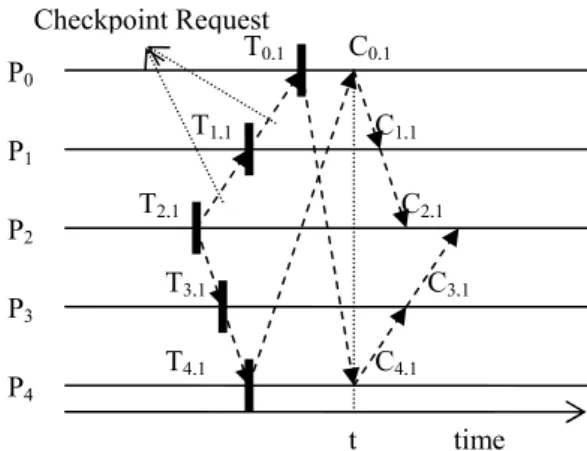
[4], the authors have considered both unidirec-tional and bidirecunidirec-tional ring networks. How-ever, their proposed checkpointing and recov-ery algorithms for unidirectional ring networks are trivial and a modified approach toward the same is to appear in[12]. Therefore, in this work we focus our attention on the bidirectional ring networks only. Since our objective is to design high performance checkpointing and recovery approaches compared to those in [4], we start with a brief and clear description of their check-pointing and recovery approaches. It may help in understanding clearly our ‘problem formula-tion’ which is stated later in this section. In[4], the proposed algorithm for bidirectional ring networks works in the following way. Con-sider a ring network consisting of five processes P0, P1, P2, P3, and P4 as shown in Figure 1a. Assume that the network is a bi-directional one and each process can send messages only to its predecessor and successor. For example, in this diagram process P0 can communicate only to processes P1and P4, process P1can communi-cate only to processes P0and P2, and so on. Without any loss of generality, let us assume that process P2initiates the checkpointing algo-rithm. Process P2first takes a temporary check-point T2,1, and then sends checkpoint requests to its predecessor and successor processes P1 and P3respectively. Each process, on receiving the first checkpoint request, takes a temporary checkpoint T1,1 and T3,1 respectively and for-wards the request to the process from which it did not receive the request. Hence P1 forwards the request to P0, and P3 forwards to P4. P0 and P4on receiving the checkpoint request first
take temporary checkpoints T0,1 and T4,1 and forward the message to P4and P0respectively. P4receives the checkpoint request from P0and P0 receives the checkpoint request form P4. This checkpoint request message is the second request to both P0 and P4, hence both P0 and P4 convert their respective temporary check-points T0,1 and T4,1 to permanent checkpoints C0,1 and C4,1 respectively. After converting to permanent checkpoints, P0 and P4 forward the checkpoint request to P1and P3respectively. P1 and P3 on receiving the second checkpoint re-quest convert their respective temporary check-points to permanent checkcheck-points C1,1 and C3,1 respectively and forward the checkpoint request to initiator process P2. Suppose that process P2 receives the checkpoint request from P1 first. This message is the first checkpoint request to initiator P2. Hence it converts its latest tempo-rary checkpoint T2,1 to permanent checkpoint C2,1. Initiator process does not forward the checkpoint request any further. Eventually, it also receives the checkpoint request sent from process P3, which it discards and the check-pointing algorithm is terminated. In Figure 1a it is shown that at time t the temporary checkpoint T0,1 is converted into a permanent checkpoint, denoted here as C0,1. The same is followed for all processes in the system.
P0
P1
P2
P3
P4
C1,1
C2,1
C3,1
C4,1
C0,1
T1,1
T2,1
T3,1
T4,1
T0,1
Checkpoint Request
t time
Figure 1a.An example of the checkpointing algorithm.
P0
P1
P2
P3
P4
C1,1
C2,1 C0,1
T1,1
T2,1
T3,1
T4,1 T0,1 Checkpoint Request
failure f t
resume
resume resume resume
resume
Recovery messages
Discarded messages
t
t1
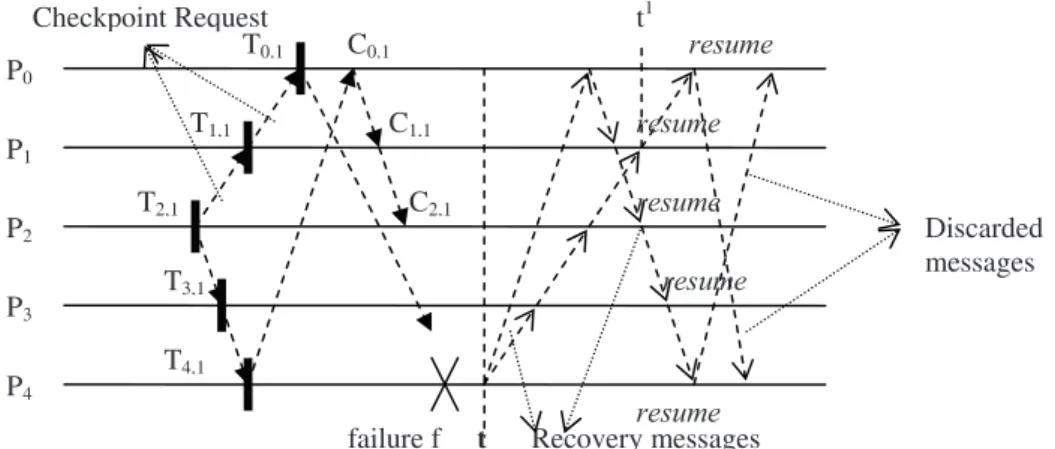
Figure 1b.An example of the recovery algorithm.
Assume that before P4starts the recovery algo-rithm, processes P0, P1, and P2have converted their respective temporary checkpoints to per-manent checkpoints C0,1, C1,1 and C2,1. Pro-cess P3 did not receive yet any message from P4 and hence it did not convert its temporary checkpoint to a permanent one.
After process P4 recovers from its failure(say, at time t as shown in Figure 1b), it initiates the recovery algorithm. It sets itsflag visitflag to true and sends recovery message to its adja-cent processes P3 and P0 with its latest check-point version number. On receiving a recovery message, each process sets its flag visitflag to true and forwards the recovery message to the process from which it did not receive recovery message. Process P3 forwards the message to P2and process P0to P1. Assume that process P2 receives the recovery message sent by P3before the recovery message from process P1. Process P2sets its flag to true and forwards the message to process P1. Process P1, which receives the recovery message from P0first, sets itsflag visit flag and forwards the request to process P2. Later process P1receives the recovery message forwarded by process P2, say at time t1. This is the second such recovery message to process P1. It observes that itsflag visitflag is already set to true. Therefore it first sets itsflag resumeflag to true and then forwards the message to its prede-cessor process P0and starts computation from its latest permanent checkpoint C1,1. Eventu-ally, process P2 receives the recovery message sent by process P1. This message is the sec-ond recovery message to P2. It observes that
its flag visit flag is true. Therefore, it sets its
flag resume to true, forwards the message to
P3 and restarts the computation from its latest permanent checkpoint C2,1.
Process P0 receives the recovery message from P1, it observes that its flag visit flag is true. Therefore, it sets its flag resume flag to true, and then forwards the message to its predeces-sor process P4 and restarts computation from C0,1.
Process P3 receives the recovery message sent from P2. This message is the second recovery message to process P3. On receiving the recov-ery message, P3 observes that itsflag visitflag is set to true. Hence it sets its flag resume to true and then forwards the message to process P4and rolls back to its latest checkpoint. Since its latest checkpoint is a temporary checkpoint T3,1, it first converts the temporary checkpoint T3,1to a permanent checkpoint C3,1and restarts computation from that checkpoint.
Recovery messages are sent to process P4from P0and P3. Suppose that P4 receives the recov-ery message sent by process P3before it receives the recovery message from process P0. This is the first recovery message to the initiator. Its
flag visit flag is already set. Hence, on
restarted its computation. Hence, this second recovery message is discarded. In the mean-time, process P0receives the recovery message sent by process P4. In a similar way it observes that its flag resume flag is already set to true. Hence, it discards this recovery message. In the above example, we note that the recov-ery message is forwarded by any process if and only if the flag resume flag of the process is false. We also observe that during recovery, if the latest checkpoint of a process is found to be a temporary checkpoint, it is converted into a per-manent checkpoint and then the computation is started from that checkpoint. In this context, it is worth mentioning that restarting during a process is delayed until theflag resumeflag be-comes true. Besides, the numbers of control messages required for the checkpointing and the recovery algorithms are significantly large. Problem Formulation
In the checkpointing algorithms proposed in
[4], [5], [7], and [9], processes are supposed to take temporary checkpoints first, and then these checkpoints are converted to permanent ones and only then, these permanent checkpoints are considered to form a CGS of the system. How-ever, during the execution of the checkpointing algorithm, if a process is busy with some high priority procedure, when a checkpointing re-quest arrives at it, the process will not take a checkpoint. In such a situation, every process that has already taken a temporary checkpoint must discard it and continue normal execution. Later, the checkpointing algorithm has to be restarted again. The same problem may arise when a process receives a request to convert its temporary checkpoint to a permanent one while it is busy executing a high priority procedure. In this case also, the checkpointing algorithm has to restart later. Thus, such situations definitely affect the execution time of the application pro-grams adversely.
To avoid this problem we have proposed a checkpointing algorithm which takes perma-nent checkpoints directly, without taking tem-porary checkpoints, and whenever a process is busy, the process takes a checkpoint after com-pleting the current procedure. The proposed checkpointing and recovery algorithms are both single phase and non-blocking ones. We do not consider concurrent initiations of the algo-rithms, as it may cause message storm in large
distributed systems. We have shown that the proposed algorithms take much less time for their execution and use much less number of control messages(and hence much less number of interrupts to a process)when compared to the algorithms in[4].
This paper is organized as follows. In Section 2 we have stated the system model, the rele-vant data structures, and a formal description of the proposed checkpointing algorithm along with an illustration. In Section 3 we have stated the recovery algorithm along with an illustra-tion. Also, in this section we have discussed the performance of the proposed algorithms. In Section 4 we have stated how the proposed ba-sic checkpointing algorithm can be modified so that only minimum number of processes will take checkpoints, which has not been addressed in[4].
2. System Model, Data Structures, and the Checkpointing Algorithm
2.1. System Model
We consider that the bidirectional ring network architecture consists of n processes P0, P1, P2, . . ., Pn−1. These processes do not share mem-ory and they communicate via messages. We also assume that the ithprocess can directly send a message to jthprocess if and only if j= (i+1)
mod n or j= (i−1)mod n. That is jthprocess is the immediate successor to ithprocess if and only if j = (i +1) mod n and jth process is the immediate predecessor to ithprocess if and only if j = (i−1) mod n. The communica-tion channel is assumed to be first in first out
(FIFO).
2.2. Data Structures
A checkpoint sequence number denotes the num-ber of times the checkpointing algorithm has been executed so far. In other words, if the checkpoint sequence number is k, it means that the checkpoint is taken on the kth execution of the checkpointing algorithm. Initially, check-point sequence number for each process is set to zero.
In our algorithms, we use two kinds of control messages. The first one is a checkpoint request
< Cp,i >, which as in [4], is sent by an ini-tiator process Pi (to initiate the checkpointing algorithm)to its adjacent processes, where i is the process id of the initiator process. The sec-ond control message is the recovery message
< Rc,j >used in the recovery approach. The recovery algorithm is initiated by the process which has recovered from a failure. This pro-cess initiates the recovery algorithm by send-ing this recovery message to its adjacent pro-cesses, asking them to restart from their respec-tive checkpoints taken during the jthexecution of the checkpointing algorithm.
2.3. An Illustration
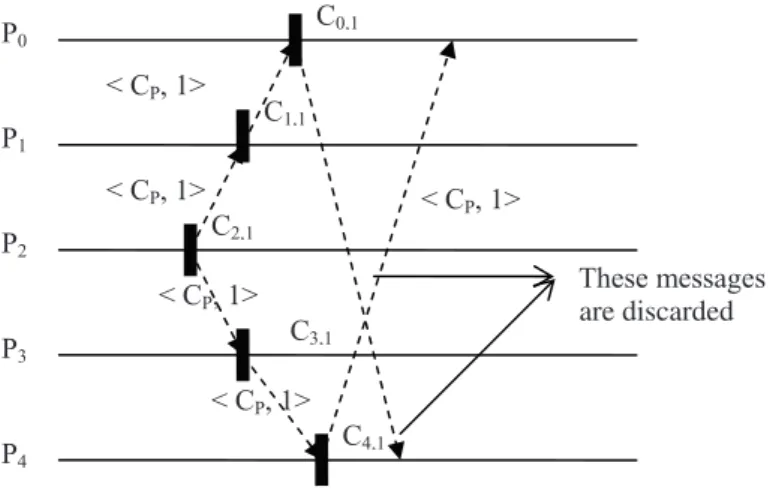
We now explain with an example how our pro-posed checkpointing approach works. Consider a distributed system of five processes P0, P1, P2, P3, and P4 in a bidirectional ring network as shown in Figure 2. Assume that process P2 initializes the checkpointing algorithm. It takes a permanent checkpoint C2,1, increments its checkpoint sequence number which is ini-tially zero, and sends checkpoint requests with
the checkpoint sequence number< CP,1 >to its respective predecessor and successor pro-cesses P1 and P3. Process P2 then continues normal computation associated with the appli-cation program. Eventually, the checkpoint re-quests reach their destinations P1and P3. When process P1 receives the checkpoint request, it first takes a permanent checkpoint C1,1and then increments its checkpoint sequence number and forwards the checkpoint request to its adjacent process P0from which it did not yet receive any control message and continues normal compu-tation. Similarly, when process P3receives the checkpoint request from the initiator process P2, it first takes a permanent checkpoint C3,1, then increments its checkpoint sequence number. It then forwards the checkpoint request to process P4and then continues normal execution. On re-ceiving the checkpoint request, process P4first takes a permanent checkpoint C4,1, increments its checkpoint sequence number, forwards the checkpoint request to its adjacent process P0 and then continues normal execution.
Suppose that process P0receives the checkpoint request from P1 before the checkpoint request from P4. Process P0 takes a permanent check-point C0,1, increments its checkpoint sequence number and forwards the request to its adjacent process P4from which it did not yet receive the checkpoint request. After forwarding the re-quest, process P0 continues normal execution. Eventually, process P4receives the checkpoint request sent by process P0. Process P4 checks its checkpoint sequence number and finds that it has already taken a checkpoint during the cur-rent execution of the algorithm and so it discards the request message. Similarly, when process
P0
P1
P2
P3
P4
C1,1
C2,1
C3,1
C4,1
< CP, 1>
< CP, 1>
< CP, 1>
< CP, 1>
< CP, 1>
C0,1
These messages
are discarded
P0 receives the checkpoint request sent by pro-cess P4, it checks its checkpoint sequence num-ber and concludes that it has already participated in the current execution of the algorithm and so it discards the request and continues normal ex-ecution. It may be observed that in our approach the number of control messages needed is much less than the one in [4]. An estimate of this number is given later.
2.4. Process Behavior
The following discussion is important for de-signing the checkpointing algorithm for bidi-rectional ring networks. In any checkpointing algorithm, when a process receives a checkpoint request from an initiator, it may take one of the following two actions:
– either takes a checkpoint by giving the highest priority to the interrupt caused by the checkpoint request, or
– does not respond to the initiator’s request
(which means that the process is execut-ing a procedure of higher priority and does not take a checkpoint).
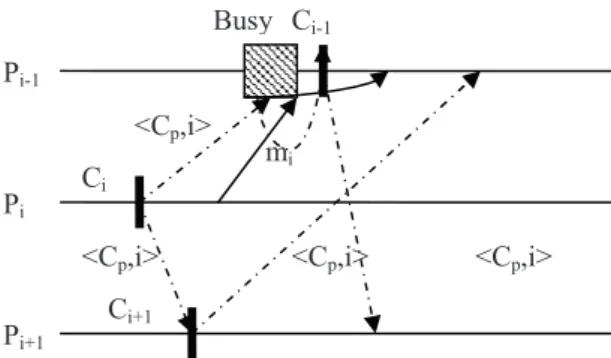
In the proposed algorithm, when a process re-ceives a checkpoint request from the initiator, it may decide not to take a checkpoint imme-diately because it is executing a higher priority procedure. In this case, instead of discarding the checkpoint request to take the checkpoint, the process takes the checkpoint after the conclu-sion of its current procedure. Any application messages received will be queued up and exe-cuted in first in first out manner when the current procedure is completed. Figure 3 illustrates this approach.
Pi-1
Pi
Pi+1
Ci
Ci+1
mi
Busy
<Cp,i>
<Cp,i> <Cp,i> <Cp,i>
Ci-1
Figure 3.Process behavior during the execution of the checkpointing algorithm.
In Figure 3, assume that it is the kth execution of the checkpointing algorithm and process Pi is the initiator. Process Pi takes a checkpoint Ci, increments its checkpoint sequence number and then sends checkpoint requests to its ad-jacent processes Pi−1 and Pi+1. Suppose that process Pi−1 is executing some high priority job and decides not to take a checkpoint. So the checkpoint request is saved in Pi−1’s local queue. Assume that process Pi sends an appli-cation message mi after taking the checkpoint Cito Pi−1. The message miis also saved in its queue as the process Pi−1 is busy. After com-pletion of the procedure, process Pi−1checks its queue and first processes the checkpoint request and then processes the application message mi
(i.e. following the FIFO order). Therefore, no such application message can ever be an orphan and checkpoints taken during the execution of the algorithm are all mutually consistent. As a result, all checkpoints taken during any kth execution of the checkpointing algorithm are always mutually consistent and, therefore, they are globally consistent checkpoints.
2.4.1. Assumptions
2.5. Checkpointing Algorithm for Bidirectional Ring Network: Algorithm A
The responsibilities of the initiator process and of all other processes are stated below.
Initiator process Pi
Step 1: take a checkpoint;
Step 2: increment the checkpoint sequence number; Step 3: send a checkpoint request<Cp,i>to successor
and predecessor;
Step 4: continue with normal execution;
/*Algorithm is terminated at the initiator process*/
At process Pj
it receives the checkpoint request<Cp,i>
if checkpoint request<Cp,i>is the second request
received
/*A process may receive at most two reque-sts from its adjacent processes during an execution of the algorithm*/
discard the request; continue normal execution;
else, if serving a higher priority procedure take a checkpoint after the procedure ends; increment the checkpoint sequence number; forward the checkpoint request<Cp,i>to
ad-jacent process from which checkpoint request was not received;
continue normal execution;
/* The responsibility of Pj associated with
the current execution of the algorithm ends*/
else
take a checkpoint;
increment the checkpoint sequence number; forward the checkpoint request<Cp,i>to
ad-jacent process from which checkpoint request is not received;
continue normal execution;
/* The responsibility of Pj associated with
the current execution of the algorithm ends*/
———————————————————
Correctness Proof: We will prove that there can-not exist any orphan message between any two recent checkpoints taken respectively by any two processes during the execution of the check-pointing algorithm.
Consider the following two possible situations that may occur whenever an application mes-sage miis sent by process Pito another process Pj;
(1) the application message miis sent before Pisends a checkpoint request to Pj;
(2) the application message miis sent after Pi has sent a checkpoint request to Pj; In the first situation, since after sending the application message mi process Pi has sent a checkpoint request, it means that process Pi has either initiated the checkpointing algorithm or Pi has received a checkpoint request from another process. According to the algorithm, if process Pi initiates the checkpointing algo-rithm, it first takes a permanent checkpoint and then sends a checkpoint request to its adjacent processes. On the other hand, if process Pi has received a checkpoint request from another process, it first takes a checkpoint and then for-wards the checkpoint request. Hence, in any case, process Pitakes a checkpoint first, before sending a checkpoint request message. There-fore, the application message misent by Pi be-fore it sends its checkpoint request cannot be an orphan.
In the second situation, the application message mi is sent after Pi has sent the checkpoint re-quest to Pj. Since the communication channel is first in first out, therefore Pj first takes its checkpoint on receiving the checkpoint request and then processes the application message mi. Therefore, the application message mi cannot be an orphan.
The above argument is true for all processes in the system. Therefore, orphan messages do not exist in the system. So the checkpoints taken during the execution of Algorithm A are mutu-ally consistent. Hence, the proof follows.
3. Recovery in Bidirectional Ring Network
The proposed recovery approach in this work is explained with an example below. Consider a distributed system of five processes P0, P1, P2, P3, and P4as shown in Figure 4.
P0
P1
P2
P3
P4
C0,1
C1,1
C2,1
C3,1
C4,1
<RC,1>
<RC,1> <RC,1,> <RC,1>
m4
m1
m2
m3
m5
<RC,1> < CP, 1>
< CP, 1>
< CP, 1>
< CP, 1> < CP, 1>
< CP, 1>
Failure f
Time t
0
Figure 4.An example of our recovery approach.
After recovering from the failure, P2 starts the recovery algorithm. Process P2 sends to its ad-jacent processes P1and P3 a recovery message < Rc,1 >, where 1 is the checkpoint sequence number to which each receiving process shall roll back. Process P2then rolls back to its per-manent checkpoint C2,1and restarts its normal execution.
On receiving the recovery message < Rc,1 > process P1forwards the recovery message to its predecessor process P0from which it did not re-ceive the recovery message and then rolls back to its permanent checkpoint C1,1as specified in the recovery message and restarts computation from that checkpoint. Similarly, process P3, on receiving the recovery message, forwards the message to its successor process P4from which it did not receive the recovery message and rolls back to the checkpoint C3,1 and continues nor-mal execution.
Process P0, on receiving the recovery message from process P1, forwards the message to P4 and rolls back to C0,1and continues normal ex-ecution. Without any loss of generality, sup-pose that process P4 first receives the recovery message sent by P3. On receiving the recov-ery message, it first forwards the recovrecov-ery mes-sage to its adjacent process P0, the one from which it did not yet receive the recovery mes-sage, and rolls back to its latest checkpoint C4,1 and restarts computation from that checkpoint. Process P0discards this recovery message, see-ing that this message has the same checkpoint sequence number as the previous one it has
re-ceived. Process P4 does the same when it re-ceives the recovery message from P0.
Observe that, in our approach, as soon as a process receives the first recovery message, it immediately rolls back to its latest consistent checkpoint and restarts computation. But, in
[4], restarting at a process is delayed until its
flag resume flag becomes true. Also note that
our proposed approach uses much less number of control messages.
3.1. Recovery Algorithm for Bidirectional Ring Network: Algorithm B
The responsibilities of the initiator process and of all other processes are stated below.
Initiator process Pi
Step 1: send recovery message<Rc,i>with the current
checkpoint sequence number j to adjacent processes; Step 2: rollback to the latest checkpoint;
Step 3: restart from the checkpoint and continue execu-tion;
/* The Algorithm is terminated at the initia-tor process */
Any process Pj
it receives the recovery message<Rc,i>
if the recovery message < Rc,i > is the second
recovery message received
/*A process may receive at most two re-covery messages from its adjacent processes during an execution of the algorithm*/
discard the request; continue execution; else
forward the recovery message <Rc,i > to the
adjacent process from which the recovery mes-sage was not received;
rollback to the checkpoint as specified in the recovery message;
restart from the checkpoint and continue execu-tion;
/* The responsibility of the process asso-ciated with the execution of the recovery algorithm is terminated */
3.2. Performance
3.2.1. Comparison of the Number of Control Messages Used
We start with a comparison of the number of control messages (i.e. the checkpoint request and recovery messages) used by our proposed checkpointing algorithm and the algorithm re-ported in[4]. We consider single process initia-tion of the algorithm in[4]. In the bidirectional ring network, the algorithm proposed in [4] re-quires two checkpoint requests for a process to take a permanent checkpoint. For the first request each process takes a temporary check-point and after receiving the second request the process converts the temporary checkpoint to
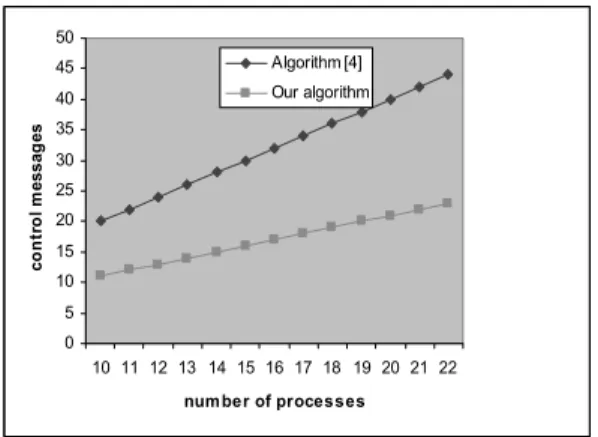
a permanent checkpoint, and when the initia-tor receives two requests it terminates the algo-rithm. Hence, in an n-process system, for the checkpointing algorithm to complete, 2n num-ber of control messages are needed. With the algorithm presented in this paper each process requires only one checkpoint request to take a permanent checkpoint. Therefore, the number of control messages in our proposed approach for a bidirectional ring network is only n+1 in the worst case, which is almost half of the number used in the algorithm proposed in [4]. The recovery algorithm in [4] requires 2n−1 control messages. In our presented algorithm, this number is only n+1. It also shows that in our work processes are interrupted much less frequently because of the less number of control messages used. It definitely contributes to the speed of execution of the approaches presented in this work.
3.2.2. Comparison of the Execution Times
The main advantage of our presented check-pointing algorithm is that it creates a globally consistent set of checkpoints in much less time, when compared to the algorithm proposed in
[4]. Suppose that t is the average time a mes-sage takes to travel from one process to another in an n process system. The checkpointing algo-rithm in[4]requires n*t time units to complete, whereas our presented checkpointing algorithm requires only(n/2+1)*t time units to complete in the worst case. A summary of the perfor-mance comparison is given in Table 1. Observe that we use the same topology as in[4], and so it is correct to assume the existence of the same message passing mechanism in the system, ir-respective of what checkpointing algorithm is used. So, we can assume the same value for ‘t’ for both our work and the work in[4].
Algorithm Property Mandal(4) AlgorithmOur
Checkpointing Algorithm
Number of Control
Messages 2n n+1
Recovery Algorithm
Number of Control
Messages 2n−1 n+1
Checkpointing
Algorithm ExecutionTime n*t (n/2+1)*t
Figure 5a shows the variation of the execution times in the two checkpointing algorithms with the number of processes in the system and Fig-ure 5b shows the variation of the number of control messages used by the two checkpoint-ing algorithms with the number of processes in the system. It is evident that our proposed checkpointing algorithm outperforms the algo-rithm proposed in[4].
0 50 100 150 200 250 300 350 400 450 500
10 11 12 13 14 15 16 17 18 19 20 21 22
num ber of processes
ti
m
e ta
ke
n
Algorithm [4] Our Algorithm
Figure 5a. Execution time vs. no. of processes.
0 5 10 15 20 25 30 35 40 45 50
10 11 12 13 14 15 16 17 18 19 20 21 22
number of processes
co
n
tr
o
l m
ess
ag
es
Algorithm [4] Our algorithm
Figure 5b.No. of control messages vs. no. of processes.
In our work, we have not considered concurrent initiations of either the checkpointing or the re-covery algorithm. We strongly argue that such initiations create basically message storm in dis-tributed systems, particularly when the number of processes n is large. So this may not be a good practical approach for large n. It is evi-dent that in[4]and[10]the respective message complexities are O(n2) and O(n3) for concur-rent initiations as opposed to O(n) for single initiation in our work.
4. Further Modification
The presented algorithm can be further modified to allow only minimum number of processes to take checkpoints. Note that this minimality consideration has not been addressed in[4]. The modification can be done in the following way. It is clear that a process does not need to take a checkpoint if it has not sent any application message to its adjacent processes. Suppose that each process maintains a flag, message sent, which is initially set to false. The flag is set to be true the first time a process sends an appli-cation message to its adjacent process since its last checkpoint. Every time the process takes a checkpoint, the flag is reset to false. When-ever a process receives a checkpoint request, it checks its message sent flag. If it is true, it takes a checkpoint, increments its checkpoint sequence number, and forwards the message to its adjacent process. If themessage sentflag is false, the process does not take a checkpoint and forwards the message to its adjacent process. It can be observed that even if a process does not take a checkpoint in the current checkpointing interval, the latest checkpoints of all the pro-cesses still form a consistent global state(CGS)
of the system.
5. Conclusion
be applied to a generic network. It needs major modification for that purpose, which may re-sult in the loss of its efficiency. The reason for this is as follows: in bidirectional networks, a process may receive orphan messages from its predecessor and its successor only; whereas in a generic network, a process may receive or-phan messages from any number of the other processes based on the topology. So making checkpoints mutually consistent is a lot more complex problem than the one in ring networks and, therefore, it needs major modification of the proposed checkpointing algorithm to be-come suitable for arbitrary topology.
References
[1] Y.-M. WANG, Consistent Global Checkpoints that
Contain a Given Set of Local Checkpoints. IEEE Transactions on Computers, 46(4) (1997), 456– 468.
[2] M. SINGHAL, N. G. SHIVARATRI, Advanced
Con-cepts in Operating Systems.McGraw-Hill, 1994.
[3] R. KOO, S. TOUEG, Checkpointing and
Rollback-recovery for Distributed Systems. IEEE Transac-tions on Software Engineering, SE – 131(1987), 23–31.
[4] P. S. MANDAL, K. MUKHOPADHYAYA, Concurrent Checkpoint Initiation and Recovery Algorithms on Asynchronous Ring Networks.Journal of Parallel and Distributed Computing, 64, Issue 5 (2004), 649–661.
[5] G. CAO, M. SINGHAL, On Coordinated
Checkpoint-ing in Distributed Systems.IEEE Transactions on Parallel and Distributed Systems, 9(12) (1998), 1213–1225.
[6] D. MANIVANNAN, M. SINGHAL, Quasi-synchronous
Checkpointing: Models, Characterization, and Classification.IEEE Transactions on Parallel and Distributed Systems,10(1999), 703–713.
[7] G. CAO, M. SINGHAL, Mutable Checkpoints: A New Checkpointing Approach for Mobile Comput-ing Systems. IEEE Transactions on Parallel and Distributed Systems,12(2001), 157–172.
[8] E. N. ELNOZAHY, D. B. JOHNSON, W. ZWAENEPOEL,
The Performance of Consistent Checkpointing. Pro-ceedings of the 11th Symposium on Reliable
Dis-tributed Systems,(1992), 86–95.
[9] L. M. SILVA, J. G. SILVA, Global Checkpointing for
Distributed Programs.Proceedings of the 11th
Sym-posium on Reliable Distributed Systems, (1992), 155–162.
[10] R. PRAKASH, M. SINGHAL, Maximum Global
Snap-shot with Concurrent Initiators.Proceedings of the 6th IEEE Symposium of Parallel and Distributed
Processing,(1994), 334–351.
[11] M. JONSSON, Two Fibre-ribbon Ring Networks for
Parallel and Distributed Computing Systems.Opt. Eng.,37(12) (1998), 3196–3204.
[12] B. GUPTA, N. MOGHARREBAN, S. RAHIMI, A. VE -MURI, A High Performance Non-blocking Check-pointing/Recovery Algorithm for Ring Networks.
Proceedings of the 2006 Intl. Conf. Parallel and Distributed Processing Techniques and Applica-tions (PDPTA-06),(2006)Las Vegas, 234–240.
Received:August, 2006
Recvised:March, 2007
Accepted:July, 2007
Contact addresses:
Bidyut Gupta Department of Computer Science Southern Illinois University Carbondale 1000 Faner Drive Carbondale IL 62901-4511, USA
Shahram Rahimi Department of Computer Science Southern Illinois University Carbondale 1000 Faner Drive Carbondale IL 62901-4511, USA
Ziping Liu Department of Computer Science Southeast Missouri State University One University Plaza Cape Girardeau, MO 63701-5950, USA
BIDYUTGUPTAreceived his M.Tech degree in Electronics Engineering and PhD degree in Computer Science from the University of Calcutta, India in 1978 and 1986, respectively. From 1986 to 1988, he was with the Computer Science Department of Colorado State University at Fort Collins as a visiting member of the faculty. In 1988, he joined the Computer Science Department of Southern Illinois University at Carbondale as assistant professor, where at present he is a full profes-sor and the graduate program director. His research interests include distributed systems, mobile computing, mobile ad-hoc networks, and software agents. He is a senior member of the IEEE.
SHAHRAMRAHIMIreceived his PhD in Scientific Computing from the University of Southern Mississippi in 2002, and his BS degree from National University of Iran(Tehran)in 1992. Currently, he is an asso-ciate professor and the undergraduate program director at the Computer Science Department of Southern Illinois University. Dr Rahimi is also the Editor-in-Chief of the International Journal of Computational Intel-ligence Theory and Practice. His research interests include distributed systems, mobile computing, mobile ad-hoc networks, software agents and soft computing.