VOLUME 18 ISSUE 1 (2020), Page 148 – 159
DO DURATION OF STAY AND PARK VISITATION MATTER? AN EVALUATION OF PARK DISTANCE
Nurhayati Abdul Malek1 & Amanina Nashar2
1
Faculty of Architecture, Planning and Surveying
UNIVERSITI TEKNOLOGI MARA
²Research Officer
MENTARI DESIGN
Abstract
Among ways to keep up with healthy lifestyle include physical activities. Recent statistics by the Ministry of Health (2016) indicated a drastic increase in the prevalence of non-communicable disease from 1990 to 2016 and the number is expected to increase or remain high. In response to the issue, the Eleventh Malaysia Plan 2016-2020 was formulated to improve Malaysians’ wellbeing by providing ample open spaces to encourage an active lifestyle. This paper aims to investigate the association of proximity to neighbourhood park and its level of utilisation. 680 respondents were involved in the questionnaire survey conducted at 7 selected neighbourhood parks. The output of the Pearson Correlation evinced that proximity to neeighborhood parks was highly associated to the level of park utilisation. There was a strong and positive relationships between (i) park distance and numbers of visitations (r = 0.841,n = 680,p = 0.000< 0.01), (ii) park distance and length of stay (r = 0.803, n = 680, p = 0.000< 0.01), and (iii) number of visitations and length of stay (r = 0.644, n = 680,p = 0.000< 0.01). The results also indicated that that the longer the distance of the park from home, the longer the time spent at the park. Whereas, the shorter the distance of the park from home, the higher the utilisation of the park.
INTRODUCTION
Malaysia is one of the developing countries besides other Asian and European countries that experience a high number of non-communicable disease (NCDs). Apart from other determinants, physical inactivity is identified as the leading cause of NCDs and other health-related problems (Ministry of Health Malaysia, 2016). Including Malaysia, statistics have reported over 5.3 million deaths a year worldwide due to unhealthy lifestyle (Sallis and Carlson, 2015). The Malaysian government has introduced green cities and neighbourhood as its core initiatives towards achieving sustainable cities (Ministry of Housing and Local Government Malaysia, 2010). Besides enhancing people’s wellbeing and increasing bodily health and muscle composition, strong evidence shows that physical activity helps in overcoming various types of cancer, depression and high blood pressure (Fong et al., 2012; Ferioli et al., 2018). This paper intends to investigate the association of National Park (NP) proximity with its utilisation for the improvement of the quality of neighbourhood park (QNP) in Malaysia. The objectives of this study are to (i) identify the relationship between park distance and number of visits, (ii) to investigate the association of park distance with length of stay and (iii) to investigate the association of number of park visitations with length of stay.
DETERMINANT FACTORS TO PARK UTILIZATION
Over the past century, there has been a dramatic interest in the subject of green open spaces (GOS). Numerous urban theorists emphasise the importance of GOS for social connectedness, recreational opportunities, enhancement of physical health and wellbeing (Samimi et al., 2009; Karuppannan et al., 2012; Brown et al., 2013). Despite the fact that GOS brings extensive value to the community, the issues of underutilisation of parks or GOS in Malaysia remain unchanged (Norsidah et al., 2015). Urban theorists agree that types of activities, safety, legibility, quality and proximity are the prominent factors that influence GOS utilisation (Ewing and Handy, 2009; Sugiyama et al., 2010; Taylor et al., 2011; Paquet, Cargo, Kestens and Danial, 2010; Akpınar, 2014). A current study conducted on the quality of GOS in Malaysia suggests that distance is one of the essential criteria for successful GOS (Nurhayati and Amanina, 2018).
Previously, several studies have reported that proximity of park to residence influences the time spent in the park and level of park utilisation. In Chicago, people who live near to parks are more likely to visit the park due to shorter travel time as compared with people who live farther from parks. Meanwhile, people who live farther away from parks would hardly visit the park yet tend to stay in the parks much longer than those who live nearby (Gobster 2002; Tinsley et al., 2002). Other studies related to satisfaction of neighbourhood park evince that distance has the strongest influences on GOS utilization compared to other factors (Hadavi et al., 2017). This suggests that the more frequently people visit the parks, the more likely that they would be involved in PA.
The frequency of park utilisation is strongly associated with a higher level of PA (Bedimo-Rung et al., 2005; Kaczynski and Henderson, 2008). Studies conducted by Kaczynski et al. (2009) reveal that proximity to parks strongly relates to age. Indeed, Sanesi and Chiarello (2006) claim that residential area, marital status and age are strong factors influencing park utilisation. Meanwhile, studies by Barbosa et al. (2007) and Schipperijn et al. (2013) discover that accessibility is an important factor that influences park usability. However, there is lack of reliable methods to measure park accessibility (Maroko et al., 2009). It is important to note that factors such as proximity to GOS are closely related to accessibility, travel time, street environment and land uses (Balfour and Allen, 2014; Pojani and Stead, 2015; So, 2016).
METHODOLOGY
Site Study
Seven neighbourhood parks under the jurisdiction of Petaling Jaya City Council (Majlis Perbandaran Petaling Jaya, MBPJ) and Shah Alam City Council (Majlis Perbandaran Shah Alam, MBSA) were selected for this study. 680 park users were involved as respondents of the questionnaires. Table 1 shows detailed information about on of the park selected for the study.
Table 1 Details on selected Neighbourhood Parks in Malaysia
Name of Parks Location Size Jurisdiction
Taman Rimba Riang Section 9, Kota Damansara 4.45ha MBPJ
Taman Aman Petaling Jaya 5.2 ha MBPJ
Taman Jaya Petaling Jaya 10.7 ha MBPJ
Ara Damansara Park Ara Damansara 9.9. ha MBPJ
Taman Rekreasi Tasik Seksyen 7 Seksyen 7, Shah Alam 18 ha MBSA
Western Park Setia Alam 4.35 ha MBSA
RESULT AND DISCUSSION
In line with the findings from the literature, this study believed that distance served as one of the significant factors influencing neighbourhood park (NP) utilisation particularly in Malaysia. SPSS 16 was utilized to conduct Pearson Correlation. The Pearson Correlation determined whether there was a significant correlation between, i) park distance from neighbourhood and number of visitations, and ii) park distance from neighbourhood and length of stay in the park.
The options for park distance were: 1=< 1km, 2= 1km - 2km, 3= 3km - 4km, 4= 4km - 5km, and 5= < 5km. The options for park visitiations were: 1= this is my first time, 2= everyday, 3= 2-3 times/ week, 4= every weekend and 5= 1-3 times/ month. The options for the the length of stay were: 1= 1 hour, 2 = 1 hour, 3 = 2-4 hours, 4= 4-6 hours, and 5= full day.
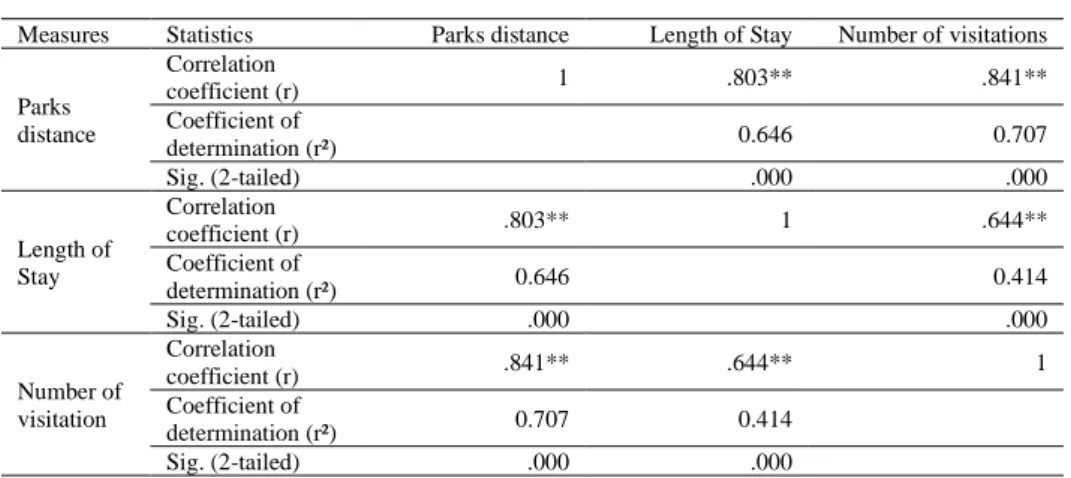
Table 2 shows the output of the correlation analyses. The results indicate a strong and positive correlation between (i) park distance and number of visitations. Moreover, there is a strong and positive correlation between (ii) park distance and length of stay, and (iii) number of visitations and length of stay. The results show that (i) the shorter the park distance from home, the greater the utilisation of the park, (ii) the longer the distance of the park from home, the longer the time the user spent at the park, and (iii) the lesser the number of visitations, the longer the time the user spent at the park.
Table 2: Statistical Output of Bivariate Correlations on NP distance and utilization in Malaysia
Hº There are no statistical correlations between (i) parks distance and numbers of visitation, (ii) parks distance and length of stay, and (iii) number of visitation and length of stay
H¹ There are statistically significant correlations between (i) parks distance and numbers of visitation, (ii) parks distance and length of stay, and (iii) number of visitation and length of stay
Measures Statistics Parks distance Length of Stay Number of visitations
Parks distance
Correlation
coefficient (r) 1 .803** .841**
Coefficient of
determination (r²) 0.646 0.707
Sig. (2-tailed) .000 .000
Length of Stay
Correlation
coefficient (r) .803** 1 .644**
Coefficient of
determination (r²) 0.646 0.414
Sig. (2-tailed) .000 .000
Number of visitation
Correlation
coefficient (r) .841** .644** 1
Coefficient of
determination (r²) 0.707 0.414
The followings are the results of the correlation statistics:
i. At the 99 % confidence level, there is a statistically strong and positive correlation between park distance and number of visitations (r = 0.841, n = 680, p = 0.000< 0.01). The coefficient of determination (r2 = 0.707,
p < 0.01) indicates that park distance explains 70.7% variation in number of visitations. Therefore, the null hypothesis is rejected. ii. At the 99 % confidence level, there is a statistically strong and positive
correlation between park distance and length of stay (r = 0.803, n = 680, p = 0.000< 0.01). The coefficient of determination (r2 = 0.644, p < 0.01)
indicates that park distance explains 64.6% variation in length of stay. Therefore, the null hypothesis is rejected.
iii. At the 99 % confidence level, there is a statistically strong and positive correlation between number of visitations and length of stay (r = 0.644, n = 680, p = 0.000< 0.01). The coefficient of determination (r2 = 0.414,
p < 0.01) indicates that number of visitations explains 41.4% variation in length of stay. Therefore, the null hypothesis is rejected.
The statistical outputs suggest that park distance has a strong connection to park utilisation, that is (i) the number of visits and (ii) the length of stay at the park.
Park Distance in Relation to Time Spent at Park
In Malaysia, one of the greatest challenges is to encourage people to be involved in outdoor physical activities. Park planners need to identify the needs of people of various ages to get them involved in outdoor activities. Moreover, time spent at the park indicates higher chances of getting involved in different types of outdoor activities. Several studies have documented that the more time spent outdoors, the healthier people’s well-being and the happier they will be (Thompson and Travlou, 2007; Mitchell and Popham, 2008). The claim is supported by Lestan et al. (2014) who assert that the proximity of open green spaces to home strongly affects the number of visitations and time spent at the park. The findings from this study also indicate that a park located farther from home leads to longer travel time. Whereas, park visitors who stay closer to the neighbourhood park would pay frequent visits to the park and spend lesser travel time to reach the park as compared with visitors who could only go to the park over the weekend. Current studies by Bertram et al. (2017) indicate similar findings where individuals tend to spend more time at the park during the weekend.
Sreetheran, 2017). Therefore, further studies and more in-depth investigation related to NP distance and duration of time spent are needed. It is believed that frequency of park visitation and time spent are among important indicators of successful GOS design (Amir Hossein Askari, 2014). However, there is no specific justification hitherto of whether parks should be located near to, or farther from the residential areas. Different GOS-related studies measure distance differently depending on the context of the study. Moreover, some studies indicate that distance is highly related to other factors such as accessibility and streetscape design.
Park Distance in Relation to Frequency of Visitation
Based on Table 2, the results suggest that residents who live within less than 1 kilometer from the park tend to have higher frequency of visitation. Meanwhile, residents who live farther away from the park, but within less than 5 kilometers; show less visitation to the nearest NP. The results indicate that the distance of park from neighbourhood significantly influences the utilisation of neighbourhood parks. Previous studies have reported that park proximity is one of the main reasons that invite and attract frequent visits to the parks in Putrajaya. The respondents stated that their attraction to the parks reflected in their regular visits was due to the short distance of the parks from their residences (Norsidah et al., 2015). Kayczynski and Henderson (2008) state that proximity to GOS is highly connected to the increase in physical activities and the health of the communities. These findings are further supported by the studies conducted in New Delhi, India which evince that frequency of park visitation is strongly influenced by distance to the park. People who live less than 1 kilometer are more likely to pay visits to the parks as compared with those who live further than 1 kilometer away. Similarly, other studies also report the same results where the distance to GOS influences the utilization of the park (Coles and Bussey, 2000; Neilsen et al., 2013).
areas attract more residents to utilise them due to their sense of attachment to natural environment.
CONCLUSION
This study has proven that distance is one of the important design characteristics that have an influence on park visitation and time spent at the park. However, according to previous studies that investigated distance, other factors such as accessibility, streetscape design, safety and attractiveness need to be considered when delving into the issue of park usability. In the Malaysian context, neighbourhood parks situated close to the residential areas are more preferred instead of other influential factors such as maintenance, facilities, safety, and park qualities. Previously, the results of this study have evinced that visitors who live less than 1 kilometer from the park pay frequent visits to the park as compared to those who live further than 1 kilometer away. Hence, studies on possible factors related to distance such as accessibility, street characteristics and socio-economic background need to be investigated further to support the current study comprehensively for future GOS planning and design references.
REFERENCES
Agboola, O. P., Rasidi, M. H., & Said, I. Bin. (2016). Challenges in Sharing Neighbourhood Open Space Among Residents in South-West, Nigeria. International Journal of Multidisciplinary Academic Research, 4(2), 34–49. Retrieved from www.multidisciplinaryjournals.com
Akpınar, A. (2014) Assessing the users’ perceptions, preferences, and reasons for use of urban greenway, Journal of Faculty for Istanbul University, 64 (2), pp. 41–55. Amir Hossein Askari. (2014) ‘Assessment of Urban Public Spaces: Cases of Kuala
Lumpur City Center’ Unpublished doctoral thesis, Universiti Malaya, Selangor, Malaysia.
Barbosa, O., Tratalos, J.A., Arms worth, P.R., Davies, R.G., Fuller, R.A., Johnson, P., Gaston, K.J. (2007) Who benefits from access to green space? A case study from Sheffield, UK. Landscape Urban Plan. 2-3 (83), pp. 187–195.
Badland, H., Hickey, S., Bull, F., Giles-Corti, B. (2014) Public transport access and availability in the RESIDE study: Is it taking us where we want to go? Journal of Transport Health, 1, pp. 45–49.
Balfour, R., & Allen, J. (2014) Local action on health inequalities: Improving access to green spaces. Wellington House, London: Public Health England, UCL Institute
of Health Equity. Retrieved from
https://assets.publishing.service.gov.uk/government/uploads/system/uploads/ attachment_data/file/357411/Review8_Green_spaces_health_inequalities.pdf Bedimo-Rung, A.L., Mowen, A.J., Cohen, D.A. (2005) The significance of parks to
physical activity and public health: a conceptual model. American Journal of Preventive Medicine, 28, pp. 159-168.
Bertram, C., Meyerhoff, J., Rehdanz, K., &Wüstemann, H. (2017) Differences in the recreational value of urban parks between weekdays and weekends: A discrete choice analysis. Landscape and Urban Planning, 159, pp. 5-14.
satisfaction, physical activity, obesity and wellbeing. Journal of Epidemiol. Community Health, 62 (4), pp. 1-7.
Brown, G., Schebella, M. F., & Weber, D. (2013) Using participatory GIS to measure physical activity and urban park benefits. Landscape and Urban Planning, 121, pp. 34-44.
Cohen, D. A., Han, B., Derose, K. P., Williamson, S., Marsh, T., Rudick, J., & McKenzie, T. L. (2012) Neighborhood poverty, park use, and park-based physical activity in a Southern California city. Social Science & Medicine, 75(12), pp. 2317-2325. Coles, R. & Bussey, S. (2000) Urban forest landscapes in the UK progressing the social
agenda'. Landscape and Urban Planning, 52(2/3), pp 181-188.
Dill, J.(2004) “Measuring network connectivity for bicycling and walking” Paper submitted to 89th Transport Research Board Annual Meeting, Williamsburg, Virginia. Available at http://reconnectingamerica.org/assets/Uploads/TRB2004-001550.pdf
Ewing, R. and Handy, S. (2009) Measuring the unmeasurable: urban design qualities related to walkability. Journal of Urban Design, 14 (1), pp. 65–84.
Fong D.Y., Ho J.W., Hui B.P., Lee A.M., Macfarlane D.J., Leung S.S., Cerin E., Chan W.Y., Leung I.P., Lam S.H., Taylor A.J., Cheng K.K. (2012) Physical activity for cancer survivors: meta-analysis of randomised controlled trials, BMJ, 344,e70. Ferioli, M., Zauli, G., Martelli, A. M., Vitale, M., McCubrey, J. A., Ultimo, S. &Neri, L.
M. (2018) Impact of physical exercise in cancer survivors during and after antineo plastic treatments. Oncotarget, 9 (17), pp. 14005- 14034.
Gobster, P.H. (2002) Managing urban parks for a racially and ethnically diverse clientele. Leisure Sciences, 24, pp. 143-159.
Hadavi, S., Kaplan, R., & Hunter, M. R. (2017) How does perception of nearby nature affect multiple aspects of neighbourhood satisfaction and use patterns?. Landscape Research, 43 (3), pp. 360-379.
Kaczynski, A.T., Henderson, K.A. (2008) Parks and recreation settings and active living: a review of associations with physical activity function and intensity. Journal of Physical Activity and Health, 5, pp. 619-632.
Kaczynski, A. T., Potwarka, L. R., Smale, B. J. A., & Havitz, M. F. (2009). Association of Parkland proximity with neighborhood and park-based physical activity: Variations by gender and age. Leisure Sciences, 31(2), 174–191.
Karuppannan, S., Sivam, A., Koohsari, M., &Sivam, A. (2012) Does urban design influence physical activity in the reduction of obesity? A review of evidence, The Open Urban Studies Journal, 5, pp. 14-21.
Kawada, K., Yamada, T., &Kishimoto, T. (2014) Street Choice Logit Model for visitors in shopping districts. Behavioral Sciences, 4(3), pp. 154-166.
Lestan, K. A., Eržen, I., &Golobič, M. (2014) The role of open space in urban neighbourhoods for health-related lifestyle. International journal of environmental research and public health, 11(6),pp. 6547-6570.
Lo, A. Y., & Jim, C. Y. (2012) Citizen attitude and expectation towards greenspace provision in compact urban milieu. Land use policy, 29(3), pp. 577-586.
City: a quantitative and qualitative approach. International Journal of Health Geographic, 8(1), 34, pp 1-23,
Ministry of Health 2016. National Strategic Plan for Non-Communicable Disease (NSP- NCD) 2016-2025. Non-Communicable Disease (NCD) Section, Disease Control Division, Ministry of Health Malaysia. Retrieved from http://www.moh.gov.my/moh/resources/Penerbitan/Rujukan/NCD/National%20 Strategic%20Plan/FINAL_NSPNCD.pdf
Ministry of Housing and Local Government Malaysia. (2010) Malaysian Town Plan: Planning in Green Malaysia. Retrieved from https://issuu.com/anwar_townplan/docs/ townplan_vol_7_ issue_1_with_cover. Mitchell, R.; Popham. (2008) F. Effect of exposure to natural environment on health
inequalities: An observational population study. Lancet, 372, pp. 1655–1660. Mohd Salleh, M. Z., Abdul Malek, N., Othman, N., & Syed Othman Thani, S. K. (2019).
The Malaysian Cycling-Friendly Neighbourhood: A Signal For The Enhancement Of The Convenience Infrastructure. MATEC Web of Conferences, 266, 06004. Nielsen, A.B., van den Bosch, M., Maruthaveeran, S. et al. (2014) Species richness in
urban parks and its drivers: A review of empirical evidence. Urban Ecosyst 17, 305–327.
Nor Akmar Abdul Aziz. (2012) Green space use and management in Malaysia. Forest & Landscape Research, 51, pp. 1-71.
Norsidah Ujang, AmnieMoulay&KhalilahZakariya. (2015) Sense of well-being indicators: Attachment to public parks in Putrajaya, Malaysia. Procedia-Social and Behavioral Sciences, 202, pp. 487-494.
Nurhayati Abdul Malek, Manohar Mariapan& Nik Ismail Azlan Ab Rahman. (2015) Community Participation in Quality Assessment for Green Open Space in Malaysia, Procedia-Social and Behavioral Sciences, 168, pp. 219-228.
Nurhayati Abdul Malek & Amanina Nashar. (2018) Measuring Successfulness of Malaysian Green Open Spaces: An Assessment Tool. Theoretical & Empirical Researches in Urban Management, 13(2), pp. 21-37.
Nurhayati Abdul Malek &AmaninaNashar. (2018) Use Pattern and Activities: The Evaluation of Malaysian Green Open Space Design. Journal of the Malaysian Institute of Planners,6 (3), pp. 121-131.
Paquet, C., Cargo, M., Kestens, Y. & Daniel, M. (2010) Reliability of an instrument for direct observation of urban neighbourhoods, Landscape and Urban Planning, 97, pp. 194-201. https://doi.org/10.1016/j.landurbplan.2010.06.001
Paul, S., & Nagendra, H. (2017) Factors Influencing Perceptions and Use of Urban Nature: Surveys of Park Visitors in Delhi. Land, 6(2), 27.
Pojani, D., & Stead, D. (2015) Sustainable urban transport in the developing world: beyond megacities. Sustainability, 7(6), pp. 7784-7805.
Rasidi, M. H., Jamirsah, N., & Said, I. (2012). Urban Green Space Design Affects Urban Residents’ Social Interaction. Procedia - Social and Behavioral Sciences, 68(November), 464–480.
Sallis, J. F., & Carlson, J. A. (2015) Physical Activity: Numerous Benefits and Effective Interventions. Population Health: Behavioral and Social Science Insights, 169-184, Maryland, United State: National Institute of Health. Retrieved from https://www.researchgate.net/profile/Michael_Spittel/publication/311734534_Po pulation
_HealthBehavioral_and_Social_Science_Insights/links/58582f3c08aeffd7c4fbb3 70/Popul ation-Health-Behavioral-and-Social-Science-Insights.pdf#page=179 Samimi, A., Mohammadian, A. K., &Madanizadeh, S. (2009) Effects of transportation
and built environment on general health and obesity. Transportation research part D: transport and environment, 14(1), pp. 67-71.
Sanesi, G., &Chiarello, F. (2006). Residents and urban green spaces: The case of Bari, Urban Forestry & Urban Greening, 4 (3-4), pp. 125-134.
Schipperijn, J.; Bentsen, P.; Troelsen, J.; Toftager, M.; Stigsdotter, U.K. (2013) Associations between physical activity and characteristics of urban green space. Urban Forestry & Urban Greening, 12 (1), pp. 109–116.
Schipperijn, J., Cerin, E., Adams, M. A., Reis, R., Smith, G., Cain, K., &Mitáš, J. (2017) Access to parks and physical activity: An eight-country comparison. Urban Forestry & Urban Greening, 27, pp. 253-263.
So, S. W. (2016). Urban Green Space Accessibility and Environmental Justice: A GIS-Based Analysis in the City of Phoenix, Arizona (University of Southern California). Retrieved from https://spatial.usc.edu/wp-content/uploads/2016/07/So-Shuk-Wai.pdf
Sreetheran, M. (2017). Exploring the urban park use, preference and behaviours among the residents of Kuala Lumpur, Malaysia. Urban Forestry & Urban Greening, 25, 85–93.
Sturm, R., & Cohen, D. (2014) Proximity to urban parks and mental health. The journal of mental health policy and economics, 17(1), pp. 19 -24.
Sugiyama, T., Francis, J., Middleton, N.J., Owen, N., Giles-Corti, B. (2010). Associations between recreational walking and attractiveness, size, and proximity of neighbourhood open spaces. American Journal of Public Health, 100 (9), 1752– 1757.
Taylor, B. T., Fernando, P., Bauman, A. E., Williamson, A., Craig, J. C., & Redman, S. (2011). Measuring the quality of public open space using Google Earth. American journal of preventive medicine, 40(2), 105- 112.
Tinsley, H.E.A., Tinsley, D.J. and Croskeys, C.E. (2002) Park usage, social milieu and psychosocial benefits of park use reported by older urban park users from four ethnic groups, Leisure Sciences, 24, pp. 199-218.
Thompson, C.W.; Travlou, P. (2007) Open Space: People Space; Taylor & Francis Group: Abingdon, London, UK.
Toftager, M., Ekholm, O., Schipperijn, J., Stigsdotter, U.K., Bentsen, P., Grønbæk, M., KamperJørgensen, F. (2011) Distance to green space and physical activity: A Danish national representative survey. Journal of Physical Activity and Health, 8, pp. 741–749.
Wright Wendel, H. E., Zarger, R. K., &Mihelcic, J. R. (2012) Accessibility and usability: Green space preferences, perceptions, and barriers in a rapidly urbanizing city in Latin America. Landscape and Urban Planning, 107, pp. 272–282.