African Journal of Reproductive Health December 2018; 22 (4):123
ORIGINAL RESEARCH ARTICLE
A Gap Analysis of Mother, New-born, and Child Health in West
Africa with Reference to the Sustainable Development Goals 2030
DOI: 10.29063/ajrh2018/v22i4.13
Vesna Bjegovic-Mikanovic
1, Raphael Broniatowski
2, Stephen Byepu
3and Ulrich Laaser
4*
School of Public Health & Management, Faculty of Medicine, University of Belgrade, Serbia1; EPOS Health Management, Bad Homburg, Germany2; INHA University, Incheon, Korea3; Faculty of Health Sciences, University of Bielefeld, Germany4
*For Correspondence: Email: [email protected]; [email protected]
Abstract
The Economic Community of West African States (ECOWAS) comprises 15-member states with an estimated population of 350 million. This account relates the present status of maternal, neonatal, and under-five-mortality to the Sustainable Development Goals (SDG) targets set for 2030. For each SDG indicator, progress observed was compared with that needed to meet the target (assuming linear progression). The time gap was calculated as the difference between the time remaining to the target year (2030) and the estimated time needed to achieve the target. The highest maternal mortality ratio is found in Sierra Leone (1360 in 2015), followed by Nigeria (814) and Liberia (725). Whereas Sierra Leone and Nigeria keep high positions also for the neonatal and under-five mortality rate, Liberia ranks clearly better than the ECOWAS average. Globally skilled health professionals‘ density is 25 per 10,000 population and in Nigeria close to it with 20.1 whereas Guinea takes the last position with 1.4. The gap analysis shows that ECOWAS countries have a realistic chance to likely reach the SDG targets in 2030 with a delay of less than 4 years regarding maternal, neonatal, and under-five-mortality although their skilled health professionals‘ density is considerably lower than for the entire African region. (Afr J Reprod Health 2018; 22[4]: 123-134).
Keywords: West Africa, Mother, New-born and Child Health, Sustainable Development Goals, Gap Analysis, Health Worker Density
Résumé
La Communauté économique des États de l'Afrique de l'Ouest (CEDEAO) compte 15 États membres et une population estimée à 350 millions d'habitants. Ce compte relie l‘état actuel de la mortalité maternelle, néonatale et des moins de cinq ans aux objectifs de développement durable (ODD) fixés pour 2030. À cette fin, l‘analyse du délai qui reste pour atteindre les objectifs des ODD consiste de la méthodologie recommandée précédemment par le Programme des Nations Unies pour le développement pour évaluer les progrès accomplis dans la réalisation des Objectifs du Millénaire pour le Développement (OMD). Pour chaque indicateur, les progrès observés ont été comparés à ceux nécessaires pour atteindre la cible (en supposant une progression linéaire). L'écart de temps pour un indicateur individuel a été calculé comme étant la différence entre le temps qui reste jusqu'à l'année cible (2030) et le temps nécessaire pour atteindre la cible (en supposant la vitesse prévue par le programme national). Le taux de mortalité maternelle le plus élevé se situe en Sierra Leone (1360 en 2015), suivi du Nigéria (814) et du Libéria (725). Alors que la Sierra Leone et le Nigéria conservent des positions élevées également en ce qui concerne le taux de mortalité néonatale et celle des moins de cinq ans, le Libéria se classe nettement mieux que la moyenne de la CEDEAO. Le nombre de professionnels de la santé qualifiés dans le monde est de 25 pour 10 000 habitants. Au Nigéria, il est proche de 20,1 tandis que la Guinée occupe le dernier rang avec 1,4. L‘analyse des lacunes montre que les pays de la CEDEAO ont une chance réaliste d‘atteindre les objectifs des ODD en 2030 avec un retard de moins de quatre ans en ce qui concerne la mortalité maternelle, néonatale et des moins de cinq ans, bien que la densité de leurs professionnels de la santé qualifiés soit considérablement inférieure à celle de la région africaine entière. (Afr J Reprod Health 2018; 22[4]:123-134).
African Journal of Reproductive Health December 2018; 22 (4):
124
Introduction
Maternal, new-born and child health (MNCH) are interconnected, related to all developmental stages (infancy, childhood, and puberty, reproductive and post-reproductive periods) and need strong attention of global, regional and national actors striving towards the achievement of sustainable
development1,2. Despite envisioned
opportunities3.4, recent scientific evidence points to successes and failures in reaching MNHC targets of Sustainable Development Goals (SDGs)5. Transparent MNCH policies, measurable objectives and evidence-based interventions are seen as the main success factors3. In addition to unfavorable social-economic determinants6, failures are particularly evident when the focus is on the continuum of care. Especially in low developed countries MNCH require unrestricted access to care provided by families and communities, by outpatient and outreach services, and by clinical services throughout the lifecycle, including adolescence, pregnancy, childbirth, and the postnatal period. Regrettably, the most important dimensions of Universal Health Coverage (UHC) – availability, accessibility, acceptability and quality are frequently in need for accelerated development in resource limited countries7. The UHC2030 agenda relates to one of the most important targets of SDG-3. It is hardly achievable in the ECOWAS to larger degree because weaknesses of the health system and the extreme lack of qualified health workforce. Also, MNCH services in rural areas are much less developed than in the central regions. Therefore, the Agenda for Sustainable Development8 and the updated ―Global Strategy for Women‘s, Children‘s and Adolescents‘ Health‖ (2016-2030) with the slogan ―Leaving no woman and no child behind‖9
, are envisioning the strong movement speeding up interventions in all countries recognized for underachievement. These international policies are calling on governmental, multilevel and multi-sectorial initiatives. Drawing on the best available information today, attempts are visible to analyze health policies and actual status of MNCH that will determine the health of future generations at
the global level and be a basis for interventions10.
However, in low resourced settings, such as the Economic Community of West African States (ECOWAS), there is limited evidence about potentials to achieve the targets of SDGs related to MNHC and very often evidence provides lessons reflecting only particular countries11,12.
ECOWAS was established May 28, 1975 via the treaty of Lagos – comprises 15-member states (8 francophone, 5 Anglophone and 2 Lusophone) and covers a surface of 5,114,162 km2 with an estimated population of 350 million13. ECOWAS Vision 2020, published in 2010, had expressed commitment towards a democratic and prosperous community and prioritized three main areas for the near future: regional resources development under sustainable environment, integration and mobility with access to education and health, and good governance14. Despite numerous strategies in this region dedicated to improving MNCH, a recent review has pointed to serious weaknesses in implementation and recognized needs for several improvements: strengthening stakeholder commitment, firming up the availability of resources, capacity building of workforce for health, and knowledge transfer with partnership platforms11. Almost all countries of ECOWAS are still struggling with high burden of maternal, neonatal and child morbidity and mortality5. Some countries are without development plans for health services in general or MNCH specifically, the latter as part of national health plans or separate. A few countries like Liberia have a well-developed set of objectives and targets for the near future, e.g. the Investment Plan for Building a Resilient Health System 2015 to 202115, however with questionable implementation.
African Journal of Reproductive Health December 2018; 22 (4):
125
Liberia and Sierra Leone) and health systems‘ weakness is well documented in international reviews16. Such experience points to the lack of necessary attention among stakeholders to MNCH and its strengthening, as well as concern about extreme resource limitations. Today, there is growing recognition of the requirement for stronger health policies - finally due to the EVD crisis - with responsibility to implement better MNCH services and improve the health system as a whole17,18. Particularly, international partners are looking at national health policies when they prioritize their global health investments in MNCH19. One of the crucial requests is to improve monitoring and evaluation of health policies‘ implementation. The global indicators‘ framework adopted by the United Nations General Assembly through the UN Economic and Social Council in March 2017 has given detailed recommendations for setting national targets20.
Methods
This analysis relies mainly on information collected fromwebsites of the national Ministries of Health and of international organizations, nota bene the World Health Organization (WHO) and other United Nations (UN) Agencies as well as published scientific literature. Table 1 provides the websites of the Ministries of Health. As a quantified and comparable targeting of national development goals is not available this account compares the present status of maternal, neonatal, and under-five-mortality in each country with the targets of the Sustainable Development Goals (SDG) for 203021, considering this sector a priority and at the same time as a marker for the achievability of the SDGs in general.
As all ECOWAS member states accepted the SDGs as a target to be achieved until the year 2030, a gap analysis was conducted. A thorough gap analysis allows policy makers to analyse the situation and resources they have, versus the desirable situation and additional resources they will need from local, national and international agencies for any scenario identified in their plans. They can then work on narrowing the gap between an observed situation and the targeted future, as
well as between required resources versus resources available. The gap analysis here follows the indicators relating to SDG-3 targets published in 201722. To do this it was essential to have available valid baseline and observed values for years in between.
For the analysis of the time gap remaining to achieve the SDG targets 2030, the methodology recommended earlier by the United Nations Development Program (UNDP) in order to assess progress towards the Millennium Development Goals (MDG)23 was used.
For each indicator, progress observed was compared with that needed to meet the targets (assuming linear progression). The time gap for an individual indicator was calculated as the difference between the time remaining to the target year and the time needed to achieve the target (assuming the speed foreseen by the national agenda). Formally, the time gap (G) was determined in the following way:
G = Tr − Tn
Where, Tr – remaining time is: Tr = tt − tc
tt and tc denote the target year and the year of observation respectively;
Tn – time needed to achieve the target (assuming linear progress) is:
xc − xb Tn = tt − [tb + (tt − tb) ---] xt – xb
tb – baseline year,
xb – baseline value of the indicator, xt – target value of the indicator, xc – observed value of the indicator.
Positive values of the time gap reflect over-performance, negative values indicate underperformance (i.e. time lag).
African Journal of Reproductive Health December 2018; 22 (4):
126
Table 1: Websites and development plans of Ministries of Health in the ECOWAS member states
ECOWAS countries Websites of the Ministries of Health Health Services Development Plans
Benin http://beninmoh.eu5.org/service1.html -.-
Burkina Faso http://www.sante.gov.bf/ Plan_strategique_SNIS_2010-2020.pdf
Cape Verde http://www.minsaude.gov.cv/ Plano nacional de Desenvolvimento sanitario Saúde 2012-2016
Côte d'Ivoire http://www.sante.gouv.ci/ Various specific health programmes
Gambia http://moh.gov.gm/ http://moh.gov.gm/sites/default/file s/National%20Health%20Strategic %20Plan%202014-2020.pdf Ghana http://www.moh.gov.gh/ Ghana National Healthcare Quality
Strategy 2017-2021
Guinea http://www.sante.gov.gn/index.php/fr/ Feuille de Route Nationale Pour Accélérer la Réduction de la Mortalité Maternelle, Néonatale et Infanto-Juvénile - 2012 - 2015 Guinea-Bissau [http://www.who.int/medical_devices/countries/g
nb.pdf]
-.-
Liberia http://moh.gov.lr/ Investment Plan for Building a Resilient Health System 2015 to 2021
Mali http://www.sante.gov.ml/ Reforme du système de santé 2017 Niger http://www.msp.ne/ Plan strategique recerche en sante
2013-2020
Nigeria http://www.health.gov.ng/ Better Health for All
Senegal http://www.sante.gouv.sn/ Plan Sénégal Emergent : Plans d‘actions Prioritaires 2014 - 2018 Sierra Leone http://health.gov.sl/ -.-
Togo http://www.sante.gouv.tg/fr plan stratégique de gestion des déchets médicaux _2016-2020
ECOWAS http://www.ecowas.int/ecowas-sectors/health/ ECOWAS Vision 2020
stakeholders to derive recommendations for accelerating action.
The borderline for ―unlikely‖ had been set at a (negative) time gap Gq being more than one quarter of the remaining time:
Gq = Gt /Tr <-0.25
For the predominantly used year of determination of the observed interim value i.e. 2015 the borderline time lag can be calculated as (2030-2015) * -0.25 = <-3.75.
Results
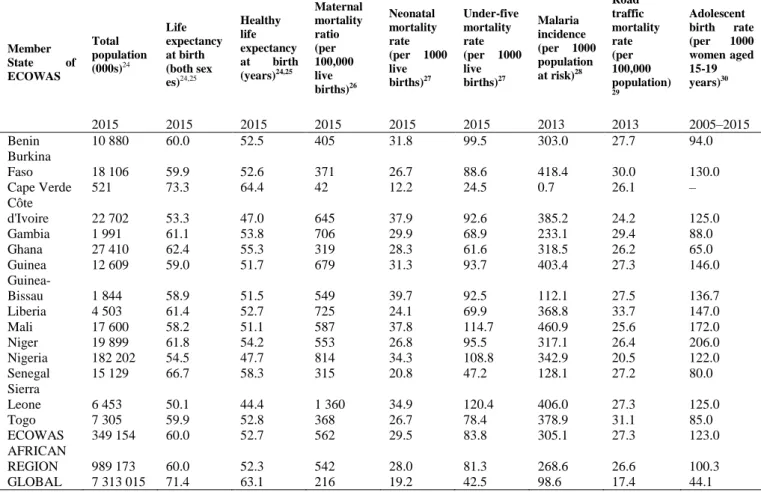
Table 2 shows the most important health indicators of the ECOWAS countries relating to MNCH. The highest maternal mortality is found in Sierra Leone
(1,360 per 100.000 live births), followed by Nigeria (819) and Liberia (725). Whereas Sierra Leone and Nigeria keep their high positions also for the under-five mortality rate with 120.4 and 108.8 per 1,000 live births (joined by Mali with 114.7), Liberia surprises with a rate of 69.6 clearly below the ECOWAS average of 83.8 possible due to impaired statistical validity of Liberian data as a sequelae of the long-lasting civil war in combination with the subsequent Ebola crisis in Liberia. The adolescent birth rate is one of the highest worldwide with 123 per 1,000 girls (globally 44.1).
African Journal of Reproductive Health December 2018; 22 (4):
127
Table 2: Selected health indicators in ECOWAS member states (based on sources referenced)
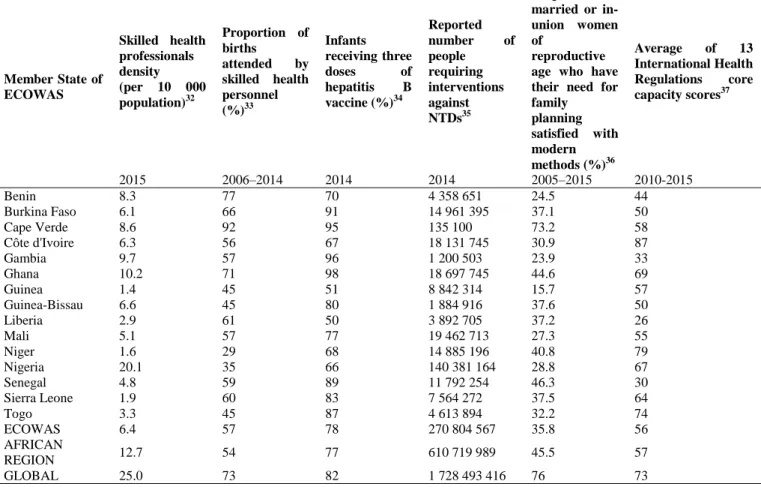
These indicators are related to health system structure, quality and effectiveness of performance. Table 3 presents a comparison of indicators describing the health workforce in ECOWAS member states, the African region and the world average. Globally skilled health professionals‘ density is 25 per 10,000 population and in Nigeria close to it with 20.1 whereas Guinea takes the last position with 1.4. This contradicts to some degree the figures in table 1 with life expectancy and healthy life expectancy higher in Guinea than in Nigeria (59.0 and 51.7 vs. 54.5 and 47.7 years).
Of special interest may be the last column in table 3 referring to the implementation of the 13
international health regulations. Under the International Health Regulations (IHR-2005)31 all States Parties are required to have or to develop minimum core public health capacities to implement the IHR-2005 effectively. The IHR monitoring process involves assessing, - through a self-assessment questionnaire sent to States Parties - the implementation status of 13 core capacities. They include the following areas: legislation, coordination, surveillance, respond, preparedness, risk communication, human resources, laboratory diagnostic, points of entry, zoonosis (detection and response), food safety, chemical events (detection and response), and radio-nuclear capacity (emergency detection and response).
Member State of ECOWAS
Total population (000s)24
Life expectancy at birth (both sex es)24,25
Healthy life expectancy at birth (years)24,25
Maternal mortality ratio (per 100,000 live births)26
Neonatal mortality rate (per 1000 live births)27
Under-five mortality rate (per 1000 live births)27
Malaria incidence (per 1000 population at risk)28
Road traffic mortality rate (per 100,000 population) 29
Adolescent birth rate (per 1000 women aged 15-19 years)30
2015 2015 2015 2015 2015 2015 2013 2013 2005–2015 Benin 10 880 60.0 52.5 405 31.8 99.5 303.0 27.7 94.0 Burkina
Faso 18 106 59.9 52.6 371 26.7 88.6 418.4 30.0 130.0 Cape Verde 521 73.3 64.4 42 12.2 24.5 0.7 26.1 – Côte
d'Ivoire 22 702 53.3 47.0 645 37.9 92.6 385.2 24.2 125.0 Gambia 1 991 61.1 53.8 706 29.9 68.9 233.1 29.4 88.0 Ghana 27 410 62.4 55.3 319 28.3 61.6 318.5 26.2 65.0 Guinea 12 609 59.0 51.7 679 31.3 93.7 403.4 27.3 146.0
Guinea-Bissau 1 844 58.9 51.5 549 39.7 92.5 112.1 27.5 136.7 Liberia 4 503 61.4 52.7 725 24.1 69.9 368.8 33.7 147.0 Mali 17 600 58.2 51.1 587 37.8 114.7 460.9 25.6 172.0 Niger 19 899 61.8 54.2 553 26.8 95.5 317.1 26.4 206.0 Nigeria 182 202 54.5 47.7 814 34.3 108.8 342.9 20.5 122.0 Senegal 15 129 66.7 58.3 315 20.8 47.2 128.1 27.2 80.0 Sierra
Leone 6 453 50.1 44.4 1 360 34.9 120.4 406.0 27.3 125.0 Togo 7 305 59.9 52.8 368 26.7 78.4 378.9 31.1 85.0 ECOWAS 349 154 60.0 52.7 562 29.5 83.8 305.1 27.3 123.0 AFRICAN
African Journal of Reproductive Health December 2018; 22 (4):
128
Table 3: Selected health services indicators in ECOWAS member states (based on sources referenced)
Member State of ECOWAS
Skilled health professionals density (per 10 000 population)32
Proportion of births
attended by skilled health personnel (%)33
Infants receiving three
doses of
hepatitis B vaccine (%)34
Reported
number of
people requiring interventions against NTDs35
Proportion of married or in-union women of
reproductive age who have their need for family planning satisfied with modern methods (%)36
Average of 13 International Health Regulations core capacity scores37
2015 2006–2014 2014 2014 2005–2015 2010-2015
Benin 8.3 77 70 4 358 651 24.5 44
Burkina Faso 6.1 66 91 14 961 395 37.1 50
Cape Verde 8.6 92 95 135 100 73.2 58
Côte d'Ivoire 6.3 56 67 18 131 745 30.9 87
Gambia 9.7 57 96 1 200 503 23.9 33
Ghana 10.2 71 98 18 697 745 44.6 69
Guinea 1.4 45 51 8 842 314 15.7 57
Guinea-Bissau 6.6 45 80 1 884 916 37.6 50
Liberia 2.9 61 50 3 892 705 37.2 26
Mali 5.1 57 77 19 462 713 27.3 55
Niger 1.6 29 68 14 885 196 40.8 79
Nigeria 20.1 35 66 140 381 164 28.8 67
Senegal 4.8 59 89 11 792 254 46.3 30
Sierra Leone 1.9 60 83 7 564 272 37.5 64
Togo 3.3 45 87 4 613 894 32.2 74
ECOWAS 6.4 57 78 270 804 567 35.8 56
AFRICAN
REGION 12.7 54 77 610 719 989 45.5 57
GLOBAL 25.0 73 82 1 728 493 416 76 73
Data from 2015 show that States Parties are making good progress on a number of core capacities, notably in the areas of surveillance, zoonotic diseases, response, coordination, laboratory, legislation policy, and risk communication.
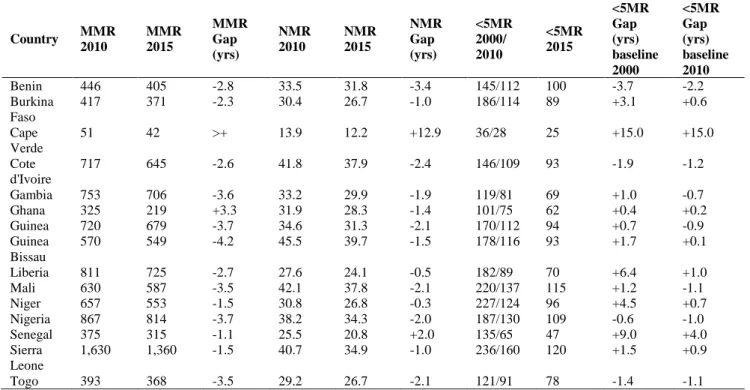
Table 4 presents the regional comparison of maternal mortality ratios (MMR) and gaps/failures in ECOWAS countries to achieve in 2030 the SDG target of 70 maternal deaths due to complications of pregnancy, delivery and postpartum per 100,000 live-births. Out of 15 countries in the ECOWAS region Cape Verde already has achieved the SDG target for 2030. Assuming linear trends, only Ghana is on track in the reduction of maternal mortality, while all others will likely succeed in their efforts with a maximum delay of four years except for Guinea
Bissau with more than 4 years being late in achieving the global target.
Looking at gaps in the ECOWAS region related to Neonatal Mortality Rates (NMR), again Cape Verde is the only country with achievement of SDG‘s set target already in 2015 whereas Senegal is on track. All other countries in the region are in the position to likely achieve the target of 12 neonatal deaths per 1,000 live-births (occurring within 28 days after birth) with a delay of less than 4 years, given that the available data are sufficiently valid.
African Journal of Reproductive Health December 2018; 22 (4):
129
Table 4: Regional comparison of gaps in ECOWAS countries: Achievability of SDG targets 2030
Source of data: http://www.who.int/reproductivehealth/publications/monitoring/maternal-mortality-2015/en https://data.unicef.org/topic/child-survival/neonatal-mortality
Source of data for baseline value in 2010: http://apps.who.int/gho/data/node.main.525?lang=en
Source of data for baseline value in 2000: https://data.unicef.org/wp-content/uploads/2015/12/IGME-report-2015-child-mortality-final_236.pdf
The only country close to risk of failure – not to achieve this SDG target, is Benin. However, looking at a different baseline value – that one from 2000 – the situation would be even better – most ECOWAS countries would faster achieve progress.
Discussion
Evaluation is the last step in each policy cycle38, while monitoring is starting from the very beginning and continuing throughout the policy implementation. The results of health policy evaluation could bring different outcomes: continuation of the process, implementation, revision of objectives and targets, as well as termination of the policy. The main health policy documents should be developed thinking about the
evaluation of outputs and short-term/long-term impacts, following the logic of SDGs.
The Gap Analysis presented here supports the relative positioning of the ECOWAS member states despite the linear progress assumed between baseline, observed intermediate and target value. Overall this analysis shows that the community of ECOWAS countries has a realistic chance to reach the SDG targets in 2030 about Maternal, Neonatal, and <5MR, straight continuation of progress assumed (except Guinea Bissau with a time lag of 4.2 years for the reduction of maternal mortality). Also compared with the average values for the entire African Region, the ECOWAS group is at the same level except for malaria incidence, the adolescent birth rate (table 2), and satisfied needs
for family planning. However, skilled health professionals‘ density is considerably lower
Country MMR
2010
MMR 2015
MMR Gap (yrs)
NMR 2010
NMR 2015
NMR Gap (yrs)
<5MR 2000/ 2010
<5MR 2015
<5MR Gap (yrs) baseline 2000
<5MR Gap (yrs) baseline 2010
Benin 446 405 -2.8 33.5 31.8 -3.4 145/112 100 -3.7 -2.2 Burkina
Faso
417 371 -2.3 30.4 26.7 -1.0 186/114 89 +3.1 +0.6
Cape Verde
51 42 >+ 13.9 12.2 +12.9 36/28 25 +15.0 +15.0
Cote d'Ivoire
717 645 -2.6 41.8 37.9 -2.4 146/109 93 -1.9 -1.2
Gambia 753 706 -3.6 33.2 29.9 -1.9 119/81 69 +1.0 -0.7 Ghana 325 219 +3.3 31.9 28.3 -1.4 101/75 62 +0.4 +0.2 Guinea 720 679 -3.7 34.6 31.3 -2.1 170/112 94 +0.7 -0.9 Guinea
Bissau
570 549 -4.2 45.5 39.7 -1.5 178/116 93 +1.7 +0.1
Liberia 811 725 -2.7 27.6 24.1 -0.5 182/89 70 +6.4 +1.0 Mali 630 587 -3.5 42.1 37.8 -2.1 220/137 115 +1.2 -1.1 Niger 657 553 -1.5 30.8 26.8 -0.3 227/124 96 +4.5 +0.7 Nigeria 867 814 -3.7 38.2 34.3 -2.0 187/130 109 -0.6 -1.0 Senegal 375 315 -1.1 25.5 20.8 +2.0 135/65 47 +9.0 +4.0 Sierra
Leone
1,630 1,360 -1.5 40.7 34.9 -1.0 236/160 120 +1.5 +0.9
African Journal of Reproductive Health December 2018; 22 (4):
130
23
26 27
29 29 31
33 34 34 34 35
36
41 43
53
0 10 20 30 40 50 60 70 80
Niger Mali Sierra Leone
Guinea Guinea Bissau
Burkina Faso
Liberia Togo Nigeria Benin Cote d'Ivoire
Gambia Senegal Ghana Cape Verde
Nu
m
be
r
Source:
GDB 2015 SDGs Collaborators. Measuring the health related Sustainable Development Goals in 188 countries: a baseline analysis from the Global Burden of Disease Study 2015. The Lancet 2016; 388: 1813-50.
Figure 1: Health related SDG index in ECOWAS member states – 2015 (based on source indicated)
by 50% (table 3: 6.4 per 10,000 population vs. 12.7). This calls into question a quantitative relationship between the number of health workers and people's health.
In addition to SDG-3, for monitoring achievements in health, WHO also selected 6 indicators of relevance for health under additional 5 goals, the indicators39 are:
SDG-6: Ensure availability and sustainable management of water and sanitation for all,
SDG-7: Ensure access to affordable, reliable, sustainable and modern energy for all,
SDG-11: Make cities and human settlements inclusive, safe, resilient and sustainable,
SDG-13: Take urgent action to combat climate change and its impacts,
SDG-16: Promote peaceful and inclusive societies for sustainable development, and: provide access to justice for all and build effective, accountable and inclusive institutions at all levels.
In 2016, SDGs Collaborators listed 10 SDGs, in addition to SDG-3, whose achievement will lead to health improvement, in addition:
SDG-1: End poverty in all its forms everywhere,
SDG-2: End hunger, achieve food security and improved nutrition, and promote sustainable agriculture,
SDG-5: Achieve gender equality and empower all women and girls, and
SDG-8: Promote sustained, inclusive, and sustainable economic growth, full and productive employment, and decent work for all.
Therefore, out of 17 SDGs, 11 are related to health, with 28 targets and 47 indicators (out of 230 proposed)40. To integrate these variant concepts SDG Collaborators have proposed an overall health-related SDG index, predominantly
using the Global Burden of Disease Study performed in 2015, by using similar
African Journal of Reproductive Health December 2018; 22 (4):
131
Human Development Index41. The main purpose is to secure tracking general progress at the country level. The index, which represents the function of 33 health related indicators, is calculated for 188 countries and its values go from 85 (the best) to 20 (the worst), Figure 1. It appears that the SDG Index allows for a more plausible ranking of ECOWAS countries. However, the relation between the lowest Niger and the highest Cape Verde is more than 1:2. The main recommendation derived from international documents is that each country localizes/tailors SDGs, targets and indicators towards its national/local environment, however to provide a core or minimal indicator set for the national and international situation analysis and monitoring of progress towards 2030 as proposed by the UN Council in March 203020. The national situation analysis in any case should serve to formulate realistic goals and objectives based on critically evaluated data.
The way of formulation of goals and objectives is essential for the success in implementation and monitoring/evaluation of any health policy. A basic understanding, however, of the key terminology is essential. In this avail a goal is a generalized statement of the result or achievement to which the effort is directed, while formulation of the objectives and targets is more complex and requests formulation of the specific health problem and its determinants (direct causes and risk factors that, based on scientific evidence or theory, are thought directly to influence the level of a specific health problem). Policy makers must make sure that the selected determinants directly affect the health problem, because lack to address appropriate determinants during the intervention may lead to failure in addressing health problems and achieving stated objectives. An objective is the estimate of the level to which a health problem is expected to be reduced within a specified time and must be long-term, realistic, and measurable. The process of building objectives follows SMART principles (Specific, Measurable, Achievable, Realistic, and Timely). During setting objectives, of importance is the process of priority setting at first decisions about which problems one country will or can address
and what the health sector will do to make a difference. Consensus is the core of participatory planning, resulting from a collaborative decision-making process that honors partnership, participation, involvement of appropriate leadership (official and unofficial), and builds a fundament of trust within an atmosphere of flexibility. Both, the SDG framework and the Global Strategy for Women‘s, Children‘s and Adolescents‘ Health (2016-2030)9
put special attention to the formulation of national health policies. For this purpose, UN Country Teams (UNCTs) have developed a Reference Guide to support countries in tailoring SDGs42. In addition, the African Union adopted a Health Strategy, based on SDGs to lead the region from 2016-203043.
Conclusions and Recommendations
Though, some emergency situations cannot be planned, such as the devastating consequences of the Ebola epidemic, governments must take the necessary steps to carefully monitor health services and the health of their populations and eventually advance it with incremental changes as more promising for the final achievements than declare major change without precise planning based on the SMART principles. An important element is the horizontal interlinkage within and between maternal–perinatal and other health-care services to address the diversity of the burden of poor maternal health.
African Journal of Reproductive Health December 2018; 22 (4):
132
Public Health programs and their accreditation must be established in different areas, here especially for midwifery. The same is mandatory for Continued Professional Development (CPD) which should be linked to licensing.
Frustration and therefore fluctuation of health staff is a serious problem too as it determines the quality of work. Therefore, retention schemes should have priority including further extension of payroll positions and opportunity for CPD. Governments have to decide for larger and reliable allocation of financial means to the health sector which might be facilitated by intensified efforts to reach the Abuja target of 15% of the national budget. To guaranty sustainability these resources should come from national governments and not from development partners except through budget support.
Efficient implementation of progress in the health system is in particular need of improvement of other health determinants outside of health sector: 1) extensive improvement of the road system especially in hard to reach areas to accelerate emergency transport, 2) development of electricity network with solar energy installation as a standard, and 3) full coverage of mobile networks to allow for professional counseling in the periphery (including the provision of mobile office phones or VHF equipment to health facilities).
Acknowledgements
The authors are grateful to Richard Gargli and Roosevelt McCaco in Monrovia, Liberia for their help in identifying the relevant publications.
Conflict of Interest
None declared.
References
1. Ahmed SM, Rawal LB, Chowdhury SA, Murray J, Arscott-Mills S, Jack S, Hinton R, Alam PM and Kuruvilla S. Cross-country analysis of strategies for achieving progress towards global goals for women's and children's health. Bull World Health Organ 2016; 94(5): 351-61. DOI: 10.2471/BLT.15.168450.
2. Ramaswamy R, Kallam B, Kopic D, Pujic B and Owen
MD. Global health partnerships: building multi-national collaborations to achieve lasting improvements in maternal and neonatal health. Globalization and Health 2016; 12: 22. DOI 10.1186/s12992-016-0159-7
3. Kuruvilla S, Schweitzer J, Bishai D, Chowdhury S, Caramani D, Frost L, Cortez R, Daelmans B, deFrancisco A, Adam T, Cohen R, Alfonso YA, Franz-Vasdeki J, Saadat S, Pratt BA, Eugster B, Bandali S, Venkatachalam P, Hinton R, Murray J, Arscott-Mills S, Axelson H, Maliqi B, Sarker I, Lakshminarayanan R, Jacobs T, Jacks S, Mason E, Ghaffar A, Mays N, Presern C and Bustreo F, on behalf of the Success Factors for Women‘s and Children‘s Health study groups. Success factors for reducing maternal and child mortality. Bull World Health Organ 2014; 92(7): 533-44B. DOI: 10.2471/BLT.14.138131.
4. Gurusamy PSR and Janagaraj PD. A Success Story: The Burden of Maternal, Neonatal and Childhood Mortality in Rwanda - Critical Appraisal of Interventions and Recommendations for the Future. Afr J Reprod Health 2018; 22(2): 9-16. DOI: 10.29063/ajrh2018/v22i2.1.
5. GBD 2016 SDG Collaborators. Measuring progress and projecting attainment on the basis of past trends of the health-related Sustainable Development Goals in 188 countries: an analysis from the Global Burden of Disease Study 2016. Lancet 2017; 390(10100): 1423-1459. DOI: 10.1016/S0140-6736(17)32336-X.
6. Pega F, Valentine NB, Rasanathan K, Hosseinpoor AR, Torgersen TP, Ramanathan V, Posayanonda T, Röbbel N, Kalboussi Y, Rehkopf DH, Dora C, Villar Montesinos ER and Neira MP. The need to monitor actions on the social determinants of health. Bull World Health Organ 2017; 95: 784–787. DOI: http://dx.doi.org/10.2471/BLT.16.184622.
7. Campbell J, Buchan J, Cometto G, David B, Dussault G, Fogstad H, Fronteira I, Lozano R, Nyonator F, Pablos-Méndez A, Quain EE, Starrs A and Tangcharoensathien V. Human resources for health and universal health coverage: fostering equity and effective coverage. Bulletin of the World Health Organization 2013; 91(11): 853-63.
8. UN. Transforming our World: The 2030 Agenda for Sustainable Development. Available from: https://sustainabledevelopment.un.org/post2015/tran sformingourworld/publication [accessed 06 October 2018].
9. Global Strategy for Women‘s, Children‘s and
Adolescents‘ Health (2016-2030). Available from: http://www.who.int/life-course/partners/global- strategy/globalstrategyreport2016-2030-lowres.pdf?ua=1 [accessed 06 October 2018]. 10. Countdown to 2030 Collaboration: Boerma T, Requejo J,
African Journal of Reproductive Health December 2018; 22 (4):
133
Borghi J, Buse K, Aguirre LC, Chopra M, Chou D, Chu Y, Claeson M, Daelmans B, Davis A and 31 others. Tracking progress towards universal coverage for reproductive, maternal, newborn, and child health. Lancet. 2018; 391(10129): 1538-1548. DOI: 10.1016/S0140-6736(18)30104-1.
11. Sombie I, Bouwayé A, Mongbo Y, Keita N, Lokossou V, Johnson E, Assogba L and Crespin X. Promoting research to improve maternal, neonatal, infant and adolescent health in West Africa: the role of the West African Health Organisation. Health Research Policy and Systems 2017, 15(Suppl 1): 53. DOI: 10.1186/s12961-017-0209-5.
12. Otive-Igbuzor EJ, Effa TK, Teitsworth E, Kangai R, Hildebrand C, Lara D and Dunning D. Saving the Lives of Women, Newborns, and Children: A Formative Study Examining Opportunities to Improve Reproductive, Maternal, Neonatal, and Child Health Outcomes in Nigeria. Afr J Reprod Health. 2017; 21(3):102-108.
13. ECOWAS. Basic information. Abuja, Nigeria:
Commission of the Economic Community of West African States 2018. http://www.ecowas.int/about-ecowas/basic-information/ [accessed 18 October 2018].
14. ECOWAS Commission. Vision 2020. Abuja, Nigerija:
ECOWAS CEDEAO 2010.
https://drive.google.com/file/d/0B1DAmtM1BcbMd VJFWEhreUwzSms/view [accessed 06 October 2018].
15. Ministry of Health, Republic of Liberia. Investment Plan for Building a Resilient Health System 2015 to 2021. Monrovia, Liberia: Ministry of Health, 2015. 16. Shoman H, Karafillakis E and Rawaf S. The link
between the West African Ebola outbreak and health systems in Guinea, Liberia and Sierra Leone: a systematic review. BMC Globalization and Health 2017; 13:1 DOI: 10.1186/s12992-016-0224 17. Elston JWT, Cartwright C, Ndumbi P and Wright J. The
health impact of the 2014–15 Ebola outbreak. Public Health 2017; 143: 60-70. DOI: https://doi.org/10.1016/j.puhe.2016.10.020. 18. Kruk ME, Gage AD, Arsenault C, Jordan K, Leslie HH,
Roder-DeWan S, Adeyi O, Barker P, Daelmans B, Doubova SV, English M, Elorrio EG, Guanais F, Gureje O, Hirschhorn LR, Jiang L, Kelley E, Lemango ET, Liljestrand J, Malata A, Marchant T, Matsoso MP, Meara JG, Mohanan M, Ndiaye Y, Norheim OF, Reddy KS, Rowe AK, Salomon JA, Thapa G, Twum-Danso NAY and Pate M. High-quality health systems in the Sustainable Development Goals era: time for a revolution. Lancet 2018; DOI: http://dx.doi.org/10.1016/S2214-109X(18)30386-3.
19. Pitt C, Grollman C, Martinez-Alvarez M, Arregoces L and Borghi J. Tracking aid for global health goals: a systematic comparison of four approaches applied
to reproductive, maternal, newborn, and child health. Lancet Glob Health 2018; 6(8): e859-e874. DOI: 10.1016/S2214-109X(18)30276-6
20. UN Economic and Social Council, Statistical
Commission. Report of the Inter-agency and Expert Group on Sustainable Development Goal Indicators: Revised list of global Sustainable Development Goal indicators. Pages; 15-49.
https://unstats.un.org/unsd/statcom/48th-session/documents/2017-2-IAEG-SDGs-E.pdf [accessed 06 October 2018]
21. UN-DESA. Transforming our World: The 2030 Agenda for Sustainable Development. Available from: https://sustainabledevelopment.un.org/post2015/tran sformingourworld/publication [cited 2017 Mar 10] 22. UN Economic and Social Council, Statistical
Commission. Report of the Inter-agency and Expert Group on Sustainable Development Goal Indicators: Revised list of global Sustainable Development Goal indicators. Pages; 15-49. Available from:
https://unstats.un.org/unsd/statcom/48th-session/documents/2017-2-IAEG-SDGs-E.pdf [cited 2017 Apr 30]
23. UNDP Regional Bureau for Europe and the
Commonwealth of Independent States. National Millennium Development Goals: A framework for action. Annex 2 and Annex 3. New York: UNDP office 2006. Page 107-11.
24. World Population Prospects, the 2015 revision
(WPP2015). New York (NY): United Nations DESA, Population Division.
25. WHO annual life tables for 1985–2015 based on the WPP2015, on the data held in the WHO Mortality Database and on HIV mortality estimates prepared by UNAIDS. WHO Member States with a population of less than 90 000 in 2015 were not included in the analysis.
26. WHO, UNICEF, UNFPA, World Bank Group and the United Nations Population Division. Trends in maternal mortality: 1990 to 2015. Estimates by WHO, UNICEF, UNFPA, World Bank Group and the United Nations Population Division. Geneva: World Health Organization; 2015 (http://www.who.int/reproductivehealth/publication s/monitoring/maternal-mortality-2015/en/, accessed 23 April 2017).
27. Levels & Trends in Child Mortality. Report 2015. Estimates Developed by the UN Inter-agency Group for Child Mortality Estimation. New York (NY), Geneva and Washington (DC): United Nations Children‘s Fund, World Health Organization, World Bank and United Nations; 2015 (http://www.unicef.org/publications/files/Child_Mo rtality_Report_2015_Web_9_Sept_15.pdf, accessed 23 April 2017).
African Journal of Reproductive Health December 2018; 22 (4):
134
(http://www.who.int/malaria/publications/world-malariareport-2015/report/en/, accessed 23 April 2017).
29. Global status report on road safety 2015. Geneva: World Health Organization; 2015 (http://www.who.int/violence_injury_prevention/roa d_safety_status/2015/en/, accessed 23 April 2017). 30. World Fertility Data 2015. New York (NY): United
Nations, Department of Economic and Social Affairs, Population Division; 2015. http://www.un.org/en/development/desa/population/ publications/dataset/fertility/wfd2015.shtml, accessed 23 April 2017). Regional aggregates are the average of two five-year periods, 2010–2015 and 2015–2020, taken from: World Population Prospects: The 2015 Revision. DVD Edition. New York (NY): United Nations, Department of Economic and Social Affairs, Population Division; 2015
(http://esa.un.org/unpd/wpp/Download/Standard/Fer tility/, accessed 23 April 2017).
31. WHO. International Health Regulations (2005)
Monitoring Framework. Available from: http://www.who.int/gho/ihr/en/ [cited 2017 Apr 30] 32. Skilled health professionals refer to the latest available
values (2005–2013) in the WHO Global Health Workforce Statistics database.
33. WHO global database on maternal health indicators, 2016 update [online database]. Geneva: World Health Organization.
34. WHO/UNICEF coverage estimates 2014 revision. July
2015. See:
http://www.who.int/immunization/monitoring_surve illance/routine/coverage/en/index4.html)
35. Global Health Observatory [website]. Geneva: World Health Organization. See: http://www.who.int/gho/en/, and the Preventive Chemotherapy and Transmission Control (PCT) databank. Geneva: World Health Organization. http://www.who.int/neglected_diseases/preventive_ chemotherapy/databank/en/.
36. World Contraceptive Use 2016. New York (NY): United
Nations, Department of Economic and Social Affairs, Population Division; 2016. Forthcoming. Regional aggregates are estimates for the year 2015, taken from model-based estimates and projections of family planning indicators 2015. New York (NY): United Nations, Department of Economic and Social Affairs, Population Division; 2015. See: http://www.un.org/en/development/desa/population/ theme/family-planning/cp_model.shtml
37. International Health Regulations Monitoring Framework [online database]. Geneva: WHO. See: http://www.who.int/gho/ihr/en/
38. Anderson G and Hussey PS. Influencing government policy: a framework. In: Guest C, Riccardi W, Kawachi I, Lang I. 3rd edition. Oxford Handbook of Public Health Practice. Oxford-New York: Oxford University Press 2013.
39. WHO. World Health Statistics 2016: Monitoring Health for the SDGs. Geneva WHO Press, 2016. Available from:
http://who.int/gho/publications/world_health_statisti cs/2016/en/ [cited 2017 Apr 30]
40. GDB 2015 SDGs Collaborators. Measuring the health- related Sustainable Development Goals in 188 countries: a baseline analysis from the Global Burden of Disease Study 2015. The Lancet 2016; 388: 1813-50.
41. WHO. Health Workforce. Available from:
http://www.who.int/hrh/workforce_mdgs/en/ [cited 2017 Apr 30]
42. UN Development Group. Mainstreaming the 2030 Agenda for Sustainable Development. Reference Guide to UN Country Teams. 3rd revision. New
York: United Nations Development Group 2017. Page 16. Available from: https://undg.org/wp- content/uploads/2017/03/UNDG-Mainstreaming-the-2030-Agenda-Reference-Guide-2017.pdf [cited 2017 Apr 30]
43. African Union. Africa Health Strategy 2016 – 2030.
Available from: