Modeling a Multi-Agent System
for Retrieving Information
from Distributed Sources
Sophie-Julie Pelletier , Samuel Pierre and Hai Hoc Hoang
Softimage, Montr´eal, CanadaDepartment of Computer Engineering, ´Ecole Polytechnique de Montr´eal, Canada
This paper presents a multi-agent system called ISAME and designed for intelligent information retrieval from heterogeneous distributed sources. ISAME constitutes a virtual library that supplies a set of software agents with a simplified access to a set of dynamic information sources available under electronic formats, as well as services for facilitating and optimizing information retrieval. The system also uses TCP/IP communication protocols, and proposes a series of garbage-collection mechanisms to avoid the preservation and propagation of information among agents, or messages that become inaccessible or outdated as well as the use of the resources that become undesirable. The originality of this system rests on the fact that it simplifies the information retrieval from distributed heterogeneous sources by making these sources transparent to the user.
Keywords: information retrieval, distributed sources, heterogeneous networks, multi-agent architecture, vir-tual library.
1. Introduction
Access to information is efficient when one knows where to find the information he or she is looking for. However, this task becomes com-plex when the information source is unknown. The complexity considerably increases when one does not know the type of information use-ful for his or her purpose and has only limited knowledge of the information sources put at his or her disposal without mentioning the fact that the arrangement and use of these sources can considerably vary from one to another. Thus, it becomes necessary either to ease the task of in-formation retrieval, or to provide the users with some automation mechanisms.
In the elaboration of search engines, two main goals are generally pursued. The first goal is the provision to users of a vast array of infor-mation sources. The second goal is to supply these users with services usually provided by a competent librarian. The usefulness of such tools lies in their capacity to adequately meet each user’s particular needs.
Over the years, information retrieval processes have witnessed considerable changes. Informa-tion sources are diversified and indexed on nu-merical supports; most often, their contents are only accessible in numerical formats. Now, it is possible to access large information sources, either on CD-ROMS(dictionaries, abstracts of
journal papers, proceedings of conferences, en-cyclopedia,:::)or on institutional networks(
da-ta from enterprises, university libraries)or
thro-ugh the Internet(web sites, ftp sites,:::).
More-over, distinction among electronic storage for-mats and different types of information media displays have practically disappeared. Thus, thanks to multimedia application software, texts, photographs, and videos can be displayed on desktop. In effect, one can speak of democrati-zation of information.
What are the most relevant sources of infor-mation at the beginning of the research?
How to express the research theme for a par-ticular information source? How to refine research?
What are the dependability and quality of the information accessed from a given source?
If two sources give contradictory informa-tion, how to identify the most credible source?
At what pace does the information content change?
These questions reveal an increased transfer of technical burdens from information profes-sional to users. Therefore, in order to facili-tate and render information retrieval more ef-ficiently, it is imperative to equip users with new tools. Given the fact that a large num-ber of information sources are now available on electronic supports, computers are increas-ingly used for information retrieval. Further, the information found is usually handled in a computerized environment. Consequently, it is necessary for the tools that are available on the users’ desk to be integrated to both the user’s work environment and numerical sources of in-formation. To be efficient, such tools must be able to assess the context of an information re-quest. The questions to be answered are the following: Who is the user? For what purpose is the research being undertaken? What are the relevance and quality of the retrieved informa-tion10],11]?
This paper proposes a multi-agent architecture for information retrieval from distributed hete-rogeneous sources. This architecture leads to a client/server system using TCP/IP as
com-munication protocol,Windows 95 as operating system, and Java as programming language. Section 2 characterizes the main challenges re-lated to the issue and analyses some relevant works related to the problem treated. Section 3 describes the proposed multi-agent architec-ture for information retrieval, while Section 4 presents the implementation details of this ar-chitecture. Section 5 analyses implementation results.
2. Challenges and Related Work
The creation of either a tool or an intelligent in-formation retrieval assistant brings about huge problems related to the notion of intelligence and the associated concept of the assistant. Hu-mans succeed in accomplishing many tasks, solely with the help of their cognitive system. It appears that there are no known artificial in-telligence techniques that synthesize this cogni-tive system. Moreover, there is no universal or optimal research tool for all these information sources. In this section, in order to approach the problems of communications among agents, we elaborate some specifications of an information retrieval assistant and state the basic principles on which the multi-agent environment lies.
2.1. Description of a Research Assistant
Based on heuristic analysis of tasks traditionally achieved by human research assistants such as librarians, a list of characteristics usually met by an “ideal” research tool was established5],
14]. In effect, a librarian or a research assistant
specialized in information retrieval has, among other qualifications, the following aptitudes:
Knowledge of information sources: A human agent knows about the information sources to which he or she has access, information format, and update frequencies. She or he ceaselessly explores the new possibilities offered by these sources.
Knowledge of the client: A human research as-sistant also knows his or her client’s(or user’s)
profile, i.e. the preferences and needs of the latter. This profile is updated according to the interactions between the research assistant and the information client.
Adequate presentation of results: A research assistant knows how to present results of the research according to practical format for the client(selection of the most relevant documents
only, bibliographical index only, abstracts only, and order of relevance). This format can vary
depending of the request context. The quan-tity of presented results is also being adjusted according to this context.
client define the information request through successive refinement mechanisms. Explana-tion of research process: A research assistant is capable of providing the client with the ex-planations needed to complete the process of information retrieval. In doing so, the research assistant trains his or her client to be more effi-cient in retrieving information, and thus avoids making the client totally dependent on the as-sistance services.
Autonomy and pro-activity: The research as-sistant is on the look out for new information deemed interesting for the client. The research assistant accumulates this information, and ti-mely presents it to the client.
Within the framework of computerized imple-mentation, the execution of each of the iden-tified assistant aptitudes constitutes a complex problem. Given the rapid changes in the realm of automated information retrieval, it is ineffi-cient to integrate all these tools into a unique computer entity. Since integrated tools are in-creasingly complex to model and maintain, it is necessary to devise a modular approach to this problem.
Diversity and heterogeneity of information sour-ces, as well as of associated research techniques, constitute only one aspect of the knowledge nec-essary for an intelligent assistant. Other, totally distinct tasks, but complementary to the search-ing of information resources, also require spe-cific implementation techniques. Thus, estab-lishing a user’s profile requires precise and dis-tinct knowledge of exploring information sour-ces. Similarly, filtering research results which adequately fulfill users’ needs, is a different task from providing an explanation of the pro-cess used for retrieving information. This brief analysis leads to the following assessment: the intelligence of a given assistant cannot be de-signed in a monolithic fashion2],12].
2.2. Basic Principles of the Multi-Agent Architecture
A more modular architecture that allows for the distribution of the assistant’s intelligence seems more appropriate to the context described pre-viously. Such a modular architecture requires that each module — part of the assistant — intelligently achieves the task to which it has
been dedicated8],19]. In order to orient these
modules’ individual activities towards the ex-pected global behavior, the system requires that they are equipped with collaboration and com-munications mechanisms18]. This is a matter
of defining a multi-agent architecture allowing for the creation of an assistant according to the following criteria:
independence of the intelligent assistant in relation to the modes of implementation of used information sources;
independence of the assistant in relation to users who want to call upon these informa-tion sources and in relainforma-tion to the types of request related to these sources;
independence of the same assistant towards the availability of known sources.
The whole idea is to allow for the integration of tools already available, as well as to add others as they become available. For the as-sistant to play his or her role, the following items should be considered: the user’s profile, intelligent techniques for selecting information sources and the ability to explain the reasoning used to accomplish the research. It should be noted that the user is defined as either a human or a software entity. For the sake of simpli-city, hereafter, we use the use the pronoun “it” instead of “she” or “he”.
The proposed architecture is called ISAME; it is largely inspired by architectural notions defined by Lander and Lesser13]and UMDL project
group 5]. ISAME uses the KQML language
developed by Finin et al. 6]. Agents can be
seen as black boxes. They incorporate know-ledge, languages and mechanisms used in the exchange with agents external to the ISAME architecture.
2.3. Communication Among Agents
In order to collaborate, heterogeneous agents must access the techniques through which they can efficiently communicate7]. For such
in interactions. It enables agents to base their messages on common syntax and semantic. Even though communication in multi-agent sys-tems could be carried out in a procedural fash-ion, that is through an exchange of autonomous executables, the majority of research in inter-agents communication is done on the commu-nication using declarative messages. In such a case, the agent emits messages whose syntax and semantics are precise and often based on two components: a label indicating the type of message and the content, that is, the message itself.
Communication languages used by autonomous agents are called inter-agents communication languages. At the world stage, the KQML
(Knowledge Query and Manipulation
Langu-age) 4], 6], 15] is among the languages that
are undergoing development. KQML is be-ing increasbe-ingly adopted as a standard, and has been already used throughout the world in a dozen of multi-agent projects, including the two large-scale ones: ARCHON in England9]and
UMDL in the United States5].
KQML allows for the exchange of messages because its syntax, semantic and message en-velope are standardized. But, KQML does not impose restrictions on the way of expressing the content of information conveyed by the mes-sage. One of KQML’s disadvantages lies in the fact that it is not sufficiently appropriated for the expression of complex messages such as request for databases and mathematical ex-pressions to be evaluated by the message re-ceiver. The KQML research team has proposed a more appropriate language in order to express the value of the parametercontentof a message, the KIF (Knowledge Interchange Format)
lan-guage7]. KIF is based on the syntax similar to
LISP language.
Whatever syntax is chosen, the words used to express knowledge(message content) and the
values must be derived from a vocabulary com-mon to the agents called “ontology”. Such ontology provides the agents with a frame of reference allowing them to share and interpret information. A type of ontology can be devel-oped for each of the knowledge realms within a group of agents involved in generic informa-tion retrieval, stock markets, search for whether forecast, electronic commerce, etc. In short, two agents exchanging KQML messages, must
both know the language and ontology allowing for the expression of the values related to the parameter content of exchanged performative statements.
3. Multi-Agent Information Research Architecture
In this paper, the proposed architecture aims to establish a support environment for colla-boration and coordination among autonomous specialized agents. Such an environment is called ISAME. It must be persistent in a way that agents can, if needed, display service re-quests or results, or services that have already been provided. Persistence refers to the fact that ISAME must be in service on a continuous ba-sis, that is, without interruption and for an inde-finite period of time. In the case where ISAME is put in waiting for a given period of time, its state must be saved, then restored when it be-comes active. In this way, ISAME’s long-term and short-term memories(agents, messages in
transit, etc.) could be preserved. The set of
tasks assigned to the assistant does not fall on a single software entity. Rather, these tasks fall under the responsibility of a team of specialized agents, a set of software entities.
3.1. Basic Principles and Constraints of the Architecture
The ISAME architecture is based on the follow-ing five basic principles:
an open architecture with minimum con-straints to the agents;
four integrated classes of agents; a taken-for-granted class of agents;
communications through KQML type of de-clarative messages and a language express-ing information content and ontology that is specific to ISAME, the ISAME-L and a
and for the purpose of providing the designers of agents with maximum latitude in the ISAME environment, the architecture imposes on the agents the following minimum set of require-ments:
understanding of KQML and ISAME-L lan-guages as well as of the Agent and/or Virtual
library ontology;
publication of KQML types of performative statements;
publication of the physical (IP) address at
which the agent can be reached;
reading and writing of messages according to mailbox mechanisms defined by ISAME in an autonomous fashion (i.e., without a
request from ISAME).
If an agent respects these constraints, then it can be registered on ISAME, and thus it can enter communications with other agents. However, it
is not guaranteed that an agent will find other agents to communicate with! Actually, because ISAME is only a site that facilitates the meet-ing among agents, it has no control over those agents that are registered on the environment. Thus, it is possible that no research agent is registered when a user-agent places an informa-tion request. However, if an agent(who is able
to undertake information research)is registered
at ISAME, such an agent would likely be able to respond to the request. In order to increase the chances of response to an information re-quest, the user can define his or her request as being persistent. This request will remain valid until the user withdraws it. The results are then supplied to the user according to its own response frequency specifications: every day, several times a day, when a result is found, when a new source of information responds to the request, etc.
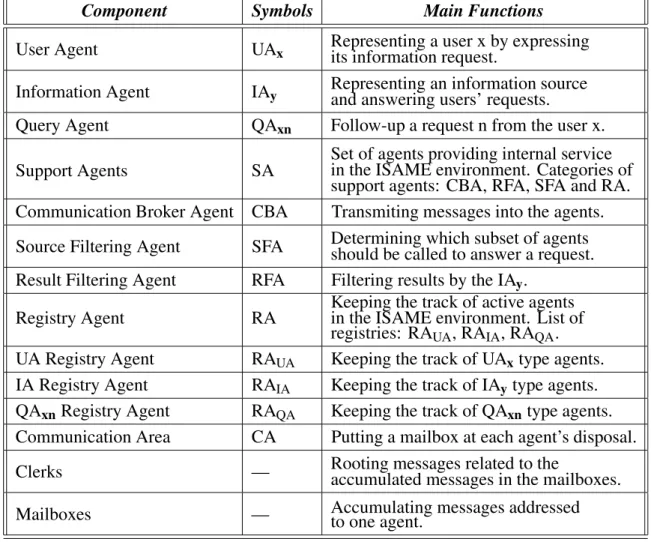
Component Symbols Main Functions
User Agent UAx Representing a user x by expressingits information request.
Information Agent IAy Representing an information sourceand answering users’ requests.
Query Agent QAxn Follow-up a request n from the user x.
Support Agents SA Set of agents providing internal servicein the ISAME environment. Categories of support agents: CBA, RFA, SFA and RA. Communication Broker Agent CBA Transmiting messages into the agents.
Source Filtering Agent SFA Determining which subset of agentsshould be called to answer a request.
Result Filtering Agent RFA Filtering results by the IAy.
Registry Agent RA Keeping the track of active agentsin the ISAME environment. List of registries: RAUA, RAIA, RAQA.
UA Registry Agent RAUA Keeping the track of UAxtype agents.
IA Registry Agent RAIA Keeping the track of IAytype agents.
QAxn Registry Agent RAQA Keeping the track of QAxntype agents.
Communication Area CA Putting a mailbox at each agent’s disposal.
Clerks — Rooting messages related to theaccumulated messages in the mailboxes.
Mailboxes — Accumulating messages addressedto one agent.
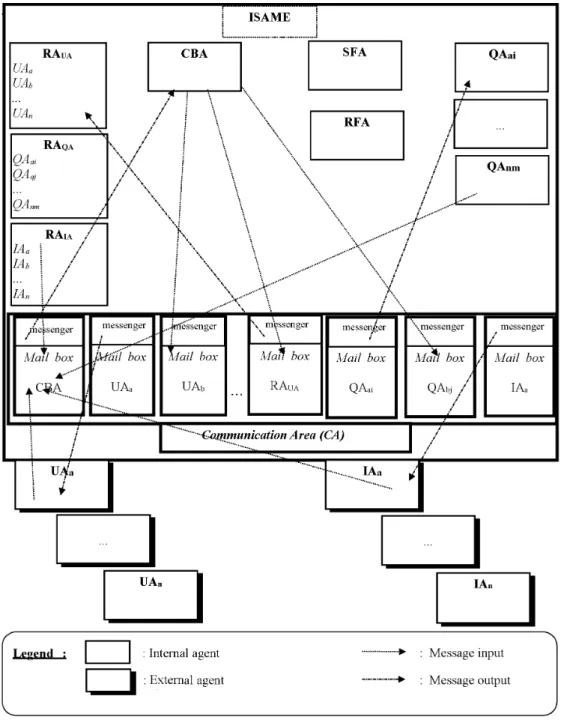
Fig. 1.ISAME Architecture.
3.2. Typologies of ISAME-Supported Agents
As illustrated in Figure 1, ISAME supports four categories of agents: User Agents, Information Agents, Request Agents and Support Agents. The types of services supplied by these cate-gories make each of them different from the other. Table 1 synthesizes ISAME’s main ele-ments, their respective symbols and main func-tions.
3.2.1. User Agents (UA)
The know-how of agents of UA type is referred to by the symbol UAx, where x identifies the
user to whom the agent is being associated. The role of these agents consists of presenting the request in a multi-agent environment, which in turn calls upon a communication channel be-tween the user and the ISAME environment. There exists one UAxwhen a user is registered
A UAx allows for the independence of the
re-search assistant towards the user interface, be-cause it serves as an intermediary between the two. Moreover, since all UAx are agents
reg-istered at the ISAME environment, but created outside this environment, it is possible for these agents to integrate the level of sophistication re-quired by the pre-processing of information as desired within the context of use of informa-tion. Finally, the UAx themselves carry out the
presentation of results and support the users in handling the results.
3.2.2. Information Agents (IA)
In our model, the IAs are referred to by symbol IAy, where y identifies the information source
presented by the agent. All IAs establish a link between the information sources and the ISAME environment. In order to receive re-quests, each information source must register its IAyat the ISAME environment.
Like the UAx, the IAy are registered at, but
created outside the ISAME. They supply the required homogeneous interface and heteroge-neous sources of information. Indeed, the IAy
have the required knowledge on the request tools to be used on presented information sour-ces. Information sources become known to ISAME through the registration of their IAy.
For their part, the IAysecure the independence
of ISAME towards the heterogeneity of sources, as well as towards their availability.
3.2.3. Query Agents (QA)
In our model, QA are ISAME’s internal agents which look over the interests of users. They are referred to with the symbol QAxn where x
represents the user agent which formulated the request and n the specific number of this request. QAxn are created from either punctual or
per-sistent requests coming from users. A request is punctual if it has been processed only once. Such a request disappears from the environment once results have been presented to the user. A persistent request is the one that remains in the environment until a user withdraws it. Such a request is regularly processed once a day, when a new information agent becomes available. In this context, the user is informed of any new result found.
QAxn carry out the requests and hand-over the
results to UAx. QAxn communicate with the
Source Filtering Agent(SFA)in order to
deter-mine the set of IAy to which requests must be
forwarded. In short, the QAxnforward requests
to the IAy, accumulate results, and
communi-cate with the RFA in order to filter and format the results; then, they hand over the result to the requesting UAx.
3.2.4. Support Agents (SA)
The SAs facilitate coordination and communi-cation among the three categories of agents. The following are SA examples: Communication Broker Agent orCBA, Registry Agents orRA, Source Filtering Agent orSFA, Result Filtering Agent orRFA.
Communication Broker Agent (CBA)
This agent ensures the routing of messages among active agents in the ISAME environ-ment. Every message is sent to the CBA which in turn forwards it to the appropriate address(es).
Thanks to the CBA, agents interacting in the ISAME environment do not have to know each other, because the CBA identifies potentially in-terested addressees in the sent message. How-ever, an agent can always explicitly mention the message addressee. In such a case, the CBA sends the message only to the designated ad-dressee. The main purpose of the CBA is to avoid that all agents have to register with each other as well as to retain the information on other available agents.
Registry Agents (RA)
Creation of these agents is inspired by UMDL architecture5]. In the ISAME environment, the
function of a RA is to keep the track of active agents. There is one RA for each of the follow-ing categories : UAx, IAyand QAxn. These are
of UAx, QAxn and Iay. This information
in-cludes the agent’s profile, messages that were sent to or by an agent, or messages that are being processed by other agents.
Source Filtering Agent (SFA)
From a user’s profile and statistics on IAyknown
in ISAME, the SFA suggests a sub-set of IAy
for a given request.
Result Filtering Agent (RFA)
From the result picked up by a QAxn and the
user’s profile supplied by the UAx, the RFA
undertakes the first filtering of results before results are sent to the UAx. Two of these
classes of agents, the UAx and IAy, are of
ex-ternal type. They are agents defined outside the ISAME environment, but reside on the clients’ machines and have the communication interface required for the interactions with other ISAME-registered agents. QAxnand SA are also called
agents of internal type, because they are created within ISAME and hosted in the ISAME envi-ronment’s server. QAxn and SA remain on the
server until they are considered useless.
3.3. Autonomy of Agents
Agents work in parallel and in an autonomous fashion. Each of them intervenes when it is needed according to its appropriate characteris-tics, the properties it had given itself and those known in the environment. This work consists of two main tasks: sending out mails and an-swering the incoming ones, as well as putting know-how for the benefit of maintenance ser-vices.
3.3.1. Mail Management
Each agent has the task of scrutinizing and an-swering the mail that comes in its mailbox. In effect, each agent is provided with a mailbox in the ISAME’s communication area (CA). A
mailbox is a data structure located on the envi-ronment’s server where the CBA is found. The CBA deposes all the messages that should be delivered to agents. ISAME puts an office clerk or messenger at the disposal of each agent. The messenger directly and regularly delivers mail to the agent when the latter is awake, that is, capable of carrying out required activities. The
office clerk works continuously and in an au-tonomous fashion. It resolves the agent’s ad-dress to which it is attached, by calling upon a TCP/IP type of connection or another
connec-tion, if it is deemed necessary.
Different scenarios are possible if the agent is not active, that is, when it is dormant and there-fore cannot receive the messages sent by the office clerk. These scenarios mainly depend on the type of agent. If an IAyis not responding to a
request for an information sent to it, the request will be destroyed. However, if it is a matter of answering a request for an information which is addressed to a UAx, the message will be
pre-served and some other time the messenger will try to contact the UAx. The agent controls the
frequency of sent messages, as well as the prior-ities according to which these messages will be sorted out. It notifies its preferences to one of the registries assigned to the following classes of agents: UA, IA or QA. It also informs the messenger who has the mechanisms ensuring the independence of the architecture towards the availability of agents, and prevent the agent from uselessly monitoring its mailbox(es).
When an agent desires to send a message to an-other agent, it directly sends it to the CBA that delivers it to the appropriate agent(s)’s
mail-box(es). In order to standardize
communica-tion with the CBA, every message sent to it must go through the unique address published in the ISAME environment. Such a standard is also applicable to the agents found on the server or on the CBA.
Currently, the unique address published in the ISAME environment consists of an address of TCP/IP type. All the agents registered at the
ISAME environment must know the TCP/IP
communications protocol. The CBA is as a unique point of entry for external and internal agents. For this purpose, the CBA’s TCP/IP
address must at all times remain public.
3.3.2. Collaboration and Achievement of Maintenance Tasks
Each of the ISAME’s agents must autonomously make its knowledge available for the benefit of other agents by responding to their requests. It must also achieve maintenance tasks required by the community of agents. Thus, the UAx
must be registered in the environment. The IAymust also be registered in the environment,
and continuously update their knowledge on each source of information they represent. The QAxnmust ensure that conditions for ending the
search for information are not reached(all IAy
have supplied their results or the delay allocated for the request is reached). However, if the
re-quests are persistent, a new request must be launched at a certain interval. Registries must be sure that the agents registered with them re-main accessible. They must also eliminate those agents which are no longer registered with them. Success of the environment depends on the exe-cution of these two categories of tasks by all agents. The exchange of mails allows agents to collaborate and enables one or several users to simultaneously process several tasks.
3.4. Communications Space (CA)
Activities realized in the ISAME environment are all directed through the exchange of mails among agents. No central control is exercised.
Rather, agents exchange services and informa-tion according to their needs and good will. In order to support the agents in this exchange of messages, the environment puts at disposal of each agent one mailbox through which each receives messages. A dedicated messenger is linked to each agent and directly delivers mes-sages to the agent’s communication manager. One or several entities (objects or others) are
dedicated to the activities of receiving or send-ing messages on the agent’s residence machine. This delivery system allows for better time man-agement to each agent, because agents do not have to constantly monitor their mailbox in or-der to verify arrival of messages. Moreover, the clerk carries out some complementary tasks in order to prevent the agent from processing outdated messages.
As illustrated in Figure 2, all messages are distributed among the addressees’ mailboxes through the CBA. If the addressees are explic-itly indicated, the message will be delivered to corresponding mailboxes. There is, however, an exception to this rule: if an agent is no longer part of the environment and, consequently, its mailbox has been destroyed, the CBA sends back a message of “sorry” type to the sender to notify that the message could not be delivered. If the addressee is not explicitly mentioned, the CBA determines the list of the agents who could be interested in the message. In fact, the use of performative statement lists that are known by each agent does the work of determination. Regarding the maintenance agents, this list is
known by the CBA or available with RA agents for the benefit of UAx, IAy and QAxn agents.
In all cases, agents must communicate with the CBA in order to interact with each other. In the ISAME environment, the CBA’s address is the only necessary public address. The agents which desire to register in the environment, send messages to other agents, or decline to use their addresses.
For these exchanges of messages to be carried without problems, a control mechanism must be put in place to ensure the synchronization of activities in the mailboxes. The messenger un-dertakes this task of synchronization, because it is the only participant that has direct access to
the mailboxes. The CBA records the messages in the mailboxes through the messenger which withdraws them from the mailbox, and deliv-ers them to the agent. In its cleaning function, the messenger is also responsible for deleting messages. The synchronization is undertaken through semaphore signals used by the messen-ger.
Finally, since ISAME is a distributed environ-ment, it is the role of the entities that handle messages for the agents to solve the problems inherent to messages distribution. Thus, it is necessary to use a communication protocol of TCP/IP type. Both, the messenger-supported
protocols and the protocol chosen by the agent’s
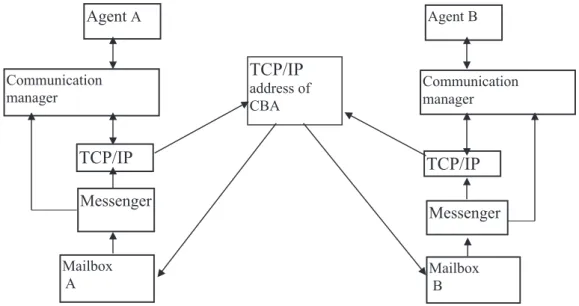
Fig. 3. Message exchange through an inter-process communication between two agents.
communication manager, determine the com-munication protocol used by the agents.
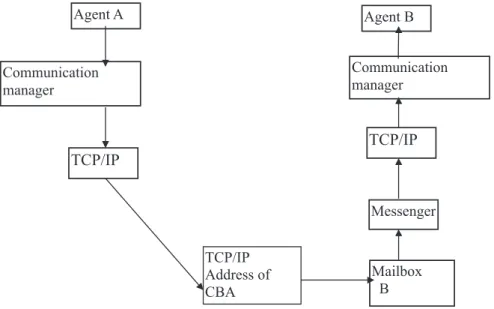
Figure 3 illustrates an inter-process exchange of messages between two agents, A and B, avail-able on the ISAME environment’s server. The TCP/IP protocols are used independently from
both the communications manager’s physical location and the clerk. This is because the ex-change of messages among objects is possible only if the agent and, therefore, its commu-nication manager are in the ISAME environ-ment’s server, a place where the messenger is also found(Figure 4).
3.5. Communication among Agents in ISAME
Communication among agents is established through the exchange of messages transiting via the CBA and the communication space, be-fore reaching an addressee. Messages’ syntax and semantics are based on performative state-ments which follow the standards established by KQML. The language used for the content parameter is ISAME-L. Two form of ontology are also being defined: the Agent ontology for the share of information relative to the Agents
and the VirtualLibraryontology that expresses the request for information retrieval.
The process of routing messages via the CBA, the mailboxes and the messenger form a hybrid model for blackboard techniques and communi-cations through messages17],20],21]. This
hybrid model centralizes services and processes common to all agents, but leaves the filtering and processing of data to the agents. The ser-vices and processes consist of filtering and dis-tributing the messages. Among the advantages of the blackboard techniques, ISAME retains a certain level of communication standardization and the centralization of information services. This is for allowing the agents to be independent from each other, and for avoiding the occurrence of bottlenecks.
1. Communication Standardization
Although the CBA does not control the con-tent of information exchanged among agents; it, however, ensures that all messages conform with the KQML language. In effect, if a mes-sage does not conform with the KQML lan-guage syntax, or its addressee cannot be found
in the environment, the CBA deletes it. In the case where the CBA is able to identify the mes-sage sender, it sends to him an “error” mesmes-sage explaining why the message could not be cor-rectly routed.
2. Centralized Service of Information Distribution
Before reaching its addressees, every message exchanged within the ISAME environment must transit via the CBA. The advantage of this is that agents do not have to know each of their corre-spondents or their precise addresses. The other advantage is the support of the message destined to a known addressee and the diffusion of mes-sages of public interest. However, the control of messages exchanged among agents is not cen-tralized through the CBA. Furthermore, in order to avoid bottlenecks, the agents are not provided with a public space. Rather, a private data space is put at the disposal of each agent in the mail-box. This space does not include the knowledge incorporated in the agent. It only includes mes-sages destined to an agent. Moreover, the agent does not have to read the messages inscribed in its mailboxes, because these messages are deliv-ered in the agent’s own environment. Thus, the mailboxes serve to free the CBA from sending messages to the addressees. At the same time, like in communications through blackboards, these mailboxes allow the agents to exchange messages in an asynchronous fashion, that is, sending messages even though the addressee is not ready to receive them. The mailbox keeps the messages until the agent is ready to receive them.
Centralized reception of messages via the CBA can cause a bottleneck. But, this bottleneck can be easily avoided since several processes of receiving messages can simultaneously be put in place for the benefit of CBA-published ad-dresses. Bottleneck can be avoided by provid-ing the CBA with the capacity of routprovid-ing several messages. Routing of these messages should be parallel, through the use of autonomous thread processes. As a result, it is impossible for an agent to block other agents’ activities.
activities. However, communication through messages has the disadvantage of increasing the traffic on telecommunication networks, even though this type of communication allows the agents greater freedom.
Among the biggest risks inherent to this type of architecture is the fact that several elements of this environment may be inaccessible, out-dated, or remain unused. This entails a waste of resources that otherwise could be better used. Therefore, it is necessary to establish cleaning mechanisms to verify that all agents continue to exist, free unused mailboxes, eliminate outdated mails in each mailbox, acknowledge that persis-tent requests still have some usefulness for the client, exclude low performance IAy, and so on.
These cleaning activities fall to ISAME’s in-ternal agents, mainly the registries, the CBA and the messenger monitoring the IAy, UAxand
QAxn from the moment of their registration in
the ISAME environment until their voluntary or forced withdrawal from this environment. Inter-nal agents also manage logistics related to the mailboxes, because they (excluding the
com-munications clerk) are persistent and their life
span equals that of the environment. The clerks, for their part, inspite of being temporary(their
life span corresponds to the life span of their agents in the environment), they possess critical
information regarding the work of both the reg-istries and the CBA. This is because, regularly, messengers communicate with their agents ei-ther through TCP/IP or locally. They know
whether or not the agents are available. If an agent was declared inaccessible or outdated, the registry could take different courses of action: excluding the agent from the environment, de-stroying its mailbox and messenger by asking the CBA to order all other agents to ignore any request coming from that particular agent. If this process of denying a request concerns an agent of UAxtype, the registry responsible for
the QAxnwill eliminate all QAxn related to the
excluded UAx. In this continuous cleaning
ope-ration, the messengers have another use: di-rect handling of mailboxes’ messages including deletion of outdated messages(example: an
in-formation request followed by canceling of the request; a request coming from an agent which is no longer registered at ISAME; an expired request).
4. Implementation Details
Architecture presented in the previous section tries to grasp the set of needs relative to an in-telligent information retrieval by autonomous agents. Although it is desirable to put these ele-ments in place in order to provide all agents with an optimal work environment, the core of this system remains the CBA support agents, RAs, communication through messages. This section specifies these elements and presents the soft-ware and hardsoft-ware environments on which pro-gramming and implementation tests have been made.
4.1. Subset of Implemented Concepts
The subset of concepts chosen for implementing and testing the proposed architecture includes services of virtual libraries and handling the content mainly represented by the user and in-formation agents. This subset has been selected in order to allow for a realistic evaluation of the architecture’s flexibility. This means:
1. showing that ISAME constitutes a unique access point of entry for virtual library’s ser-vices and content;
2. evaluating the extent to which user and in-formation agents remain totally independent from each other in their implementation mo-de and availability;
3. showing that implementation of user agents is independent from the complexity and di-versity of services provided by the ISAME environment;
4. demonstrating that information and user agents can be registered as they become available;
5. showing that the use of mailboxes and clerks allows for the improvement of messages de-livery connected to permanent agents; 6. allowing for the first evaluation of the tasks
forms of ontology, agent types, associated mes-sages. Each of these categories will be followed by a description of selected elements.
1. Languages and Forms of Ontology
KQML, ISAME-L, AgentOntology, VirtualLi-braryOntology are totally supported by ISAME’s implementation.
First, we have to mention that we use different terms to present ISAME. Architecture, System, Environment, Platform and Language are all re-lated to ISAME. Environment means that agent can communicate and cooperate with each oth-ers with certain constraints such as knowing KQML and ISAME language. ISAME lan-guage is a subset of KQML containing infor-mation expression and specific agent ontology. It is based on a list of reserved words with ap-propriate parameters. AgentOntology contains a reserved word to determine information on the agents and their appropriate values. This information can be represented as a sequence performative(reserved(value)). For instance,
query(agent ID:content(<sigleton>|<set>))
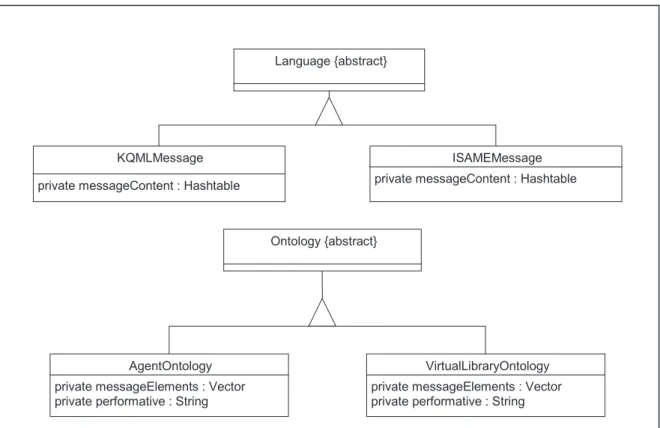
VirtualLibraryOntology is used to express agent communication when queries are sent by UA. This ontology supports three kinds of performa-tive: Error Code, Query and Results. As well as AgentOntology, VirtualLibraryOntolgy con-tains reserved word and associate value related to each performative. The previous represen-tation can be used for VirtualLibraryOntology too, only the set of performatives is different. These languages and ontology are implemented through a hierarchy of classes using the UML formalism 1], 3]. In Figure 5, each of these
classes constitutes an analyzer. The KQMLMes-sage and ISAMEMesKQMLMes-sage language analyzers allow for the validation of message syntax ex-changed among the agents and the message envelop’s semantic. AgentOntology and Vir-tualLibrary analyzers carry out validation of ISAME message contents. Each implanted agent comprises a language and ontology. It filters each message it receives through the ap-propriate language and type of ontology. The message interpretation and control of the activ-ities associated with each received message is carried out by the derived classes of MessageIn-terpreter.
Fig. 6.Hierarchy of agent classes.
2. Agent Types and Associated Messages
The CBA is the ISAME environment’s unique point of entry for all external agents, because the
socketaddress published for entering into com-munication with the environment is the CBA’s message reception address. The RAIA plays the SFA’s role by providing the QAxn agents
with recommendation services on information sources. This recommendation is carried out at the reception of a recommend-alltype of mes-sage. Finally, in order to achieve efficient result-filtering activities, in the absence of the RFA, the QAxn is responsible for a simplified
filter-ing.
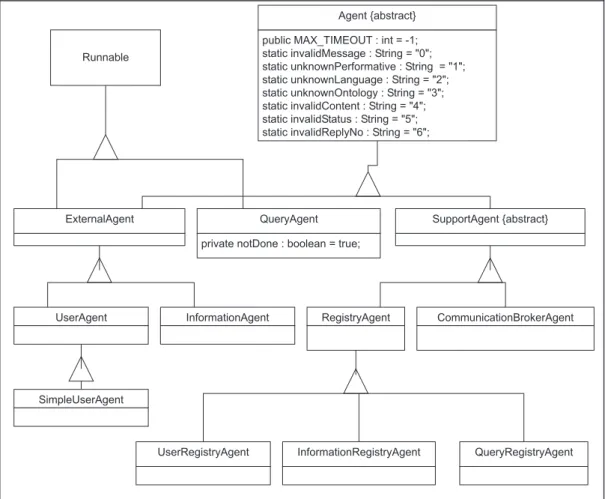
Generic versions of users and information agents are available in the environment. These generic user agents can be derived to create agents that are specific to user needs and information sources. A simplified version of a user agent, theSimpleUserAgenthas been derived from the
UserAgentclass in order to validate registering and withdrawing mechanisms, as well as the
life cycle of QAxnagents. Figure 6 presents the
hierarchy of classes of agents.
The abstract class MessageInterpreter consti-tutes a thread process that carries out interpreta-tion and execuinterpreta-tion of each message received by the agents. For each class of agents, new classes must be derived from theMessageInterpreter. This permits the message handling process to correspond with the context and role of each agent. These interpreters are the know-how re-lated to each agent.
(in this case the message is routed to the
in-terpreter that is waiting for a response), or the
message is independent (in this case a new
in-stance of interpreter will be created to handle the message). The set of interpreters of messages
presented in Figure 7 undertakes the interpreta-tion of messages through associated procedural methods (ex.: interpretTellMessage,
interpret-BorkerOneMessage). To ensure efficient
man-agement, all interpreters that are working for
an agent are associated to it, through an object
MessageInterpreterQueue.
3. Objects and Agents Distribution Among the Server and Client Machines
In the ISAME architecture, the environment’s server regroups the support agents, request agents, mailboxes and messengers. User agents, information and communication managers are
located on a client machine, the machine of the agent designer. Distribution of elements among the server and the client follows a very simple rule: the ISAME environment supplies services to user agents and the information defined by in-stitutions and individuals who want to benefit ei-ther continuously or punctually from ISAME’s services.
Even though the support and request agents im-plemented in the framework of this experiment are all located in the same machine, cation between the messengers and communi-cation managers is entirely based on TCP/IP.
As predicted, all communication managers sent their messages to the CBA through TCP/IP. The
messengers also communicate with the man-agers through TCP/IP.
4. Communications Mechanisms
Two groups of classes are necessary for the implementation of communication mechanisms
among the agents. On the one hand, reception and sending of messages must be placed inside each agent. On the other, the mail system al-lows the CBA to route messages by transiting them via the ISAME environment, before they reach the addressee.
For sending and reception of messages, the
CommunicationCenter class places the neces-sary tools inside each agent. This commu-nication center is made of two objects: a re-ceiverMessageReceivercaptures incoming ex-ternal messages, and a sender MessageSender
sends the messages outside the environment. When a message is received, it is inserted in a queue, that is in FIFO order(First In First Out).
Then, a message manager associated with the agent, that is aMessageHandlerthat withdraws it from the queue, and puts it back for process-ing. When a message from aMessageHandler
comes into the agent’s location, the agent carries
out the necessary verifications and routes it to-wards the appropriate MessageInterpreter. To interpret a message, an agent must insert it in the
MessageSender’s queue of messages ready for sending. For the agents to carry out an efficient management of the messages’ communication ring, theMessageReceiver, MessageSenderand
MessageHandlerconstitute autonomous thread processes that function parallelly. Thus, each agent can simultaneously receive, process and send messages.
In order to meet the needs of all agents, dif-ferent classes have been derived from both the
MessageReceiverandMessageSender. In order to send their message to the CBA for switch-ing, all agents, excepting the CBA, use a mes-sage sender based on the socket, SocketMes-sageSender. For the CBA’s needs, a class of
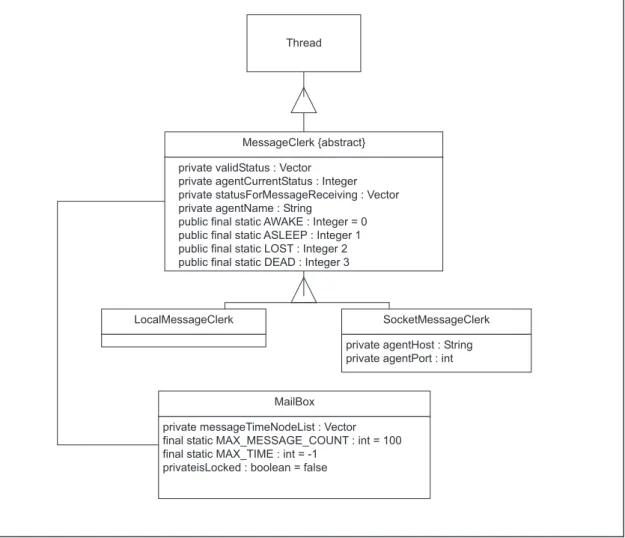
CBAMessageSender has been derived. Simi-larly, all agents use a message receiver based on the sockets, SocketMessageReceiver. The classes used to facilitate the CBA’s work are presented in Figure 8.
4.2. Hardware and Software Environment
The set of classes in the ISAME environment, set of users and interface classes have been re-alized with the help of the following software:
operating systems:
Windows 95/98/NT/2000/XP
programming language: Java
development tools: Borland C++ 5.1,
Sy-mantec Visual Caf´e 1.0, Java Development Kit (JDK) 1.0.1, and Sun Microsystem 1.1
Development Kit, JavaAgent’s object library and also with the J2SE SDK 1.4 version. The ISAME environment and its agents have been developed on PC machines connected to a Microsoft Windows network NT. The core of ISAME (support agents, request agents,
mail-boxes and messengers) is located in ISAME’s
server. The other machine behaves like a client of the ISAME environment and is the location of the agent created to carry out testing. All agents distributed on the server or among the clients communicate via sockets and through TCP/IP links. The number of sockets can vary
from one machine to another.
According to RFC 2391, for most TCP/IP hosts,
port range 0-1023 is used by the servers listen-ing for incomlisten-ing connections. Clients trylisten-ing to initiate a connection typically select a port in the range of 1024-65535. However, this convention is not universal(and not always followed). It is
possible for client nodes to initiate connections using a port number in the range of 0-1023, and there are applications listening on port numbers in the range of 1024-65535 22]. In the case
of ISAME, it attributes addresses from 1024 to 4999 to client processes. These are the Sock-etMessageClerkandSocketMessageSender ob-jects. For server processes, ISAME uses num-bers that are 5000 and more. These are the Sock-etMessageReceiverobjects. The characteristics of the server used for developing and testing the ISAME architecture are the following:
processor: Pentium 4, 1.8 GHz.
RAM: 256 Mb.
Network card: 3Com EtherLinkXL COMBO 10/100Mb Ethernet Adapter.
Physical(IP)address: 206.106.88.156.
Socketaddresses for ISAME only:
CBA, the ISAME environment point of entry: socket 5000.
RAUA, RAQA and RAIA: addresses from sockets 5002 to 5004.
For testing, 10 socket addresses have been reserved to query agents (QA): from
sock-ets 5005 to 5014. This number of addresses can be increased according to the server’s capacity.
The characteristics of the client machine used are:
Processor: Pentium 4, 1.8 GHz.
RAM: 256 Mb.
Network card: NT 3COM NIC ETHERNET 10/100 PCI.
Physical(IP)address: 206.167.88.146.
5. Analysis of the Implementation Results
Objects implemented in ISAME allow for achie-ving a certain number of tasks such as register-ing and withdrawregister-ing user agents and informa-tion, processing requests, and any interaction related to this processing. In this context, the ISAME environment is active on the server ma-chine (CBA, RAUA, RAQA are thus waiting
for messages) and a new user agent desires to
take advantage from information retrieval ser-vices offered by ISAME. For this purpose, the user agent must follow the following steps: 1. registration in the ISAME environment; 2. sending of the user request to the ISAME
environment;
3. eventual withdrawal from the ISAME envi-ronment.
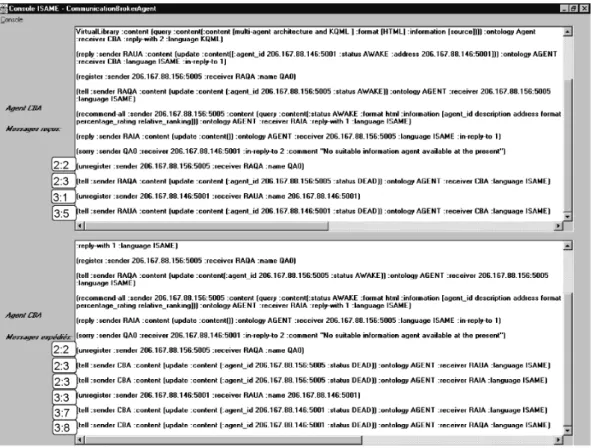
These three steps have been executed in the ISAME environment. Figures from 9 to 15 show content of the messages exchanged among agents.
The evaluation of ISAME is based on the results obtained from the implementation, expected po-tential of unimplemented elements, and com-parison to the UDML project. Until now, there has been no doubt that UDML is the most am-bitious research project in the sector of infor-mation retrieval.
5.1. ISAME as Access Point
The ISAME environment offers a unique access point to the virtual library’s set of services and content. However, although information filter-ing services and research results are part of the ISAME environment support services, the qual-ity and quantqual-ity of information content remain always strongly dependent on the quality and quantity of content supplied by the agents reg-istered at ISAME. This is due to the fact that information sources are external to the ISAME environment, and thus, they are not controlled by the environment as such. This problem is not peculiar to ISAME. Rather, it is inherent to any multi-agent architecture.
Fig. 10.Messages exchanged by the CommunicationBrokerAgent(continued).
Fig. 12.Messages exchanged by the UAx.
Fig. 14.Messages exchanged by RAIA.
To minimize the impact of the problems inher-ent to distributed information retrieval systems, we proceeded by supplying the agents with a range of tools such as languages and tools for homogenizing communication, languages inter-preters, and types of ontology. This is done in order to avoid the ambiguity and the simpli-fied integration of new agents to the environ-ment. The validity of such tools must be tested through the implementation of user and infor-mation agents. These characteristics are not only found on ISAME, but also on most multi-agent architectures dedicated to intelligent re-search. Notably, this is the case of UDML projects and JavaAgent that are based on agent-registering centralized systems and services ex-changed among agents.
Like ISAME, UMDL uses several registry agents that preserve information on different categories of agents: users, information and mediation agents(agents that are responsible for the
plan-ning of requests, calledQuery Planners, and the registries themselves). If in ISAME, UAx and
IAy must explicitly send their message to the ap-propriate registry agent(RAUA or RAIA), the
UMDL environment does not seem to make this distinction explicit. The documentation now available on UMDL does not allow for deter-mining how this distinction is being carried out.
5.2. Independence of User and Information Agents
Results obtained from the implementation of ISAME support the argument for the indepen-dence of agents. In effect, thanks to the work of support agents, request agents, internal commu-nication agents and common forms of ontology, the UA and IA agents remain totally indepen-dent from each other, in their mode of imple-mentation as well as in their availability. A request placed by an UAx at ISAME is
to-tally delegated to a QA agent until the return of results. This request benefits from a set of ser-vices supplied by the environment(UA and IA
agents’ profiles, handling of persistent requests, optimizing choice of information sources, filter-ing and deliverfilter-ing results).
Total isolation of the UAxfrom the selection of
information sources, gathering and filtering of
information results and knowledge, largely sim-plifies the work of designing user agents. From the users’ perspective, however, this isolation may become an unacceptable constraint for the designers who desire to exercise more control over the request. During the processing of a user request, UA and IA agents do not have to think about the complexity and diversity of services supplied by ISAME. This independence comes from the standardization of communication lan-guages and types of ontology. In effect, as far as external agents use valid performative state-ments, and as long as these agents respect the syntax and semantic of known languages and types of ontology in the environment, the qual-ity of interactions among external and internal agents is secured.
It should be noted that dynamism of user and formation agents is not always supported in in-telligent information retrieval projects. A small number of reviewed research projects present an open architecture allowing for the integration of new information sources or services. Several of these projects, although based on a multi-agent approach, consist of closed boxes supplying the user with a fixed request interface. That is an imposed user agent. Moreover, only system de-signers are able to add or withdraw information sources from the environment. Thus, designers totally control the contents supplied to the users.
5.3. Optimization of Communication through Mailboxes
Thanks to mailboxes’ services, in order to se-cure the return of information from solicited agents, ISAME’s external agents do not need to be permanently connected. Similarly, an agent wishing to supply an answer does not depend on the availability of its partner. This useful task is carried out by the messenger system and mailboxes provided by ISAME.
However, if an agent remains inactive in ISAME for a long period of time, the message put in waiting will not be delivered. Such messages will rather be destroyed.
Communications among UMDL agents are ba-sed on the CORBA (Common Object Request
Broker Architecture) standard16]. This
total number of messages exchanged in ISAME, by requiring an appropriate coordination among different participants. However, communica-tion through CORBA leads to other constraints: imposition of one or several ORBs(Object
Re-quest Broker)and registration of agents or their
objects of communications at this ORB. This work can be largely extended in the case where the UMDL server takes care of the entire num-ber of all the constraints.
5.4. Comparison with system JATLite
Under different aspects we could compare our work with JATLite: The main part of the sys-tem is the Communication Broker, which faci-litates communication among all agents. This agent needs help from the Register Agent and maintains communication with each agent mail-boxes. To preserve continuous flow, the clerk will carry the queue in order to prevent outdated messages being processed by an agent. As men-tioned in Table 1 and Figure 1, we could show that ISAME environment is composed of both categories of agents: External agent and Inter-nal Agent. Information Agent andUser Agent
are bothExternal agents. Query Agent, Source Filtering Agent, Result Filtering Agent, Registry AgentareInternal Agent. TheCommunication Area manages the exchange through TCP/IP
Protocol among the mechanism of Messenger and/or Mailboxes. The messenger takes care of
the synchronization. In JATLite the role of the Router Server includes different services such as: Message Queuing, Message Routing, Agent Name Server, Register, Security, List Agents, Disconnect and message reservation. In this paper, this role is being managed by the Com-munication Broker, but this agent delegates re-sponsibilities among other agents or supports the agents. In this context this agent is also a support agent.
6. Conclusion
This paper proposed a multi-agent architec-ture, called ISAME and designed for intelli-gent information retrieval from heterogeneous distributed sources. ISAME constitutes a vir-tual library that supplies the agents with a sim-plified access to a set of dynamic information
sources available under electronic formats, as well as services for facilitating and optimizing information retrieval.
The elaboration of ISAME has several aspects including: analysis of the virtual library con-cept, evaluation of multi-agent systems, as well as possible solution to implementation needs, elaboration of a multi-agent architecture sup-porting the entire needs and services related to virtual libraries and implementation and analy-sis of the implemented architecture.
ISAME proposes a series of support agents that serve as intermediaries among agents who pro-duce and consume information. At the com-munication level, ISAME tries to short-circuit the problems that are inherent to blackboard techniques by implementing a hybrid technique based on the use of mailboxes and messen-gers. The architecture also uses TCP/IP
com-munication protocols, and proposes a series of garbage-collection mechanisms that allow to avoid the preservation and propagation of infor-mation among agents, or messages that become inaccessible or outdated, as well as the use of resources that became undesirable. To the ex-tent that the ISAME architecture is essentially linked to the problem of information retrieval, it contributes to establishing elements that al-low the users, or information source monitors, to participate in the electronic exchange of in-formation through specialized agents. These elements comprise the use of a precise minimal subset of performative statements of KQML and ISAME-L types and two pre-defined forms of ontology, VirtualLibrary and Agent.
Originality or the power of ISAME architec-ture resides in the way it simplifies information retrieval from heterogeneous and distributed in-formation sources by making these resources transparent to the users. Although only a part of the ISAME’s architecture has been imple-mented, it is probable that, due to the work of intelligent agents, the users will not have to worry about the implementation method, local-ization, availability and the interaction language related to each of the sources.
resources are dynamically modified according to each one’s availability.
However, some of ISAME’s current elements must be reconsidered in the future, in order to improve the architecture and various processes. Firstly, in order to avoid any catastrophic loss of information collected by the user, it is necessary to revisit the method used to exclude agents. Moreover, it is also desirable that ISAME not only integrates a more elaborate model for es-tablishing agent profiles, but also preserves, for a certain period of time, the profiles of excluded agents. This is a necessary requirement when an agent is being re-registered in reasonable de-lays. Finally, the implementation of the CBA and registry agents could be reviewed in a man-ner allowing for a distribution of these agents on different servers. In the end, this permits in-terconnection of different ISAME environments that supply agents with more hardware and soft-ware resources.
Acknowledgement
The author would like to thank the anonymous referees for their work and insightful comments on this paper, as well as Mrs Sabine Kebreau for helpful comments and contributions to the re-vised version of this paper. This work has been supported in part by the Telelearning Network Centres of Excellence of Canada.
References
1] BAUER, B., MULLER, J.P., ODELL, J.(2000), “Agent UML: A formalism for specifying multi-agent soft-ware systems,” First International Workshop on Agent Oriented Software Engineering, Limerick Ireland, June, pp. 91–104.
2] BIRMINGHAM, W.P. (1995), “An Agent-Based Ar-chitecture for Digital Libraries,”D-Lib Magazine, July.
3] CASTRO, J., KOLOP, M., MYLOPOULOS, J. (2001), “UML for Agent-Oriented Software Develop-ment: The Tropos,” (UML’ 01 Conference), University of Toronto, October. Available at the following URL address: http://www. cs.toronto.edu/km/tropos/uml01jm.pdf
4] COHEN, P.R., LEVESQUE, H.J. (1995), “Commu-nicative Actions for Artificial Agents,”Proceedings of the First International Conference on Multi-Agent Systems(ICMAS ’95), June, San Francisco, pp. 65–72.
5] Digital Library Project Research Proposal. Avail-able at the following URL address: http:// http2.sils.umic|h.edu/UMDL/HomePage.html
6] FININ, T. ET AL. (1993), “Specification of the KQML Agent-Communication Language,” Available at the following URL address:
http://www.cs.umbc.edu/kqml/mail/kqml
7] GENESERETH, M.R., FIKES, R.E. (1992), Know-ledge Interchange Format Version 3.0 Reference Manual. Report Logic-92-1, Stanford University, Logic Group, USA.
8] GIORGINI, P.(2001), “Multi-Agent Architecture as Organizational Structures,” Submitted to Journal of Autonomous Agents and Multi Agent Sys-tems. Available at the following URL address:
http://www.cs.toronto.edu/ mkolp/org-mas-ijcis.pdf
9] JENNINGS, N.R., CORERA, J.M., LARESGOITI, I. (1995), “Developing Industrial Multi-Agent Sytems,” Proceedings of the First International Conference on Multi-Agent Systems(ICMAS ’95), June, San Francisco, pp. 423–430.
10] KING, J.A. (1995), “Intelligent Retrieval,” AI Ex-pert, 10(1), January, pp. 15–17.
11] KING, J.A.(1995), “Intelligent Agents : Bringing Good Things to Life,” AI Expert, February, pp. 17–19.
12] KNOBLOCK, C.A., ARENS, Y.(1994), “An Architec-ture for Information Retrieval,” AAAI Symposium on Software Agents, March, Stanford University, pp. 49–56.
13] LANDER, S., LESSER, V. (1994), Sharing Meta-Information to Guide Cooperative Search Among Heterogeneous Reusable Agents.Technical Report pp. 94–48, University of Massachusetts, Amherst, USA.
14] LAWRENCE, S., GILLES, C.L., BOLLACKER, K. (1999), “Digital Librairies and Autonomous Cita-tion Indexing,”IEEE Computer, 32(6), pp. 67–71.
15] MAYFIELD, J., LABROU, Y., FININ, T.(1995), “Eval-uation of KQML as an Agent Communication Lan-guage,” Workshop on Agents Theories, Languages and Architectures, IJCAI ’95, August, Montreal, Qu´ebec, pp. 282–291.
16] MOWBRAY, T.J., ZAHAVI, R. (1995), The Essen-tial CORBA: Systems Integration Using Distributed Objects.Object Management Group Publishers.
17] NII, H.P.(1993), “Blackboard Systems at the Archi-tecture Level,”Expert systems With Applications, 7, pp. 43–54.
19] WOOD, M.F., DELOACH, S.A. (2000), “And Overview of the Multiagent Systems Engineering Methodology,”Lecture Notes in Computer Science, AOSE 2000, Volume 1957, Issue, pp. 207–222.
20] WOOLDRIDGE, M.(1992),The Logical Modelling of Computational Multi-Agent Systems.Ph.D. Thesis, Department of Computation, University of Manch-ester, U.K., August.
21] WOOLDRIDGE, M., JENNINGS, N.R.ET AL.(2000), “The Gaia Methodology For Agent-Oriented Analysis And Design,” Journal of Au-tonomous Agents and Multi-Agent Systems, 3(3), pp. 285–312. Available at the following URL address: http://citeseer.nj.nec.com/ wooldridge00gaia.html
22] RFC 2391, (1998),
http://rfc-2391.rfc-index.org/rfc-2391-3.htm
Received:August, 2000
Revised:February, 2003
Accepted:February, 2003
Contact address:
Sophie-Julie Pelletier Softimage Montr´eal, Canada
Samuel Pierre Department of Computer Engineering ´Ecole Polytechnique de Montr´eal C.P. 6079, Succ. Centre-Ville Montr´eal, Qu´e., Canada, H3C 3A7 Phone:(514)340-4711 ext. 4685 Fax:(514)340-3240 e-mail:[email protected]
Hai Hoc Hoang Department of Computer Engineering ´Ecole Polytechnique de Montr´eal C.P. 6079, Succ. Centre-Ville Montr´eal, Qu´e., Canada, H3C 3A7
SOPHIEPELLETIERholds a B.S. degree in computer science from the University of Sherbrooke(Canada)and a Master degree in applied sci-ences from ´Ecole Polytechnique of Montr´eal. As a researcher at CITI
(Centre d’innovation en technologies de l’information), she has devel-oped many generic and specific applications based on the multi-agent systems, and this, in collaboration with various private enterprises. She now is a headmaster in information technology at Microcell Telecom-munications Inc. in Montr´eal.
SAMUELPIERREreceived the B.Eng. degree in civil engineering in 1981 from ´Ecole Polytechnique de Montr´eal, the B.Sc. and M.Sc. degrees, both in mathematics and computer science, in 1984 and 1985, respec-tively, from the UQAM, Montr´eal, the M.Sc. degree in economics in 1987 from the Universit´e de Montr´eal, and the Ph.D. degree in electri-cal engineering in 1991 from ´Ecole Polytechnique de Montr´eal. He is currently a Professor of computer engineering at ´Ecole Polytechnique de Montr´eal where he is Director of the Mobile Computing and Net-working Research Laboratory(LARIM)and Industrial Research Chair NSERC/Ericsson in Next-Generation Mobile Networking Systems. Dr. Pierre is the author of four books, co-author of two books and five book chapters, as well as over 200 other technical publications includ-ing journal and proceedinclud-ings papers. He is a Fellow of the Engineerinclud-ing Institute of Canada. His research interests include wireline and wireless networks, mobile computing, performance evaluation, artificial intelli-gence, and electronic learning(e-learning). He is a senior member of IEEE and a member of ACM. He is an Associate Editor of IEEE Com-munications Letters and IEEE Canadian Review. He also serves on the editorial board of Telematics and Informatics published by Elsevier Science.
HAI HOC HOANG was born in Thai-binh, Vietman. He received the B.Eng. degree in mining engineering from ´Ecole Polytechnique
(Montr´eal)in 1967, the B.S. degree in economics, and the M.S. and Ph.D. degrees in operations research form the University of Montr´eal