Hungarian Association of Agricultural Informatics European Federation for Information Technology in Agriculture, Food and the Environment
Journal of Agricultural Informatics. Vol. 8, No. 3 journal.magisz.org
An overview of social media use in agricultural extension service delivery
Aliyu Akilu Barau
1, Safiul Islam Afrad
2I N F O
Received 28 Jul 2017 Accepted 15 Nov 2017 Available on-line 21 Nov 2017 Responsible Editor: M. Herdon
Keywords:
Agriculture Extension, Delivery, Service and Social Media
A B S T R A C T
Social media are contemporary digital communication means comprising various tools that allow interaction among people and information exchange worldwide. Its active users have reached around 3 billion globally as at April, 2017. Since agricultural extension service delivery is primarily a communication process, proper integration of social media is necessary. However, owing to the conducted researches so far the present paper was centred on making an overview of the current perspective of social media and agricultural extension service delivery. Evidences obtained revealed that there are many social media platforms being used in agricultural extension service delivery worldwide with Facebook having highest popularity (64.7%). Most of the agricultural stakeholders using social media are versatile users (33.5%) who usually visit only to find information (75.7%). Many challenges are currently faced in using social media for agricultural extension service delivery; viz. illiteracy, shortage of infrastructure, limited participation, non-institutionalisation, lack of quality control, lack of adequate yardstick for measuring impact and need for gender sensitive approach. In general, social media is gradually appreciated in agricultural extension service delivery, but faced with challenges. Thus, the necessity to put structures in place and required efforts by all stakeholders to ensure good use of its benefits.
1. Introduction
Social media are a contemporary channel of digital communication that is composed of various evolving tools for discussion, interaction and sharing of information among people. These digital tools include among others Facebook, Twitter, Farmbook, WhatsApp, ResearchGate. Merriam-Webster (2015) defines social media as forms of electronic communication through which users can create online communities to share information, ideas, personal messages and other content. Terry (2009) and, Kaplan and Haenlein (2010) stated, basically social media comprise of digital technologies that facilitate communication of user generated content through continuous interaction. To sum it up, Suchiradipta & Saravanan (2016) defined social media as web based tools of electronic communication that allow users to interact, create, share, retrieve and exchange information and ideas in any form (text, pictures, video, etc.) that can be discussed upon, archived and used by anyone in virtual communities and networks.
In the present time, it is no longer a news that social media continues to generate wide acceptance in the society, regardless of age and location, especially among youth who are easily swept by appealing trends. In this vein, Adler and Kwon (2002), Bargh (2004) &, Banmeke and Oose (2012) all reported in a similar way that social media tools are becoming widely accepted in Africa, largely by the youth, although Africa seems to be less technologically advanced. History recorded that social media has been the fastest adopted media technology so far. According to Kuria (2014) social media has revolutionized communication whereby it has managed to surpass traditional gatekeepers in the traditional media; that is editors and other decision makers who set the agenda. Nevertheless, social media has not overthrown traditional media, but is complementing it in agenda setting. Traditional media has been the main
1Aliyu Akilu Barau
Department of Agricultural Extension and Rural Development
Bangabandhu Sheikh Mujibur Rahman Agricultural University, Gazipur, Bangladesh. [email protected]
2Safiul Islam Afrad
Department of Agricultural Extension and Rural Development
Bangabandhu Sheikh Mujibur Rahman Agricultural University, Gazipur, Bangladesh. [email protected]
doi: 10.17700/jai.2017.8.3.395 50
medium for companies to reach their audiences and there has been a great deal of control which is avoided on social media. Social media is dominated by user generated content and is an evolutionary stimulus because users not organisations or the traditional news media now control the creation and distribution of information. Given the traditional or old media geographic and feedback limitations, Kuria (2014) further stressed that social media has allowed for the crossing of boundaries whereby people of different geographical regions locally and internationally have been able to exchange ideas on various forums. This has allowed for necessary conversations to take place.
However, it is not devoid of disadvantages. For example, social media did not only give new meaning to communication, interaction and culture, but led to several social movements and revolutions. These include 2009-2010 revolutions in some Arab countries of the Middle East. Additionally, due to its high level of unregulated nature, information could be false sometimes. Harley (2013) reported that large unregulated system of social media platforms can account for blowout of both false information and rumours. It can also detach a farmer, extension worker or any other professional in the line, rather than facilitate salient physical interactions which are indispensable for proper networking and ultimate development.
In the agricultural sector, there is growing rate of social media usage amongst stakeholders. Sokoya et al.(2012) opined that there is climbing increase in the utilization of social media among agricultural researchers, professionals and others stakeholders in the agricultural sector. Social media have ensured quick delivery and response to information between the receiver and sender. An effective way of ensuring successful delivery and sustainability of a viable agricultural extension subsector. In the words of Mukhtar et al. (2015), social media has fostered a fast platform for information dissemination and interactive contact; rivalled by none in this time. The degree of social media penetration is obviously growing faster that imagined, couple with the level of technology advancements that continue to bring world at everyone’s finger tips and make information accessible without having to go through hiccups of travelling and delays. Stanley (2013) expressed that it is staggering to believe that in little as two short decades, the evolution of the internet and social media has taken place right before our very eyes. Therefore, since extension deals with audience (farmers centrally) to effect positive social change social media present a great opportunity.
In essence, social media has changed the way we communicate, read, search, think, talk, watch, listen, and sometimes start a revolution – be it political and or social. Social media is more about sociology and psychology of communication than about technology (Saravanan & Suchiradipta, 2014). Hence, having what Baumüller (2010) termed as “ballooning” population in the social media, which skyrockets with each passing day and reported to have reached around 3 billion active users as at April 2017 (Figure 1) is an enticing opportunity worth exploring in agricultural extension service delivery.
Figure 1. Active Social Media Users
Source: Hootsuite, 2017
doi: 10.17700/jai.2017.8.3.395 51
The evolution of social media and the rate at which it penetrates public space is certainly something that cannot be ignored. This is because if only that the entirety of World Wide Web could come in 1991 and social media in just two decades (precisely 1997), and make such huge coverage and impact, then agricultural extension service delivery should not be left behind in integrating and making good use of the social media. Since, nobody knows what happens in the next two decades or few moments, how archaic our present communication media would have become in the near future? And how difficult it would be to integrate such media in agricultural extension service delivery having left the gap of not integrating social media today? All these and many more stress the importance of social media use in agricultural extension service delivery. Moreover, extension was primarily built on the premise of aiding change through communication and service delivery. In line with the current circumstance and aforementioned needs, the present paper was aimed at addressing the following objectives:
1) To identify some commonly used social media platforms in agricultural extension service delivery and their respective pages;
2) To highlight the state of social media use in agricultural extension service delivery; and
3) To appraise the challenges in the use of social media for agricultural extension service delivery.
2. Methodology
This paper exclusively worked on secondary data, hence a review. Therefore, the methodology adopted was narrative textual case study method (NTCS). NTCS is a social science research method that intensively employs the information, data and academic materials made available and by information communication technology facilities such as intranet, internet, world wide web, online databases, e-libraries etc. (Adli & Leijon, 2007 as cited in Barau & Afrad, 2017). The method do also uses relevant opinions from people and other traditional methods of social research. In the preparation process, significant number of books, journals, reports and publications were consulted. Various websites were perused to source information. Vital contributions from experts also guided the preparation in no small measure.
3. Review of Major Findings and Discussion
Findings and their logical discussions are presented below in order of the objectives of the present study:
3.1. Social Media Platforms Used in Agricultural Extension Service Delivery and Their
Respective Pages
Utilising different social media platforms in delivering agricultural extension services provides both quick delivery and wider coverage in addition to enabling stakeholders’ interaction and knowledge sharing. Social media platforms such as Facebook, YouTube, Blogs, Wikis and Podcasts offer enormous potential to extensionists for reaching their audience, but then, the principles of suitability of message content and needs of the audience must be observed for successful delivery (Kinsley, 2010; Gharis et al., 2014).
A search on agricultural extension service delivery on YouTube as at 8 July, 2017 shows 888 results with thousands of views collectively. Talk more of Twitter and Facebook that are more accessed than the former. The diversity and numerical day-by-day increase of these social media platforms demonstrates interest, desire for valuable information and need to further strengthen efforts in order to the close proximity of knowledge to end users, extensionists, researchers and other stakeholders. Valsamidis et al. (2013) opined that for research and extension organizations, social media provides opportunity for opinion mining to understand farmers’ concerns, their problems and opinions, and evaluation of their attitudes towards agricultural aspects. There are also social media platforms that are centred on creating a peer network from researchers, academicians and other professionals of which relevant stakeholders in agricultural extension service delivery are part of. These include Academia.edu, LinkedIn and ResearchGate. Suchiradipta & Saravanan (2016) stated that LinkedIn, Academia.edu and ResearchGate have more users from researchers, academicians and other professionals to create a peer
doi: 10.17700/jai.2017.8.3.395 52
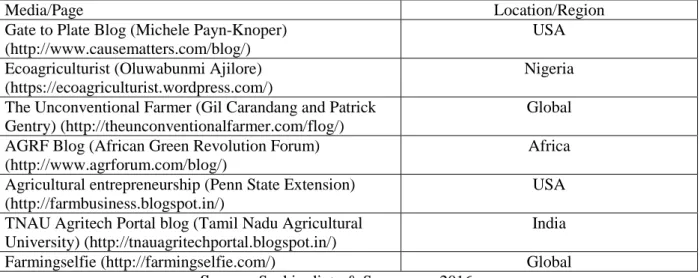
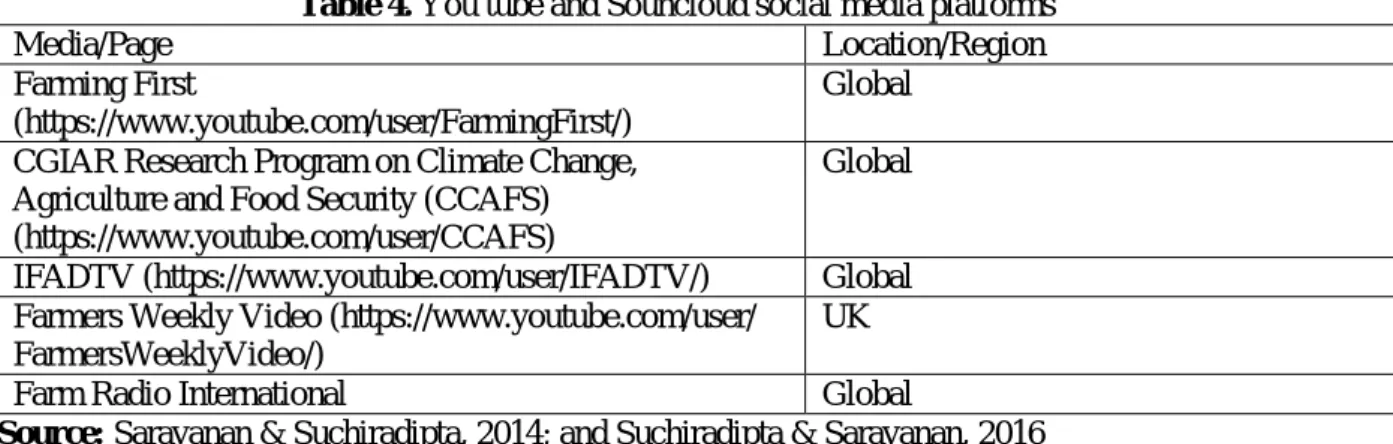
network. Be that as it may, Tables 1, 2, 3 and 4 present some other important social media platforms used in agricultural extension service delivery:
Table 1. Facebook social media platforms
Media/Page Location/Region
Livestock Information and Marketing Centre (https://www.facebook.com/groups/Livestock.TN/)
India
Mkulima Young (Young Farmer)
(https://www.facebook.com/mkulima.young)
Kenya
Turmeric Farmers’ Association of India (https://www.facebook.com/turmeric.farmers)
India
National Ecological Producers Association(APNE) (https://www.facebook.com/anpe.peru)
Peru
Krishi Vigyan Kendra, Namakkal
(https://www.facebook.com/krishi.namakkal)
India
Agricultural Extension in South Asia (AESA)
(https://www.facebook.com/ groups/428431183848161/)
South Asia
Global Forum for Rural Advisory Services (GFRAS) (https://www.facebook.com/groups/gfras/)
Global
Vivasayam Karkkalam (Let us Learn Agriculture) (https://www.facebook.com/groups/madhualan)
India
Source: Saravanan & Suchiradipta, 2014
Table 2. Twitter social media platforms
Media/Page Location/Region
AgChat (https://twitter.com/agchat) USA, UK, Australia, New Zealand, Ireland
Agriculture Proud (https://twitter.com/AgProud) USA Young Farmers (https://twitter.com/F4YFKenya) Kenya
USDA (https://twitter.com/USDA) USA
INGENAES (https://twitter.com/INGENAES) Global
eXtension4U (https://twitter.com/eXtension4U) USA
MEAS (https://twitter.com/MEAS_extension) Global
GFRAS (https://twitter.com/infogfras) Global
e-Agriculture (https://twitter.com/e_agriculture) Global
Source: Suchiradipta & Saravanan, 2016
Table 3. Blog social media platforms
Media/Page Location/Region
Gate to Plate Blog (Michele Payn-Knoper) (http://www.causematters.com/blog/)
USA
Ecoagriculturist (Oluwabunmi Ajilore) (https://ecoagriculturist.wordpress.com/)
Nigeria
The Unconventional Farmer (Gil Carandang and Patrick Gentry) (http://theunconventionalfarmer.com/flog/)
Global
AGRF Blog (African Green Revolution Forum) (http://www.agrforum.com/blog/)
Africa
Agricultural entrepreneurship (Penn State Extension) (http://farmbusiness.blogspot.in/)
USA
TNAU Agritech Portal blog (Tamil Nadu Agricultural University) (http://tnauagritechportal.blogspot.in/)
India
Farmingselfie (http://farmingselfie.com/) Global
Source: Suchiradipta & Saravanan, 2016
doi: 10.17700/jai.2017.8.3.395 53
Table 4. You tube and Souncloud social media platforms
Media/Page Location/Region
Farming First
(https://www.youtube.com/user/FarmingFirst/)
Global
CGIAR Research Program on Climate Change, Agriculture and Food Security (CCAFS) (https://www.youtube.com/user/CCAFS)
Global
IFADTV (https://www.youtube.com/user/IFADTV/) Global Farmers Weekly Video (https://www.youtube.com/user/
FarmersWeeklyVideo/)
UK
Farm Radio International Global
Source: Saravanan & Suchiradipta, 2014; and Suchiradipta & Saravanan, 2016
The various highlighted social media platforms and their respective pages in the tables shown the variety of opportunities explored by the extension service providers to communicate with audience; members and non-members as well. In fact, social media provides room for assessing opinion of the audience which would in turn enhance the efficiency of extension service delivery.
3.2. Highlights on the state of social media use in agricultural extension service delivery
The strides made by social media in the present day agvocacy is no doubt worthy of giving attention by professionals, especially those in the work of agricultural extension service delivery. Because, communication is their key central role. Duggan & Brennen (2012) reported that social media is a key means of communication and outreach in the present day, with 67 percent of online adults using social networking sites and 83 percent of 18-29 year olds using social media in the USA. This evidence of report stresses how social media occupies a vital position in our day-to-day life.
Democratization of information, communication and knowledge management are the basic philosophy of social media as opined by Saravanan et al. (2015). Hence, social media fit very suitably in agricultural extension service delivery; though requires incorporating basic principles of quality extension service delivery. Be that as it may, it is just as important to look at the perception of extension workers on using social media in agricultural extension service delivery. This gives initial basis for design and delivery of services to audience through any type of social media platform. In a related study by Newbury et al. (2014), extension educators in New York State of USA revealed that social media has potential benefit for usage in agricultural extension service delivery on various parameters the study took into consideration (Figure 2).
doi: 10.17700/jai.2017.8.3.395 54
Figure 2. Perceived benefits of using social media in extension education
Source: Newbury et al. (2014)
Of the parameters put on a scale of one, none was less than 0.5 with speed of communication as high as 0.9, indicating a positive perception of social media utilisation potential in agricultural extension service delivery.
As regards preferences of the social media platforms by stakeholders in Agricultural Extension and Advisory Services (AEAS), a global survey conducted by Suchiradipta & Saravanan (2016) reported that in spite of the high number of respondents using social media platforms (99 %), only 51.10 percent of them was member in / follower of any Agricultural Extension and Advisory Service pages / accounts / handles. Similarly, Facebook was acknowledged to be the most preferred social media in agricultural extension, probably due to cost effectiveness and simplicity of operation (Figure 3).
Figure 3. Social media platform user preference
Source: Suchiradipta and Saravanan (2016)
Per
cen
ta
ge
of
th
e
doi: 10.17700/jai.2017.8.3.395 55
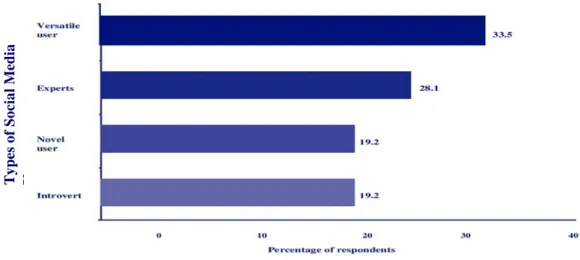
Also, based on the types of social media platform users by Alarcon-del-amo et al. (2011) in terms of sharing information and communicating with others on a regular basis viz. introverts (only update profile and mostly communicate through private messaging), novel users (update profile, actively seek out information, spend time tagging photos, log in between 1-5 hours a week), versatile users (update profile, send public and private messages, shares links, comment on discussion threads, mostly in social media for professional activities) and expert communicators (log in several times a day, actively engaged in all social media / networking activities, stay updated and interact very frequently both professionally and personally), the global study by Suchiradipta and Saravanan (2016) revealed that a substantial number of the respondents identified themselves as versatile users (33.5 %) followed by expert communicators (28.1 %), and novel users, while introverts tied at 19.2 percent (see figure 4).
Also, based on the types of social media platform users by Alarcon-del-amo et al. (2011) in terms of sharing information and communicating with others on a regular basis viz. introverts (update profile and mostly communicate through private messaging), novel users (update profile, actively seek out information, spend time tagging photos, log in between 1-5 hours a week), versatile users (update profile, send public and private messages, share links, comment on discussion threads, mostly in social media for professional activities) and expert (log in several times a day, actively engaged in all social media / networking activities, stay updated and interact very frequently both professionally and personally), the global study by Suchiradipta & Saravanan (2016) revealed that a substantial number of the respondents identified themselves as versatile users (33.5 %) followed by expert communicators (28.1 %), and novel users, while introverts tied at 19.2 percent (Figure 4).
Figure 4. Types of social media users
Source: Suchiradipta and Saravanan (2016)
The types of social media platforms users in agricultural extension service delivery highlights the state of social media in extension service delivery with respect to the stakeholders, and emphasizes the kind of targeted audience and the needs needed to be addressed.
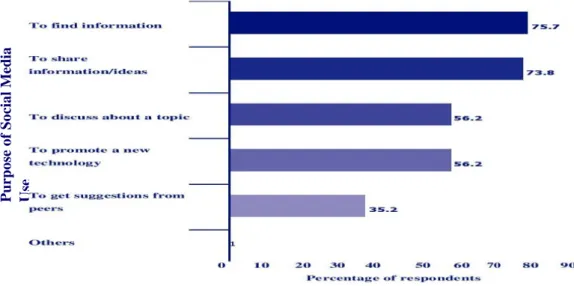
Despite the current globally reported average satisfactory level of social media platforms’ membership/followership by the stakeholders in agricultural extension service delivery, 1001-10,000 clients (25.1% and highest) are reached (Suchiradipta and Saravanan, 2016). On the use of social media for agricultural information purpose, stakeholders mostly either share or find information rather than discuss, suggest or promote a technology (innovation). An evidence to this is presented in Figure 5.
The types of social media platforms users in agricultural extension service delivery highlights the state of social media in extension service delivery with respect to the stakeholders, and emphasizes the kind of targeted audience and the needs needed to be addressed.
Despite the current globally reported average satisfactory level of social media platforms’ membership/followership by the stakeholders in agricultural extension service delivery, 1001-10,000
Ty
p
es
of
S
oc
ial
M
ed
ia
U
doi: 10.17700/jai.2017.8.3.395 56
clients (25.1% and highest) are reached (Suchiradipta and Saravanan, 2016). On the use of social media for agricultural information purpose, stakeholders mostly either share or find information rather than discuss, suggest or promote a technology (innovation). An evidence to this is presented in Figure 5.
Figure 5. Use of social media for agricultural information purpose
Source: Suchiradipta & Saravanan (2016)
On the other hand, stakeholders (mostly farmers, extensionists, NGOs, business men and administrators amongst others) look for a variety of information on social media. A study conducted by Kuria (2014) in Kenyan community of lower Kabete under Kiambu County reported that audience (farmers) usually seek different forms of agricultural information on social media (Table 5).
Table 5. Kinds of information sought by audience in lower Kabete, Kiambu county Kenya
Information Sought Mean Standard Deviation
Technological information 3.701 0.9431
Educational and training information 3.913 0.5423
Business and trade information 3.176 0.8612
Government agricultural policies and plans 3.113 1.0617
Weather condition and Environmental information 3.363 1.2610
Variety of seeds 2.984 0.9745
Agrochemicals 3.853 0.6734
Credit facilities, source, terms and conditions 2.152 1.0080
Market trend, price, and stock available 2.357 0.6834
Source: Kuria, 2014
In essence, the time and place have come for social media in this information age and that agricultural extension service delivery is gradually blending into the trend.
3.3. Challenges in the use of social media for agricultural extension service delivery
Social media offers tremendous opportunity to explore in agricultural extension service delivery. Nonetheless, its usage and effective integration into the extension system poses a number of challenges. In a position paper of Global Forum for Rural Advisory Services (GFRAS) tagged the “New Extensionist” Sulaiman & Davis (2012) expressed that extension and advisory services is faced with new and complex challenges which need new capacities to effectively deal with them. Among these challenges are how to properly integrate and make good utilisation of social media. In consonance with that, a number of researches that include Kipkurgat et al. 2016, Kuria, 2014 and Suchiradipta &
P
u
rp
os
e of
S
oc
ial
M
ed
ia
U
se
doi: 10.17700/jai.2017.8.3.395 57
Saravanan (2016) discussed several challenges in the use of social media for agricultural extension service delivery.
Hence, an appraisal of the global challenges is presented below:
Relative cost for Access: This concerns the relative cost compared to outcome. Large number of farmers are subsistent with little to incur data cost for accessing social media. This farmers are commonly found in Africa and Asia (mostly developing countries). In addition, there’s high internet cost at internet café. These ultimately present challenge to social media use in agricultural extension service. Andres & Woodard (2013) indicated that high internet cost restricts the use of multimedia like images and videos as they consume much more data than text.
Lack of Infrastructure: Poor electricity supply and internet connectivity infrastructures are part of the key challenges to social media use in agricultural extension service delivery, most affected are rural communities in developing countries. ITU (2015) reported that internet penetration was only 9.6 per cent in less developed countries due limited internet facilities and unreliable supply of electricity.
Illiteracy: Stakeholders in agricultural extension service delivery especially farmers and extension workers are less educated, and to use social media one requires both educational and technical literacy. In a study by Thomas & Laseinde (2015) they reported that extension workers require training on basic skills in the use of social media.
Lack of Quality Control: Free nature of social media in terms of comments and creation of content is something that extension service cannot compromise. Worse even is the today’s cybercrime perpetration, because of the delicate nature of information usually handled. Thus, information shared, especially by organizations need to be controlled for effectiveness and uphold of reputation. One of the possible ways to achieve that was put forward by Baena (2015) where she stated that in order to keep the organization’s reputation high, there is a real need of a full time moderator who makes sure that information shared are reliable, up-to-date, and in focus with organisation’s aim. Equally important, skilled human resource is necessary to maintain social media interactions, privacy concerns and conflicting perceptions. Fuess (2011) reported that irrelevant posts, privacy concerns, stakeholders’ conflicting perceptions and lack of capacity in using social media act as deterrents to using social media in extension service program delivery.
Limited Participation: It has been acknowledged severally that most of the social media users on agriculture related pages and platforms are passive with a few that are active. This shows low interaction which limits knowledge sharing and the scope of the information shared in reaching maximum audience globally.
Non-institutionalisation: Social media is yet to get the required institutionalisation at several organisational levels. Many institutions have not attached the importance of it in public or even private spheres. But, the relevant role that can be played by social media in agricultural extension service delivery cannot be overemphasized. Olakulen (2015) opined that extension services would be more effective and efficient if social media can be streamlined in its operations.
Lack of Adequate Yardstick for Impact Measurement: As at present, monitoring, and assessing the quality and worth of information shared on social media are unsatisfactory for extension service delivery. The available mechanisms are only friends, followers, mentions, number of visitors, likes, conversation index, and number of sharing of shared content. In agricultural extension service delivery, assessing and monitoring are paramount for evaluation and planning.
Need for Gender Sensitive Approach: As a result of cultural and societal limitations on women, integration of social media into agricultural extension service delivery needs to take into account gender sensitive approach in order to cater for all regardless of advantage or otherwise. For that reason, designing policy and approaches towards that is a challenge to overcome.
Satisfying Heterogeneous Users: Audience in extension service delivery determine the message and method to be used in delivery of agricultural information/technology. This audience usually cut across young, adult, old, men, women, rural and urban. Likewise, social media users targeted.
doi: 10.17700/jai.2017.8.3.395 58
Consequently, the openness of social media point out a challenge in fulfilling the extension needs of different social media users.
4. Conclusions and Recommendations
Based on the major findings and their relevant discussion the following conclusion and recommendations have been drawn:
4.1. Conclusion
Social media are electronic communication tools that allow users to interact, create, share, retrieve and exchange information and ideas in any form that can be discussed upon, archived and used by virtual communities and networks.
There are numerous social media platforms used in agricultural extension service delivery worldwide, with Facebook having highest popularity and penetration.
Although, stakeholders have positive perception on social media use in agricultural extension service delivery, majority are passive participant.
There are a number of new and complex challenges at personal, institutional, infrastructural and security levels in the use of social media for agricultural extension service delivery.
4.2. Recommendations
Given the low level of subsistence farmers’ literacy and passive or limited participation of stakeholders at institutional level, governments and other service providers need to strengthen capacities for proper integration of social media in agricultural extension service delivery. This will go a long way to facilitate further and effective use of social media in agricultural extension service delivery.
Organisations and change agents need to dedicate human resource for maintenance of quality control and, message accuracy and suitability, respectively. Likewise, ensure gender inclusion in service provision. This widens the scope of usage and adoption.
Availability of infrastructure and access to internet facilities should be enhanced by governments and other service providers so as to enable proper utilisation of social media for agricultural extension service delivery, especially by the extension workers and farmers.
There’s the need to advance technology more by developing a tool/yardstick of measuring the impact of agricultural extension service delivery through social media. These technologies
would certainly enable and expedite monitoring and evaluation, which are an integral
part of agricultural extension service delivery.
Also, there is the need for further research on social media use at farmers’ field level.
These explores areas that require added streamlining efforts to suit the socioeconomic
conditions of farmers.
References
Adler, PS & Kwon, SW 2002. ‘Social Capital: Prospects for a New Concept’ Academy of Management Review, 27, pp. 17-40.
Alarcon-del-Amo, MD, Lorenzo-Romero, C & Gomez-Borja, MA 2011. ‘Classifying and Profiling Social Networking Site Users: A Latent Segmentation Approach’ Cyber Psychology, Behaviour, and Social Networking, 14(9): pp. 547-553. https://doi.org/10.1089/cyber.2010.0346
Andres, D & Woodard, J 2013. ‘Social Media Handbook for Agricultural Development Practitioners’ USAID and FHI 360.
Baena, IR 2015. ‘Personal Opinion on Social Media in Agricultural Extension and Advisory Services’ Global Survey on Social Media for Agricultural Extension and Advisory Services, Global Forum for Rural Advisory Services (GFRAS) Interest Group for ICT (ICT4RAS). GFRAS, Lindau, Switzerland.
Banmeke, OT & Oose, MO 2012. ‘Assessment of the Use of Social Network Tools (SNTs) By Agriculture Researchers in South West Nigeria’ Communications of the IIMA, 12(3), pp 32-41
doi: 10.17700/jai.2017.8.3.395 59
Barau, AA & Afrad, MSI 2017. ‘Potentials of Rural Youth Agripreneurship in Achieving Zero Hunger’ World
Rural Observations 9(2) pp. 1-11. doi:10.7537/marswro090217.01
Bargh, JA & Mckenna, KYA 2004. ‘The Internet and Social Life’ Annual Review of Psychology, 55, pp. 573-590. https://doi.org/10.1146/annurev.psych.55.090902.141922
Baumüller, H 2010. ‘Facilitating Agricultural Technology Adoption among the Poor: The Role of Service Delivery through Mobile Phones’ ZEF Working Paper Series, ISSN 1864-6638.
Duggan, M & Brennan, J (July 13, 2017). ‘The Demographics of Social Media Users-2012’ Pew Internet. Retrieved from: http://pewinternet.org/Reports/2013/Social-media-users.aspx
Fuess, LC 2011. ‘An Analysis and Recommendations of the Use of Social Media within the Cooperative Extension System: Opportunities, Risks and Barriers (Honours Thesis)’ College of Agriculture and Life Sciences, Social Sciences of Cornell University, Ithaca, New York.
Gharis, LW, Bardon, RE, Evans, JL, Hubbard, WG & Taylor, E 2014. ‘Expanding the Reach of Extension through Social Media’ Journal of Extension, 52(3) pp. 1-11. Available on https://www.joe.org
Haley, S 2013. ‘The Value of Social Media for the Rural Industry(Masters thesis)’ Harper Adams University, Shropshire, United Kingdom. Pp. 33.
Hootsuite. 2017. ‘Digital in 2017 Global Overview’ Vancouver, Canada: Hootsuite Media Incorporated. Available on https://www.techinasia.com/talk/digital-snapshot-internet-social-media-2017
ITU. 2015. ‘ICT Facts and Figures 2015. Available on http://www.itu.int/en/ ITU-D/Statistics/Documents/facts/ICTFactsFigures2015.pdf.
Kaplan, A & Haenlein, M 2010. ‘Users of the World, Unite! The Challenges and Opportunities of Social Media’ Business Horizons, 53, pp. 59-68. Available on
http://michaelhaenlein.com/Publications/Kaplan,%20Andreas%20%20Users%20of%20the%20worl d%20unite.pdf.
Kinsley, J 2010. ‘Five Social Media Tools for the Extension Toolbox’ Journal of Extension, 48(5) Article number 5TOT7. Available onhttps://www.joe.org
Kipkurgat, T, Onyiego, M & Chemwaina, S 2016. ‘Impact of Social Media on Agricultural Extension in Kenya: A Case of Kesses District’ International Journal of Agricultural Extension and Rural Development Studies, 3(1), pp. 30-36. Available on www.eajournals.org
Kuria, CW 2014. ‘Use of Social Media as a Source of Agricultural Information by Small Holder Farmers: A Case Study of Lower Kabete Kiambu County (MA Thesis)’ University of Nairobi. Pp 4-5.
Merriam-Webster. 2015. ‘Social Media’ Retrieved from http:// www.merriam webster.com/social-media/
Muktar, BG, Mukhtar, U & Ahungwa, GT 2015. ‘Harvesting Youth for Agro-entrepreneurship: Stimulus Role of Social Media in Nigeria’ International Journal of Applied Research and Technology, 4(11) pp. 94 – 100.
Newbury, E, Humphreys, L & Fuess, L 2014. ‘Over the Hurdles: Barriers to Social Media Use in Extension Offices’ Journal of Extension, 52(5), pp. 8-10, Article 5FEA1. Available on https://www.joe.org/joe/2014october/a1.php#top
Olakulen, OJ 2015. ‘Personal Opinion on Social Media in Agricultural Extension and Advisory Services’ Global Survey on Social Media for Agricultural Extension and Advisory Services, Global Forum for Rural Advisory Services (GFRAS) Interest Group for ICT (ICT4RAS). GFRAS, Lindau, Switzerland.
Saravanan, R & Bhattacharjee, S 2014. ‘Social Media: New Generation Tools for “Agricultural Extension”?’ Available on http://www.aesagfras.net/Resources/file/Saravanan%20Final%20 blog%2042.pdf. pp. 1
Saravanan, R., Suchiradipta, B., Chowdhury, A., Hall, K. & Odame, H. H.2015. Social Media for Rural Advisory Services, Note 15. GFRAS Good Practice Notes for Extension and Advisory Services. GFRAS: Lindau, Switzerland. www.betterextension.org
Sokoya, AA, Onifade, FN, Alabi, AO 2012. ‘Connections and Networking: The Role of Social Media in Agricultural Research in Nigeria’ Session: 205-Social Networking for Agricultural Research, Education, and Extension Service: An International Perspective-Agricultural Libraries Special Interest Group, pp. 23-28
Stanley, S 2013. ‘Harnessing Social Media in Agriculture’. A Report. New Zealand: New Zealand Nuffield Farming Scholarship Trust.
doi: 10.17700/jai.2017.8.3.395 60
Suchiradipta, B & Saravanan, R 2016. ‘Social Media: Shaping the Future of Agricultural Extension and Advisory Services’ GFRAS Interest Group on ICT4RAS Discussion Paper, GFRAS: Lindau, Switzerland. Pp. 9.
Sulaiman, RS & Davis, K 2012. ‘The New Extensionist: Roles, Strategies and Capacities to Strengthen Extension and Advisory Services’ Global Forum for Rural Advisory Services, November. Available on https://www.g-fras.org/en/knowledge/gfras-publications.html
Terry, M 2009. ‘Twittering Healthcare: Social Media and Medicine’ Telemedicine and E-health, 15, 507– 511. https://doi.org/10.1089/tmj.2009.9955
Thomas, KA & Laseinde, AA 2015. ‘Training Needs Assessment on the Use of Social Media among Extension Agents in Oyo State Nigeria’ Journal of Agricultural Informatics 6(1) pp. 100-111. Available on journal.magisz.org. https://doi.org/10.17700/jai.2015.6.1.144
Valsamidis, S, Theodosiou, T, Kazanidis, I & Nikolaidis, M 2013. ‘A Framework for Opinion Mining in Blogs for Agriculture’ Procedia Technology, 8,pp. 264-274. https://doi.org/10.1016/j.protcy.2013.11.036
doi: 10.17700/jai.2017.8.3.395 61