Hungarian Association of Agricultural Informatics European Federation for Information Technology in Agriculture, Food and the Environment
Journal of Agricultural Informatics. Vol. 8, No. 1 journal.magisz.org
A study on the digitization of supply chains in agriculture - an Indian experience
Suresh K Mudda1, Chitti B Giddi2, Murthy PVGK3
I N F O
Received 20 Apr. 2016 Accepted 20 Aug. 2016 Available on-line 15 Mar. 2017 Responsible Editor: M. Herdon
Keywords: India, Supply chain, Digitization, ICT
A B S T R A C T
In the present day context of globalisation, changing information needs of the farmers, increasing pressure of population on the food security system, encouraging the developing economy like India to look for various alternatives in supply chain management and its digitization for its efficient and sustainable agricultural development. India is likely to be considered as the food basket to the world constituting 52% of total land under cultivation as compared to global average of 11%. It is also producing 134.5 MT of fruits and vegetables but due to inadequate cold storage and preservation facilities and improper supply chain infrastructure; there is enormous loss of wastages. Supply chains are principally concerned with the flow of products and information between supply chain member organizations procurement of materials, transformation of materials into finished products, and distribution of those products to end customers. Today’s information-driven, integrated supply chains are enabling organizations to reduce inventory and costs, add product value, extend resources, accelerate time to market, and retain customers. Information Technology has started its dent in certain rural livelihoods especially the farmers in developing countries like India. IT can also do wonders in empowering small and marginal farmers who are operating in a complex, diverse and risk prone environment, who have poor access to information, especially regarding the production systems, customers and markets. In India, the limiting factors for farmers wanting to maximize their farm incomes are poor market linkages, poor access to quality farm-inputs, services and technology, lack of information about Government resources, institutions and extension services. ICT systems have pivotal role to play in market led extension activities. ICT s can connect the producers with buyers to initiate and sustain long term, mutually beneficial and sustainable professional relationships.
1. Introduction
In the present day context of globalisation, changing information needs of the farmers, increasing pressure of population on the food security system, encouraging the developing economy like India to look for various alternatives in supply chain management and its digitization for its efficient and sustainable agricultural development. Information Technology has started its dent in certain rural livelihoods especially the farmers in developing countries where India has no exception. It can also do wonders in empowering small and marginal farmers who are operating in a complex, diverse and risk prone environment, who have poor access to information, especially regarding the production systems, customers and markets. In India, the limiting factors for farmers wanting to maximize their farm incomes are poor market linkages, poor access to quality farm-inputs, services and technology, lack of information about Government resources, institutions and extension services. Internet is a faster and less expensive ever increasing speed mode of communication frequently used in IT for remote rainforest villages as compared to traditional communication services, such as mail and telephones. E-centres can help to improve social and economic opportunities in isolated areas, facilitate communication between indigenous peoples and organizations, and raise awareness of their concerns
1 Suresh K Mudda
Acharya N G Ranga Agricultural University, Hyderabad, India. [email protected]
2 Chitti B Giddi
INGRAIN, Hyderabad, India. 3 Murthy PVGK
doi: 10.17700/jai.2017.8.1.287 46
to mainstream society. In Asian countries, information technology and telecommunications have assumed an ever-increasing role in the creation of wealth at all levels.
The farmers also lack real time information about consumers, market demand and prices and hence are prone to more exploitation by existing intermediaries in the supply chain. With the growth of organized retailing and free global trade, farming is becoming highly knowledge intensive, commercialized, competitive and globalised, making it necessary to digitize, rebuild competitive and efficient agri-supply chains to benefit both the farmer as well as the consumer.
Digitization has a pivotal role to play in market led extension activities. ICTs can connect the producers with buyers to initiate and sustain long term, mutually beneficial and sustainable professional relationships. The existing disconnection between the producers and buyers in terms of harmonization of standards of agricultural produce is the cause for low value realization for the producers. Practically, the same disconnection is also increasing the cost of procurement for the buyers of agricultural commodities. Digitization helps to integrate the production, post-harvest management, value addition and marketing of agricultural produce. The ICT sphere also encompasses the quality aspects, agronomic aspects, traceability aspects and details of measurement of active ingredients, nutrition values etc. In the marketing and value addition perspective, usage of ICT to digitize the information contributes to increased efficiency and value enhancement of agricultural supply chains. Specially, in the Indian context, where the number of land holdings is small and big in number, reaching the multitudes of small farmers is the key for future food security. In a way the disintermediation in the supply chains can be possible by application of ICTs in adequate levels. The supporting mechanism or social benefits that are aimed to reach farmers can also be effectively implemented with the help of ICTs. In this background an effort has been made to study the digitization of supply chain management for its effectiveness in Indian context.
1.1. Indian agriculture
India is likely to be considered as the food basket to the world constituting 52% of total land under cultivation as compared to global average of 11%. It is also producing 134.5 M T of fruits and vegetables but due to inadequate cold storage and preservation facilities and improper supply chain infrastructure, there is enormous loss of wastages. Agriculture and its allied industries sector employs 67% of the country's population. In the post WTO regime, an effective agricultural marketing system through cost effective supply chain management, is the key driver of the sustainable development of agricultural economy. Agriculture has been the backbone of Indian economy since independence and before that, right now with nearly 12 per cent of the world’s arable land, India is the world’s third-largest producer of food grains, the second- third-largest producer of fruits and vegetables and the third-largest producer of milk; it also has the largest number of livestock. Add to that a range of agro- climatic regions and agri-produce, extremely industrious farmers, a country that is fundamentally strong in science and technology and an economy which one of the largest in the world with one of the highest growth rate and you should have the makings of a very good harvest. Yet the comprehensive outlook for Indian agriculture is far more complex than those statistics might suggest. Having just extricated itself from a period of negative growth of -0.1 percent in 2008-2009, to rise to an unspectacular 0.4 per cent in 2009-2010 with upward revision in the production, ‘agriculture, forestry and fishing’ sector in 2010-11 has shown a growth rate of 6.6 per cent, as against the growth rate of 5.4 per cent in the Advance estimates. Adjusted for inflation, even this 6.6 percent growth looks unexciting when compared to the growth rates in services and manufacturing. Today, agriculture accounts for 13.8 percent of the country’s gross domestic product, compared to 51 percent in the 1950s (Government of India, 2011). Worse, India is amongst the world’s largest wasters of food and faces a potential challenge to provide food security to its growing population in light of increasing global food prices and the declining rate of response of crops to added fertilizers. The reforms of 1991 have introduced Indian agriculture to the globalization which has very significant impact on agriculture and supply chain.
1.2. Supply chain management
products, and distribution of those products to end customers. Today’s information-driven, integrated supply chains are enabling organizations to reduce inventory and costs, add product value, extend resources, accelerate time to market, and retain customers.
The real measure of supply chain success is how well activities coordinate across the supply chain to create value for consumers, while increasing the profitability of every link in the supply chain. In other words, supply chain management is the integrated process of producing value for the end user or ultimate consumer. The supply chains of different agricultural commodities in India, however, are fraught with challenges stemming from the inherent problems of the agriculture sector. The agri supply chain system of the country is determined by different sartorial issues like dominance of small/ marginal farmers, fragmented supply chains, absence of scale economies, low level of processing/value addition, inadequacy of marketing infrastructure etc. The agri supply chains in India and their management are now evolving to respond to the new marketing realities thrown by the wave of globalisation and other internal changes like rise in the level of disposable income of consumers, change in the food basket of the consumers towards high value products like fruits, vegetables and animal protein. The new challenges of the agricultural economy of the country have now spurred the government agencies to go in for different legal reforms for enabling and inviting private investment in agricultural marketing infrastructure, removing different entry barriers to promote coordinated supply chain and traceability.(Sazzad.P 2014).The amended APMR Act, the major agricultural Marketing Act of the country, being implemented by the different states of India, now contains enabling provisions to promote contract farming, direct marketing and setting up of private markets (hitherto banned). These measures will go a long way towards providing economies of scale to the small firms in establishing direct linkage between farmers, and processors/ exporters/ retailers, etc. Thus, the measure will provide both backward and forward linkages to evolve integrated supply chains for different agri produce in the country (MANAGE 2013).
Marketing channels for fruits and vegetables in India vary considerably by commodity and state, but they are generally very long and fragmented. The majority of domestic fruit and vegetable production is transacted through wholesale markets although depending on the state and commodity; farmers may sell to traders directly at the farm gate, to traders at village markets, or directly to processors, co-ops and others.
1.3. Coordinated supply chains
Coordinated supply chains involve structured relationships among producers, traders, processors, and buyers whereby detailed specifications are provided as to what and how much to produce, the time of delivery, quality and safety conditions, and price. These relationships often involve exchanges of information and sometimes assistance with technology and finance. Coordinated supply chains fit well with the logistical requirements of modern food markets, especially those for fresh and processed perishable foods. (Ahya, 2006). These chains can be used for process control of safety and quality and are more effective and efficient than control only at the end of the supply chain. Several companies in India are beginning to invest in integrated supply chain management systems and infrastructure with emphasis on quality and, to a lesser extent, on safety. Different models are emerging including fruit and vegetable retail outlets that directly procure produce from farmers or grower associations through various formal/informal contractual arrangements. Collection-cum-grading centres have been established in rural areas with all produce moving through a central distribution facility having modern infrastructure including cold storage, ripening rooms and controlled atmosphere chambers. Growers are required to follow certain specifications and are often provided with some inputs and technical advice about agronomic and post-harvest practices (MANAGE, 2013).
doi: 10.17700/jai.2017.8.1.287 48
been digitized and kept ready as a blue print for further reference. It also provides an exemption from the levy of market fees for produce covered by contract farming agreements and provides indemnity to farmers’ land to safeguard against the loss of land in the event of a dispute. Contract buyers will now be able to legally purchase commodities through individual purchase contracts or from farmers markets. Provision has also been made in the legislation for direct sale of farm produce to contract buyers from farmer’s fields without it being routed through notified markets. This calls for the collective action in supply chains.
Initiatives are taken to establish more terminal markets based on modern infrastructure. Terminal markets would endeavour to integrate farm production with buyers by offering multiple choices to farmers for sale of produce such as electronic auctioning and facility for direct sale to exporter, processor and retail chain network under a single roof. In addition, the market would provide storage infrastructure thus offering the choice to trade at a future date to the participants. It is envisaged to offer a one-stop-solution that provides Logistics support including transport services & cool chain support and facility for storage (including warehouse, cold storage, ripening chamber, storage shed), facility for cleaning, grading, sorting, packaging and palletisation of produce and extension support and advisory to farmers.
The model presents integration of agri supply chains for perishables through terminal markets. Presently in the regime of fragmented and inefficient agri supply chains there is no control and command of chain partners on the other following that they are not able to maintain quality of produce in their chain. In order to bring integrated command, source quality produce by way of organizing farmers in groups and providing them the right technical advice and link farmers to the market, modern terminal market complexes will prove a dent. With increasing private investment in the food retail sector and impending changes in contract and marketing laws, shorter and more direct supply chains with traceability are expected to become more common. The incidence and spread of coordinated supply chains will be closely connected with the pace and direction of food retail sector modernization within India. Thus far, changes in food retail have been gradual, and considerably slower than observed in many other developing countries. Supermarket procurement regimes for sourcing of fruits, vegetables, dairy and meat strongly influence the organization of the supply chains. The rising scale of organized retail in the Asian countries (like Metro Cash & Carry, Tata Chemicals and Field Fresh Foods, Bharti Enterprises, Reliance Fresh in India) is now playing a vital role in organizing farmer production bases and integrating these into the retailers’ fresh produce supply chain, thus procurement systems in this segment is changing fast responding to the consumer demand and competition.
2. Digitization and its implications
agile, demand-driven supply, focusing on reducing end-to-end supply network time by building a flexible and responsive supply network is the need of the hour. (Narula, et al 2010)
The educational and professional institutions should take for guiding the latest information using IT as a tool and make it available to the farmers. The need of the day is to harness the vast potential of agriculture in Indian economy.(ICT source book)
The ICT sphere also encompasses the quality aspects, agronomic aspects, traceability aspects and details of measurement of active ingredients, nutrition values etc. In the marketing and value addition perspective, ICT contributes to increased efficiency and value enhancement of agricultural supply chains. Specially, in the Indian context, where the number of land holdings is small and big in number, reaching the multitudes of small farmers is the key for future food security. In a way the disintermediation in the supply chains can be possible by application of ICTs in adequate levels. The supporting mechanism or social benefits that are aimed to reach farmers can also be effectively implemented with the help of ICTs. In conditions of poor information flows supply chains are highly fragmented. Otherwise information technology driven innovations make it easier to acquire, manage, and process information and allow closer integration between adjacent steps in the value chain. There is therefore greater integration of supply chains based on information availability (Kunaka, 2010)
Information on supply chain management is a basic element in any development activity. Once it is digitized Information will be available and accessible to all, be it scientific, technical, economic, social, institutional, administrative, legal, historical or cultural in nature. Agricultural information is useful only if it is available, if the users have access to it, in the appropriate form and language. What do the farmers want? They require information inter alia on supply of inputs, new technologies, early warning systems (drought, pests, diseases), credit, market prices etc. Information, in the field of agriculture, to be of benefit, has to be tailored to local agro-ecological and socio-economic conditions. It has to be backed up by relevant input supply services, and public policies. Synchronization in time and space between knowledge and input delivery systems is essential to impart credibility to the extension message. Agricultural Extension Services do play an important role in delivering information, knowledge and advice to farmers. However to remain relevant in these changing times, it has to specialise in “effectively managing and transferring knowledge or information packages”. Emerging digital technologies can play an important role in supporting extension in this regard. (Meera 2014). Over the past two decades, Governments all around the world have invested heavily in strengthening the national ICT infrastructure.
Need for improved agricultural extension throughout the developing world has never been greater. Agricultural and rural development and hence, rural extension continue to be in transition in the developing world. These transitions are happening because of the forces that are driving the world agriculture today. The vulnerability of farming in the developing world is quite evident due to forces like climate change, changes in natural resources quality, lack of coping strategies at micro and macro levels of decision making, coupled with globalization, emerging market forces like commodity markets, sustainability constraints etc. The challenges can only be met from information intensive efforts in the extension systems (Shaik Meera, N et.al 2010). These information intensive extension efforts can be possible when extension systems embrace digital opportunities available with us today.
2.1. E-choupal experience of ITC
doi: 10.17700/jai.2017.8.1.287 50
Figure 1. Demonstration for farmers
2.2. e-governance in fisheries
The Fisher Friend Mobile Application (FFMA) is a unique, single window solution for the holistic shore-to-shore needs of the fishing community, providing vulnerable fishermen immediate access to critical, near real-time knowledge and information services on weather, potential fishing zones, ocean state forecasts, and market related information. The application is an efficient and effective decision support tool for the fisher community to make informed decisions about their own personal safety and the safety of their boats, as well as make smart choices for fishing and marketing their catch. FFMA is developed on an android platform in partnership with Wireless Reach Qualcomm and Tata Consultancy Services and is currently available in English, Tamil, and Telugu (Figure 2).
Figure 2. The Fisher Friend Mobile App
2.3. ICT platform of EID Parry
East India Distilleries (EID) Parry has implemented the project “Parry’s Corner” to help the farmers, provide them with value-added services, and improve their income levels and the productivity of their farms. The self-help groups in the vicinity are using the ICT platform for e-commerce. This has helped in the creation of social networks. Social networks facilitate the diffusion of ICT platforms. The major reason for the success of this project has been that the company has been in operation in that region for a long time. The high levels of trust existing between the company executives and farmers helped in the rapid diffusion of the utilization of the ICT platform for a variety of reasons. The technology selected was a low cost option and hence the overheads were not high for platform.
yields, access to finance, agricultural extension services, and time required to transact with EID Parry all have reportedly improved. These improvements have not been quantified, however (FAO, 2005).
2.4. Farmers portal of government of India
The Farmers' Portal of the Department of Agriculture & Cooperation is a platform for farmers to seek any information related to agriculture (Figure 3). Detailed information on farmers’ insurance, agricultural storage, crops, extension activities, seeds, pesticides, farm machineries, etc. is provided. Details of fertilizers, market prices, package and practices, programmes, welfare schemes are also given. Block level details related to soil fertility, storage, insurance, training, etc. are available in an interactive map. Users can also download farm friendly handbook, scheme guidelines, etc.
Figure 3. The Farmers' Portal of the Department of Agriculture & Cooperation
2.4. Kisan call centre services
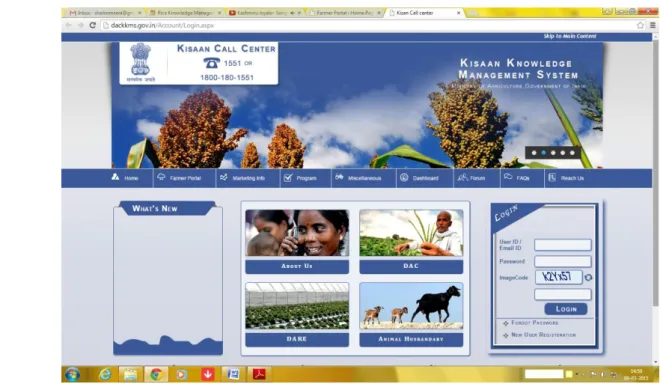
Kisan Call Centres (KCCs) (Figure 4) was launched by the Ministry of Agriculture took to harness the potential of ICT in agriculture. This initiative was aimed at answering farmer’s queries on a telephone call in their own language / dialect. IFFCO Kisan Sanchar Limited (IKSL) was selected by the Department of Agriculture and Cooperation (DAC), Ministry of Agriculture (MoA), Government of India, to manage the KCC services. The services were re-launched on 1st May 2014 by IKSL. In this endeavour, IKSL had completely revamped the services and set up state of the art ICT infrastructure (Figure 5).
doi: 10.17700/jai.2017.8.1.287 52
Figure 5. The Knowledge Management System
2.5. m-kisan Project of Government of India
The project conceptualized, designed and developed in-house within the Department of Agriculture & Cooperation USSD has widened the outreach of scientists, experts and Government officers posted down to the Block level to disseminate information, give advisories and to provide advisories to farmers through their mobile telephones. Since its inception nearly 72 crore messages or more than 210 crore SMSs have been sent to farmers throughout the length and breadth of the country. These figures are rising ever since.
These messages are specific to farmers' specific needs & relevance at a particular point of time and generate heavy inflow of calls in the Kisan Call Centres where people call up to get supplementary information. SMS Portal for Farmers has empowered all Central and State Government Organizations in Agriculture & Allied sectors (including State Agriculture Universities, KrishiVigyanKendras, Agromet Forecasts Units of India Meteorological Department, ICAR Institutes, Organization in Animal Husbandry, Dairying & Fisheries etc.) to give information/services/advisories to farmers by SMS in their language, preference of agricultural practices and locations.
USSD (Unstructured Supplementary Service Data), IVRS (Interactive Voice Response System) and Pull SMS are value added services which have enabled farmers and other stakeholders not only to receive broadcast messages but also to get web based services on their mobile without having internet. Semi-literate and illiterate farmers have also been targeted to be reached through voice messages.
3. Limitations
As the Supply Chain involves a number of players, the extent of integration of services depends on the degree of trust and information sharing amongst the players. It is often observed that the big players in their efforts to make vertical/horizontal integration of different activities end up gobbling up the weak ones. What in fact is called for is strengthening of the system and process, so that requisite synergies evolve to give benefits to all the partners.
In order to shore up the emergence of professionally managed agri-supply management of different agricultural produce, the Government should play its facilitating role.
Some of the major issues that need to be focused in the public domain are:
Focus should be laid on free play of demand and supply forces in the market. This has to be enabled by removing different entry barriers, having a proper market information system, promoting grading and standardization, taking care of quality and safety issues, putting up a strong system of risk management and price formation mechanism. This can be done only by digitizing the information available at various levels of supply chain.
Different legal restrictions inhibiting growth of competitive environment should be dismantled and replaced by a facilitating legal environment.
Infrastructure is the major constraint in Indian marketing system. Since it is difficult to arrange sufficient funds from the public exchequer for the development of infrastructure facilities, the need of the hour is to explore different Public Private Partnership models.
The extension mechanism of the country is production oriented relegating the marketing aspects to the backburners. It is time for the Stakeholders to provide basic information in supply chain in a digitized form.
Within broad framework of a conducive environment provided by Government side, the private sector should come up in a pro-active manner to invest in agriculture sector. In no way, they should be discouraged by the teething troubles as entrepreneurs in this virgin sector in India. The managerial efficiencies brought about by the private sector to the agricultural economy of the country will go a long way towards ensuring optimum utilisation of resources, thereby ensuring sustainable growth for the sector.
4. Conclusions
Usefulness of ICT in the form of digitising the all possible information is well established in improving productivity of Agricultural sector and this needs to be addressed by authorities. Food loss reduction is less costly than an equivalent increase in food production. If efforts are not made to modernize the harvest handling system for horticultural crops, then postharvest losses will continue to have a negative economic and environmental impact. There is no doubt that postharvest food loss reduction significantly increases food availability. An efficient collaboration between stakeholders will reduce risk, losses and greatly improve the efficiency to ensure food security and development.
The important link between the whole chain of digital networks and their applications is the ultimate beneficiaries of these initiatives those are the stakeholders. It is common to find that intended users (farmers) are either unaware of the ICT services / or do not perceive these services as applicable in their field conditions. Unfortunately the task of understanding the clientele and their information need has been subsided by the technological enthusiasm that is prevailing in Indian context. (Shalendra 2013)
doi: 10.17700/jai.2017.8.1.287 54
The idea of Digitization of supply chain, essentially provides linkages, enhance market access, improve business process, increase product diversity and reduce development cycle time in Indian agriculture. Understanding ICT context for Indian agriculture will help developing nation level strategies. Digital India's perspective of agriculture will have a real challenge in integrating 'knowledge' with 'time critical services' in the whole chain of agricultural value chain. We should have evidences of use, pattern, purpose, users etc., for ICT activities. These IT applications cannot be limited to marketing aspects alone but are to be integrated with the production aspects for its sustainable development. These aspects are having certain social implications in Indian context. The existing land use patterns, land records, tenancy norms soil health and its enrichment are being digitized and also need to be recorded. Information Technology should be used for maintaining an updated and enriched database of region specific agricultural information and timely dissemination of the information pertaining to seed selection, actions relating to arrival of monsoon, climate control etc. to the farmers. In addition, information regarding agricultural products, demand-supply status in respect of different products and the current price should be made available on-line to the farmers for taking timely decisions on crop product diversification strategies and positioning of the same in right market to get optimum revenue. With agile, demand-driven supply, focusing on reducing end-to-end supply network time by building a flexible and responsive supply network is the need of the hour.
The educational and professional institutions should take for guiding the latest information using IT as a tool and make it available to the farmers. The need of the day is to harness the vast potential of agriculture in Indian economy.
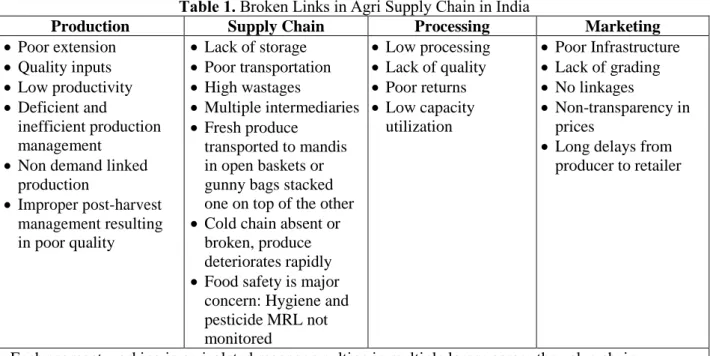
Table 1. Broken Links in Agri Supply Chain in India
Production Supply Chain Processing Marketing
Poor extension
Quality inputs
Low productivity
Deficient and
inefficient production management
Non demand linked production
Improper post-harvest management resulting in poor quality
Lack of storage
Poor transportation
High wastages
Multiple intermediaries
Fresh produce transported to mandis in open baskets or gunny bags stacked one on top of the other
Cold chain absent or broken, produce deteriorates rapidly
Food safety is major concern: Hygiene and pesticide MRL not monitored
Low processing
Lack of quality
Poor returns
Low capacity utilization
Poor Infrastructure
Lack of grading
No linkages
Non-transparency in prices
Long delays from producer to retailer
Each segment working in an isolated manner resulting in multiple losses across the value chain
References
Ahya, C 2006 ‘The Retail Supply Chain Revolution’. The Economic Times, Retrieved on 29.03.2013 from
h
ttp://articles.economictimes.indiatimes.com/2006-12- 07/news/27452233_1_retail-revolution-retail-sector-supply-chain.FAO (Food and Agriculture Organization) 2005, ‘Case Study: Community Based Information Systems’, India.
Government of India 2011, Economic Survey report, Ministry of Finance.
http://www.manage.gov.in/studymaterial/scm/E.pdf .Reading material on Supply chain management in agriculture.
Kunaka, C 2011, ‘Logistics in Lagging Regions: Overcoming Local Barriers to Global Connectivity’, Washington DC, World Bank.
MANAGE, 2013, Reading material on supply chain management, Rajendranagar, Hyderabad, India.
Sapna, A, Narula, Navin Nainwal, 2010, ICT and agriculture supply chains, opportunities and strategies for successful implementation. Information technology in developing countries. A newsletter of the IFIP working group. 9.4 vol. 20, no.1. www.iimahd.ernet.in/e gov/ifip/feb2010/sapna.narula.htm.
Sazzad, P 2014, ‘Food supply chain management in Indian Agriculture: Issues, opportunities and further research’. African journal of management, vol. 8, no.14, pp. 572-581. doi. 10.5897/ajbm2013.7292
Shaik Meera, N 2014, ‘Digital India & Agricultural Sector - Can we make it Digital Bharat?’ Concept paper, DRR, Rajendranagar, Hyderabad.
Shaik Meera, N, Arunkumar, S, Amtul Waris, Vara Prasad, C, Muthuraman, P, Mangalsen, and Vikranth, BC 2010, ‘E-Learning in extension systems- Emperical study in Agricultural Extension in India’. Indian Journal of Extension Education, vol. 46, no. 3&4, pp. 94-101.