Haitse Kreek
The Function of Expert Knowledge in The European
Union’s Decision-making Process
A shift during the TTIP-negotiations?
Master Thesis, 10 August 2018
Supervisor: Dr. J. Christensen
Leiden University, the Netherlands
Preface
In front of you lies the dissertation “The Function of Expert Knowledge in The European Union’s Decision-making Process: A shift during the TTIP-negotiations”, a qualitative
analysis of which function of knowledge is predominant in the EU during the
TTIP-negotiations. It is written as part of the Master program of Public Administration –
International and European Governance at Leiden University.
During the research I had some difficulties regarding the collection and selection of
valuable documents for the analyses. Finally, I was able to obtain a reasonable selection of
documents, which allowed me to answer the posed question in this research. Fortunately, Dr.
Christensen was willing to help me and willing to answer my questions relating such problems.
For this, I would like to thank my supervisor for his guidance and support during this
research. In addition I would like to thank my friends and family for keeping me motivated in
times I really needed it.
Abstract
This research explains the different functions of knowledge utilization in the European
Commission and European Parliament during the TTIP-negotiations. The study focuses on
issue salience as variable that explains the function of knowledge utilization in the European
institutions. Using EU documents, involving expert knowledge, regarding TTIP, the study tests
which function of knowledge utilization is predominant in times of different levels of issue
salience. The research found, that during the TTIP-case the function of knowledge is more
Contents
1 Introduction 3
1.1 Research Question 4
1.2 Justification 5
1.3 Structure of the Thesis 6
2 Literature Review & Theory 7
2.1 Understanding Knowledge Utilization 7
2.2 The EU Decision-making Process and the Role of Expertise 9 2.3 Knowledge Utilization in the European Institutions 11 2.4 Determinants of the Function of Knowledge Utilization 12
2.5 Features of Policy Area 14
2.6 Expectations in Summary 15
3 Research Design 16
3.1 Single-case Study 16
3.2 Case Selection 16
3.3 Data 17
3.4 Concepts and Operationalization 21
3.5 Limitations 24
4 Results 25
4.1 Knowledge Utilization prior to Negotiations 25
4.2 Knowledge Utilization after the Mandate 30
4.3 Knowledge Utilization after July 2015 35
5 Conclusion 40
6 Appendix 42
1 Introduction
Expertise, rather than political ideology or budgetary resources, is one of the most important sources of power in the European Union’s (EU) decision-making process (Radaelli, 1999).
Policy makers are free to use or not-use social research in order to address concrete social questions. Existing literature gives insight in how and why research is used and shows us that expert knowledge is not always used to get the best policy outcome (Boswell, 2008; Rimkutė & Haverland, 2015; Schrefler, 2010; Weiss, 1979;). The decision-making process of the European Union relies heavily on working groups, committees and expert groups (Hix, 2005; Radaelli, 1999) and therefore expert knowledge could be considered as an instrument to gain influence in the EU legislative procedure.
The delegation of regulatory powers to independent regulatory agencies, who are expected to use knowledge for problem-solving purposes (Schrefler, 2010), raises questions. From the European Commission it is expected to use knowledge instrumental (Tallberg, 2002) and therefore the use of knowledge is taken for granted. In their pursuit for expertise the Commission relies heavily on external sources, such as expert groups and other interest groups (Metz, 2013).Greenwood (2007) argues that the involvement of interest groups might improve the policy process. Involving different parties in the process increases the legitimacy and quality of policies, since it includes more different voices (Greenwood, 2007). Dür and Mateo (2012), however, argue that the degree of influence among these interest groups differs, raising questions about the legitimacy of the input. Because of the increasing power of expertise in the policy process and the difference of influence among interest groups, it is likely that actors try to take advantage of it, but what about the European institutions themselves?
Boswell (2008) and Majone (1996) argue that knowledge is used by these bureaucracies to gain legitimacy, and strengthen their position. Therefore, knowledge can be used to increase the bureaucracy its output (the instrumental function) or to give credibility to their existence or decisions (symbolic function) (Boswell, 2008). If the symbolic function of knowledge in the European Commission is predominant, how legitimate is this?
European Council are no longer the only two EU institutions involved. The EP can, since the Treaty of Lisbon, veto trade agreements, and has to be kept informed during negotiations (Van den Putten, De Ville & Orbie, 2014).
Previous trade agreement negotiations, negotiations before 2009, did not gained as much public attention as the TTIP-negotiations did. TTIP, the Transatlantic Trade and Investment Partnership, is a bilateral agreement between the European Union and the United States of America. In short, its goal is to reduce barriers and tariffs to increase mutual investments and benefits(European Commission, n.d.-a). Where previous trade agreements
faced less contestation, TTIP did because of the intensive nature of the agreement and the many differences between the EU and the US. With the democratically elected EP involved in the process, the European Commission might be expected to use expert knowledge in a different way as they used to do. Increasing salience regarding TTIP might affect the function of knowledge, an expected instrumental function might shift to the symbolic function to legitimize their decisions.
1.1 Research Question
The aim of this study is to give more insight in the use of the different functions of knowledge utilization by the European Commission, during the TTIP-negotiations. As a powerful resource in EU’s decision-making, expertise can be considered more than just an instrument for
bureaucracies to reach their goals. Important variables that explain the use of expertise can be the features of the policy area and the feature of the organization itself (Boswell, 2008). This study focus less on the features of the organization and more on the features of the policy area. It will take the differences of salience regarding TTIP over time into account, to test whether this influences the function of knowledge utilization. For this reason the research question posed in this study is:
“How did the function of knowledge utilization, in the European Commission and the European
Parliament, change during increasing issue salience regarding the TTIP-process?”
over time, while the documents related to TTIP are studied to explain which function of knowledge utilization is observed.
This study differs from other studies about knowledge utilization. Some studies (Boswell, 2008; Rimkutė & Haverland, 2015) have focused on the function of knowledge in particular cases of the European Commission, but none of them have focused on a shift of the function of expert knowledge in one particular case, something this study intents to do.
1.2 Justification
The important role of expertise and the dependence of the European institutions on expert knowledge provided by the European Commission, is probably the most predominant reason to study the subject of knowledge utilization in case of the EU. Questions about why knowledge utilization take place or not take place, are no longer the biggest concerns in this research field. Weiss (1979) already showed the different meanings of knowledge utilization, raising questions regarding the reasons why knowledge enters the decision-making process.
More recent research focusses on the reasons behind knowledge utilization in the policy process of the European Union. Rimkute and Haverland (2015) studied which function of knowledge is used by the European Commission in the policy process, by the perspective of the researcher involved. Research of Boswell (2008) and Schrefler (2010) tried to develop a theory explaining the determinants for the different functions of knowledge utilization. Both indicate the features of the policy area as important determinant. Although there are many similarities, there is some ambiguity regarding which features are most important in determining the different functions of knowledge utilization. As a contribution, this research tries to give an overreaching feature of the policy area to explain which function of knowledge utilization will occur. Schrefler (2010) and Lundin and Öberg (2014) carefully associate salience with knowledge utilization, an association that is interesting to study. Despite the increasing research on knowledge utilization in the policy process in general, there have been few attempts to apply the theory developed by Boswell (2008) and Schrefler (2010). This research tries to test whether salience, as feature of the policy area, could be considered as a determinant for the different function of knowledge utilization or that it cannot.
1.3 Structure of the Thesis
There is already a lot of literature about knowledge utilization, but since it is only part of the EU literature for a few decades I feel compelled to start with an introduction of the role of expert knowledge in the EU decision-making process. In the same chapter a literature review is done to understand what research utilization is, and to identify the factors that influence the function of knowledge in the decision-making process. The third chapter will explain the research design that is used to answer the research question. It discusses the conceptualization
2 Literature Review & Theory
This chapter starts by explaining what is considered expert knowledge and will further elaborate on the already mentioned different functions of knowledge utilization. The second section will describe the importance of expertise in the European decision-making process and how the different institutions obtain expertise. Then a short literature review on knowledge utilization in the European Commission and the European parliament is given. This is followed by a section identifying the different variables and a section discussing the most important variables and translating them into expectations. Eventually the formulate expectations will be summarized in the last section of this chapter.
2.1 Understanding Knowledge Utilization
To provide a good starting point for an introduction of knowledge utilization, it is important to clarify what is meant by expert knowledge or in other words by expertise. From the existing literature it appears that there is no universal and all-encompassing definition of expert
knowledge (MCBride & Brugman 2012). The most accurate and simplified definition discussed in the work of MCBride and Brugman (2012) is ‘the definition of Booker and McNamara: “Expert knowledge is what qualified individuals know as a result of their technical
practices, training, and experience” (MCBride & Brugman, 2012, p. 13).’ Boswell (2008) in her work uses a more specific definition, given by Stone, to explain what is meant by expertise:
A codified, scholarly and professional mode of knowledge production that has its prime institutional loci in universities, policy analysis units of government department or international organizations and private research institutes and produced by academics, think tank experts and professionals. (Stone, 2001, p. 1)
Based on the given definitions, in this work expertise or expert knowledge is considered: a product of technical practices, training and experience produced by academics, think tanks experts and professionals. This means that for example policy advice by academics, think tank experts and other professionals in a particular field, is considered expert knowledge, and that expert knowledge is not necessarily the result of a particular academic writing.
a particular subject area, does not necessarily mean that it can be translated into policies. This might be caused by a lack of ability to convey the knowledge, or by the new and unfamiliar circumstances where the expert has to deal with. Questions about whether knowledge is used or not, and the reasons for this are discussed a lot in the literature. Caplan (1979) refers to this problem as the “Two-Communities” theory. The Two-Communities theory explains
non-utilization by the separate worlds of experts and policy-makers with different and conflicting values (Caplan, 1979). Since scientists are mainly concerned with pure science and esoteric issues and policy makers are more concerned with immediate issues, a gap between knowledge
producers and knowledge users arises. The bigger this gap, the less knowledge utilization by policy makers will take place (Caplan, 1979). Weiss (1979) gave new insights in the discussion about knowledge utilizations with the different meanings of research utilization. Weiss (1979) summarizes seven different forms of research utilization in her attempt to explain the use of social science in public policy: the problem-solving model, the interactive model, the political model, the tactical model, the enlightenment model and research as Part of the Intellectual Enterprise of Society. The most interesting models, for this study, are the problem-solving model, where knowledge is used to answer concrete questions. The political model, where knowledge is used by decision-makers as instrument to address conflicting positions. And the tactical model, where knowledge is used to oppose action demands of the public (Weiss, 1979). Further research, build on Weiss her work, shows us that these seven models of Weiss, also can be categorized in another way. Most common in the existing literature is the distinction between the instrumental function of knowledge utilization and the symbolic function of knowledge utilization. Expert knowledge, that is valued in an instrumental way, is used in order to help an organization or institution to reach its goals (Boswell, 2008). This form is most similar to the problem-solving model, described by Weiss (1979), and is used when an organization uses expert knowledge in order to perform their tasks (Schrefler, 2010). ‘Or as it
is defined by Haverland and Rimkutė “scientific knowledge as an instrument to solve
policy-problems and/or increase the problem-solving capacity” (Rimkutė & Haverland, 2015, p.8).’ Different definitions of the symbolic function of knowledge utilization are given in the
literature (Boswell, 2008; Daviter, 2015; Rimkutė & Haverland, 2015; Schrefler, 2010). The description of Boswell (2008) differs from the symbolic function as it is described by Schrefler. ‘According to Schrefler the symbolic function is used “to gain legitimacy vis-a-vis other policy actors and can be used to prove its competence and rationality” (Schrefler, 2010, p. 315).’ The
(Boswell, 2008). To prevent confusion about these different definitions the definition of Boswell is used, in this work, to describe the symbolic function of knowledge utilization. The symbolic function of knowledge is divided into two different forms: a legitimizing/political one and a substantiating one (Boswell, 2008; Rimkutė & Haverland, 2015; Schrefler, 2010). The legitimizing function of expert knowledge: “By being seen to draw on expert knowledge,
an organization can enhance its legitimacy and bolster its claim to resources or jurisdiction over particular policy areas” (Boswell, 2008, p.3). While expert knowledge, used as substantiating function, is used to help substantiate predetermined organizational preferences (Boswell, 2008;
Schrefler, 2010; Weiss, 1979; Whiteman, 1985).
In short this means that use of expert knowledge in public policy-making processes can be categorized in three different functions of knowledge utilization: the instrumental function, the legitimizing/political function and the substantiating function.
2.2 The EU Decision-making Process and the Role of Expertise
Radaelli (1999) in his work discusses the technocratic nature of the European Union, highlighting the importance of expertise in the EU. The role of expertise becomes clear in the original plan of integration of the European Union. The original conception of integration, exhibits aspects of technocratic characteristics, with the special position given to experts in making supranational policy (Radelli, 1999). The founding fathers of the European Union emphasized a governance based on technocratic consensus (Radaelli, 1999). Radaelli (1999) observes a shift in the nature of power, political ideology is no longer the most powerful force in decision-making as it is in national governance.
Literature about multi-level governance in the EU shows us that the decision-making process of the European Union differs from that of the nation state in absence of a central government (Hix, 2005; Marks, Hooghe & Blank, 1996). Instead the EU’s decision-making power is divided among different institutions and different levels of governance (Hix, 2005),
involving a lot of working groups and expert committees (Hix, 2005; Radaelli, 1999). According to Radaelli (1999), in European regulatory policy, expert knowledge is more
important and powerful than budget resources. Because of the complexity and the focus on efficiency of EU regulatory policies, they depend on expertise and they are suitable for discussion and negotiation in expert groups (Radaelli, 1999, p. 6).
advisory expert groups. The existence of these advisory committees, working groups, and expert groups can be explained best by the resource-dependence theory (Metz, 2013). The theory can be used to describe the mutual relation between the European institutions and these ‘external actors’. In general, the resource-dependence theory emphasizes the idea that organizations in their struggle to survive need resources, “but because they are not internally
self-sufficient, they require resources from their environment” (Metz, 2013, p. 269). An organization thus becomes dependent on the actor that possesses the resources needed. To become less dependent on that actor, in their attempt to gain more autonomy, the organization
will manipulate the relation with their environment (Metz, 2013). For this reason, to be in control of its dependencies, the European Commission created these formerly called consultative entities by itself (Metz, 2013). These expert groups are established among different policy areas and provide the Commission’s administration, responsible for a particular
policy area, of neutral non-binding advice (Metz, 2013). The main reason for the existence of these groups is thus lowering costs and dependencies. However, the literature (Boswell, 2008) also indicates substantiating and legitimizing functions of these groups, this will be discussed in the next section of this chapter.
As co-legislator, the European Parliament is tasked with monitoring the executive and therefore it is in need of information and expertise. According to (Dobbels & Neuhold, 2014, p. 81) there are three sources of (technical) information available to the EP: in-house sources; information of other European institutions; and information of third parties. Except form their own knowledge, knowledge of “personal assistants, political group staffers, civil servants from
the secretariat working for the committee, the library service, and the directorate on impact assessments” (Dobbels & Neuhold, 2014, p. 81) can be considered as in-house sources.
Information of other European institutions is obtained from the European Commission and the Council. Third parties, from whom information is obtained, are for example NGOs, business interest groups, citizen interest groups and other organizations (Dobbels & Neuhold, 2014).
In short, there can be concluded that both the European Commission as the European Parliament are in need for expert knowledge to fulfill their tasks. The European Commission,
2.3 Knowledge Utilization in the European Institutions
Some research about the use of expert knowledge by the European institutions, the European Commission and the European Parliament, in the decision-making process of the EU has been done.
The increased powers of the European Parliament in the decision-making process of the EU has expanded the literature on the role of the EP. However, research regarding the use of knowledge, is fallen behind, while expertise is valued as an importance source of power in the EU policy process. Dobbels and Neuhold (2014) made an attempt to fill some of these
knowledge gaps by studying how the European Parliament obtains and processes information. How this knowledge is subsequently used, is underdeveloped in the literature. The EP is tasked with monitoring the executive andexpertise is used to fulfill this task, but what is the role of political ideology on knowledge utilization? Yordanova (2009) shows that committee assignment of EP members take place based on their interest in particular policy areas. While MCelroy argues that these committees represent the ideological composition of the plenary party group (as cited by Yordanova, 2009, p. 254), Yardanova shows that the prevailing ideological preferences influences the output of the committees. Obtained information through committees reports, is thus contains knowledge that supports predetermined preferences. Since the members of the European Parliament are democratically elected representatives, the findings of Yardanova are not unexpected.
Literature on knowledge utilization and its functions in the European Commission is more comprehensive. The research of Boswell (2008) is the first research that set up a framework that explains under which conditions the different functions of knowledge utilization are expected to occur in the European Union. Her research is a qualitative case-analysis focusing on the knowledge utilization by the Commission in immigration policy, in the case of the European Migration Network. The study of Rimkutė and Haverland (2015), is also about the use of scientific expertise by the European Commission. It differs from the one
of Boswell in that it does not focus on one specific case and in that it has a quantitative research design, it focuses on the perception of scientific members of the Commission’s expert
committees.
(2015) in their research concluded that the European Commission, contrary to the research of Boswell, uses expert knowledge in an instrumental way. Their research does also indicate a legitimizing and substantiating function of knowledge, but in their role as agenda-setter the commission relies, according to Rimkutė and Haverland (2015), on the instrumental function
of knowledge utilization.
2.4 Determinants of the Function of Knowledge Utilization
Different explanations for which function of knowledge utilization is predominant in the
European policy-making process can be found in the literature. The literature provides different theories in explaining institutional/organizational behavior. The most common explanation and most influential in studies of European decision-making is given by theories of rational choice, or rational choice institutionalism (Pollack, 2007). In short, theories of rational choice are about maximizing power and realizing mandated goals (Boswell, 2008). The theory, in explaining institutional behavior, is based on the given functions an institution has to perform and their role in policy outcomes (Pollack, 1997).
According to Rimkutė and Haverland (2015), this functionalist approach fits best in explaining institutional choices, especially in European Union decision-making. As explained by Pollack (1997), this functional approachaccounts for causes in terms of their effects. The Commission is delegated with the task to produce well-informed, long term oriented policies at the EU level (Rimkutė and Haverland, 2015). EU decision-making is based on knowledge
rather than political ideology (Radaelli, 1999) and therefore it is expected that the European Commission’s behavior is based on evidence (Rimkutė and Haverland, 2015). Following this
argument it is expected that the Commission, as agenda-setter and by drafting legislation, acts in a neutral way and uses knowledge instrumentally. There could be concluded that the determinant for using knowledge is the fact that it is the task of the organization to use it, in order to produce well-informed, long term oriented policies. This results in using the
instrumental function of knowledge.
Precisely these theories about delegation raise questions about the argument made
above. Schrefler (2010), in her study about independent regulatory agencies, emphasizes the importance of delegation theories in order to indicate the connection between delegation and the use of scientific knowledge. ‘According to Schrefler, “delegation theories bring to the fore the strategic dimension of knowledge utilization” (Schrefler, 2010, p. 312).’ Principal-Agent
Therefore, as another explanation of institutional/organizational behavior, Boswell (2008) uses an organizational institutionalist approach. According to Boswell (2008) and Schrefler (2010), institutions would act in order to secure their internal and external legitimacy (Boswell, 2008; Metz, 2013; Schrefler, 2010). In short, operating in an unstable organizational field is one of the determinants in using knowledge. A determinant that comes close to the one of Boswell is the level of problem tractability that is described by Schrefler (2010). However, this does not determine what kind of knowledge utilization takes place (Boswell, 2008). To determine which function of knowledge will be used, the type of organization involved should
be studied (Boswell, 2008).
According to Boswell (2008) the two different types of organizations, the action organization and the political organization, determine strategies for securing legitimacy. Action organizations in their pursuit for legitimacy use output, the effects of their decisions. The political organization derive legitimacy by talk and decisions (Boswell, 2008). This means that action organizations are expected to use knowledge instrumentally in order to improve their output, while political organizations are more likely to use knowledge in a way of legitimation (Boswell, 2008).
Legitimation through ‘talk’ implies espousing certain norms and values in the organization’s formal structure and its rhetoric. Legitimation through ‘decisions’
implies being seen to take action to respond to issues that have been framed as requiring political action. (Boswell, 2008, p. 5).
There could be concluded, that the type of organization involved relates to the function of knowledge utilization. Political organizations are expected to use knowledge in a legitimizing way, while action organizations use knowledge in an instrumental way. The substantiating function could be used by both types of organizations.
According to Boswell (2008) the determinants of the substantiating function of knowledge are the features of the policy area. Boswell (2008) highlights two different features:
prevails, but this does not necessarily mean that other functions of knowledge utilization cannot occur.
Therefore, the level of contestation can be considered a more important determinant for the substantiating function of knowledge. “Organizations facing opposition to their policy preferences may find it expedient to draw on additional resources to lend credibility to their views” (Boswell, 2008, p. 5). The importance of the level of conflict of the subject area is also
shown in the work of Schrefler (2010). Both argue that when the level of conflict is high an organization is likely to use the substantiating function of knowledge.
2.5 Features of the Policy Area
As already discussed, features of the policy area are considered to be the most important variables influencing the type of knowledge utilization (Boswell, 2008; Schrefler, 2010), especially influencing the substantiating function of knowledge (Bowell, 2008).
The relation between policy features and knowledge utilization is also shown by research of Lundin and Öberg (2014). Lundin and Öberg (2014), in their article argue that the level of political disputes, as well the level of public attention, have a positive effect on the degree of expert knowledge used by bureaucracies. Although the study does not focus specifically on the function of knowledge, it does highlight another aspect of the policy area: the degree of public attention paid to an issue. It is believed that media and public attention to public issues effects the use of expert knowledge, since public administrators do not want to be caught ignoring such knowledge (Lundin & Öberg, 2014, p. 29). That public attention affects organizational behavior, is explained by Koop (2011), who tries to explain the effects of political salience on independent regulatory agencies. Instead of public attention, Koop (2001) in her work uses the concept of salience, a concept that includes more than only the public interest in an issue. By salience or political salience, there is referred to the importance actors attributed to policy issues (Beyers, Dür & Wonka, 2015; Koop, 2011). Beyers et al. (2015) distinguish different forms of salience: salience for citizens, salience for interest groups and salience for policy-makers. In this work, issue salience is used to refer to the importance of any of these actors attributed to a specific policy issue.
policy. With the support of the public opinion these groups are more likely to achieve their goals (Rasmussen et al, 2014). Brunsson argues that the higher the numbers of actors involved, the higher the degree of contestation (as cited in Schrefler, 2010, p. 316). In addition, low issue salience ensures that the level of contestation over a particular subject remains the same (Schrefler, 2010).
That salience has an impact on the level of conflict is demonstrated by Koop (2011). In her article, she argues that issue salience positively affects the amount of attention politicians pay to independent regulatory agencies. Politicians are influenced by public opinion, for example by upcoming elections, therefore independent regulatory agencies will be held more accountable. This intensified political control by politicians results in a lower amount of agency discretion (Koop, 2011). The intensive interference of democratically elected actors increases the likeliness of contestation.
As shown above issue salience, through mobilization and political control, is expected to cause a more contested policy area, including different actors with conflicting interests. And as argued “Organizations facing opposition to their policy preferences may find it expedient to draw on additional resources to lend credibility to their views” (Boswell, 2008, p. 5). Following
this argument it is expected that organizations that operate during high issue salience, will use the substantiating function of knowledge.
2.6 Expectations in Summary
Now the literature about the function of knowledge utilization is discussed, some expectations were formulated:
1. The function of knowledge is more instrumental when issue salience is low than when issue salience is high.
2. The function of knowledge is more legitimizing when issue salience is low than when
issue salience is high.
3. The function of knowledge is more substantiating when issue salience is high than when
issue salience is low
3 Research Design
In this chapter it is first explained what kind of research design is used to answer the research question. The second section explains how and why this case is selected. In the third section of this chapter information on the data is given. The fourth section describes the definition and methods of measuring the variables. Finally a discussion about the limitations of the research is held.
3.1 Single-case Study
The goal of this research is to explain how and why a shift of the function of knowledge utilization take place in the case of TTIP-negotiations. In order to answer the research question, this research will be a single-case study, since the function of knowledge utilization is observed over time within the TTIP-case. ‘According to Toshkov a “Case study research is about the intensive study of a single case” (Toshkov, 2016, p. 286).’ This research is thus based on an
analysis of the data of one particular case and not on a comparison between different cases. “Single-case studies provide possibilities to analyze a case at a much higher resolution and at
much greater depth, so that not only the covariation between variables but also the detailed causal mechanisms that connect them are made visible” (Toshkov, 2016, p. 291). The logic of this within-case analysis is comparative, since it is examined how the variation in salience across different time periods affects knowledge utilization by the European Commission and the European Parliament. In particular, this study focuses on how issue salience affects contestation over the subject and how this influences the function of knowledge utilization. To be clear: the process form issue salience to contestation, resulting in a shift of the function of knowledge utilization, is the causal mechanism studied in this research. The type of theory testing used here, focuses on whether the effects are realized by the hypothesized causal mechanisms, a strategy that has the most potential (Toshkov, 2016).
3.2 Case Selection
First of all, the European parliament, the representatives of the European citizens, gained more power in the area of trade. As already mentioned in the introduction of this study, the European parliament became co-legislator in the area of trade. According to article 218 of the Lisbon treaty (European Union, 2009), the European Parliament have to give their consent to open negotiations concerning trade agreements. Furthermore, is it the task of the European Commission to give updates on how the negotiations develop. Second, the TTIP-negotiations gained more public attention than all other transnational trade negotiations ever did before. Third, the TTIP-negotiations became extremely contentious. The STOP TTIP campaign
collected over 3.2 million signatures from European citizens against the establishment of TTIP (STOP TTIP, n.d.), indicating increased public attention and contestation over the subject.
In other cases, no shift is expected because these are already issues of high salience or the salience did not change over time, therefore the TTIP-case is the most interesting case to look at. Trade policy, due to its huge extent, affects no longer only trade issues, but also influences non-trade issues (Van den Putten, De Ville & Orbie, 2014). A consequence is that trade issues gain more attention from civil society interest groups. With the new powers of the European Parliament, the people and civil society organizations could have more influence on the negotiations. Therefore, it is expected that during the TTIP-negotiations issue salience will differ and that it will be a great case to examine the influences on the function of knowledge utilization. Within the case, there are three different periods selected that will be studied. These time periods are divided by the resolutions of the European Parliament. It is believed, based on the literature (Koop, 2011), that the EP resolutions are affected by issues salience in the European Union. Therefore these three periods will display three different periods with a difference in salience regarding TTIP.
3.3 Data
In order to answer the research question this research will be an analysis of documents related
to TTIP, published by the European institutions. To gather the most important data, the focus is on documents involving expert knowledge and on resolutions of the EP. Documents are
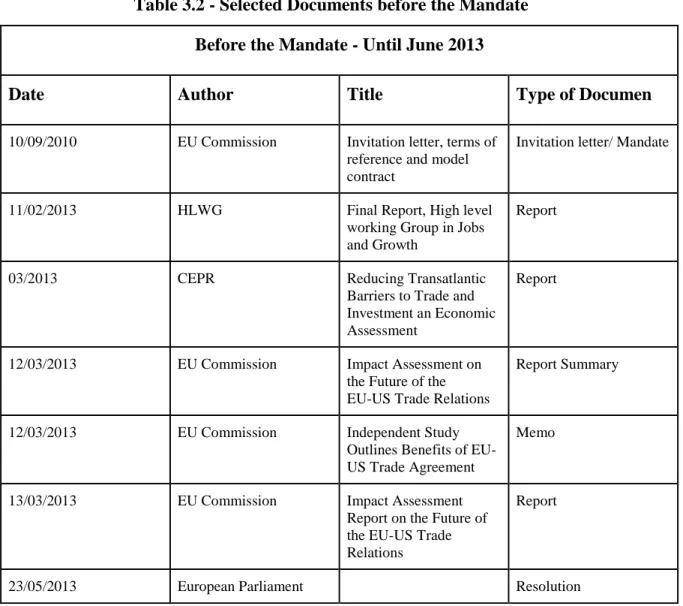
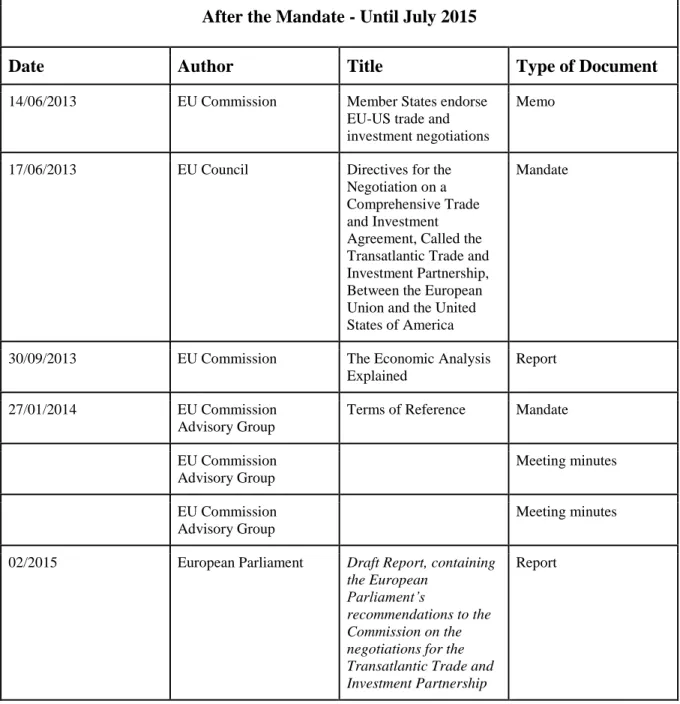
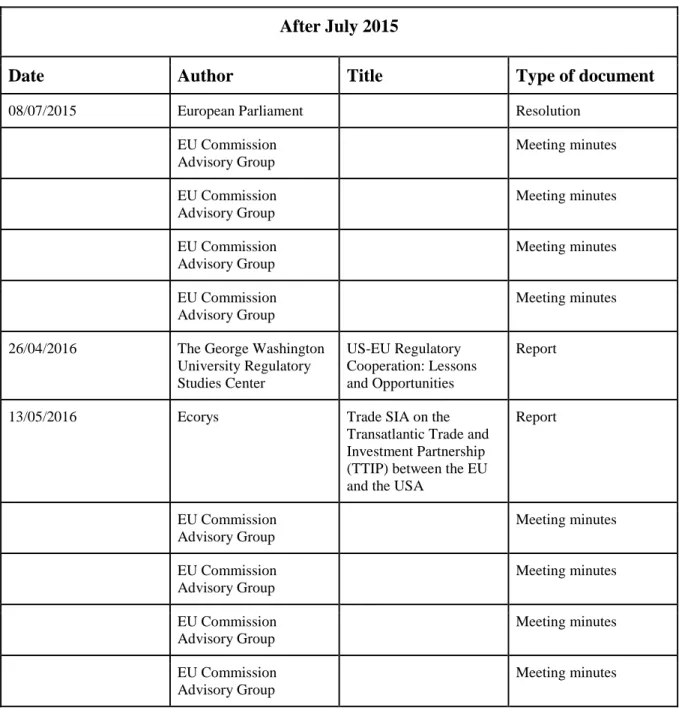
Commission and the European Parliament. Some of the most important documents (not all) are shown in the tables below.
The resolutions of the European Parliament are considered important, since the EP gives hearing to issues of high salience, by representing the European citizens. In addition, the resolutions give insight in knowledge utilization in the European Parliament. The documents selected are presented in chronological order in the tables below. As explained the documents selected are divided in three different time periods, as it is believed that the EP resolutions will display differences in contestation over the subject, caused by increasing issue salience.
Table 3.2 - Selected Documents before the Mandate
Before the Mandate - Until June 2013
Date Author Title Type of Documen
10/09/2010 EU Commission Invitation letter, terms of
reference and model contract
Invitation letter/ Mandate
11/02/2013 HLWG Final Report, High level
working Group in Jobs and Growth
Report
03/2013 CEPR Reducing Transatlantic
Barriers to Trade and Investment an Economic Assessment
Report
12/03/2013 EU Commission Impact Assessment on
the Future of the EU-US Trade Relations
Report Summary
12/03/2013 EU Commission Independent Study
Outlines Benefits of EU-US Trade Agreement
Memo
13/03/2013 EU Commission Impact Assessment
Report on the Future of the EU-US Trade Relations
Report
23/05/2013 European Parliament Resolution
preferences of the European Commission regarding to the framework and to uncover the structure and the mandate of the network. The memo’s included, should provide us with the
preferences and the position of the European Commission in the case of TTIP. The EP resolution is not only used to indicate issue salience and to indicate contestation, but also to determine knowledge utilization by the European Parliament.
Table 3.3 - Selected Documents after the Mandate
After the Mandate - Until July 2015
Date Author Title Type of Document
14/06/2013 EU Commission Member States endorse
EU-US trade and investment negotiations
Memo
17/06/2013 EU Council Directives for the
Negotiation on a Comprehensive Trade and Investment Agreement, Called the Transatlantic Trade and Investment Partnership, Between the European Union and the United States of America
Mandate
30/09/2013 EU Commission The Economic Analysis
Explained
Report
27/01/2014 EU Commission
Advisory Group
Terms of Reference Mandate
EU Commission Advisory Group
Meeting minutes
EU Commission Advisory Group
Meeting minutes
02/2015 European Parliament Draft Report, containing
the European Parliament’s
recommendations to the Commission on the negotiations for the Transatlantic Trade and Investment Partnership
Again the mandate for the European Commission in case of the TTIP-negotiations is important to determine the targets of the Commission, and the memos are included to determine the preferences. Since the focus is on a shift of knowledge utilization, reports of meeting minutes between the expert group and the Commission are included, as well as reports of scientists.
Table 3.4 - Selected Documents after July 2015
After July 2015
Date Author Title Type of document
08/07/2015 European Parliament Resolution
EU Commission Advisory Group
Meeting minutes
EU Commission Advisory Group
Meeting minutes
EU Commission Advisory Group
Meeting minutes
EU Commission Advisory Group
Meeting minutes
26/04/2016 The George Washington
University Regulatory Studies Center
US-EU Regulatory Cooperation: Lessons and Opportunities
Report
13/05/2016 Ecorys Trade SIA on the
Transatlantic Trade and Investment Partnership (TTIP) between the EU and the USA
Report
EU Commission Advisory Group
Meeting minutes
EU Commission Advisory Group
Meeting minutes
EU Commission Advisory Group
Meeting minutes
EU Commission Advisory Group
The second EP resolution included in this analysis is used to indicate issue salience, indicate contestation and to indicate knowledge utilization by the European Parliament. Reports of meeting minutes between the expert group and the Commission, as well as reports of scientists are included to determine knowledge utilization by the European Commission and its function. The gathered data involving expert knowledge is analyzed by doing a content analysis. The information found in the documents is judged based on the indicators of knowledge, which are explained in the next section of this chapter. The data on issues salience is gather through a manual content analysis of the biggest European media webpages.
3.4 Concepts and Operationalization
The expectations are built on the following theoretical concepts: the features of the policy area and the types of knowledge utilization. The conception of the dependent variable, the function of knowledge utilization is borrowed from the literature discussed in the previous chapter (Boswell, 2008; Rimkutė and Haverland 2015; Schrefler, 2010). As discussed, there are three different functions of knowledge utilization (instrumental, legitimizing, substantiating) and in this research the definitions given by Bowell (2008) will be used. Besides these three functions there is also a possibility to not use expert knowledge at all, thus there are four forms of research utilization.
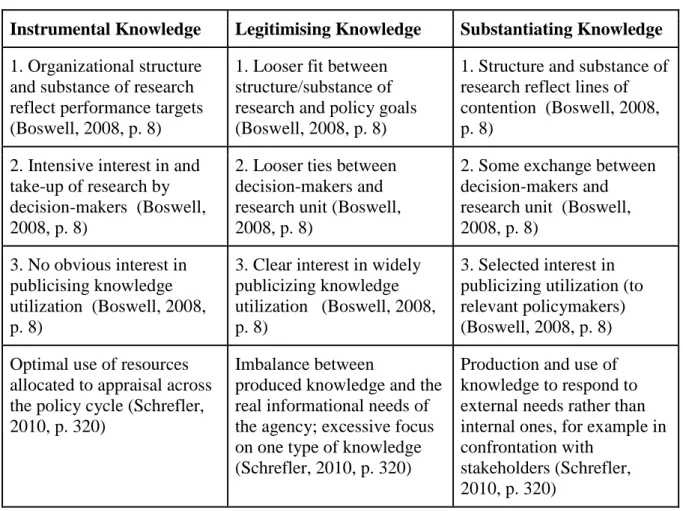
The types of knowledge will be measured by the indicators as they are described in the work of Boswell (2008), the work of Schrefler (2010) and the work of Hunter and Boswell (2015). The first indicator for the function of knowledge, mentioned by Boswell, is the structure and substance of the organization providing expertise: when the organizational structure and the substance of expert corresponds with the performance targets of the organization, this indicates the instrumental function of knowledge; when there is a looser fit between structure/substance of research and the policy goals, this indicates the legitimizing function of knowledge; when the structure and substance of research reflect lines of contention, it indicates
the substantiating function of knowledge (Boswell, 2008, p. 7).
The structure is considered to reflect performance targets when a commission, research
research unit or expert group is composed of figures trusted to act in line with the organization its preferences. Time and resources are granted enough to find supporting evidence for the organization.
The second indicator is the relation between the decision-makers and the expert group (Boswell, 2008). Intensive interest indicates the instrumental function, looser ties indicates the legitimizing function and only some specific interest indicates the substantiating function of knowledge utilization. The relation is considered intensive when a commission, research unit or expert group can operate relatively independent as long as they focus on knowledge that is
useful for the organization (Hunter & Boswell, 2015). Policymakers are highly interested in the knowledge produced and on how it can be transferred into policies (Boswell, 2008). Looser ties are characterized by a high degree of independence for the commission, research unit or expert group, as long as it does not harm their credibility (Hunter & Boswell, 2015). Policymakers are less interested in the findings of the commission, research unit or expert group. Only some specific interest is paid when policymakers focus on the control in terms of reference (Hunter & Boswell, 2015, p. 14), but not on the detailed aspects of the findings or methodology (Boswell, 2008, p. 7).
The third and last indicator described by Boswell (2008), is the interest in publicizing knowledge utilization. This can be scaled: No obvious interest, clear interest, and selected interest, indicating successively the instrumental, legitimizing, and substantiating function of knowledge utilization. In addition to this indicator, Hunter and Boswell (2015) are more specific regarding the interest in publicizing findings of commissions. They argue that the legitimizing function is indicated by not necessarily a clear interest in publicizing the findings, but a clear interest in publicizing the existence of a commission and its composition (Hunter and Boswell, 2015).
All three indicators of Boswell (2008) are presented in figure 3.1, to give a clear overview. The description of the indicators given by Schrefler (2010), also shown in figure 3.1
Figure 3.1 Indicators of Function of Knowledge Utilization
Instrumental Knowledge Legitimising Knowledge Substantiating Knowledge
1. Organizational structure and substance of research reflect performance targets (Boswell, 2008, p. 8)
1. Looser fit between structure/substance of research and policy goals (Boswell, 2008, p. 8)
1. Structure and substance of research reflect lines of contention (Boswell, 2008, p. 8)
2. Intensive interest in and take-up of research by decision-makers (Boswell, 2008, p. 8)
2. Looser ties between decision-makers and research unit (Boswell, 2008, p. 8)
2. Some exchange between decision-makers and research unit (Boswell, 2008, p. 8)
3. No obvious interest in publicising knowledge utilization (Boswell, 2008, p. 8)
3. Clear interest in widely publicizing knowledge utilization (Boswell, 2008, p. 8)
3. Selected interest in publicizing utilization (to relevant policymakers) (Boswell, 2008, p. 8)
Optimal use of resources allocated to appraisal across the policy cycle (Schrefler, 2010, p. 320)
Imbalance between
produced knowledge and the real informational needs of the agency; excessive focus on one type of knowledge (Schrefler, 2010, p. 320)
Production and use of knowledge to respond to external needs rather than internal ones, for example in confrontation with
stakeholders (Schrefler, 2010, p. 320)
The independent variables, the features of the policy area, were already divided into more specific variables. The most important variable that is studied during this analysis is the level of issue salience. As explained there is a difference between public salience, stakeholder salience and political salience (Beyers, Dür and Wonka, 2015). In this study, when “issue salience” is mentioned there is referred to all three forms. Commonly used indicators of issue
3.5 Limitations
The limitations of the design of this research could be found in the difficulty of empirically tracing knowledge utilization. As argued by Weiss (1997) knowledge utilization mostly take place by enlightenment, which means that it affects policies in an indirect manner. This makes it difficult to trace knowledge utilization, especially the instrumental function of knowledge, since this “may not have immediate and practical consequences” (Schrefler, 2010, p. 315).
Another problem that might occur is that the function of knowledge could change over time (Hunter & Boswell, 2015). Schrefler (2010) as example notes that the legitimatizing function
often precede the other two functions.
In addition Hunter and Boswell (2015) argue that organizations will always reason for a problem-solving use of knowledge. Such claims are, according to Brunsson, necessary to contribute credibility tomotivations and legitimacy (as cited in Hunter & Boswell, 2015). The available documents are likely to contain a problem-solving narrative. To address these problems regarding tracing the functions of knowledge utilization, this research focuses not only on the arguments made for using knowledge and how it is used, but also on how expert knowledge came about. In an attempt to trace knowledge utilization as good as possible, the structure of an expert group as well as what goes on within a group is observed.
The design of this research depends mainly on documents available at the time of this analysis. This could be problematic, since this means that it depends largely on documents published by the European Commission itself. Some documents, that can be crucial pieces, could still be classified or just not available. This means that the context or the motivation remains hidden, while these are important for within-case analysis (Toshkov, 2016). For example, the publication of documents by the European Commission does not necessarily means that it is done in their own interest or that they wanted to do it by themselves. It can be done on demands of the European Parliament, influencing some of the indicators used for the independent variable. Even if all documents are published and no information is left out, a
content analysis could be considered not enough. The context in which the documents are published is often difficult to trace. Personal experiences of members of expert groups and staff
members of the European commission are not included, and these could provide us with important information about the context.
4 Results
In this chapter the documents selected and the results concerning issue salience will be analyzed. As explained in the previous chapter, three different periods within the case will be discussed. The discussion takes place in chronological order of the documents, while at the same time issue salience is measured and discussed. The results of the TTIP-case mentioned in the media can be found in the appendix, which gives a complete overview of the media analyzed.
4.1 Knowledge Utilization prior to Negotiations
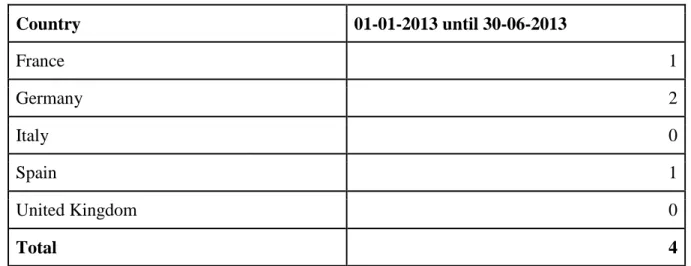
In the period prior to the TTIP-negotiations little attention has been paid to TTIP by the European media. As shown in table 4.1, TTIP is only mentioned four times during this period. Based on the little attention that has been paid, there can be concluded that the time prior to the negotiations is characterized by low issue salience. As expected there is little to no contestation over the subject during this period, as is shown later on in this part of the analysis.
Table 4.1 - TTIP mentioned in European Media
Country 01-01-2013 until 30-06-2013
France 1
Germany 2
Italy 0
Spain 1
United Kingdom 0
Total 4
analysis in support of trade negotiations and trade policy issues (DG Trade, 2010). An important part of the mission of the DG Trade is:
Negotiating bilateral and multilateral trade agreements, ensuring that the rules we agree are actually applied, and working closely with the WTO and other multilateral institutions. This allows us to tackle international trade and customs barriers, backed up where needed with EU legislation. Our aim is to meet the challenges posed by globalisation and to ensure that as many people as possible can seize the opportunities
it offers. (DG Trade, 2010, p.4)
‘The DG Trade gave the mandate “to conduct economic studies, to provide economic
advice on trade dispute cases, to develop analytical tools for trade policy and to contribute to workshops and seminars in support of trade negotiations and trade policy issues” (DG Trade, 2010, p. 5).’ As a result the Centre for Economic Policy Research (CEPR) was rewarded with
a contract to provide economic analysis in support of trade negotiations and trade policy issues (European Commission, 2011). The mandate and the structure of the framework were clear. CEPR was tasked with doing studies, providing advice, developing analytical tools and contributing to workshops in support of trade negotiations and trade policy issues.
The scope and the subject areas that had to be carried out were very broad, but not necessarily unclear. The Commission in their invitation already mentioned a list of subjects that could come up for studies (DG Trade, 2010). Based on the mandate, one could argue that knowledge is used instrumentally, since the Commission is in need for expertise to fill the knowledge gaps. However, substantiating purposes of this framework cannot be excluded, since a slightly predetermined political agenda can be observed.
Regarding the composition of the so called framework, there were some requirements on the qualifications and the technical capacity of the experts involved. For example, team
leaders and senior economist must at least have a PhD-level qualification (DG Trade, 2010). The composition of the unit can be considered suitable to fill the knowledge gaps. The
framework was granted with high independence, but the studies that had to be done “constitute the bulk of the tasks to be carried out under this framework contract” (DG Trade, 2010, p. 6).
In other words the European Commission gave the mandate for specific studies that had to be carried out. The structure of the framework corresponds with the goals of the Commission, “since the studies are meant to give an economic answer to questions related to trade
of the framework contributes to the problem-solving ability of the European Commission. However, this does not exclude the legitimizing or substantiating function, since it can also be seen as lending credibility to their decisions or existence.
CEPR after they were awarded with the contract, published the report “Reducing Transatlantic Barriers to Trade and Investment an Economic Assessment” in March 2013. The
report is based on previous research conducted by Ecorys in 2009, and also commissioned by the European Commission. The outcome of the CEPR study (2013) is in favor of transatlantic trade negotiations. The specific mandate to conduct this study is not available, but it looks like
that the substance of the research fills the existing knowledge gaps. That being said, one could conclude that the DG Trade and therefore the Commission is using expert knowledge in an instrumental way.
Even though a prevalence of the instrumental function can be observed, the other functions of knowledge utilization cannot be excluded completely. The organizational structure and the substance of the research produced casts doubts on the prevalence of a legitimizing function of knowledge. Since the underlying intentions of the European Commission are difficult to trace, not strong conclusion can be made about the substantiating function of knowledge so far.
Around the same time, after the 28 November 2011 EU-US Summit meeting, the High-Level Working Group on Jobs and Growth (HLWG) was established. The HLWG was “tasked to identify policies and measures to increase U.S.-EU trade and investment to support mutually beneficial job creation, economic growth, and international competitiveness” (European
Commission, 2013a, p. 1). The group did not have identifiable members, but consisted of different EU and U.S. bureaucrats and of different experts. The composition of the group, existing of people that can be trusted to act in line with the preferences of the European Commission, indicates a substantiating function of the HLWG.
Despite that the mandate and structure of the group seems unclear, “deadlines were agreed and a series of thematic subgroups went into details in all areas covered” (European
Commission, 2013a, p. 5). This can be considered as an indicator for a clear organizational
structure that corresponds with the performance targets of the European Commission. That being said, there can be concluded that knowledge is used instrumentally. However, it is important to note that this is the narrative of the European Commission.
European Commission are not known. Especially in the case of HLWG, the underlying intentions can be questioned, since it focuses mainly on an agreement between the EU and US and not necessarily on alternatives and on what is best.
To determine whether the European Commission uses knowledge in an instrumental way rather than in a legitimizing or substantiating way, it is necessary to study the Impact Assessment Report on the Future of the EU-U.S. Trade Relations (European Commission, 2013a). This document also contains a recommendation for a Council Decision, authorizing the opening of negotiations on a comprehensive trade and investment agreement, called the
Transatlantic Trade and Investment Partnership, between the European Union and the United States of America.
The European Commission uses the CEPR and the HLWG reports to argue in favor of TTIP and to reject alternatives that could also increase mutual benefits. The CEPR report also asses these alternatives, but are not included in the Impact Assessment of the European Commission. This means that the European Commission has a selected interest in publicizing knowledge, something that indicates the substantiating function of knowledge utilization. This creates the idea that the Commission has predetermined preferences, and that it uses knowledge to accomplish these preferences.
The next step of this analysis is the mandate of the European Council to the European Commission on 17/06/2013. The document itself is published on October 2014, but the negotiating directives were given to the European Commission on June 14th, 2013. This document, in combination with the Commission its memo on the mandate, is important in order to determine the performance targets of the European Commission in the Case of the TTIP-negotiations. Based on the documents related to the mandate, there could be concluded that the target of the European Commission is to negotiate and establish a bilateral trade agreement with the United States of America, that is built on shared principles and values:
The Agreement will exclusively contain provisions on trade and trade-related areas applicable between the Parties. The Agreement should confirm that the transatlantic
trade and investment partnership is based on common values, including the protection and promotion of human rights and international security. (Council of the European Union, 2013, p. 1)
of the European Union, 2013). Further it becomes clear that the Council of the European Union wants the Commission to protect member states’ cultural diversity and the cultural measures
taken by the EU. In short the mandate of the Council of the European Union consist of directives focused on protection of the European Union’s legislation and focused on mutual
economic benefits. The mandate contains also specific directives for particular policy subjects, but the Commission is given a high degree of independence in their attempt to establish such an agreement. The memo on the mandate, written by the European Commission on June 14th 2013, reflects the directives of the Council of the European Union:
Sustainable development will be an overarching objective. We aim to ensure that the agreement respects international environmental and labor agreements and standards, and promotes high levels of protection for the environment, workers and consumers. We will not encourage trade or investment by lowering any such standards. (European Commission, 2013b, p. 1)
Based on the memo there could be concluded that the directives were set out in broad terms and that the Commission enjoys great independence in setting up the proposals related to TTIP. The Commission states that it is aware of the importance to foresee the Council and the EP from information during the process, something the EP reminds the Commission of in their resolution of May 23th, 2013.
The resolution of the European parliament, does not present any confliction position between the EP and the European Commission, since it relies heavily on the CEPR study and on the work of the HLWG. The resolution does not contain any evidence of the contribution of new expert knowledge by the European Parliament. This does not necessarily mean that the EP completely depends on knowledge provided by the Commission, but it makes it difficult to trace knowledge utilization. Therefore it is difficult to conclude which function of knowledge
utilization the European Parliament used during this period. The indicators of the function of knowledge utilization are rather useless in this situation. However, based on the indicators it is
There can be concluded that the period until the given mandate is characterized by low issue salience and low contestation. Based on the available documents relating expert knowledge, all functions can be observed. The documents on CEPR indicate a prevalence of the instrumental function of knowledge. However, the findings of CEPR were used to sustain the Commission its preferences. The substantiating function of knowledge can also be observed in the structure of the HLWG and the utilization of its findings. To conclude the European Commission uses both, the instrumental and substantiating function of knowledge. It is difficult to draw strong conclusion on knowledge utilization in the European Parliament, since they rely
mainly on the research provide by the European Commission. Based on the indicators of the function of knowledge utilization the only function that cannot be excluded is the legitimizing function, and therefore the EP is likely to use knowledge in a legitimizing way in this specific period.
4.2 Knowledge Utilization after the Mandate
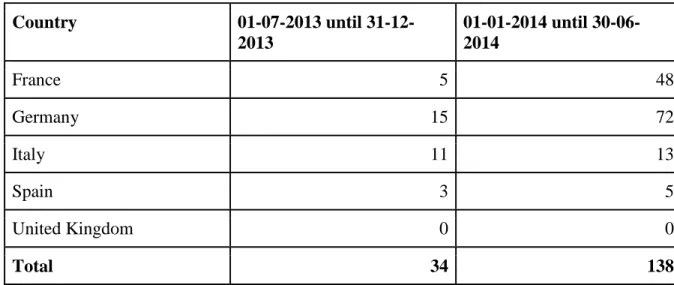
In the second half of 2013 the European media does not pay much attention to TTIP, as shown in table 4.2. TTIP is only mentioned 34 times and therefore there could be argued that the TTIP-negotiations are still of low issue salience. This differs from the first half of 2014, TTIP is mentioned 138 times during this period and a slightly increasing issue salience is measured.
Table 4.2 - TTIP mentioned in European media
Country 01-07-2013 until
31-12-2013
01-01-2014 until 30-06-2014
France 5 48
Germany 15 72
Italy 11 13
Spain 3 5
United Kingdom 0 0
Total 34 138
group was setup to provide EU TTIP negotiators with technical and practical advice on areas under negotiation (European Commission, 2014a).
The group is chaired by the EU TTIP chief negotiator and consist of different experts representing different fields of interest. The experts involved are not academic experts, but rather interest group representatives. As can be observed from the group details, presented by the European Commission, no individual expert is appointed in his or her personal capacity (European Commission, n.d.-b). However, according to the group details, each individual is an expert in their field of interest, as well as in EU trade policy. Meetings of the expert group take
place on initiative of the EU TTIP chief negotiator, generally in between the negotiation rounds or at the request of at least five members. This resulted in seventeen meetings of the expert group until July 2015. Based on the composition of the group, there could be concluded that the structure of the expert group indicates the legitimizing or substantiating function of knowledge rather than that it contributes to the problem-solving ability of the European Commission. The group is composed of figures that are considered authoritative in their field of interest, this indicates the legitimizing function of the group. The substantiating function and instrumental function cannot be excluded based on the structure of group. The fact that the group is chaired by the chief negotiator could indicate both functions. It indicates the instrumental function, since the chief negotiator is expected to know precisely where the knowledge gaps are and what knowledge is useful during the negotiations. At the same time it indicates the substantiating function, because the chief negotiator is a figure that is trusted to act in line with the Commission its preferences.
However, one could argue, by looking at the mandate of the group, that the European Commission uses the legitimizing function of knowledge. The goal of the group is to exchange thoughts on different aspect of TTIP and the problems that might arise, examining specific questions related to the negotiations. “The aim is not necessarily to reach consensus, but to
shed light on issues of importance in the negotiations through frank and focused discussion of different perspectives” (European Commission, 2014a, p. 2). The scope and the subject areas
that had to be carried out were very broad, and during the first two meetings it was to some
members unclear (European Commission, 2014b&c). The lack of design becomes clear during one of the meetings of the group. ‘As is noted during the meeting of 12 June, “this Advisory
of the expert group.The unclear design and mandate implies that the expert group is used as a source of legitimation.
The intensive interest in the expert group might indicate an instrumental function of knowledge utilization. However, one could argue that there is an imbalance between the “produced” knowledge and the real informational needs of the European Commission. This
indicates the legitimizing function of knowledge utilization. The legitimizing function of the expert group is also indicated by the focus on publicizing the existence of the group rather than publicizing their findings. Based on the three indicators of the function of knowledge
utilization, there could be concluded that the expert group has a legitimizing function.
In April 2014 the final inception report of Ecorys on “Trade Sustainability Impact Assessment (Trade SIA) in support of negotiations of a comprehensive trade and investment agreement between the European Union and the United States of America” is published. This
report is produced after Ecorys was awarded with the contract to do a Trade Sustainability Impact Assessment on TTIP. The invitation to tender related to a contract to provide this assessment was published in July 2013 and contains some important information on the organizational structure of the research unit.
‘The mandate given by the DG Trade is to provide a “Trade Sustainability Assessment
in support of negotiations of a comprehensive trade and investment agreement between the European Union and the United States of America” (DT Trade, 2013, p. 10).’ Within a year
three different self-standing reports have to be produced by the contractor, containing recommendations to maximize the benefits and to minimize the negative consequences of the trade agreement (DG Trade, 2013). Important to note is that the DG Trade (2013), in the invitation stresses that the contractor is not tasked with redoing the analysis of CEPR. Based on the mandate, several conclusions can be made. There could be argued that the mandate shows that there is already a clear political agenda in the invitation letter of the DG Trade. The focus of the contractor should be on supporting the trade negotiations and on making
recommendations. One could argue that this mandate indicates the substantiating function of expert knowledge. However, since the assessment should be carried out during the negotiations
it can be of great value to the Commission, to increase its output and to strengthen its position in the negotiations. This is an indicator for the instrumental function of knowledge.
field of interest. The composition of the unit can be considered suitable to fill the knowledge gaps. Based on the structure, there could be argued that the research unit contributes to the problem-solving ability of the European Commission.
The research unit was appointed a steering committee that is tasked with supporting and monitoring the work of the contractor. The committee is responsible for “reviewing and commenting upon the content, quality and reliability of the reports” (DG Trade, 2013, p. 19). The actual role and influence of the committee cannot be assessed based on the available documents. However, one could argue that the steering commission is tasked to make sure that
the focus is on producing useful knowledge that can transfer into policies, contributing to the problem-solving abilities. Based on the first two indicators, there could be concluded that the instrumental function of knowledge prevails. The legitimizing function cannot be indicated, but there are some signs of the substantiating function of knowledge. The controlled interest of the DG Trade in terms of reference could indicate the substantiating function of knowledge. The third indicator seems rather useless, since knowledge utilization itself cannot be traced in the documents.
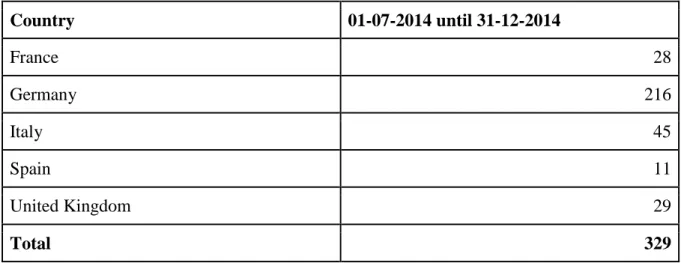
During this time the first signs of increasing issue salience occur. As already shown in table 4.2, TTIP is already mentioned 100 times more by the media than in 2013. Table 4.3 shows that in the second half of 2014 this has increased again. As expected, more contestation over the subject is observed during periods of higher issue salience. In 2014 on July 15, 148 organizations from eighteen different European member states filed an application of the ECI STOP TTIP, in order to stop the TTIP-negotiations (STOP TTIP, n.d.). This does not only highlight the increase of salience, but it also indicates contestation.
Table 4.3 - TTIP mentioned in European media
Country 01-07-2014 until 31-12-2014
France 28
Germany 216
Italy 45
Spain 11
United Kingdom 29