TEKS
REVIEW
What safety procedures should be followed
during investigations?
Because laboratory and field investigations often involve the use of hazardous or potentially hazardous materials and equipment, the risk of accidents or injury is always present. However, by following some general safety practices and procedures during investigations, accidents and injuries can be prevented.
Basic safety requirements for working in the laboratory include
knowing emergency procedures and the locations of all safety equipment, following directions, and never working in the laboratory alone. It is also important to be aware of the hazards and handling procedures for all the materials and equipment you use. Other important safety policies are listed in Figure 1.
Demonstrating Safe Practices
1A
TEKS 1A
Demonstrate safe practices during laboratory and field investigations, including the appropriate use of safety showers, eyewash fountains, safety goggles, and fire extinguishers.
Figure 1
• Notify the teacher of any sensitivities or allergies to chemicals or other substances.
• Do not leave an experiment unattended.
• Never chew gum, eat, or drink in the laboratory. • Always wear shoes and avoid wearing loose-fitting
clothing and dangling jewelry.
• Secure long hair and loose clothing; roll up loose sleeves when working with burners or flames. • Inspect all equipment for damage prior to use; do
not use damaged equipment.
• Keep the floor clear of all objects such as personal items, spilled liquids, and any other item that may cause someone to trip or fall.
• Never point the open end of a test tube containing a chemical at other people.
• Do not touch any chemical with your hands. • Never inhale chemical vapors by placing the
container directly under your nose.
• Never pour chemicals down the sink drain unless you’ve been specifically instructed to do so. • When diluting an acid, always pour the acid
slowly into the water, stirring to dissipate the heat. CAUTION: Never pour water into a concentrated acid.
• Know the location of all emergency exits in the laboratory and the building.
• Wash your hands with soap and water at the end of each investigation.
Laboratory Safety Do’s and Don’ts
TEKS 1A • Copyright © Pearson Education, Inc., or its affiliates. All Rights Reserved. 1
Study Tip
Look for all symbols that represent safety
equipment and
protective devices in the laboratory. Learn the meaning of the symbols and purpose of each device so that you can act quickly in an emergency.
What is the appropriate use of important
safety equipment?
Safe practices should always be the highest priority during laboratory and field investigations. Each person has a responsibility to learn the dangers that may be present while working in the laboratory and the purpose and operation of all emergency safety equipment. Although everyone should know how to use safety equipment, a teacher’s instructions should always be followed in an emergency.
One of the most important safety practices is to be familiar with the proper use of protective safety devices. These devices include safety showers, fire blankets, eyewash fountains, safety goggles, aprons, gloves, and fire extinguishers. Such knowledge is vital to responding to accidents and to eliminating the risk of serious personal injury.
When is it appropriate to use a safety shower
or fire blanket?
Whenever the skin or clothing is exposed to a significant amount of corrosive or toxic chemicals, the contaminants must be immediately washed away with large quantities of water. An emergency safety shower is the most effective way to quickly eliminate contaminants on your skin or clothing and avoid injury. In any circumstance in which the use of a safety shower is necessary, it is important to act quickly and remove any affected articles of clothing to avoid further exposure. Once the hazardous
materials have been washed away, obtain medical attention immediately. If clothing or hair catches fire, do notrun because running fans flames. A fire blanket can be used to smother flames. Or, a safety shower can be used if there is one nearby.
When is it appropriate to use safety goggles?
As a rule, safety goggles should be worn at all times in the laboratory and during field investigations. During an experiment, it is likely you will use wet or dry chemicals. There is a constant danger of splashes or particles entering the eye. Safety goggles can also help protect eyes from damage due to explosions and flying debris.
When is it necessary to use an eyewash
fountain?
Even though the use of safety goggles is required, eyewash fountains are located in all laboratory environments where the eyes may be exposed to hazardous chemicals. In the event that one or both eyes are exposed to a hazardous substance, an eyewash fountain should be used without delay. Hold the eyelids open, and flush the affected eyes thoroughly for several minutes to ensure the substance has been purged. Then seek immediate medical attention.
TEKS 1A • Copyright © Pearson Education, Inc., or its affiliates. All Rights Reserved. 2
What types of fire extinguishers are
appropriate for use in laboratory
environments?
Not all fires are the same, and no single fire extinguisher works on every type of fire. Fires are designated by type and listed by class. The most common fire classifications, combustibles, and appropriate extinguishing agents are shown Figure 2.
Water extinguishers are never used in the laboratory as they are rated only for Class A fires. The use of a water extinguisher on a Class B, C, or D fire in the laboratory or field is extremely hazardous. Pouring water on fires involving combustible liquids, electrical equipment, or combustible metals may spread the fire or make it worse.
End-of-Course Assessment Review
1. Classify If isopropyl alcohol were to catch fire in the laboratory, what class fire would this be?
A. Class A
B. Class B
C. Class C
D. Class D
2. Infer If an electric hot plate caught fire in the lab, which class of fire extinguisher would you use and why?
3. Differentiate What is the appropriate personal safety response to a significant amount of corrosive liquid chemical splashed on clothing?
4. Evaluate A student says that he does not need to wear safety goggles for an experiment because no liquid chemicals are being used. What would your response be to this student?
TEKS
Figure 2
Ordinary materials such as paper, wood, cardboard, and plastics
Flammable or combustible liquids such as gasoline, kerosene, and most organic solvents Electrical equipment
Combustible metals such as magnesium, potassium, and sodium
Dry chemical
CO2 or dry chemical
CO2 or dry chemical Dry powder agents A
B
C D
Fire Classifications, Combustibles, and Extinguishers
Class Combustibles Extinguishing Agent
TEKS 1A • Copyright © Pearson Education, Inc., or its affiliates. All Rights Reserved. 3
TEKS
REVIEW
Why is it important to know specific hazards
of chemical substances?
Before working with any chemical substance, it is important to be thoroughly familiar with its properties, specific hazards, safety
precautions, and handling procedures. Hazardous chemical substances are generally classified according to their hazard types as listed in
Figure 1 below.
What are Material Safety Data Sheets (MSDS)?
Material Safety Data Sheets (MSDS) are data forms that contain detailed information on the properties, hazards, and health effects of chemical substances. MSDS also provide guidelines for the safe handling, storage, and disposal of hazardous substances. The sheets are prepared and made available by chemical suppliers.The U.S. Occupational Safety and Health Administration (OSHA) requires the presence of MSDS wherever hazardous materials are produced,
shipped, or used. These locations include all chemistry laboratories. An MSDS includes the information listed in Figure 2.
Hazards of Chemical Substances
1B
TEKS 1B
Know specific hazards of chemical substances such as flammability, corrosiveness, and radioactivity as summarized on the Material Safety Data Sheets (MSDS).
Vocabulary
Material Safety Data Sheets (MSDS) flammable substance corrosive substance radioactive substance
Figure 1
TEKS 1B • Copyright © Pearson Education, Inc., or its affiliates. All Rights Reserved. 4
Flammable/Combustible Liquids
Corrosives
Oxidizers
Water Reactives Pyrophorics
Peroxide-forming
Compressed Gases
Cryogens
Generate vapors that will burn when ignited
Corrode metal and damage living tissues (acids, bases, and others)
Cause other materials to combust
React with water to form heat and flammable gases Ignite spontaneously in air
Explodes if subject to shock or sparks
Disperse forcefully and quickly if released
Freeze human tissue quickly (super-cooled fluids)
Hazardous Chemical Substances
Type of Hazard Description
Acetone Methanol Sulfuric acid Sodium hydroxide Bromine
Hydrogen peroxide Alkali metals Diethylzinc Diphsophine Isoprophyl ether Potassium amide Oxygen
Acetylene Liquid nitrogen
Examples
Chemical Identity Manufacturer
Hazardous Ingredients Physical/Chemical Characteristics
Fire & Explosion Hazard Reactivity
Health Hazard
Safe Handling & Use
Control Measures
Name, weight, and chemical formula Name, address, and phone number Hazardous components by chemical identity
Boiling point, vapor pressure, melting point, and other physical and chemical properties
Flash point, flammability limits, extinguishing method, and firefighting procedures Stability, a list of materials and conditions to avoid, and hazardous by-products Routes of physical entry such as inhalation, ingestion, or skin, symptoms of exposure, and emergency/first aid procedures
Precautions for handling and storage, and steps to be taken if a spill or release occurs
Protective measures for handling
Material Safety Data Sheets
Section Description
1
Health Instability
2
3
Flammability Specific Hazards 0 Low 1 Slight 2 Moderate 3 High 4 ExtremeIn addition to Materials Safety Data sheets, many hazardous materials are also labeled with a “hazard diamond”, published by the National Fire Protection Association (NFPA). The NFPA warning label rates materials for health (blue), flammability (red), and instability (yellow). The three color-coded sections range from 0 (the least severe hazard) to 4 (the most severe hazard.) The bottom section is usually blank. It may be used to present specific hazards or special fire-fighting measures.
What are the specific hazards of flammable,
corrosive, and radioactive substances?
Flammables A flammable substance gives off combustible vapors that can easily ignite. Flammables include solids, liquids, and gases. These substances have a flash point of below 100º F. Their vapors can ignite at temperatures near room temperature.
As their MSDS specifies, flammable substances should only be used only with proper ventilation and away from heat, electric sparks, and flames. Flammable substances should also be stored in approved fire-retardant storage cabinets and should never be placed near corrosives. Flammable substances include diethyl ether, acetone, gasoline, toluene, and methyl alcohol.
Corrosives A corrosive substance is a compound that is highly reactive and will cause serious damage to living tissue. The MSDS for corrosives include warnings against contact with skin, eyes, or any part of the body. They also recommended first aid measures that include flushing a
damaged area with water for up to 15 minutes, followed by immediate medical attention. Corrosives should be stored in well-ventilated areas and away from flammables and heat. Typical corrosives found in laboratories include sulfuric acid, hydrochloric acid, and sodium hydroxide.
Figure 2
Figure 3
“Hazard Diamond”
Study Tip
Review the MSDS of chemicals that you use in the laboratory. Become familiar with the format and the information presented in the forms.
TEKS 1B • Copyright © Pearson Education, Inc., or its affiliates. All Rights Reserved. 5
1
Health Instability
2
3
Flammability Specific Hazards 0 Low 1 Slight 2 Moderate 3 High 4 ExtremeTEKS 1B • Copyright © Pearson Education, Inc., or its affiliates. All Rights Reserved. 6
Radioactivity A radioactive substance spontaneously emits ionizing radiation. These substances include solids, liquids, and gases. Depending on the level of radioactivity of the substance and the level of exposure, ionizing radiation can damage cells, injure tissues and organs, and can lead to cancer.
Use of radioactive materials is tightly controlled. Anyone who uses
radioactive substances must be trained and certified. As with all hazardous substances, the MSDS provides safe handling procedures and safety
precautions, as well as first aid and containment measures.
End-of-Course Assessment Review
1. Infer The reason that radioactive substances are dangerous is
A they will react violently with other chemicals.
B the radioactivity will spread to any chemical placed nearby.
C they can burn in air.
D the radioactivity can damage living cells.
2. Identify Which is a characteristic of a corrosive substance?
A The substance forcefully and quickly disperses if released.
B The substance quickly freezes human tissue.
C The substance seriously damages skin cells on contact.
D The substance causes other materials to combust.
3. Evaluate While some students are working in the lab, one student spills a corrosive substance and asks the others to help him mop it up with paper towels and carry them to the trash can. Another student objects and says they should warn everyone nearby and inform the instructor. Which approach is the appropriate safe response, and why?
4. Infer Give at least one reason why diethyl ether, a flammable liquid, should not be stored in a commercial refrigerator.
5. Evaluate Why is storing chemicals in alphabetical order not a safe approach?
TEKS
TEKS
REVIEW
TEKS_TXT
Demonstrate an understanding of the use and conservation of resources and the proper disposal or recycling of materials.
1C
Conservation of Resources
and Proper Disposal
TEKS 1C
Why is the conservation of resources
and proper disposal or recycling
of materials important?
Most natural resources are limited. Conservation of these resources will ensure that they are available for future generations. Similarly, proper disposal or recycling of waste materials is essential to maintaining human and environmental health. Figure 1 is the universal sign for recycling. But even if you see this symbol, always follow your teacher’s instructions regarding proper disposal or recycling of materials in the laboratory. Waste reduction is especially important in a chemistry laboratory. Chemistry experiments involve many chemicals and they may produce hazardous wastes. One way to reduce waste is to use the smallest amounts of chemicals required whenever possible. Another way to reduce waste is to use materials that can be recovered, or recycled, instead of being discarded.
When chemicals cannot be recycled, disposal must follow strict guidelines and comply with local, state, and federal regulations. These regulations were implemented to avoid the health problems and expense caused by pollution and contamination. By effectively managing the use of materials through conservation and recycling, and by properly disposing chemical waste, both human health and the environment can be protected.
What are the proper ways to reuse and
recycle materials in the laboratory?
Many materials used in the laboratory can be reused after thorough cleaning and safe removal of chemical residues. These materials include containers and instruments made of sturdy glass, plastic, and metal. Materials that cannot be reused, but can be recycled, should be collected and sent to recycling plants. Recyclable items should always be discarded in containers designated for each type of material.
Before placing items in recycling containers, care should be taken to make sure they are decontaminated. Decontamination is the removal of
hazardous compounds. Decontamination should only be performed under the supervision of your teacher or qualified laboratory personnel.
Vocabulary decontamination
Figure 1
Recycling Symbol
TEKS 1C • Copyright © Pearson Education, Inc., or its affiliates. All Rights Reserved. 7
Some chemicals used in the laboratory can also be reused or recycled. Solvents such as acetone, methanol, and toluene are routinely reused because they can easily be purified. Chemicals that cannot be purified in the laboratory may still be good candidates for recycling because of the value of the chemical. For example, solutions containing silver ions are frequently recycled because silver is very expensive. Designated containers should always be used for each chemical to be recycled because mixing certain materials can be extremely hazardous.
What are the proper ways to dispose
of materials in the laboratory?
Whenever chemical substances and equipment are used in the laboratory, some waste will be generated. Because of the potential risks, very little laboratory waste can be disposed of in public waste containers. However, some laboratory consumables—materials that cannot be recycled and were not exposed to chemicals—may be discarded as regular trash. Your teacher will tell you which, if any, of the lab materials you use can be disposed of in the regular trash.
Hazardous or toxic chemical wastes must be disposed of separately and according to proper guidelines for safe disposal. They also must be properly labeled. The manner in which hazardous materials are disposed of is determined by the reactive properties of each substance. The
recommended disposal method for a substance is provided on its Material Safety Data Sheet (MSDS).
Chemicals such as dilute acids, bases, and certain organic compounds can be discarded by pouring them down the drain with large quantities of water. Materials that are acceptable for this disposal method are water soluble, have very low toxicity, and, if organic, are readily biodegradable. However, this type of disposal should only be performed with the
approval of your teacher and after a thorough review of disposal
guidelines. Figure 2 shows one example of a warning that may be found posted on some laboratory sinks. In some situations, no chemicals can be poured down a drain.
Some hazardous chemical wastes can be neutralized, or made
non-hazardous. Wastes that cannot be neutralized must be shipped to a hazardous waste landfill by a licensed company approved by the
Department of Transportation. You will most likely not be working with this type of chemical wastes in your chemistry labs.
Disposal of all hazardous chemical wastes must comply with local, state, and federal regulations. The federal agencies responsible for regulating waste disposal are the U.S. Environmental Protection Agency (EPA) and the Occupational Safety and Health Administration (OSHA). Failure to properly dispose of chemical wastes is dangerous and unhealthy, and can result in fines and lawsuits.
Figure 2 No Disposal Sign
NOTICE
DO NOT
DUMP CHEMICALS DOWN THIS DRAINStudy Tip
Think about the lab investigations you performed throughout the year. Recall the disposal methods used for various chemicals and other materials.
TEKS 1C • Copyright © Pearson Education, Inc., or its affiliates. All Rights Reserved. 8
End-of-Course Assessment Review
1. Identify A student uses a glass beaker to mix hydrochloric acid and water in an experiment. After the experiment is complete, should she place the beaker in a recycling bin suitable for glass?
A Yes. Glass beakers should always be recycled after any use.
B No. The beaker should be discarded in the trash.
C Yes. Hydrochloric acid is dangerous and any item that contains it should be recycled immediately.
D No. Glass beakers are reusable. They can easily be cleaned after an experiment and stored.
2. Analyze A researcher finishes an experiment and is unsure of how to dispose of a particular chemical. Which of the following describes the safest approach?
A Contain the chemical tightly and put it in the trash.
B Combine it with other chemical waste.
C Label the chemical as “Waste” and leave it out for someone else to dispose of.
D Refer to the chemical’s MSDS for the recommended disposal method.
3. Evaluate At the end of a laboratory experiment, a student disposes of all liquid chemicals by flushing them down the sink drain with water. Explain what is wrong with this action.
4. Demonstrate Understanding During an investigation, Evan spills some compound on the lab table. His lab partner tells him that the compound should be recycled. Evan collects the substance and disposes of it in a container marked for general recycling. Explain two mistakes Evan made.
5. Infer Why would a laboratory never have a single container for all waste chemicals?
TEKS
TEKS 1C • Copyright © Pearson Education, Inc., or its affiliates. All Rights Reserved. 9
TEKS
REVIEW
What is the definition of science?
Science is the use of evidence to construct testable explanations and predictions of natural phenomena, as well as the knowledge generated through this process. In other words, science is the study of the natural and physical world using physical, mathematical, and conceptual models. Scientific explanations must be both testable and falsifiable—able to be proven incorrect. Observation, experimentation, research, and the use of models produce evidence that allow scientists to understand natural phenomena. Scientists study patterns and make predictions about natural phenomena and processes to understand how the world works.
In many cases, because of the use of observation, experimentation,
research, and models, scientists can predict the results of a natural process even if they do not have all the information about that process. Many explanations of natural processes are accepted as valid because there is so much evidence supporting them, and because they have been observed and/or tested under a wide variety of conditions. When scientific explanations have been tested and widely accepted, predictions about future events usually end up to be accurate.
Science is not the same as technology. Technology is the application of science, often for industrial or commercial uses. Science identifies how or
why a natural or physical phenomenon occurs. Technology identifies how to
apply that phenomenon for a practical use.
Why study science?
There are many different reasons why people study science. Chemists might study compounds for potential use in medicines. Meteorologists might study weather patterns to predict hurricanes and tornadoes. Geologists might study natural processes to recognize how events in the past might influence events, such as earthquakes, in the future. Doctors, dentists, veterinarians, nurses, and pharmacists study science to provide health care to you and your pets. Physicists study the physical world from the smallest of particles to the vastness of the universe. What would you be most interested in studying through science?
Definition of Science
2A
TEKS 2A
Know the definition of science and understand that it has limitations, as specified in subsection (b)(2) of this section.
(b)(2) Nature of science. Science, as defined by the National Academy of Sciences, is the “use of evidence to construct testable explanations and predictions of natural phenomena, as well as the knowledge generated through this process.” This vast body of changing and increasing knowledge is described by physical, mathematical, and conceptual models. Students should know that some questions are outside the realm of science because they deal with phenomena that are not scientifically testable.
Study Tip
Remember that scientific concepts must be part of the natural and physical world and must be testable and falsifiable. Concepts that do not fit into these categories are not scientific.
TEKS 2A • Copyright © Pearson Education, Inc., or its affiliates. All Rights Reserved. 10
J. J. Thomson’s model,
about 1904 Ernest Rutherford’smodel, 1911 model, 1913 Niels Bohr’s
Modern Model
+ +
What are the limitations of science?
Because science is the study of natural and physical phenomena, science has limitations. Science is not emotion, art, or feeling. Science cannot determine which painting is more appealing or who is the best choice for president. Science cannot answer questions regarding faith or personal feelings. Such phenomena are outside the realm of science because they are not scientifically testable. Science can provide information, but
non-scientific factors decide how we use science.
Current scientific knowledge is limited to the information presently known about the natural and physical world. This is why all scientific hypotheses and models are subject to change. As we learn new information, current scientific understandings sometimes become outdated. As new information becomes available, new technologies may also arise, making old
technologies obsolete.
For example, Figure 1 shows how scientists’ model of the atom has
changed over time. As scientists conducted new experiments and gathered new evidence and data, they discarded older models of the atom in favor of revised or new models. Each newer model supported the new
information that scientists had gathered.
Figure 1
A Changing Model of The Atom
TEKS 2A • Copyright © Pearson Education, Inc., or its affiliates. All Rights Reserved. 11
TEKS 2A • Copyright © Pearson Education, Inc., or its affiliates. All Rights Reserved. 12
Many ideas and explanations that are currently known about the natural and physical world are a result of the use of physical, mathematical, and conceptual models. Sometimes a process or idea is too large (such as the universe) or too small (such as atoms) to be studied directly, or because it is too dangerous or too expensive to be studied directly. It is important to note that models never represent a process or idea perfectly, and will change as more knowledge is gained through additional scientific research. As models become more sophisticated, they can more accurately predict the system they are concerned with.
End-of-Course Assessment Review
1. Define Which of the following questions is not a scientific question?
A What caused dinosaurs to become extinct?
B How is hydrochloric acid produced and contained in the stomach?
C How are atoms of nitrogen different from atoms of carbon?
D Was Isaac Newton the greatest scientist that ever lived?
2. Define The circuitry for computers was invented after scientists learned how electrons flow through certain materials, such as silicon. Computer circuitry is an example of
A a prediction.
B a limitation of science.
C technology.
D a model.
3. Evaluate Your friend tells you that commercial space travel to other planets will never be possible. The technology to get people into space is too expensive, too dangerous, and too complicated. Knowing what you know about science, what would you tell your friend?
4. Compare and Contrast Describe an area of study that is not
science. Write three to five sentences describing why the area you chose is not science and how it could be changed to qualify as science.
TEKS
TEKS
REVIEW
Study Tip
The root words
contained in hypothesis tell you the meaning of the word. Hypo- means “under,” and -thesis means “proposition.” In a way, a hypothesis is an underlying proposition for an experiment or observation.
TEKS_TXT
Know that scientific hypotheses are tentative and testable statements that must be capable of being supported or not supported by observational evidence. Hypotheses of durable explanatory power which have been tested over a wide variety of conditions are incorporated into theories.
2B
Scientific Hypotheses
TEKS 2B
What is a scientific hypothesis?
Suppose you slice an apple in half. You place half the apple in the refrigerator, and set the other half on the counter and leave the room. When you return an hour later, you notice that the apple half on the
counter has turned brown. You look in the refrigerator and observe that the half of the apple you placed inside is only slightly brown. You recall that a change in color of a substance can be an indicator that a chemical reaction has taken place. After observing both apple halves, you hypothesize that the chemical reactions that cause an apple to brown occur more quickly at higher temperatures.
In the example above, you developed a tentative explanation, or scientific hypothesis, for why the apple half on the counter undergoes a chemical reaction more quickly than the half in the refrigerator—chemical reactions that cause an apple to brown occur more quickly at higher
temperatures. A scientific hypothesis is a tentative statement or explanation for an observation in nature. Scientific hypotheses are capable of being tested and supported, or not supported, through further observation and experimentation.
Why must a scientific hypothesis be testable?
Typically, once a scientific hypothesis is stated, the next step is to develop an experiment or conduct observational research to identify evidence that either supports or does not support the hypothesis. This is because a hypothesis has no meaning unless there is observational evidence or data that supports it. For example, the scientific hypothesis, “Chemical reactions
that cause an apple to brown occur more quickly at higher temperatures” has no
meaning without an experiment or data to support it. Therefore, a scientific hypothesis must be testable. Then, information and evidence gathered can be analyzed to draw conclusions about the hypothesis. In some cases, a hypothesis will be supported by the evidence that accumulates. In other cases it will not be supported.
Vocabulary Hypothesis
TEKS 2B • Copyright © Pearson Education, Inc., or its affiliates. All Rights Reserved. 13
Make an
observation scientific hypothesis Form a based on the
observation
Yes: Repeat experiment or gather additional
data to confirm.
Gather observational evidence and data or develop an experiment
to test the hypothesis
Is the hypothesis supported?
No: Modify or reject the hypothesis
Figure 1 Development of a Hypothesis
What if a scientific hypothesis is supported?
Suppose you design a scientific experiment to test the effect of temperature on the rate of the chemical reactions that cause an apple to brown. If you find that your experiment supports your hypothesis, are you finished? Not quite. The experiment should be repeated several times to confirm the results and to ensure that no errors have been made. Additionally, a hypothesis should be tested over a variety of conditions to confirm that all variables have been considered that might alter the results. In the best scientific tradition, it is also important to have others repeat the experiment separately to confirm the results. It is always possible that a single
investigator may accidentally introduce some form of bias into the results. The more investigators who have been able to replicate the results, the less likely it will be that any bias is involved.
Hypotheses that have undergone significant testing by multiple independent scientists over a variety of conditions can be said to have durable explanatory power—that is, they have stood up to multiple tests by many scientists. If hypotheses have been consistently supported through multiple tests, they are incorporated into a theory (if one exists) related to its given topic. At that point, additional research and tests are often devised in attempt to ensure that the revised theory is supported under all known conditions.
What if a scientific hypothesis
is not supported?
On the other hand, suppose the experiment did not support the
hypothesis. Was the experiment then a failure? Not necessarily. A scientific investigation is never a failure, as long as it leads to information and knowledge you did not previously have. But if it is not supported, the original hypothesis itself is not very useful for making predictions or understanding observations, so it is typically modified, or in some cases, discarded. If it is modified, the cycle begins again with additional
observational research and data or a new experiment to test the modified hypothesis. This cycle of development is illustrated in Figure 1.
TEKS 2B • Copyright © Pearson Education, Inc., or its affiliates. All Rights Reserved. 14
Why is a scientific hypothesis only
a tentative explanation?
It is important to note that hypotheses are only tentative explanations and are not proven facts, regardless of how many experiments and
observations support the hypothesis. This is because as new data and evidence become available, a hypothesis may need to be revised or even rejected altogether. As such, a hypothesis can never be proven true or accepted as absolute truth. It can only be supported through further observation, evidence, and experimentation.
End-of-Course Assessment Review
1. Infer Which of the following is a logical next step if a scientist’s repeated experiments do not support his hypothesis?
A Alter the experiment so that the hypothesis would be supported.
B Incorporate the scientific hypothesis into a theory.
C Modify the hypothesis and conduct a new experiment.
D End the failed investigation.
2. Identify Why can a scientific hypothesis never be proven true?
A A scientific hypothesis is unreliable.
B Supporting evidence is difficult to identify.
C New information might become available that contradicts the scientific hypothesis.
D It is impossible to design an experiment that can directly test a scientific hypothesis.
3. Explain What does it mean when a hypothesis is said to have durable explanatory power? Explain.
4. Hypothesize Suppose you find that a battery-operated flashlight is not working. Write a hypothesis explaining why your flashlight might not work. Then, explain why your statement qualifies as a hypothesis.
5. Analyze Suppose you designed several experiments to test your hypothesis in Question 4 above. It turns out that none of your experiments supported your hypothesis. Was your experimentation and hypothesis a failure? Explain. Then, describe what steps you should take next.
TEKS
TEKS 2B • Copyright © Pearson Education, Inc., or its affiliates. All Rights Reserved. 15
TEKS
REVIEW
What does it mean that scientific theories
are considered well-established and
highly-reliable explanations?
A scientific theory is different from the common use of the word theory. If you say that “I have a theory as to why Texas A&M lost that game,” you mean that you suspect that you know the reason; you have a guess. But that is very different from a scientific theory. (In this review, when we use the term theory we mean scientific theory.)
A scientific theory is a well established, highly-reliable explanation of a natural or physical phenomenon. Natural phenomena include every part of our physical environment. Natural phenomena also include the forces and energies that operate on and within our environment, such as gravity. Physical phenomena include anything that can be observed with one or more of our senses. A theory cannot be based on a nonnatural or a nonphysical cause and still be considered to be a scientific theory. Being established and highly reliable means that a theory has been repeatedly and consistently upheld by numerous, extensive scientific investigations conducted by many independent researchers. Theories are capable of unifying a broad range of observations and hypotheses.
A theory is powerful because it can be used to predict a wide variety of future events. A theory also explains how or why an event or process occurs. For example, the kinetic molecular theory explains how gas particles move. This explanation can be applied to predict the behavior of any gas under a wide variety of circumstances.
Why must a theory be capable of being
tested by multiple independent researchers?
Anyone could propose an explanation for events in nature. A scientific theory, however, has been tested by multiple independent researchers. This means that many scientists working separately from one another have verified the results of experiments related to the theory. This is important because individual researchers can make errors, introduce investigator bias, or use faulty methods. When a large number of independent researchers conduct investigations, the results are much more likely to be accurate.
Scientific Theories
2C
TEKS 2C
Know that scientific theories are based on natural and physical phenomena and are capable of being tested by multiple independent researchers. Unlike hypotheses,
scientific theories are well-established and highly-reliable explanations, but they may be subject to change as new areas of science and new technologies are developed.
Vocabulary scientific theory
TEKS 2C • Copyright © Pearson Education, Inc., or its affiliates. All Rights Reserved. 16
A theory is a fact.
A theory is a guess.
Over time, a theory can become a law.
A theory can never be proven true. New technology, discoveries, and information can lead to its modification or rejection.
In everyday language, theory refers to a guess or a suspicion. However, a scientific theory is an explanation that is both reliable and well-supported.
A scientific theory cannot become a scientific law. A theory explains events, while a law does not.
Common Misconceptions About Theories
Misconceptions Facts
How are theories subject to change as
new areas of science and new technologies
are developed?
Although theories are thoroughly tested and evaluated, they can be changed if further scientific study supports a better explanation for the phenomenon being studied. That is, a theory is the most useful and powerful explanation of the data available at the current time. Strictly speaking, a theory is neither accurate nor inaccurate.
All theories are subject to change as new areas of science and new technologies are developed. If new evidence is identified that is not consistent with an existing theory, the theory might be revised or rejected. For example, part of Dalton’s atomic theory explained that atoms are indestructible and never change into other atoms. Years later, with the aid of new technology, other scientists observed changes to atoms resulting from radioactivity. They also observed nuclear fission, the process in which large atoms break apart into smaller atoms. As a result, parts of Dalton’s atomic theory were revised.
What is the relationship between
a scientific theory and a scientific law?
A common misconception is that when enough evidence is gathered, a scientific theory can become a law. In fact, scientific laws and theories are very different.
Both laws and theories are supported by large bodies of evidence gathered by multiple independent researchers. However, a theory explains a
phenomenon, while a law does not offer an explanation. A scientific law is a concise statement that summarizes the results of many observations and experiments. For example, the law of conservation of energy states that energy can be changed from one form to another, but it is neither created nor destroyed. This law is well-supported by the results of many
experiments. But because it does not explain how energy is conserved, it is a law instead of a theory. Some common misconceptions about theories are listed in Figure 1 below.
Study Tip
To remember the power of a theory, think of the letters WEHR, which stand for Well
Established, Highly
Reliable.
Figure 1
TEKS 2C • Copyright © Pearson Education, Inc., or its affiliates. All Rights Reserved. 17
End-of-Course Assessment Review
1. Identify Which of the following best defines a scientific theory?
A a well-established, highly-reliable explanation of a natural event
B a preliminary guess or idea about an event in nature
C a true statement about an event in nature
D a well-established principle that does not include an explanation
2. Explain When would an established scientific theory most likely be revised or replaced?
A when one scientist argues against the theory
B when public opinion amasses against the theory
C when new evidence is gathered that does not support the theory
D when the theory is promoted to a law
3. Evaluate Suppose that you were to hear that a talented chemistry student in another class had just discovered a new theory of chemistry. Evaluate that claim based on three characteristics of a scientific theory outlined in this TEKS.
4. Describe If scientific theories cannot be proven true, why are they so powerful and useful?
5. Evaluate Your friend is describing the concept of gravity. She states that if she drops an object, it will fall to the ground every time. Most likely, does the friend’s description of gravity involve a hypothesis, a theory, or a law? Explain.
6. Explain How does the development of new technologies affect scien-tific theories? Explain.
TEKS
TEKS 2C • Copyright © Pearson Education, Inc., or its affiliates. All Rights Reserved. 18
TEKS
REVIEW
TEKS_TXT
Distinguish between scientific hypotheses and scientific theories.
2D
Scientific Hypotheses
and Scientific Theories
TEKS 2D
What is a scientific hypothesis?
A scientific hypothesis is a proposed explanation for observations or an answer to a scientific question for which you can gather objective data that supports or refutes it. To create a hypothesis, a scientist asks a question about how or why a specific event occurs (or does not occur) and constructs a statement that explains the phenomenon. This statement, if testable, can be the hypothesis for an investigation.
Hypotheses are proposals. They are starting points for specific, controlled research projects. Scientists must test hypotheses. When possible, scientists test hypotheses by setting up experiments that involve independent variables, factors that change during an experiment, to determine if they affect the outcome. When a scientist changes an independent variable, he or she records any changes in the outcome, the dependent variable. Once the experiment is complete, the resulting data can be examined to
determine if they support the hypothesis. If the hypothesis is not
supported, the scientist must construct a new hypothesis, and the process begins again.
For example, suppose that a researcher observed that bath towels seem to lose their absorbency when they are dried using fabric softener sheets. He constructs the following hypothesis: Using fabric softener causes towels to become less absorbent.
The researcher can test this hypothesis by devising and performing an experiment. One experiment could involve two test groups of identical towels. Each test group is dried under almost identical conditions. The only difference is that a fabric softener sheet is added to the dryer for one test group only. After the towels are dried, the absorbency of each towel is measured. If the towels dried with the fabric softener sheets are less absorbent than the other towels, then the hypothesis is supported.
How can you distinguish between scientific
hypotheses and scientific theories?
In everyday conversation, the word theory generally means “suspicion.” You might say, “I have a theory as to why you got a C on the chemistry test.” But in science the word theory has a different meaning. A scientific theory is a well-supported explanation for observations made in many situations. So theories are much broader than hypotheses.
Study Tip
The prefix hypo- means “beneath” or “less than.” You can think of a
hypothesis as a less powerful statement than a theory.
TEKS 2D • Copyright © Pearson Education, Inc., or its affiliates. All Rights Reserved. 19
Most hypotheses refer to a specific situation or case, but a theory provides an explanation for a broad range of observations.
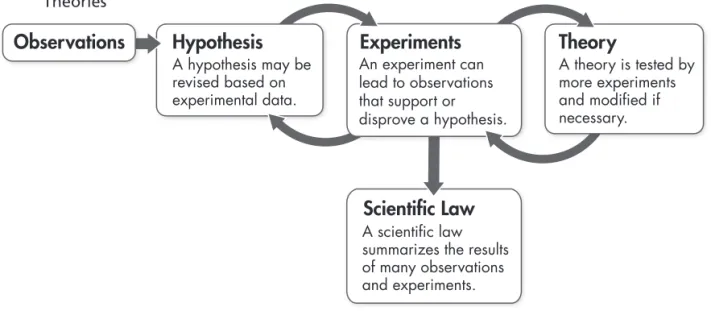
In chemistry, scientists might test hypotheses concerning the physical properties of oxygen gas, the electrical conductivity of a solution of sodium chloride, or the chemical reactivity of compounds such as acetic acid or ammonia. In contrast, the theories of chemistry explain the physical or chemical properties of a large number of elements or compounds. A theory might explain the chemical reactivities of a large class of compounds, such as acids or bases. In the flowchart in Figure 1, you can compare the roles that hypotheses and theories play in scientific methodology.
Figure 1 Role of Hypotheses and Theories
How do scientific theories develop?
One of the most important theories in chemistry is the atomic theory of matter, which states that all matter is made of very tiny particles called atoms. Today, this theory is universally accepted. Scientists have explained the structure of atoms and identified the forces that hold atoms together. With the aid of very powerful microscopes, scientists now can photograph and manipulate individual atoms.
Yet similar to other theories, the atomic theory of matter developed over time. The origin of the theory can be traced to ancient Greece. Democritus, a Greek philosopher, proposed that matter was made of tiny indivisible particles. The word atom comes from the Greek word meaning
“indivisible.” While Democritus’ arguments for atoms had merit, Aristotle and other leading Greek philosophers rejected them. Hundreds of years passed before scientists seriously considered an atomic theory of matter. Technology is often essential in the development of a new theory or the revision of an existing theory. For example, in the mid-1800s, scientists began experimenting with a device called a cathode ray tube. This led to the discovery of the electron, one of the particles that compose atoms. Further discoveries of atomic structure also depended on new technology, well-constructed experiments, and logical reasoning.
Scientific Law
Experiments
Hypothesis
A hypothesis may be revised based on experimental data.
Observations
A scientific law summarizes the results of many observations and experiments. An experiment can lead to observations that support or disprove a hypothesis.
Theory
A theory is tested by more experiments and modified if necessary.
TEKS 2D • Copyright © Pearson Education, Inc., or its affiliates. All Rights Reserved. 20
End-of-Course Assessment Review
1. Identify Which of the following statements describes a hypothesis that might be useful for a scientific experiment?
A All atoms are made of protons, neutrons, and electrons.
B Increasing the surface area of a sample of iron will increase the rate at which it rusts.
C The ratio of hydrogen to oxygen atoms is 2:1 for every water molecule.
D For ideal gases, the pressure and volume are inversely proportional.
2. Evaluate Which of the following statements is the best definition of a scientific hypothesis?
A a suspicion or hunch about an event in nature
B a proposal that can be tested in an experiment
C an idea or explanation that most people agree with
D a well-supported explanation for a broad set of observations
3. Distinguish Suppose you were to read about a scientific statement based on data from hundreds of years of research and observation that applies to a broad set of naturally occurring events. Would you
consider it a hypothesis or a theory?
A a hypothesis
B a theory
C both
D neither
4. Distinguish Suppose that your lab partner states that he has just come up with a theory that explains the results of your last investigation. What are three reasons you could give him that his explanation is a hypothesis and not a theory?
TEKS
TEKS 2D • Copyright © Pearson Education, Inc., or its affiliates. All Rights Reserved. 21
TEKS
REVIEW
How do you plan investigative procedures?
When planning investigative procedures, members of the scientific community use the same scientific methodology that you use in a lab setting. Scientific methodology usually includes the following steps:
1. Making observations
2. Asking questions
3. Formulating a hypothesis
4. Testing a hypothesis
These steps represent a logical approach to explaining phenomena in the natural world and are a useful tool for planning scientific investigations. When planning investigations, it is not always necessary to follow the steps in order or even to use all the steps. Scientific methodology provides guidelines for all kinds of scientific inquiry.
Why is it important to ask questions about
observations?
Observations are always a part of scientific investigative procedures. An observation often leads to another step in scientific methodology: asking questions. For example, a scientist might observe that the same hen can make different vocalizations. When following investigative procedures, scientists ask questions about their observations. If a scientist notices a phenomenon that is unexplained, he or she may ask a question about it. The observation that hens have different vocalizations can lead to the question of “What do the different vocalizations of a hen mean?”
Why is it important to formulate a testable
hypothesis?
Scientists formulate testable hypotheses to test the answers to the questions that have arisen from their observations. These hypotheses form the basis of investigative procedures. A hypothesis is a reasonable explanation as to why something occurs. In order to be used in investigative procedures, a hypothesis must be testable. It must be able to be supported or refuted by evidence.
Planning and Implementing
Investigative Procedures
2E
TEKS 2E
Plan and implement investigative procedures, including asking questions, formulating testable hypotheses, and selecting equipment and technology, including graphing calculators, computers and probes, sufficient scientific glassware such as beakers, Erlenmeyer flasks, pipettes, graduated cylinders, volumetric flasks, safety goggles, and burettes, electronic balances, and an adequate supply of consumable chemicals.
TEKS 2E • Copyright © Pearson Education, Inc., or its affiliates. All Rights Reserved. 22
Testable hypotheses contain clear wording and clearly state what happens to the dependent variable (the phenomenon being observed) when the independent variable (the factor that changes in the experiment) is changed. A testable hypothesis may follow this pattern: “If [independent variable] happens, then [dependent variable] happens.”
In the question of hen vocalizations, a testable hypothesis could be “If a hen makes a cluck-cluck-cluck vocalization, her chicks come to feed.” This hypothesis is testable because a scientist can listen for the sound and then observe the chicks’ behavior. If they come and feed only when they hear
the cluck-cluck-cluck vocalization, the hypothesis is supported.
The independent variable is the cluck-cluck-cluck sound; the dependent variable is the chicks’ behavior. If the hen makes a different sound that produces the same outcome (the chicks running to feed), the hypothesis is not supported.
How do scientists implement procedures
to test hypotheses?
Scientists implement procedures to test their hypotheses by setting up experimental conditions that enable the dependent variable to be observed while the independent variable is changed. In the case of the hen and chicks, a scientist could implement a procedure that would involve listening for the hen’s cluck-cluck-cluck and observing the chicks’ response to it. Over time, and by carefully eliminating the possibility of other explanations, the hypothesis may be accepted and be used by others to predict when chicks will come to eat.
How can you select equipment and technology
for an investigation?
An investigative procedure needs the appropriate equipment and technology to be conducted properly and accurately. Laboratory equipment must meet standards for both safety and accuracy. Some equipment and technology helps in taking measurements. An electronic balance, for example, can measure mass quickly and accurately. A graduated cylinder provides quick and accurate measurements for the volume of liquids. This equipment is also reliable, meaning repeated measurements of the same subject will yield very similar results.
As you plan a scientific investigation, make a list of all the equipment and technology you will need. You may need to revise your list to use only the equipment available to you, and to use this equipment efficiently. For example, instead of using three volumetric flasks to measure the same volume of a liquid, you could use the same flask three times. Perhaps you can reduce your use of expensive chemicals, or replace them with less expensive ones.
Computers and graphing calculators can help you store and analyze data. If your investigation will generate a large amount of numerical data, consider entering the data directly into a computer or graphing calculator. Your teacher can instruct you on how to use these pieces of technology.
Study Tip
Smaller quantities will require smaller units; larger quantities require larger units. As you are planning an experiment, consider the quantities you are measuring and choose equipment that is appropriately scaled with the units you need.
TEKS 2E • Copyright © Pearson Education, Inc., or its affiliates. All Rights Reserved. 23
In the chemistry lab, remember to use only the scientific equipment that your teacher provides. Always follow your teacher’s instructions on the care and use of laboratory equipment.
End-of-Course Assessment Review
1. Identify Which of these would you use to measure 0.2 mL?
A a pipette
B a beaker
C a measuring spoon
D a volumetric flask
2. Explain Why is it important to use clear wording and clearly stated outcomes in a hypothesis?
A Hypotheses are not facts or scientific theories, so they need to be explained clearly.
B Hypotheses have to be clear to explain natural phenomena to other scientists.
C Hypotheses have to be clearly expressed so one can determine if an experiment confirms or refutes them.
D Hypotheses may become part of a scientific theory, so it is important to write them well.
3. Evaluate Which of these hypotheses is most easily tested?
A If plants are overwatered, they die.
B If the weather is cold, people get sick.
C If 2 g ammonium nitrate is added to 2 L of water, the temperature of the water will decrease by 1°C.
D If 2 g baking soda is added to a solution of water and vinegar, a chemical reaction happens.
4. Plan A procedure requires you to test the pH of 500 mL of an unknown solution your instructor gives you by dropping phenolphthalein in 0.5 mL increments. List the materials and
equipment you need for this procedure. Explain how you would use each item.
5. Plan Formulate a hypothesis and design an experiment to determine how the amount of available sunlight affects the size of peppers growing on a plant. Determine your independent and dependent variables and what kind of equipment you will need.
TEKS
TEKS 2E • Copyright © Pearson Education, Inc., or its affiliates. All Rights Reserved. 24
TEKS
REVIEW
TEKS_TXT
Collect data and make measurements with accuracy and precision.
2F
Accuracy and Precision
TEKS 2F
What is accuracy?
Suppose two students are performing the same experiment, but are working separately. One step in the procedure requires them to make a 10% salt solution. To make the solution, they each need to mix 10.0 g of salt in 90.0 mL of water. Using a balance, Student A measures 10.4348 g of salt for her solution. Student B measures 10.1927 g of salt for his solution. Which measurement is more accurate?
The accuracy of a measurement identifies how close that measurement is to an accepted or true value. If the true value of salt needed for the experiment is 10.0 g, then Student B’s measurement is more accurate. Student B’s measurement of 10.1927 g is closer to the value of 10.0 g than Student A’s measurement of 10.4348 g.
Collecting accurate data is important, because if the data are accurate, they reflect what was expected or what truly happened. With accurate data, one can be more confident in the reliability of the results. Because Student B prepared a more accurate 10% salt solution than did Student A, the results of Student B’s experiment might be more reliable than Student A’s results. To achieve reliable results, scientists need to make accurate measurements. For example, a hospital pharmacist preparing a solution must accurately measure the amounts of compounds needed to prevent over- or under-medicating a patient. A marine biologist who dives deep into the ocean needs to accurately measure the amount of oxygen she needs in her tank to remain safe. Scientists launching a satellite into space have to launch the satellite at an accurate velocity to achieve the preferred orbit of the satellite.
What is precision?
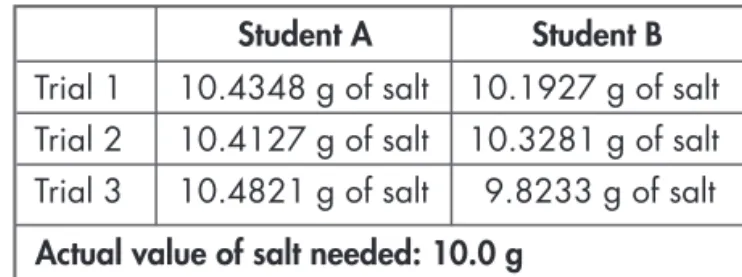
Precision refers to how much a series of measurements varies. In other words, the more precise a series of measurements, the closer they are to one another. Now, suppose Student A and Student B decide to repeat the experiment two more times to confirm their results. They obtain the measurements shown in Figure 1 on the next page. Whose measurements are more precise?
Study Tip
When trying to
remember the difference between accuracy and precision, keep in mind that an accurate
measurement is close to the accepted or actual measurement.
Vocabulary accuracy precision
TEKS 2F • Copyright © Pearson Education, Inc., or its affiliates. All Rights Reserved. 25
Because Student A’s three measurements are closer in value to one another than Student B’s measurements, Student A’s measurements are more precise. However, because Student B’s measurements overall are closer to the actual value of 10.0 g, they are more accurate than Student A’s.
Why are accuracy and precision important
in data collection?
The goal of any scientific investigation is to obtain measurements that are both accurate and precise. Knowing the degree of accuracy and precision for a given measurement or group of measurements is important in science. The accuracy and precision of a measurement depend on the units used in a measurement and the number of significant digits stated. For example, if you want to know the average distance from Earth to the sun, you might search the Internet to find the data. One source tells you that the
average distance is 150,000,000 km. A second source tells you that the average distance is 149,597,870 km. The second measurement is more accurate because it is closer to the accepted average distance of 149,597,870.691 km. The second measurement is also more precise because it includes a greater number of significant digits.
The accuracy of a measurement is related to the instrument used. Typically, an instrument that measures in smaller units or smaller increments can provide more accurate results than a tool that measures in larger units or larger increments. For example, suppose you are trying to measure 10 mL of hydrochloric acid. A graduated cylinder that measures to the nearest milliliter would allow you to measure 10 mL more accurately than would a graduated cylinder that measures to the nearest 10 milliliters.
The degree of precision of a measurement is also related to the instrument used. For example, suppose a chemist extracts a salt from a solution in the lab. When determining the mass of the extracted salt, he uses a balance that measures to the nearest gram. He determines that the mass of the salt is 2 g. Another chemist, who is working on the same experiment, uses a balance that measures to the nearest ten thousandth. She reports that she extracted 2.3484 g of salt from her solution. Which chemist extracted more salt from his or her solution?
In this situation, it is impossible to determine. Because the first chemist’s balance measures only to the nearest gram, any mass from 1.50 g to 2.49 g will result in a reading of “2 g.” If the first chemist uses an instrument that measures mass to the same degree of precision as the second chemist, then the two masses can be compared. When comparing measurements, the degree of precision of the tool used can greatly influence the results.
Figure 1 Student A Student B
Trial 1 Trial 2 Trial 3
10.4348 g of salt 10.4127 g of salt 10.4821 g of salt
10.1927 g of salt 10.3281 g of salt 9.8233 g of salt
Actual value of salt needed: 10.0 g
TEKS 2F • Copyright © Pearson Education, Inc., or its affiliates. All Rights Reserved. 26
Felipe Sarah
Trial 1 Trial 2 Trial 3
7.96 g/cm3 8.05 g/cm3 7.92 g/cm3
7.24 g/cm3 7.75 g/cm3 8.57 g/cm3
Accepted value of the density of iron = 7.86 g/cm3
15
10
5
3
2
a b
End-of-Course Assessment Review
1. Identify The accepted value for the boiling point of water is 100˚C. During an experiment, students recorded the temperature observations listed below. Which one is the most accurate temperature for the boiling point of water?
A 102˚C C 95˚C
B 97˚C D 103˚C
2. Infer Two students need to determine the density of iron for part of an experiment. Using the information in the table below, calculate the average of each student’s trials. Which student has the most precise set of measurements? Which student’s average is the most accurate?
A Sarah’s measurements are more precise and her average is more accurate.
B Felipe’s measurements are more precise and his average is more accurate.
C Sarah’s measurements are more precise but Felipe’s average is more accurate.
D Felipe’s measurements are more precise but Sarah’s average is more accurate.
3. Explain Suppose you need to measure 2.25 mL of water. There are two different graduated cylinders, shown at right, that you can use to measure the water. Using the terms precise and accurate, explain why you would choose graduated cyl-inder a or b. All measurement markings shown are in milliliters.
4. Describe Suppose you work at a theme park. Your supervisor wants you to make a sign displaying the maximum weight that a roller coaster train can carry. Your supervisor knows that the maximum weight is 1686.5 kg. However, he wants the sign to be quickly understood and tells you to make a sign that says: Maximum Weight 1700 kg. How could the lack of precision in this example cause problems?
TEKS
TEKS 2F • Copyright © Pearson Education, Inc., or its affiliates. All Rights Reserved. 27
TEKS
REVIEW
How does dimensional analysis help you
express and manipulate chemical quantities?
Dimensional analysis involves using ratios called conversion factors. Multiplying by the appropriate conversion factor lets you convert a quantity from one unit to another. Every conversion factor is numerically equal to 1.How does scientific notation help you express
and manipulate quantities?
Scientific notation is used to express very large numbers. A quantity expressed in scientific notation is in the format of a number multiplied by 10 raised to a power. For example, the average distance between Jupiter and the sun is 778,300,000 km. In scientific notation, this measurement is 7.783 × 10⁸ km.
In scientific notation, the coefficient (the number being multiplied) must be equal to or greater than 1 and less than 10. For numbers greater than 10, the exponent is positive and is equal to the number of places the original decimal point was moved to the left. For example, light travels through empty space at a speed of 1,079,000,000 kilometers per hour. To convert this number to scientific notation, begin by moving the decimal point to the right of the leftmost digit:
Dimensional Analysis, Scientific
Notation, and Significant Figures
2G
TEKS 2G
Express and manipulate chemical quantities using scientific conventions and mathematical procedures, including dimensional analysis, scientific notation, and significant figures.
Vocabulary
dimensional analysis scientific notation significant figure
Sample Problem
For example, to convert between kilograms and grams, begin by writing the equation:
1 kilogram = 1000 grams
This equation leads to two conversion factors:
1 kilogram 1000 grams and
1000 grams 1 kilogram
Use the first conversion factor to convert from grams to kilograms. For example:
600 grams × 1000 grams 1 kilogram = 0.6 kilograms
Notice that the unit gram cancels out of the expression.
To convert from kilograms to grams, use the conversion factor that has grams in the numerator and kilograms in the denominator.
7.5 kilograms × 1000 grams1 kilogram = 7500 grams
TEKS 2G • Copyright © Pearson Education, Inc., or its affiliates. All Rights Reserved. 28
1.079,000,000.
1m 10 20 30 40 50 60 70 80 90
1m 10 20 30 40 50 60 70 80 90
1m
0.8 m
0.77 m
0.772 m
Then count how many places the decimal moved. Since the decimal moved 9 places to the left, you raise 10 to that power (109). The speed of light
expressed in scientific notation is 1.079 × 10⁹ kilometers per hour.
For numbers less than 1, the exponent is negative and equals the number of places the original decimal point was moved to the right. The radius of a helium atom is 0.000000000031 meters. To express this measurement in scientific notation, move the decimal point 11 places so that it is just to the right of the 3. This gives the result of 3.1 × 10⁻¹¹ meters.
How do significant figures help you express
and manipulate quantities?
When you measure something, there is always a degree of uncertainty in the measurement. For this reason, the last digit is considered an estimate. This digit represents the degree of precision of the measuring tool. For example, depending on the ruler that is used, the width of the door shown in Figure 1 might be reported as 0.8 m, 0.77 m, or 0.772 m.
Significant figures are the digits that represent the precision of a
measurement. For example, the population of Tyler County, Texas, might be reported to be 21,000 people, 20,600 people, or 20,556 people. The first measurement has two significant figures (2 and 1), the second
measurement has three significant figures (2, 0, and 6), and the third measurement has five significant figures.
The following are rules for identifying significant figures in measurements.
1. All nonzero digits are significant. The numbers 543, 54.3, and 0.543 each have three significant figures.
2. All zeros that appear between nonzeros are significant. The numbers
2034, 2.034, and 20.34 each have four significant figures.
Figure 1
Study Tip
As you perform
calculations, keep track of an excess of significant figures. Then round off the answer to the correct number of significant figures.
TEKS 2G • Copyright © Pearson Education, Inc., or its affiliates. All Rights Reserved. 29