Renormalizing random-phase approximation by using exact pairing
L. Tan Phuc,1,2,*N. Quang Hung,1,†and N. Dinh Dang3,‡
1Institute of Fundamental and Applied Sciences, Duy Tan University, Ho Chi Minh City 700000, Vietnam 2Faculty of Physics and Engineering Physics, Vietnam National University Ho Chi Minh City–University of Science,
Ho Chi Minh City 748355, Vietnam
3Quantum Hadron Physics Laboratory, RIKEN Nishina Center for Accelerator-Based Science,
2-1 Hirosawa, Wako City, 351-0198 Saitama, Japan
(Received 7 December 2018; revised manuscript received 22 April 2019; published 20 June 2019)
A fully self-consistent renormalized random-phase approximation is constructed based on the self-consistent Hartree-Fock mean field plus exact pairing solutions (EP). This approach exactly conserves the particle number and restores the energy-weighted sum rule, which is violated in the conventional renormalized particle-hole random-phase approximation for a given multipolarity. The numerical calculations are carried out for several light-, medium-, and heavy-mass nuclei such as22O,60Ni, and90Zr by using the effective MSk3 interaction. To study the pygmy dipole resonance (PDR), the calculations are also performed for the two light and neutron-rich 24,28O isotopes, whose PDRs are known to be dominant. The results obtained show that the inclusion of ground-state correlations beyond the random-phase approximation (RPA) by means of the occupation numbers obtained from the EP affects the RPA solutions within the whole mass range, although this effect decreases with increasing the mass number. At the same time, the antipairing effect is observed via a significant reduction of pairing in neutron-rich nuclei. The enhancement of PDR is found in most neutron-rich nuclei under consideration within our method.
DOI:10.1103/PhysRevC.99.064322
I. INTRODUCTION
The random-phase approximation (RPA) is a popular the-oretical method to study the low-lying excitations and high-lying giant resonances in nuclei. The RPA states are built on the vibrational collective excitations, which are the su-perpositions of elementary excitations. The RPA eigenvalues are the energies of the excitations, whereas the isoscalar (IS) and isovector (IV) transition probabilities in a nucleus are calculated by using the components of the RPA eigenvectors.
The RPA excitation operator is composed of many particle-hole (ph) components, which are represented by the ph pair operatorsBphandB†ph, whereB†ph=a†
pahwitha†pandahbeing
the particle (p) creation and hole (h) annihilation operators, respectively. By assuming that the RPA ground state is not much different from the Hartree-Fock (HF) one and by using the quasiboson approximation (QBA), the expectation value
RPA|[Bph,B†ph]|RPA of the commutator [Bph,B†ph] in the RPA ground state is replaced with that obtained within the HF one, that is HF|[Bph,B†ph]|HF =δppδhh [1]. In other
words, the QBA implies that the ph pairs behave like bosons, neglecting their fermionic structure. This is equivalent to the violation of the Pauli principle between the ph pairs. In the region of medium- and heavy-mass nuclei, where the nuclear ground-state properties are well described within the HF mean
*[email protected] †[email protected] ‡[email protected]
field, the low-lying excitations and giant resonance states are often well described by the RPA. This can be easily understood by recalling the fact that the RPA uses the initial inputs from the nuclear mean-field ground state to generate the excitations. However, in light nuclei, the validity of the mean-field description and QBA are still questionable and deserve more study [1]. This can be clearly seen especially in exotic light systems, where the existence of clustering within the core is an evidence that the mean-field picture may not hold [2]. Also the concept of a nucleon moving in an averaged mean field of the remaining N−1 nucleons is sound only when N is sufficiently large. The mixture of single-particle and collective modes in light nuclei also worsens the QBA.
The restoration of the Pauli principle in the RPA has been carried out within the renormalized RPA (RRPA) by taking into account the ground-state correlations (GSC), which are neglected in the QBA [3–6]. In this method, the expecta-tion value RPA|[Bph,B†ph]|RPA Dph≡ fh− fp is used instead of the HF oneHF|[Bph,B†ph]|HF =δppδhh, which
is assumed within the RPA based on the QBA, with fk= RPA|a†k,ak|RPA (k=p,h) being the particle (k=p) or hole (k=h) occupation number in the correlated RPA ground state |RPA. These occupation numbers fk can be expressed
in term of the RPA eigenvector components, the so-called backward-going amplitudeYphν. The resulting system of RRPA equations becomes nonlinear with respect to the amplitudes
Yphν in the GSC factor Dph, which renormalizes the RPA
A major problem of the RRPA, as was pointed out for the first time in Ref. [9], is the violation of various model-independent sum rules, such as the Thomas-Reich-Kuhn (TRK) sum rule for the giant dipole resonance (GDR) or the Ikeda sum rule for the Gamow-Teller transitions, because the GSC factor Dph reduces the absolute values of the matrix
elements of the residual interaction. One way to overcome this shortcoming is to take into account the contribution of the particle-particle (pp) and hole-hole (hh) excitations of all multipolarities [9–11]. However, this approach is time consuming as it doubles the size of the RPA matrix. Moreover, although the inconsistency inherent in the QBA is removed by taking into account the particle occupation numbers fp>
0 and the hole occupation numbers fh<1, the RRPA still contains another inconsistency as it is still based on the HF mean field, where these occupation numbers are always set to be 0 for all the unoccupied states above the Fermi level, i.e., the p states, and 1 for all the occupied ones below the Fermi level, i.e., the h states.
On the other hand, the RRPA does not include super-fluid pairing, which plays an important role, especially in neutron-rich nuclei. Pairing is taken into account within the quasiparticle RPA (QRPA) [1]. However, owing to the QBA for the quasiparticle pair operators (similar to that of the RPA), the standard QRPA also violates the Pauli principle, and the renormalized QRPA (RQRPA) also suffers from the sum rule violation, as was pointed out in Ref. [9]. The QRPA also uses the pairing solutions obtained from the Hartree-Fock-Bogoliubov (HFB) or BCS theories, which violate the particle-number conservation, resulting in the chemical po-tential as a Lagrangian multiplier to be determined in the equation for the average particle number in the ground state.
In the present paper, we propose a novel approach which employs the exact pairing solutions (EP) [12,13] to renor-malize the phRPA. The EP produces the exact occupation numbers fk, which come from the pp and hh pairing
cor-relations. These occupation numbers replace the HF ones,
fh=1 and fp=0, in a self-consistent way as has been
explained and applied to both self-consistent relativistic [14] and nonrelativistic mean fields [15] in the calculations carried out for realistic nuclei. The Hartree-Fock mean field plus EP (HFEP) supplies a good set of initial inputs for the RRPA, where the GSC factors Dph are obtained in a self-consistent
way with the HFEP. In this way, this method resolves three issues at once, namely the above-mentioned inconsistency in the HF mean field used in the conventional RRPA, the inclusion of pairing in the RPA, and the particle number conservation, which is always exactly fulfilled within the EP. The present paper will show if this method of renormalizing the RPA by using the HFEP is capable of restoring the Pauli principle and the energy-weighted sum rule (EWSR) without the need of extending the RPA configurations beyond the ph ones. Naturally, the application of this approach requires the monopole pairing correlation in nuclei so that the GSC factors
Dph <1 can be generated within the EP. The EP, in principle,
always generates a finite pairing energy, even for the magic nuclei such as 48Ca [12]. Therefore, it is expected that our approach can be applied to any nuclei, especially neutron-rich or proton-rich ones.
The proposed approach is applied in calculations for the dipole case in several light-, medium-, and heavy-mass nuclei, namely 22O, 60Ni, and 90Zr as well as neutron-rich 24,28O isotopes, whose pygmy dipole resonances (PDR) have been predicted and/or observed [16–20].
II. FORMALISM
A. Mean field plus exact pairing
The ground-state quantities such as the single-particle wave functions ϕ, single-particle energies , and nucleon densitiesρ are used as the initial inputs for constructing the excited states in the RPA [1]. In this paper, these quantities are extracted from the Skyrme-Hartree-Fock mean field, de-scribed by the Hamiltonian
ˆ
HHF= i
ˆ
ti+
i<j
ˆ
vi j+
i<j<k
ˆ
vi jk, (1)
where ˆt is the kinetic energy and ˆvi j and ˆvi jk are the
two-body and three-two-body potentials, respectively. These potentials are included in the expression of the Skyrme interaction as follows
ˆ
vi j=t0(1+x0Pˆσ)δ(r)+21t1[δ(r)k2+ k 2
δ(r)]
+t2kδ(r)k+iW0(σi+ σj)k×δ(r)k, (2)
ˆ
vi jk=t3δ(ri− rj)δ(rj− rk), (3)
where ˆPσ =12(1+σiσj) is the spin-exchange operator
ex-pressed via the Pauli spin matricesσi(j),kis the conjugate of
the wave vectork, andr= ri− rj. The three-body term in the
Skyrme interaction can be expressed in terms of the two-body one via the nucleon density [21]
ˆ
vi jk−→vˆi j= t3
6(1+Pˆσ)δ(ri− rj)ρ
αri− rj
2
, (4)
where ρ=ρZ+ρN with ρZ and ρN being the proton and
neutron densities, respectively.
To include the effect of pairing correlation in the mean field, the HamiltonianH of the nuclear system is rewritten in the second quantization [1]
ˆ
H=HHFˆ +Hpairˆ , (5)
with
ˆ
HHF= j
ja†jmajm, (6)
ˆ
Hpair= −G mm
a†jma †
jmajmajm, (7)
where a†jm and ajm are the single-particle creation and
an-nihilation operators of a nucleon moving on the jth single-particle levels with projections±m, andGis the parameter of the constant monopole pairing interaction. The total (ground-state) energy of the nuclear system is given as
where EHF and Epair are the HF and pairing energies,
re-spectively. The correction for the center of mass (c.m.) en-ergy Ec.m., which is presented in detail in Refs. [22,23], is
subtracted a posteriori after the variation of HF equation.
Epair is obtained by diagonalizingH. The diagonal and off-diagonal matrix elements of this Hamiltonian within the EP are obtained as [12]
{sj},{Nj}|H|{sj},{Nj} =
j
jNj− G
4(Nj−sj)(2 j−sj−Nj+2)
, (9)
{sj}, . . . ,Nj+2, . . . ,Nj−2, . . . ,|H|{sj}, . . . ,Nj, . . . ,Nj, . . .
= −G
4[(Nj−sj)(2 j−sj−Nj+2)(2 j−sj−Nj)(Nj−sj+2)]
1/2.
(10)
Each basis state |{sj},{Nj} in the matrix elements above
represents the jth level with Nj=2 j=2(j+1/2)
nucle-ons and sj unpaired particles. The pairing energy Epair and
single-particle occupation numberfj, which are obtained after
diagonalizing H, are employed to redefine the currents and densities [15,22] and calculate the pairing gap by using the following equations
ρq(r)=
j fj
2j+1 4π ϕj(r)
2,
(11)
τq(r)=
j fj
2j+1 4π
[∂rϕj(r)]2+
l(l+1)
r2 ϕj(r) 2
, (12)
Jq(r)=
j fj
2j+1 4π
j(j+1)−l(l+1)−3 4
2
rϕj(r) 2,
(13)
=−GEpair, (14)
where ρq, τq, Jq, and are the nucleon densities, kinetic
energy densities, spin-current densities, and exact pairing gap, respectively. The subscriptq denotes proton or neutron, and ϕj is the single-particle wave function. Without pairing, the
values fj in Eqs. (11)–(13), which are denoted as fHFj , are
always equal to 1 for the levels below the Fermi surface and 0 for those above it, as in the case of HF mean field. With pairing, the values fj follow the distribution of exact pairing
solutions, namely fEP
j <1 (>0) for the levels below (above)
the Fermi surface. These occupation numbers are again used in the currents and densities in Eqs. (11)–(13) to redefine them for the initial input of the next step within the RRPA.
B. Renormalizing random-phase approximation by using exact pairing
1. ThephRRPA
As mentioned above, the ground-state quantities are used to construct the RPA excited states. The details of the RPA and RRPA were presented in Ref. [11]. In this section, we present briefly the main results of these methods.
The RPA phonon operator is a superposition of ph-pair operators in the form [1]
Q†JMi=
ph
XphJiB†ph(JM)−YphJiBph(JM), (15)
where Jπ =0+,1−,2+, . . . is the angular momentum (mul-tipolarity) with natural parity π, and M = −J,−J+
1, . . . ,J−1,J are its projections. The symboldenotes the time-reversal operatorOJM=(−1)J−MOJ,−M. The operator B†ph(JM) is the ph-pair creation operator with the total angular momentumJand projectionM
B†ph(JM)=
mpmh
jpmpjhmh|JMa†jpmpajhmh. (16)
The RPA excited state is defined by using the phonon operator (15) on the RPA ground state|RPA, namely
|JMi =Q†JMi|RPA, (17) where QJMi|RPA =0. These RPA states are orthonormal-ized, viz.,
JMi|JMi = RPA|[QJMi,Q†JMi]|RPA =δJJδMMδii.
(18)
The expectation value of the commutation relation [Bph,B†ph] in the RPA ground state is calculated as
RPA|[Bph(JM),B†ph(JM)]|RPA =δjpjp
mpmhmh
jpmpjhmh|JMjpmpjhmh|JMRPA|a †
jhmhajhmh|RPA
−δjhjh
mpmpmh
jpmpjhmh|JMjpmpjhmh|JMRPA|a†jpmpajpmp|RPA
δJJδMMδjpjpδjhjhDph, (19)
whereDphis the the GSC factor
Dph∼= fh−fp= RPA|a†jhmhajhmh|RPA − RPA|a
†
In order to obtain a set of linear equations with respect to the amplitudesXphJiandYphJiin Eq. (15), it is assumed that the RPA ground state |RPA is not much different from the HF one
|HFso that it can be replaced with the latter [1]. This leads to the substitution fh fhHF= HF|a
†
jhmhajhmh|HF =1 and
fp fHF
p = HF|a †
jpmpajpmp|HF =0. Consequently, the GSC
factor Dph is replaced with DphHF= fhHF−fpHF=1 and the
expectation value of the commutation relation (19) becomes
HF|[Bph(JM),B†ph(JM)]|HF =δJJδMMδjpjpδjhjh. (21)
This approximation is called the QBA as it treats the ph pairs like bosons, which obey the exact boson commutation relation. This also means that the QBA ignores (or violates) the Pauli principle between the fermion pairs. Within the QBA, the orthonormal condition (18) requires the amplitudes
XphJiandYphJito obey the following normalization condition
ph
XphJiXphJi−YphJiYphJi=δJJδii, (22)
whereas the closure relations
i
XphJiXpJih−YphJiYpJih
=δppδhh,
i
XphJiYpJih−YphJiXpJih
=0 (23)
ensure the inverse expression of the ph-pair creation operator in terms of the phonon one
B†ph(JM)=
i
XphJiQ†JMi+Y Ji phQJMi
. (24)
By using the boson-mapping technique [6,7,11] to express the particle-number operator in terms of the sums of products
Bph† Bph, the particle and hole occupation numbers are calcu-lated within the RPA as
fpRPA = 1
2jp+1
HF|
mp
a†jpmpajpmp|HF
= 1
2jp+1
Ji
(2J+1)
h
YphJi2, (25)
fhRPA =1− 1 2jh+1HF|
mh
ajhmha
† jhmh|HF
=1− 1 2jh+1
Ji
(2J+1)
p
YphJi2. (26)
The RRPA phonon operators are different from the RPA ones by the presence of the GSC factorDph, which is smaller
than 1 [7]
Q† JMi= ph XJi ph Dph
B†ph(JM)− Y
Ji ph
Dph
Bph(JM)
(27)
and
B†ph(JM)=Dph i
XJi phQ
† JMi+Y
Ji phQJMi
. (28)
In this form, the RRPA amplitudesXJi phandY
Ji
phfulfill the same
normalization and closure relations as those of RPA [Eqs. (22) and (23)]. However, the occupation numbers within the RRPA are now calculated from the recurrent expressions [7,11]
fp = 1
2jp+1RPA|
mp
a†jpmpajpmp|RPA
= 1
2jp+1
Ji
(2J+1)
h
DphYphJi2, (29)
fh =1− 1 2jh+1
RPA|
mh
ajhmha
†
jhmh|RPA
=1− 1 2jh+1
Ji
(2J+1)
p
DphYphJi2, (30)
with
Dph≡ fh− fp=1−
Ji
(2J+1)
1 2jp+1
h Dph YJi ph 2 + 1
2jh+1
p Dph
YJi ph
2
. (31)
The amplitudesXJi phandY
Ji
phare calculated based on the
com-ponents of the eigenvectors of the phRRPA matrix equation
A B
−B −A
XJi
YJi
=EJi
XJi
YJi
, (32)
where EJi are the phRRPA eigenvalues (phonon energies).
The matricesAandBare given as
Aph,ph =(p−h)δppδhh+
DphDphph|Vres|hp, (33)
Bph,ph =
DphDphpp|Vres|hh, (34)
where k is the single-particle energy of a spherical
orbital |jk,mk with k=p,h, and Vres is the two-body
residual interaction [24]. The presence of the GSC factors
DphDph renormalizes the residual interaction by reducing
the absolute value of its matrix element ph|Vres|hp to
DphDphph|Vres|hp. The phRRPA equations are nonlinear
with respect to the amplitudesYJi
ph and need to be solved by
iteration. In the first step, the RPA equations withDph =1 are
solved. The GSC factorDph is then calculated by using the RPA occupation numbers fh and fp defined in Eq. (26). The phRRPA matrix (32) is then diagonalized to obtain a new set of eigenvectors, which produces new GSC factorsDphfor the next step. This process is repeated self-consistently until the criterion of convergency is achieved.
2. Inclusion of exact pairing
an alternative method by using the exact solutions of the pairing problem (Sec. II A) to renormalize the phRPA. We expect that not only can this method restore the EWSR at each multipolarity Jπ without the need to include the pp and hh excitations, but it also takes into account the exact pairing, having ensured the exact particle number already in the reference state, unlike the HFB or BCS theories used in the (R)QRPA. The Hamiltonian of the nuclear system is now written as
ˆ
H=HˆHF+Hˆpair+Hˆres, (35)
where ˆHresis the residual Hamiltonian [1]
ˆ
Hres=
phph
AphphB†phBph+
1 2
phph
(BphphBph† Bph+H.c.).
(36) Because the size of the matrix to be diagonalized in the exact pairing Hamiltonian is limited [25,26], only the levels in a truncated spectrumT around the Fermi surface are used for the EP. The occupation numbers of the hole and particle states outside the truncated spaceT remain 1 and 0, respectively. These exact occupation numbers are used to produce the GSC factors (37a) and (37b), which are employed to renormalize the RPA as mentioned in Sec.II B 1. In particular, all the GSC factorsDph in the phRRPA matrices (33) and (34) are now replaced withDEP
ph as
DEPph =
fEP
h − fpEP (p,h∈ {T}),
1 (p,h∈ {/ T}),
(37a)
(37b)
and the set of phRRPA equations is diagonalized. The backward-going amplitudesYJi
ph, obtained after this
diagonal-ization, are used to calculate the RPA occupation numbers
fRPA
k (k=p,h), following Eqs. (29) and (30) for each
mul-tipolarityJπ withπ =(−1)J. These occupation numbers are then used to replace those within the Hartree-Fock mean field as the initial values of the new loop. These steps are repeated until convergence is reached, namely each single-particle energy satisfies the criterion|j(n)−j(n−1)|10−4 MeV
(nis the number of iterations).
The total energy of the nuclear system is calculated as
E =EHF+Epair+ERPA−Ec.m., (38) where the RPA energyERPAis given as [1]
ERPA= −
1 2TrA+
¯
h
2
Ji
EJi = −
Ji
¯
hEJi
ph YJi
ph 2 Dph . (39)
The pairing-strength parameter G in the EP calculation is adjusted so that the EWSR is fulfilled and the pairing gap obtained within the exact pairing is close to the experimental odd-even mass difference. This procedure guarantees a full consistency between the mean field and the renormaliza-tion process using EP. We refer to this method as the SC-HFEPRPA hereafter.
3. TheEWSR
The reduced transition probabilities B(E J) between the ground state |0 and excited state |ν ≡ |JMi within the
SC-HFEPRPA have the same form as that in the conventional phRRPA, namely
B(E J,0→ν)(EJi)
= |ν|FˆJ|0|2= ph
DphXphJi+YphJip||FˆJ||h
2 , (40)
where p||FˆJ||h are the reduced matrix elements of the
one-body excitation operators FˆJM [24,27]. To present
the distribution of the probabilities B(E J,0→ν)(EJi) over
the discrete one-phonon states |ν with energies EJi as a
continuous function of the excitation energyE, this distribu-tion is often smoothed by representing the delta funcdistribu-tion as δ(x)=ε/[π(x2+ε2)]. As the result, one obtains the strength
function
SJ(E)= ε π
i
B(E J,EJi)
(E−EJi)2+ε2,
(41)
where ε is the smoothing parameter. This parameter some-times is associated with the escape width↑≡2εcaused by the coupling to the continuum, which is around few hundred keV [11], or even with the spreading width ↓ (several MeV) of the giant resonance, which is caused by coupling of 1p1h to more complicate configurations such as 2p2h, etc., as the mechanisms are beyond the reach of the RPA. The energy-weighted sum of strengths (EWSS) of theB(E J)(EJi)
distribution at each multipolarityJπ is obtained as the sum of
B(E J) with the weightEJior the integral ofE×SJ(E) within
the energy interval 0E(EJi)Emax. As the electric dipole
excitations (Jπ =1−) are considered in this paper, the E1 EWSS within the SC-HFEPRPA is given as the first moment
m1= Emax
0
E S1(E)dE =
i
EiB(E1,Ei), (42)
where the multipolarity J=1 in the subscript for EJi is
omitted for simplicity.
For a complete set of the exact eigenstates|ν, the EWSR holds, for which the first m1 (42) is equal to half the ex-pectation value of the double commutator[Fˆ,[H,Fˆ]]in the ground state, that is m1= 120|[ ˆF,[H,Fˆ]]|0. The standard
RPA fulfills the EWSR, where m1 is calculated within the standard RPA, whereas the ground state|0 is replaced with the HF ground state |HF [28]. In the present paper, the fulfillment of the IS and IV EWSRs is verified based on the ratio of them1 value calculated within the SC-HFEPRPA to
its corresponding theoretical value. For theE1 resonances, to avoid the overlap between the spurious state and the physical states, the ground-state expectation value of the double com-mutator is estimated after subtracting the effect of center-of-mass motion [24,29,30]. TheE1 IS EWSR is obtained in this way as
m1IS= h¯ 2
2m∗ A
4π(33r
4 −25r22), (43)
whereA,m∗, andr2are the atomic mass, corrected
(effec-tive) mass, and root-mean-square radius of the nucleus, re-spectively. Within the standard RPA,m∗is equal tomA/(A−
1) since fHF
BIS
(E
1
)(e
2fm 6)
0 200 400 600 800 1000
E (MeV)
0 10 20 30 40 50 60
wit h η≠ 1 withη = 1
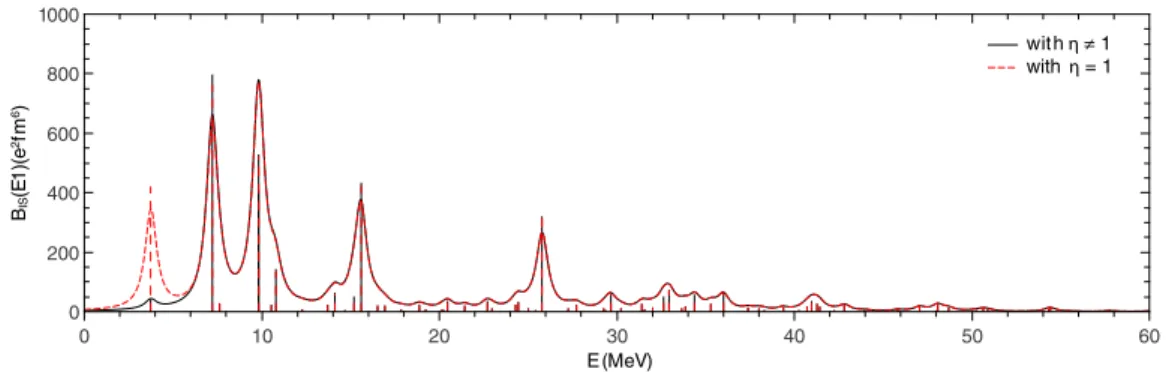
FIG. 1. The IS dipole transition probabilities of22O obtained within the SC-HFEPRPA withη=1 andη=1.
is approximated by using the one-body part of the momentum operator [22]
Pc.m.2 ≈ j
fjpˆ2j ≈ f
j
ˆ
p2j, (44)
where the average occupation number of the hole states is
f =
j=hfj
j=hj. The two-body part of the momentum operator and the average occupation number of the particle states, whose contribution is negligible, are omitted for simplicity, so that the center-of-mass correction can be expressed in a compact form in terms of the nucleon mass as
m∗=m A
A− f. (45)
After the first loop of the iteration, the mean field is modified by the single-particle occupation numbers, that is, fHF
j is
replaced with fRPAj . Because of the center-of-mass motion,
which is modified by the EP and RPA occupation numbers, the ground-state expectation values for the nuclear density distri-bution must be corrected. The latter are usually expressed in terms of their radial moments [27,31,32]
r2n =
ρ(r)r2nd3r. (46)
After diagonalizing the EP matrix to obtain the new HF density with EP ρHFEP
j (r), the nuclear radial moments are
BIS
(E
1
) (e
2fm 6)
0 200 400 600 800 1000
E (MeV)
0 10 20 30 40 50 60
E = 60 MeVc E = 130 MeVc
BIV
(E
1)
(e
2fm 2)
0 0.5 1 1.5
E (MeV)
0 10 20 30 40
(a)
(b) E = 60 MeVc
E = 130 MeVc
BIS
(E
1)
(e
2fm 6)
0 500 1000 1500 2000 2500 3000 3500
E (MeV)
0 10 20 30 40 50
E = 60 MeVc E = 150 MeVc
BIV
(E
1
)(
e
2fm 2)
0 1 2 3 4 5 6 7 8
E (MeV)
0 5 10 15 20 25 30
(a)
(b) E = 60 MeVc
E = 150 MeVc
FIG. 3. Same as Fig.2but for90Zr.
correcteda posteriorito contribute to the IS EWSR
r2n =
ηρ∗(r)r2n
d3r, ρ∗(r)=
j
fjm fρm fj (r), (47)
where fjm f is the occupation number in mean field, which is equivalent to fjHF=1 within the self-consistent HF
approxi-mation, fEP
j within the self-consistent HFEP, or fjRPA within
the SC-HFEPRPA. The radial moments are renormalized by using the parameterηso that Eq. (46) holds for the first-order radial moment (n=0) after including pairing and correlations from the residual interactions into the mean field, that is
∞
0
ηρ∗(r)d3r=1. (48)
The integrand (48) represents the distribution of one nu-cleon in the radial mesh of nucleus. This normalization is important as it helps to reduce the transition probability at the spurious state, keeping the total IS EWSS almost unchanged
as shown in Fig. 1, where the value of the E1 IS EWSS obtained for 22O within the SC-HFEPRPA by using η=1
(0.677391×10⁵ e2fm6MeV) is larger than that given with η=1 (0.671324×10⁵e2fm6MeV) only by about 0.9%.
The E1 IV EWSR is expressed in term of the model independent Thomas-Reiche-Kuhn (TRK) sum rule as
mIV1 =(1+κ)TRK, TRK= 9 4π
¯
h2
2m∗ NZ
A . (49)
The enhancement factor κ in Eq. (49) is caused by the velocity-dependent terms of the Skyrme interactions [33], whose value is given in Eq. (29) of Ref. [24].
III. RESULTS AND DISCUSSION
The numerical calculations in the present paper were carried out making use of a self-consistent HF-RPA code with the full residual interaction. This code was developed
TABLE I. The truncated spaces used in the EP calculations for22O,60Ni, and90Zr.
Hole levels Particle levels
22O (Neutron) 1s
1/2, 1p3/2, 1p1/2, 1d5/2 2s1/2, 1d3/2, 2p3/2, 2p1/2, 3s1/2, 2d5/2
60Ni (Neutron) 1d
5/2, 2s1/2, 1d3/2, 1f7/2, 2p3/2 2p1/2, 1f5/2, 1g9/2 90
BIS
(E
1
)(e
2fm 6)
0 200 400 600 800 1000
E (MeV)
0 10 20 30 40 50 60
4 hole levels + 6 particle levels 3 hole levels + 6 particle levels 2 hole levles + 6 particle levels
E = 60 MeVc
BIV
(E
1)
(e
2fm 2)
0 0.2 0.4 0.6 0.8 1 1.2
E (MeV)
0 5 10 15 20 25 30 35 40
4 hole levels + 6 particle levels 3 hole levels + 6 particle levels 2 hole levles + 6 particle levels
E = 60 MeVc
(a)
(b)
FIG. 4. The IS (a) and IV (b) dipole transition probabilities of22O obtained within the SC-HFEPRPA by removing one and two hole levels.
by Colò et al. and made accessible for the nuclear physics community [24]. In the present paper, we have extended this code to include the EP and renormalize the RPA residual
interactions. The main limitation of this code is that it can only be used to calculate the properties of spherical nuclei with filled subshells. This limitation remains within our extension.
BIS
(E
1
)(e
2fm 6)
0 200 400 600 800 1000
E (MeV)
0 10 20 30 40 50 60
BIV
(E
1
)(e
2fm 2)
0 0.2 0.4 0.6 0.8 1 1.2
E (MeV)
0 5 10 15 20 25 30 35 40
4 hole levels + 4 particle levels 4 hole levels + 6 particle levels 4 hole levles + 8 particle levels
E = 60 MeVc
4 hole levels + 4 particle levels 4 hole levels + 6 particle levels 4 hole levles + 8 particle levels
E = 60 MeVc
(a)
(b)
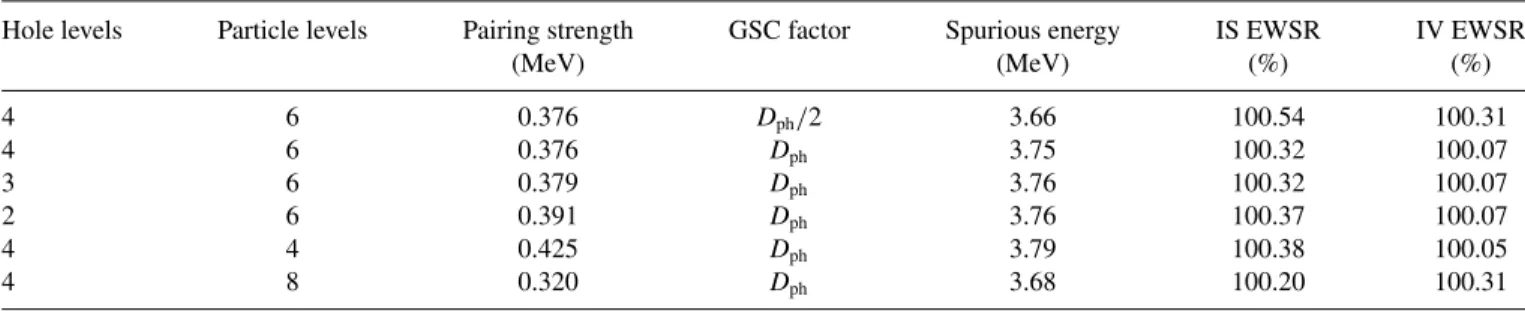
TABLE II. Results obtained within the SC-HFEPRPA for22O by usingE
c=60 MeV and different truncated single-particle levels.
Hole levels Particle levels Pairing strength GSC factor Spurious energy IS EWSR IV EWSR
(MeV) (MeV) (%) (%)
4 6 0.376 Dph/2 3.66 100.54 100.31
4 6 0.376 Dph 3.75 100.32 100.07
3 6 0.379 Dph 3.76 100.32 100.07
2 6 0.391 Dph 3.76 100.37 100.07
4 4 0.425 Dph 3.79 100.38 100.05
4 8 0.320 Dph 3.68 100.20 100.31
Based on a test by using a series of BSk and MSk interactions conducted in Ref. [15], the Skyrme interaction MSk3 is employed in the present paper. The self-consistent HFEP calculations using this MSk3 interaction reproduce well the experimental ground-state properties (binding energy, radii, and nucleon density) of all nuclei under consideration in the present paper. For example, the difference between the calcu-lated average binding energy BE/Aand the experimental data is lower than 0.5%. The renormalization of the RPA is pro-ceeded in two ways: (1) The HFEP is solved self-consistently as in Ref. [15]. Then, the RPA equations are solved once in the end. This process is referred to as the non-self-consistent HF-EP-RPA (HFEPRPA) hereafter; (2) The HF, EP, and RPA are iteratively solved for each loop until the convergence is reached. This process is referred to as the SC-HFEPRPA. We consider three spherical nuclei, whose masses range from light
to heavy, namely 22O, 60Ni, and 90Zr. The calculations are performed in a box of 15 fm radius with a radial mesh of 0.1 fm and cutoff energyEc=60 MeV forJπ =1−. This choice
is reasonable for the calculations for the three selected nuclei above [24].
The multipolarity Jπ =1− is used in our calculation, which is the most important for numerically evaluating the
E1 EWSR to be compared with the model independent sum rule, that is the TRK one. The cutoff energy Ec=60 MeV
is sufficiently large to perform our calculation because the spurious state obtained with thisEcis well separated from the
physical ones as has been shown in Ref. [24]. By increasing the cutoff energyEcto 130 MeV, we found that the energy of
the spurious state in22O is indeed shifted down from 3.75 to
3.12 MeV (see Fig.2). The same trend is seen in the results of calculations withEc=60 and 150 MeV for the heavy90Zr
BIS
(E
1
)
(e
2fm 6)
0 200 400 600 800 1000
E (MeV)
0 10 20 30 40 50 60
Dph D /2ph E = 60 MeVc
BIV
(E
1
)
(e
2fm 2)
0 0.5 1 1.5
E (MeV)
0 5 10 15 20 25 30 35 40
(a)
(b) Dph
D /2ph E = 60 MeVc
BIS
(E
1
)(e
2fm 6)
0 200 400 600 800 1000
E (MeV)
0 10 20 30 40 50 60
BIV
(E
1
)(e
2fm 2)
0 0.2 0.4 0.6 0.8 1 1.2
E (MeV)
0 5 10 15 20 25 30 35 40
RPA
SC-HFEPRPA HFEPRPA RPA
SC-HFEPRPA HFEPRPA
(a)
(b)
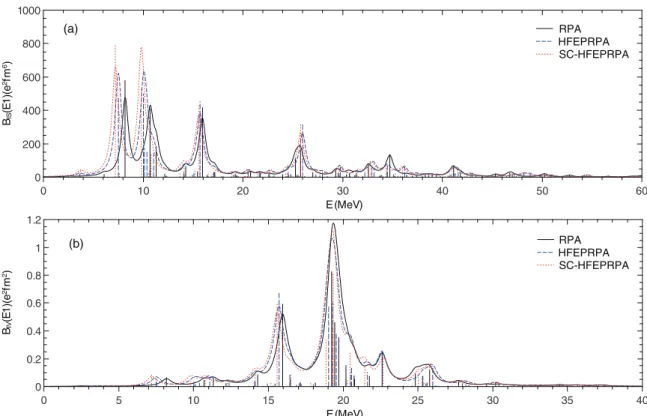
FIG. 7. The IS (a) and IV (b) dipole transition probabilities of22O obtained within different approaches. The sticks and lines represent the probabilitiesB(E1,0→1−) and strength functionsS(E) (the smoothing parameterε=0.4 MeV), respectively.
nucleus as shown in Fig.3. The energy of spurious state in this nucleus is reduced from 2.24 to 1.34 MeV. These results show that the higherEc we choose, the lower the spurious energy
we can obtain. However, the calculations also become much more time consuming. Therefore, the valueEc=60 MeV is
chosen.
BIS
(E
1
)(e
2fm 6)
0 200 400 600 800 1000 1200
E (MeV)
0 10 20 30 40 50 60
BIV
(E
1
)(e
2fm 2)
0 1 2 3 4 5 6
E (MeV)
0 5 10 15 20 25 30
RPA HFEPRPA SC-HFEPRPA RPA HFEPRPA SC-HFEPRPA
(a)
(b)
BIS
(E
1
)(e
2fm 6)
0 500 1000 1500 2000 2500 3000 3500
E (MeV)
0 10 20 30 40 50
BIV
(E
1
)(e
2fm 2)
0 1 2 3 4 5 6 7 8
E (MeV)
0 5 10 15 20 25 30
RPA
SC-HFEPRPA HFEPRPA RPA
SC-HFEPRPA HFEPRPA
(a)
(b)
FIG. 9. Same as Fig.7but for90Zr.
Because of the limitation of the size of the pairing matrix to be diagonalized, we cannot carry out the EP calcula-tions within a too large space of single-particle levels. We therefore adopted the truncated space given in Table I for each nucleus. This truncated space is chosen based on an assumption that pairing affects only few single-particle levels around the Fermi surface [25,26]. The numbers of nucleons, which are left outside these truncated spaces, are 0(N)-8(Z), 8(N)-28(Z), and 50(N)-28(Z) for22O,60Ni, and90Zr, respec-tively. They fill the shells, which form the magic cores, hence preventing any correlation. Two additional oxygen isotopes,
24O and28O, are also employed in the study of the PDR in
neutron-rich nuclei by using our method. The GSC factor
Dph is obtained after diagonalizing the EP matrix. The values of RPA occupation number fk (k=p,h) are obtained by
solving Eqs. (26) and (31) self-consistently with the accuracy
|Dph(n)−Dph(n−1)|10−3, with n being the number of
iterations.
To test the above assumption for the truncated single-particle levels, we have selected different configuration spaces
by adding or removing some hole or particle levels. The nu-merical test for22O withEc=60 MeV shows that removing
one and two hole levels (Fig. 4) or removing/adding two particle levels (Fig. 5) slightly changes the energy of the spurious state (Table II) but the corresponding IV and IS
B(E1) distributions remain practically unchanged with differ-ent truncations. Therefore, to keep a reasonable calculation time, the truncated space for the EP calculations given in TableIis chosen.
The spurious state’s energy might be also affected by the factor 12, which is added to the GSC factorDphas mentioned
in Refs. [6,34]. The numerical test for22O withEc=60 MeV
indicates that no significant change is seen between the results obtained by using Dph and 21Dph (Fig.6). Therefore, to see
the effect of GSC beyond the RPA at its strongest, we use the formalism without the factor 12 in front Dph, as done previously in Ref. [11].
Shown in Figs. 7–9 are the IS and IV transition proba-bilitiesB(E1,Ei) and strength functionsS(E1) of all nuclei
under consideration obtained within the RPA, HFEPRPA, and
TABLE III. The fulfillment of the IS and IV EWSRs obtained within the RPA, HFEPRPA, and SC-HFEPRPA by using the MSk3 interaction with the cutoff energyEc=60 MeV.
IS (%) IV (%)
RPA HFEPRPA SC-HFEPRPA RPA HFEPRPA SC-HFEPRPA
22O 99.611 99.556 100.325 99.920 100.648 100.074
60Ni 99.659 100.991 101.161 99.962 99.087 99.229
90
TABLE IV. Pairing energies obtained within the HFEPRPA and SC-HFEPRPA. The quantity δ=(EHFEPRPA
pair −
ESC-HFEPRPA
pair )/E
HFEPRPA
pair (%) represents the depletion of the pairing effect.
Epair(MeV)
HFEPRPA SC-HFEPRPA δ(%)
22O −4.623 −3.312 28.36%
60
Ni −3.301 −2.937 11.02%
90Zr −1.290 −1.095 15.12%
SC-HFEPRPA for the dipoleJπ =1−. It is seen from these figures that the strength distributions of the IS and IV GDRs are shifted down, similar to those reported in our previous work within the RRPA [11]. This shift is significant in the light22O nucleus (Fig.7), small in the medium60Ni nucleus
(Fig.8), and insignificant in the heavy90Zr one (Fig.9). The explanation of this effect comes from the mean-field descrip-tion and collectivity, which are good for medium and heavy nuclei because of their statistical properties, and become worse in light systems. The results obtained also show that the
TABLE V. Ratio r=SPDR/SGDR obtained within the RPA, HFEPRPA, and SC-HFEPRPA.
RPA HFEPRPA SC-HFEPRPA
22O 0.0236 0.0297 0.0301
24O 0.0565 0.0627 0.0623
28O 0.1030 0.1085 0.1110
60
Ni 0.0272 0.0263 0.0269
90Zr 0.0156 0.016 0.0155
SC-HFEPRPA produces a stronger shift than that taking place within the HFEPRPA, whose mean field is not affected by the RPA occupation numbers. On the other hand, the spurious mode is shifted up in all cases within the HFEPRPA and SC-HFEPRPA. However, this shift is not too strong, hence the spurious mode is still well separated from the other physical states. This spurious mode is also approximately suppressed by a modified isoscalar dipole operator as in Eq. (32) of Ref. [24]. In general, for medium and heavy nuclei, the results obtained by renormalizing the RPA as done in the present paper are not much different from the predictions of the conventional RPA.
σ
(m
b
)
−20 −10 0 10 20 30 40
(MeV)
0 10 20 30 40 50
22O
Exp RPA HFEPRPA SC-HFEPRPA
Ec=130 MeV
E
(a)
σ
(m
b
)
0 50 100
(MeV)
15 20 25 30
60Ni
Exp RPA HFEPRPA SC-HFEPRPA
E
(b)
σ
(mb
)
0 50 100 150 200 250
(MeV)
12 14 16 18 20 22 24 26
90Zr
Exp RPA HFEPRPA SC-HFEPRPA
E
(c)
σ
(m
b
)
0 50 100 150 200 250
(MeV)
12 14 16 18 20 22 24 26
90Zr
Exp RPA HFEPRPA SC-HFEPRPA
E
(d)
Shown in Table III are the fulfillments of the EWSR within the RPA, HFEPRPA, and SC-HFEPRPA. For the HFEPRPA and SC-HFEPRPA, the IS and IV EWSRs are fulfilled owing to the contribution of pairing correlation and GSC. These results confirm the assumption that the effect caused by the pp and hh configurations or high-order ones is effectively included in the pairing correlation. Although the EWSR is restored in both HFEPRPA and SC-HFEPRPA, the basic difference between these two approaches is that the modification of the mean field via RPA occupation numbers is performed only within the SC-HFEPRPA. On the other hand, unlike some common implementations of QRPA, the particle number is always conserved in the present EP-based approaches.
During the renormalization, the pairing effect is found to be reduced in the SC-HFEPRPA. As presented in TableIV, the reduction of pairing energy is always more than 10% and reaches∼30% in the neutron-rich22O nucleus. This re-veals the mutual influence of pairing and residual correlations via the GSC factorDEP
ph and RPA occupation numbers. Both
of the short-range pairing and long-range ph residual in-teractions are included in the nuclear mean field, which may serve as an explanation for this phenomenon. In the beginning, the mean field (HFEPRPA) contained only the pairing correlation. After the SC-HFEPRPA calculation was performed, the new mean field contained both of the pair-ing and residual correlations. Therefore, the pairpair-ing corre-lation is reduced to give room for the residual correcorre-lation, which comes from the RPA. In particular, the mean field is modified not only by pairing, as within the HFEPRPA, but also by the residual correlation from the RPA within the SC-HFEPRPA in a self-consistent way. This reduction of pairing can be associated with the antipairing effect within the SC-HFEPRPA.
The PDR, which appears around the particle-emission threshold in the neutron-rich nuclei, is also observed in our calculations for22,24,28O,60Ni, and90Zr. Shown in TableVis the ratior=SPDR/SGDRbetween the EWSS of the PDR (0 Eν 12 MeV) and GDR (0Eν60 MeV). The interval of PDR energies is often chosen from 0 up to 15 MeV [20,35]. We chooseEmax=12 MeV to avoid the overlap of the PDR to the GDR region, which is seen in Figs.7,8, and9. The values of r are small (1–2%) in the stable nuclei60Ni and 90Zr, whereas its values increase from 3% to 11% in the
neutron-rich nuclei 22,24,28O. Both the HFEPRPA and SC-HFEPRPA produce a pronounced PDR in these neutron-rich nuclei. This enhancement can be explained by the contri-bution of EP, leading to the GSC factor DEP
ph, as discussed
in Ref. [20].
Finally, we compare our calculated photoabsorption cross sections in three nuclei under consideration with the experi-mental data [16,36,37] in Fig.10. The calculated cross sec-tions are generated from the strength functionS(E1) obtained by using the MSk3 and SkM∗interactions. The smoothing pa-rameterεin Eq. (41) is chosen equal to 1.5, 2.5, and 1.25 MeV to produce the GDR widths =3.0, 5.0, and 2.5 MeV for
22O,60Ni, and90Zr, respectively. The results obtained show no
significant difference between the conventional RPA and our approaches. The maximum peak of cross sections obtained
within our approaches is shifted down to the lower excitation energy. This shift is most prominent for90Zr, which is around 2 MeV [Fig. 10(c)]. When the SkM∗ interaction, which is known to well describe the GDR in heavy nuclei [38], is used for90Zr, the shift is eliminated and a better agreement with the experimental data is seen [Fig. 10(d)]. It can also be observed from Figs. 10(c) and 10(d) that, for the 90Zr nucleus, the SkM∗interaction produces an enhancement of the IV dipole transition probabilities as compared to those ob-tained by using the MSk3 interaction. This comparison shows that, for the giant resonances, the difference between the pre-dictions by various approximations such as RPA, HFEPRPA, and SC-HFEPRPA is smaller than those caused by different interactions, so the agreement is fair if the interaction is well tailored to the phenomenon at hand.
IV. CONCLUSIONS
The present paper proposes a novel approach to renormal-ize the RPA by making use of the exact pairing solution. The GSC factor, which includes pairing correlation, is em-ployed to renormalize the residual interaction. The calcula-tions are performed at each separate multipolarity Jπ in two ways, the non-self-consistent (HFEPRPA) and self-consistent (SC-HFEPRPA), for22,24,28O,60Ni, and90Zr nuclei by using
the Skyrme interaction MSk3. The results obtained show that the drawback of the phRRPA is removed, namely the IS and IV EWSRs are fulfilled without adding any pp and hh configurations, hence the extension of RPA matrices and time-consuming calculations are avoided. As compared to the RPA results, the effects of GSC and EP in the renormalization are significant in light nuclei and small in medium and heavy nuclei.
The antipairing effect is observed for the first time within the SC-HFEPRPA, which reduces the pairing energy from more than 10% up to around 30% in the neutron-rich 22O
nucleus. This shows the contribution from the mutual effect of the short-range pairing and long-range ph residual interaction to the mean field. The PDR, owing to the oscillation of the excess neutron against the proton-neutron core, is also found to be enhanced in neutron-rich nuclei because of the pairing effect. The GDR cross sections are also calculated and no significant difference between the results obtained within the conventional RPA and our approaches is seen. They agree fairly well with the experimental data.
ACKNOWLEDGMENTS
[1] P. Ring and P. Schuck,The Nuclear Many-Problem(Springer, Berlin, 2004).
[2] Y. Suzuki, K. Yabana, R. G. Lovas, and K. Varga,Structure and Reactions of Light Exotic Nuclei(Taylor & Francis, London, 2003).
[3] K. Hara,Prog. Theor. Phys.32,88(1964). [4] J. Sawicki,Phys. Rev.126,2231(1962).
[5] K. Ikeda, T. Udagawa, and H. Yamamura,Prog. Theor. Phys.
33,22(1965).
[6] D. J. Rowe,Phys. Rev.175,1283(1968).
[7] F. Catara, N. D. Dang, and M. Sambataro,Nucl. Phys. A579,1 (1994).
[8] J. Dukelsky and P. Schuck,Phys. Lett. B464,164(1999). [9] J. G. Hirsch, P. O. Hess, and O. Civitarese,Phys. Rev. C54,
1976(1996).
[10] F. Catara, G. Piccitto, M. Sambataro, and N. Van Giai, Phys. Rev. B54,17536(1996).
[11] N. Q. Hung, N. D. Dang, T. V. Nhan Hao, and L. T. Phuc,Phys. Rev. C94,064312(2016).
[12] A. Volya, B. A. Brown, and V. Zelevinsky,Phys. Lett. B509, 37(2001).
[13] V. Zelevinsky and A. Volya, Phys. Atom. Nuclei 66, 1781 (2003).
[14] W.-C. Chen, J. Piekarewicz, and A. Volya, Phys. Rev. C89, 014321(2014).
[15] L. T. Phuc, N. Q. Hung, and N. D. Dang, Phys. Rev. C97, 024331(2018).
[16] A. Leistenschneideret al.,Phys. Rev. Lett.86,5442(2001). [17] E. Tryggestadet al.,Phys. Lett. B541,52(2002).
[18] G. Co’, V. De Donno, C. Maieron, M. Anguiano, and A. M. Lallena,Phys. Rev. C80,014308(2009).
[19] G. Co’, V. De Donno, M. Anguiano, and A. M. Lallena,Phys. Rev. C87,034305(2013).
[20] N. D. Dang and N. Q. Hung,J. Phys. G40,105103(2013). [21] D. Vautherin and D. M. Brink,Phys. Rev. C5,626(1972). [22] K. Langanke, J. A. Maruhn, and S. E. Koonin,Computational
Nuclear Physics 1(Spring, Berlin, 1990).
[23] M. Bender, K. Rutz, P.-G. Reinhard, J. A. Maruhn, and W. Greiner,Phys. Rev. C60,034304(1999).
[24] G. Colo, L. Cao, N. V. Giai, and L. Capelli, Comput. Phys. Commun.184,142(2013).
[25] N. Q. Hung and N. D. Dang,Phys. Rev. C79,054328(2009). [26] N. Q. Hung, N. D. Dang, and L. T. Quynh Huong,Phys. Rev.
Lett.118,022502(2017).
[27] A. Bohr and B. Mottelson,Nuclear Structure, Vol. I(Benjamin, New York, 1969).
[28] D. J. Thouless,Nucl. Phys.22,78(1961).
[29] M. N. Harakeh and A. E. L. Dieperink,Phys. Rev. C23,2329 (1981).
[30] N. Van Giai and H. Sagawa,Nucl. Phys. A371,1(1981). [31] G. D. Alkhazov, I. S. Novikov, and Yu. M. Shabelski,Int. J.
Mod. Phys. E20,583(2011).
[32] R. Neugart and G. Neyens, in The Euroschool Lectures on Physics with Exotic Beams, Vol. II, edited by J. Al-Khalili and E. Roeckl, Lecture Notes in Physics Vol. 700 (Springer, Berlin, 2006), p. 135.
[33] K. F. Liu,Phys. Lett. B60,9(1975).
[34] H. Lenske and J. Wambach,Phys. Lett. B249,377(1990). [35] N. D. Dang, V. K. Au, T. Suzuki, and A. Arima,Phys. Rev. C
63,044302(2001).
[36] A. Lepretre, H. Beil, R. Bergere, P. Carlos, A. Veyssiere, and M. Sugawara,Nucl. Phys. A175,609(1971).
[37] S. C. Fultz, B. A. Alvarez, B. L. Berman, and P. Meyer,Phys. Rev. C10,608(1974).