Dams for Development
What is the social impact of the Nam Theun 2 on the resettled Nakai People?
MA International Relations
Floris Hooghiemstra [email protected]
Abstract
The World Bank hails hydropower as the sustainable development tool to challenge the energy needs and alleviate poverty in countries. These large dams entail complex and multidimensional social impacts on local communities. This thesis assesses the social impacts on the resettled communities affected by the newest developmental project of the World Bank, the Nam Theun 2. Relocation leads to disappearance of traditional practices and the uptake of a modern market-based life style. Deploying the Matrix Framework find that this resettlement is not without its setbacks and impactful changes. Livelihood activities that are far removed from the traditional cultural practices fail to mature, while other activities closer connected to the previous lifestyle performed above expectations in providing villagers with a sustainable source of income. All with all, The World Bank failed to implement
Table of Contents
1 Introduction ... 3
1.1 Hydropower worldwide ... 3
1.2 Nam Theun 2 ... 3
1.3 Research question ... 4
2 Literature Review... 5
2.1 Dams for development ... 5
2.2 Benefits of hydropower ... 6
2.3 Costs of hydropower ... 7
2.4 Gap ... 10
2.5 Solution... 11
2.6 Matrix Framework ... 12
2.7 Resettlement ... 15
2.8 Conclusion ... 16
3 Methodology ... 17
3.1 Approach ... 17
3.2 Data ... 18
4 Results ... 19
4.1 Development of agriculture and animal husbandry ... 19
4.2 Timber and non-timber forest cultivation ... 26
4.3 Fisheries in the reservoir lake ... 30
4.4 Other off-farm economic activities ... 31
5 Conclusion ... 34
1 Introduction
1.1 Hydropower worldwide
Dams have become increasingly popular in the past decades as sustainable development model for developing country rich in natural resources. Dams provide solutions to multiple challenges and are multipurpose projects. Especially the Mekong region stands out in the current frenzy on dams. The potential for hydropower in this region is enormous, as by the end of last century more than 90% of the resources were still untapped (Sims, 2015). Consequently, the number of large hydropower projects in Southeast Asia is to increase dramatically in the next decades to come. The World Bank is an active promoter of hydropower for development in this region. The Bank is the primary financer of large dams worldwide in developing countries (Shoemaker & Robichaud, 2018).
Hydropower, however, is not without its disadvantages. Previous World-Bank projects have been embroiled in public controversy over the enormous social and environmental costs, often paid for by the local communities (Singh, 2009). The academic debate reflects these public concerns and much literature is dedicated to benefits and costs of dams. The social impacts of dams take the centre of this debate, that takes its contributions from a wide variety of disciplines. This diversity of the literature is a strength, since large dam projects entail a myriad of social impacts that require different approaches. Simultaneously, the diversity of the debate as there are no unifying elements in the literature that connect the findings on social impacts (. Without thorough and structured social impact assessments, the debate on the benefits and costs is impeded and unable to develop the answer the ultimate questions: do the benefits outweigh the costs?
1.2 Nam Theun 2
Theun 2 would serve as the model for future hydropower and other sustainable development projects in Laos (Smits, 2012).
There are multiple reasons to assess the social impacts of the Nam Theun 2 Dam. The pivotal and leading role of the project, declared by the main global financer of development; the scale and impacts of the undertaking, the controversy; the resettled communities as indicator of the overall success; and the recent end of the Resettlement Implementation Period. This research sets out to determine the effectiveness of the new hydropower development model of the World Bank in facilitating the livelihood of re-established villagers in the context of the Nam Theun 2, and future projects conducted by the World Bank in the Mekong Region.
1.3 Research question
In order to gauge the effectiveness of this model of development, this thesis focuses on the outcomes of the resettlement produced through villagers’ engagement with the NT2 resettlement
livelihoods programmes. These people potentially experience the most adverse impacts and physical restructuring of their social culture. Relocation is one of the most significant challenges of hydropower development (Scudder & Colson, 1982). Successful relocation serves as a good indicator on the project as a whole. How did governments, financers and developers deal with the most vulnerable and affected communities in a dam project? As former vice-president of the United States Hubert Humphrey (1965-1969) once stated “the treatment of the weakest members of society is a reflection of society as a whole”.
This thesis analyses the results of the resettlement livelihoods programmes for reconstructing the livelihood systems of the Nakai people at the relocation sites, against the expected outcomes as consented during the prior negotiations. The research questions is as followed: what is the social impact on the resettled Nakai people of the Nam Theun 2? The purpose of examining if the
implementation of these programmes to determine if this new model of hydropower development has achieved the desired outcomes, is to reach an answer to the question if dams can be worth the
2 Literature Review
2.1 Dams for development
During the 20th century, large hydropower dams emerged as the symbols of modernity around the world. Dams are hailed for their versatility of serving multiple purposes. Dams are effective to harness water, generate energy, flood control and domestic use. Additionally, dams could assist in poverty reduction and increased water supply for the local communities around the dam site.
Hydropower projects became synonymous with progress and economic development. For instance, the UN emphasis the significance of affordable energy in the developing world as critical for the realisation of the Millennium Development Goals (United Nations Development Program (UNDP), 2006). At the World Summit on Sustainable Development in 2002, stakeholders pledged to increase hydropower projects to generate sustainable affordable energy. Two-thirds of the economically viable hydropower generation is yet untapped, with 90 percent of this potential in developing countries (Namy, 2007). Large hydropower dams are viewed as the big solutions to the big energy global challenges, with yearly 45 billion USD invested in hydropower (Ansar, Flyvbjerg, Budzier, & Lunn, 2014).
Construction and implementation of large hydropower projects go hand in hand with numerous impacts felt by a wide variety of communities. In recent decades dams projects have become mired in controversy as the projected benefits come at significant social and environmental costs (Namy, 2007). At one end of the spectrum is Phoenix, Arizona, that could grow into a large city in a desert region because of the increased drinking water reserves supplied by the Roosevelt Dam. At the other end of spectrum are the 40 to 80 million people estimated that had to be relocated because of dams according to the World Commission of Dams (WCD) (2000). Famous examples of controversial social impacts are: The Three Gorges Dam requiring the resettlement of 1.4 million people and the government of China acknowledged the pressing geological, human and ecological costs; The Narmada Dam in India sparked widespread outrage because of the proposed forced relocation of 200,000 people from their homes; And the constriction of the flow of the Nile by the Aswan Dam led to decreased fertility of the
agricultural land all over Egypt (Shah & Kumar, 2008). The attention over the years on the controversial social impacts has not hampered the increased investment over the years in hydropower, as the
criticism rises simultaneous the proposed dam projects (Ansar et al., 2014). Especially the World Bank is a focal point of criticism, as the Bank actively promotes hydropower for the sustainable development for developing countries (World Bank, 2007).
dams into account. Critics of large dams charge the projects of being unbalanced because “the poor, other vulnerable groups and future generations are likely to bear a disproportionate share of the social and environmental costs of large dam projects, without gaining a commensurate share of the economic benefits” (Jones, 2015, p. 12). The criticism focusses largely on the World Bank, as main financer of large
dam projects worldwide (Namy, 2007). International organisation, including the World Bank, support dams because the social, technological and economic benefits outweigh potential negative social impacts overall in the economic development of countries (World Bank, 2007).
2.2 Benefits of hydropower
The benefits of electricity generation with hydropower are numerous and stressed by several scholars. Evans, for instance, conducted research towards the average cost of production of electricity ranged over the full cycle of each energy generation technology, and found that the average price to generate one Kw/H is 0,05 US dollar with hydropower. This is significantly cheaper than other renewable energy sources (Evans, Strezov, & Evans, 2009). Aside from high capital investments required upfront, the economic costs of hydropower generation are relatively low. Once constructed, hydropower plants have low operation costs and long life span. The average hydroelectricity dam is expected to have a lifespan of 50 – 100 years, which allows for a long time for the developing parties to receive a return of investment and produce a net profit (WCD, 2000; World Bank, 2007). There are clear economic benefits of hydropower projects compared to other forms of electricity generation to challenge the energy-needs of countries according to Ansar. The Itaipu Dam on the border of Brazil and Paraguay generates more electricity annually than Switzerland (Ansar et al., 2014).
The environmental benefits of hydropower versus fossil-based generation are far superior. Hydropower generates energy from a non-depletable natural source, making this form of energy production non-exhaustive unlike fossil fuels (Koch, 2001). Hydropower generation plants only emit greenhouse gasses as result of the decomposing biomass that accumulates in the reservoir lake. Typically, in cooler climates less bio mass decomposition occurs and the carbon emissions are minimal (Evans et al., 2009). Only electricity generation through wind contains lower carbon emissions than hydropower (ibid). However, most developing countries landscapes are better equipped for hydropower generation, making dams an accessible alternative to fossil fuel-based electric production (Yüksel, 2009).
Dams have the potential to assist in energy, socioeconomic and environmental challenges. Developmental organisations embrace hydropower as tool to enhance the economies of developing countries by exploiting their natural resources, while simultaneously benefitting the local population (World Bank, 2007). The Chinese government regards hydropower as fundamental sector for the development of the national economy and actively stimulates this industry (Koch, 2001). Laos envisions its future as the ‘battery of Southeast Asia’ and aims to exploit its vast hydropower potential for exports,
functioning as major source of income for the country’s development (UN, 2010).
2.3 Costs of hydropower
2.3.1 Environmental and economic costs
During the past decades, a growing international movement has emerged that oppose and criticise dams as sustainable development tool. This is reflected in the academic literature where many scholars stress that many dams do not meet the expectations and are accompanied with
unacknowledged social and environmental costs (Lawrence, 2012; Namy, 2007; Scudder, 2012). Namy states that if these costs significantly obscure cost-benefit assessments of dams (2007). The World Commissions on Dams, partly founded by the primary source of finance for large hydropower the World Bank, found that in between 40 to 80 million people have been displaced by dams worldwide (WCD, 2000). This makes dams unparalleled as displacing force in the global history. It highlights the urgency to carefully monitor and manage the potential impacts of dams on livelihood, health, and traditional cultures (Namy, 2007).
Especially in developing nations, the costs of projects raise higher than expected as result of limited funding, absence of technical expertise within the government, resources and lack of quality assurance. Ansar and his team found that the potential errors leading from this mismanagement are faulty
engineering, inadequate geological planning, and superficial social and environmental impact assessments (2014). These potential flaws in the project planning may result to catastrophal environmental and social impacts, as the case with the Sardar Sarovar Dam in India. The developing company, Sardar Sarovar Narmada Nigam Ltd, and the main financer, the World Bank, failed to allocate sufficient budget for the social impact of the dam, leaving tens of thousands households without compensation after the inundation of the reservoir (Wade, 2011).
Despite hydropower being considered as a renewable energy source, hydropower generation contains significant environmental impacts in developing countries according to Shoemaker &
Robichaud. By diverting the natural flow of the river for hydropower generation, dams alter the existing stream hydrology, sediment transport within the river and migratory patterns (Shoemaker & Robichaud, 2018). Disintegration of the river ecosystem, change the upstream and downstream in almost essentially different ecosystems. Sediment is not allowed anymore to freely float through the river and flood patterns change for instance. In many scenarios, tributary and main river blockades brought a decline in wetlands adjacent to the river. Dams hold back sediment and thereby deprive downstream water of vital nutrients, affecting riparian communities depending on these nutrients for agriculture (McCully, 1996).
2.3.2 Social costs
As mentioned in the previous paragraph, dam projects in developing countries have been found to be more prone to erroneous factors in the process. Bakker acknowledges this with her research into large infrastructure in Southeast Asia. The author analyses the social impact of dams in the Mekong region. The peace dividend of the 1990’s led to numerous hydropower development plans initiated in
Other research findings complement Bakker as local communities have been the victim of development-induced resettlement before in Southeast-Asia (Vandergeest, 2003). Land tenure reforms led to the dispossession of individuals for accumulating state property, without receiving compensation. This reforms led thousands of people homeless in Laos (Vandergeest, 2003). Therefore, participation and consultation of the potentially affected people through developmental organisations, such as the World Bank, is necessary to mitigate the social impacts (Cernea, 2000).
Beck, Claassen and Hundt confirm the concerns of Bakker. According to the authors, inadequate environmental, social and economic assessments have contributed to unsustainable development in many hydropower projects in the Mekong region. The lack of transparency, corruption and poor participatory impeded the sustainability of the projects (Beck, Claassen, & Hundt, 2012; Shoemaker & Robichaud, 2018). The benefits are exaggerated and the mitigation measures for the affected people have been inappropriate, unrealistic or poorly executed at most (Beck et al., 2012). Especially the alternative livelihood plans have insufficiently compensated the relocated households, because of the poor quality and small lots, possibly leading to the Malthusians squeeze of the affected people (Beck et al., 2012; Rigg, 2005).
2.4 Gap
The academic debate centres on the social impacts of dams in developing countries (Namy, 2007). Wold Bank projects and assess whether their claim to put humans are at the centre of dam development is correct (Kirchherr & Charles, 2016). Answering this question on the social impacts are of large dams is vital and a focus point for the academic debate in the field (Kirchherr & Charles, 2016). Especially since there is close interaction within this field between scholars and dam developing organisations such as the World Bank (Vanclay, 2002). Scholars often serve on independent monitoring panels of dam projects, or are deployed to conduct fieldwork for NGO’s or developers (Higashi, 2010;
Richter et al., 2010).
Scholars have explored the impacts of dams in developing countries, with a focus on the
Mekong region, for decades since the opening up of the region (Kirchherr, Pohlner, & Charles, 2016). . A wealth of studies has been undertaken to assess the social impacts from a variety of disciplines. All these articles contribute to the debate by researching the social impact of dams. Only by thorough assessment of the social impacts, the benefits can be outweighed to the costs.
Despite the abundance of articles, various scholars state that many research gaps remain in the literature, amongst others the leading anthropologist Michael Cernea of the World Bank (Cernea, 2004b; Tilt, Braun, & He, 2009; Vanclay, 2002). One of the main weaknesses in the literature is the assessment of the social impacts of dams. Most authors depend on “Inductive, ‘thick description’ and qualitative research approach focused on the resettlement area”, and fail to delineate or assess their
social impact research (Kirchherr & Charles, 2016, p. 102). A reason for the authors engaging in social impact research without a framework, is the complexity of dams’ social impact. A myriad of social
impacts occur during the design, construction and operational phase over various dimensions. The impact of dams are more complicated and comprehensive than of other infrastructure projects, because of the multitude of purposes dams serve (Kirchherr et al., 2016). Scholars often do not possess the resources to comprehensively study all the social impacts, particular components are focused upon.
Consequently, their observations and findings provide an in-depth image of vertainimpacts of the dam, but not a complete assessment. This approach to assess this transformative hydropower project is both an asset as its main point of weakness (Barney, 2019). The complex processes
surrounding the mega dams clear up with their narratives. However, in most articles the authors failed to unify their different findings one single coherent framework on social impacts. This lack of a
conducted during field surveys by the researcher themselves. While these paint a picture of the
resettlement, it is difficult to extrapolate these individual findings into the bigger social impacts without an overarching framework to place the data in the right context (Kirchherr et al., 2016).
The main pitfall of the social impact literature is most authors explaining just a few single social impacts without tying these together. Scholars should be collaborating and assess the total social impacts of dams. Especially now in the current frenzy of dams in the Mekong region, thorough
assessment of the social impacts of large dams is critical. Only by painting the complete picture of a dam, scholars can hold dam-developers and financers accountable for effectiveness of their mitigation
programs for the social impacts (Singh, 2009).
2.5 Solution
However, as Kirchherr et al noted, it is impossible for single scholars to conduct complete assessments of the social impacts (2016). Therefore, the authors recommend to deploy an inclusive framework that can be divided in different aspects and parts: the Matrix Framework. This framework allows researchers to study single social impacts under an overarching framework. By deploying a framework to assess the social impacts, the external validity of the single assessment gains strength as these can complement each other and allow for comparison. This paper elaborates more upon the Matrix Framework in chapter 4.
In order to partially fil the gap, this thesis sets out to research the social impact of Resettlement in one of the largest and most controversial dam projects in the Mekong: the Nam Theun 2 in Laos. Assessing the social impacts of this particular hydropower project is of great concern for three reasons. Firstly, the social impacts of this dam project have not been effectively addressed because of difficulty of their evaluation (Beck et al., 2012). Secondly, the World Bank is the primary financers of this project and boasted the Nam Theun 2 as the newest sustainable development tool of its arsenal. Research showed that the World Bank functions as precursor for hydropower development as the primary financer of hydropower worldwide (Namy, 2007). Other dam developers follow the World Bank hydropower models for guidance on the sustainable development of infrastructure projects in developing countries (Kirchherr et al., 2016). Finally, many of the costs and benefits of dams in the Mekong Region applied to the Nam Theun 2 extend to other projects in the region (Beck et al., 2012).
Theoretical Framework 2.6 Matrix Framework
2.6.1 Limitations of frameworks
Dam projects inherently possess social impacts. The social impacts of dams are “responses of
social systems to physical restructuring of their environment” (Shields, 1975, p. 265). The
conceptualisation of social impacts of large dam projects is complex with a myriad of social impacts happening over various dimensions. Dams affect numerous people in one way or another. Vanclay’s attempt to conceptualise all social impacts highlights the difficulty to operationalise and conceptualise the social impacts of dam projects. The author suggested no less than 80 different social variables to be taken into account (Vanclay, 2002). Additionally, these impacts are felt over space, time and value. Some social impacts affect second to third generations (Takesada, 2009). A sound theoretical framework that conceptualises the relevant social impacts, that can be replicated and extrapolated, is crucial for thorough research on large hydropower projects.
Kirchherr and Charles’ analysis of the literature led to a significant finding. If scholars and
authors deploy a framework within their research, there is little consensus over which framework. Kirchherr and Charles found 27 different frameworks in the 55 articles written on social impact of hydropower utilising theoretical frameworks to delineate the subject prior to their research. Out of the 27 existing frameworks existing in the literature, only four are utilised more than two times by
researchers. This indicates the absence within the field of commonly agreed frameworks, despite several attempts by various stakeholders to join forces to create such framework.
The current frameworks in the literature possess multiple significant deficits (Kirchherr & Charles, 2016; Smyth & Vanclay, 2017). The spatial and the temporal dimension are often limited. Frameworks delineate a clear impact zone with a well-defined geographical boundary and often only take the operational phase into consideration (Harvey, 2011). Most frameworks found in the literature exclude the understudied impacts on downstream communities for instance (Cernea, 2004a). The impacts of hydropower projects have the possibility to extend to regional, national or even international level, and occur before, during, and after the construction phase. This is unaccounted for in the
literature (Kirchherr & Charles, 2016).
debate. Subsequently, a definite set of social impacts is not desirable but Kirchherr and Charles recommend a firm basis adjustable to the distinctive local setting of each project. This would enhance the external validity of research and tie the discipline together.
2.6.2 Overarching Framework
The final limitation is the unacknowledged causality loops of social impacts. Frameworks do not conceptualise the interconnectivity of the impacts. Villagers resettling to a new site brings both physical as socio-cultural changes. New access to electricity for instance is cited as a major benefit for resettled communities in multiple dam projects (Tilt et al., 2009). Electricity access alters livelihoods, which in turn changes cultural practices. These causality loops are challenging to incorporate in a framework and often excluded (Kirchherr & Charles, 2016).
Kirchherr and Charles devised a new theoretical framework that would account for these limitations, without leading to extensive reports. The Matrix Framework is an aggregation of multiple frameworks on social impact. It includes the various dimensions and components of impact identified in the literature. Kirchherr and Charles integrated these scholarly findings into the Matrix Framework, in an attempt to foster agreement upon the overall set of variables when studying the social impact of dams. Incorporating these dimensions and components in the Matrix Frameworks creates a more holistic perspective specifically addressing the social impacts of dams. The Matrix Framework is relatively recent and only deployed on by a handful of researchers (Kirchherr et al., 2016; Owusu, Yankson, Asiedu, & Obour, 2017; Sadeghi, Skandar Seidaiy, & Reza Rezvani, 2017), or in modified form (Moran, Lopez, Moore, Müller, & Hyndman, 2018).
by Kirchherr, & Charles, 2016, Environmental Impact Assessment Review, 60(C), 99-114.
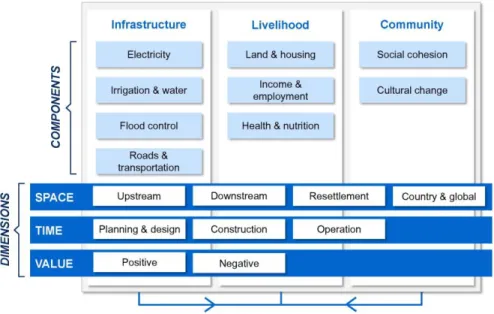
The Matrix Framework conceptualises the social impact of dams from both a dimension as a component perspective. The dimensions are space, time and value, as identified in the literature. The components are infrastructure, livelihood and community. Figure 1 is a visualisation of the framework showing how the dimensions and components fit together.
Dimensions in the Matrix Framework are stretched compared to their counterparts in the corresponding frameworks. Expanding the dimension of space includes considering the dams’ social impact from an upstream, downstream, resettlement as well as regional perspective. For the dimension of time, the MF assesses the impact from the start of the dam project in the planning and design phase. Finally, the impacts of dams can be positive and negative (Kirchherr & Charles, 2016).
The nine different components of social impact outlined are clustered in three categories. Infrastructure entails electricity, irrigation and water, flood control and roads & transportation. Impacts on livelihood are land & housing, income & employment and heath & nutrition. The community impacts are social cohesion and cultural change. Despite structuring the components in these three categories, the MF acknowledges that the interconnectivity of the components. Additionally, the components may occur besides different dimensions of social impact. The components are sequential and not mutually exclusive. Changes in infrastructure can lead to changes in livelihood, which in turn can induce changes in community.
2.7 Resettlement
Another asset of this framework is its divisibility. Kirchherr and Charles specifically stress that the Matrix Framework lends itself as a jigsaw puzzle. Solving the complete puzzle all at once is too ambitious according to the authors. Kirchherr and Charles state that “a single scholar or a small team of scholars usually cannot comprehensively study the breadth of these social impacts even for a single dam” (Kirchherr et al., 2016, p. 116) The authors recommend that researchers deploy the Matrix Framework to assess specific dimensions, instead of the entirety of dimensions and components. The model allows individual studies to be tied together under this overarching framework.
The scope of this research is studying the Resettlement of the Nakai People within the context of the Nam Theun 2. The main question is what the social impacts is on the livelihood of the resettled people. Therefore, this research studies the Livelihood component mainly, and excludes Infrastructure and Community prior to the research, despite these components being related to Livelihood. The main reason for the exclusion of Infrastructure is that most authors on the Nam Theun 2 agree that the NTPC, after an initial delay, provided adequate infrastructure for the resettled Nakai people (Lawrence, 2012). Community requires a qualitative in-depth approach, while this research is focussed on incorporating quantitative and official data to provide an overview of the resettlement. Cultural change and social cohesion are difficult to capture in statistics. The Matrix Framework suggest assessing the resettlement according to the following three categories: Land & Housing, Income & Employment, and Health & Nutrition.
These categories are co-related so a clear distinction is hard to make. Nevertheless, Kirchherr and Charles line out a basic division on what every category entails. Kirchherr and Charles define the category Land & Housing as the social dimension of infrastructure, whereas the pillar Infrastructure covers more basic infrastructure such as roads. Farmlands and livestock fall under Land & Housing (IDAM et al., 2012; Kirchherr & Charles, 2016). Income & Employment includes all factors regarding monetary aspects. Material wealth such as monetary benefit-sharing impacts, royalty benefits and changes in income inequality. Furthermore, this category entails embodied wealth, which is defined as “wealth that is implicitly carried by a person” (Wang, Lassoie, Dong, & Morreale, 2013, p. 133). Health &
2.8 Conclusion
The Matrix Framework tackles the limitations of the frameworks by incorporating their
individual dimensions and components, and complement them. Kirchherr and Charles aided the field of hydropower enormously with their bold step to create a framework that is overarching, consolidating and divisible. These three assets of this holistic framework are perfectly fitting to assess the
3 Methodology
3.1 Approach
Kirchherr and Charles recommend to alter the Matrix Framework to the unique local setting of each dam (2016). The authors intentionally created room within the framework for flexibility, hence the categories not being rigidly determined. The theory rather delineates the social impacts to assess. As mentioned in the chapter before, to assess the livelihood of the resettled communities, the Matrix Framework prescribes to take Land & Housing, Income & Employment and Health & Nutrition into account. The Resettlement of the Nakai people will be assessed based on these three components.
However, as the Resettlement Programmes for the Nakai people categorise four livelihood activities as the foundation for sustainable resettlement, I will structure the thesis alongside these four categories: Development of agriculture and animal husbandry; Timber and non-timber forest cultivation; Fisheries in the reservoir lake; And other off-farm economic activities (NTPC, 2005). These fundamental align with the categories prescribed by the Matrix Framework. Therefore, this thesis will conduct research to these four social impacts and its maturation time during the Resettlement.
Process tracing is the most suitable method of analysis on the development of the livelihood activities. Process tracing is a fundamental tool for within-case analysis developed (George & Bennett, 2005). Process tracing is defined as “the systematic examination of diagnostic evidence selected and analysed in light of research questions” (Collier, 2011, p. 823). Temporal sequences of events or
phenomena often serves as the diagnostic pieces of evidence. This method has the potential to decisively contribute to identifying new political and social phenomena and systematically describing them (George & Bennett, 2005). Beach and Pedersen further defined qualitative process tracing as identifying causal mechanism between independent variables and the outcome of the dependent variable. The ambition is “to craft a minimally sufficient explanation of a particular outcome, with
sufficiency defined as an explanation” (Beach & Pedersen, 2013, p. 51)
The independent variable is the Resettlement Programmes in this research, with the
dependable outcome being the different livelihood activities for the resettled villagers. The outcome of this process sheds light upon the success of the World Bank’s new development initiatives of mitigating
resettlement. The four main categories of the Resettlement Livelihood Program (Development of agriculture and animal husbandry; Timber and non-timber forest cultivation; Fisheries in the reservoir lake; And other off-farm economic activities) serve as the indicators of the change in quality of life, since the villagers themselves determined that these categories would improve their livelihood after
The developer and the resettled communities agreed for each category on the outcome of each program. These programs should lead to sustainable livelihood activities for the resettlers at the end of the Resettlement Implementation Period. These goals are stipulated in the Concession Agreement between the villagers and developers. The actual outcome will be compared towards the original objective for that category, and answer the question whether or not sustainable livelihood is created. Additionally, a detailed narrative will be derived from the available data to explain the particular outcome of each program.
3.2 Data
The livelihoods of the resettled Nakai people will be assessed according to the official data of the World Bank and the Nam Theun 2 Power Company, developing company of the dam, published in yearly Living Measurement Studies Surveys. These surveys provide raw data on the livelihoods of resettlement. The NTPC and World Bank collaborated with several to assess the development of their social and environmental plans, such as the International Union for Conservation of Nature, to increase the quality of the data and knowledge of these reports.
This data will be complemented with the findings of the independent monitoring body, the Panel of Social and Environmental Experts (POE). Several internationally acclaimed scholars sat on this Panel, increasing its legitimacy and affirming its independence (Shoemaker & Robichaud, 2018). The independent monitoring panel, commissioned by the World Bank, has already proven to contribute to an unbiased, nuanced reporting on the impact of the Nam Theun 2 (Fan Li, 2015).
The data of both the World Bank and the Panel of Experts will serve as the primary source of data for this experiment, with the emphasis on the data of the latter because of its role as independent monitoring. The reference for the PoE report is on the basis of the names of the members in the Panel, because its view does not represent the World Banks view (which is exactly the purpose of the Panel): (McDowell, Mann, & Talbot, 2018). The leading report of the World Bank is the Living Standards Measurement Survey 8 (LSMS, 2018), which is the final report on livelihood conducted by the World Bank.
Furthermore, this research will consult various first-hand reports from third parties such as NGO’s and development scholars to increase triangulation of the sources. This will only enhance the
Based on this data, the livelihoods of the Nakai people will be constructed over the course of the Resettlement Implementation Period. This reconstruction enables answering the question if the NTPC established sustainable livelihoods for the resettled people.
4 Results
The subject of this research are the resettled communities on the Nakai Plateau. The flooding of the Nakai Plateau is the primary cause for resettlement within the project. Approximately 6,300 people have been resettled from the Plateau (Lawrence, 2012). Part of the social safeguards is the NT2
Resettlement livelihood programmes. The goal of the Resettlement Programmes is creating livelihood strategies that both fit the villagers’ social and cultural background, as the dramatically altered landscape and intertwined opportunities. Extensive public negotiations between NT2 developers and Nakai villagers resulted in pursuing certain market-based opportunities after resettlement. World Bank officials designed these programmes to assist the resettled villagers to transition towards a market-oriented livelihood simultaneously to the reduction of their former grounds and resources (NTPC, 2005).
The four the main livelihood categories within the resettlement program are the development of agriculture and animal husbandry, timber and non-timber forest cultivation, fisheries in the reservoir lake and other off-farm economic activities. These livelihoods programs should provide the resettled villagers with a range of economic opportunities to become economic self-sufficient. Villagers can combine the several livelihood activities suited to each households’ needs and skills. These activities all together should be achieved according to the Resettlement Objectives and Resettlement Provisions as laid out in Concession Agreement (NTPC, 2005). The role of the NT2 developers is to support this transition by providing technical assistance, new resources, and improve infrastructure to access markets. These main livelihood activities represent the foundation of the re-establishment of the resettled villagers (Singh, 2009). Therefore, in order to conduct an assessment on the social impacts of the NT2, the progress on these activities will be analysed.
4.1 Development of agriculture and animal husbandry
4.1.1 Plan Concession Agreement
Clause 9.7.1 of the Concession Agreement required that the NTPC “will develop and implement
develop productive and sustainable agriculture as part of their livelihood system” (NTPC, 2005, p. 20). The same applies for livestock, where the CA requires the NTPC to create a sustainable and productive livestock program (ibid). The sustainability both programs is the foundation for a long-term consistent source of income for the resettled households. Agriculture and livestock accounted for 65% of the pre-resettlement income, and consequently is considered the main pillar for sustainable livelihood activities (NTPC, 2005)
4.1.1.1 Agriculture
The Lao word Nakai translates in English to “the land where rice will not grow” (Higashi, 2008). The name highlights that the people habituating the Plateau knew already since the start of settlement that the poor soil quality presents challenges for agriculture. NTPC developers analysed the soil quality prior to the Resettlement and found that the soil on the Plateau is a class of Acrisol. This type of soil constitutes of sandstone with fragments of mudstone and siltstone (NTPC, 2005). This soil is weather-beaten, infertile and not absorptive. Additionally, the analysis indicated that pH, organic matter content, the cation-exchange capacity (CAC) and the amount of vital nutrients are all low. These factors render agricultural production difficult. The reports note that these soils are prone to erosion which places more severe limitations to their agricultural potential (NTPC, 2005). Villagers compensated this poor arable land with the development of rotational cropping. The Nakai people planted different crops such as upland rice, maze, corn and cassava. Furthermore, no fertilisers and other inputs were supplemented to the soil. The communities maintained the nutrient levels by cultivating multiple tracts of land where most would lay fallow for the accumulation of biomass what would serve as fertiliser (World Bank, 2010). Rotational cropping method requires large areas of arable land to leave fallow, because it takes at least eight years before the soil is enriched again (Goldman, 2006).
The inundation of the reservoir lake confines the Nakai communities to different agricultural methods. The original lands of cultivation are flooded. The Social Development Plan provides all
households with as part of their compensation package, however the World Bank already notes in 2010 that “the available land is considerably less than many used before as part of their rotating agricultural
system” (World Bank, 2010, p. 17). Prior to inundation, the Nakai people cultivated in total 700 ha of
arable land in various forms of cropping. The majority of this land was used to grow upland rice field, with corn, cassava and vegetables only accounting for 139 ha. Households harvest average plots ranging from 0.4 to 2.4 ha(NTPC, 2005). Most of these lands are not available for rotation crop production after the inundations since these either are allocated for the reservoir lake, or will fall under the state’s Land
The Concession Agreement allocates .66 ha of farmland to each households for production. A further 1.0 ha land could potentially be distributed to households in the reservoir drawdown zones (NTPC, 2005). One of the bodies administering the RIP, the Resettlement Management Unit,
acknowledged that the available land could only sustain smaller families, but “may be insufficient for a
household with many family members” (Higashi, 2008, p. 2). This is part of the transition away from
subsistence-based agriculture. The Concession Agreement stipulates that the villagers should intensify their usage of the plots by deploying new agricultural techniques and methods. These are specifically designed to improve the productive capacity of the poor soils of the Plateau, by boosting organic matter levels, CAC and nutrient saturation (NTPC, 2005).
The NTPC promotes the use of electrified irrigation systems, modified seeds and organic
fertilisers to develop intense and sustained production without impoverishing the soil (NTPC, 2005). The NTPC would supply the communities with the new agricultural equipment, the genetically modified seeds, organic fertilisers and train the villagers in these new farming methods immediately after the relocation. The developers viewed technological innovation as the most effective way to increase the agricultural productivity to supply markets (NTPC, 2005). Crops and seeds proven to withstand the difficult conditions on the Plateau, such as certain peanut varieties, mung beans and soybeans, were distributed to the villagers. The NTPC encouraged villagers to cultivate these highly marketable crops together with tobacco. The profits of these crops would provide the resettled villagers with necessary income to compensate for the decreased land availability for subsistence farming.
For the relocated communities, a lot is at stake with this experiment to deliver positive results. If the outcomes of the agricultural program did not succeed to increase the soil quality, intensive
commercial agriculture would not be feasible without depleting the nutrients in the soil. This may result in a continual diminishing of both quality and quantity of the agricultural output (International Rivers, 2005; NTPC, 2005)
4.1.1.2 Animal Husbandry
The World Bank and NTPC underwrite the importance of livestock for the villagers’ livelihood activities. Simultaneously, the Social Development Plan recognises the limitations the reduced
that the pre-resettlement livestock levels and stocking rate are impossible to sustain. Despite this, the SDP states that villagers who did not possess buffalos prior to the resettlement are entitled to two free buffalos. 59% of Nakai households could receive livestock for breeding to expand the potential sources of income (NTPC, 2005). The NTPC is aiming to improve the productive capacity of the livestock by introducing health care and nutrition supplements and upgrade the breeding stock. Therefore, the quantity could be reduced while the output can be maintained (NTPC, 2005).
The goal of the livestock development program is similar to that of agriculture, to develop sustainable livelihoods for the resettled villagers.
4.1.2 Resettlement Implementation Period
4.1.2.1 Agriculture
The Panel of Experts advised that by the ending of the Resettlement Implementation Period, the Provisions, as formulated in the Concession Agreement, have not been achieved (McDowell et al., 2018). The Social Development Plan laid out for villagers to use different seeds and crops to grow marketable crops. The POE notes that at the conclusion of the RIP, a visible increase of barbed wire fencing to protect crops from wandering livestock is taking place (2018). This visible trend however still has to translate to a viable vegetable and rice production that provides the villagers with sufficient income (LSMS, 2018). The POE mentions the uncertain future of cropping and the emerging problems with excess livestock numbers serve as indication that farming currently is unsustainable. Building up a viable agricultural livelihood tailored to the need of the villagers was constrained by the poor quality of the soil. The results of the electric irrigation of the potential arable lands fell behind expectations on the Plateau. The new farming methods encouraged by the NTPC turned out to be too costly and labour-intensive for the villagers to implement (ibid).
utilised their plots for subsistence farming to complement their diet, by planting various vegetable and fruit trees.
In 2013 the number of households engaging in some form of cultivation rose to 1,051 (out of the 1,236). Cassava replaced the upland rice as single most important crop, representing 40% of the total potential value while being mostly used in mono-cropping (McDowell, Mann, & Talbot, 2016). Households did not adopt the other crops, besides upland and paddy rice, promoted by the NTPC because of either the complexity or high labour-intensity (Higashi, 2010; McDowell et al., 2018) This growth of cassava advanced until 2016 because of the expansion of contract cassava planting. The cultivation of cassava nearly halved in 2017 as result of the lower demand in Vietnam and declining yields.
The effects of the mono-cropping of cassava have been detrimental for the sparse plots. Cassava drains the soil from its nutrients and require a significant amount of fertilisers for cultivation without other crops (Higashi, 2010). Some of the plots require either laying fallow for several years or extensive fertilising for commercial production again (McDowell et al., 2018). On top of the erosion of soil, an estimated 44% of the irrigation system has fallen in disuse or disrepair at the Nakai Plateau. Part of the problem according to the villagers is the disproportionate complexity of the systems, while they are partly responsible for the upkeep and maintenance (McDowell et al., 2018). The production decreased sharply with the average yield dropping from 21,630 Kg/ha to 8,501 Kg/ha (LSMS, 2018).
The future of sustainable commercial farming possibilities depends on the different crops planted after the retreat of cassava. Crops, seeds and farming methods based on the enriching and watering of soil is the basis for the sustainability of cropping, together with a working irrigation system for all plots. The POE note that a small number of farmers took up the recommendations of the NTPC with enthusiasm and produce commercial yields in a sustainable matter (McDowell et al., 2018). However, the majority of the resettled households did a limited uptake of sustainable agriculture as envisioned in the Concession Agreement. The main inhibitors are the lack of water and household labours to cultivate the plots, together with the recommended methods and crops requiring a high investment.
4.1.2.2 Animal Husbandry
this number is still significantly less than the pre-resettlement herd on the Plateau, which was twice the size as the current herd (World Bank, 2004).Cattle saw the biggest increase with 86% growth from 2010 until 2017, since cattle requires less grazing lands (LSMS, 2018). Small livestock numbers, such as poultry and pigs, grew steadily since 2010 for both subsistence as commercial activities. Several chicken farms, supported by NTPC’s Happy Nakai Program, have been established by Nakai households, that “appeared
well-organised and managed, with lots of room for expansions” (McDowell et al., 2018, p. 32).
This growth of especially large livestock stretches the available resources on the Nakai Plateau. As mentioned before, the initial carrying capacity of the Plateau is estimated by the NTPC on
approximately 2,400 buffalos (2005). Livestock are now competing with farmers for the arable plots of land, with livestock roaming around freely and damaging crops (McDowell et al., 2018). The size of the buffalo herd makes the livestock prone to epidemics without the sufficient health care, or
malnourishment in the case of a drought.
The options are stark according to the POE, either regulate the numbers by regular sale or meet the feed and land requirements (McDowell et al., 2018). Despite encouragement of the RMU, the resettled villagers are reluctant to manage the numbers down by sale. Auction and trade fairs so far led to only three recorded sales of buffalos (ibid). Nakai farmer’s traditional ideas on selling large livestock is
mainly to raise cash for celebrations or emergencies, not on regular bases. Buffalos especially are the piggy banks of villagers that provide additional income for retirement. Furthermore, during the forced sale of livestock before the inundation, NGO’s noted that various traders took advantage of
disadvantageous position of Nakai villagers and bought up livestock for inflated prices (Higashi, 2010; International Rivers, 2009). This likely did not raise confidence for the villagers to engage with
commercial trade for large livestock. The other solution of meeting the feed- and land requirements is in the current land distribution not feasible. There is no additional communal land available that could serve as grazing ground for livestock (McDowell et al., 2018).
4.1.3
Conclusion
Adopting cropping as a sustainable livelihood activity by the resettled households was impeded by the labour-intensive new farming methods. The allocated plots necessitated high maintenance to keep the soil enriched and arable. Complex irrigation networks needed maintenance by the villagers, while simultaneously villagers were encouraged to experiment with new crops and farming methods. Over the resettlement implementation period, this combination failed to attract the resettled
households into commercial viably agriculture. Villagers view other activities such as fishing in the reservoir lake and the illegal harvesting of rosewood as less-labour intensive and a reliable source of income, than the unfamiliar new promoted agricultural practices that require adaption (McDowell et al., 2013). Only a short window opportunity for cassava planting raised the revenues of agriculture on the Plateau to almost 40% of total income. However, with both the demand dropping and the soil eroding, there are concerns about the future of cropping. Therefore, the developers and villagers failed to create and implement a sustainable agriculture program.
The same conclusion applies to the requirements in the Concession Agreement regarding animal husbandry on the Plateau. The numbers of large livestock did grow considerably over the RIP, with 29% for buffalos and 85% of cattle(LSMS, 2018). However, these numbers extend well beyond the estimated carrying capacity of the Plateau and exposes the livestock vulnerable towards epidemics and droughts, despite last dry-season not taking a significant toll on the population. Both options, meeting land requirements and commercial trade, to regulate and manage the herd appear unfeasible and necessitate a cultural shift from the Nakai people. Poultry is the exception with various sustainable chicken farms existing on the Plateau. Rearing chicken is a trend that could prove to provide the households with a viable and consistent source of income, which suits the cultural practices on the Plateau. To conclude this section, the data shows that the NTPC failed to develop a sustainable animal husbandry program on large.
4.2 Timber and non-timber forest cultivation
4.2.1 Plan Concession Agreement
The main objectives of the CA is establishing sustainable timber harvesting, processing and marketing of woodproducts; sustainable harvesting, processing and marketing of NTFPs and forest plantation development (NTPC, 2005).
4.2.1.1 Forest
Timber and other non-timber forest products (NTFP) are significant sources revenue on the Nakai Plateau. The current administrative and management arrangement impede the local communities to receive direct benefits from the forests from commercial forest operations. Villagers only have the legal rights to engage in timber and NTFP harvesting for subsistence-based purposes. Some villagers are involved in commercial logging operations, but as employee. Despite commercial operations being illegal for the Nakai villagers, forest resources are important for the households. The role of timber, and other forest products in the daily lives is significant. The surrounding forest provides the households with resources for rural energy needs, to complement their diet and bring opportunities to earn extra income (World Bank, 2010). In the project feasibility study in 1997, villagers identified 306 different types of NTPC used in daily life (Foppes et al. 1997). The government of Laos acknowledged the
importance of the forest on the Nakai Plateau for the local communities, and designated the forest area on the southern side of the reservoir as community forest for sustainable harvesting and logging operation by the Nakai people.
forces(NTPC, 2005, Foppes et al. 1997). The protection and conservation of the Forest is laid out in the Forest Management Plan.
4.2.1.2 Nakai Plateau Village Forest Association
The commercial exploitation of the community forest would be organised through the Nakai Plateau Village Forestry Association (VFA). The VFA is expected to provide significant income for the resettled households by providing job opportunities and redistribute cash dividends (NTPC, 2005, World Bank, 2010). The resettled people are shareholders in this licensed limited liability company, which obtained a 23,400 hectare concession from the Government of Laos in forested areas surrounding the resettlement villages.
The Village Forest Association was intended to become the flagship of the resettlement operation. The VFA would provide a substantial and ongoing income for all households on the Nakai Plateau through their shares, and generate many jobs for the resettlers as the association would branch out to other commercial value-added activities, such as furniture making. The dividends of the shares would provide the villagers with one third of their future income. The NTPC estimates that the annual return in salaries of the generated jobs is US$240,000 to the Nakai villagers (2005).
4.2.2 Resettlement Implementation Period
4.2.2.1 Forest
The resettled households remained using timber and NTFP collection as primary economic livelihood activity. The disappointing results from livestock and agriculture led to the ‘Rosewood syndrome’, as dubbed by the Panel of Experts (2018). Villagers preferred to the illegal harvesting of
4.2.2.2 Nakai Plateau Village Forestry Association
The outcome of this pillar is significantly below the expectations. The VFA only produced three dividends totalling around 100 US$ per resettler and the amount of sustainable jobs that would be generated did not materialise at all (McDowell, 2016). The projected annual return of US$240,000 was nowhere to be reached with the spare jobs created (LSMS, 2018). The VFA was able to make
contributions to the resettlement by providing timber for many of the resettlement houses and conducted several commercial furniture activities. These were useful contributions in themselves, but fell short of the high expectations of both parties on forehand (McDowell, 2018). The state of this sector in 2015 has been a major reason for the POE to extend the RIP beyond its original duration (McDowell, 2016).
The VFA faced considerable constraints with the resource base depleted to an unquantified degree by poor management, illegal logging by both outside parties as villagers and the reallocation of lands originally assigned to the VFA. Land has been reassigned to provide resettlers and
second-generation families with additional agricultural land (LMSM 8, 2018). Furthermore, the limited company dealt with unreasonable heavy taxation of the government. The forest production started off as
expected with the company reaching its annual cutting quota in the first years of 6,000 cu.ms. However, the illegal logging plus the lack of reforestation activities required the lowering of the quota to 2,000 cu.ms. This depressed quota together with the concession area reduced led to a decrease in production of the company. The only profitable division of the VFA consisted of logging production for Japanese markets. In the latest public consultation, however, villagers expressed virtually no interest in continuing forestry production, because of the failures of the company. At the moment there is a government ban on the exports of logs from Laos (LSMS, 2018).
Furthermore, the possession of the community hamlets, originally designated to the VFA for maintenance and management, transferred to the communities. Villagers wished to preserve these community hamlets for the use of villagers and their children. Village-level protection of these hamlets will be maintained, together with improving NTFP processing and commercialisation, and reforesting these hamlets. The projected important role of the VFA in forestry production and management of the community hamlet ceases to exist in the resettlement livelihood activity program (McDowell, 2018).
4.2.3 Conclusion
led to a decrease of NTFP accumulation for the households. The resettlers entered the forest to collect commercially valuable, yet exhaustive and endangered flora and fauna. The relationship with the forest changed for the villagers. Resettled households are unable to utilise the resources of the forest, such as wildlife, bamboo and fruit, to complement their daily diet, as other authors were concerned about on forehand (Lawrence, 2012; Souksavath & Nakayama, 2013).
The reallocation of plots of lands to function as community hamlets brings hope for this pillar. The conservation and protection on village-level can be used to maintain these areas, as is the desire of the villagers. Since these forest areas are adjacent to the relocation sites, the forest returns to the villagers and becomes easily accessible again.
4.3 Fisheries in the reservoir lake
4.3.1 Plan Concession Agreement
Fish plays an important role in the daily life on the Nakai Plateau (Souksavath & Nakayama, 2013). The economic significance is limited. Before the inundation of the reservoir lake and the
relocation, the sale of fish ranked as the fourth most significant source of income for the Nakai people. Villagers derived roughly 10% of their total income of commercial fishing (NTPC, 2005). Fish, however, serves a far larger role in the subsistence economy of the households. The average consumption of fish by the affected households is estimated on 0.95 Kg per person each day. (NTPC, 2005). The vast majority of the households complement their diet with fish and only a handful households were involved in commercial fish trade. Fish are mainly caught for direct consumption and occasional surpluses are sold at local markets or to neighbours (ibid). The NTCP estimates the amount of fish caught for household consumption on 60%.
The importance of fish is reflected in the Social Development Plan. The inundation of the reservoir lake in 2008 would facilitate the Nakai villagers with an expected accompanied bloom in fish stocks for their advantage. The Concession Agreement grants the households exclusive legal access to fishing activities in the reservoir for 10 years, establishing a monopoly over fertile fishing grounds (World Bank, 2010). The resettlement villages were constructed on the southern coastline on request of the villagers, to provide instant access to the reservoir. The catchment would be reported to the Reservoir Fishery Association that taxes seven percent, for the upkeep of the reservoir (NTPC, 2005).
The objectives for fishery as incorporated in the Concession Agreement is to maintain the fish stocks in the reservoir lake, both in biomass and species diversity, ensure resettlers realise maximum benefits and that illegal fishing is kept to a minimum.
4.3.2 Resettlement Implementation Period
Fishing in the reservoir has proven to be the most consisted and effective pillar contributing to the livelihood of the resettled households. After an the initial extremely high yields shortly after the inundation, the catchment stabilised. The median daily catch from October 2009 until October 2017 is six kilogram per household per day, with only some minor fluctuations (LSMS, 2018). It is estimated that roughly 70% of the catch is sold while 15% is intended for household consumption (ibid). The remainder of the catch is processed by drying or fermenting. The fish stocks in the reservoir lake remained
These figures only refer to the legal catch. Estimated is that around 40% of the total catch is sold to outside traders without first reporting the catch to the RFA, and paying the seven percent tax (LSMS, 2018). A larger problem is the appeal of these fertile fishing grounds to outsiders. Despite the monopoly, external fishers are spotted on the reservoir lake. The RFA tries to apprehend outside illegal catch by registering and providing clear identification for the boats of the resettled households. However, more effective patrolling needs to be conducted to reduce illegal fishing (McDowell, 2018).
Since the start of the RIP, fishing has been a major source of income for the resettled households because the other pillars have not lived up the expectations. 29% of the income of households stems from fishing at the end of the RIP (LSMS, 2018). Field surveys of the NTPC, POE and Mekong Watch found villagers indicating that fishing and illegal logging are the main commercial livelihood activities after the resettlement (2010, 2012, 2010). The NTPC and GoL noted the dependency on fisheries for the resettlers and extend their monopoly on fishing until 2030 (McDowell, 2018).
4.3.3 Conclusion
The current returns for the resettled households on the Nakai Plateau provide the villagers with a major source of income and appears to be sustainable. The fish stocks are stable and experimental fishing confirms the diversity of species within the lake. This pillar has been from the start of the RIP the strongest livelihood pillar. The considerable reliance on this livelihood activity from the villagers did not deplete this resource, which is an indication of a healthy sustainable population.
4.4 Other off-farm economic activities
4.4.1 Plan Concession Agreement
The general principles for other off-farm economic activities to replace the loss of livelihoods prior to resettlement include the access to skills training, promotion of setting up small shops,
employment in NTPC facilities and services related to tourism (NTPC, 2005). This pillar is one of the most obvious changes of the villagers’ livelihood as their connectivity to the job market rises. New sources of
labour become available to the former isolated communities. Already in 2005, a surge of wage-positions opened up for villagers as result of the construction of the Nam Theun 2 Project. This surge is expected to grow even further at times of the resettlement and immediately after (NTPC, 2005; World Bank, 2010). The project would generate 400 jobs during the construction phase and 100 additional jobs after the completion (NTPC, 2005).
Furthermore, the NTPC will offer vocational training to the resettlers and equip the current, and the next generation for the labour-market (NTPC, 2005). The NTPC pledged themselves to hiring
initiative promotes and supports the Nakai people to start up small-scale businesses with both training and resources (NTPC, 2005).
This livelihood pillar is expected to become the most substantial source for livelihood activities, and at the same time the most challenging pillar. While offering the greatest opportunity for benefits after resettlement, preparing former subsistence-based villagers for the job market requires a grand cultural shift and big adaption to the new circumstances (Souksavath, 2013).
4.4.2 Resettlement Implementation Period
Many villagers at the resettlement sites profited from the increased connectivity to the labour market right after the relocation. The World Bank reports indicate that villagers have been taken up challenges of engaging with the labour-market as shopkeepers, mechanics, tailors and other
entrepreneurial activities (World Bank, 2010). Businesses were set up at the relocation sites to cater to the influx of construction workers from outside the Plateau. These businesses proved vital sources of income in the first years of the relocation. After the end of construction, the primary market was lost and ventures ended up closing and leaving some of the entrepreneurs in greater debt than prior the resettlement. Other types of start-ups that catered the villages proliferated and these villagers maintained a steady income through these businesses. Small shops selling miscellaneous items have become integrated in the economic systems of the villages (McDowell, 2018; World Bank, 2010). Ventures that required entrepreneurship in a semi-urban environment did not attract many villagers, and only a handful of businesses were establish outside of the relocation sites. This is mainly due to a lack of start-up capital, technical assistance and this activity is too far removed from their traditional livelihood (McDowell, 2018). The LSMS indicates that the income derived of business is still small with only providing for 1% of the income (2018).
currently 37 students following courses with a scholarship from the NTPC (LSMS, 2018).
4.4.3 Conclusion
The ambitions and objectives as stipulated in the Concession Agreement fall within the realised outcomes on the Plateau. The increased connectivity to the job market have led to a significant source of income for the households, despite certain constraints. Both the project as the Village Forestry Association did not generate the expected jobs, but the private sector has compensated for these deficiencies over time. Unfortunately, the opposite has to be concluded for promoting entrepreneurship among the resettlers. Most of the ventures opened during the RIP had to close their activities already, leading some villagers indebted to the NTPC and other financers. Only 1% of the income generated on the Plateau derives from business, with only a handful different business types existing. The most successful business are ‘corner store’s, which seem to replace the original function of the forest as
5 Conclusion
The outcomes produced by the implementation of the Resettlement Livelihood Program four pillars, have not yielded the anticipated results for the villagers and developers. Both core livelihood activities fell substantially short of the expectations, as agriculture and forestry providing a limited contribution to the incomes on the Plateau. Despite the promotion and support of the World Bank and the NTPC, the addition of modern technology, practices and resources, these livelihood activities did not overcome the barriers of reestablishment that is characterised by the loss of land, resources and cultural livelihoods. The other two livelihood pillars managed to compensate for these shortcomings to sort extent. Both pillars managed to provide the villagers with an array of sustainable economic livelihood activities according to their resettlement objectives and projections. However, as the NTPC did not predict the increased connectivity and fisheries support the villagers with an abundance of livelihood activities, these failed to turn the post-resettlement landscape into the envisioned sustainable upgrade for the Nakai people. The Rosewood Syndrome exemplifies the developments during the Resettlement Implementation Period. A significant part of the population resorted to illegal activities because the other activities were too labour intensive and unfamiliar.
As the Matrix Framework prescribed, focusing on these social impacts and incorporating qualitative and quantitative data, results in an in-depth extensive assessment of the Nam Theun 2. The claim of the World Bank to ‘leave the people affected better behind than prior’ only partially rings true.
Relocation of remote populations entail complex shifts of livelihood practices to adjust to the new surroundings and resources. Despite the potential livelihoods activities being composed in collaboration with the Nakai people, half of the envisioned activities turned out to be unsustainable and not offering sufficient economic benefits for households to sustain. Especially the outcomes for livelihood activities that require a grand cultural shift from their traditional livelihoods, toward new commercial activities, performed worse.