SUSTAINING GARDEN STEWARDSHIP:
ENVIRONMENTAL EDUCATION IN RURAL YOUTH DEVELOPMENT PROGRAMS
Anthony A. Mayer
A thesis submitted to the faculty at the University of North Carolina at Chapel Hill in partial fulfillment of the requirements for the degree of Master of Science in
the Curriculum for the Environment and Ecology.
Chapel Hill 2017
Approved by: Elizabeth Dickinson Peter White
iii ABSTRACT
Anthony A. Mayer: Sustaining Garden Stewardship: Environmental Education in Rural Youth Development Programs
(Under the direction of Elizabeth Dickinson)
To help youth create a viable society and cope with future ecological crises, this qualitative research further develops a practice that I call garden ecopedagogy. I rely on the literature of transformational learning, emerging adulthood, eco-psychology and a post-modern appraisal of environmental education to explore community-based garden education. Using a grounded theory approach, I conducted ten, semi-structured, in-depth interviews with
Resourceful Communities—a coalition of grassroots rural development organizations—to answer these questions: How do participants’ worldviews and educational paradigms impact garden education? And, how can these findings inform the design of a garden ecopedagogy curricula? My analysis pointed to an effective experiential teaching strategy which merged instructivist and constructivist theories of learning. I also found that affirming rural priorities and perspectives of nature is vital to environmental education. The youth-directed garden-education programs can help bridge class divides and transform individuals to become assertive,
iv
TABLE OF CONTENTS
List of Tables ……… vi
Chapter One: Introduction ………..1
Research Premise and Rationale ……….………... 2
Research Partner: Resourceful Communities ………..….………...…… 5
Study Overview ……….…………..………...6
Research Questions………...………...6
Chapter Two: Theoretical Framework and Literature Review ...8
Environmental Education (EE)………..….……….……… 9
Human-Nature Dualism………..…………... 10
Environmental Education and Human Development ………... 11
Ecopedagogy ………..……….…...…………... 12
Garden Ecopedagogy ………...………. 13
Chapter Three: Methods ………15
Methodological Overview………...…...…………...15
Rationale for Qualitative Approach ………..………...……… 15
Research Site: Entry and Access ………...………...……...…..16
Data Collection Strategy: A Grounded Theory Approach………...……..……16
Interview Methods………...………..…17
v
Chapter Four: Findings ………..23
Educational Themes………..….……..……...23
Experiential Learning………..…………...…… 24
Community Education……….………...…25
Instructivism……….……..26
Youth Directed……… ………...………...…26
Constructivism……….………...…...…27
Program Barriers…………..………..………....29
“The Environment”……...…………...………...………...………32
Chapter Five: Discussion and Conclusion ………34
Educational Paradigms.……….….………...………..……….34
The Value of Education: Outcome vs. Process……….……….………...….35
Limits of Sustainability………..………..……..37
Triple Bottom Line: People, Profit, Planet………...……….…...…….37
People: Individual or Communal Goals………...…….………38
Profit: The First Priority ………...………..……. 40
Planet: Whose Environment?... 40
Suggestions for Garden Ecopedagogy……….……..………42
Rural Knowledge of Nature: “The Bears are Coming to the Surface”………...….43
vi
Appendix A: Educational Paradigms ………..……….……….……….….. 47
Appendix B: Interview Guide ……… 48
Appendix C: Coding Categories ……….... 49
vii
LIST OF TABLES
1
Chapter One: Introduction
I often hear professors say to their students, “You are the ones who will solve the
problems of climate change and overpopulation.” What is problematic about this statement is that adults from older generations, who have consumed the most energy resources and have perpetuated the most environmental degradation in history, would hand this degrading world to their successors and ask them to fix it. Young people have less experience, knowledge, financial capital, and fewer professional connections, and they have been indoctrinated into the same dysfunctional economic, social, and political systems. Millennial youth certainly will be left with this hardship; yet, providing them with tools to cope and possibly change society is possible. Educating youth for the transition to a sustainable post-petroleum world is the most important work of the 21st century (Berry, 2000; Heinberg, 2011; Orr, 1992).
The Transition Movement, a rapidly spreading international coalition of local grassroots initiatives, is emerging to encourage the transition to a just and sustainable society (Escobar, 2009; Feola & Nunes, 2014).1 The movement is made up of activists, educators, entrepreneurs, local municipalities, and non-profit organizations. Their efforts include renewable energy, appropriate technologies, new urbanism, environmental justice, alternative economic systems, and alternative agriculture. Due to my interests in horticulture, education, and community engagement, I contribute to the Transition Movement through environmental education (EE) programs based around community gardens and local food systems.
2
In this thesis project, I will use qualitative methods—specifically in-depth,
semi-structured, open-ended interviews with ten participants—to analyze a coalition of EE programs while improving my practice as an environmental educator. In order to provide context, this introduction briefly overviews our global ecological crises, and also defines and articulates my view of sustainability. In addition, I will introduce my research partner, Resourceful
Communities (RC), as well as propose research questions. These questions focus on assessing the strengths and needs of community-based garden education programs, and understanding the paradigms embedded in their teaching materials and practices.
Research Premise and Rational
Unprecedented global environmental crises are becoming the defining aspect of the 21st century (MEA, 2005; Randers, 2012). Many experts suggest we are at the beginning of a new geologic epoch, the Anthropocene (Berry, 2000; Steffen et al., 2011; Waters, Zalasiewicz, Williams, Ellis, & Snelling, 2014). Ocean dead zones, collapsed fisheries, loss of farmland, major epidemics, dwindling freshwater supplies, poverty, terrorism, proxy warfare, and broken political systems are all products of modern socio-ecological systems (Meadows, 2008). Heinberg (2011) has added an innately flawed economic system and resource depletion, alongside climate change, as a trifecta of global crises.
Other cultural critics point to less obvious (though not less poignant) ontological crises of meaning, stemming from consumerism, information overload, and a breakdown of community connections (Escobar, 2013; Ingold, 2000). Modern society is clearly destined to enter a
3
global leadership makes minimal effort to address our fundamental ecological crises (Gill, 2011), grassroots organizations have been addressing issues of sustainability.
Using the term sustainability is risky and complicated because the definition varies with context, and sustainability’s meaning has morphed and weakened with political and marketing overuse. Therefore, I discuss the term and then clarify how I define and use it. Difficulties defining sustainability have arisen due to tensions between an ecological worldview and
capitalist Eurocentric economic models. The most commonly quoted definition of sustainability comes from the Bruntland Report: “Sustainable development (SD) is development that meets the needs of the present without compromising the ability of future generations to meet their own needs” (WCED, 1987 p. 41). The term and the concept quickly gained popularity and criticism.
SD does acknowledge human needs, presumably the essential need of the world’s poorest people, and implies ecological limits. However sustainable development is anthropocentric—the needs of other species are neither central nor implied. Some critics claim that linking
sustainability with development is an intellectual oxymoron (Redclift, 2006; Wu, 2014). Escobar (2006) has envisioned a post development world where de-growth economics ensure our long term viability. Indeed, capitalist interests in profit have coopted sustainable development at the expense of people and the environment. The meaning of “sustainability” has also been watered down through use as a marketing tool to green wash economic products.
To stay out of the linguistic fray surrounding sustainability, I avoid the term
“development” and return to a more literal definition. Sustainability refers to the quality of a
4
unsustainable; our society must transform itself or it will fail within the lifetimes of today’s youth (Hornborg, 2009; Macy & Johnstone, 2012; Randers, 2012; Scheffer et al., 2012). I believe the difficulty is not in defining sustainability but conceiving of a society that lives within limits.
Today, the primary goal of all education should be envisioning sustainability in order to achieve an ecologically viable society (Jones, 2016; Orr, 1992; Scheffer et al., 2012) .
Theologian Thomas Berry (2000) calls the transformation to a sustainable and humane society The Great Work of our time. Sterling (2004, p. 55) invokes systems thinking, calling
sustainability an “emergent property of education.” Many eco-centric companies and NGOs, take
a practical approach to defining and achieving sustainability—the “triple bottom line.” For these organizations, sustainability rests on three pillars: social, economic, and environmental
sustainability, or “people, profit, planet.” My research partner, RC, takes a triple bottom line (3BL) approach to their work, therefore I will discuss this topic further in chapter five.
This project aims to further develop the emerging field of garden ecopedagogy (GEP). Incorporating gardens into environmental and sustainability education can be challenging. The interdisciplinary nature requires cooperation between teachers who often lack the knowledge, time, or institutional support to take on new curricula. In public schools, Webster (1996, p. 75) says, “education for sustainability is suicide, but time and change are on our side;” change comes
when the old system is falling apart. Community gardens have greater freedom but face different challenges such as non-professional volunteer staffing, lack of funding for materials, and
5 Research Partner: Resourceful Communities
In this thesis project, I worked with RC, a non-profit organization that supports over 500 grassroots community organizations in and around North Carolina.2 RC is based in Chapel Hill, North Carolina, with twelve employees, and has awarded over $3 million in small grants. It was started in 1991 as a program of The Conservation Fund to support environmental conservation and economic development in rural areas of the Southeast. Assisting a diverse set of community organizations, RC promotes social, economic and environmental sustainability (3BL) by
providing direct funding, skill building workshops, and resource connections. Religious, racial, ethnic, economic and geographic diversity is represented well in RC partner groups. Many of the RC partners run community gardens and sustainable agriculture enterprises with an educational component.
RC’s parent organization, The Conservation Fund, was founded in 1985 by Pat Noonan
of The Nature Conservancy. The Conservation Fund spends 96% of all donations on programing and is a top-ranked environmental charity by the Land Trust Accreditation Commission and Charity Navigator. With annual contributions over one hundred million dollars (Giles, 2016), The Conservation Fund has protected seven million acres of land in all fifty states through
acquisition, mitigation, and strategic investments in sustainable enterprise.
Any garden-based education program requires curricula and teaching materials to
function well, and RC is no exception. Community gardens often expend considerable resources to establish a space, and then face the question, “What do we do with it?” While many
educational resources exist online to fill the need, RC identifies problems of access, scope of
2 Resourceful Communities supports grassroots community organizations and refers to them as partners. I will use the term RC partners in this thesis when referring to this group of
6
materials, intended audience, and lack of expertise. Some of the RC partners collect materials ad hoc for use within communities often duplicating efforts. RC is in need of a consolidated garden curriculum, a “field manual” of lessons, activities, and resources for garden education programs
that non-expert volunteer staff can use. RC’s need for an educator's field manual is the practical impetus driving this research.
Study Overview
My research is grounded in the methodological practice of Participatory Landscape Design.3 In broad terms, this design process works with stakeholders to identify a problem, collect information, analyze that information for relevance, create solutions, and communicate those solutions. Like the scientific method, Participatory Landscape Design poses questions and collects and analyses data. In addition, this process creates a product of applied knowledge, a plan, communicated through graphic and written means. The analogous product of this research project is a garden education field manual. Creating this field manual for RC partners is the overarching goal. To contain the scope of my research, this thesis will provide analysis of current educational practices of RC partners, and conclusions directed towards the creation of a field manual. However, the production of the garden education field manual will occur at a later date after my graduation.
7 Research Questions
To create a curriculum for RC partners, the stakeholders for this project, I will investigate their strengths, needs, and constraints as well as the educational philosophies contained within their programs. During the process, I will address three research questions:
1. What are the educational paradigms that operate within RC partners’ garden education practices?
2. What are the strengths and constraints of their garden education programs and the teaching materials they use?
3. How can these findings improve GEP and inform the design of a garden education field manual?
8
Chapter Two: Theoretical Framework and Literature Review
“All the hallmarks of modernism are there in the school: the hierarchy, the fragmentation of function, the standardization of ethos, product, process and outcome…the terminal decline in faith in the modern world and all its institutions isolates the school as some sort of irritant, or as a symbol of what has passed … we have nothing left to offer you, they seem to say, but our myths.”
- Kenneth Webster (1996, p. 73) This research aims to improve practices of the broad field of EE by interrogating the leading reductionist paradigm that dominates most environmental study and thought. A
reductionist paradigm is marked by a mechanistic view that separates humans from nature and incorporates a relational worldview grounded with systems thinking. Within EE there is a shift from a traditional focus on biodiversity and conservation to a new focus on “ecological literacy.” This new focus examines sustainability through a lens of human ecology, including the role of humans in natural systems, and looks to the future to envision a post-modern society (Dickinson, 2013; Hicks & Holden, 1995; Orr, 1992). Adopting a systems view, EE students can be better able to understand not just the components of a functioning ecosystem, but the natural processes and societal dynamics as well. Systems thinking is required for stewardship as today’s youth nurture, improve and even create novel natural systems.
9
Skaer, 2014; Blair, 2009). Additionally, landscape design in particular can be an excellent tool to teach critical thinking skills (Salama & Wilkinson, 2007). Within landscape design, students can collect and analyze environmental and cultural data then practice skills to create and
communicate aesthetic and ecologically sound solutions. Through the design process, students engage with their environment in a co-creative role of stewardship. Garden education also aligns well with the values of a new ecopedagogy movement because it provides an experience of empowerment, demonstrates issues of social justice, promotes eco-literacy, allows emerging holistic worldviews, requires critical thinking, and helps create personal attachments to place. Environmental Education (EE)
According to Sterling (2004), EE broadly has its roots in the work of Maria Montessori, John Dewey, and Rudolf Steiner. In the 1970’s, contributions from the environmental movement came from influential writers such as Rachael Carson and Donna Meadows, a contributor to the book The End of Growth. During this period, Arne Ness was forming the Deep Ecology
movement, a philosophy based on the idea that all life has value regardless of its use to humans. In the 1980’s, EE expanded, but it became fragmented and incoherent with its many schools of
thought. At the 1992 Rio Summit, The United Nations’ “Education for Change” became an umbrella for many EE pedagogies, such as Education for Sustainable Development, Education for Sustainability, and Education for the Future.
In 2002, an online argument broke out among various educators over the meaning of the various directions of EE. Sterling (2004) says the arguments are a result of educators’ conflicting worldviews between a realist and an idealist perspective. Many conservationists, who focus on preserving biodiversity, come from natural science disciplines and hold a modernist,
10
and outcomes. This philosophy is associated with an instructivist approach, that knowledge generated through the scientific method is transferred to students who will emerge from education with the desired values and pro-environmental behaviors. In contrast, environmental educators with a postmodern perspective have an idealist view of reality. They have a
constructivist approach to education and tend to link environmental issues with social issues. These constructivist educators focus on the intrinsic value of education, the process of learning, and the qualities and context of learners and their setting. This educational philosophy allows multiple views of reality and indigenous based knowledge creation. Constructivists see EE as a transformational process where the learner may develop a new ecological paradigm, or holistic worldview (Daloz, 2004; Dunlap, Van Liere, Mertig, & Jones, 2000; Escobar, 2009). Sterling’s contrast of instructivism and constructivism is a primary lens I use in my analysis.
(See Appendix A for Sterling’s orientations of EE.) Human-Nature Dualism
Many great academic, scientific, philosophical, spiritual and inspirational writers attribute our current global ecological crises to the human nature dualism, our cultural collective illusion of separation from nature. Theologian Thomas Berry (2000, p. 4) states, “The deepest cause of our present devastation is found in a mode of consciousness that has established a radical discontinuity between the human and other modes of being and the bestowal of all rights on the humans.” Albert Einstein called this experience of separation a delusion of consciousness (Eves, 1977). In Taoism, the complementary nature of yen and yang also suggests that dualism is inherent in consciousness. Others trace the separation of humans from nature to the Agricultural Revolution (Quinn, 1995), Judeo-Christian domination (Berry, 2000; Orr, 1994), and the
11
A new ecological paradigm emerged in the mid to late 20th century (Orr, 2002), acknowledging the earth is finite; we are not separate from the environment and its limits. Promoting the adoption of this new relational worldview is the most critical task for EE (Berry, 2000; Capra, 2002; Orr, 2011; Shepard, 1998; Steffen et al., 2011). A holistic worldview is antecedent to education itself as Montessori (1948, p. 5) states, “only when the child is able to identify its own center with the center of the universe does education really begin.” When learners discover that they are part of nature, their new worldview makes them players in the game. When we adopt a relational worldview, we have agency, responsibility and an invitation
to co-create reality with the natural world (Heron & Reason, 1997; Pierce, Martin, & Murphy, 2011). In my work with youth, I find this attitude excites students, they are tired of hearing the bad news and hoping some technological fix will brighten their future.
EE and Human Development
Louise Chawla (1998) proposed the theory Significant Life Experience to explain the formative influences of environmental activists. Chawla (2007) states, “Active care for the environment in adulthood is frequently associated with positive experiences of nature in
childhood or adolescence” (p. 144). Chawla and Cushing (2007) also mention that EE programs
designed for middle and secondary school students need to incorporate experiences of peer mentoring and political action. Through vicarious learning and repeated success (Bandura, 1994), gardens allow learners to practice environmental stewardship on a manageable level and develop a belief in their self-efficacy, antecedents to an activist adulthood.
12
critical to forming a personal worldview including the values and beliefs that guide decisions on a daily basis. Arnette (2004) calls the period of life from late adolescence to the mid 20’s
emerging adulthood. During emerging adulthood people address worldview questions directly
and reach an initial resolution. Forming a worldview becomes more intensive and serious. Arnette states, “Few people enter emerging adulthood with a well-established world view, but few people leave their twenties without one” (p. 166). Fostering adults with an environmentally sensitive worldview is crucial to changing our society’s impact on the environment. Therefore,
advancing an EE practice that addresses this development in youth can have a long-lasting impact.
Ecopedagogy
I draw my influences as an educator from within the many modes and philosophies of EE; however, I lean heavily towards ecopedagogy—a nascent emerging field of ecological-based education. Kahn (2010), a leading ecopedagogy scholar, connects our global environmental disaster to an anthropocentric worldview within a cultural matrix of domination that uses techno-capitalist infrastructure to control society and the planet. This harsh but valid assessment
provides the socio-political critique absent from mainstream EE. In addition, ecopedagogy addresses worldviews, promotes eco-literacy and recognizes indigenous knowledge. It combines a deep indivertible concern for the environment with emancipatory social justice, proposing major economic, social, and cultural change towards a sustainable global civilization. Antunes and Gadotti (2005, p.136) suggest that EP is “connected to a utopian project to change human, social and environmental relationships.”
13
pedagogy as an approach to education in the southern hemisphere (Kahn & Kellner, 2007). Freire’s focus on social justice contrasted with the Global North’s Eurocentric EE aimed at
sustainable development. EE has been (and still is) dominated in large part by a white, male, middle-class perspective (Kahn, 2010). Most populations suffering with environmental
degradation, pollution and extractive industries are communities of color, poor rural white people in the United States, and periphery countries.4 Critical pedagogy originated in South America where indigenous movements protested international corporate exploitation. Ivan Illich also had an early influence on critical pedagogy. Illich focused on environmental studies based in natural science; however, he stressed the value of traditional ecological knowledge found in indigenous cultures. His critique of sustainability focuses on the privilege and domination of academic knowing as Eurocentric. Indigenous knowledge is validated in ecopedagogy and with constructivist oriented EE.
Ecopedagogy is uniquely suited to address the conflict within EE and provide environmental programing within RC partners. In his dissertation, Kahn (2007) outlines the formation of ecopedagogy, and stresses the importance of bridging two perspectives. In the Global South, critical pedagogy needed synthesis with the ecological sciences to address environmental issues. In contrast, Northern EE practice needs a critical perspective to reject assimilation from capitalist interests. A parallel dichotomy, between elite academic
environmentalism and rural southern working class communities, exists in my study setting as well.
14 Garden Ecopedagogy
My philosophy of GEP is based on personal experience and my review of ecopedagogy, transformational learning, and reconstructive postmodernism (Daloz, 2004; Griffin, 1992; Kahn & Kellner, 2007; Orr, 1992; Sterling, 2007). I promote garden-based education aimed at four areas of study: worldview, eco-literacy, empowerment, and sustainability. First, students will question the dominant worldview that separates humans from nature; they will explore alternate holistic paradigms and use this knowledge to begin articulating their personal worldview. Second, they will develop eco-literacy using systems thinking, and apply these lessons to the garden and local places they inhabit. Third, the curriculum will promote empowerment on personal, interpersonal and community levels. Last, students will define sustainability,
understand some of its implications and learn skills to undertake a more sustainable lifestyle. In addition, GEP fosters a connection with place at local and bioregional scales, a motif that applies across the four areas of study.
To sum up, this literature review has examined four areas of study which I rely on to form a philosophy of education that can help today’s youth meet the unique ecological
challenges of the 21st century. First, incorporating a relational worldview with systems thinking allows learners to participate with nature as stewards within socioecological systems. Second, I rely heavily on Sterling’s examination of EE, both for his terminology and to underpin my
constructivist stance. Third, my focus on teenage youth fills a hole in the EE literature as emerging adulthood is a critical developmental period to promote pro-environmental attitudes.
15
Chapter Three: Methods
Tools of research depend on the researchers questions and paradigm of inquiry (Dickinson, 2010). In this chapter, I begin by stating the philosophical foundation of my methodology and explaining my grounded theory approach to data collection. Next, I give an overview of the study setting and details of the interview process. Finally, I describe my methods for managing and analyzing the interview data.
Methodological Overview
Here, I begin by briefly overviewing the epistemological, ontological, and axiological underpinnings that frame my methods and research. Philosophically, I hold a participatory view of inquiry (Heron & Reason, 1997), in which I conceptualize knowledge as a social construction and the meaning we make of reality is a subjective process (Capra & Luisi, 2014; Lincoln & Guba, 2000). Ontologically, I acknowledge a real world exists outside humans; however, as Heron and Reason argue, “Mind and the given cosmos are engaged in a co-creative dance, so that what emerges as reality is the fruit of an interaction of the given cosmos and the way mind engages with it” (p. 279). This relationship between conscious inquiry and reality is mirrored in
the relationship between researcher and participants. These stakeholders will certainly contribute to the collection of data and validation but may also help frame the questions and impact analysis in a reflexive cycle (Marshall & Rossman, 2010). Finally, the design process shapes my ideology chiefly through its purpose as a practical endeavor of applied knowledge.
Rationale for a Qualitative Approach
16
investigate the prevalent paradigms of EE practitioners and the teaching materials they use. These paradigms inform values, beliefs and assumptions about education and worldviews, in particular human-nature relations (Dickinson, 2011; Kuhn, 1970; Schroeder, 2007). The complex nuance of understanding how these perspectives create meaning and shape the process of EE can be understood best through a qualitative approach (Denzin & Lincoln, 2011; Lincoln & Guba, 2000). In addition, the applied nature of this research in a specific contextual setting does not warrant a multivariate approach but an interpretive one (Alford, 1998; Marshall & Rossman, 2010). Finally, the design practice guiding my research approach often relies on intuitive insights of creative process. This intuitive process, that derives meaning from interviews and creates solutions, is inherently qualitative.
Research Site: Entry and Access
17
Data Collection Strategy: A Grounded Theory Approach
Broadly speaking, I used a grounded theory approach to data collection (Bryant & Charmaz, 2007; Corbin & Strauss, 1990). With grounded theory, some empirical themes are established before data collection, but ideally the structural freedom of conversational interviews allows patterns to emerge from interview data (Ryan & Bernard, 2003). As Basit (2003) asserts, data analysis is not a final stage of qualitative research; instead data analysis occurs throughout the project. I prepared questions for semi-structured interviews (see Appendix B) that address: a) the general nature and conditions of garden education; b) the informant’s worldview and
educational philosophy; and c) the organization’s specific needs for a garden education field manual. However, as a grounded theory framework allows, these interview questions are only a guide as the interview can then follow other interesting and relevant topics that occur within the dynamic nature of the interview (Guba, 1981; Spradley, 1979). This approach follows a long standing precedence of redirecting the inquiry during field interviews to accommodate new information and the promise of more relevant topics (Doby, 1967). I requested flexibility in data collection to utilize a strength of qualitative methods, their ability to accommodate the
unexpected (Way, 2005). Interview Methods
semi-18
structured open ended interviews (Chevalier & Buckles, 2013) to gather data about participants’ experience and views of garden education. When I needed more context, clarity or elaboration, these interview methods permitted me to follow up in the moment and create a conversation with participants. In essence, these conversations allowed me to explore the meaning, value and process of EE.
In December 2016, after securing IRB approval, I spent three weekends traveling through Central and Eastern North Carolina to conduct ten in-depth, semi-structured interviews. The setting was primarily small rural towns such as Enfield, Aurora, Clinton, Delco, Laurinburg, Edward, and Ahoskie. These towns are located in remote areas with limited economic
opportunities. Agriculture, resource extraction, and light manufacturing are the primary source of employment though unemployment is high. Most of the programs serve communities with a high proportion of African American, Latino, and Native American minorities. In addition to
economic distress, these areas are also food deserts where many residents do not have access to a grocery story. Instead these people purchase meals at convenience stores and dollar stores where EBT cards are accepted. Two interviews were conducted in the cities of Wilmington and
Asheboro. These urban areas have different resources, but the programs still address the needs of poor minority communities with economic and food insecurity.
19
economic and religious demographics. As stated, two participants were RC employees and the remaining eight were the leaders of partner organizations, or their designated contacts. The interviewees all work with garden education programs, have a high level of involvement in program management, and have frequent contact with the program’s youth. Seven of the ten participants I interviewed female. Four participants identified themselves as African American while another four were white. One was Latina and another identified as American Indian. The majority (over 80 percent) are college educated, career professionals, and all the participants work with programs in rural economically distressed areas of the state. Their garden programs promote nutrition education, economic development, job skills, youth empowerment, leadership, social justice, and/or environmental issues.
The interviews were about one hour long and were held in a private location of the participants’ choice. I obtained the participants’ written permission to make audio recordings of
all the interviews. I generally followed my prescribed questions; occasionally, however, I followed interesting comments that seemed off topic. Twice I refrained from asking questions about environmental worldview because, in context, the question and its language stood out as an example of my academic bias; I felt asking the question might have damaged my report with the participant.
20
made grammatical judgments translating spoken word into written text. The transcripts were entered into Dedoose qualitative data-analysis software.5
Data Analysis Strategies
Inspired by grounded theory (Bryant & Charmaz, 2007; Corbin & Strauss, 1990; Glaser, 1978), my analysis investigates the threads and themes within the data that create a story about gardens, education, and sustainability. Grounded Theory is a systematic analytic process that various researchers use in different ways. I use Corbin and Strauss’ (1990, p. 5) grounded theory methodology, which they describe as, “procedures designed to develop a well-integrated set of concepts that provide a thorough theoretical explanation of social phenomena.” Ideally,
grounded theory allows for discovery, independent of the preconceived categories and assumptions of the researcher (Charmaz, 2003).
I coded the interviews in Dedoose analytical software using open coding (Ryan &
Bernard, 2003) to encourage categories and ideas that emerge from the content of the interviews. The coding process involves reading transcripts line by line to find excerpts that are relevant to my query. Keeping the research questions in mind, I highlighted excerpts with relevant
information and labeled them with one word or a short phrase. I added more labels, or codes, as needed, creating groups of excerpts, each representing a theme or category. After an initial set of 10-15 codes were established, I started the process over again with assistance to reestablish codes and improve validity. This time all content was subject to scrutiny, not just sections relevant to the research questions. With this approach, I created more codes, some in broad categories such as relationships and operational aspects. In addition to looking at the content, I
21
also created codes for artifacts of communication such as metaphor, repetition, and affect. This final process created a set of 79 codes (see Appendix C). Though there is always a tension
between theoretical bias and emerging knowledge derived empirically from data, this use of open coding and grounded theory methods offered the best opportunity to deepen my understanding of garden-based EE.
This section describes the process I used to organize the data into thematic categories. In qualitative research, the analysis process is ongoing. As Basit (2003) claims, analysis occurs throughout all aspects of the research. I coded the interviews using broad categories and simple labels so excerpts could be sorted without much deliberation. Initially I did not group the codes were into a hierarchy. After I coded all the interviews, some code groups fit easily into four major categories or root codes: Education, Environmental, Connections, and Program Traits. Other root codes emerged as initial groupings were analyzed for consistency. For example, I added the codes access to food and food justice to the category Justice. Then I grouped the codes connection to food, social connection, and connection to nature, altogether to create a broad
category about connections. Once grouped, I sorted the codes by their number of excerpts from highest to lowest. Using this process, I produced a nested structure of code groupings by frequency.
22
23
Chapter Four: Findings
In this chapter, I describe and explore relevant themes that I interpreted in the data. A description of the data in all the codes goes beyond the scope of this research project, so I do not analyze every group. I have identified three important categories that are relevant to my research questions: education styles, the environment, and program critiques. Other codes do inform my analysis when they are cross listed within these three categories. To make the following section more readable, I drop the use of the technical term code and I use the word theme instead. Educational Themes
The most important category for this study contains excerpts about the style of education that participants talked about using. Within this large group, I found several themes related to established educational philosophies: constructivism, instructivism, experiential education, the Socratic method, and service learning. Other themes relate to informal teaching methods: community based, youth
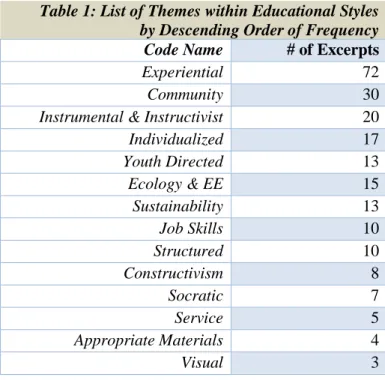
directed, structured, and visual learning. The remaining themes refer to teaching materials and educational content such as ecology, sustainability and job skills. Table 1 shows how often the themes occur. I describe each theme and its significance below.
Table 1: List of Themes within Educational Styles by Descending Order of Frequency Code Name # of Excerpts
Experiential 72
Community 30
Instrumental & Instructivist 20
Individualized 17
Youth Directed 13
Ecology & EE 15
Sustainability 13
Job Skills 10
Structured 10
Constructivism 8
Socratic 7
Service 5
Appropriate Materials 4
24 Experiential Learning
The dominant theme representing participants’ educational styles is experiential learning, which is typified by hands-on activities with problem solving as a common approach. Garden-based education is commonly experiential, where educators often give students a wide range of real world situations to master. Examples include planning seasonal plantings, running a market stand, environmental site assessment, and working on the operations of the educational program itself. Gardening is rich with opportunity for learning, as this quote from one participant shows:
They found out these herbicides are there, ‘but we don’t want that on our greens.’ Then they’d find home remedies, like one farmer told them to put down red pepper. They put pepper on it and the collards ended up being better with no dangerous pesticides. They learned how to solve problems in a sustainable kind of way, or in a health focused way, or in a way that allowed them to keep integrity in what they wanted.
Not only did these students identify, research, and solve problems, but they were able to do it in a meaningful way that reflects and expresses their values.
The programs I researched use outreach as common approach to educate and empower youth. By putting together promotional materials, the youth take pride in their efforts,
disseminate educational content, and learn technical communication skills such as graphic design and Microsoft Office software. Several organizations run weekly newspaper articles and one allows the youth to make video documentaries. Outreach efforts culminate with public events run by youth; organization and responsibility is essential. One participant says public speaking is a transformative experience for their youth and a powerful promotional tool for the organization:
25
While gardening offers many ways to engage in problem solving and experiential learning, outreach is especially potent for personal development because it combines knowledge of content, communication skills, and personal pride.
Community Education
Another major theme that I interpreted from the interviewees’ description of their practice is community education. The excerpts describe an interwoven network of learning.
Knowledgeable local mentors volunteer to teach diverse subjects from soil science to video editing. Local school systems, businesses and nonprofits, as well as larger institutions like agricultural extension and 4H, all contribute resources and information to garden education programs. However, the information flows both ways. Youth often take home what they have learned and educate their families. Many youth form activist groups to improve their
communities and, as stated earlier, the youth conduct most of the outreach for their programs, educating friends, family, and local leaders throughout the community. This web of connections can cause subtle community transformation, as one participant expressed:
We really have to educate our youth and educate our parents, because it’s an underhanded way of making parents aware of what’s really going on. This food program is subtle stuff, to the point that it gets people in a chair, it gets people at the table talking, it gets people who are in that system who are teaching, who are principals and what not. They get to see their kids and their parents trying to do good things for the community. If you’re the person conducting or working with this group, you have to pat them on the back, the principals and the school teachers and tell them how wonderful they’re doing, and create a climate where everybody can see what that village looks like.
26 Instructivism
Excerpts revealing both instrumental and instructivist philosophies form another major theme in the data. My use of these terms comes from the work of Sterling (2004). An
instrumental philosophy values education as a mean to an end in contrast to an intrinsic value of
education. Instructivism is a perspective on learning that places emphasis on the teacher in the role of an instructor. The learner is the passive recipient of knowledge, receiving content and exploring ideas in pursuit of teacher defined goals (Pagani, 2009). Intructivist and instrumental philosophies are complementary and form a traditional approach to EE. That is, given the right information (instructivism), people will adopt pro environmental behavior (instrumental value).
I interpreted these two educational orientations in moderate amounts throughout the interviews. I perceived these philosophies more often in participants with a background in public school teaching, not surprising as their training and experience is focused on curriculum, content and assessment. Environmental subjects and connection with common core standards are
frequently mentioned within the instructivist theme. My assumption—that outside organizations providing teaching materials and expert assistance would promote an intructivist approach—was not supported by the data. In conclusion, the garden education programs exhibit a moderate presence of instrumental and instructivist philosophies, in large part driven by individual educators. This approach typically is used to promote environmental knowledge, and it is associated with public school partnerships.
Youth Directed
27
and run the programs themselves. This colorful story from one participant justifies their approach:
My mom and dad had 12 kids. My mom knew every one of her kid’s strengths, what they did well and what they didn’t do well. My dad had no patience, he’s a good man, but you could get a good cussing out if it was hot and we weren’t doing what we were supposed to. So, I take my mom’s approach – you praise a kid when they’re good and place them where they’re good at so they can be successful. If you’re in a garden program, you might not be good at being outside chopping the weeds or operating some kind of tool, you may be good at marketing, you may be good at selling at the farmer’s market. There’s just so much to do, so I take that approach, learning the kids and knowing what they want. Participants guide their program with youth interests to keep youth engaged and get their buy-in on projects. They give youth the power to direct their program which develops accountability, leadership, job skills. This youth centered approach appeared in every program and it is the core philosophy of many participants.
Constructivism
To finish this section on educational themes, I interpret constructivism as it appears in the data. In accordance with Sterling (2004), I use the term constructivism in contrast to
instructivism. As the primary post-modern theory of learning, constructivism states that
knowledge is not simply information transferred from a teacher; instead, it is created within the mid of the learner. Constructivism is a dominant paradigm within RC partners’ garden education programs. It is revealed in numerous themes throughout the interviews, primarily experiential education. I examine the connection between constructivism and experiential education because these garden programs are inherently experiential. Whether they are weeding the vegetables, sharing a meal, or envisioning a presentation, program youth are engaged in knowledge
28
What you’re doing is creating memorable moments. The takeaways don’t have to be super complex or elaborate. The biggest takeaway for example, are the simple small things. When the kids try a new fruit, or try a new vegetable on their own initiative and they want to, you’re not making them do it at all or even trying to encourage them, just creating an opportunity or setting where that can happen. Those are the things where the change occurs.
In this example, the educator is not telling youth what to think. They facilitate memorable moments that lead to growth and expand the students’ awareness of their world. This process, of transforming awareness, is the basis of experiential education and constructivism.
Like experiential education, the interviews reveal two other constructivist themes. The Socratic Method (teaching by asking questions) steers discussion towards a topic or conclusion. The educator does not give students information; instead, they allow students to discover answers for themselves. Constructivist methods are present with service learning as well.
Constructivist educator John Dewey laid the ground work for service learning theory linking it to socially interactive, and meaningful experiences (Giles & Eyler, 1994). Service learning is transformative, and like the Socratic Method, it is another way that RC partner programs utilize a constructivist approach.
29
I stated earlier that instructivism is most often applied towards EE; however, a
constructivist paradigm dominates EE in these garden education programs. Experiential learning is a staple of EE, as this quote demonstrates:
The foundation of the element of teaching is understanding what are all the intersections that we have with nature, as humans. And how can you connect with it on any level? Maybe you can connect with nature by going out on a peaceful hike and just being surrounded by something that is totally nature, maybe that’s your experience of nature. But we’re also experiencing nature every time we eat lunch. And I think that broadening of perspective, of what nature is, is a key part of teaching.
This participant clearly values connection to nature as a primary educational experience. The educator also wants to transform the learner’s awareness of nature, redefining it to include food and perhaps, by extension, themselves.
In this section, I have shown how the data reveals the educational philosophies of my research participants. In essence, in the garden education programs under study, experiential education is the norm; however, activities go well beyond gardening to include community education and outreach, marketing, and stewardship of natural areas. These programs involve a community wide network where teaching and learning occur in multiple directions and scales. Every program acknowledges the value of education directed and driven by youth interests. Instructivist and instrumental philosophies are moderately represented, driven by individuals, associated with school curricula and lean towards environmental subjects. Finally,
constructivism is well represented as experiential education and applied throughout the curricula. Program Barriers
30
theme is not related to my questions about educational philosophies, but the information is useful for integrating GEP with RC partner programs.
The most commonly expressed barrier to the garden education programs, without question, is the cultural setting. As one of the interviewees succinctly stated:
The challenges are the community that you live in. You have people who don’t want anything, or don’t know any better, so they don’t try, so we don’t have a lot of support, only word of mouth. As far as coming out and helping and volunteering and participating we don’t have it.
Many participants report a lack of support from local community organizations and occasionally active discouragement. This barrier ranges from nonparticipation of individuals, to withholding of resources by schools and churches, and to local leaders who voiced their opinions that the youth would fail. One participant shared:
(The youth) would get little tastes of the negativity. You think kids doing something positive, everybody would support it… they saw the difficulty in us getting a garden, in us advocating for them. We couldn’t hide that, as much as we tried to shelter them from it. ‘Why were people talking and saying this isn’t going to go anywhere? Why are people so negative? We’re doing great things.’ And I said, ‘welcome to the world, this is the community you live in.
This program functioned well under youth direction until adults in the community took over. At that point egos and issues of control slowly brought the program down.
Communities can also sabotage a project with unrealistic expectations. This program manager described their reluctance to take on new partners:
31
Whether the community is forcing a project or unable to share the vision of youth-led programming, the attitudes of local individuals is often the greatest impediment to a garden education program.
Language is a common theme, as a barrier to programs and a frequent critique of
participants. The main problem with language is it divides people of different backgrounds. This excerpt about educational materials displays a class division:
Extension and NC State, the folks that are putting out agricultural education, (the) information doesn’t translate, it’s not appropriate for a lot of the farmers that are here. And that has to do with language. That has to do with varying education in literacy levels … a lot of times the conceptual way that agricultural topics are explained, it doesn’t translate. And so, I think that’s something that we often, it’s not a frustration but a lot of times they say, ‘you should be working with extension’ and we’re like, at this moment, extension doesn’t have the capacity to provide.
This excerpt was an extreme example because the farmers are not native English speakers, but I heard the same concerns about language stated in nearly every interview. When it comes to teaching materials, the language and content contain too much academic jargon—they are not practical enough.
32
provoked silence, deflecting, and nervous laughter. Language is frequently a barrier for programs and a common focus of criticism. It triggers negative responses, creates misunderstanding, and reproduces class division. I will discuss this significant theme further in chapter five.
“The Environment”
The environment theme shows how RC partners teach EE. It suggests the subject is a weak link in RC programs but also describes solutions. Garden education programs expose youth to environmental concepts using the garden as a microcosm of the larger natural world and promoting sustainable garden practices. Some common topics are habitat for pollinators to increase biodiversity or composting to demonstrate nutrient cycles and avoid harsh synthetic chemicals. One participant talks about researching their pollinator garden:
We want to research some native plants that should naturally occur here and also get more of our heirloom varieties, and have the students research why were they significant in our history and why were we using them for so long and now we’re not. That was kind of an environmental piece to that we hope to incorporate.
While the garden is an effective source of environmental lessons, many participants admit EE is still a lower priority than economic and social issues. Occasionally an applicant to RC may say, “We’re not harming the environment” or “We’re recycling, we’ll do recycling.” That is the first
thing that people think about. This interviewee says the par needs to be higher, for example: I was talking to one gentlemen who said, ‘you know I go fishing but I have to throw all my fish back …’ And there’s a person who does youth work right in his community … how great to do a mentorship program with this gentleman where he teaches the kids to fish, and the kids investigate water quality and learn where you write if there are problems, what kind of permitting is needed in this community. You know?
33
We’re on a trash dump, a lot of times gardening is hard to do from the ground so we decided to do raised beds gardens … that’s what our problem is, ours is an environmental issue because of the landfill. We really have been pushed to the side. The education part about the environmental issues, the people over here don’t know, they live here but they don’t know. I would love to get the education part done, not just for the children but for the adults, because we need to know the history.
Gardens are an excellent place to demonstrate ecological concepts. However, these efforts are limited. Tying content to personal experience, environmental justice, and place identity provides a deeper connection.
In this chapter, I detailed my interpretations of how participants frame their experiences with garden education programs. I focused first on the contrasting educational philosophies underlying conflicts in EE, instructivism and constructivism. While interviewees talk about both approaches, constructivism prevails through an array of teaching methods, mainly experiential education. Another focus of the chapter examined the barriers participants face and their
34
Chapter Five: Discussion & Conclusion
In this chapter, I discuss the paradigms grounding my philosophy of educational as they relate to this study. Then I examine what is called the “3BL” approach—the “Triple Bottom Line” of people, profit, and planet—and examine the limitations and possibilities of its
application in the study context. Next, I address how language and bias are major barriers to EE. Finally, I offer solutions to these barriers to improve the practice of EE and GEP.
Educational Paradigms
Here, I focus on a discussion of the two contrasting theories of learning that I interpret from the interviews—constructivist and instructivist pedagogy. Constructivism is widely
accepted by most education scholars; however, EE, public education, and society at large are still dominated by the traditional instructivist paradigm (Gruenewald, 2004; Webster, 1996). This traditional paradigm embraces standardized testing, reflecting an instrumental value of
education. Constructivists value the intrinsic process of education. These contrasting values that emphasize either outcomes or experience, form another axis of orientation in education. RC programs successfully merge these orientations creating a holistic approach that some scholars call reconstructive post-modern education (de Guerre & Taylor, 2004; Griffin, 1992). GEP should adopt this synthesis of competing paradigms used by RC partners because it creates transformational learning.
35
applied knowledge. Given their garden settings and youth development objectives, a
constructivist approach inevitably permeates RC programs; however, instruction is important because it can support action by providing background and procedural information. Youth can make sense of this information by using it. By completing activities and reflecting on the experience, youth can better engage in the iterative process that relates theory to practice. As Heron and Reason (1997) suggest, experience validates knowledge and grounds it in context, while action consummates knowledge and brings it to fruition. Action and experience are two sides of a coin that is knowledge creation. This natural and spontaneous learning process is phenomenological (a property of conscious awareness), precognitive, and intrinsic to human experience. RC partners are generally not professional educators—they did not speak of their approach in these terms. However, by using a sophisticated and holistic educational paradigm that merges theory and practice, these programs succeed at improving their communities, as the recognition and funding they receive at a regional scale indicates. This idea, of the
complementary nature of constructivism and instructivism is neither new nor original, in fact it underlies the flipped classroom model and problem based learning. A holistic approach merging theory and practice is an essential part of garden education that should be incorporated into GEP. The Value of Education: Outcome vs. Process
36
results of the process. For some participants who I interviewed, having youth apply to their program and receive a stipend is important. One program leader shares:
[Paying youth] has created a whole different culture around our program that I think is extremely valuable … there’s this accountability aspect, this responsibility and also maturity that comes with it … there’s a lot more follow up on their end even when I haven’t asked … I think a lot of it has to do with getting paid.
The garden education programs use this approach to develop accountable, effective, and reliable youth. Still, programs directed by youth frequently demonstrate intrinsic values of education. One youth may pursue accounting, while another develops marketing or journalism skills. These outcomes are not prescribed, but they evolve and emerge from the educational process. The research participants provide nurturing yet challenging environments to utilize the intrinsic and transformative power of experiential education.
The study participants tend to be idealistic and process oriented; however, the operational realities of running a non-profit organization also require an outcome based orientation. Funding requires program assessment with concrete and verifiable goals. In this regard, my participants were adept at giving statistics of college enrollment and job placement. Some programs track produce sales, local access to healthy foods, and eating habits. Like standardized testing in schools, these quantitative examples of the extrinsic value of education are valuable for program comparison and accountability, but they do not capture the full value and impact that these programs generate. This remarkable outcome illustrates the point:
37
This outcome is obviously neither planned nor prescribed; instead, it is a result of a
transformative process, or, the intrinsic qualities of the program allow this deeper level of youth development.
Limits of Sustainability
The word sustainability is often overused, watered-down, and co-opted. Most of us are aware of the marketing value of sustainability in green advertising and political posturing. However, sustainability’s full implication, that our culture in not viable, creates tension and psychological discomfort, causing people to deflect and re-appropriate the word towards a more comforting usage. In my introduction, I defined sustainability literally as the ability to continue a given action indefinitely. However, as I found in my research, the use of the term to point out the failings of industrial society can be understood as naïve or problematic because the word is already co-opted. When I used the term sustainability in my interviews, participants always opted to talk about program sustainability, hoping their program could continue despite limited funding and excessive personal effort. The term needs a qualifier such as sustainable agricultural sustainability, program sustainability, or 3BL sustainability.
Triple Bottom Line: People, Profit, Planet
The green movement, working within conventional social and economic systems, shifts sustainability towards a more encompassing concept with the use of the 3BL approach, known in
38
framework; this approach is a viable and realistic guide for RC efforts. My examination is aimed at uncovering the implications and limitations of the 3BL approach. To understand this approach, I examine how each of the 3BL components are framed and implemented, while considering the program’s setting and broader societal contexts. This discussion leads to an interesting conflict
that relates social class and ecopedagogy, which I address in a later section. People: Individual or Communal Goals
Within RC programs, the focus on people in a 3BL approach addresses social justice and a concern for human well-being. Within garden education programs, this often takes form
through public health issues such as nutrition and physical fitness. Obesity is a national issue and diabetes is especially prevalent in poor, African American communities. Both are familiar problems in the Southeast, and funding sources to address them are available through many partnerships. Garden projects promote outdoor activity, provide heathy produce, and address structural issues of food access, making them a great fit for tackling these public health
problems. Many programs educate youth about healthy living by growing, cooking, and tasting healthy foods. They address systemic food justice issues with garden markets and empower youth with entrepreneurial experience.
39
It’s important that people get educated. You have to figure out what happens to you when people make decisions in Raleigh that impact you here … your local county
commissioners and school board members, you ask them a question like ‘tell me a little bit about the school improvement team’, or ‘talk to me about conversations at the school level about health and education and policy councils at your school’… It’s being able to ask questions and bringing elected officials to your part of the community. To survive we really have to educate our youth … because it’s an underhanded way of making parents aware of what’s really going on.
This quote shows the social barriers that programs face and the need for work that transforms social structure. The garden education programs’ solutions to social justice issues, through personal responsibility and individual empowerment, are remedial. That is, these are limited, corrective solutions focused on behavioral change. In contrast, an alternative emphasis on developmental solutions oriented towards capacity building would alter the structure of society.
Local and regional political structures reinforce this remedial, outcome-oriented approach. Empowering individuals is more likely to align with the views of external funding agencies, while a more radical developmental solution that transforms culture is threatening to the status quo. One participant said “the youth were really frightening people.” She sums it up
best:
Change has to happen in the mindsets of the people. You can have millions, money does have influence, I can buy your loyalty to a degree, I can buy your engagement, but I can’t buy your heart. That has to come because you truly believe, and that’s a cultural shift. Preach ownership, preach poverty breaking strategies from the pulpit so that it can infiltrate the culture and transform how people see themselves and interact with each other. That is what changes communities.
In poor, rural settings, these participants understand, live with, and work against the oppressive qualities of our culture. However, the focus on personal responsibility and personal
40 Profit: The First Priority
The second piece of 3BL sustainability is economic. Not surprisingly, the garden education programs have a strong incentive to address economic issues because they are set in economically depressed, rural communities. While social justice issues are popular, the youth-centered approach more often leads to a focus on economic development. Since most of the programs operate in poor communities, the youth naturally want to increase their chances of getting out of poverty. This motivation, along with support from government agencies and outside funders, creates programs that focus more on economic development than either environmental or social issues. This economic focus manifests primarily through personal development and job skills training. This focus on economics reflects society’s bias towards a competitive, materialistic, market based economic system, a system that preserves structural poverty. Throughout society, youth are trained to be effective workers without examining the political economic system in which they live.
RC partner programs, however, are in a unique position to counter this indoctrination by shifting the focus of economic programing towards topics like alternative currencies, community financing, or the slow money movement. I support the personal growth and empowerment efforts present in the garden education programs; youth need to learn how to succeed in our economy. Additionally, it is also important that they learn to question capitalism, to reform it, disrupt it, and rebuild it if necessary.
Planet: Whose Environment?
The third category of the 3BL approach to sustainability, addressing environmental issues, is clearly the weakest leg in RC programs. Garden education programs teach
41
stewardship by avoiding the use of harsh synthetic fertilizers and pesticides, or conducting trash clean-up along roadsides and waterways. Participants also address local environmental justice issues as an effective way to create environmental concern. All of the approaches mentioned above are valid but they can reduce the environment to a simplified anthropocentric concept. Unstructured visits to wilder natural areas may cause youth to connect with nature at a deeper level. However, the criticism that RC programs have a weak environmental component is oversimplified; there is a deeper issue involved.
Acknowledging global environmental crises challenges our basic paradigms of identity and purpose, however, within the communities and programs I studied, understanding class biases related to affluence and education take precedence if we want to promote environmental sustainability. Class bias distorts the goals, practices and assessment of EE and community development programs. Specifically, within RC programs, educated and affluent stakeholders (like me) must contend with a pro-environmental worldview which discounts working class priorities, and knowledge of nature. Contrary to stereotypes, working-class rural people often have an intimate understanding of nature; as inhabitants, they rely on their forests, fields, and waterways for economic resources and sustenance. In contrast, an urban environmentalist may see these natural areas as pristine, erasing thousands of years of human occupation (Cronon, 1995) . Additionally, environmentalism may be an unaffordable luxury. Rural communities in my research setting are more concerned with survival than climate change, where feeding families is a higher priority. Understanding and navigating the social disconnect, between
42 Suggestions for Garden Ecopedagogy
Acknowledging bias is the first step towards addressing the weak environmental focus of RC programs. RC helps partner programs acquire funding and in turn requires a 3BL approach to address economic, social, and environmental issues. My data shows wide agreement among participants that the environmental piece is their weakest effort. Confounding this problem is the class bias in favor of addressing environmental issues. As an ecologist, I have this environmental bias, and many of the RC employees share this perspective. To address the environmental issue and my personal bias, I recall a guide for transcending paradigms (de Guerre & Taylor 2004): accept the equality of participants, and cultivate a willingness to listen. In this spirit, I explore solutions contained within my interview data.
From the data, I present two suggestions to promote pro-environmental attitudes within the research setting—and possibly within poor, working class, rural areas of North Carolina in general. First, environmental educators should address environmental assets and issues that concern local people, and affirm their identities of place. One participant points out that “too often environmentalist go to saving trees or animal rights. Why would you use that argument? Why not talk about how the community is affected?” Rural communities, she says, “bear the
brunt of our food industry.” These communities also receive pollution from resource extraction, urban waste disposal, and industries in search of cheap labor. Find out how these issues affect the specific community. Ask questions and listen to people’s feelings about it. Find out what’s important locally. That is the first step in EE.