THE IMPACT OF UN PEACEKEEPING ON THE STRATEGIC ESCALATION OF FORCE BY BELLIGERENTS
Kellan Robinson
A thesis submitted to the faculty of the University of North Carolina at Chapel Hill in partial fulfillment of the requirements for the degree of Master of Arts in the Department of Political Science.
Chapel Hill 2020
ABSTRACT
Kellan Robinson: The Impact of UN Peacekeeping on the Strategic Escalation of Force by Belligerents
(Under the direction of Stephen Gent)
ACKNOWLEDGEMENTS
TABLE OF CONTENTS
LIST OF TABLES . . . vi
LIST OF FIGURES . . . vii
INTRODUCTION . . . 1
LITERATURE REVIEW . . . 3
INSTITUTIONAL BACKGROUND ON THE INITIATION OF A PEACEKEEP-ING OPERATION . . . 5
THEORY . . . 6
UNAMID EXAMPLE . . . 10
RESEARCH DESIGN AND DATA . . . 12
RESULTS . . . 17
ROBUSTNESS CHECKS . . . 23
CONCLUSION . . . 26
LIST OF TABLES
1 Descriptive Statistics . . . 14
2 Model 1 Results for Battle Field Deaths . . . 18
3 Model 2 Results for Civilian Deaths . . . 21
4 Robustness Checks RDD One Year Prior to Intervention Announcement . . . 23
LIST OF FIGURES
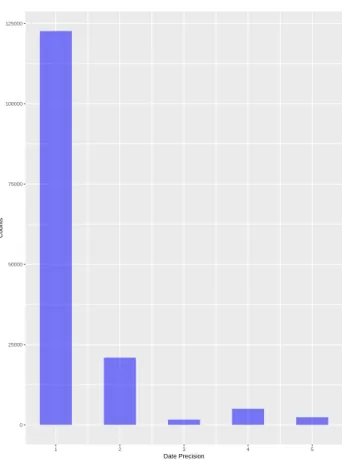
1 Histogram of Date Precision . . . 13
2 Scatter Plot of Battle Field Deaths . . . 17
3 Regression Discontinuity Design: Battle Field Deaths . . . 18
4 Scatter Plot of Civilian Deaths . . . 20
5 Regression Discontinuity Design: Civilian Deaths . . . 21
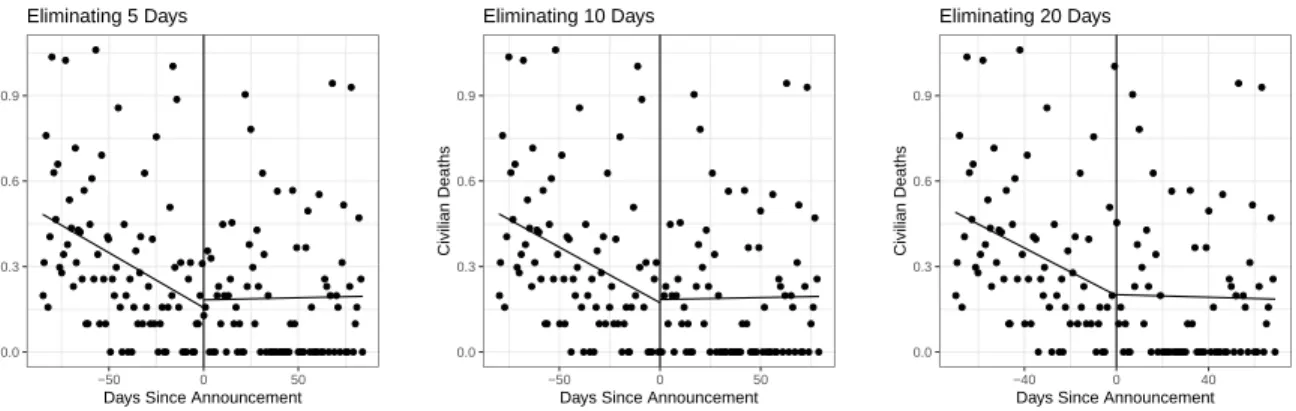
6 Eliminating Observations Around the Cut-point. . . 22
7 RDD Individual States Battle Field Deaths . . . 24
INTRODUCTION
On July 31st of 2007, the UN passed a resolution to send a peacekeeping force to the Darfur region of Sudan. This peacekeeping operation was announced in the wake of a tenuous peace agreement between state forces of Sudan and one rebel faction in the region, providing just enough justification for a peacekeeping operation to take place. With tenuous support from the state of Sudan for the operation, the United Nations Hybrid Operation in Darfur (UNAMID) was created with the goal of civilian protection. The mission was a multidimensional operation where peacekeepers could intervene with the use of force in order to secure peace. Only one day after the announcement of the peacekeeping operation, rebel use of force dramatically increased. Pressing to gain territory and resources quickly, Sudanese rebels attacked Adila, a town linked to Darfur through its railroad. In this one-day offensive, battlefield deaths doubled from their total in the previous three months. The rebel coalition captured fifty government vehicles and gained important strategic ground against the government. In this case, the announcement of a UN peacekeeping operation did not prevent more violence on the battlefield from occurring. In fact, could the announcement of a UN Peacekeeping Operation (PKO) and the rebel offensive be connected? Could the announcement have actually increased the levels of violence perpetrated by rebels?
a similar effect? Could the nature of the intervention itself cause governments or rebel groups to increase their use of force before intervention? If there is such an effect, understanding how the announcement of a PKO changes rebel and government strategy could reinforce the importance of the immediacy of peacekeeper deployment and inform commanders of the conflict environment they step into. Analyzing the period of time after peacekeeping announcement, when the arrival of an operation is imminent, would answer these questions.
In this paper, I explore the timing of peacekeeping intervention as it impacts levels of conflict. I argue that after the United Nations Security Council (UNSC) passes a mandate but before peacekeepers arrive, insurgents will strategically increase their use of force on the battlefield and against civilians in order to maximize access to resources before the PKO arrives. A key element of this argument is the nature of a multidimensional PKO that has a mandate justified under Chapter VII of the UN Charter. Under Chapter VII, intervention requires minimal consent from host states to establish an operation. This minimal consent translates to the state’s ability to position an operation in regions where state authority is contested, and bring that territory back under state control. In this fashion, the state can manipulate UN intervention, and could lead rebels to see a PKO as a boost in power of the state. This causes insurgents to try to strategically control territory within the country from which they receive new recruits, monetary resources, and natural resources before the UN operation arrives.
LITERATURE REVIEW
A broad range of studies indicate that peacekeeping benefits recipient countries in the long run. Once selection effects are controlled for, peacekeeping decreases the odds of civil war recurrence through several mechanisms (Fortna, 2004b). Peacekeeping increases the costs of returning to conflict, allows belligerents to credibly signal, and decreases the probability of small incidents and skirmishes dissolving back into conflict. Sambanis (2008) further parses out these findings through determining when PKOs foster a more lasting peace. He finds that mission effectiveness in achieving long-term peace is contingent upon the mandate of a mission. Mandates that focus on determining the causes of hostility and work within local capacities to change the existing situation more effectively secure peace (Sambanis, 2008).
Other studies that focus on short-run effectiveness compliment studies on the long-term effects. Doyle and Sambanis (2000) discover that peacekeeping operations reduce more immediate violence if their mandates are more extensive. Peacekeeping is even more effective in the short term when it increases the costs of conflict and reduces commitment problems faced by belligerents. However, this only applies when the PKO operates at full capacity in terms of boots on the ground (Hultman, Kathman, and Shannon, 2014a). Additionally, missions with larger military troop counts decrease civilian casualties in conflict. However, UN PKOs more successfully mitigate violence against civilians committed by rebel groups rather than by governments, as the PKO’s continued presence hinges upon government permission at the local level (Fjelde, Hultman, and Nilsson, 2019) .
presence. In fact, under certain conditions belligerents are incentivized to escalate the use of force before a peacekeeping operation occurs.
The literature on third party intervention offers some insight in this regard. The possibility of both biased and unbiased third-party intervention affects strategic decisions taken by rebels and governments when using conventional and unconventional force. The conflict management literature speaks to the effects of these interventions by the international community in situations of mass violence and atrocities. Kuperman (2008) identifies the moral hazard presented to rebels in the lieu of the advent of the “Responsibility to Protect” (R2P) protocol. Governments often use genocidal violence on sub-state secessionist entities as a way to squelch rebellion. The R2P invoked by the international community to intervene in this kind of atrocity, gives secessionist groups reason to believe that third-party intervention will occur on their behalf if they overtly rebel. This results in government violence against insurgents that may not have occurred otherwise. In this way, intervention by international organizations like the UN might increase rather than decrease violence (Kuperman, 2008).
INSTITUTIONAL BACKGROUND ON THE INITIATION OF A PEACEKEEPING OPERATION
The charter of the UN does not specifically address when peacekeeping can and cannot occur. However, the UNSC justifies PKOs through invoking Chapter VI and Chapter VII of the UN Charter. Peacekeeping that occurs under Chapter VI is typically considered traditional peacekeeping in which the UN receives strong and credible consent that all belligerent parties are committed to a peace process. Conversely, Chapter VII peacekeeping operations deploy to “volatile post-conflict settings where the state is not able to maintain security and public order (UN).” Under these conditions the UN obtains more relaxed consent from belligerents, and generally, a less effective political solution to a conflict exists. Weak host state consent is required, whereas consent by different non-state actors is sought but not required. This kind of intervention normally occurs when a conflict affects regional stability or entails heavy civilian targeting (UN).
THEORY
Insurgent territorial control is vital to the survival of insurgent groups for several reasons. Territorial control provides a pool of civilians from which to draw recruits, an ability to tax civilians and gain more monetary resources, room to conduct military training, access to natural resources in the area, and a zone where insurgents can control civilian informants to the government (Weinstein 2007, Arjona 2016). All of these factors lead to increased security as well as material and human resources for the group, which help insurgents to grow in strength against the government. In this context, more territory can be won through overt use of force against the government, exerting force over civilian populations, or more covert control of civilian populations (Weinstein 2007). However, the arrival of a PKO threatens rebel ability to pursue territorial control.
Most peacekeeping intervention occurs in a conflict environment when rebel groups pose a significant threat to the government (Fortna 2008). As a result, at the time of UN intervention, insurgent group control threatens the host state’s territorial control. Under legal justification of Chapter VII of the UN Charter, when the UN passes the initial mandate and sends in peacekeepers, it becomes significantly more difficult for rebel groups to use conventional force in order to win more territory relative to the government. This happens for several reasons. First, the UN more successfully decreases violence when rebel groups are strong compared to the government (Hultman, Kathman, and Shannon 2014). This suggests that the UN is better at mitigating violence and potentially minimizing the effective use of conventional force by rebels to gain more territory from the government, even when rebel groups are strong.
PKO means the probability of the government winning territory goes up, while the probability of insurgents winning territory goes down.
Since the UN must receive only minimal consent from the host-state in order to intervene in a conflict, according to Chapter VII, the state’s ability to withhold local consent plays out in the following manner. Peacekeepers rely on consent from the state to move around and set up bases in different parts of the state. If the state withholds domestic consent in certain regions, the host government controls the movement of peacekeeping forces within the state. This gives the state significantly more power over the way the PKO enforces peace. In contested territory, the government might strategically allow UN forces to suppress insurgents through enforcing peace agreements. In places where the government wants to gain more territory from insurgents, it might ban peacekeepers from entry. In this manner, the government might feel less threatened by the insurgent group once a peacekeeping intervention has occurred, and it might even have the opportunity to win back more of its territory from the insurgents.
Rebels know, due to the reasons expressed above, that once intervention occurs their probability of winning more territory decreases, while the probability of the government’s ability to gain territory increases. Since rebel groups foresee their probability of securing future payoffs decreasing upon mission announcement, they factor in this future difficulty in the present. This future difficulty makes it more appealing for rebels to fight in the present and secure their position vis-a-vis the government. In light of these considerations, in the time between when the UN establishes a PKO and before it reaches its maximum capacity, one way non-state actors will try to gain contested territory is through direct confrontation with state forces on the battlefield. This would lead to an increase in the use of conventional force to try and secure their position before peacekeeping occurs. The goal for the rebel group, during this time period, is to win as much territory as possible before the state experiences the benefits of a UN PKO. As a result of this logic, I argue:
• H1: After the establishment of a UN PKO justified under Chapter VII of the UN Charter but before intervention occurs, non-state actors party to an ongoing conflict will increase their conventional use of force.
Insurgent groups will commit more indiscriminate acts of violence against civilians when they play an extractive role and when short-term resource interests motivate their behavior. In other words, indiscriminate violence against civilians is most likely to occur when rebels have short time horizons and attempt to capture territory quickly (Weinstein, 2007). Additionally, Wood, Kathman, and Gent (2012) find that rebels will escalate the use of force against civilians shortly before governments receive reinforcement from third party biased interventions in favor of the state, since resource extraction capabilities are under threat. In this scenario, rebel groups will try to make a push to solidify their ability to continue to fight against the increased strength of the government through extracting more resources through territorial control. UN intervention creates shorter time horizons for rebel groups, as, when in full force, it puts on hold the extraction of resources. Rebels put in this situation will intensify their push for territorial control and as a result:
• H2: After the establishment of a UN PKO but before intervention occurs, insurgent groups will escalate violence against civilians.
The scope of this paper is one-sided and deals specifically with the rebel’s response to the announcement of peacekeeping. While I do not formally hypothesize about how the announcement of peacekeeping affects the government use of force, I do have some theoretical expectations. Previous research indicates that UN PKOs reduce more violence against civilians committed by non-state actors. Since the PKO does not receive consent from the government at the local level and the government controls where the peacekeeping operation can and cannot intervene, the mission’s exposure to government-led civilian targeting is limited (Fjelde, Hultman, and Nilsson, 2019). This is consistent with the aforementioned expectation that governments can still exercise a considerable amount of territorial control and even make gains in this regard with a PKO present.
UNAMID EXAMPLE
The mission in Darfur provides an example of this process due to the low levels of consent for the mission given by the host-state and the way the government of Sudan limited the mission’s access to parts of the region. Darfur is a region of Sudan that had remained autonomous until 1916 when it was coopted into Sudan. Starting in 2000 several uprisings took place in the region which sought to overthrow the state. The state responded to these uprisings with the use of force, and this conflict reached its peak in 2003. At this time, different rebel groups within Darfur joined forces with the rebel group, Sudan People’s Liberation Movement/Army (SPLM/A), who then supplied them with arms (Lanz, 2013).
At this time, the government began peace talks with the SPLM but also sent troops into Northern Darfur with the intent of targeting the rebel base in the region. Between 2003 and 2004 it is estimated that 400,000 people fell victim to violence. This crisis attracted the attention of the international community, and many non-profit groups already in the region pushed for more governmental involvement, asking that the international community recall the responsibility to protect (R2P) and failed intervention in Rwanda. This pressure caused governments like the U.S. to name what had happened as genocide. This labeling meant the international community had a responsibility to act. The international community chose to intervene through a PKO whose mandate passed on July 31, 2007 (Lanz, 2013).
forces started to arrive in January of 2008 with the agreement already in shambles. Peacekeepers entered into a difficult environment (Lanz, 2013).
Additionally, peacekeepers faced intense host-state scrutiny and control for the entirety of the mission. Sudan controlled the number of visas they allowed the UN to have for peacekeepers and thus controlled the size of the mission. Darfur is a geographically large and densely populated area. With a restricted seventy-five percent operating capacity in terms of troop numbers, peacekeepers had difficulty controlling the vast expanse. The host-state government also subjected peacekeepers to a curfew. In several cases the UN was criticized for not appropriately investigating cases or protecting civilians that fell victim to government brutality. Finally, when the Sudanese army planned to raid towns in South Darfur that harbored rebels, the government even asked the UN to vacate the towns. While the UN in this case negotiated for the ability to stay in the area where government violence against civilians could have taken place, they helped to negotiate a settlement between the rebels and the government where the rebels were still forced to leave. As a result of these factors, caused by weak host-state consent, the effectiveness of the mission was severely limited (Lanz, 2013).
RESEARCH DESIGN AND DATA
In order to test these hypotheses, I use data from the UCDP Georeferenced Event Dataset. This dataset captures individual events of organized violence perpetrated by state or non-state actors against combatants and civilians. It not only captures these violent events at the state-level but disaggregates them to the region and PRIO-Grid level. For this analysis I will aggregate observations in this dataset to the state-day unit of analysis. The PRIO-Grid divides the globe into fifty-five by fifty-five kilometer sections. If an organized violent event occurs in one of the grids, it becomes a data point in this data-set. I aggregate these data points based off of the state they occurred in and the day on which the occurred. I examine the universe of peacekeeping operations that are justified under Chapter VII of the UN convention between 1999 and 2018. I chose this time-frame since the bulk of UN PKOs occurring under Chapter VII did not begin until the turn of the 21st century.
0 25000 50000 75000 100000 125000
1 2 3 4 5
Date Precision
Counts
Figure 1: Histogram of Date Precision
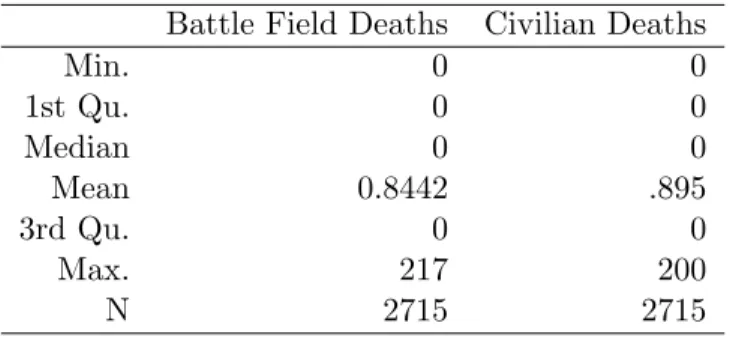
The research design I employ for this analysis is a regression discontinuity (RD) design. This research design allows me to exploit the randomness surrounding the timing of a UN PKO an-nouncement and observe whether or not the rebel use of force increases after the cut-point date through observing variation in my dependent variable battle field and civilian deaths. With regards to battle deaths, I cannot differentiate between confrontations where the state initiates violence and others where the rebel group initiates violence. As a result, I use the sum of all battle deaths occurring in an event as the dependent variable for testing hypothesis one. For the analyses of my second hypothesis, I rely on the dependent variable civilian deaths. I cannot filter this data by whether state or non-state actors perpetrated this violence. I have included a table of the descriptive statistics for both of these variables.
Battle Field Deaths Civilian Deaths
Min. 0 0
1st Qu. 0 0
Median 0 0
Mean 0.8442 .895
3rd Qu. 0 0
Max. 217 200
N 2715 2715
Table 1: Descriptive Statistics
where the state receives UN peacekeeping and the time when they do not. The difference at the cut-point will communicate whether or not rebels escalate the use of force after UN PKO announcement. This three-month window is my period of interest because during this time rebels and government can re-position themselves or solidify their existing position, if they choose to, before the operation arrives. Three months is an institutional goal for when the UNSC hopes to have the first boots on the ground after passing the mission mandate. This institutional goal defines the period of time I use in the research design.
This design is useful because I utilize the ninety days before the announcement of peacekeeping intervention as a control group and the ninety days after announcement as a treatment group. I compare states and their levels of violence each day before and after announcement. In this way, RD design mimics an experimental design with a randomized control group and a randomized trial group. This allows me to avoid potential confounding variables in a way that a Poisson or negative binomial regression would not. The day the UNSC chooses to vote on the resolution to pass a peacekeeping operation should be independent from the levels of violence occurring the ninety days before announcement. This is because it takes months to establish a peacekeeping operation, and while levels of violence determine whether or not a PKO gets established in the first place, levels of violence should not determine the exact day the UNSC votes on these issues. In this way the treatment, UN announcement, is administered randomly and is independent from levels of violence in the ninety days leading up to the PKO announcement. Comparing the same countries in time periods before and after intervention ensures treatment and control groups that are very similar to one another and differ only in their levels of the dependent variable due to the treatment.
itself on the level of violence. It does this through comparing the same grid cells and their violence right before the announcement and right after the announcement. The assumption is that the day right before announcement should not be different from one day after announcement. The only difference between those days should be that the announcement of a UN peacekeeping operation is made public. Taking observations immediately to either side of the cut-point and estimating the average difference in levels of violence between both these points, allows me to see whether or not the announcement of a peacekeeping operation drives an increase in violence in the days following the announcement. If there is significant discontinuity at the cut-point then the announcement more than likely causes this discontinuity. If there is continuity at the cut-point, then, more than likely, an increase in violence already existed before the announcement of the operation. In this way, I get closer to isolating causality and ensure that I do not attribute an upward trend in conflict to the announcement if the upward trend occurred regardless of the presence of an announcement. As a result, this research design provides a more rigorous test of my hypothesis, and gives good reason to believe that a causal relationship exists if my results are as hypothesized. If I had used a poisson or negative binomial regression with a dichotomous variable indicating the ninety days following mission announcement, I could not exploit the similarity in the days surrounding the cut-point, and the effect size of the dichotomous variable could reflect an upward trend of violence in the data present regardless of the announcement.
RESULTS
The first way to assess if there is a discontinuity around the cut-point is through a simple scatter plot. This scatter plot for battlefield deaths is displayed in Figure 2. Contrary to my hypothesis, it seems that if there is a discontinuity in battlefield deaths after the announcement of the peacekeeping operation, then there might be less battlefield deaths. However, this discontinuity is difficult to asses simply by looking at data points.
0 50 100 150 200
−50 0 50
Days from Mission Announcement
Number of Con
v
entional Deaths
Figure 2: Scatter Plot of Battle Field Deaths
announcement. The length of day interval, referred to as a bin, averages all the data points that fall within it. The appropriate bin size is calculated using an evenly spaced variance method. With this method bin sizes vary dependent on amounts of variation in the data.
0.0 0.2 0.4 0.6
−50 0 50
Days Since Announcement
Battle Deaths
Figure 3: Regression Discontinuity Design: Battle Field Deaths
Figure 3 displays that upon UN peacekeeping announcement the number of battlefield deaths seemingly decreases, signaling a decrease in belligerence by rebels and the government. Less than one fourth of the count of battle field deaths occur after peacekeeping announcement than before the announcement. It seems that, contrary to Hypothesis 1, UN peacekeeping announcements might actually decrease rebel use of force. However, when examining the treatment effect and the confidence interval on the difference between means at the cut-point it seems evident that there is no statistical significance in these findings, and provides evidence of a null effect.
Treatment Estimate P-Value 95% Confidence Interval
Model 1 0.044
( 0.130 ) 0.734 [-0.211 , 0.299]
I could find a null effect for several reasons. One decision that could be driving these effects is the aggregation of all battle deaths in the given time period. Since I was unable to differentiate between battles where the government had initiated conflict and battles where rebels had initiated conflict, it could be that government decisions to not initiate battles during this time period are driving this effect. Governments might not initiate conflict on the battle field after UN intervention announcement for several reasons. First, the government can use the peacekeeping intervention in its favor and does not need to solidify its position vis-a-vis the rebel organization before intervention. During intervention, the government is still able to use conventional force to win territory, keeping the PKO in the dark through strategically withholding local consent. Additionally, it benefits from the ability to place troops in areas where it faces security threat. Second, during this time span, before the UN has sunk significant costs into the mission and can easily pull-out, the government has an incentive to behave in accordance with the loose peace agreement the UN had both parties agree to before intervention, to ensure UN intervention actually takes place. For these reasons we might see government aggression going down in the time period after intervention which might be conflating the testing of Hypothesis 1.
0 50 100 150 200
−50 0 50
Days from Mission Announcement
Number of Civilian Deaths
Figure 4: Scatter Plot of Civilian Deaths
0.0 0.3 0.6 0.9
−50 0 50
Days Since Announcement
Civilian Deaths
Figure 5: Regression Discontinuity Design: Civilian Deaths
These findings also seem to be statistically significant at the .05 level. By transforming the coefficient, taking into account the previous transformation of the dependent variable, we find that the announcement of a PKO seems to increase the counts of civilian victimization by a little over eighteen percent. Examination of the coefficient reveals that peacekeeping announcement leads to an overall increase of civilian victimization following the announcement of a PKO.
Treatment Estimate P-Value 95% Confidence Interval
Model 2 0.171
( 0.069 ) 0.013 [0.042 , 0.350]
Table 3: Model 2 Results for Civilian Deaths
cut-point yield no statistically significant difference before and after treatment. This reveals that at the days surrounding the cut-point the peacekeeping operation might have an impact, however, in the following time period, the announcement has a null effect. This casts doubt on my causal mechanism. If rebels were to increase their use of force surrounding announcement according to my hypotheses, they should do so for the ninety days until the peacekeeping operation arrives. I find no support of this and thus, find limited support Hypothesis 2.
0.0 0.3 0.6 0.9
−50 0 50
Days Since Announcement
Civilian Deaths
Eliminating 5 Days
0.0 0.3 0.6 0.9
−50 0 50
Days Since Announcement
Civilian Deaths
Eliminating 10 Days
0.0 0.3 0.6 0.9
−40 0 40
Days Since Announcement
Civilian Deaths
Eliminating 20 Days
ROBUSTNESS CHECKS
In order to address internal validity concerns of this empirical strategy, I have included a robustness check to provide evidence that there is no other kind of discontinuity caused by the selection of the cut-point. Substantively, this means determining whether or not the date on which mission announcement occurs has an impact on the outcome of battle field deaths or civilian use of force. If for example, on the date of intervention, a national holiday like an independence day, occurred which sparked protesting or rioting every year on that date, then the date itself might explain the discontinuity we see in the model rather than the announcement of a mission.
To confirm that the date is substantively insignificant in explaining fatalities, I construct the same data set for the the year prior to intervention and run the RD design on this lagged dataset. I find no statistical significance in any of the results from one year prior to intervention announcement. This provides evidence that the date itself is not driving results.
Treatment Estimate P-Value 95% Confidence Interval
Battle Deaths 0.110
( 0.108) 0.261 [-0.106 , 0.391]
Civilian Deaths 0.050
( 0.090) 0.596 [-0.153 , 0.266]
Table 4: Robustness Checks RDD One Year Prior to Intervention Announcement
0.0 0.2 0.4
−50 0 50
Days Since Announcement
A
v
er
age Battle Deaths
Burundi
0.00 0.25 0.50 0.75
−50 0 50
Days Since Announcement
A
v
er
age Battle Deaths
Central African Republic
0.0 0.2 0.4 0.6
−50 0 50
Days Since Announcement
A
v
er
age Battle Deaths
Democratic Republic of Congo
0.0 0.5 1.0 1.5
−50 0 50
Days Since Announcement
A
v
er
age Battle Deaths
Mali
Figure 7: RDD Individual States Battle Field Deaths
In the case of civilian fatalities I ran the same robustness check. Similarly, in most cases, a single state does not seem to be disproportionately affecting results. However, one case that could potentially be impacting results is the Central African Republic since results at the cut-point are nearly quadruple other differences in means in countries from the same RD design. This could indicate something uncontrolled for in the Central African Republic is happening on or surrounding the intervention announcement date that is significantly impacting results.
0 1 2 3
−50 0 50
Days Since Announcement
A
v
er
age Civilian Deaths
Central African Republic
0.0 0.2 0.4
−50 0 50
Days Since Announcement
A
v
er
age Civilian Deaths
DRC 0.0 0.1 0.2 0.3 0.4
−50 0 50
Days Since Announcement
A
v
er
age Civilian Deaths
Sudan
In Table 5 I have included RD results excluding both of these outlier cases. The removal of the CAR case, when looking at civilian casualties, does change substantive results for civilian deaths adding more uncertainty to the findings in support of Hypothesis 2.
Treatment Estimate P-Value 95% Confidence Interval Battlefield Deaths -0.030
( 0.295 ) 0.821 [-0.725 , 0.575]
Civilian Deaths 0.097
( 0.055) 0.062 [-0.006 , 0.239]
CONCLUSION
This study contributes to the literature on UN intervention and strategic considerations made by rebel groups in civil conflict. Theoretically, it demonstrates that the announcement of UN intervention could cause a strategic increase in levels of force by rebels on the battlefield and against civilians. This work expands upon the puzzling empirical observance of an increase of force by rebels following the announcement of a UN PKO in Darfur, and bridges the gap between literature on PKOs and the impact of intervention on belligerent strategy. Empirically, I find no support for Hypotheses 1 and very tentative support for Hypothesis 2. Major limitations of this study include the inability to differentiate between rebel instigated battlefield clashes and those instigated by the government. In future research, it is essential to isolate whether or not the state or insurgent group initiates battle field violence before and after peacekeeping announcement.
Future study should be supplemented by case studies and quantitative work done at the sub-national level. This analysis, driven by data limitations, is multisub-national in scope. While this yields more generalize-able results, the inclusion of the robustness checks demonstrates the possibility that a single case could drive statistical significance for the population of cases. One possible avenue of future research is difference in difference analysis at the region-month level. While the coding project would have been too great for this current project, progress reports by the UN Secretary General reveal specific regions the UN plans to send peacekeepers in the future. The effect of this kind of announcement at the regional level could lend itself to difference in difference testing comparing changes in levels of violence in the regions mentioned in the progress report to those regions not included.
to assess the viability of a PKO. The negotiation and settlement of a peace accords or cease-fire encouraged or negotiated by the UN could also signal PKO intent. One final event which might insight increased rebel violence before PKO intervention, is the commitment of troops by contributing countries to the mission before UNSC establishment of the operation. All of these avenues should be explored, and depending on the case, some might prove more relevant than others in determining the use of force by insurgents.
Finally, while hypothesized in this paper, the effect of UN PKO announcement on the strategic use of force by governments should also be examined. Does the government behave as expected upon UN announcement? Is there an aforementioned signal that determines when the government will increase or decrease the use of force against civilians? Results from the regression discontinuity design on battlefield deaths reveal no significant impact on government use of force in the wake of a PKO announcement. However, as stated above, a disaggregation of who instigated battles is essential to determine whether the government increases or decreases their use of force in this instance.
REFERENCES
AP (2008). Sudan Rebels Resume Heavy Fighting in Darfur. Sudan Tribune.
Arjona, Ana (2016). Rebelocracy: Social Order in the Colombian Civil War. Cambridge University Press.
Balch-Lindsay, D., Enterline, A. J., and Joyce, K. A. (2008). Third-party intervention and the civil war process. Journal of Peace Research, 45(3), 345-363.
Doyle, Michael W., and Sambanis N. (2000). International Peacebuilding: A Theoretical and Quantitative Analysis. The American Political Science Review, 94(4): 779-801.
Doyle, Michael W., and Sambanis N. (2007). No Easy Choices: Estimating the Effects of United Nations Peacekeeping. International Studies Quarterly 51: 217-226.
Fjelde, H., Hultman, L., and Nilsson, D. (2019). Protection through presence: UN peacekeeping and the costs of targeting civilians. International Organization, 73(1), 103- 131.
Fortna, Virginia Page (2004a). Interstate Peacekeeping: Causal Mechanisms and Empirical Effects. World Politics 56: 481-519.
Fortna, Virginia Page (2004b). Does Peacekeeping Keep Peace? International Intervention and the Duration of Peace after Civil War. International Studies Quarterly 48: 269-292.
Fortna, Virginia Page (2008). Does peacekeeping work?: shaping belligerents’ choices after civil war. Princeton University Press.
Greig, J. M., and Diehl, P. F. (2005). The peacekeeping–peacemaking dilemma. International Studies Quarterly, 49(4), 621-645.
Horne, C., and Barney, M. (2019). The Impact of UN Peacekeeping Operations on Human Trafficking. International Migration, 57(5), 3-20.
Horne, C., Robinson, K., and Lloyd M. (2019). The Relationship between Contributors’ Domestic Abuses and Peacekeeper Misconduct in United Nations Peacekeeping Operations. International Studies Quarterly.
Hultman, L., Kathman, J., and Shannon, M. (2014a). United Nations peacekeeping and civilian protection in civil war. American Journal of Political Science, 57(4), 875-891.
Karim, S., and Beardsley, K. (2016). Explaining sexual exploitation and abuse in peacekeeping missions: The role of female peacekeepers and gender equality in contributing countries. Journal of Peace Research, 53(1), 100-115.
Koops, J., Tardy, T., MacQueen, N., Williams, P., and Lanz, D. (2015-07-09). African Union–United Nations Hybrid Operation in Darfur (UNAMID). In The Oxford Handbook of United Nations Peacekeeping Operations. : Oxford University Press.
Kuperman, A. J. (2008). The moral hazard of humanitarian intervention: Lessons from the Balkans. International Studies Quarterly, 52(1), 49-80.
Sambanis, Nicholas (2008). Short- and Long-Term Effects of United Nations Peace Operations. The World Bank Economic Review 22(1), (9-32).
Smith, Alastair (1998). Fighting Battles, Winning Wars. Journal of Conflict Resolution 42(3): 301-320.
Sullivan, P. L., and Karreth, J. (2015). The conditional impact of military intervention on internal armed conflict outcomes. Conflict Management and Peace Science, 32(3), 269-288.
Sundberg, Ralph, and Erik Melander (2013) Introducing the UCDP Georeferenced Event Dataset. Journal of Peace Research, 50(4), 523-532
United Nations (2018). Remarks to Security Council High-Level Debate on Collective Action to Improve UN Peacekeeping Operations.” https://www.un.org/sg/en/content/sg/speeches/2018-03-28/collective-action-improve-un-peacekeeping-operations-remarks.
United Nations. “Mandates and the Legal Basis for Peacekeeping.” https://peacekeeping.un.org/en/mandates-and-legal-basis-peacekeeping.
Weinstein, Jeremy M. (2007). Inside Rebellion. The Politics of Insurgent Violence. Cambridge: Cambridge University Press.