Chapter 5:
Gaits and Cyclic Motion
Motion planning
Motion Planning
Given the local connection, could we just define a path through
the world, and then use
Motion Planning
Inverse kinematics not always sufficient:
2. Singularities, Sinks, and Joint limits: what’s wrong with these?
1. Constrained directions – only
certain paths are admissible
Aξx
Figure 3.1: Connection vectorfields for the three-link kinematic snake shown in Table. 2.1. TheAξy field
is null at all points in the shape space, as the middle wheelset constrainsξy to zero under all conditions.
Due to singularities in the vectorfields at the linesα1=±π, α2=±π, andα1=α2, the magnitudes of
the vectorfields have been scaled by their arctangents for readability. The input shape vectors ataand
bproduce pure forward translation and pure negative rotation, respectively.
3.2 Examples
Beyond allowing for characterization of the effect of input shape velocities, the connection vector fields also facilitate decomposing the displacements caused by shape changes and gaits into their constituent motions, as demonstrated in the examples below.
3.2.1 F loating Snake
As the first two rows of the floating snake’s local connection in (2.10) are null, all the information regardingthesystem’sposition changein responsetoashapechangeisencoded in the third, rotational row of the local connection. The plot of Aξθ, the corresponding
connection vector field, in Fig. 3.2(a) matches an intuitive understanding of how a system governed by conservation of angular momentum should behave: the general trend to point in the +α1, −α2 direction corresponds to the central body counterrotating against the
outer links. The exact heading of the field varies with how much leverage the links exert on the system; the more extended an outer link is, the more the central body needs to counter-rotate to nullify the outer link’s angular momentum.
29
Kinematic snake can’t pass through singularities at “C” shapes Three-link swimmer can’t move laterally from this shape
Motion Planning
•
Full optimal control requires solving whole path
at once (respecting constraints, limits, etc.)
•
Maneuver-based planning precalculates short
paths that
1. Avoid joint limits and singularities
2. Displace the system in some “useful” manner
3. Can be concatenated together to form a
Gaits
Gaits are
cyclic
motions in the shape space
Nonconservativity and Noncommutativity
Kinematic gaits operate on two basic principles:
•
Nonconservatvity: System pulls itself forward
more than it pushes itself backward each cycle
•
Noncommutativity: System rotates during the
Nonconservativity Example
Stokes’s Theorem
(vector calculus version)
Curl
Curl is sometimes described as “how
much the vector field is ‘rotating’
around a point”
Magnitude also comes in
here, so this description
can be somewhat
confusing
Another way to think of it is “the
derivatives of the vector components
along orthogonal directions in the
space”
Curl and the Floating Snake
–
+
Gaits and Stokes’s theorem
Walsh and Sastry, 1995
Displacement
Available
coordinate choices?
Good
coordinate choice?
Noncommutativity
Car cannot move sideways, but,
because translations and rotations
do not commute, it can “parallel
park” to get a net lateral motion
curl
curl
Lie Brackets
Lie bracket measures how vector fields change along each other
Lie bracket
Directional derivative
of Y along X
Directional derivative
of X along Y
Output of the Lie bracket of two vector fields is a vector field. At each point,
differentially flowing along X, Y, -X, and –Y (in order) is equivalent to flowing along
[X,Y] for equal time
NONCONSERVAT IVIT Y AND NONCOMMUTAT IVIT Y IN LOCOMOT ION
7
There are several applications of the Lie bracket in the context of control systems, but the
interpretation most germane to the present work is that
fl
owing differentially along
X
,
Y
,
−
X
, and
−
Y
is equivalent to
fl
owing differentially along [
X, Y
].
A special defi
nition of the Lie bracket applies to elements of the Lie algebra
g
corresponding
to a Lie group
G
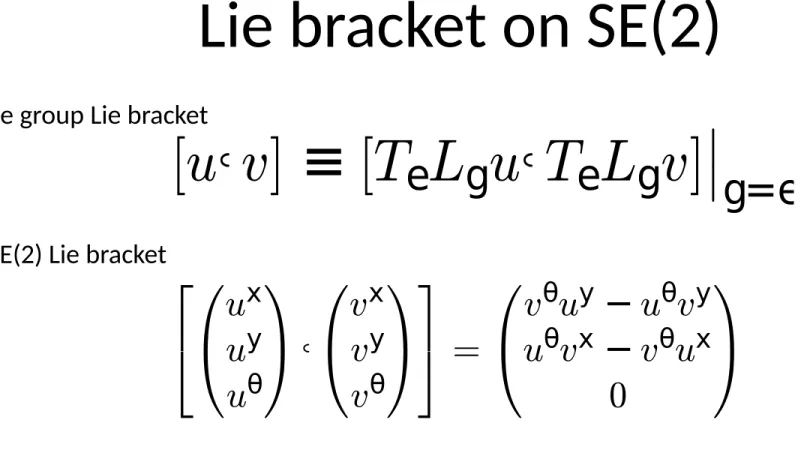
. In this case, the Lie bracket of two vectors
u, v
∈
g
is the Lie bracket of the
two
left-invariant
vector
fi
elds on
G
generated by applying the left lifted action to
u
and
v
,
[
u, v
]
≡
[
T
e
L
g
u, T
e
L
g
v
]
g=e
.
(3.5)
Hodge-Helmholtz decomposition.
The fundamental theorem of calculus states that for a
one-dimensional function, if we know
dy/dx
as a function of
x
, then we know
y
(
x
) up to a
constant of integration. Expansions of this principle to higher dimensions lead to the
fun-damental theorem of vector calculus, which, among other results, states that if we know the
gradient of a function, we know the function up to the addition of a scalar, and that if we
know the curl of a vector
fi
eld, we know the vector
fi
eld up to the addition of a gradient
(conservative)
fi
eld. In terms of differential forms, both these statements are aspects of a
more general theorem that states that if we know the exterior derivative
dω
of a form
ω
, then
we know
ω
up to the addition of a closed form.
In single-variable calculus, many functions have canonical anti-derivatives, such as
´
cos =
sin, to which the constant of integration is added. Similarly, it is often useful to designate
a core form
Ω
as the anti-exterior-derivative of a form
ω
. This separation is achieved by
the
Hodge decomposition
[
3
], referred to as the
Helmholtz decomposition
in vector calculus
contexts. The Hodge-Helmholtz decomposition splits a
k
-form
ω
into three components,
ω
=
d
A
+
δ
B
+
C
,
(3.6)
where
d
A
is an exact, and therefore closed,
k
-form (corresponding to a curl-free vector
fi
eld),
δ
B
is a
k
-form orthogonal to the set of closed
k
-forms (a divergence-free
fi
eld in vector calculus),
and
C
is a
harmonic remainder
(satisfying boundary conditions), generally much smaller than
either of the
fi
rst two components. Drawing on the properties that
d(d
A
) = 0 and that the
exterior derivative is a linear operator, we can see that as
dω
=
d(δ
B
+
C
)
,
(3.7)
dω
is unaffected by the choice of
A
and that
d
A
thus acts similarly to a constant of integration
when determining
ω
from
dω
.
The
d
A
term is the projection of
ω
onto the space of conservative
k
-forms. For one-forms,
the sum
δ
B
+
C
therefore has the interesting property of being the
smallest
one-form with an
exterior derivative equal to that of
ω
,
argmin
dω =dω
(
´
Ω
ω
2
) =
ω− d
A
=
δ
B
+
C
,
(3.8)
where the
“size”
of
ω
is its squared norm integrated over the domain. In [
13
,
14
], we
demon-strated a useful correspondence between this sum (which, due to the relatively small
contribu-tion of
C
, we refer to as the
“divergence free component”
for brevity) and an optimal choice of
coordinates for locomotion analysis, and presented a numerical algorithm for
fi
nding it over a
ni
fi
te domain, based on that in [
9
]. In
§
6
, we examine this application more closely, and from
a differential geometric standpoint.
When we have a Lie group, we can talk about the Lie bracket of two vectors
u,v
in
T
eG
as
meaning the Lie bracket of their left-invariant fields, evaluated at the origin
Lie bracket on SE(2)
NONCONSERVAT IVIT Y AND NONCOMMUTAT IVIT Y IN LOCOMOT ION
7
There are several applications of the Lie bracket in the context of control systems, but the
interpretation most germane to the present work is that
fl
owing differentially along
X
,
Y
,
−
X
, and
−
Y
is equivalent to
fl
owing differentially along [
X, Y
].
A special defi
nition of the Lie bracket applies to elements of the Lie algebra
g
corresponding
to a Lie group
G
. In this case, the Lie bracket of two vectors
u, v
∈
g
is the Lie bracket of the
two
left-invariant
vector
fi
elds on
G
generated by applying the left lifted action to
u
and
v
,
[
u, v
]
≡
[
T
e
L
g
u, T
e
L
g
v
]
g=e
.
(3.5)
Hodge-Helmholtz decomposition.
The fundamental theorem of calculus states that for a
one-dimensional function, if we know
dy/dx
as a function of
x
, then we know
y
(
x
) up to a
constant of integration. Expansions of this principle to higher dimensions lead to the
fun-damental theorem of vector calculus, which, among other results, states that if we know the
gradient of a function, we know the function up to the addition of a scalar, and that if we
know the curl of a vector
fi
eld, we know the vector
fi
eld up to the addition of a gradient
(conservative)
fi
eld. In terms of differential forms, both these statements are aspects of a
more general theorem that states that if we know the exterior derivative
dω
of a form
ω
, then
we know
ω
up to the addition of a closed form.
In single-variable calculus, many functions have canonical anti-derivatives, such as
´
cos =
sin, to which the constant of integration is added. Similarly, it is often useful to designate
a core form
Ω
as the anti-exterior-derivative of a form
ω
. This separation is achieved by
the
Hodge decomposition
[
3
], referred to as the
Helmholtz decomposition
in vector calculus
contexts. The Hodge-Helmholtz decomposition splits a
k
-form
ω
into three components,
ω
=
d
A
+
δ
B
+
C
,
(3.6)
where
d
A
is an exact, and therefore closed,
k
-form (corresponding to a curl-free vector
fi
eld),
δ
B
is a
k
-form orthogonal to the set of closed
k
-forms (a divergence-free
fi
eld in vector calculus),
and
C
is a
harmonic remainder
(satisfying boundary conditions), generally much smaller than
either of the
fi
rst two components. Drawing on the properties that
d
(
d
A
) = 0 and that the
exterior derivative is a linear operator, we can see that as
dω
=
d
(
δ
B
+
C
)
,
(3.7)
dω
is unaffected by the choice of
A
and that
d
A
thus acts similarly to a constant of integration
when determining
ω
from
dω
.
The
d
A
term is the projection of
ω
onto the space of conservative
k
-forms. For one-forms,
the sum
δ
B
+
C
therefore has the interesting property of being the
smallest
one-form with an
exterior derivative equal to that of
ω
,
argmin
dω =dω
(
´
Ω
ω
2
) =
ω− d
A
=
δ
B
+
C
,
(3.8)
where the
“
size
”
of
ω
is its squared norm integrated over the domain. In [
13
,
14
], we
demon-strated a useful correspondence between this sum (which, due to the relatively small
contribu-tion of
C
, we refer to as the
“
divergence free component
”
for brevity) and an optimal choice of
coordinates for locomotion analysis, and presented a numerical algorithm for
fi
nding it over a
ni
fi
te domain, based on that in [
9
]. In
§
6
, we examine this application more closely, and from
a differential geometric standpoint.
10
ROSS L. HAT T ON AND HOWIE CHOSET
(a) World velocity
(b) Body velocity
(c) Alternate
interpreta-tion of body velocity
Figure4.1: T hreerepresentations of thevelocity of a robot. T herobot, represented by thetriangle, is translating
up and to the right while spinning counterclockwise. In
(a)
, the world velocity, ˙
g, is measured with respect
to the global frame. T he body velocity, ξ, in
(b)
is the velocity represented in the robot’s instantaneous local
coordinate frame. T he body velocity is actually calculated by transporting the body back to the origin frame,
as in
(c)
, but by symmetry this is equivalent to bringing the world frame to the system.
Table 4.1: Interpretations of elements of T
eG, as used in this paper.
Symbol
Meaning
First Introduced
ξ
Body velocity
§
4.1
z
Exponential coordinates
§
4.1
ζ
Body velocity integral
§
5.2.1
¯
ζ
Corrected body velocity integral
§
5.2.2
g
= exp (
z
) of a vector
z
∈
se
(2)
fi
nds the net displacement of a system starting at the origin
and moving with body velocity
ξ
=
z
for one unit of time, and takes the form
(
x, y
) =
(
z
x
, z
y
)
,
for
z
θ
= 0
1
z
θ
sin
z
θ
1
−
cos
z
θ
cos
z
θ
−
1
sin
z
θ
z
x
z
y
,
for
z
θ
= 0
θ
=
z
θ
.
(4.5)
The elements of
z
are the
exponential coordinates
corresponding to
g
. Note that both the body
velocity and exponential coordinates are elements of the tangent space of the body frame,
but have different physical interpretations. In the following discussion, we will maintain the
orthographic distinction between these quantities, summarized in Table
4.1
, adding two more
interpretations in
§
5.2
.
The Lie bracket of two vectors
u, v
∈
se
(2) for an
SE
(2) system
fi
nds the net effect of
moving differentially in the
u, v,
−
u,
−
v
directions and is calculated as
u
x
u
y
u
θ
,
v
x
v
y
v
θ
=
v
θ
u
y
−
u
θ
v
y
u
θ
v
x
−
v
θ
u
x
0
,
(4.6)
Lie group Lie bracket
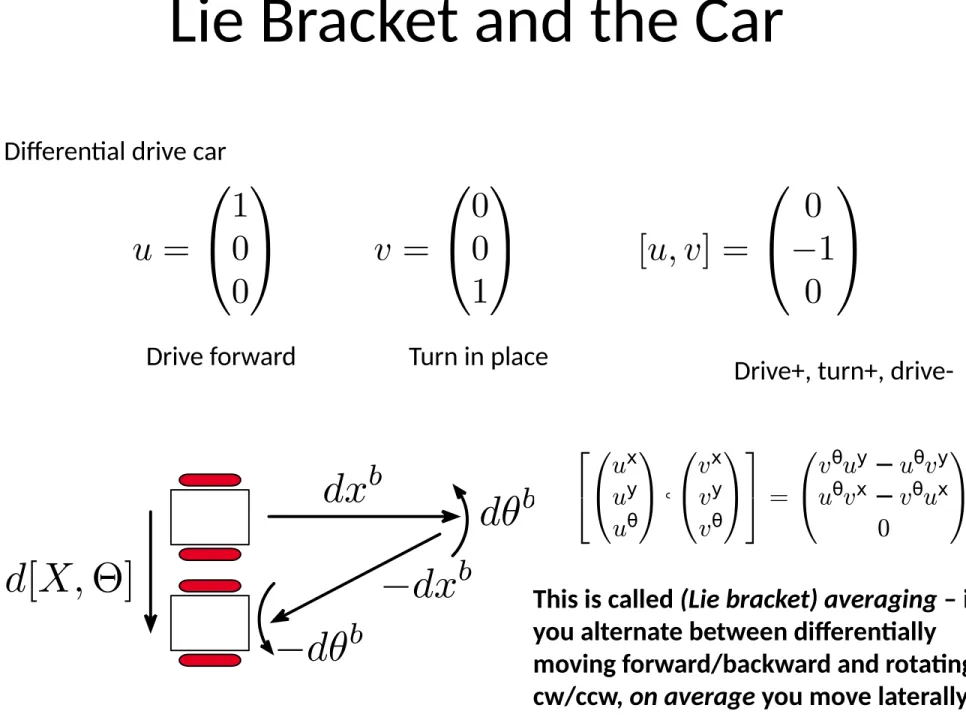
Lie Bracket and the Car
Differential drive car
Drive forward
Turn in place
Drive+, turn+,
drive-10 ROSS L. HAT T ON AND HOWIE CHOSET
(a) World velocity (b) Body velocity (c) Alternate interpreta-tion of body velocity
Figure4.1: T hreerepresentations of thevelocity of a robot. T herobot, represented by thetriangle, is translating up and to the right while spinning counterclockwise. In (a), the world velocity, ˙g, is measured with respect to the global frame. T he body velocity, ξ, in (b) is the velocity represented in the robot’s instantaneous local coordinate frame. T he body velocity is actually calculated by transporting the body back to the origin frame, as in(c), but by symmetry this is equivalent to bringing the world frame to the system.
Table 4.1: Interpretations of elements of TeG, as used in this paper.
Symbol
Meaning
First Introduced
ξ
Body velocity
§
4.1
z
Exponential coordinates
§
4.1
ζ
Body velocity integral
§
5.2.1
¯
ζ
Corrected body velocity integral
§
5.2.2
g
= exp (
z
) of a vector
z
∈
se
(2)
fi
nds the net displacement of a system starting at the origin
and moving with body velocity
ξ
=
z
for one unit of time, and takes the form
(
x, y
) =
(
z
x, z
y)
,
for
z
θ= 0
1
z
θsin
z
θ1
−
cos
z
θcos
z
θ−
1
sin
z
θz
xz
y,
for
z
θ
= 0
θ
=
z
θ.
(4.5)
The elements of
z
are the
exponential coordinates
corresponding to
g
. Note that both the body
velocity and exponential coordinates are elements of the tangent space of the body frame,
but have different physical interpretations. In the following discussion, we will maintain the
orthographic distinction between these quantities, summarized in Table
4.1
, adding two more
interpretations in
§
5.2
.
The Lie bracket of two vectors
u, v
∈
se
(2) for an
SE
(2) system
fi
nds the net effect of
moving differentially in the
u, v,
−
u,
−
v
directions and is calculated as
u
xu
yu
θ,
v
xv
yv
θ=
v
θu
y−
u
θv
yu
θv
x−
v
θu
x0
,
(4.6)
1
. Controlability:
DO WE WANT TO MORE FORMALLY DEFINE CONTROLLABILITY AND/OR ITS RELATIVES
ON THE NEXT SLIDE?
Nonholonomically-constrained systems by definition cannot instantaneously move
in some directions: their distributions do not span their configuration spaces
If we take a distribution
DID WE DEFINE A DISTRIBUTION YET? PERHAPS WE SHOULD REMIND PEOPLE
HERE
D={V
1,V
2}
and find that the Lie bracket [V
1,V
2] is outside the span of D, we can combine D with the Lie bracket field
to make a new distribution
D’={v
1,v
2,[v
1,v
2]}
whose span is one dimension higher, and represents the directions the system can move either with a
differential control input or with a first order oscillation
I WOULD LIKE TO CALL OUT WHAT WE MEAN BY
AN OSCILLATION BUT PERHAPS JUST SPOKEN WORDS IS ENOUGH
of the controls. In some cases, we can
further expand the distribution with higher-order Lie brackets, e.g.,
D’’ = {v
1,v
2,[v
1,v
2], [v
1, [v
1,v
2]]}
If we reach a point where we
can’t add dimensions
–
YOU MEAN REACH THE FULL DIMENSION
by taking
more Lie brackets, this is an
involutive distribution
: it describes the full set of directions in which the
system can move differentially. If a system’s involutive distribution spans the whole configuration space,
then the system is said to be
controllable
– we have a set of inputs that can move the system in any
direction. (Note that in general there will be more efficient/effective ways to move the system in
non-primary directions, controllability is a proof of existence)
2. Relationship to gaits.
Importance of Lie brackets
are associated with unit shape velocities,
and so their Lie bracket corresponds to the
motion produced by a differential
oscillation in the shape space (i.e. a
differential gait)
Lie Bracket and Larger Motions
One of the nice things about thinking of Lie
bracket motions as differential gaits is that it
gives us intuition as to how the system will move
over larger gaits: Two differential cycles are
equivalent to their combined perimeter if the
overlapping edges cancel out.
This gives us an area rule: over a larger gait,
magnitude of average flow field is the area
integral of the Lie bracket over the region
enclosed by the gait –
I FEEL AREA COMES OUT
OF NOWHERE? Why can we talk about area?
Note that here there is a small-angle condition on this assumption, and we are also assuming that local connection is constant (and thus that input fields are left invariant) – EXPLAIN LOCAL
CONNECTION IS CONSTANT
10 ROSS L. HAT T ON AND HOWIE CHOSET
(a) World velocity (b) Body velocity (c) Alternate interpreta-tion of body velocity
Figure4.1: T hreerepresentations of thevelocity of a robot. T herobot, represented by thetriangle, is translating up and to the right while spinning counterclockwise. In (a), the world velocity, ˙g, is measured with respect to the global frame. T he body velocity, ξ, in (b) is the velocity represented in the robot’s instantaneous local coordinate frame. T he body velocity is actually calculated by transporting the body back to the origin frame, as in (c), but by symmetry this is equivalent to bringing the world frame to the system.
Table 4.1: Interpretations of elements of TeG, as used in this paper.
Symbol
Meaning
First Introduced
ξ
Body velocity
§
4.1
z
Exponential coordinates
§
4.1
ζ
Body velocity integral
§
5.2.1
¯
ζ
Corrected body velocity integral
§
5.2.2
g
= exp (
z
) of a vector
z
∈
se
(2)
fi
nds the net displacement of a system starting at the origin
and moving with body velocity
ξ
=
z
for one unit of time, and takes the form
(
x, y
) =
(
z
x, z
y)
,
for
z
θ= 0
1
z
θsin
z
θ1
−
cos
z
θcos
z
θ−
1
sin
z
θz
xz
y,
for
z
θ
= 0
θ
=
z
θ.
(4.5)
The elements of
z
are the
exponential coordinates
corresponding to
g
. Note that both the body
velocity and exponential coordinates are elements of the tangent space of the body frame,
but have different physical interpretations. In the following discussion, we will maintain the
orthographic distinction between these quantities, summarized in Table
4.1
, adding two more
interpretations in
§
5.2
.
The Lie bracket of two vectors
u, v
∈
se
(2) for an
SE
(2) system
fi
nds the net effect of
moving differentially in the
u, v,
−
u,
−
v
directions and is calculated as
u
xu
yu
θ,
v
xv
yv
θ=
v
θu
y−
u
θv
yu
θv
x−
v
θu
x0
,
(4.6)
This rule is consistent with the Lie
bracket as a
bilinear operator
– it
scales linearly with
u
and
v.
Example: Increasing forward translation and rotation each linearly increases the lateral translation
Lie Brackets and Exponential Maps
Lie bracket gives us average velocity of the system: moving for dt along each of
u, v
,
-u
, and
-v
is equivalent to moving for dt along [u,v]. (note that the total “time” in
the cycle is different from the “flow time” along the Lie bracket field).
To get the
displacement
over the cycle, we can exponentiate this
velocity:
CAN YOU REMIND ME AGAIN WHEN THE EXPONENTIAL
IS RELATED TO A GROUP OPERATOR; IS THIS TRUE FOR ALL LIE
GROUPS, IE IS THE DEFINING FEATUER OF LIE GROUPS
Here, [
u,v
]
dt
gives the
exponential coordinates
of the net displacement, In the future, we will
denote such exponential coordinates as
z
.
Also note that if we scale
u
or
v
, we proportionally increase the displacement
Nonconservativity
Noncommutatvity
6
ROSS L. HAT T ON AND HOWIE CHOSET
Where necessary,
musical notation
[
1
] is used to denote the relationship between
k
-forms
and their vector-calculus duals, with
ω
=
v
representing a conversion from a one-form to a
vector
fi
eld, and
v
=
ω
the conversion from vectors to one-forms. Similarly, the
Hodge star
operator provides the mathematical structure for representing a differential area (a two-form)
by its normal vector (a one-form), as (
∗ω
) .
The
exterior derivative dω
of a
k
-form
ω
measures how each component of
ω
changes in
directions normal to that component, and is itself a
k
+1-form. For the examples we consider in
this paper, which are restricted to
k
-forms over two-dimensional spaces, the exterior derivative
is intuitively linked to two common vector operations
–
gradient and curl. The gradient vector
e
fi
ld of a function (zero-form) is the dual to the function
’
s exterior derivative; likewise, the
curl of a two-dimensional vector
fi
eld is the corresponding one-form
’
s exterior derivative.
2
Two important classi
fi
cations of differential forms are
closed
and
exact
. Closed forms have
null exterior derivatives,
dω
= 0, and exact forms are themselves the exterior derivatives of
other forms,
ω
=
dω
a
. An especially useful result from differential geometry [
1
] is that exact
forms are automatically closed,
d
(
dω
) = 0, which is equivalent to saying that the curl of a
gradient
fi
eld is always zero (and thus that gradient
fi
elds are conservative). We will return
to this point in our discussion of optimal coordinates.
Stokes’s theorem.
Stokes
’
s theorem [
6
] equates the integral of a differential
k
-form
ω
along
a closed
k
-dimensional manifold
∂Ω
on a space
U
to the integral of the exterior derivative of
that
k
-form over a
k
+ 1-dimensional manifold
Ω
bounded by the original manifold,
ˆ
∂Ω
ω
(
u
)
du
=
ˆ
Ω
dω
(
u
)
du.
(3.1)
In two dimensions and with
ω
a one-form, the surface
Ω
is simply the region of
U
enclosed
by the closed curve
∂Ω
, and (
3.1
) specializes to the simple area integral
‰
∂Ω
ω
(
u
)
du
=
¨
Ω
∂ω
2
∂
u
1
−
∂ω
1
∂
u
2
du
1
du
2
.
(3.2)
This equation is commonly encountered as
“
Green
’
s theorem
”
in vector calculus, where it is
described as equating a line integral along a closed loop on a vector
fi
eld with an area integral
of the
fi
eld
’
s curl.
Lie bracket of vector fields.
The Lie bracket [
29
] of two vector
fi
elds
X
and
Y
measures
their rates of change with respect to each other. For
fi
elds de ne
fi
d on an
n
-dimensional space
U
, the Lie bracket is a vector
fi
eld de
fi
ned as
[
X, Y
] = (
∇
Y
·
X
)
−
(
∇
X
·
Y
)
,
(3.3)
or componentwise as
[
X, Y
]
i
=
n
j =1
x
j
∂
y
i
∂
u
j
−
y
j
∂
x
i
∂
u
j
=
−
[
Y, X
]
i
.
(3.4)
2
In three dimensions, the exterior derivative has three magnitude components, corresponding to a
three-dimensional curl vector field (created via the Hodge star operator). In four or more dimensions, the number of
components in the exterior derivative continue to grow as (n
2− n)/ 2, even though the curl is undefined. T hese
cases are, however, outside the scope of the present work.
–
+
curl
Combining Nonconservativity and
Noncommutativity
Example: Kinematic snake
Coordinate optimization
Available coordinate choices
New rotational vector field
gradient with respect to shape
Orientation during gait
Optimal orientation
Hodge-Helmholtz
Decomposition
Same Curl
Original
Closest Gradient
Optimal orientation
Fin
d
that
minimizes
Optimal
Mean
Orientation during gait
Original
Mean
Optimal position
Optimal position
Generality
Floating snake
Time
Floating snake
Coordinate optimization
Black: Displacement
magnitude and span
Grey: Original area
integration
Red: Optimized area
integration and
displacement span
Snakes on a Plan
(Hatton, Knepper, Travers, Droge, Egerstedt)
Gait Velocity Power Efficiency
Slither
(longitudinal) 2.8 cm/sec 13.1 W 130.2 mWh/m Rolling
(transverse) 26.4 cm/sec 28.7 W 30.2 mWh/m Rotate 22.5 deg/sec 29.0 W 0.481
mWh/deg Transition
between gaits 0 cm/sec (lasts 1 sec)
28.5 W 0 mWh/m
(costs 3.65 mWh)
Separate position and internal shape variables
Plan for position and “almost” defer shape variables until execution
Chose position variables based on “best gait”
Discrete Planner:
sample position
(rectangle),
extend straight line
,
Towards Simple Motion Models
Intuitive relationship between
rotation of the wheels and
motion of the chassis.
Virtual Chasis
Once again, choice of
body frame matter
Fixed to a link is bad
(but easy to define)
Compute Virtual Chassis
Optimal Coordinate from
before minimizes
orientation variation
•
Approximate: Align
with principal shape
components via SVD.
•
Pipes: Exploit
Benefits of Virtual Chassis
•
“Straighter” paths in the
world while executing gaits.
•
Direction of displacement is
independent of starting
phase in the gait
•
Can alter bounding boxes
on the fly
•
Plan for other terrains
Open Issues
•
Need to implement
•
Transitions
Combining Nonconservativity and
Noncommutativity
Is it legitimate to just add nonconservative and noncommutative
elements together?
Yes (as an approximation)
Exponential coordinates (average velocity for normalized time) of net displacement over
a cycle are in general
16 ROSS L. HAT T ON AND HOWIE CHOSET
We can simplify the rather ungainly expressions in (5.3) and (5.4) in the following manner: First, we focus our attention only on the g˙term in the lower half of the equation. Second, we take g0 = e, such that (5.3) gives the averaged velocity in the body frame of the system,
thereby eliminating the TeLg0 term. Finally, we note that as A1 and A2 are both elements
of TeG, they are elements of g, and we can use (3.5) to make the lifted actions inside the Lie
bracket implicit, as described in §3.2. These three changes reduce the lower halves of (5.3) and (5.4) to
A(r)r˙1, A(r)r˙2 r0
= −dA + A1,A2 (r0), (5.5)
in which the right-hand expression is the local curvatureof A at r0, denoted as DA(r0) [26].
An expanded treatment of this derivation is given in the Appendix.
5.2. T he Body Velocity Integral (BVI) and the Corrected Body Velocity Integral (cBVI). For larger-amplitude (i.e. non-differential) gaits, Radford and Burdick [33] have shown that the exponential coordinates z(T) for the net displacement over a gait φ can be approximated as
z(φ) =
¨
φa
−dA dr1 dr2+
¨
φa
[A1,A2] dr1 dr2+ higher-order terms , (5.6)
where φa is the oriented region of M enclosed by φ, and the two integrands sum to the right-hand side of (5.5). The expression in (5.6) is of an especially useful form, as the first two terms are both area integrals over the region of the shape space enclosed by the gait. By plotting either the first integrand [13,37] or the sum of the two integrands [4,26], we can visualize the locomotion capabilities of the system over arbitrary choices of gait. This notion plays a key role in the results of this paper, but before we examine it in more depth, we make an aside to supply some insight as to the form of (5.6). In previous works, this equation has only been presented as resulting from the straightforward application of calculus to the Magnus expansion for a Lie group [21], but examining the components individually provides strong intuition as to their provenance and links them directly to the noncommutativity and nonconservativity of the system dynamics.
To ground this discussion, we refer to the example kinematic snake gaits overlayed on the connection vector fields and their derivatives in Fig. 5.1(a). As discussed in [13,14], the counterclockwise circular path through the shape space in Fig. 5.1(a) corresponds to an image-family of gaits (one gait per starting point on the curve), for which the resulting locus of displacements is the arc in Fig. 5.1, with zero net rotation over any of the gaits. Note that for zero net rotation (i.e. zθ = 0), the exponential map in (4.5) is an identity map, and that
for this example, the zx and zy components of the exponential coordinates thus correspond
directly to the x and y components of the displacement.
5.2.1. Body Velocity Integral. Previously, we have shown [11,13,14] that thefirst integral in (5.6) produces the body velocity integral (BVI), ζ of the system over φ. The BVI describes the net “forward minus backward”motion of the system over the gait in each body direction,
ζ(T) =
ˆ T
0
ξ(t) dt =−
ˆ
φ
A(r) dr= −
¨
φa
dA dr1 dr2, (5.7)
d is the exterior derivative, which is like the curl, but more technically correct for talking about covectors
[A1,A2] is the local Lie bracket,
as if A did not change with r
Derivation for this equivalence
Full Lie bracket on the configuration space
Conditions we can apply for these shape inputs:
28 ROSS L. HAT T ON AND HOWIE CHOSET
as displacements [15]. We are also considering the the nature of optimal coordinates in three dimensions, and for systems in new physical regimes, such as the sand-swimmer in [22].
Appendix A. Derivation of the Local Curvature.
The expression for the local curvature of the connection in (5.5) was presented in [26], based on earlier work in [24]. To the best of our knowledge, however, the relationship between this curvature and the Lie bracket in (5.3) has not been explicitly shown in modern notation. Here, we offer a derivation linking the two expressions,i.e., showing that
˙
r1
−TeLgA(r)r˙1 ,
˙
r2
−TeLgA(r)r˙2 q0 =
0
−dA + A1,A2 (r0) . (A.1)
First, a general Lie bracket in which the vector components can be grouped into two subvectors, i.e., of the form
[q˙1,q˙2] = r˙˙1
g1 ,
˙
r2
˙
g2 , (A.2)
can be evaluated by applying the Lie bracket formula in (3.4) blockwise to (A.2), producing the expression
˙
r1
˙
g1 ,
˙
r2
˙
g2 (r0,g0) =
∂ ˙r2
∂r r˙1−
∂ ˙r1
∂r r˙2 +
∂ ˙r2
∂g g˙1−
∂ ˙r1
∂g g˙2
∂ ˙g2
∂r r˙1−
∂ ˙g1
∂r r˙2 +
∂ ˙g2
∂g g˙1−
∂ ˙g1
∂g g˙2 (r0,g0)
. (A.3)
Second, for the problem at hand we are considering a pair of vector fields in which the r˙
vectors are each a unit vector aligned with the chosen basis, and so have components (using Kronecker delta notation),
˙
rji = δij. (A.4)
The position vectors in the vector fields are functions of the shape velocity,
˙
gi = −TeLgA(r)r˙i = −TeLgAi(r), (A.5)
where the final equality is due to the ith shape velocity serving to select the ith column of the local connection.
Given these two definitions, the partial derivatives of the shape velocity fields are clearly zero,
∂ ˙ri
∂r = 0 and
∂ ˙ri
∂g = 0, (A.6)
as they are constant fields. The position velocity fields’derivatives with respect to the shape e
fi lds can be found by applying the product rule for differentiation,
−∂ ˙gi
∂r (r0,g0) =
∂ TeLgAi(r)
∂r (r0,g0) =
∂ TeLg
∂r Ai(r0) +TeLg0
∂Ai(r)
∂r , (A.7)
Differential cycle in the shape space is
NONCONSERVAT IVIT Y AND NONCOMMUTAT IVIT Y IN LOCOMOT ION
15
nd
fi
r
˙
(
t
) =
−A
−1(
r
(
t
))
g
˙
(
t
), and then integrating
r
˙
(
t
) over time produces the necessary shape
change. This approach, however, does not in general work over long time scales in the presence
of nonholonomic constraints (which place certain
g
˙
vectors outside of the span of
A
) or joint
limits (which prevent the execution of certain
r
˙
vectors).
Gait-based approaches provide an attractive solution to the path planning problems posed
by these constraints. Rather than specifying a path through position space and dictating that
the system rigidly follow this path, a motion planner can design gaits with a range of net
displacements and then choose among them to build a motion plan that on
“
average
”
follows
a speci
fi
ed path. This raises the question, then, of how to design useful gaits. A predominant
means of answering this question is the use of
averaging
techniques, which are related to the
Lie bracket. Here, we will brie
fl
y review several such averaging techniques, while drawing
connections between them that have not previously been made explicit.
5.1. Lie Brackets and the Local Connection.
A gait with very small amplitude in the
shape space can be considered as a differential oscillation of the shape, and the net motion
re-sulting from such an input can be found by the use of Lie brackets. For a speci
fi
ed input shape
velocity
r
˙
, a system at con
fi
guration
q
0= (
r
0, g
0) has position velocity
g
˙
=
−
T
eL
g0A
(
r
0)
r
˙
.
Moving with this velocity can be interpreted as
fl
owing along the vector
fi
eld
X
(
q
) de
fi
ned
over the con
fi
guration space as
X
(
q
) =
r
˙
−
T
eL
gA
(
r
)
r
˙
.
(5.2)
If we de
fi
ne two unit-magnitude input shape velocities as
r
˙
1= [1 0]
Tand
r
˙
2= [0 1]
T, then
the Lie bracket
˙
r
1−
T
eL
gA
(
r
)
r
˙
1,
˙
r
2−
T
eL
gA
(
r
)
r
˙
2 q0,
(5.3)
gives the average velocity vector achieved by differentially
fl
o
wing along the vector
fi
e
lds
de ne
fi
d by
r
˙
1,
r
˙
2,
−˙
r
1, and
−˙
r
2in order,
i.e.
differentially oscillating the shape around
q
0.
4The structure of the con
fi
guration space gives the Lie bracket in (5.3
) a natural second
representation,
0
T
eL
g0−dA
(
r
0) +
T
eL
g− 10 gA
1(
r
0)
, T
eL
g0− 1gA
2(
r
0)
(5.4)
where
A
iis the
i
th column of
A
and
dA
is its exterior derivative with respect to
r
˙
1and
˙
r
2. Note that in the Lie bracket in (5.3),
A
varies with
r
, but that in the Lie bracket term
in (5.4), it is held to its value at
r
0. In subsequent discussion, we will refer to this latter
form as the
local
Lie bracket. The top half of (5.4) is null, re
fl
ecting that a cyclic motion in
M
by de
fi
nition causes no net change in those coordinates. In the bottom half, the exterior
derivative and local Lie bracket terms respectively represent how the system dynamics change
with the shape and with motion through the position space, in a blockwise application of (3.4)
to (5.3)
4
Although we use coordinates here, the results hold for any selection of independent ˙
r
1
and ˙
r
2vectors and
so we do not incur any loss of generality.
28 ROSS L. HAT T ON AND HOWIE CHOSET
as displacements [15]. We are also considering the the nature of optimal coordinates in three dimensions, and for systems in new physical regimes, such as the sand-swimmer in [22].
Appendix A. Derivation of the Local Curvature.
The expression for the local curvature of the connection in (5.5) was presented in [26], based on earlier work in [24]. To the best of our knowledge, however, the relationship between this curvature and the Lie bracket in (5.3) has not been explicitly shown in modern notation. Here, we offer a derivation linking the two expressions, i.e., showing that
˙
r1
−TeLgA(r)r˙1 ,
˙
r2
−TeLgA(r)r˙2 q0 =
0
−dA + A1,A2 (r0) . (A.1)
First, a general Lie bracket in which the vector components can be grouped into two subvectors, i.e., of the form
[q˙1,q˙2] = rg˙˙1 1 ,
˙
r2
˙
g2 , (A.2)
can be evaluated by applying the Lie bracket formula in (3.4) blockwise to (A.2), producing the expression
˙
r1
˙
g1 ,
˙
r2
˙
g2 (r0,g0) =
∂ ˙r2
∂r r˙1−
∂ ˙r1
∂r r˙2 +
∂ ˙r2
∂g g˙1−
∂ ˙r1
∂g g˙2
∂ ˙g2
∂r r˙1−
∂ ˙g1
∂r r˙2 +
∂ ˙g2
∂g g˙1−
∂ ˙g1
∂g g˙2 (r0,g0)
. (A.3)
Second, for the problem at hand we are considering a pair of vector fields in which the r˙
vectors are each a unit vector aligned with the chosen basis, and so have components (using Kronecker delta notation),
˙
rji = δij. (A.4)
The position vectors in the vector fields are functions of the shape velocity,
˙
gi = −TeLgA(r)r˙i =−TeLgAi(r), (A.5)
where the final equality is due to the ith shape velocity serving to select the ith column of the local connection.
Given these two definitions, the partial derivatives of the shape velocity fields are clearly zero,
∂ ˙ri
∂r = 0 and
∂ ˙ri
∂g = 0, (A.6)
as they are constant fields. The position velocity fields’derivatives with respect to the shape e
fi lds can be found by applying the product rule for differentiation,
−∂ ˙gi
∂r (r0,g0) =
∂ TeLgAi(r)
∂r (r0,g0) =
∂ TeLg
∂r Ai(r0) +TeLg0
∂Ai(r)
∂r , (A.7)
and
(shape input vector field components are constant)
28 ROSS L. HAT T ON AND HOWIE CHOSET
as displacements [15]. We are also considering the the nature of optimal coordinates in three dimensions, and for systems in new physical regimes, such as the sand-swimmer in [22].
Appendix A. Derivation of the Local Curvature.
The expression for the local curvature of the connection in (5.5) was presented in [26], based on earlier work in [24]. To the best of our knowledge, however, the relationship between this curvature and the Lie bracket in (5.3) has not been explicitly shown in modern notation. Here, we offer a derivation linking the two expressions, i.e., showing that
˙
r1
−TeLgA(r)r˙1 ,
˙
r2
−TeLgA(r)r˙2 q0 =
0
−dA + A1,A2 (r0) . (A.1)
First, a general Lie bracket in which the vector components can be grouped into two subvectors, i.e., of the form
[q˙1,q˙2] = r˙˙1
g1 ,
˙
r2
˙
g2 , (A.2)
can be evaluated by applying the Lie bracket formula in (3.4) blockwise to (A.2), producing the expression
˙
r1
˙
g1 ,
˙
r2
˙
g2 (r0,g0) =
∂ ˙r2
∂r r˙1−
∂ ˙r1
∂r r˙2 +
∂ ˙r2
∂g g˙1−
∂ ˙r1
∂g g˙2
∂ ˙g2
∂r r˙1−
∂ ˙g1
∂r r˙2 +
∂ ˙g2
∂g g˙1−
∂ ˙g1
∂g g˙2 (r0,g0)
. (A.3)
Second, for the problem at hand we are considering a pair of vector fields in which the r˙
vectors are each a unit vector aligned with the chosen basis, and so have components (using Kronecker delta notation),
˙
rij = δij. (A.4)
The position vectors in the vector fields are functions of the shape velocity,
˙
gi = −TeLgA(r)r˙i =−TeLgAi(r), (A.5)
where the final equality is due to the ith shape velocity serving to select the ith column of the local connection.
Given these two definitions, the partial derivatives of the shape velocity fields are clearly zero,
∂ ˙ri
∂r =0 and
∂ ˙ri
∂g = 0, (A.6)
as they are constant fields. The position velocity fields’ derivatives with respect to the shape e
fi lds can be found by applying the product rule for differentiation,
−∂ ˙gi
∂r (r0,g0) =
∂ TeLgAi(r)
∂r (r0,g0) =
∂ TeLg
∂r Ai(r0) +TeLg0
∂Ai(r)
∂r , (A.7)
28 ROSS L. HAT TON AND HOWIE CHOSET
as displacements [15]. We are also considering the the nature of optimal coordinates in three dimensions, and for systems in new physical regimes, such as the sand-swimmer in [22].
Appendix A. Derivation of the Local Curvature.
The expression for the local curvature of the connection in (5.5) was presented in [26], based on earlier work in [24]. To the best of our knowledge, however, the relationship between this curvature and the Lie bracket in (5.3) has not been explicitly shown in modern notation. Here, we offer a derivation linking the two expressions, i.e., showing that
˙
r1
−TeLgA(r)r˙1 ,
˙
r2
−TeLgA(r)r˙2 q0 =
0
−dA + A1,A2 (r0) . (A.1)
First, a general Lie bracket in which the vector components can be grouped into two subvectors, i.e., of the form
[q˙1,q˙2] = r˙˙1
g1 ,
˙
r2
˙
g2 , (A.2)
can be evaluated by applying the Lie bracket formula in (3.4) blockwise to (A.2), producing the expression
˙
r1
˙
g1 ,
˙
r2
˙
g2 (r0,g0) =
∂ ˙r2
∂r r˙1−
∂ ˙r1
∂r r˙2 +
∂ ˙r2
∂g g˙1−
∂ ˙r1
∂g g˙2
∂ ˙g2
∂r r˙1−
∂ ˙g1
∂r r˙2 +
∂ ˙g2
∂g g˙1−
∂ ˙g1
∂g g˙2 (r0,g0)
. (A.3)
Second, for the problem at hand we are considering a pair of vector fields in which the r˙
vectors are each a unit vector aligned with the chosen basis, and so have components (using Kronecker delta notation),
˙
rji =δij. (A.4)
The position vectors in the vector fields are functions of the shape velocity,
˙
gi =−TeLgA(r)r˙i =−TeLgAi(r), (A.5)
where the final equality is due to the ith shape velocity serving to select the ith column of the local connection.
Given these two definitions, the partial derivatives of the shape velocity efi lds are clearly zero,
∂ ˙ri
∂r = 0 and
∂ ˙ri
∂g = 0, (A.6)
as they are constant fields. The position velocity fields’ derivatives with respect to the shape e
fi lds can be found by applying the product rule for differentiation,
−∂ ˙gi
∂r (r0,g0) =
∂ TeLgAi(r)
∂r (r0,g0) =
∂ TeLg
∂r Ai(r0) +TeLg0
∂Ai(r)
∂r , (A.7)
28 ROSS L. HAT T ON AND HOWIE CHOSET
as displacements [15]. We are also considering the the nature of optimal coordinates in three dimensions, and for systems in new physical regimes, such as the sand-swimmer in [22].
Appendix A. Derivation of the Local Curvature.
The expression for the local curvature of the connection in (5.5) was presented in [26], based on earlier work in [24]. To the best of our knowledge, however, the relationship between this curvature and the Lie bracket in (5.3) has not been explicitly shown in modern notation. Here, we offer a derivation linking the two expressions, i.e., showing that
˙
r1
−TeLgA(r)r˙1 ,
˙
r2
−TeLgA(r)r˙2 q0 =
0
−dA + A1,A2 (r0) . (A.1)
First, a general Lie bracket in which the vector components can be grouped into two subvectors, i.e., of the form
[q˙1,q˙2] = rg˙˙1 1 ,
˙
r2
˙
g2 , (A.2)
can be evaluated by applying the Lie bracket formula in (3.4) blockwise to (A.2), producing the expression
˙
r1
˙
g1 ,
˙
r2
˙
g2 (r0,g0) =
∂ ˙r2
∂r r˙1−
∂ ˙r1
∂r r˙2 +
∂ ˙r2
∂g g˙1−
∂ ˙r1
∂g g˙2
∂ ˙g2
∂r r˙1−
∂ ˙g1
∂r r˙2 +
∂ ˙g2
∂g g˙1−
∂ ˙g1
∂g g˙2 (r0,g0)
. (A.3)
Second, for the problem at hand we are considering a pair of vector fields in which the r˙
vectors are each a unit vector aligned with the chosen basis, and so have components (using Kronecker delta notation),
˙
rij = δij. (A.4)
The position vectors in the vector fields are functions of the shape velocity,
˙
gi = −TeLgA(r)r˙i = −TeLgAi(r), (A.5)
where the final equality is due to the ith shape velocity serving to select the ith column of the local connection.
Given these two definitions, the partial derivatives of the shape velocity efi lds are clearly zero,
∂ ˙ri
∂r =0 and
∂ ˙ri
∂g = 0, (A.6)
as they are constant fields. The position velocity fields’ derivatives with respect to the shape e
fi lds can be found by applying the product rule for differentiation,
−∂ ˙gi
∂r (r0,g0) =
∂ TeLgAi(r)
∂r (r0,g0) =
∂ TeLg
∂r Ai(r0) +TeLg0
∂Ai(r)
∂r , (A.7)
(TeLg is independent of r)
NONCONSERVAT IVIT Y AND NONCOMM UTAT IVIT Y IN LOCOMOT ION 29
and noting that TeLg is independent of r, so
−∂ ˙gi
∂r (r0,g0) =TeLg0
∂Ai(r)
∂r . (A.8)
Further, each derivative ofg˙i in the lower-left term of (A.3) is multiplied by the shape velocity
˙
rj with i= j, selecting out the jth derivative and giving these terms the form
−∂ ˙gi
∂r r˙j (r0,g0) =
∂ ˙gi
∂rj (r0,g0) =TeLg0
∂Ai(r)
∂rj . (A.9)
Differentiating the position velocities with respect to the position space follows the same pattern,
−∂ ˙gi
∂g (r0,g0) =
∂ TeLgAi(r)
∂g (r0,g0) =
∂ TeLg
∂g Ai(r0) +TeLg0
∂Ai(r)
∂g (A.10)
= ∂ TeLg
∂g Ai(r0). (A.11)
Inserting the results of (A.6), (A.9), and (A.11) into (A.3) and factoring out a TeLg0 term
from each subexpression in the bottom row reduces the Lie bracket to
˙
r1
˙
g1 ,
˙
r2
˙
g2 (r0,g0)
=
0
TeLg0 −
∂A2(r)
∂r1 −
∂A1(r)
∂r2 +
∂ TeLg A2(r0)
∂g Tg0LgA1(r0)
−∂ TeLg A1(r0)
∂g Tg0LgA2(r0)
.
(A.12) The left-hand term in this new expression is the exterior derivative of the local connection,
∂A2(r)
∂r1 −
∂A1(r)
∂r2 r0 =dA(r0). (A.13)
Taking g0 = e (placing the origin at the initial position of the system) eliminates the TeLg0
factor applied to the whole row and makes the right-hand term in the new expression,
∂ TeLg A2(r0)
∂g TeLgA1(r0)−
∂ TeLg A1(r0)
∂g TeLgA2(r0) . (A.14)
Using the definition of the Lie bracket in (3.3), this expression is clearly the bracket
[TeLgA1(r0), TeLgA2(r0)] = [A1,A2](r0), (A.15)
(A is independent of g)