For help accessing information in this document,
NOTE REGARDING NEXT STEPS AND IMPLEMENTATION
This Service Efficiency Study provides advice and recommendations to the City Manager and was conducted in
consultation with the relevant Agencies. The Study identifies actions and directions that could result in more
efficient and effective service delivery, organizational and operation arrangements and associated savings.
The City Manager will work closely with City and Agency senior management to determine which of the actions are
feasible and can be implemented, implementation methods and timeframes, and estimated savings. In some
cases, further study many be required; in other cases the actions may not be deemed feasible. Implementation will
be conducted using various methods and may be reported through annual operating budget processes or in a
report to Council or an applicable Board, where specific authorities are necessary. In all cases, implementation will
comply with collective agreements, human resources policies and legal obligations.
Preliminary estimated savings have been identified in the study by year where possible. In some cases savings
may be included in the 2014 or future years’ budget submissions. Achievement of these savings is highly
dependent on the viability of these actions as determined by City and Agency senior management, timeframes and
other implementation considerations.
City of Toronto -
Shared Services
Efficiency Study
Final Report
Management Consulting
May 2013
Table of Contents
Section
Page
Executive Summary
3
1. Part 1: Key Findings
19
1.1 Background and Context
20
1.2 Approach and Methodology
24
1.3 Findings and Opportunities
31
1.3.1 Human Resources / Labour Relations
32
1.3.2 Information Technology
39
1.3.3 Insurance and Risk Management
48
1.3.4 Internal Audit
52
1.3.5 Legal Services
57
1.3.6 Purchasing and Materials Management
60
1.3.7 Records Management
69
1.3.8 Real Estate Services
74
Disclaimer: This document has been prepared and is intended solely for the City Manager of the City of Toronto’s use and may not be relied upon by any other person without KPMG LLP’s (KPMG) express written permission. KPMG will not assume responsibility or liability for damages or losses suffered by anyone as a result of circulation, publication, reproduction, or use of this document contrary to the provision of this disclaimer. The
© 2013 KPMG LLP, a Canadian limited liability partnership and a member firm of the KPMG network of independent member firms affiliated with KPMG International
Cooperative (“KPMG International”), a Swiss entity. All rights reserved. 2
Table of Contents (continued)
Disclaimer: This document has been prepared and is intended solely for the City Manager of the City of Toronto’s use and may not be relied upon by any other person without KPMG LLP’s (KPMG) express written permission. KPMG will not assume responsibility or liability for damages or losses suffered by anyone as a result of circulation, publication, reproduction, or use of this document contrary to the provision of this disclaimer. The information in this document is based on the scope of the review and limitations set out herein.
Section
Page
1.4 Cross-Functional Recommendations
78
1.4.1 Increased Collaboration Across Organizations
79
1.4.2 Shared Services Secretariat
84
1.4.3 Implementation Approach and Governance
89
1.5 Implementation Strategy
93
1.6 Financial Impact
98
2. Part 2: Detailed Operating Models
101
2.1 “Tier 1” Operating Models
102
2.2 “Tier 2” Operating Models
291
Appendices
Appendix A: Jurisdictional Review
309
Appendix B: Opportunities Considered but Not Preferred
326
Appendix C: Summary of Engagement Activities
331
Appendix D: Glossary of Terms
338
Executive
Summary
This section of the report highlights the
salient points of analysis and
recommendations formed during the
engagement.
© 2013 KPMG LLP, a Canadian limited liability partnership and a member firm of the KPMG network of independent member firms affiliated with KPMG International
Cooperative (“KPMG International”), a Swiss entity. All rights reserved. 4
The concept of sharing services across multiple organizations or functional units is relatively straightforward; individual agencies carry out a number of corporate support functions, which, when analyzed across multiple agencies and divisions, may exhibit duplication, overlap, and redundancy. Shared service structures aim to address these gaps and inefficiencies by bringing together resources, functions, processes, and skills from dispersed organizational units to create economies of scale, increase standardization, pool skill sets, and often generate critical mass required to yield a positive return on new investments.
Recognizing the potential for shared services in the City, both the Council’s Executive Committee and the City’s Auditor General formed directional recommendations to explore shared services. These recommendations formed the basis for a wide-ranging review to describe the manner in which the City and its agencies could share business support services. In May of 2012, the City issued a tender for consulting services to undertake such a review to a roster of qualified firms (REOI # 9144-11-7001). Through a competitive process, KPMG was selected as the successful vendor for this
assignment.
The primary objective of the review was to identify opportunities for shared services across City divisions and agencies for common services and functions, with the aim of reducing costs, increasing service efficiency and effectiveness, and improving customer service.
The scope of the review included City divisions and six agencies: Exhibition Place (EP), Toronto Parking Authority (TPA), Toronto Police Services (TPS), Toronto Transit Commission (TTC), Toronto Public Health (TPH), and Toronto Public Library (TPL). The City identified the following eight functions as priority areas for shared services: human resources and labour relations, information technology, insurance and risk management, internal audit, legal services, purchasing and materials management, records management, and real estate.
This report represents the final deliverable of the engagement.
Executive Summary
The scope of the review entailed analysis of seven organizations (agencies and the City) across eight business services functions. This presented a challenge, in which 56 possible permutations of shared service opportunities would need to be analyzed. To attain focus and allow for depth of analysis, a “top-down” approach to prioritization was employed based on what was most material, practical, and feasible.
The use of selection criteria assisted the Steering Committee to select service delivery models with the greatest potential for organizational success and the greatest value for the City of Toronto. Following the selection of
opportunities by the Steering Committee, a tiered approach was utilized to determine the level of analysis to be applied to each opportunity. Opportunities were stratified as either Tier 1 or Tier 2.
Tier 1 opportunities received detailed analysis, including the development of a supporting business case and implementation plan to guide the realization of the opportunity
Tier 2 opportunities received a high-level description of the nature and scope of the opportunity, including key considerations for implementation© 2013 KPMG LLP, a Canadian limited liability partnership and a member firm of the KPMG network of independent member firms affiliated with KPMG International
Cooperative (“KPMG International”), a Swiss entity. All rights reserved. 6
The findings and recommendations presented in the body of this report were informed by: documents and information forwarded by City divisions and agencies; interviews with over 67 individuals; 14 workshops with participants from across the City; a jurisdictional scan of leading practices in shared services in public sector entities; as well as the expertise and experiences of KPMG.
The table below and continued on the next pages describe the key findings and recommendations associated with each in-scope function. All agencies and divisions are included in the recommendations unless otherwise indicated.
Executive Summary
Key Findings by Function
Key Findings and
Observations Recommended Shared Service Opportunities For Consideration
Tier 1 Tier 2
The degree of collaboration and coordination among agency and City HR practitioners is perceived to be limited
No apparent formal mechanisms currently exist to share knowledge, experience, and leading practices across the City and agencies
Of all the functions in scope, HR arguably has the greatest degree of commonality of activities and processes, yet very little of it is seemingly harnessed
1. Labour Relations Strategy and Coordination – Development of a City-wide strategy for Labour Relations directed by Council’s Labour Relations Committee and executed with support from a specialized, coordinated team. 2. Change Management Centre of Excellence - Implement a change management function within the Human Resources Division of the City to assist in the ongoing delivery of components of change.
3. Share Common Learning Functions - Training that is generic in nature could be provided as a shared service to the City and its agencies and coordinated through the City’s Human Resources Division. 4. Common HR Information Systems - The City could adopt a leadership role in standardizing HR information systems across agencies, incorporating their needs into the development and
implementation of common platforms and applications.
5. Consolidate Health & Safety Function – Consider implementing a shared services model for the provision of occupational health and safety services, to be led by the City’s HR division. Site and
organization specific processes would remain with respective agencies, as per provincial legislation. 6. Shared Payroll and Benefits Administration - The
City’s Pension, Payroll and Employee Benefits (PPEB) Division could become the provider of payroll and administration services for agencies when the maturity and capability of the organization is sufficient to do so.
Key Findings by Function (continued)
Key Findings and Observations Recommended Shared Service Opportunities For Consideration
Tier 1 Tier 2
Although the City has taken steps to consolidate and centrally provision nearly all core IT infrastructure services for City Divisions, the service delivery model is not a formalized shared service model.
The main data centre location for the City is at capacity and the current data centre environment is dispersed, potentially creating implications on management costs and operations.
7. Shared Service Delivery of Common IT Infrastructure Services - Create a technology infrastructure shared services unit under the Shared Services Division of the City Manager’s Office that delivers core IT infrastructure services. The primary focus of the new Unit is to provide data centre, infrastructure management, and storage services. For participating City agencies, there are some exceptions as a result of specific security, privacy, or legislative requirements (i.e., portions of data centre, infrastructure management and storage for TPL, TTC, TPS and TPH).
8. Application Portfolio Rationalization - Establishment of a
seconded project team with the objective of
implementing an application rationalization program. The purpose of this team will be to design the future target state of the application landscape, and identify potential applications for consolidation.
Information Technology
Key Findings and Observations Recommended Shared Service Opportunities For Consideration
Tier 1 Tier 2
Provides legal services in a number of areas to a number of agencies Issues of capacity and
specialization often hinder collaboration and sharing of resources
There is little overlap or duplication of activities between the City and
None. None.
© 2013 KPMG LLP, a Canadian limited liability partnership and a member firm of the KPMG network of independent member firms affiliated with KPMG International
Cooperative (“KPMG International”), a Swiss entity. All rights reserved. 8
Executive Summary
Key Findings by Function (continued)
Key Findings and Observations Recommended Shared Service Opportunities For Consideration
Tier 1 Tier 2
Procurement is pre-dominantly tactical, with limited formal emphasis on strategic sourcing and no apparent evidence of formalized category management
Services provided by the City’s Purchasing and Materials Management Division are primarily reactive
Although there is some joint procurement and sharing of contracts across divisions and agencies for a few select
commodities, these arrangements are infrequent and informal.
9. Category Management as a Shared Service - The creation of a new procurement shared service unit under the Shared Services Division of the City Manager’s Office. The mandate of this organization is to operate using category management and strategic sourcing approaches, acting as a procurement ‘agent’ for the City and agencies.
10. City Stores Rationalization - Rationalization of the corporate stores and reduction of consumable products moving through the stores by significantly increasing the proportion of direct delivered products and the automation of the P2P processes.
Purchasing and Materials Management
Key Findings and Observations Recommended Shared Service Opportunities For Consideration
Tier 1 Tier 2
The use of external insurance providers by TPA and TTC appear to be outliers with respect to models adopted by other agencies and divisions. In some cases, the arrangement is warranted and produces benefits for the City as a whole. The City does not have formal risk
tolerance statements.
None. 11. Common Insurance Procurement - TTC
work with the City on the procurement of insurance products as well using the City’s insurance for the coverage of non-specialized policies
12. Use of City Insurance by TPA - TPA adopt the City’s insurance program provided the City can provide insurance on similar terms for a lower premium than TPA is currently incurring.
Insurance and Risk Management
Key Findings by Function (continued)
Key Findings and Observations Recommended Shared Service Opportunities For Consideration
Tier 1 Tier 2
Instances of collaboration happen either on a highly tactical level or on a one-off basis, with limited City-agency long-term planning involved
Vendor management and contract management practices appear to be inconsistent, with each organization adopting both formal and informal processes of evaluating and managing contractors
There are several lessor functions scattered throughout organizations, however landlord negotiation and contracting activities are perceived to be non-core to the mandate of the reviewed agencies
13. Rationalize Lessor Activities -Consolidate lessor activities across agencies (namely TTC and TPA) into the Leasing & Site Management Unit (L&SM) within Real Estate Services (RES). Examples of lessor activities include
negotiations and tenant management, lease abstracting, and lease administration.
14. Coordinated Contract and Vendor Management - The City’s RES will establish, own and manage an information system platform (e.g., SAP Real Estate Suite) in order to maintain a database of vendor records and share information regarding outsourced real estate services such as appraisals, tenant improvements and remediation.
Real Estate Services
© 2013 KPMG LLP, a Canadian limited liability partnership and a member firm of the KPMG network of independent member firms affiliated with KPMG International
Cooperative (“KPMG International”), a Swiss entity. All rights reserved. 10
Executive Summary
Key Findings by Function (continued)
Key Findings and Observations Recommended Shared Service Opportunities For Consideration
Tier 1 Tier 2
Some coordination takes place among audit professionals, but the nature and the scope of professional interaction is limited There is no evidence of leveraging of
expertise across agencies to augment existing resources with knowledgeable and experienced professionals from sister organizations
Consolidation of the function is perceived to be prohibitive and unnecessary due to the specific operational requirements of two of the larger agencies within scope, TPS and TTC. Moreover, there was little evidence that would suggest that such an
arrangement would be beneficial to all participating organizations
None. 15. Quality Assurance Centre of
Excellence - A formal collaborative structure (e.g., community of practice) is implemented and accessed by staff currently performing quality assurance functions across the City divisions. 16. Use of the City’s Internal Audit
Division by agencies - In-scope agencies that currently do not have an internal audit function should utilize the City’s Internal Audit division for their respective compliance, assurance and business risk consulting needs
Internal Audit
Key Findings by Function (continued)
Key Findings and Observations Recommended Shared Service Opportunities For Consideration
Tier 1 Tier 2
Varying levels of maturity exist with respect to records management and records storage across the City
While some agencies may model or base their policies and procedures on those of the City, there is no authoritative or consistent schema or system for records management among the agencies The City is operating between 95-98%
capacity within its records centres The intake and submission process for
access and privacy requests (i.e., Freedom of Information requests) for all
organizations is antiquated, relying mostly on manual data entry activities
17. Records Centre Alternate Service Delivery - The operation and
management of the City’s two records storage centres could be
outsourced to a third party record storage service provider.
18. Formalize Records Management Collaboration - A Joint Working Group could be established to formalize a community of practice for records management
practitioners across the City. 19. Expedite Transition to Digital
Records - The City should expedite the transition to digital records and include the City agencies in its plan and actions.
20. Automate Freedom of Information (FOI) Submission and Intake Process - The City and its agencies could automate and digitize the submission and intake of FOI requests submitted by the public through the implementation of a common IT platform.
© 2013 KPMG LLP, a Canadian limited liability partnership and a member firm of the KPMG network of independent member firms affiliated with KPMG International
Cooperative (“KPMG International”), a Swiss entity. All rights reserved. 12
A number of observations and opportunities were identified which apply across all functions, and directly or indirectly enable shared services. Three such opportunities are described below.
Increase Collaboration Across Organizations
As part of this assignment, the project team on occasion brought together representatives performing common functions from across the City and its agencies for workshops, meetings, and interviews. Through this process, it became evident that, in general, the representatives from across the municipality were not familiar with each other. This subtle finding has major implications for the sharing of services across the City. The City and its agencies cannot venture to share services without first understanding the realm of possible opportunities, as well as how or where commonalities may exist.
The City and its agencies can achieve benefits and potentially operational savings by simply communicating more often and purposefully. Thus, it is recommended that the City and its agencies endeavor to increase working-level
communication and collaboration across the municipality. Examples of such collaboration could include: establishing and maintaining a network of contacts; establishing working groups, committees or communities of practice which meet to achieve stipulated goals; and pooling resources to achieve a common objective.
Establishing a Shared Services Secretariat
The City is undergoing a significant program of change by implementing opportunities and recommendations, which were developed as part of the Core Service Review and Efficiency Studies conducted over the past two years. This shared service study has outlined a number of additional initiatives that will likely be rolled out in the near future. While the accountability for implementing other efficiency studies falls largely on the affected divisions, creation of shared services models does not lend itself well to any particular agency or division of the City. As a result, there appears to be an organizational gap with respect to the responsibility and accountability for carrying out recommendations from this shared service review.
As one of the most immediate action items, we recommend a creation of a Shared Service Secretariat (SSS) to lead the City of Toronto and its agencies through the next phases of shared service development (design, transition and run).
Executive Summary
Implementation Approach and Governance
Throughout this review, stakeholders expressed concerns about the ability and authority of the City Manager to implement shared service models involving arms-length agencies. They pointed to the independent nature of agency organizations, their distinct mandate, Board governance structure, and even legislative acts. The autonomy of agencies’ Boards makes imposed cooperation and collaboration in the form of shared services a challenging proposition.
There are two basic approaches to gain cooperation and collaboration of agencies in participating in a shared services arrangement. The City Manager can adopt:
Value-driven approach – articulate a business case, which clearly demonstrates to the agencies the potential cost savings, service level improvements, productive resource reallocation, and other benefits, and the degree to which they overshadow drawbacks, limitations, and risks
Authority-driven approach – obtain authority from the Council to impose shared service arrangements onto agencies, prescribing in the accountability framework how business services are to be delivered to the agencies Business cases presented in this report afford an opportunity for the City and agencies to work together in achieving cost reductions and service improvements, if implemented correctly. We believe there is significant value to be gained from proceeding with shared services models we have put forward. As a result, we recommend that the City Manager adopt a value-driven approach, at least initially, to implement shared services across the City and agencies.A large number of recommendations contained in this report are inherently beneficial, typically not requiring extensive analysis or a full business case (examples include increased collaboration, centres of excellence, leveraging existing training and health and safety functions, among others). These are likely to be readily adopted by agencies. For more complex recommendations, as part of the process of bringing agencies on board, the City needs to supply a basis of evidence in the form of a detailed business case that the shared service arrangement will be a beneficial one for the City and the sum of all participating agencies. Cost, performance, and productivity data could be used to support business case conclusions.
Cross-Functional Opportunities and Recommendations
(continued)
© 2013 KPMG LLP, a Canadian limited liability partnership and a member firm of the KPMG network of independent member firms affiliated with KPMG International
Cooperative (“KPMG International”), a Swiss entity. All rights reserved. 14
Executive Summary
Estimated Financial Impact
Size of the ball indicates relative value of the model - illustrative
1.HR - Labour Relations Strategy 2. HR - Change Management Centre of
Excellence
3.IT - Shared Service Delivery of Common IT Infrastructure Services
4.PMM – Category Management as a Shared Service Centre
5.PMM – Rationalization of City Stores 6.RE - Rationalize Lessor Activities 7.RM – Alternative Service Delivery of
Records Storage Operations 8.HR – Sharing Common Learning
Functions
9.HR - Shared Payroll and Benefits Administration
10.HR – Common HR Information Systems 11.HR - Consolidated OH&S function 12.IT – Application Portfolio Rationalization 13.IR – Use of City Insurance by TPA 14.IR – Common Insurance Procurement 15.IA - IAD is Used for Internal Audit by
Applicable Agencies
16.IA - Quality Assurance Centre of Excellence
17.RE – Contract and Vendor Management 18.RM - Expedite Transition to Digital
Records
19.RM – Automate the FOI Submission and Intake Process
20.RM – Formalize Records Management Collaboration Tier 1 Opportunities Tier 2 Opportunities
Legend
# Corresponds to the opportunities below:KPMG estimated savings and required investments for a number of shared service operating models. These are largely Tier 1 opportunities. Estimated figures are presented in the table below. Total estimated savings range from $60.4 million to $66.9 million for opportunities which were quantified.
Function Opportunity Name InvestmentInitial
Estimated Annual
Operating Costs Annual Estimated Benefits
HR Labour Relations Strategy and Coordination Not Quantified $150 - $375k $47m
HR Change Management Centre of Excellence - $125 - $375k Not Quantified
IT Shared Service Delivery of Common IT Infrastructure Services $3m to $10m Not Quantified $2m to $8m
PMM Category Management as a Shared Service $0.5m - $10m
RM Alternative Service Delivery of Records Storage Operations $213k Not Quantified $175k to $355k
RE Rationalize Lessor Activities - $49k $230k - $530k
For other opportunities, where quantification of savings was more challenging, KPMG identified the potential category of savings. These categories are described in the body of the report and visually represented in the diagram at left. Table 1 – Summary of Quantified Savings
1 Timing O rga ni za ti ona l I m pa ct 4 16 Low High Long-Term Short-Term 3 6 9 20 7 18 8 2 11 12 13 15 5 17 10 19 14
The implementation of the operating models and opportunities proposed within this report require consideration regarding the sequencing and dependencies with new or existing initiatives. For some operating models, it is important to note that the next stage of activities may not be implementation, but rather further analysis. Specifically, for Category Management of the Procurement Function, Shared Common IT-Infrastructure and Alternative Service Delivery of Storage Operations, we consider the next logical steps to focus on further developing the solution leading to an implementation plan. In contrast, the remaining Tier 1 opportunities may move into the next phase of implementation as outlined in the business cases.
The table below illustrates the proposed sequencing of tier 1 opportunities and the rationale for their respective positions. It is important that the first few initiatives establish early wins and successes and provide the foundation for remaining opportunities.
Implementation Strategy
Key Considerations for Implementation:
• Shared vision of the
direction of prioritized initiations and functional direction (Executive buy-in)
• Clear commitment to
change for the approved initiatives and
involvement of
functional management in the next phase for approved projects
• Effective governance
structure
• Change management
skills
• Realistic time frames • Detailed business cases • Sufficient resources
available for implementation
• Good communication • Services are designed
with “customer” focus and for improved services and outcomes
• Measurement of
progress against objectives and benefit tracking
Table 2 – Proposed Sequencing of Implementation of Operating Models
Initiative Sequencing Timing of Initiation Rationale
Shared Service Secretariat 1 (a) Establish ASAP Required to oversee suite of shared service opportunities
Change Management Centre of Excellence
1 (b) Establish ASAP Required to assist in change
Labour Relations Strategy 2 Tranche 1 Largest potential savings to be realized
Category Management of the Procurement Function
31 Tranche 1 Spend analysis is the fundamental next step,
requiring significant effort. Shared Services of Common IT
Infrastructure
42 Tranche 2 Detailed business case analysis is the fundamental
next step, requiring significant effort and time.
Rationalization of City Stores 5 Tranche 2 Should be part of daily operations
Alternative Service Delivery of Records Storage Operations
6 Tranche 2 Next steps can be achieved through a structured
RFI process
Rationalize Lessor Activities 7 Tranche 2 -
(1) The Procurement Shared Services Unit will not be transitioned to its permanent governance structure under the Shared Services Division until year 3.
© 2013 KPMG LLP, a Canadian limited liability partnership and a member firm of the KPMG network of independent member firms affiliated with KPMG International
Cooperative (“KPMG International”), a Swiss entity. All rights reserved. 16
It has been our privilege to have this opportunity to work with the City of Toronto and its agencies on this engagement and we look forward to maintaining our relationship.
We thank the Shared Services Steering Committee as well as all Functional Leads and participants for their oversight, cooperation, participation, and frank and open input.
How To Read This Report
Report Structure
This report presents detailed results of the Shared Services Efficiency Review. It is structured to convey the following: Part I: Key Findings – This section of the report summarizes the key findings, observations, opportunities and
recommended operating models, providing a high-level narrative of the detailed business cases and opportunities contained in Part II. This section of the report also includes analysis regarding the financial impact and implementation of the shared service operating models.
Part II: Detailed Operating Models – This section of the report includes detailed operating models for all “Tier 1” shared service opportunities. The structure of each operating model follows:
• An executive summary
• A summary of the current state
• An overview of the proposed operating model
• Identification of the customers and service providers for the model
• Governance framework
• Analysis of the benefits and drawbacks of the model
• Quantification of potential savings, where applicable
“Tier 1” operating models also include implementation considerations including the following components: • A sample work plan and timelines for implementation
• Risk mitigation plan
• Identification and quantification of transition costs, where applicable and available
• Transition governance and resources
• Communication strategy
Part II also includes a detailed description of all “Tier 2” shared service opportunities, including: • An overview of the proposed model, including rationale for its adoption
• Analysis of the benefits, drawbacks, & risks
© 2013 KPMG LLP, a Canadian limited liability partnership and a member firm of the KPMG network of independent member firms affiliated with KPMG International
Cooperative (“KPMG International”), a Swiss entity. All rights reserved. 18
The purpose of this document is to summarize the work completed over the course of this engagement relating to the identification and analysis of opportunities for shared services across the City of Toronto. This report constitutes the final deliverable for this project.
KPMG’s role was to outline certain matters that came to our attention regarding opportunities for shared services, and to offer our comments and recommendations to The City of Toronto for consideration. These comments, by their nature, are critical in nature as they relate solely to opportunities for change or enhancement and will not address the many strong features of the City and its agencies.
Our procedures consisted primarily of inquiry, observation, comparison and analysis of City-provided information. Additional procedures included jurisdictional research, interviews with key stakeholders from within the City and across the agencies, as well as the leading practice knowledge and expertise of KPMG resources. Such work does not
constitute an audit. Accordingly, we express no opinion on financial results, internal control or other information. The audience for this report is the City Manager, who has commissioned the Shared Service Efficiency Study on behalf of Council. The report has been produced for the sole purpose of review, validation, and refinement by the City
Manager’s Office (CMO) and those with explicit permission by the CMO. Thus, the report may not be edited,
distributed, published, made available or relied on by any other person without the express written permission by KPMG or City Manager’s Office.
The CMO is responsible for the decisions to implement any options contemplated as a result of the Shared Service Efficiency Study and for considering their impact. Implementation of these opportunities may require the CMO to plan and test any changes to ensure that the City of Toronto will realize satisfactory results.
All media inquiries about the Shared Services Study project and this report should be directed to the City Manager’s Office.
Limitations
The main focus of this study was identifying opportunities for sharing services among City divisions and agencies. KPMG did not perform detailed assessment of the effectiveness or efficiency of City services.
The financial analyses of costs or savings associated with shared service opportunities included in this report is estimated based on the data provided by the City and its agencies as well as external benchmarks and the experience of KPMG. These calculations should not be utilized for budgeting purposes. The actual annual savings percentages realized will vary from those presented, and such variance may be material. Actual annual savings are highly dependent on future City-driven decisions and activities.How To Read This Report
1.0 Part 1: Key
Findings
This section of the report summarizes the
key findings, observations, opportunities
and recommended operating models,
providing a high-level narrative of the
detailed business cases and
opportunities contained in Part II. This
section of the report also includes
analysis regarding the financial impact
and implementation of the shared service
operating models.
1.1 Background
and Context
This section of the report outlines the
context, within which the City is
undertaking this initiative.
Project Background
In 2011, faced with significant budget challenges and supported by a new political direction, the City undertook a series of reviews aimed at identifying opportunities for delivering municipal services in a more sustainable, efficient and effective manner. Wide ranging in scope and nature, these reviews uncovered a number of areas, in which improved collaboration, coordination, and sharing of services could yield improvement in service levels and reduce service delivery costs. The Core Service Review, conducted by KPMG, specifically identified corporate support functions within the City and across agencies as candidates with high potential for shared service operating models.
This year, due to combination of cost savings and greater than expected revenues, the budget pressures have eased. However, the business case for more efficient, effective, and value-added shared service models across City agencies is as valid as it was a year ago. Taxpayers expect their
government to operate in an efficient manner, and internal stakeholders (staff, management, etc.) expect service levels for corporate support services to stabilize or improve. Furthermore, credit rating agencies are seeking fiscal stability to maintain the City’s credit rating. According to Moody’s, “… [the agency expects] the City to gradually work towards a permanent solution to the existing operating budget pressures”. Shared service structures, when implemented properly, could be required to meet these expectations.
With that backdrop, in considering KPMG’s Core Service Review Final Report, the Executive Committee of the Council recommended that: "the City Manager review opportunities identified in the KPMG report related to efficiencies through shared service models for communications, facilities management, fleet, real estate, information technology, legal services, human resources and finance and administration for all City divisions and large City agencies, including Toronto Library, Toronto Police, Toronto Transit Commission, Toronto Zoo, and other agencies as appropriate; and incorporate as appropriate in the 2012 and 2013 budget process".
Independently, Toronto's Auditor General has also put forward suggestions for a shared service approach in nine service areas including accounting, audit, financial information systems, fleet services, information technology, human resources, legal services, procurement, and real estate
management. His conclusions were based on previous audit results submitted to Council.
Collectively, these recommendations have formed the basis for a review, which described the manner in which the City and its agencies could share business support services with the objective of reducing costs, increasing service efficiency and effectiveness, and improving customer service. In May of 2012, the City issued a tender for consulting services to undertake such a review to a roster of qualified firms (REOI # 9144-11-7001). Through a competitive process, KPMG was selected as the successful vendor for this assignment.
© 2013 KPMG LLP, a Canadian limited liability partnership and a member firm of the KPMG network of independent member firms affiliated with KPMG International
Cooperative (“KPMG International”), a Swiss entity. All rights reserved. 22
Background and Context
Introduction to Shared Services
The concept of sharing services across multiple organizations or functional units is relatively straightforward. Essentially, individual agencies carry out a number of corporate support functions, which, when analyzed across multiple agencies and divisions, may exhibit duplication, overlap, and redundancy. Furthermore, the fragmented nature of services often prevents efficiencies and expertise from being built up in individual organizations, leading to higher costs and potentially lower service levels.
Shared service structures aim to address these gaps and inefficiencies by bringing together resources, functions, processes, and skills from dispersed organizational units. These arrangements thus create economies of scale, increase standardization, pool skill sets, and often generate critical mass required to yield a positive return on new investments (i.e., information technology, process reengineering, automation, etc.). As a result, due to sharing of services, organizations are able to experience lower process costs, improved productivity, better quality of outputs, and ultimately enhanced internal customer satisfaction levels.
However, it is important to recognize that in reality, the nature, structure, and scope of shared service arrangements can vary dramatically, depending on a number of factors. These include the maturity of existing organizations, business objectives of each unit/agency, uniqueness of in-scope
functions, readiness and capacity for change, and other organizational, technological, cultural, and financial considerations. As a consequence,
exploration and development of shared service models need to take into account these often highly complex factors to arrive at a solution that creates value for all parties involved. Thus, from a practical perspective, creation of mutually beneficial structures for sharing of services is neither simple, nor straightforward. It requires significant analytical rigor, proofs of concept from prior cases, extensive stakeholder engagement, multiple validation stages, and thoughtful implementation planning. These were the project elements the City requested in its statement of work for this assignment.
Scope of Work
In June of 2012, the City engaged KPMG to conduct a shared service review involving City divisions and the following six organizations:
Exhibition Place (EP)
Toronto Parking Authority (TPA)
Toronto Police Service (TPS)
Toronto Public Health (TPH)
Toronto Public Library (TPL)
Toronto Transit Commission (TTC)The City identified the following eight functions as priorities for shared services:
Human Resources/Labour Relations (HR/LR)
Information Technology (IT)
Insurance and Risk Management (IRM)
Internal Audit (IA)
Legal Services (LS)
Purchasing and Materials Management (PMM)
Records Management (RM)
Real Estate (RE)Project goals included identifying, developing, and assessing opportunities to deliver corporate services in a more horizontal manner, in contrast to the fragmented state of delivery currently. This concept and the in-scope functions and agencies are demonstrated in the figure below.
As part of the project, the City required KPMG to validate priority areas, conduct jurisdictional research on leading practices and municipal comparators, assess current state of service delivery, propose operating models for future state shared services entities, and develop an
implementation plan for each priority function.
Upon the completion of the project, the City expected to be presented with actionable plan of how to move forward in implementing shared services structures within the City and across the six agencies.
The next section of this report outlines our approach and methods employed in completing this assignment.
EP TPA TPS TPH TPL TTC
HR / Labour Relations IT
Insurance & Risk Management Internal Audit Legal Services Purchasing & MM Records Management Real Estate
Fu
tu
re
Sta
te
M
od
els
1.2 Approach and
Methodology
This section of the report outlines the
method applied by KPMG to deliver the
scope of work required by the City.
Project Objectives and Deliverables
As per the City’s Statement of Work, the purpose and intent of the Shared Service Efficiency Study included:
Identifying opportunities for shared services across City divisions and agencies for common services and functions, with the objective of reducing costs, increasing service efficiency and effectiveness, and improving customer service
The results of the Shared Services Efficiency Study will be reported to the City Manager for decision making and potential escalation to City Council, where appropriate
It is Council's responsibility to make final decisions about the implementation of shared service arrangements between the City and its agenciesThe following list describes key consideration points and expectations which guided the execution of the study:
The process was seen as fact-based, evidence-driven and objective
The unique elements of each organization were considered and retained
Agency and City stakeholders were involved in identification of options and development of models
KPMG leveraged leading practices and industry benchmarks available at its disposal to contribute to the development of shared service models and standards
Approach did not include a pre-defined solution
The City Manager was provided with information that is in an “implementation-ready” stateThe engagement concluded in February 2013, and resulted in the following deliverables:
A Project Charter
Identification of priority functions and opportunities for shared services
Shared service operating models for priority functions, including supporting business cases and implementation plans
A report describing leading practices in shared services in the public sector
A final report summarizing the findings of the Shared Service Efficiency Study (this document)© 2013 KPMG LLP, a Canadian limited liability partnership and a member firm of the KPMG network of independent member firms affiliated with KPMG International
Cooperative (“KPMG International”), a Swiss entity. All rights reserved. 26
Approach and Methodology
Project Governance
Projects of this nature require a very clear governance structure, unambiguous roles and responsibilities, and well-defined accountabilities. The City Manager chaired a Steering Committee to oversee and guide the work of the Shared Services Efficiency Study. The Steering Committee was
composed of the City Manager and the Deputy City Managers and was supported by the Director, Strategic & Corporate Policy Division and other key senior staff as required including Human Resources, Financial Planning, Executive Management, and Strategic Communications.
Throughout the engagement KPMG liaised with the City Manager’s Office in order to access information and stakeholders, and to provide overall project management for the Study. The specific roles of the City Manager’s Office and KPMG are listed below:
The engagement did not include the following activities, which were deemed to be out of scope for the Study:
Identification or analysis of efficiency and effectiveness opportunities which do not relate to shared services
Review or analysis of additional functions or organizations which were not identified in the Statement of Work
Detailed articulation of cost savings potential to be achieved through shared service opportunities
Management decisions on what actions to pursue with respect to shared servicesCity Manager’s Office
KPMG
Provision of background documentation of relevance to the Efficiency Study
Provision of access to key informants for the purposes of gathering and analyzing data
Provide, validate, and verify accuracy of all financial and budget data and all other available information related to particular functions and entities
Project communications to stakeholders
Decisions regarding the implementation of operating models arising from this review
Identification of opportunities and potential models for shared services
Implementation planning for models with high potential
Conduct a jurisdictional review of shared services in other public sector entities
Provision of high-level costs savings resulting from implementing shared servicesProject Work Plan
To meet the objectives of this review, KPMG analyzed the scope and nature of services delivered under each of the in-scope functions and organizations, identified opportunities the City could potentially undertake to adopt shared services, and designed operating models to support the implementation of each opportunity. The Study consisted of six broad phases and is visually depicted below. Specific techniques and methods used in our analysis and formulation of opportunities are presented on the following pages.
2.
I
dentifying functional areas with the highest potential for shared services4. A
ssessing current range of services and standards and developing business cases for shared services3. A
nalyzing models employed and key success factors in otherjurisdictions
5.
D
esigning service delivery models that meet efficiency and customer service objectives1.
Launch
Initiation & Planning
2.
Focus
Confirm Focus Areas
4.
Insight
Current Operating Model Assessment3.
Learn
Leading Practice Review5.
Design
Target Operating Model Development6.
Implement
Implementation Planning and Close out6. D
eveloping implementation plans and cost savings projections1. C
onfirming project scope, governance, work plan and timelines© 2013 KPMG LLP, a Canadian limited liability partnership and a member firm of the KPMG network of independent member firms affiliated with KPMG International
Cooperative (“KPMG International”), a Swiss entity. All rights reserved. 28
Approach and Methodology
Project Approach – Opportunity Prioritization
The scope of the review entailed analysis of seven organizations (agencies and the City) across eight business services functions. This presented a challenge, in which 56 possible permutations of shared service opportunities would need to be analyzed. To attain focus and allow for depth of analysis, the team employed a “top-down” approach to prioritization based on what was most material, practical, and feasible.
The use of selection criteria assisted the Steering Committee to select service delivery models with the greatest potential for organizational success and the greatest value for the City of Toronto. The selection criteria utilized to filter and choose the most feasible and valuable opportunities for examination are described in the table below.
Selection Criteria
Rationale and Desired Attributes
Size and scope Reflects the degree of impact across the organizations. Service delivery models with larger footprints are preferred to those that affect a small number or scope of organizations and services.
Proof of concept Service delivery models which have been demonstrated to be successful in our own organization and other jurisdictions will be preferred to those which have not.
Appetite for change Service delivery models which result in minimal organizational resistance or which are accompanied by a strong desire for change are preferred.
Cost savings Service delivery models which create the greatest cost savings (including the cost the implement) are preferred. Implementable Service delivery models which adversely affect or disconnect a service from its core business are not preferred.
Moreover, services that are highly standardized across divisions or agencies are preferred.
Time horizon Service delivery models which can be implemented in the short term will be preferred to those which require greater lengths of implementation timelines.
Service excellence Operational service delivery attributes that are well-advanced and have the capacity to take on additional scope.
Opportunities
Project Approach – Opportunity Design and Assessment
While some opportunities are straightforward and require minimal further analysis to be implemented, other opportunities are conceptual or complex in nature, and require detailed analysis and planning to guide their implementation. Thus, following the selection of opportunities by the Steering
Committee, a tiered approach was utilized to determine the level of analysis to be applied to each opportunity. Opportunities were stratified as either Tier 1 or Tier 2.
Tier 1 opportunities received detailed analysis, including the development of a supporting business case and implementation plan to guide the realization of the opportunity
Tier 2 opportunities received a high-level description of the nature and scope of the opportunity, including key considerations for implementationOperating Models
Tier 1 - Shared Services Operating Model
Detailed description and analysis of the model, including:
− Summary of the current state
− Overview of the proposed model
− Service delivery standards
− Analysis of the benefits, drawbacks, & risks
− Enablers and dependencies
− Implementation considerations
Tier 2 – Opportunity Description
Brief description of the model, including:
− Overview of the proposed model
− Analysis of the benefits, drawbacks, & risks
− Implementation considerations, including cost, savings and change management considerations
• Is the opportunity multifaceted or straight forward? • Is detailed analysis required to
understand the model or to identify requisite actions to implement the model? • Would detailed analysis of this
model provide value to the Corporation?
• How does the opportunity align with the established screening criteria? Opportunity 2 Opportunity 1 Opportunity 4 Opportunity 3 Opportunity 5... ...Opportunity ‘n’
© 2013 KPMG LLP, a Canadian limited liability partnership and a member firm of the KPMG network of independent member firms affiliated with KPMG International
Cooperative (“KPMG International”), a Swiss entity. All rights reserved. 30
Approach and Methodology
Project Approach – Assessment Inputs
KPMG used four sources of input to perform the assessment:
Background documentation, data, and financial information provided by the City and its agencies at the request of KPMG
Jurisdictional review of public entities and government bodies who have undertaken shared service initiatives. These included municipal, regional, and provincial/state governments similar in size and profiles
Input and validation from City of Toronto and agency staff, including senior management. Numerous interviews and workshops were held with City and agency representatives (see Appendix C for a list of engaged stakeholders) to identify and subsequently review shared service opportunities
KMPG experience, including KPMG’s Global Shared Service Centre of Excellence. KPMG involved its own senior employees with specialized expertise related to a particular function to identify opportunities and leading practices to inform analysis and development of opportunities1.3 Findings &
Opportunities
The following subsections of the report
summarize the current state,
observations, issues and recommended
operating models for shared services.
This section is organized by function.
1.3.1 Human
Resources/ Labour
Relations
Current State
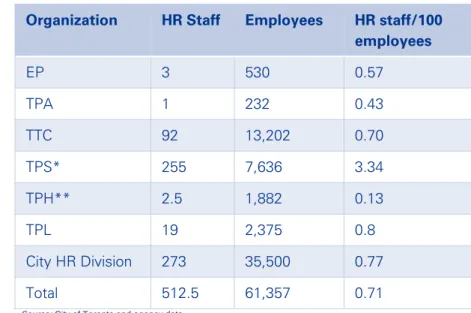
The City and every agency operate a Human Resource department to support, recruit, and develop their employees. While the names of HR functions vary across organizations, most provide a standard suite of services, including compensation and benefits, employment services, employee/labour relations, occupational health and safety, and learning and development. Specialized groups, such as HR information systems, internal investigations, critical incident reporting, among others, exist within larger organizations, warranted by either significant size of the entity or unique operational characteristics of an agency. Payroll and benefit administration functions typically are structured under Finance departments across agencies, and are thus considered outside of the HR realm. However, given strong dependencies between HR and Payroll, KPMG conducted a high-level assessment of opportunities related to payroll functions, with results presented in this report. HR staffing complement across agencies is presented in the table below. As is the case with many of the functions
analyzed in this study, the degree of
collaboration and coordination among agency and City HR practitioners is limited. A large number of workshop participants did not know one another, signaling that this study was the first opportunity for them to meet. Furthermore, no formal mechanisms currently exist to share knowledge, experience, and leading practices across the City and agencies. However, a small number of recent isolated collaborative initiatives were cited as examples of coordinated HR management practices, including
procurement of a common employee benefit service provider and adoption of some City HR policies (e.g., workplace violence policy) by agencies. Moreover, TPH, by virtue of its close working relationship with the City, appears to coordinate its HR activities with the City to a larger degree than other
Human Resources / Labour Relations
Organization HR Staff Employees HR staff/100
employees EP 3 530 0.57 TPA 1 232 0.43 TTC 92 13,202 0.70 TPS* 255 7,636 3.34 TPH** 2.5 1,882 0.13 TPL 19 2,375 0.8 City HR Division 273 35,500 0.77 Total 512.5 61,357 0.71
Source: City of Toronto and agency data
*TPS HR group consists of 102 civilian and 153 uniform members
*TPS HR figures include non-traditional HR roles, including staff in the Toronto Police College (112 staff), Uniformed Background Investigators (21 staff) and staff planning and development related to international Table 4 – Employee and HR Staff by Organization
EP 2% TPA 1% TTC 51% TPS 30% TPH 7% TPL 9% Agency Employees 0.00 0.50 1.00 1.50 2.00 2.50 3.00 3.50 4.00 EP T PA T T C T PS T PH TPL Ci ty HR Di v is io n A v er ag e H R S taf f P er 100 E m p lo y ees HR/Employee Ratio
© 2013 KPMG LLP, a Canadian limited liability partnership and a member firm of the KPMG network of independent member firms affiliated with KPMG International
Cooperative (“KPMG International”), a Swiss entity. All rights reserved. 34
Observations and Issues
Several observations were noted over the course of KPMG’s review of the HR function across the City and its agencies. Of all the functions in scope for this study, HR arguably has the greatest degree of commonality of activities and
processes, yet very little of it is seemingly harnessed across the City. Historically, the in-scope organizations’ HR functions developed as a collection of siloed departments, largely a reflection of the way these agencies are structured as independent organizations. The limited communication and coordination of activities that currently exist between the City and its Agencies by staff is fundamentally a result of how the City of Toronto was organized and how the
governance structures were set up at amalgamation. The separation of operations and the independent governance models for the Agencies has created largely independent and siloed operations.
As a result, few instances of collaboration among HR executives, or sharing of activities, resources, tools, methods, or technology were noted among the organizations. While individual agencies may or may not be operating their respective HR functions optimally (efficiency of each function was not part of this review), opportunities exist to increase
coordination and potentially reduce duplicative activities taking place when HR is viewed from a holistic City perspective.
For example, one such area of redundancy is generic training and development. The City and all of its agencies currently offer training opportunities to their employees in order to develop technical, management, and personal skills. While most of the training provided is specifically tailored to the needs of each organization and its people, a portion of the offered curriculum is generic in nature, including leadership skills, managerial competencies, behavioural traits, etc. Furthermore, some technical training is also widely applicable to many organizations, such as general computer use, Microsoft Office applications, trades, health and safety, and regulation/legislation related courses. Yet, most
organizations perform this training on their own, with no coordination with the City or each other.
Another identified area of opportunity is HR systems and tools. Agencies’ HR functions appear to utilize disparate information systems to enable and support their activities. Several systems currently exist, including employee records, recruitment management, learning management, virtual training, time and attendance, and payroll systems, each with its own license costs, maintenance costs, and upgrading/development costs.
Findings and Opportunities
Observations and Issues (cont.)
Illustrative of a lack of coordination is the Occupational Health and Safety (OHS) function. Under the Ontario
Occupational Health and Safety Act (OHSA), organizations such as the City and its agencies must carry out a range of legal obligations related to employee well-being in the workplace. This entails protection of workers, provision of relevant information and support, development and implementation of policies and procedures, and executing programs that fall under the Act. Apart from a few recent examples of policy coordination, most OHS activities are performed in isolation by individual organizations, thereby potentially hindering a unified, streamlined, and efficient approach to management and implementation of occupational health and safety.
Although Payroll and Benefits Administration technically falls under finance and not under HR in most organizations, KPMG through interviews and workshops, identified a number of instances of potential inefficiency and fragmentation of payroll and benefits processing. These include different Time and Attendance and Payroll systems, manual
processes, and varied payment arrangements. Performing duplicative payroll and benefit administration functions across multiple agencies could be costlier than operating them using a centralized or shared model.
KPMG has also noted a distinct capability and capacity gap related to Organizational Change Management across organizations. Given the degree of current and expected organizational change across a number of City divisions and agencies, insufficient and ineffective change management approaches undermine the success, adoption, and
acceptance of most transformational initiatives. Moreover, the implementation of shared service opportunities identified in this report could be detrimentally affected if change management capacity and support are lacking.
Finally, one of the most material issues identified in the HR function analysis is a lack of coordination and harmony in the realm of Labour Relations. Currently, there is very limited degree of interaction between the City’s Labour Relations group and their colleagues across agencies. Furthermore, the City does not have an overarching Labour Relations strategy that would aim to unify and direct the terms, conditions, and policies related to employment of City and agency staff, management, and executives. This notable gap has led to a widely divergent set of contracts and employment terms across the City and its agencies.
Six models for shared services were developed following the analysis of the current HR functions across the City and its agencies. They are listed on the following pages and largely reflect the issues identified as part of our review.
© 2013 KPMG LLP, a Canadian limited liability partnership and a member firm of the KPMG network of independent member firms affiliated with KPMG International
Cooperative (“KPMG International”), a Swiss entity. All rights reserved. 36
Cross Functional Opportunity: Collaboration
The most basic foundational element of shared services is improved collaboration, coordination, and information sharing. Given our observations on the limited interactions and professional relationships among functional colleagues across the City and agencies, we recommend establishing a formal mode of communication involving HR leads in participating organizations (Directors or Managers, as appropriate). This may take the form of an HR Working Group or a committee of HR representatives, with a mandate to share leading practices, discuss emerging issues and trends, identify
opportunities for joint activities, and seek operational efficiencies. While the initial cost savings associated with this recommendation may be negligible, the long-term benefits of a coordinated approach to HR management will likely be significant.
Recommended Operating Model 1: Training
To address the potential duplication and redundancy associated with generic training across the agencies, we recommend that this activity be provided as a shared service to the City and its agencies in the future. Curriculum development and training activities could be carried out through the HR Division of the City, expanding its current scope to involve various agencies. Where economically sensible, the City would utilize its own training and educational workforce, while retaining the ability to supplement its own capacity with generic training contractors. The new shared service generic learning function could reduce the need to plan, coordinate and execute training activities that are not unique to their respective organizations. Moreover, with an expanded scope, the City could better deploy and utilize its staff trainers and negotiate better pricing for external generic learning contractors.
Recommended Operating Model 2: HR Systems
With disparate, aging, and non-integrated HR systems deployed across City agencies, an opportunity exists to create common platforms for HR management and adopt modern tools and practices to support the HR function. Thus, we recommend that the City adopt a leadership role in standardizing HR information systems across agencies, incorporating their needs into the development and implementation of common platforms and applications. As the City’s own
systems come up for renewal or upgrade (e.g., the Time and Attendance system, which is currently up for renewal), the City’s HR and IT stakeholders could work closely with in-scope agencies to incorporate their requirements into a City-wide solution. A standardized set of HR information systems could allow for a common approach to HR management, eliminate the need to support several competing solutions in parallel, and potentially reduce IT operating costs for the participating organizations. It would also potentially enhance services to employees, as smaller agencies gain access to functionality they could not otherwise afford on their own.