Taking performance to a new peak
Data Sheet
4500B
RF Peak Power
Analyzer
4500B RF Peak Power Analyzer
The Boonton Model 4500B is the instrument of choice for capturing, displaying, analyzing and characterizing RF power in both the time and statistical domains. Applications include pulsed RF such as RADAR, TDMA and GSM, pseudorandom or noise-like signals such as CDMA and WLAN and modulated time slotted signals such as GSM-EDGE and TD-SCDMA.
The 4500B features 100 psec timebase resolution, video band-width up to 65 MHz (sensor dependent), flexible triggering and greater than 70 dB dynamic range (sensor dependent) without any range switching to cover the most demanding peak power measurement applications. The 4500B also features continu-ous statistical analysis of power (optional) at acquisition rates up to 25 MSa/s, a text display of up to 15 automatic measure-ments per channel as well as envelope and persistence views to provide fast in-depth signal analysis. Convenient I/O including USB ports for storing data such as instrument setups, trace waveforms and bitmap image files.
Features
• 8.4” TFT color LCD display
• Displays up to 4 measurement channels, 2 memory channels and 1 math channel simultaneously
• Automatic peak-to-peak, delay-by-time and delay-by-events triggering
• Statistical analysis including gated CCDF and PDF with linear or log presentation (optional)
• Text view of up to 15 time and power measurements per channel
• Envelope, persistence and roll mode displays • GPIB, USB and LAN
• Peak Power Sensors available with high video bandwidth, fast risetime, and wide dynamic range
High Bandwidth
Peak power meter with video bandwith up to 65 MHz and rise time less than 7 nsec (sen-sor dependent)
Efficient Design
Power factor corrected power supply and thermostatically controlled, dual-fan cooling system
Remote Control
GPIB with SCPI compliant com-mand set anvd legacy Support
Convenient I/O
Printer ports, external monitor, LAN and USB
Optional Inputs
Replace front panel inputs, optional trigger output
Dual Trigger System
Internal and external trigger with auto peak-to-peak and B trigger delay by time or events qualifier
Large Display
View multiple channels and measurements on the 8.4” color TFT display
Wide Dynamic Range
Peak power sensors are avail-able up to 40 GHz, some with 70 dB dynamic range
Powerful Automatic
Measurements
One button text key automati-cally displays up to 15 power and time measurements per channel
Superior Time Capture
View signals from 5 nsec/ div to 1 hr/div with 100 psec resolution
Intuitive User Interface
Easy to navigate, soft menu driven
Interactive Control
Most settings can be selected and updated interactively with instant visual feedback
Convenient I/O
Windows based connectivity such as USB for data storage directly to a flash drive
Fast Data Analysis
Statistical displays of PDF, CDF and CCDF including time-gated analysis (optional)
Precise Measurements
Markers and time gates allow for the analysis of specific por-tions of a waveform
Accurate
Auto-Calibration Precision
1 GHz RF step calibrator for superior linearity and absolute level accuracy
Clear Views
Persistence, envelope and roll mode displays aid visual analysis
Superior Time Capture
The Boonton 4500B features a large 8.4” diagonal TFT color LCD, 640 x 480 pixels, with CCFL backlight for a clear view of up to two live RF channels, two live trigger channels, two stored memory channels and one live math channel simultaneously.
The need to clearly view multiple channels can be invalu-able in many applications. The large color display in the 4500B is especially well suited for multiple channel applications. User selectable colors are used to distin-guish overlapping traces and to color correlate graphical channel data with its measurements. For example, if the color of the channel 1 is yellow, then the measurements calculated on channel 1 are also yellow. The traces and measurements are clearly marked and color correlated. The 4500B gives the user the flexibility to customize the display by allowing them to select the measurements or specific parametric settings and measurement indica-tors they wish to display. These measurements can be grouped to avoid clutter.
Figure 1: Analysis of CDMA Pulse Train with RF and Trigger Channels Updating Simultaneously
Figure 2: Qualify the Trigger on a Specific Event in CDMA pulse train
Unique Trigger System
The 4500B features a unique trigger qualifier that al-lows a user to qualify the trigger on a specific event or a specific delay time allowing a user-selected pulse to be captured, even when its timing is variable. Modern communications signals typically have long frames of data and it is often important to lock a peak power acquisition to a specific time slot or to a specific event within a group. The B trigger qualifier eliminates prob-lematic synchronization issues associated with time jitter within pulse bursts that are often found in UWB and RADAR applications. This qualifier may be set up to 999,999 events or up to 1 second.
Automatic Analysis
The 4500B provides power-versus-time waveform analysis of repetitive RF signals. Applications include TDMA and GSM, as well as RF amplifier linearity testing, RADAR, satcom, and avionics. The timebase extends to 5 nsec/div and the logarithmic power display will show more than 70 dB dynamic ranges at the same time. Peak power sensors are available that feature <7 nsec risetime (video bandwidth up to 65 MHz) and dynamic range of 70 dB (pulse mode) or 80 dB (modulated mode). These sensors have been optimized for use with the 4500B and are ideal for measuring RADAR or signals in 3G and future 4G wireless systems that use complex modulation such as OFDM.
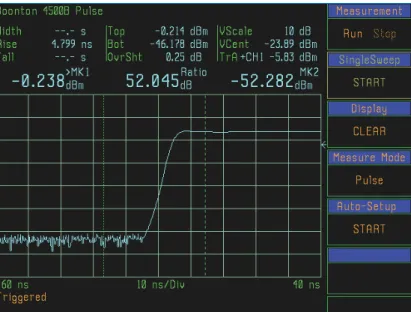
Two adjustable markers can read the power at any point across the waveform. In addition, the markers can be used to define the portion of the waveform in which the maximum power, minimum power, long term average power and peak to average ratios are measured. This is especially useful for characterizing the power level over a portion of the top of a pulse. An auto measure function measures and calculates 15 common power and timing parameters. All parameters for up to four active channels are summarized in a Text display and are also available as user defined display parameters above the Graph display.
Powerful Statistical Analysis
The 4500B features optional probability density func-tions (PDF) and cumulative distribution funcfunc-tions (CDF, CCDF) to accurately characterize noise-like RF such as CDMA, HDTV and WLAN. These statistical functions build and analyze a very large population of power samples continuously at a rate of up to 25 MHz or triggered up to 50 MHz on two channels simultaneously. These func-tions are fast, accurate and allow the measurement of very infrequent power peaks for a user-defined popula-tion size or acquisipopula-tion interval. Although the program-mable acquisition time can be very long or continuous, even short runs can resolve very low probabilities, due to the extremely high sample throughput.
Figure 3: Pulsed RF including width, rise time & fall time measurements
Sensor Inputs*
RF Frequency Range 1 MHz to 40 GHz Pulse Measurement Range -50 to +20 dBm Modulated Measurement Range -60 to +20 dBm Relative Offset Range ±100.00 dB Logarithmic Vertical Scale
0.1 to 50 dBm/div in 1-2-5 sequence 0.1 to 50 dBV/div in 1-2-5 sequence 0.1 to 50 dBmV/div in 1-2-5 sequence 0.1 to 50 dBuV/div in 1-2-5 sequence Linear Vertical Scale
1 nW/div to 50 MW/div in 1-2-5 sequence 1 mV/div to 50 kV/div in 1-2-5 sequence
Video Bandwidth 65 MHz
Rise Time <7 nsec
Single-Shot Bandwidth 5 MHz
(based on 10 samples per pulse) Pulse Repetition Rate 50 MHz max
Minimum Pulse Width 6 nsec
* Specifications sensor model dependent
Time Base
Time Base Range 5 nsec/div to 1 hr/div
Time Base Accuracy 0.01%
Time Base Resolution 100 psec
Time Base Display Sweeping or roll mode
Statistical X-Axis (optional)
Scale Linear or logarithmic,
1 to 7 cycles
Linear Ranges 0.1%/div to 10%/div
Linear Offset 0 to 99.9%, 0.1% resolution
Log Range 1e-9% to 100%
Calibration Source
Operating Modes CW, internal or external pulse
Frequency 1.024 GHz ± 0.01%
Level Range -50 to +20 dBm
Resolution 0.1 dB
Output VSWR 1.20 maximum
Absolute Accuracy ±0.065 dB (±1.5%) at 0 dBm Accuracy vs Level add ±0.03 dB per 5 dB increment
from 0 dBm Preset Internal Pulse Period 0.1 or 1 or 10 msec
Preset Internal Pulse Duty Cycle 10% to 90% in 10% increments Variable Pulse On Time 7 usec to 65.535 msec
in 1 usec steps
Variable Pulse Period 28 usec to 131.072 msec in 2 usec steps Off-time limits - within 7 usec to 65.535 msec
Pulse Polarity + or –
RF Connector Precision type N
External Pulse Input Rear panel BNC, TTL level compatible
Auto-Calibration
The calibrator is used to automatically generate linearity calibration data for peak power sensors.
Measurement System
Sensor Inputs One or two sensor measurement channels.
Measurement Technique
Random repetitive sampling system that provides pre and post trigger data as well as statistical histogram accumulation. Maximum Sampling Rate
50 Mega-samples/second on up to four channels simultaneously. (Equivalent effective sampling rate of 10 Giga-samples/second) Memory Depth 256K samples per channel at
max sampling rate Vertical Resolution 14-bit A/D Converter Waveform Averaging 1 to 16,384 samples per data
point (time domain measurement) Number of Histogram Bins 16,384
Size of Sample Bins 32-bits (4,000 mega-samples) Bin Power Resolution <0.02 dB
Statistical Acquisition (optional)
Modes Continuous or gated by pulse
mode time markers
Sampling Rate 25 Mega-samples/second on 2 channels simultaneously.
Limit Count Adjustable, 2–4096 Megasamples
Limit Time `3600 seconds (appr. 2.5 min. at full sample rate)
Terminal Action Stop, flush and restart or decimate performance
System Displays
Display Type
Power versus time (pulse mode), Power versus time (modulated mode), External trigger versus time (pulse mode), Auto-measure text (all modes), Help text (all modes), Reports (sensors, configuration, calibrator, files, stored waveforms, GPIB commands, GPIB buffers) Statistical Display Type (optional)
Cumulative Distribution Function (CDF), Complementary Cumulative Distribution Function (CCDF), Split screen, gated CCDF and power versus time (pulse mode,CCDF), Distribution function (histogram), External trigger statistical (statistical mode), Auto-measure text (statistical mode)
Trigger
Trigger Source
Channel 1 (internal), Channel 2 (internal, with optional channel 2) External trigger 1, External trigger 2 (with optional channel 2)
Trigger Slope + or –
Trigger Delay Range
Time base setting Delay range; pre trig(-), post trig(+) 5 nsec to 500 nsec -4 msec to +100 msec 1 usec to 10 msec ±4000 divisions 20 msec to 3600 sec -40 to +100 sec Trigger Delay Resolution 0.02 divisions Trigger Hold-off Range 0.0 – 1.0 sec Trigger Hold-off Resolution 10 nsec
Trigger Mode Normal, auto, auto peak-to-peak, free Run
B Trigger Mode A only, B by-time, B delay-by-events specs
B Trigger Source Chan 1, chan 2, ext trig 1, ext trig 2
B Trigger Slope + or –
B Trigger Events Counter Range 1 to 999,999 events B Trigger Time Delay Range 0.0 – 1.0 sec B Trigger Time Delay Resolution 10 nsec
Internal Trigger Level Range -40 to +20 dBm (sensor-dependent) External Trigger Level Range ±5 volts, ±50 volts
External Trigger Input 1M or 50 ohm, DC Coupled
Pulse and Modulated Mode Marker Measurements
Markers (Vertical Cursors) Settable in time relative to the trigger position
Marker Independently Power at specified time Pair of Marker:
Power at two specified times with ratio or average power between them. The minimum and maximum power between the markers and the ratio or average power between them. The average power, peak power (hold) and peak-to average power ratio between the markers. Lines (Horizontal Cursors) Settable in power
Automatic Tracking
Intersection of either marker and the waveform. Either marker and pulse distal, mesial or proximal levels.
Statistical Mode Marker Measurements (optional)
Markers (Vertical Cursors) Settable in percent (distribution functions) Each Marker Independently Power at specified percent Pair of Markers
Power ratio at two specified percents. Statistical analysis between markers (using triggered statistical mode)
Ref Lines (Horizontal Cursors) Settable in power Automatic Tracking
Set to track the intersection of either marker and the distribution function measure percent probability at a defined power level.
Pulse Mode Automatic Measurements
Pulse width Pulse rise-time
Pulse fall-time Pulse period
Pulse repetition frequency Pulse duty cycle
Pulse off-time Peak power
Pulse power Percent overshoot
Average power Top level power
Bottom level power Edge delay Pulse edge skew between channels
Statistical Mode Automatic Measurements (optional)
Peak power Average power
Minimum power Peak to average ratio Dynamic range Percent at reference lines Power at markers (absolute or normalized)
Total time (indicated)
Total number of samples (indicated)
Waveform Storage
Storage Locations
Waveforms & distribution functions can be saved to and recalled from internal storage locations and removable file-based memory devices.
External Interfaces
GPIB Programmable interface;
complies with SCPI ver. 1990 RS-232C Interface 1 Serial printer/plotter interface RS-232C Interface 2 Diagnostic interface
USB General purpose i/o interface
LPT1 Parallel printer/plotter
(Centronics type)
LAN (optional) Ethernet port.
Other Characteristics
Display 8.4” Diagonal TFT color LCD, 640
x 480 pixels, With CCFL Backlight. Main Computer Pentium based architecture
Hard Disk Internal EIDE 40 Gbytes
Acquisition Engine
32-bit Floating Point DSP in each installed channel CE Mark Compli-ance for use in the European Union
Operating Temperature: 0 to 50º C
Power Requirements 90 to 260 VAC, 47 to 63 Hz, 120W Dimensions (HWD) 19” rack-mountable;
7.0” x 17.5” x 19.5” (17.8 cm x 44.5 cm x 49.5 cm)
Ordering information
4500B RF Peak Power Analyzer, single channel, front panel inputs. -01 Dual channel, front panel inputs
-02 Single channel, rear panel inputs -03 Dual channel, rear panel inputs -06 Trigger outputs (rear panel only) -07 Calibrator, rear panel output
-10 Statistical package (includes gated CCDF and PDF) -11 LAN remote control
-15 Removeable flash drive (replacing HD) -30 Warranty extended to 3 years
97103101A Spare Removable Solid State Hard Drive with image (requires option -15) 57006 Peak power sensor*
59318 Peak power sensor* 59340 Peak power sensor*
* More sensors available
Wireless Telecom Group Inc.
25 Eastmans Rd Parsippany, NJ 07054 United States Tel: +1 973 386 9696 Fax: +1 973 386 9191 www.boonton.com © Copyright 2012 All rights reserved. B/4500B/0212/EN
Note: Specifications, terms and conditions are subject to change without prior notice.