Table of Contents
Introduction ... 3
Compliance at a Glance ... 3
I. Privacy and Security on the Seven Bridges Platform ... 4
The Seven Bridges Security Framework ... 4
Data Security ... 4
At Rest ... 5
In Transit ... 5
Authorization and Access Controls ... 6
Platform and Infrastructure Security ... 6
Additional Security Controls ... 7
II. A HIPAA Compliant Platform for All Clients ... 8
HIPAA Basics Part I: Who’s Covered and What’s Protected ... 8
Our Approach: Applying HIPAA Standards to All Genomic Data ... 9
HIPAA Basics Part II: The Rules and How the Seven Bridges Platform Enables Compliance ... 10
The Security Rule ... 10
The Privacy Rule ... 12
The Breach Notification Rule ... 13
III. Compliance with EU Data Protection Regulations Through the U.S.-EU Safe Harbor Program ... 13
The EU Data Protection Regime and U.S.-EU Safe Harbor ... 13
The Safe Harbor Privacy Principles and Seven Bridges ... 14
IV. Enabling Compliance With dbGaP Security Best Practices ... 16
What dbGaP Security Best Practices Are and Who They Apply To ... 16
dbGaP Security Compliance at a glance ... 17
Implementing dbGaP Security Best Practices Using the Seven Bridges Platform ... 18
Best Practices for Scientific Staff ... 18
Best Practices for IT Staff ... 18
Cloud Computing ... 19
V. CLIA and CAP Compliance ... 19
Introduction
This white paper describes how the Seven Bridges Platform enables our clients to be compliant with the regulatory frameworks that govern their work and how it keeps their data both private and secure.
We begin with an overview of the Seven Bridges approach to privacy and security along with a description of the protections built into the Seven Bridges Platform. It then describes how the Seven Bridges Platform enables our clients to stay compliant with standards relevant to performing Next Generation Sequencing in the cloud. In particular, we first
provide an overview of HIPAA regulations, which protect patient privacy in the
United States, as well as the EU Data Protection Directive and the U.S.-EU Safe Harbor program, which govern personal data collected from EU Member States and transmitted to the United States. We next discuss dbGaP Security Best
Practices, which lay out requirements that must be met by researchers making use of controlled-access data sets maintained by the NIH, before moving to a discussion of CLIA and CAP policies for researchers interested in clinical applications.
Compliance at a Glance
Standard Compliance on
Seven Bridges Platform
Relevant for... Brief Description
HIPAA regulations
✔
Healthcare plans, clearinghouses, and providers, and anyone processing patient data on their behalf
Comprehensive but high-level administrative and technical security standards; substantive rules governing use and disclosure of patient data EU Data Protection
Directive and U.S.-EU and U.S.-Swiss Safe Harbor
✔
Organizations based in or collecting personal data from the EU and
Switzerland
Substantive rules governing the ways in which personal data may be collected and used
dbGaP Security Best
Practices
✔
of controlled-access Researchers making usedbGaP data
Security standards aimed specifically at bioinformatics researchers, including best practices for working in the cloud CLIA and CAP
✔
Clinical labs Quality standards aimed at
ensuring consistent accuracy, reliability, and timeliness of laboratory testing
I. Privacy and Security on the Seven
Bridges Platform
The Seven Bridges Security Framework
At Seven Bridges, we believe that it’s our job to provide users with end-to-end security and control over their data and analysis so that they can focus on work rather than dealing with complex setups, compliance headaches, and security. To achieve this, we have designed a comprehensive security framework for processing genomic data in the cloud that covers three main areas:
1. Data Security: Ensuring that all sensitive data is kept safe during its full lifecycle. This includes data encryption and secure user authentication.
2. Platform and Infrastructure Security: Ensuring that the software platform and its
underlying infrastructure (server and network) support the secure architecture.
3. Security Controls: Ensuring security of the system by implementing administrative, technical, and other controls, while at the same time ensuring
compatibility with a broad range of trusted information security
frameworks and compliance requirements.
The following three sections present Seven Bridges’ take on each of these three areas and provide concrete
implementation examples from the Seven Bridges cloud platform. Since the Seven Bridges Platform is built on Amazon Web Services (AWS), we use AWS terminology for the remainder of this paper, such as “S3” to denote storage buckets and “EC2” to denote computation instances. Please refer to http://aws.amazon.com/ for details.
Data Security
The key security consideration for data of any kind is whether it is safely contained and isolated. Only an
authorized user should be able to access or copy it. This not only means that data needs to be encrypted at all times, but also that tight controls need to be
implemented around authentication and encryption key storage. In addition, certain laws and regulations specifically require control over data locality (where, geographically, data can be stored and transferred).
A phrase that is often heard in regard to encrypting genomic data is that it must be “encrypted during transfer and at rest.” While encryption during transfer is fairly straightforward from
implementation standpoint (the scheme used by Seven Bridges on AWS is outlined below), encryption “at rest” is not
uniquely defined. Using a cloud environment such as AWS, there are actually two different types of “at rest” storage: cloud storage on S3, and ephemeral storage used by the EC2 computation instances.
At Rest
The Seven Bridges Platform implements both types of “at rest” encryption. Data is by default uploaded only to encrypted S3 objects leveraging S3 server-side encryption. During
computation, all disk volumes used for ephemeral storage are encrypted using an industry standard AES-256 cipher. The Platform can also support integration with various methods of encryption key management for volume
encryption/decryption, depending on what level of security and privacy is needed.
In Transit
Regarding data transfers, all user data is transferred exclusively through
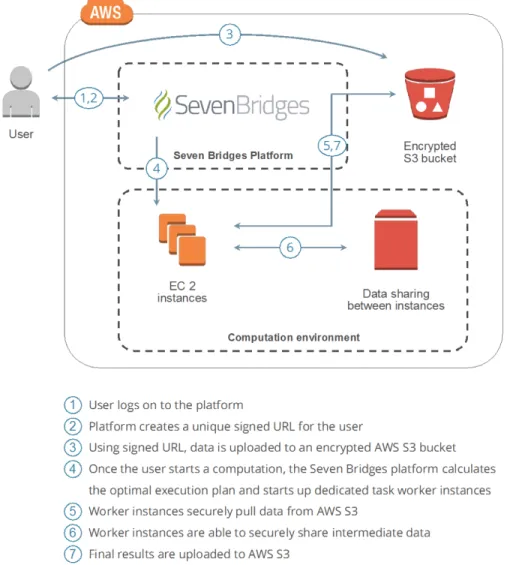
encrypted TLS/SSL channels throughout for all data flows shown in Figure 1.
Figure 1: Overview of data flow on the Seven Bridges Platform
At the end of the data lifecycle, a strict data purging policy ensures that all data is safely deleted if it is no longer needed on the ephemeral storage or when an authorized user chooses to delete data on the platform.
Authorization and Access Controls
While encryption and the safe purging of ephemeral data are key to protect it in the cloud, they are only effective with appropriate authorization and access controls. Access controls on the Seven Bridges Platform have been implemented in a very fine-grained manner. Rather than establishing principal “file owners,” access permissions are set on a per-user-per-project basis, meaning that a user’s access permissions to a given file can depend on the context (project) in which this file is being used. This includes sharing of data, which can only be performed via the platform itself unless users have the explicitly granted
permissions to download a file. Seven Bridges retains audit logs for all data access for six years to ensure regulatory compliance (as required by HIPAA).
By default, users authenticate on the platform through a username and password. However, the Seven Bridges Platform can support more strict data access control and integration of external key management.
Platform and Infrastructure Security
Running the Seven Bridges Platform on AWS allows us to take advantage of the broad spectrum of built-in complianceand features provided by AWS in the underlying infrastructure security (see http://aws.amazon.com/compliance/ and http://aws.amazon.com/security/). These features include physical datacenter security and network infrastructure security to secure media handling and data encryption. Naturally, compliance of the cloud provider does not imply
compliance of the overall platform and ecosystem, but it is a solid foundation on which to build. In addition, Seven Bridges secures its infrastructure in a number of ways:
1. All AWS computation instances run within Virtual Private Clouds (VPC). VPCs are logically isolated networks within the AWS cloud and kept only minimally open for the necessary external and internal access.
2. There is no multi-tenancy of physical resources: all
computations are performed on dedicated instances and no instances from other AWS clients run on the same hypervisor. 3. Users can choose to isolate all
computation resources through an “Instance Lockdown” mode that disables any access during the computation, even by platform admin staff
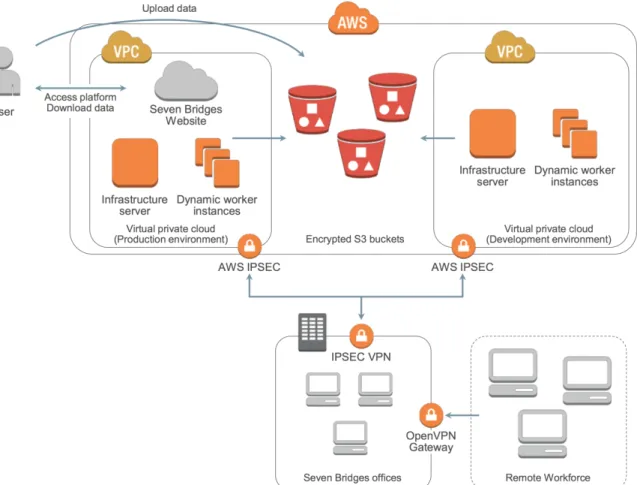
Access to the production and
development environments are secured through Virtual Private Networks as shown in Figure 2.
Figure 2: Overview of network security on the Seven Bridges Platform
In addition to building on a secure foundation, we also constantly monitor and improve the Seven Bridges Platform by following best-practices (including SANS Top-20) of infrastructure stability and security, such as:
1. Monthly software and infrastructure vulnerability assessments to discover vulnerabilities and remediate them.
2. Regular penetration tests to discover vulnerabilities in the system which may not be noticed in a regular vulnerability
assessment.
3. Regular audit log analysis and
system-level inspection to look for suspicious behavior, potential attacks, and security breaches. 4. A strict patch-management policy
and regular server updates (depending on criticality, the response/fix time is between a few hours and one week), and
restriction of access for technical staff to resources on a per-need basis.
Additional Security Controls
As in any IT framework, security of the system must also be ensured by
implementing administrative, technical, and other controls. These controls cover
all areas of information security, namely access control, security awareness and training, auditing and accountability, security authorizations, configuration management, contingency planning, authentication, incident response, dealing with equipment maintenance, secure media handling, physical and
environmental security, risk management and security planning, personnel security, systems and network security, dealing with supply chain security, and system and information integrity. Seven Bridges maintains an extensive set of
documented policies and procedures about these controls, available upon request.
II. A HIPAA Compliant Platform for All
Clients
The Seven Bridges Platform is designed to support our clients strict compliance with HIPAA.
The privacy rights of patients in the United States are protected by
regulations issued by the Department of Health and Human Services (“HHS”) implementing the Health Insurance Portability and Accountability Act (“HIPAA”), including the HIPAA Privacy Rule, the HIPAA Security Rule, and the HIPAA Breach Notification Rule. The HIPAA regulations can be found at 45 C.F.R. Parts 160, 162 and 164; the combined text is available online at http://www.hhs.gov/ocr/privacy/hipaa/ad
ministrative/combined/hipaa-simplification-201303.pdf.
At Seven Bridges we designed our Platform to meet the requirements set by the HIPAA regulations both in order to ensure compliance with regulatory obligations and more generally to ensure the Platform adheres to the highest standards of privacy and security protection. Our compliance with HIPAA regulations and policies has been independently assessed by Coalfire Systems, a leading, independent IT audit and compliance firm.
HIPAA Basics Part I: Who’s Covered and
What’s Protected
The bulk of the HIPAA regulations apply to Covered Entities, which include health insurance plans, healthcare
clearinghouses, and healthcare providers which electronically transmit patient information meeting certain standards. A subset of the regulations also apply to Business Associates, which are entities that provide services to Covered Entities or other Business Associates that involve use or disclosure of patient information protected by the regulations. 45 C.F.R. §160.103. When providing services to entities regulated by HIPAA, whether they be Covered Entities or Business
Associates, Seven Bridges plays the role of a Business Associate.
The HIPAA regulations are designed to protect “Protected Health Information” in the possession of Covered Entities or their Business Associates. Protected Health Information is information that meets two criteria:
● The information relates to the individual’s past, present, or future physical or mental health or
condition, the provision of health care to the individual, or the past, present, or future payment for the provision of health care to the individual.
● The information identifies the
individual or for which there is a reasonable basis to believe can be used to identify the individual
Protected Health Information also includes individual identifiers such as a name or Social Security number when they can be connected to the health information defined above. The HIPAA Privacy Rule also describes methods by which information can be de-identified, bringing it outside the ambit of the regulations. §164.514(a)-(b).
It’s worth noting that even if an
individual or organization is collecting and using information of a sort that would qualify as Protected Health Information, HIPAA regulations do not directly apply to that individual or organization unless they meet the criteria for Covered Entities or Business Associates. In particular, data collected for research purposes, even if personally identifiable, is not directly regulated by HIPAA. However HIPAA regulations may still have implications for researchers, for instance if their data includes personally identifiable
information and is sourced from Covered Entities or Business Associates, or if they are affiliated with regulated entities.
Our Approach: Applying HIPAA Standards to
All Genomic Data
At Seven Bridges, we havedesigned our Platform to go beyond the
requirements of the HIPAA regulations in
two important ways.
First, we treat all of our clients as if they were entities regulated by HIPAA, providing the same technical protections for their data and abiding by the same stringent policies and procedures. We do this because many clients outside the HIPAA-regulated space find that HIPAA sets a rigorous standard for the sorts of privacy and security protections they need. HIPAA’s scope can also sometimes be ambiguous, and some clients may not be sure whether they or their activities are regulated or not. This means that HIPAA Covered Entities or their Business Associates do not need to pay extra for the protections they need, and our other clients get the gold standard for privacy and security protection. (Clients who know they are regulated by HIPAA should still inform us of this in order to ensure a proper Business Associate Agreement is put in place.)
Second, we also treat all client genomic data as Protected Health Information, even if there is no
information included tying that data to a particular individual. We do this because while HHS may not yet treat genomic data as inherently personally-identifiable, we understand that our field is fast
approaching the point at which a genome or a subset of it will be able to be reliably linked to a particular individual by third
their data subjects from future developments which may render
previously-unidentifiable data identifiable, we have decided to treat all genomic data as identifiable from the get-go, providing all the protections associated with
Protected Health Information.
HIPAA Basics Part II: The Rules and How the
Seven Bridges Platform Enables Compliance
As noted above, the HIPAA regulations are divided into three main Rules,
covering Security, Privacy, and Breach Notification. The Seven Bridges Platform makes it easy to perform NGS analysis in compliance with these rules.
The Security Rule
The Security Rule at a Glance
Requirement CFR cite Compliance on the Seven Bridges Platform
Administrative
Safeguards 45 CFR §164.308 Seven Bridges has extensive policies and procedures covering all required administrative
safeguards, from risk assessment to staff training. Clearance, authorization, and training of client staff is the responsibility of the client, but Seven Bridges can recommend resources if needed.
Physical Safeguards 45 CFR §164.310 Datacenter security is handled by AWS, in a
compliant fashion. Seven Bridges policies and procedures implement required safeguards for our offices and workstations.
Technical Safeguards 45 CFR §164.312 All required safeguards are implemented on Seven
Bridges Platform, including access controls, audit logging, integrity checks, user authentication and secure transfer of data.
Organizational
Requirements 45 CFR §164.314 A Business Associate Agreement (BAA) is in place between Seven Bridges and AWS; Client-Seven
Bridges BAAs are available. Documentation and
Retention Requirements
45 CFR §164.316 All required policies and procedures are
documented and all required documentation is retained for the required minimum of 6 years.
The Security Rule lays out
requirements designed to ensure the security of patient data. It is split into three main substantive sections,
Administrative Safeguards, Physical Safeguards, and Technical Safeguards, alongside sections on organizational and documentation requirements.
The first section lays out required administrative policies and procedures. The most important of these is the requirement that a risk management system be implemented for identifying risks to data security and selecting and implementing controls to address those risks. §164.308(a)(1). Seven Bridges has a comprehensive risk management program based on the guidelines laid out in NIST Special Publication 800-30.
Other requirements cover implementation of policies and procedures for authorizing access to Protected Health Information,
implementation of incident response procedures and contingency plans, and various workforce policies such as required security awareness training, sanctions for privacy and security violations, and policies governing
clearance, supervision, and termination of staff members. §164.308(a)(2)-(8). Seven Bridges has internal policies and
procedures governing all of these
subjects, and the access control features of the Seven Bridges Platform make it easy for users to implement their own policies for access authorization and control.
Finally, the administrative safeguards section includes the requirement that Covered Entities put in place agreements requiring their Business Associates to comply with the relevant portions of the HIPAA regulations (“Business Associate Agreements” or “BAAs”). Business
Associates in turn must secure BAAs with
any third parties that provide services to the Business Associate involving use or disclosure of Protected Health
Information. §164.308(b)(1); See also §164.314(a). Seven Bridges has entered into a Business Associate Agreement with Amazon Web Services, our provider of cloud-based compute and storage, and stands ready to itself enter into such agreements with any interested clients covered by HIPAA regulations.
The second section lays out required physical security safeguards. §164.310. Since the Seven Bridges Platform is built on Amazon Web Services, we mostly rely on the state-of-the-art, more-than-HIPAA-compliant physical security protections at Amazon’s data centers
to secure our clients’ data. However Seven Bridges has also implemented policies and procedures governing physical access to our offices and
workstations, and has defined policies for dealing with data stored on portable media when such storage is required by clients for the transfer of data.
The final substantive section of the Security Rule lays out required technical safeguards, including access controls, audit logging, integrity checks, user authentication and secure transfer of data. §164.312. All of these safeguards are integrated in the Seven Bridges Platform by design. § 164.500-530.
The Privacy Rule
The Privacy Rule at a Glance
Requirement CFR cite Compliance on the Seven Bridges
Platform Rules Regarding Use
and Disclosure of PHI
45 CFR §164.502-514 Use and disclosure of PHI by Seven Bridges
staff complies with rules for Business Associates. Fine-grained access controls make it easy for clients to control use and disclosure by their own staff.
Notices of Privacy Practices
45 CFR §164.520 This is the responsibility of the Covered
Entity. Right to Request
Restrictions on PHI 45 CFR §164.522 This is the responsibility of the Covered Entity. However access controls available on
the Platform make it easy to implement requested restrictions.
Right to Access and
Amend PHI 45 CFR §164.524-26 Not Applicable - Seven Bridges Platform does not store Designated Record Sets.
Right to Accounting of Disclosures
45 CFR §164.528 Facilitated by the logging features of the
Seven Bridges Platform.
The Privacy Rule lays out in detail the ways in which Protected Health
Information may be used or disclosed. Business Associates such as Seven Bridges may only use or disclose protected health information as permitted or required by its Business Associate Agreement or as required by law. The Privacy Rule also governs notices of privacy practices and the rights of patients to access their Protected Health Information, request that it be amended, and request an accounting of disclosures. §164.500-530.
Because Seven Bridges does not have any relationship with (or, typically, any information about) patients, and all
access to, use of, and disclosure of client genomic data on the Seven Bridges Platform is at the direction of the user, compliance with the Privacy Rule is largely the responsibility of the client. However
Seven Bridges has internal policies and procedures in place to ensure client genomic data is only accessed by authorized staff members at the direction of clients or for the purpose of supporting client projects. The detailed logs kept automatically by the Seven Bridges Platform can also aid clients in responding to requests for an accounting of disclosures. All logs and other required documentation are maintained for the required minimum of six (6) years. See §164.316.
The Breach Notification Rule
Breach Notification Rule at a Glance
Requirement CFR cite Compliance on the Seven Bridges Platform
Notification by Business Associate
45 CFR §164.410 Seven Bridges has policies and procedures
providing for investigation of breaches and required notification of clients
Notification to
Individuals, the Media and HHS
45 CFR §164.400-408 This is the responsibility of the Covered
Entity.
The final Rule is the most narrow, dealing specifically with notifying patients of security breaches involving their
Protected Health Information. §164.400-414. Seven Bridges has a
comprehensive policy for investigation of potential security breaches and notification of affected clients. The policy requires all investigations to be documented in writing and all
documentation to be retained for a minimum of six (6) years. All members of the Seven Bridges staff are trained on the policy.
Because Seven Bridges will not have a relationship with individual data subjects and frequently will not even have
information regarding their identities, in most instances further notifications including ultimate notification of patients will be up to the client. See §164.410.
If you’re interested in learning more about HIPAA compliance on the Seven Bridges Platform, we encourage you to contact any member of our sales team or
directly at [email protected]. We would be happy to provide our
documented policies and procedures as well as a detailed breakdown of how we meet individual HIPAA requirements to clients or potential clients upon request.
III. Compliance with EU Data Protection
Regulations Through the U.S.-‐EU Safe
Harbor Program
The EU Data Protection Regime and U.S.-‐EU
Safe Harbor
While the United States prefers to protect privacy rights through industry-specific rules such as HIPAA, the
European Union has taken a more comprehensive approach to the
protection of personal data. In order to ensure our EU-based clients can use our platform in full compliance with EU data protection regulations, Seven Bridges has joined the U.S.-EU Safe Harbor
commitments to abide by Privacy Principles derived from EU law and cooperate with an independent third party (the Better Business Bureau) to resolve privacy-related disputes.
The foundation of the European data protection regime is the European Commission’s Data Protection Directive (officially “Directive 95/46/EC on the protection of individuals with regard to the processing of personal data and on the free movement of such data”), which lays out a detailed set of privacy rules implemented via national legislation in each EU Member State. Among these is the requirement that personal data collected from the EU can only be transferred outside the EU to countries that provide “adequate” legal protection for personal data.
In order to ensure that data
transferred to America is “adequately” protected despite the United States’ different approach to privacy regulation, the United States Department of
Commerce worked with the European Commission to develop the U.S.-EU Safe Harbor Framework. The Safe Harbor Framework allows American companies to commit to abide by seven Safe Harbor Privacy Principles, which broadly mirror the requirements of the Data Protection Directive. These commitments are legally binding and enforceable by regulatory agencies such as the Federal Trade Commission. You can learn more about the Safe Harbor program at
http://www.export.gov/safeharbor/eu/eg_ main_018365.asp.
Along with our participation in the U.S.-EU Safe Harbor program, we also participate in the U.S.-Swiss Safe Harbor program, a closely-related framework which allows for export of personal data from Switzerland to the United States.
You can verify our participation the U.S.-EU and U.S.-Swiss Safe Harbor programs through the Department of Commerce’s online registry of Safe Harbor participants available at
https://safeharbor.export.gov/list.aspx.
The Safe Harbor Privacy Principles and
Seven Bridges
At Seven Bridges, we believe the Privacy Principles represent a common sense approach to responsible
stewardship of personal data and we take our commitment to abide by them quite seriously. We comply with each of the Principles in the following ways:
● Notice: The Notice principle
requires notice of what personal data we collect and how we use it. We provide notice to our users via our Privacy Policy, available at www.sbgenomics.com/privacy .
● Choice: The Choice principle
requires us to allow data subjects to opt out of use or transfer of their data that is inconsistent with the purpose for which it was collected. We comply with this principle by providing users with fine-grained controls on how their data is shared with other users and by only using user information
to provide and improve our service.
● Onward Transfer: The Onward Transfer principle requires us to abide by the Notice and Choice principles when transferring personal data to third parties, and to ensure these third parties themselves have adequate privacy protections. We comply with this principle by only providing data to third parties for the purpose of providing and improving our service, by noting in our Privacy Policy when data may be provided to third parties, and by vetting third parties’ privacy and security protections before entrusting them with data.
● Security: The Security principle requires us to implement procedures and technical
protections to ensure data is kept secure. We comply with this principle through the measures described in this white paper and the Seven Bridges Security white paper available from
http://www.sbgenomics.com/.
● Data Integrity: The Data Integrity
principle requires us to ensure that the data we keep is relevant, accurate, current, and generally adequate to the purposes for which it was collected. We comply with this principle by keeping the data we collect on users to the minimum necessary to provide and improve our service.
● Access: This principle requires us to provide data subjects with
reasonable access to personal data we have collected. In our Privacy Policy, we describe how users can access the data they have submitted to us. Access requests for other data we may have collected (for instance, via the sales process) or requests for access by non-user data subjects may be directed to
● Enforcement: While the Safe Harbor Framework encourages data subjects to resolve disputes directly with participating
companies, it recognizes that sometimes a third party needs to step in. This principle requires us to arrange for such a third party to provide an independent dispute resolution mechanism for privacy complaints. To meet this
requirement we have turned to the Better Business Bureau’s Safe Harbor Dispute Resolution
Program, which you can learn more about at
http://www.bbb.org/council/eusafe
IV. Enabling Compliance With dbGaP
Security Best Practices
What dbGaP Security Best Practices Are and
Who They Apply To
The dbGaP Security Best Practices are a set of requirements that must be met by researchers who use the “controlled-access” tier of datasets included in the database of Genotypes and Phenotypes (dbGaP).
Researchers wishing to analyze controlled-access human genomic and phenotypic data in NIH-designated repositories governed by the NIH Genomic Data Sharing Policy (such as TCGA) are required to enter into Data Use Certification (DUC) Agreements with the NIH setting out the conditions under which they are allowed to access, store, and use the data in these databases. These conditions include adhering to a security plan that meets the requirements of the Security Best Practices, which set out general requirements for securely working with sensitive genetic data. The latest update to the Security Best
Practices, published in March 2015, also specifically addresses security concerns particular to working in the cloud.
The dbGaP Security Best Practices are available at:
http://www.ncbi.nlm.nih.gov/projects/gap /pdf/dbgap_2b_security_procedures.pdf.
Before using the Seven Bridges Platform to store or analyze controlled-access data, researchers should update their Data Access Request to specifically indicate the use of the Seven Bridges Platform as a cloud computing service. While the institution retains ultimate responsibility for the information security in cloud environments, the
implementation of this security is shared between Seven Bridges Genomics and the institution. The following information is meant to provide guidance for how the Seven Bridges Platform can facilitate secure and compliant use of
dbGaP Security Compliance at a glance
General Information Security
Guidelines The Seven Bridges Platform provides data isolation, complete access control, and user authentication. Physical Security Guidelines Storing data on the cloud with the Seven Bridges Platform
obviates the need for portable media or building facilities with restricted physical access.
Controls for Servers The Seven Bridges Platform is deployed within AWS Virtual Private Clouds and access to physical data centers is controlled by AWS’s state-of-the-art security measures. The platform allows tight control of data access throughout the data analysis life cycle and the principle of Least Privilege is enforced by default.
Source Data and Control of
Copies of Data The Seven Bridges Platform provides a robust provenance and logging system to manage not only the original files, but also any files resulting from computational analysis.
Destruction of Data A strict data purging policy ensures that all data used transiently during computation (for example on EC2 instances) is immediately deleted following its use. Data stored on S3, including original files and those resulting from computational analysis can be easily and fully destroyed by authorized users when these files are no longer needed. General Cloud Computing
Guidelines All data in the Seven Bridges Platform is encrypted both during transfer and at rest. Inbound access is restricted using Virtual Private Clouds which are configured with the minimum ports necessary for each application. Regular vulnerability scanning and penetration tests ensure that the system is always protected against even emergent threats. Audit and Accountability The Seven Bridges Platform provides fine-grained access
control and allows investigators to set and continually monitor user permissions.
Image Specific Security Seven Bridges Genomics manages server provisioning and management by using the infrastructure-as-code approach and modern configuration management tools, so any server can be rebuilt in a couple of minutes according to a certain policy. This policy handles secure base configuration of servers, regular patches and controlled change management.
Implementing dbGaP Security Best Practices
Using the Seven Bridges Platform
The Seven Bridges Platform allows for easy compliance with all relevant dbGaP standards.
The Best Practices document provides guidance for individuals in the following roles: scientific staff making use of the data, and IT staff setting up the necessary computing infrastructure. Each section also contains a subsection on using cloud computing resources like the Seven Bridges Platform. The Seven Bridges Platform meets or exceeds all the standards for working with controlled data in cloud-based environments.
Best Practices for Scientific Staff
The section of Best Practices directed at scientific staff emphasizes the
importance of establishing a formal security plan to control access to and use of data. While the Best Practices rightly emphasize that setting up a security plan is the responsibility of researchers and their institutions, the Seven Bridges Platform has a number of features which actively guide users toward creating a compliant security plan.
The Best Practices emphasize that security should be “on by default”, and be built on a strong foundation of access controls and accountability. On the Seven Bridges Platform, both are the case.
A user’s data is private by default, and fine-grained access controls allow users to grant their collaborators the minimum
permissions necessary for their roles. Individual users are required to set up their own strong passwords and all activities are logged, allowing for
accountability. Storing your data on the Seven Bridges Platform also makes it easy to avoid the use of portable media, which the Best Practices discourage, and delete
all the data as required at the end of your project.
Best Practices for IT Staff
The section of the Best Practices directed at IT staff contains more detailed recommendations for technical security controls. The Seven Bridges Platform supports all of the recommended controls.
While most are Platform defaults -- IT staff get them “automatically” -- the rest are easily enabled on an as-needed basis.
The first set of recommendations for IT staff consist of general guidelines. The Best Practices require that data not be posted publicly or available on the web, that external access to cloud instances and storage be restricted, and that software patches be up to date, all of which is handled automatically by the Seven Bridges Platform. Seven Bridges also makes it easy to set strong
passwords.
The next set of recommendations deal with physical security and controls for servers, and again, Seven Bridges meets them all. On the Platform, your data is stored and processed in AWS data centers with state-of-the-art physical security protections. The required server
controls are implemented by Seven Bridges, including enforcement of the principle of Least Privilege on the process level, use of VPN for remote access to the production environment, and retention of data access controls throughout
processing. Fine-grained access controls on the Seven Bridges Platform allow researchers to implement the principle of Least Privilege on the individual user level, restrict downloading of data and provide “view only” access as needed.
The final sets of recommendations deal with logging and destruction of data. The Seven Bridges Platform automatically logs all user activity, making it easy to keep track of copies of data and what is done with it. All logs are stored for a minimum of six years. It also makes it easy to delete data, with all data automatically purged from all systems and backup copies destroyed within a week.
Cloud Computing
As the advantage of cloud computing for bioinformatics is now clear, the March 2015 version of the Best Practices for the first time included requirements and recommendations specific to users of cloud computing environments.
As with the general requirements, on the Seven Bridges Platform everything needed for complete compliance is already implemented for you, or ready to be enabled. All data transfer to and from the Platform is conducted over HTTPS exclusively. Inbound access to
computational instances is restricted using Virtual Private Clouds, the security
allow access only to the minimum set of ports required to provide necessary functionality for your services,
administrative access is restricted to the minimum set of ports and source IP address ranges necessary, and the image specific security requirements are all met.
The user-and-project-specific access control features and extensive logging performed by the Seven Bridges Platform also make it easy to review Access Control Lists and logs of individual user activity. While the Seven Bridges Platform allows researchers to readily comply with dbGaP security policies, users retain ultimate control and responsibility for access to their projects and data.
V. CLIA and CAP Compliance
Laboratory testing performed on specimens from humans for the purpose of diagnosis, prevention, or treatment of disease or assessment of health is governed by regulations issued by the Centers for Medicare & Medicaid Services under the authority of the Clinical
Laboratory Improvement Amendments of 1988, as amended (“CLIA Regulations”).
The CLIA regulations establish quality standards for all laboratory testing to ensure the accuracy, reliability and timeliness of patient test results regardless of where the test was performed. They include quality standards for proficiency testing (PT), patient test management, quality control,
personnel qualifications and quality assurance.
While CLIA regulations set the
baseline standard for clinical labs, many clinical labs instead choose to have their practices evaluated under more rigorous standards set by the College of American Pathologists (“CAP”), considered the gold standard for clinical laboratory practices. From a regulatory perspective, because CAP standards have been recognized as going above and beyond what is required by CLIA regulations, accreditation by CAP is formally “deemed” by CMS to certify compliance with CLIA regulations as well.
At Seven Bridges we have experience working with clients to ensure compliance with CAP and CLIA standards and are happy to assist labs in setting up compliant policies and procedures.