Report # I733-041R-2007 Date: 10/03/2007
Firewall Design Considerations for IPv6
Enterprise Applications Division
of the
Systems and Network Analysis Center (SNAC)
Information Assurance Directorate
National Security Agency
Attn: I733
9800 Savage Rd. Suite 6704
Ft. Meade, MD 20755-6704
(410) 854-6191
Author
Casimir A. Potyraj, I733 (410) 854-5723
Table of Contents
Table of Contents ... iii
Table of Figures... iv
1 Introduction ... 1
2 IPv4 and IPv6 Packet Header Comparison... 1
2.1 Improving Packet Processing Performance ... 1
2.2 Impacts of IPv6 on the Firewall... 2
2.3 Striking Back with Firewall Design Consensus... 3
3 Firewall Filtering of IPv6 Headers ... 4
3.1 IPv6 Main Header Fields ... 5
3.1.1 Version ... 5 3.1.2 Traffic Class ... 5 3.1.3 Flow Label... 5 3.1.4 Payload Length ... 5 3.1.5 Next Header... 6 3.1.6 Hop Limit ... 7
3.1.7 Source and Destination Address ... 7
3.2 Option Types ... 8
3.2.1 Pad 1 and Pad N Options ... 9
3.2.2 Endpoint Identification Option ... 9
3.3 Hop by Hop Options Extension Header ... 9
3.3.1 Jumbo Payload Option... 10
3.3.2 Router Alert Option ... 10
3.3.3 Invalid Options for the Hop-by-Hop Options Extension Header... 10
3.4 Destination Options Header... 11
3.4.1 Tunnel Encapsulation Limit Option ... 11
3.4.2 Home Address Option ... 12
3.4.3 Network Service Access Point (NSAP) Address Option... 13
3.4.4 Invalid Options for the Destination Options Extension Header... 13
3.5 Routing Headers ... 13
3.5.1 Type 0 (Source Routing) ... 13
3.5.2 Type 1 (Nimrod routing) ... 15
3.5.3 Type 2 (Mobile IP) ... 15
3.6 Fragmentation Header ... 15
3.6.1 Fragmentation Security Issues ... 16
3.6.2 Two Firewall Design Approaches to Fragmentation Handling ... 18
3.6.3 Recommendations for Firewalls that Reassemble ... 19
3.6.4 Recommendations for Firewalls that do NOT Reassemble ... 20
3.7 Mobility Header... 27
3.8 ESP and AH... 28
3.9 Header Ordering and Duplicate Extension Headers ... 28
3.9.1 IPv6 Header Ordering Algorithm ... 28
3.9.2 Implications of the Header Ordering Algorithm... 32
4 IPv6 Upper Layer Protocol Processing... 33
4.1.1 UDP and TCP ... 33
4.1.2 ICMP ... 33
5 Firewalls during IPv4-to-IPv6 Transition... 34
5.1 Types of IPv4-IPv6 Transition Traffic ... 34
5.2 Filtering Tunneled Traffic ... 35
5.2.1 IP-in-IP Tunnel Threats ... 35
5.2.2 IP-in-IP Tunnel Filtering Solutions ... 36
5.2.3 Other Security Checks for Tunnels... 39
5.2.5 Other Types of Tunnels ... 39
6 IPv6 Firewalls and IPsec ... 40
6.1 The Filtering vs. Communications Security (COMSEC) Strategies... 40
6.2 Handling IPsec at the Firewall... 40
6.3 IPsec and Firewall Combinations ... 41
7 In Summary ... 43
8 Reference Documents... 44
Endnotes ... 44
Table of Figures
Figure 3-1: Double Benefit of Filtering Source Addresses ... 8Figure 3-2: Type 0 Routing Header Threat... 14
Figure 3-3: IPv6 Packet Fragment ... 21
Figure 3-4: Fragment Offset Value ... 22
Figure 3-5: Design Recommendation, EVAL_SIZE ... 23
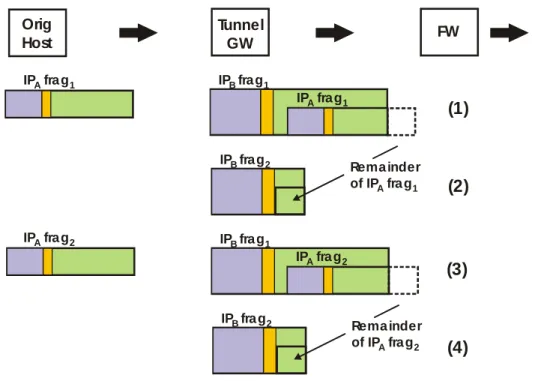
Figure 3-6: Worse Case Fragmentation-Tunneling Illustrated... 25
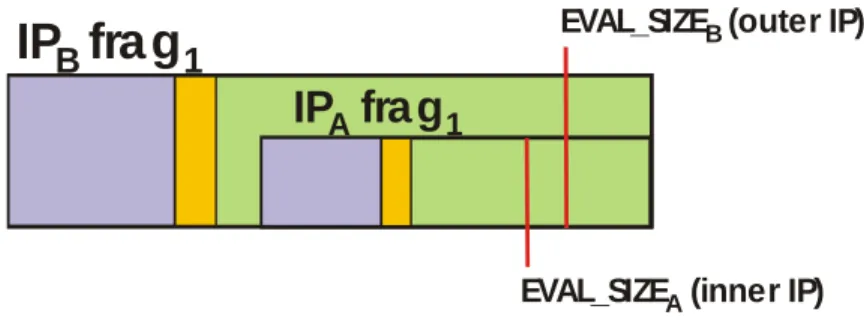
Figure 3-7: Fragmentation Checks for two layers of IP ... 26
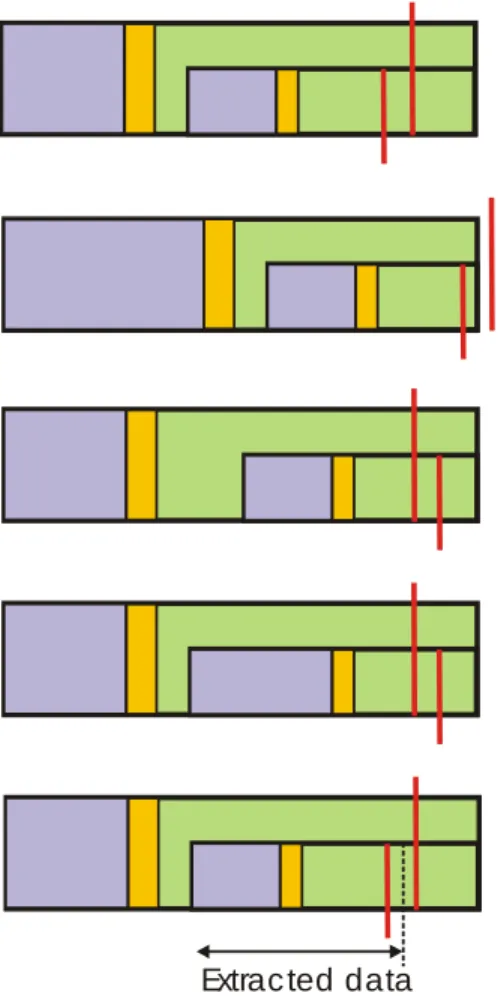
Figure 3-8: Tunnel-Fragmentation, Exceptional cases... 27
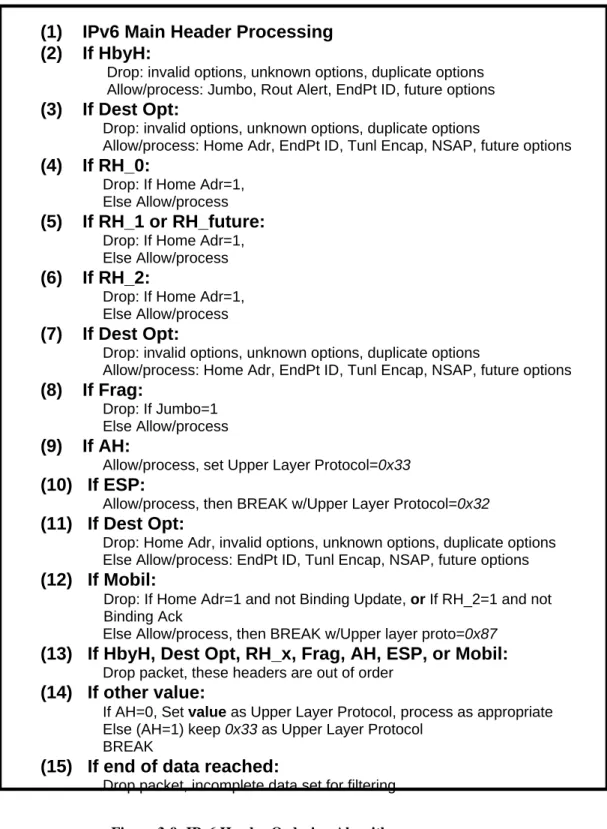
Figure 3-9: IPv6 Header Ordering Algorithm ... 29
Figure 5-1: Filtering Source Address of Tunnel Traffic... 36
Figure 5-2: Primary and Secondary Tunnel Filtering ... 37
Figure 6-1: Preferred Firewall and IPsec Combinations ... 41
Figure 6-2: Unlikely Firewall and IPsec Combination... 42
1 Introduction
This document provides opinion on IPv6 firewall design and security properties believed to be most beneficial in protecting IPv6 and IPv4/6 transition networks. The opinion intended as input into a larger process of determining what IPv6 Firewall Design Requirements should be. Firewall vendor expertise is needed to determine what is truly
achievable and practical in modern design. Firewall Design Considerations for IPv6
should not be interpreted as a DoD requirements document, though it may be referenced by such documents in the future. Design recommendations and approaches are
occasionally offered, though these are purely informational and should not be interpreted as requirements for the DoD.
2 IPv4 and IPv6 Packet Header Comparison
Far too many comparison charts and "So What's New in IPv6?" summaries are already written on the IPv6 headers to justify another. Therefore, chapter 2 is brief and focused on specific changes in IPv6 that impact firewalls.
2.1 Improving Packet Processing Performance
The IPv6 header structure is improved in a number of ways. The hop-by-hop processing required by routers is minimized and endpoint processing of the packets is optimized. Although header bandwidth is a marginal performance factor, the amount of processing required on the header fields produces the biggest impact on performance. By minimizing header processing, the performance of IPv6 has the potential to surpass that of IPv4. Product maturity is a very significant factor in the overall performance level. High performance IPv4 router designs implement a substantial amount of processing in
hardware, whereas newer IPv6 devices are often largely implemented in software. This is logical from an economic standpoint, since companies don't want to commit designs to very expensive chip masks before the revelations of early testing and experience can be incorporated. Software is slower than hardware but easier to test and modify.
IPv6 removes some unnecessary fields. The IPv4 header checksum field is one such field that is not present in the IPv6 header. A checksum value at the IP layer must be
recomputed at each hop and serves virtually no useful purpose. The link-layer is
responsible for the delivery of bits across a wire, and therefore the link layer checksums are the ones that really matter. Transmission errors, for example, are detected by the link-layer checksums and can be corrected by re-transmission. The only additional errors that can be detected by an IP layer checksum are those that occur between the link and IP layers within a given node. This almost never happens and indicates a firmware/hardware failure when it does (i.e. not a recoverable transmission error). Furthermore, a portion of these very rare hardware failures will happen to be within the checksum creation or checking logic itself. The IP layer checksum, therefore, is more likely to harm performance than improve it.
The identification field, flags field, and fragment offset field are removed from the base IPv6 header and given to the Fragmentation extension header. The IPv4 header options are similarly removed and redefined as extension headers. The IPv4 internet header length field is removed because the IPv6 main header length is always fixed at 40 bytes. The IPv4 protocol field is renamed as the next header field in IPv6, which may contain the upper layer protocol identifier or may indicate the presence of extension headers. Clearly, the primary goal of IPv6 header optimization was to improve intermediate router processing performance. The IPv6 main header is fixed at 40 bytes so intermediate routers only need to process the addresses and the hop limit, but do not have to check the header length, scan through options (if they exist), or check or re-make checksums. In IPv6, the value of 0x00 in the next header field of the main header indicates that hop-by-hop options exist that a router must process. If this next header value is non-zero, the routers can ignore everything beyond the main 40-byte header.
These optimizations will go a long way to improving IPv6 performance since the
majority of packet "touches" are optimized. Firewalls, however, need to adapt to this new header format, which is the subject of the remainder of this document.
2.2 Impacts of IPv6 on the Firewall
The performance optimizations described above in section 2.1 do not extend to
intermediary firewalls. In contrast to the goal of minimizing header processing in routers, firewalls always need to view the complete header and upper layer information in order to apply a robust security policy. Since firewalls need to consider all of the header information, these new distinctions between the IPv6 main header and the extension headers do not simplify the firewall's task but make it more difficult.
A firewall does not process all fields within a packet in the same manner. Some fields or header options (multiple fields) can be evaluated autonomously and instantly acted upon. This type of packet cleansing function can be applied to all packets across the board for conditions that are always bad or always good. Other fields must be evaluated as part of a set of conditions put up against the firewall's configured and prioritized filtering policy. These packets are sometimes allowed, and so the firewall cannot instantly determine pass/fail. It must sequentially apply an ordered set of policy conditions entry by entry. This is more of an access control function configured by a network's administrators. An example of the former case is when a firewall is configured to drop IP options in IPv4 packets. Any packet with an IP option in the header is dropped outright without further processing. The latter case can be represented by configuring the firewall to allow Telnet packets for a particular user and to drop them for everyone else. To enforce this the firewall must collect a set of packet characteristics (IP addresses, protocol type, port numbers) and apply the set of configured policy rules to this information. Clearly some filtering is harder to implement than others, especially when the design is in hardware. The impact of the IPv6 header structure on firewalls must be evaluated in terms of how it affects the ability to implement the required filtering in hardware. In particular, the access control type of filtering presents a challenge in IPv6 over what was required in IPv4. The
essential fields of address, protocol, and port are fairly easy to locate in an IPv4 packet. The protocol value is always in the main header. The TCP/UDP headers can be found directly after the main header, which has a separate header length field in the event that options are present. In IPv6, however, the protocol may be contained in the main header or it may occur after a set of hop-by-hop options, or after several optional extension headers. The fact that it can be in any one of a number of places adds complexity to firewalls.
Optional extension headers (including some with a variable number of sub-options) can occur in different orderings or an unspecified number of times, all of which dramatically increases the complexity for the firewall. The firewall must step through the set of
extensions to determine if any of the options are dangerous and also to extract the critical data fields needed for filtering that occur along the way. It must also be careful not to run out of resources as it traverses through the chain of headers. This is non-trivial since "any number" of extension headers and options can occur according to standards.
The IPv6 base specification[1] contains many occurrences of "should" and "may", as well as other exceptional language such as: "Each extension header should occur at most once except for ..."1 and "IPv6 nodes must accept and attempt to process extension headers in any order and occurring any number of times in the same packet, except for the Hop-by-Hop Options ..."2. This latter quote is highly problematic since it seems to say that an implementation will be considered compliant even if it fails miserably, as long as it tries
its best to process the packet headers. It's hard to find other instances of a good faith effort being specified as a network protocol requirement.
Although flexibility in the main IPv6 specification is convenient for future enhancements, it is also detrimental to network security because it allows adversaries more avenues of attack. The above requirement of "must accept and attempt to process" essentially guarantees hackers that no matter how strange and unreasonable their attack packets are, they can rest assured that implementations will try to execute them as best they can.
2.3 Striking Back with Firewall Design Consensus
Firewall designs need to clamp down on some of the unconstrained flexibility allowed by IPv6 specifications. A more rigorous set of constraints is needed to define what is
reasonable in IPv6 headers so that firewall hardware architectures can be optimized in achieving their filtering task. Packets beyond these constraints of reasonability are potentially dangerous (i.e. most likely attack packets) and must be dropped without consuming an exorbitant amount of the firewall’s resources.
It is important to establish that a firewall has the right and obligation to operate outside of the standards that govern normal IP traffic. Any suggestion that firewalls "must accept and attempt to process extension headers in any order and occurring any number of times in the same packet", per the IPv6 specification, must be rejected. Whenever a firewall applies security filtering to any packet it is operating beyond the authority of
specification. If a firewall drops a Telnet packet destined for an inside host, it has technically violated the IP standards which describe how that packet is delivered to the
destination address contained in the packet. Dropping the packet at the firewall is beyond the scope of the standards and this same rationale applies to the new IPv6 protocol as well.
So the question is not "Is a firewall allowed to reign in standards?" but rather "What is reasonable for the firewall do?" and "How much flexibility should a firewall tolerate?" In another example, suppose an IPv6 packet is created with five consecutive Destination Options extension headers, some containing real options and some with only padding. This is an unreasonable yet technically legal packet. If the firewall allows this packet it must process all five headers and have system resources available to deal with the results. If that is acceptable, then how about ten consecutive headers, or fifteen? If the design will not drop unreasonable packets the attacker need only determine the firewall's resource limitations. Once the firewall design does decide to draw a line and drop everything over the line, the task is simply to determine where the line should be drawn. The details in Chapter 3 aim to determine where to draw the line by arguing what is reasonable. IPv6 header filtering will be most effective if a general consensus among firewall
vendors is reached as to what is allowed and what should be dropped as unreasonable. In this way, a consistent front is established by which host and router designs can abide.
3 Firewall Filtering of IPv6 Headers
This chapter covers the IPv6 header and packet structure. Each field in the IPv6 main header is analyzed in section 3.1 and all currently defined extension headers are analyzed in sections 3.2 through 3.8 to determine their security implications and to propose a filtering method. Different varieties of the same extension header are analyzed separately (e.g. various Destination Options or Routing Header types).
Constraints on header ordering, header combinations, and duplication of headers are mentioned along the way, but readers should refer to Section 3.9 for a detailed and focused treatment of this important issue for IPv6 firewall design.
The proposed filtering method varies for different fields or headers as explained in section 2.2, from simple packet cleansing to a more complicated access control function. This document does not provide firewall configuration guidance, but rather identifies the kind of filtering that is expected to be most useful for the field, header, or option being analyzed. Terminology for three basic methods is defined here and used throughout the rest of the document.
• On-Presence - this method is only applied to optional extension headers and options and refers to filtering determined by their mere presence in a packet. It applies to all packets crossing a given interface and should be configurable (per interface) unless specified otherwise.
• On-Validity - this method applies to filtering actions relating to invalid or unwanted conditions in a main header or extension header. It to applies to all packets crossing a given interface unless stated otherwise. These filtering actions
generally do not need to be configurable since they correspond to conditions that are always bad.
• As-Condition - this method refers to access control filtering whereby a condition is available to the system administrator for use in defining its ordered list of filtering rules. Traditional IPv4 examples are: IP Address, protocol field, port numbers etc ... This method is used to identify the IPv6-specific conditions needed for firewall configuration.
3.1 IPv6 Main Header Fields
3.1.1 Version
Link layers identify IPv6 as a separate type from IPv4. For example, Ethernet type
0x0800 is now interpreted as IPv4 (formerly "IP") and IPv6 is assigned the type 0x86DD. Therefore, firewalls should check that the version field is correctly matched with its received link type field and drop any malformed frames. Failure to do this could result in a packet of version x being evaluated by the firewall under the filtering rules of version y, with unpredictable results.
Version identification is particularly important in processing tunnel packets. If an outer tunnel layer contains an upper layer protocol value of 0x04 the firewall should verify that the version field of the inner layer indicates IPv4 and if the upper layer protocol value is
0x29, the version field of the inner layer must indicate IPv6.
The version field should be filtered on-validity of these conditions.
3.1.2 Traffic Class
Firewalls should have a minimal capability of zeroing out the traffic class field or dropping packets with a non-zero traffic class field. This function is needed most for outbound traffic to eliminate unwanted data channels. The on-validity style of filtering is appropriate though this function should be configurable to enable/disable.
Firewalls may or may not choose to incorporate a more advanced role in Quality of Service (QoS) functionality, though the subject is beyond the scope of this report.
3.1.3 Flow Label
Firewalls should implement a similar function for the flow label field as described above for the traffic class field. Again, the goal is to block unwanted data channels.
3.1.4 Payload Length
The payload length field in IPv6 indicates the number of bytes remaining in the packet (or packet fragment) beyond the standard 40-byte IPv6 main header. The one exception to this rule requires the payload length to be set to 0x00 whenever the Jumbo Payload hop-by-hop option[2] is used.
As a minimum, the zero value in payload length must not cause a firewall to crash or bypass filtering of the packet. The zero value should also be used as a validity check for
the Jumbo Payload option to remove the invalid cases of two conflicting length
indicators from potentially confusing internal nodes. The on-validity method of filtering applies in this case.
Other filtering on the payload length may be implemented by a firewall design or inherited from existing IPv4 designs, though none are recommended here because they do not detect very many potential attacks. For example, the firewall could check that the length of the IP payload plus 40 bytes is consistent with the size of the link layer frame that delivered the packet; however, this would only have relevance to the link directly connected to the firewall since that information is regenerated at every hop and/or detected by a router along the way.
As explained later in sections 3.9 and 3.6.1.1 of this document, firewalls must be able to extract the full set of header data from a packet, including upper layer protocol and port values. Once this data is obtained, the packet can be filtered properly. A truncated packet must be dropped if this required data is missing. If a packet is truncated such that the tail end of the application-layer data is missing, the firewall has no context or means of detecting this condition. Such a packet is still filtered properly, however and the application must deal with the garbled data.
3.1.5 Next Header
The next header field is a crucial field for the IPv6 firewall. It corresponds to the IPv4's
protocol field which most often indicates one of three common upper layer protocols: TCP (0x06), UDP (0x11), or ICMP (0x01 in IPv4, 0x3A in IPv6). Of course there are
many other values defined by the IANA3 that are less common.
In IPv6, however, the next header field differs from the IPv4 protocol field in the fact that it doesn't always point to the upper layer protocol. It may point to an optional IPv6 extension header and that header may point to another optional header. Eventually, the last optional extension header points to the upper layer protocol. There is no specified limit on the number of extension headers that could occur although there is a limit of what is reasonable.
The next header field processing creates a significant increase in complexity for firewalls, because they could previously extract the IPv4 protocol value in a fixed location, but with IPv6 that same information must be tracked down by progressing through a variable number of headers. Furthermore, instead of one value there are now n
values to extract because the policy decision may be contingent on the presence of certain extension headers. The extraction of the (very important) upper layer protocol value and the processing of optional headers are intertwined in IPv6, so firewall designers do not have the option of simply ignoring extension headers. For an IPv6 firewall to reliably enforce filtering upon protocol/port values of a packet, it must be able to either find the upper layer protocol value or recognize when it is unable to locate the value due to lack of resources or some other failing.
This document discusses the handling of each extension header separately in the sections to follow. Though technically it is a part of each header's processing, the extraction of the protocol value from the next header field will not be discussed repeatedly in each section. Refer to Section 3.9 for a detailed analysis of header ordering and a recommended
algorithm.
Another important point regarding the next header field in IPv6 headers is that the same number space (255 possible values) is shared between extension headers and upper layer protocols with no scheme other than doctrinal assignment. If an unknown value is
encountered, there's no way to know if it's an extension header or an upper layer protocol. A firewall should treat this as both protocol unknown and header extensions unknown, and must have the capability to drop such packets. The on-validity filtering method applies here. Although firewalls may be designed with a configurable option to allow unknown values of protocol/extension header to pass, the DoD will require the ability to drop them.
3.1.6 Hop Limit
The hop limit field in IPv6 is used as a security check in the processing of Neighbor Discovery and Address Auto-configuration packets. Therefore the hop limit value of 255 is a useful filtering condition.
Filtering the hop limit field is particularly valuable in processing tunneled IPv6 packets. The specifications [3] [4] [5] require that the hop limit be decremented prior to IP tunnel encapsulation; therefore, any tunnel packet with an inner layer hop limit of 255 must be considered invalid and dropped. If the firewall is able to drop any tunneled packets where the inside IP header has a 255 hop limit, it will remove a whole class of possible
Neighbor Discovery attack packets which require a value of 255 in order to be valid at the final destination. Note that this should apply to all inner IP layers if there are more than one. The hop limit field is filtered on-validity.
3.1.7 Source and Destination Address
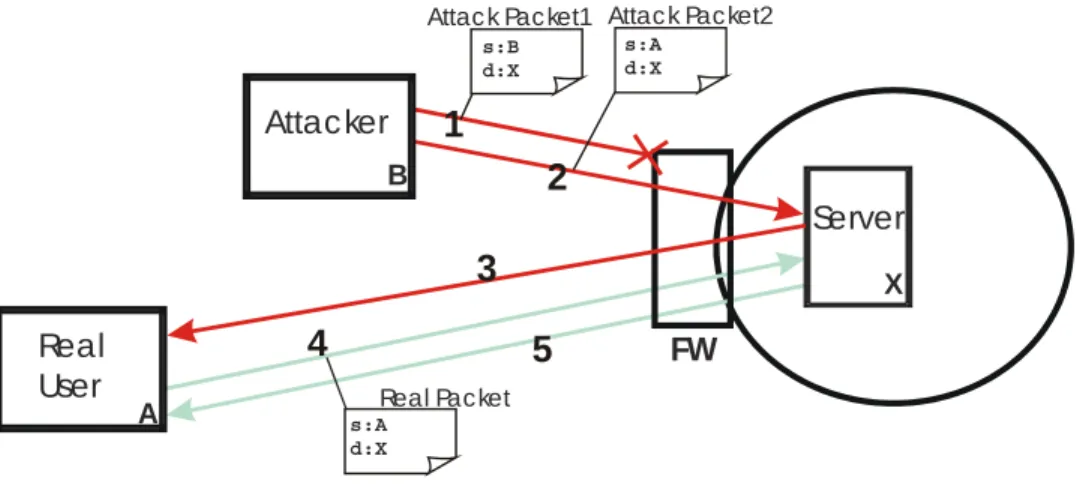
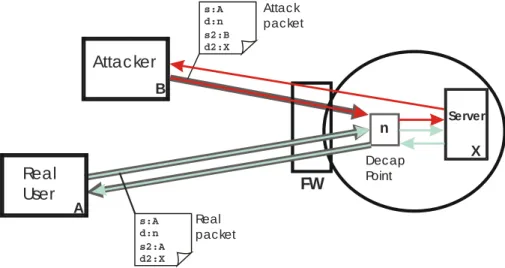
The IP address fields are critical elements in the IPv6 main header and should be filtered (as-condition) by IPv6 firewalls just as they are in IPv4. Individual firewall policy entries will typically use source and destination IP address as primary filtering conditions. Filtering source addresses of incoming packets has a double security benefit. See Figure 3-1 below. A potential attacker has two obstacles to overcome. First, since his address is blocked (1), he must guess a valid source address (2). Secondly, he must subvert the basic routing structure in order to get a response packet returned, otherwise, the response goes to the real user (3) where it is ignored as a stray and possibly logged as a security event. A legitimate user can send a packet (4) and receive the response (5) with no obstacles to overcome.
Real User Attac ker FW Server A B s:B d:X X
Attac k Pac ket1
s:A d:X
Real Pac ket
s:A d:X
Attac k Pac ket2
1
2
5 3 4
Figure 3-1: Double Benefit of Filtering Source Addresses
3.2 Option Types
IPv6 Options are individually defined in separate RFC documents and new options may continue to be added as needed. They are components (in Type-Length-Value format) that can appear in either of the two IPv6 extension headers designed to handle options: The Hop-by-Hop Options extension header or the Destination Options extension header.
The IPv6 standards provide one octet (256 values) to identify all option types without designating them as hop-by-hop or destination options. It is up to the RFC specifying the individual options as to whether they are valid in one or both of the extension headers. Firewalls need to know which options are allowed in which header if they are to enforce validity checking on the option type.
The standards also use the first two bits of the 8-bit type field to divide the space into four parts, each corresponding to a different action that a node should take if the option is unknown4. A firewall should NOT adhere to this practice. Instead firewalls should have a definite and configurable action for every option.
The set of currently undefined values for option type should be filtered as a group (on-presence) with a configurable option to ignore or drop them all. This group will be referred to as the Unknown Options in this document and currently consists of all values not specifically addressed in subsections of 3.2, 3.3, or 3.4 below.
To account for new options a firewall may anticipate the next few option values that would be assigned and separately decode them or have a programmable means to extract
values out of the group of Unknown Options. This would allow new options to be
distinguished from the Unknown Options and separately filtered on-presence. Advanced
filtering (i.e. on-validity) can not be anticipated on a hereto-undefined option, but the individual ignore/drop capability may be useful.
IPv6 options are defined below if they are permissible in both the Hop-by-Hop Options and the Destination Options extension headers. If they are limited by specification to one extension header or the other, they are described in sections 3.3 or 3.4 as appropriate.
3.2.1 Pad 1 and Pad N Options
The Pad1 and PadN options (option type:0x00 and 0x01, respectively) are valid in both the Hop by Hop Options and the Destination Options headers. These options may appear more than once in either or both of these extension headers.
The pad “options” are only used to align other options to convenient byte boundaries but don’t have any functionality themselves. The pad options should be accommodated as part of the firewall’s packet processing but do not require security policy configurations. A firewall should derive a filtering scheme for the pad options (on-validity) to abort processing and drop the packet if highly unreasonable padding is encountered. Although these packets may be benign, it is also possible that an attacker could use bizarre padding to confuse a firewall or expend a firewall’s resources. By clamping down on
unreasonable padding, this avenue of attack is removed.
The exact nature of the filtering scheme is left to firewall vendors, though some examples of unreasonable padding are as follows:
• More than one padding option back-to-back should never occur.
• PadN options with data length greater than 5 should never be needed (i.e. overall option length of 7). This assumes the RFC 2460 Appendix B guidelines of a maximum of an 8-byte boundary being defined.
• Any PadN option with data bytes that are not zeros should be dropped. This is suspicious behavior that may indicate a data channel.
3.2.2 Endpoint Identification Option
The Endpoint Identification option (option type: 0x8A) is listed by the IANA as being related to the Nimrod routing system, circa 1996. There is no known RFC document that defines the option and only RFC 1992 (informational) to explain Nimrod routing. It is not known if this option is/was intended as a Destination Option or a Hop-by-Hop option, or if there is any expectation of its implementation at all.
The on-presence filtering method is appropriate. Firewalls should detect this option and be configurable to ignore it or drop the packet.
3.3 Hop by Hop Options Extension Header
The Hop-by-Hop Options extension header, if present, must be the first header to follow the IPv6 main header. This is indicated by a value of 0x00 in the next header field in the main header. If a next header value of zero is contained at any place further down in the chain (i.e. in any extension header) the packet is invalid and should be dropped.
3.3.1 Jumbo Payload Option
The Jumbo Payload option has the option type value 0xC2 and is only valid as a Hop-by-Hop option[2]. This option allows the creation of very large IP packets and will likely only be appropriate on certain specialized networks. Network and link layer components that are not anticipating such packet lengths may experience performance degradation or failure. Furthermore, users with jumbo payloads may be able to achieve an unfair usage of bandwidth over other users. For these reasons, security policymakers should have the option of detecting and blocking this IPv6 option.
Firewalls should apply on-presence style filtering to this option and be configurable to allow it or drop the packet. If allowed, the firewall should apply additional on-validity style filtering on this packet. The following restrictions are specified and may be used as firewall validly checks:
• The IP payload length must be 0x00 when the Jumbo Payload option is present
• The Jumbo Payload option can only be used when the length is greater than 65,535 (i.e. the two most significant bytes of the jumbo length can not be 0x00)
• The Jumbo Payload option cannot be used in conjunction with a Fragmentation
extension header5
Note that any length checks performed on IP packets (Section 3.1.4) may be severely complicated by this option.
3.3.2 Router Alert Option
The Router Alert option has the value 0x05 for option type and is only valid as a hop-by-hop option[6].
The purpose of this option is to signal to routers that a closer inspection of the packet is warranted. The only security concern is regarding denial of service (DOS) attacks that could result if an attacker sends large numbers of packets with this option.
Firewalls should use on-presence style filtering on this option and be configurable to ignore it or drop the packet. The specification prohibits more than one Router Alert option to be present in a single packet even if the identifier within is different. The IPv4 equivalent of this option is defined by RFC 2113[7]. Designers should be careful not to confuse the two versions which are very similar except that the option identifier (first byte) of the IPv4 header option is 0x94. The value 0x94 is currently undefined for the IPv6 option type field.
3.3.3 Invalid Options for the Hop-by-Hop Options Extension Header
The following values are invalid in a Hop-by-Hop extension header option type field. Packets with these options in a hop-by-hop header should be dropped on-validity.
• Value 0x04, Tunnel Encapsulation Limit
• Value 0xC9, Home Address Destination option
3.4 Destination Options Header
The Destination Options extension header may appear in several locations and may appear more than once within an IPv6 header chain. This is reflected in the recommended header ordering guidance provided in Section 3.9.
3.4.1 Tunnel Encapsulation Limit Option
The Tunnel Encapsulation Limit (option type: 0x04) is a destination option defined in RFC 2473[4]. The option is used to limit the number of IP-in-IP encapsulations that may be imposed on an original packet by informing tunnel entry points to reject packets that would otherwise be encapsulated and fragmented. The IPv6 Path MTU Discovery process already provides a means of signaling the optimal packet size back to an
originating node, though there are still situations where an encapsulating node may have no other option than to fragment. The use of the Tunnel Encapsulation Limit option gives network administrators a better ability to detect and correct unwanted
fragmentation scenarios when multiple tunnels are in use.
From a security standpoint, the Tunnel Encapsulation Limit option is non-threatening. A filtering strategy must be able to deal with all encapsulated IP layers of an arriving packet regardless of whether this option is present. One or more firewalls can be used to filter the IP layers, or the packet must be dropped if the number of layers exceeds the capability of the filtering strategy. A configuration to drop protocol type 0x04 and type
0x29 in the last analyzable layer achieves this requirement. Security issues with tunneled traffic are discussed in Section 5.2 of this document.
3.4.2 Home Address Option
The Home Address option is assigned the option type value 0xC9 and is part of Mobile IP processing defined in RFC 3775[8]. This option is only valid as a Destination Option. The Mobile IP specification contains the following restrictions on placement:6
• It is illegal to have more than one Home Address option in a single IP header chain
• The Home Address option must appear after a Routing Header if one is present • The Home Address option must appear before a Fragmentation Header if one
is present
• The Home Address option must appear before the Authentication Header (AH) or Encapsulating Security Payload (ESP) headers if present
For a complete analysis of the Mobile IP scenario and a recommended firewall filtering strategy, refer to A Filtering Strategy for Mobile IPv6[9]. Conclusions from that analysis are stated below.
The analysis reveals three cases where filtering of the Home Address option is needed. First, the ability to drop all packets containing the option at a network boundary is needed. Separate configuration of this filtering for inbound and outbound traffic is
required to support the various Mobile IP filtering scenarios (i.e. Home Network, Foreign Network, and Correspondent Network).
Secondly, the Home Address option must be filtered in conjunction with an ESP header
and particular destination addresses in order to restrict home agent functionality to only the legitimate home agents. This is one of the rare occasions where the firewall does need to filter an ESP header in a packet. Inbound traffic at Home, Foreign, and Correspondent networks, is filtered to either allow or prevent home agents as site policy dictates.
Finally, it is highly desirable to have a firewall that can filter on the home address contained in the Home Address option. More specifically, to replace the IP source
address with the home address from the Home Address option for the purposes of
filtering the packet only (i.e. forwarded packets would be unchanged). Correspondent Network firewalls would use this source address swap to apply their normal filtering policies to all packets containing a Home Address option. This is an on-presence style
function (rather than filtering action) since it applies to all occurrences of the Home Address option independently and prior to all other filtering actions.
If the address swapping function above is implemented, a firewall should also allow filtering on the true source address of packets with a Home Address option, to allow the rejection of unwanted Mobile IP Foreign Networks. A firewall would need the ability to distinguish these non-swappable source address filters from the normal ones that get swapped.
The analysis in [9] provides some alternate approaches to filtering Correspondent Networks if the home address swapping capability described above is not available. These approaches, require the as-condition style of filtering for the Home Address Destination Option. Specifically, a firewall would need to be configured to: allow “any source address” with a Home Address Destination Option and allowed protocol/port values for each allowed internal destination.
In summary, firewalls should implement an on-presence address swapping function to apply to all packets across an interface if enabled. Regardless of whether address
swapping is implemented, the firewall needs the as-condition style filtering for the Home Address option. All designs will need the as-condition filtering to enforce proper use of home agents. Designs without the swapping function will have additional need of the as-condition style filtering to protect Correspondent Networks.
3.4.3 Network Service Access Point (NSAP) Address Option
The NSAP Address option (option type: 0xC3) is assigned as a Destination Option by RFC 1888 and deprecated (reclassified as historic) by RFC 4048. At the time of this writing the value is still assigned though this is likely to change at some future time. Firewalls should filter on-presence and be configurable to ignore the option or drop the packet.
3.4.4 Invalid Options for the Destination Options Extension Header
The following values are invalid in a Destination Options extension header option type
field. Packets with these options in a Destination Options header should be dropped on-validity.
• Value 0xC2, Jumbo Payload
• Value 0x05, Router Alert
3.5 Routing Headers
The Routing Header extension headers are analyzed separately according to the routing type field.
3.5.1 Type 0 (Source Routing)
The Type 0 Routing Header is the functional equivalent to the IPv4 loose source routing option. This option is rarely used in IPv4 and is typically blocked by firewalls because of its security risks. These same risks exist for the IPv6 Type 0 Routing Header.
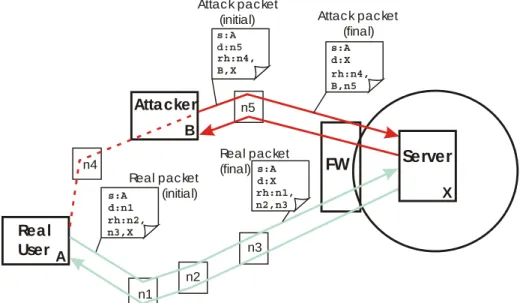
Back in Figure 3-1, filtering of source addresses was shown to have a double security benefit. If the same site accepted the Type 0 Routing Header, the double benefit is cut in half. An attacker would still need to know/guess a valid source address that is acceptable at the target site. However, with the Type 0 Routing Header, traffic would proceed along a deliberate path in both directions, allowing the attacker to insert himself in that path. See Figure 3-2 below.
Real pac ket (initial) Rea l User Atta cker FW Server A B s:A d:X X Attac k pac ket
(final)
s:A d:X
Real pac ket (final) n4 n5 n1 n2 n3 rh:n1, n2,n3 s:A d:n1 rh:n2, n3,X
Attac k pac ket (initial) rh:n4, B,n5 rh:n4, B,X s:A d:n5
Figure 3-2: Type 0 Routing Header Threat
The Type 0 Routing Header is dangerous because it allows the attacker an easy means of receiving return traffic when pretending to be another user. The dashed line in the figure above indicates the portion of the path that the packet only appears to take. It actually originates from the attacker at node B.
Another threat from the Type 0 Routing Header is that it can hide the true packet destination from a firewall. If a firewall ignores the routing header and applies the filtering policy to the packet’s destination address, it can be fooled into allowing traffic that should be blocked. Traffic is sent through the firewall to an allowed node on the inside, and normal processing of the routing header sends the packet to a different target node. Normally the firewall would block traffic sent to the target node.
Firewalls require on-presence filtering of the Type 0 Routing Header and should be configurable to ignore the header or drop the packet. Most networks will configure to drop this traffic as is done today with IPv4 source routing.
A second capability is also desirable for IPv6. It should be possible to allow the Type 0 Routing Header only for packets containing an IPsec header (either AH or ESP). With the security headers present, the attacker can no longer spoof the packet and so the above threats are removed. If this capability is provided, administrators should have three options in all:
• Drop all packets containing Type 0 Routing Header
• Ignore the Type 0 Routing Header
• Ignore the Type 0 Routing Header if a security header is also present, and drop all packets containing a Type 0 Routing Header without a security header7 The Type 0 Routing Header can actually strengthen an IPsec system in the sense that it can route encrypted packets through safer paths in an internet thereby reducing the vulnerability of the packets.
3.5.2 Type 1 (Nimrod routing)
Similar to the Endpoint Identification option (Section 3.2.2), the value 0x01 for the
routing type field of a Routing Header is reserved by something called “Nimrod Routing” of which little is known and less is specified.
Firewalls should filter this extension header on-presence and be configurable to ignore it or drop the packet.
3.5.3 Type 2 (Mobile IP)
The Type 2 Routing Header is used exclusively in support of Mobile IPv6. Though structured similarly to the Type 0 Routing Header, the Type 2 header allows only one address swapping action to occur. This swap can only occur at the destination node indicated by the original destination address.
Type 2 Routing Headers are only processed by the final destination node and the packet cannot be forwarded again after the header is processed.8 Therefore, the Type 2 header does not present the security threats that occur with the Type 0 Routing Header and should generally be allowed for use9.
The specification recommends that a Type 2 Routing Header “SHOULD” occur after a
Type 0 Routing Header if both are present. Since the Type 2 header effectively operates as a destination option, it makes no sense to ever have a Type 0 follow a Type 2 header. Firewalls should enforce this “SHOULD” as a “MUST”.
The reader should refer to [9] for a complete analysis of the Mobile IP scenario. From that analysis, filtering of the Type 2 Routing Header is only needed when it is necessary to prevent a site from acting as a Foreign Network and this can be achieved with the on-presence style of filtering.
Firewalls should detect this option and be configurable to ignore it or drop the packet.
3.6 Fragmentation Header
Packet fragmentation at the IP layer poses a difficult challenge for a firewall trying to enforce a security policy. This section presents the security issues and will make some design recommendations for handling IPv6 fragmentation at the firewall; with a goal of being secure, practical to implement, and tolerant of all reasonable traffic.
3.6.1 Fragmentation Security Issues
3.6.1.1 Issue 1: Extracting Header Information
The first issue with fragmented packets is in the challenge of extracting critical header information needed to apply full security filtering. If there are n fragments of a TCP/IP packet, the TCP header and port information will only be in one of the fragments. The other fragments have insufficient information for independent judgment and would normally be dropped if it weren't taken into consideration that they are fragments of a larger packet.
If any of the fragments are dropped, the whole packet is discarded when the reassembly operation times out at the destination host. Therefore, if the firewall can apply full security filtering to any one fragment, it can consider remaining fragments to be harmless, not counting the loss of resources as the reassembly operations times out. If critical header information is straddled across two fragments, the firewall's extraction task is complicated because it must maintain state across multiple packets. The missing fragment may be significantly delayed, fragments need to be queued, and the location of fields within a fragment must be synchronized with the previous fragment. Once the firewall begins down this path, it would be easier to perform full packet reassembly prior to filtering. Ideally, all of the required data needed to filter the packet can be extracted from a single fragment.
A firewall design must be able to determine if it has extracted the entire set of required data. For IPv6 this is significant because of the optional number of extension headers. It must be possible to drop a packet for which an incomplete set of data is extracted. 3.6.1.2 Issue 2: Fragment Overlaps
Filtering on a partially assembled packet can also be a security risk, which brings up the second issue with IP fragmentation: overlapping fragments. Fragment overlap attacks originated in IPv4 and unfortunately, the IPv6 specification does nothing to prevent them. The fragment offset field and fragment length are used to reconstruct the original packet and it should always be the case that the offset of fragment n plus the length of fragment n adds up to one byte short of the offset of fragment n+1. The offset value points to where the fragment is positioned in the overall reconstructed packet and there should never be any overlap in a normal fragmentation. The overlap attack creates packet anomalies whereby the fragments do overlap and it depends on individual
implementations as to which data ends up being used in the final reassembled packet. The fragment overlap attack works by sending fragments to a firewall which appear to be one thing but when reassembled at the inside host, are actually something else. For example, if the first fragment indicates that the packet is a TCP port 80 (http) packet, it might pass through the firewall. A subsequent overlapping fragment overwrites the port 80 portion with port 23 (Telnet) data, thereby sneaking past the firewall, which is
supposed to drop incoming Telnet packets. This attack works against firewalls that try to evaluate only the first fragment against a security policy.
3.6.1.3 Issue 3: Partial Set of Fragments
A third issue with packet fragments at a firewall is whether the security enforcement imposes any hardship on internal hosts by means of reassembly timeouts. Although evaluating/dropping a first fragment is secure, the remaining fragments get through creating an unwanted side effect. The partial set of fragments ties up resources on the destination host which waits for a missing fragment that never arrives. Fragmentation timeouts are specified to be 60 seconds, which is a long time to hold resources. It is important to note that an attacker can always send fewer than all fragments as a deliberate denial of service (DOS) attack. Security filtering cannot cure this problem outright but can only move it from one place to another. For example, if a firewall performs packet reassembly it can shield the inside hosts from this attack, but now the firewall itself is subject to the same attack. If the firewall is shut down by a DOS attack, all inside hosts are disabled.
3.6.1.4 Issue 4: Nested Fragmentation
Nested fragmentation is a fourth issue. In IPv6, fragmentation is only allowed by the originating node, not by intermediate routers. The standard is ambiguous and possibly contradictory, however, as to whether an occurrence of nested fragments is technically compliant or not. It must be assumed that nested fragments are not intended behavior because RFC 2460 states that only initiating hosts can fragment and that “the lengths of fragments must be chosen such that the resulting fragment packets fit within the MTU of the path to the packets' destination(s)”10. Given these two requirements, we can conclude that there is never a justification for a second fragmentation header to appear in an IPv6 header chain11. However, the specification does not explicitly forbid it and it does have a statement saying that implementations should try to deal with any number of extension headers that occur in any order12.
Unique to IPv6, nested fragmentation consists of a set of fragments which, after reassembly, contains yet another fragmentation header indicating that a fragment had been fragmented. This is different than what happens in IPv4 when a fragment is further fragmented by an intermediate router (which is allowed in IPv4). In that case, the
existing fragmentation fields in the IPv4 header are modified as the fragments are broken into smaller pieces. Multiple fragmentation headers in an IPv4 packet is not possible because this information is part of the main header.
The security threats of nested fragmentation are in its complexity and obfuscation of the true nature of the packet. A firewall may be fooled or a host may be "crashed" if it is not able to deal with this unexpected case.
3.6.1.5 Issue 5: Fragmentation and Tunneling
Fragmentation and packet tunneling are interrelated because tunneling adds an outer IP header to an existing IP packet, creating a potential conflict with the MTU size.
Fragmentation may be needed at a tunnel entry point if Path MTU Discovery can not adjust the packet size at the source.
Generally speaking, these fragmentation issues are more operational problems than security issues. RFC 4459 [10] explains a variety of cases that may be encountered and how the problems might be solved. Tunneling has its own security issues as described in section 5.2 of this document.
Fragments may be tunneled and tunneled data may be fragmented. A firewall design strategy for handling fragments should work in unison with its strategy for handling tunnels. It is also important that no design allow an attacker a means to escape filtering by using a particular combination of fragmentation and tunneling.
3.6.2 Two Firewall Design Approaches to Fragmentation Handling
A design decision must be made as to whether the firewall will reassemble fragments and filter the whole packet, or whether it will filter fragments and pass them through to the destination host on the secure side (inside). Both cases have advantages and
disadvantages, so both will be viewed as acceptable design approaches by this document. A firewall that has "deep packet inspection"13 capabilities will likely choose to
reassemble fragments since it needs to see deep into the application layer of packets. The more traditional firewalls may prefer to avoid the overhead of fragment reassembly to achieve higher performance (packet throughput). If a firewall is designed to filter tunneled traffic, the potential for fragmentation in multiple IP layers may be too labor intensive for a reassembly approach.
The lists of pros and cons below show that this is a non-trivial decision for a design team to make.
Advantages of fragment reassembly:
• security filtering is always applied to the full packet
• overlap attacks will fail because the firewall filters the fully reconstructed packet
• inside hosts are shielded from partial fragment DOS effects and deliberate DOS
attacks via fragments
• deep packet filtering can be performed
Disadvantages of fragment reassembly:
• performance hit of having to do the reassembly on the firewall for all inside nodes (this could be huge)
• packets may need to be re-fragmented after filtering if they are too big for the inside MTU (even more of a performance hit)
• the partial fragment DOS attacks can be made against the firewall itself, which if successful, could effect all inside hosts
• tunneled traffic can be very complicated with fragments at inner layer, outer layer, or both
3.6.3 Recommendations for Firewalls that Reassemble
3.6.3.1 Issue 1 (data extraction) and Issue 2 (overlap attacks) for Firewalls that Reassemble If reassembly is performed by the firewall, it is important that full reassembly be
performed, and that the firewall filters and passes the reassembled packets (not the fragments). Issue 1 is eliminated since the full packet is filtered. The threat from issue 2 is also removed.
The firewall must NOT reassemble fragments, filter the result, and then pass the original fragments because there is no guarantee that inside hosts will reassemble overlapped fragments in the same manner as the firewall (i.e. it is outside of specification). The firewall may have to re-fragment the packet, which is not a security threat because the firewall is trusted not to create overlaps.
3.6.3.2 Issue 3 (partial set of fragments) for Firewalls that Reassemble
A reassembling firewall doesn’t filter individual fragments and therefore does not create
the unwanted side effect of a partial set of fragments. Although fragments may reach the inside hosts, they would be generated by the firewall due to a re-fragment operation after filtering. The inside hosts would therefore receive a full set of fragments very reliably. A partial set of fragments sent by an attacker as a deliberate DOS attack is still a concern. Although the attack can not reach inside hosts, it can affect the reassembling firewall. A good design strategy to limit the effects of this attack is to incorporate a threshold on reassembly timeout occurrences over a period of time. For example, if X reassembly timeouts occur in Y minutes some action is initiated such as: temporarily block a source address, temporarily reduce the reassembly timeout, temporarily drop fragments, and/or generate an alarm. DOS attacks are difficult if not impossible to completely prevent. Quick detection of an ongoing attack is the most important element.
3.6.3.3 Issue 4 (nested fragmentation) for Firewalls that Reassemble
A firewall that reassembles should process the first Fragmentation Header encountered in a packet. If the reassembled packet contains another Fragmentation Header (i.e. nested fragmentation) then the firewall should drop the packet. Discouraging this behavior is better for all nodes in the long run.
3.6.3.4 Issue 5 (fragmentation and tunneling) for Firewalls that Reassemble
Firewalls must expect fragments to occur simultaneously in each IP layer of a tunneled packet. If a firewall is designed to filter multiple layers of IP tunneling, the worse case fragment reassembly is particularly painful. Both layers can be fragmented and the firewall can have multiple reassembly operations to perform before it is able to filter the packet.
Furthermore, reassembly of a fragmented inner IP layer is more complicated than that of untunneled traffic and could produce unwanted results. For example, assume that a packet is divided into ten fragments at the originating node A, travels to a tunnel entry point B, and then to its final destination C. The result is that tunneled packets with the inner layer fragmented are sent from node B to node C. If these fragments are
reassembled by a firewall prior to reaching C, it is not clear which of the ten outer IP headers is appropriate to assign to the reassembled packet and if any important data could potentially be lost in the other nine outer headers. The tunnel entry point is not expecting that nine of its next ten headers will be dropped and hence this potential for unexpected behavior. The standard states that the headers present in the first fragment are used to make the final reassembled packet14. However, this requirement is made with the assumption that fragments are only reassembled at the endpoint in which case the outer IP tunnel layers are gone (already processed). The case of a firewall reassembly
midstream is unique and consequential.
Re-fragmenting a tunneled packet after filtering is also an issue. If the reassembled packet is too big for the firewall to forward, should it re-fragment in the same manner the data arrived? If yes, then it would need extensive resources to remember how the packet was originally split and could potentially need to perform multiple fragmentation
operations if both layers were originally fragmented. If it fragments only the outer layer it could produce unwanted effects with the new arrangement such as burdening a tunnel exit point with fragment re-assembly operations. Network administrators may set up fragmentation and tunneling to operate in a particular way for maximum efficiency and the firewall could alter their intensions.
In conclusion, firewalls designed to filter multiple layers of IP traffic should avoid the fragmentation re-assembly approach due to the very high worse-case processing impact and the potential for creating unwanted side-effects.
3.6.4 Recommendations for Firewalls that do NOT Reassemble
3.6.4.1 Issue 1 (data extraction) and Issue 2 (overlap attacks) for Firewalls that do NOT Reassemble
Firewalls that do not reassemble fragments need another strategy for dealing with these security issues. In IPv6, the minimum specified MTU15 is 1280 bytes, which is up from 576 bytes in IPv4. An implementation of IPv6, therefore, cannot be forced (or expected) to fragment any packet that is 1280 bytes or smaller. If the link layer media cannot handle 1280 bytes (e.g.; ATM) the fragmentation/reassembly must be performed by the link layer16.
Even with IPv6's extension headers and increased address size, 1280 bytes is a lot of space and it is a very reasonable expectation that the entire IP header (including extensions) plus the upper layer protocol headers will fit within a first fragment. The 1280 byte space equals 320 four-byte words. A hypothetical worse-case packet using all of the known headers and options appears as follows (with the word size in parenthesis): IP main header (10), router alert option (1), routing header (50), home address option (5), fragmentation header (2), tunnel encapsulation option (1), mobile IP header (20), TCP (4)17. The routing header of 50 words assumes a very large number of defined hops (twelve) as a worse case. It is also very unlikely that any packet would use all of these headers simultaneously. Adding all of the headers up comes out to 93 words. Doubling everything except the TCP portion gives 89+89+4 =182 words, which can be used to represent a worse-case IP-in-IP tunneled packet.
This is still far below the 320 word boundary that corresponds to the 1280 byte MTU and thus it is reasonable for a firewall to expect that all extracted data will be found in the first fragment.
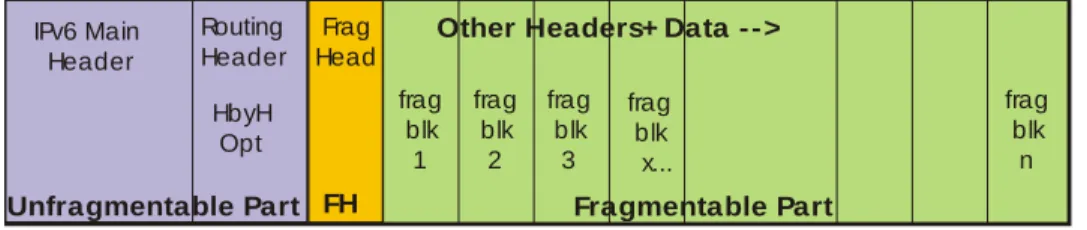
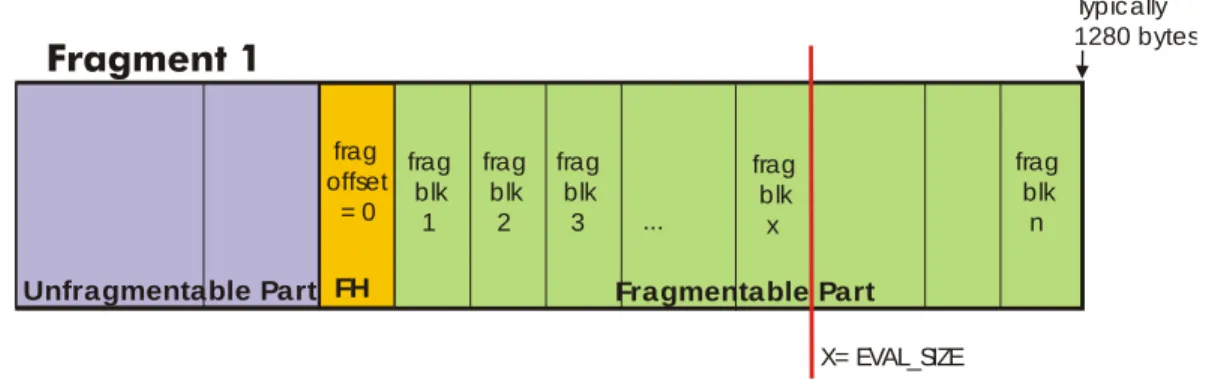
A closer look at the construction of a fragment is warranted. An IPv6 fragment consists of an "unfragmentable part", an 8-byte Fragmentation header, and some number (n) 8-byte blocks that make up the "fragmentable part". See Figure 3-3 below.
Unfragmentable Part FH Fragmentable Part
IPv6 Main Header Frag Head HbyH Opt
Other Headers+ Data - - >
frag blk 1 frag blk 2 frag blk 3 frag blk x... frag blk n Routing Header
Figure 3-3: IPv6 Packet Fragment
The unfragmentable part consists of all data required for packet delivery, and therefore required to be present in each fragment as well. Typically, this will be the Hop-by-Hop Options and the Routing Headers, if they exist. All other headers in the original packet are placed in the fragmentable part. It is incorrect to deduce that these remaining headers were designed to be in the fragmentable part for fear of a header being larger than the minimum MTU. Instead, it is merely an efficiency measure. The unfragmentable part is minimized because it is repeated multiple times (once in every fragment).
The Fragmentation Header contains a fragment offset field which indicates the starting position (i.e. the xth 8-byte block) of the data contained in this particular fragment. For example, the first fragment always has an offset of 0x00. If that first fragment contains 120 8-byte blocks of data in the fragmentable part, the second fragment will contain a
fragment offset value of 0x79 (decimal 121).
A secure firewall design strategy for handling fragments needs to be able to extract a complete set of critical data required for filtering. It is also preferable to extract all data from a single fragment to avoid the difficult task (in hardware) of maintaining state
across multiple packets. The expectation that all of the extracted data will appear in the first fragment has already been argued as reasonable. Furthermore, the integrity of the extracted data must be guaranteed by preventing subsequent fragments from overlapping back into the extracted data.
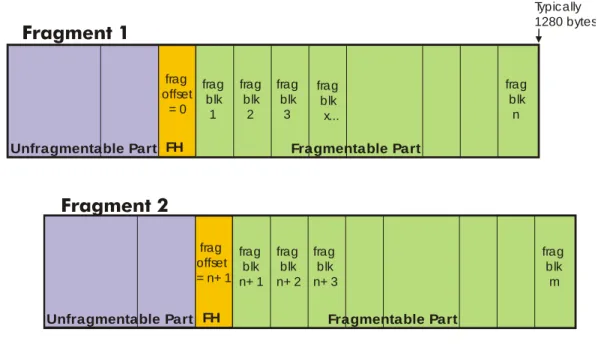
The 1280-byte minimum MTU boundary is not very useful as a filtering condition as shown in Figure 3-4. The second fragment will contain a fragment offset value that bears no relationship to the overall packet size of the first fragment.
Unfragmentable Part Fragmentable Part
frag blk 1 frag blk 2 frag blk 3 frag blk x... frag blk n
Unfragmentable Part FH Fragmentable Part
frag blk n+ 1 frag blk n+ 2 frag blk n+ 3 frag blk m FH frag offset = 0 Typic ally 1280 bytes frag offset = n+ 1
Figure 3-4: Fragment Offset Value
If the unfragmentable part of the first fragment expands, the Fragment Header moves to the right and there is less room for the fragmentable part. The value n goes down in this case as the overall fragment size stays the same. A check to prevent fragment overlap must verify that the offset of fragment 2 (normally n+1) is not erroneously set to a smaller value that would overlap with fragment 1. This check is not a function of the 1280 MTU size.
There is also no guarantee that the first fragment will be 1280 bytes though that should be the normal case. As an example of this, a 1500 byte original packet would probably be split into a 1280 byte first fragment with the remaining 220 bytes and unfragmentable part in fragment 2. It is not prohibited by the standard, however, to have an 800 byte/700 byte split since the fragments are required only to "fit within the path MTU" to the destination. Given that there is already a lot of complexity involving fragmentation-tunneling solutions as stated earlier (RFC 4459), it is highly undesirable to create any constraint here by assuming that the first fragment will always be at least 1280 bytes. For these reasons, there should be no required checks based upon the fixed value of 1280. A better approach is to name a new boundary that will be referred here as the
fragment blocks from the start of the first fragment that is big enough to include all of the extracted data for filtering, and small enough to fit within the first fragment.
Unfragmentable Part Fragmentable Part
frag blk 1 frag blk 2 frag blk 3 frag blk x frag blk n FH frag offset = 0 Typic ally 1280 bytes ... X= EVAL_SIZE
Figure 3-5: Design Recommendation, EVAL_SIZE
The firewall must perform three checks to securely handle fragments using this scheme. These checks should be relatively straightforward to implement, friendly to reasonable traffic, adaptable to extreme traffic, and, most importantly, secure. It must verify that:
1) There are at least EVAL_SIZE 8-byte blocks of "fragmentable part" data in the first fragment.
2) All of the data required to be extracted for filtering is contained within those first EVAL_SIZE blocks of the first fragment.
3) The fragment offset field of all non-first fragments is greater than EVAL_SIZE
A default value of 60 is recommended for EVAL_SIZE though designers are encouraged to make this configurable to values higher and lower than 60, allowing firewalls to adjust to unusual environments18. For example, packets with an extremely large amount of extension header data might require a larger EVAL_SIZE, whereas an environment that creates fragments much smaller than 1280 bytes may need to reduce the EVAL_SIZE. Once configured, the firewall would apply the chosen value to all fragment testing. The third check above is the only check performed on non-first fragments. If it passes, the fragment is allowed through without further processing.
The main advantage of this scheme is that a fixed test can be applied to each fragment based solely on its own contents. There are no coordinated checks required across multiple packets such as trying to determine if n+1 of fragment 2 overlaps with what is defined in fragment 1. Instead, the fixed value of EVAL_SIZE cordons off the filtered data in fragment 1 and the checks to other fragments prevent overlap back into this space. Variance in header construction and/or variance in packet length can cause the value of n to increase or decrease as long as it never crosses the worse case boundary of
EVAL_SIZE.
The scheme addresses the first two security issues: data extraction and fragment overlaps19. Other approaches are possible but they must be secure with respect to these two issues. Regardless of the scheme, it should be considered “reasonable” in IPv6 to drop a fragmented packet if the full set of filtering data is not contained in the first fragment.
3.6.4.2 Issue 3 (partial set of fragments) for Firewalls that do NOT Reassemble The process described above may drop a fragment while one or more remaining fragments still pass through. Although secure, the inside host wastes resources in this scenario, as it waits for reassembly timeout. A threshold mechanism should be incorporated to detect a certain number of dropped fragments from the same source address in a period of time. Upon activation of the threshold detector, the firewall should activate an alarm and/or temporarily block all fragments from the source. Administrators can quickly learn of the particular usage of headers or tunneling that is causing the firewall to drop fragments and take corrective action. The action of blocking a source address (rather than activating an alarm) should be optional to use since it could potentially become a means of a DOS attack.20
A firewall should not take the approach of dropping all non-first fragments following a first fragment that has already been dropped. This will not be reliable because there is no guarantee that the first fragment is transmitted first. In fact, some designs send fragments in reverse order with the last fragment sent first so the receiver can immediately calculate the size of memory needed to store all of the fragments.
A partial set of fragments can also be sent by an attacker as a deliberate DOS attack. A firewall that does not reassemble fragments can not easily detect or defeat this attack and it is the job of an administrator to correct. This should be tolerable since DOS attacks are relatively rare, highly detectable, and do not cause the permanent damage of other attacks (i.e. data loss or destruction). The reassembly timeout on inside hosts can be decreased from the standard default of 60 seconds to improve the resistance to these specific DOS attacks.
3.6.4.3 Issue 4 (nested fragmentation) for Firewalls that do NOT Reassemble Nested fragments (issue 4) should be dropped regardless of whether the firewall reassembles fragments or not. For non-reassembling firewalls, the detection of two Fragmentation headers within the set of extracted/filtered data should cause the packet to be dropped. Refer to section 3.9.1 for a proposed Header Ordering Algorithm that
implements this check.
3.6.4.4 Issue 5 (fragmentation and tunneling) for Firewalls that do NOT Reassemble The scheme described above in section 3.6.4.1 is adaptable to extreme fragmentation-tunneling scenarios, if the implementation offers EVAL_SIZE values other than just the default value. Firewalls that receive first fragments much less than 1280 bytes may need to reduce the EVAL_SIZE value and those that receive packets with extremely large headers (i.e. larger than the worse-case estimated in this document) may need to increase the EVAL_SIZE. Administrators should be able to find a workable setting in the event that tunneling causes one of these unusual variants to occur.
Later in section 5.2, tunneling is discussed in more detail and with the objective of filtering both an inner and outer IP layer. Firewalls that filter multiple IP layers need a fragmentation-handling scheme that works in the worse case scenario where both IP layers contain fragments simultaneously. For the scheme described above, the default