Fraud Detection in Electronic Auction
Duen Horng Chau1, Christos Faloutsos21 Human-Computer Interaction Institute, School of Computer Science, Carnegie Mellon University,
5000 Forbes Avenue, Pittsburgh PA 15213, USA
2 Department of Computer Science, School of Computer Science, Carnegie Mellon University,
5000 Forbes Avenue, Pittsburgh PA 15213, USA
Abstract. Auction frauds plague electronic auction websites. Unfortunately, no literature has tried to formulate and solve the problem. This paper aims to tackle it by suggesting a novel method to detect auction fraudsters, which involves de-termining and extracting characteristic features from exposed fraudsters, through analyzing the fraudsters’ transaction history which exists as a graph. We then use the features for detecting other potential fraudsters. Choosing the best features is a challenging and non-trivial task; however, with the features that we have currently selected, our method has already achieved a precision of 82% and a recall of 83% during an evaluation on some real test data from eBay. To demonstrate how our method can be used in real-world, we have developed a working Java prototype system which allows users to query the legitimacy of eBay users using our method.
1
Introduction
Electronic auction websites have created a huge virtual marketplace, where the world’s population can easily buy and sell virtually any items. In an electronic auction, a person can post items for other people to bid. The person placing the highest bid will be the winner of the auction, and will contact the seller and pay for the item. The seller will then ship the item to the buyer.
Electronic auction is a thriving business – eBay, the world’s largest electronic auction website, has reached a cumulative number of 147.1 million registered users at the end of Q1 2005, representing a 40% increase over that reported at the end of Q1 2004 [ 10].
Every day, there are millions of dollars of sales involved in electronic auction transactions. The huge sum of money has unfortunately attracted perpetrators’ attention, and a large num-ber of them commit auction frauds which are by far the most serious problems that eBay faces. Indeed, the number of reported auction frauds has been increasing over the past few years, and the trend shows that the problem is getting worse. In 2004, the Internet Crime Complaint Center (IC3) referred 103, 959 complaints, 71.2% of which were auction frauds. 87% of the victims reported monetary loss with a median of $200. [ 12] Most auction fraud involves sellers selling non-existent items. They do this intentionally: they typically do not
have the items, but they post them to the auction, receive payment from buyers, and yet never deliver the items to the buyers.
Auction fraud is a problem that has been getting increasingly serious. We believe that, as computer scientists, we could do something to help solve the problem. This belief has moti-vated our work.
2
Survey
To the best of the authors’ knowledge, this is the first work that uses a systematic approach to analyze and detect electronic auction frauds.
There have been a lot of suggested common-sense approaches on websites [ 11] and news articles [ 13] that teach people how to avoid auction frauds. However, their approaches often involve asking people to invest substantial amount of time and to constantly maintain high level of vigilance. This is what average people cannot afford to do.
Little research has been done in suggesting systematic approaches in detecting or prevent-ing auction fraud. Some researchers [ 1] have categorized auction fraud into different types, but they have not suggested any formalized methods in dealing with them. They have, how-ever, suggested that an effective approach to fight auction fraud is to allow auction commu-nities, governments and auction institutions to join forces. However, as they have pointed out, their approach can be costly both in monetary and managerial means.
There has been a lot of interest in some of the other research areas related to auction fraud detection, such as reputation systems of electronic auctions [ 4] [ 7] [ 8], graph mining [ 9], trust propagation and authority propagation [ 3] [ 6]. Also remotely related is the work on aggregat-ing values from some other set of values in a graph [ 5].
3
Proposed Approach
3.1 Problem Definition
Here, we examine the problem of detecting auction fraudsters. Specifically, we define the problem as:
Given:
· The information of some electronic auction users: their profiles and their transaction history
· Some exposed fraudsters We want to find out:
· Who else are also fraudsters
The profiles and transaction history of eBay users are readily available from the eBay website (Appendix), while the knowledge about the exposed fraudsters can be acquired from news articles, user forum on eBay, and by noting the large number of negative feedback given by other buyers or sellers saying the fraudsters have never delivered the items. Thus,
we define the auction fraud problem as given these two pieces of information, how do we identify other potential fraudsters before they carry out frauds.
It is possible for a person to create multiple identities on eBay. However, in order to im-prove the clarity of our discussion in this paper, we use the terms eBay user and fraudster to refer to individual identities on eBay rather than individual persons.
3.2 Intuition
We have observed that fraudsters show typical characteristic behaviors during their lifetime on auction websites. We have also observed that before they carry out fraudu-lent transactions, they typically exist as seemingly-legitimate users in order to estab-lish good-enough reputation for their up-coming fraudulent acts. Yet, their reputation building procedure is different from that of legitimate users. We believe we can iden-tify the fraudsters’ reputation build-up process by inspecting features derivable from their profiles and transaction history.
Reputation is an important measure of credibility in electronic auction websites. On eBay, a person’s reputation is represented by the number of unique positive ratings given by his/her dealers, minus the number of negative ratings (Appendix). The resulting number is the user’s feedback score.
Fraudsters usually aim to gain as much one-time profit as quickly as possible. Therefore they usually “sell” moderate value or expensive items in categories such as consumer elec-tronics. Yet unlike legitimate users, they do not intend to deliver those items after receiving payment from the buyers.
However, before the fraudsters can carry out the fraudulent acts, they, like other people at eBay, need to establish certain level of reputation. This is because with few positive ratings, they will look too suspicious for most auction users.
We hypothesize that auction fraudsters need good reputation so as to trick people into be-lieving that they are legitimate. We believe that fraudsters fabricate their reputation through methods that exhibit certain patterns which are different from the legitimate ones and that if we discover the fabrication process, we can essentially identify the frauds before they actu-ally take place.
3.3 Observed Patterns
From the known and publicized frauds on eBay, we learned of several common ways that fraudsters fabricate reputation. Those patterns are typically not found among legitimate users, but are well justified from the perspective of the fraudsters:
1. Selling or buying numerous cheap items from users with good reputation. Justification: fraudsters want to gain many ratings at small cost
2. Selling or buying moderate value or expensive items from collaborators. The collabora-tors may not show fraudulent acts; they may generally act like legitimate users. Justification: fraudsters want to gain few but “strong” ratings virtually without incurring any cost
3. Combination of 1 and 2.
4. Reputation fabrication process usually occurs in short period of time.
Justification: fraudsters are short-lived; they do not want to remain on eBay for too long to increase their risk of being discovered.
3.4 Determining Characteristic Features from Observed Patterns
From the observed patterns, we have reasoned that a number of features could effec-tively capture the patterns – and therefore distinguish fraudsters from legitimate users. The features are:
1. Median, sum, mean, or standard deviation of prices of items bought or sold in cer-tain time period
2. Number of items bought or sold in certain time period
3. Ratio of the number of items bought or sold to that of all transactions in certain time period
From the set of possible features above, we have selected the following 17 features. We will evaluate the effectiveness of these features in detecting fraud in section 4.
§ Median prices of items sold within the first 15, first 30, last 30, and last 15 days § Median prices of items bought within the first 15, first 30, last 30, and last 15 days § Standard deviation of the prices of items sold within the first 15, first 30, last 30,
and last 15 days
§ Standard deviation of the prices of items bought within the first 15, first 30, last 30, and last 15 days
§ Ratio of the number of items bought to that of all transactions 3.5 Decision Tree
The values of the chosen features can be extracted from the profiles and transaction history of eBay users which are readily available from the eBay website.
We first download the relevant information from eBay and store it in two tables, the pro-files and transactions tables. Then from the two tables, we extract the values of the features and save them to a third table, the features table.
Table 1. Sample profiles table
User ID Feedback score Still registered? Registration date Location
theplastics21 10 FALSE Fri Feb 11 00:00:00 EST 2005 United States
designerclothing4less404 3 TRUE Wed Jan 05 00:00:00 EST 2005 United States
joahandbruce 12 FALSE Thu Dec 02 00:00:00 EST 2004 United States
Table 2. Sample transactions table
User ID Rating Sell? Dealer ID feedback score Dealer Feedback date Item ID Item $
theplastics21 1 TRUE 420stephen 21 Tue Mar 08 10:17:00 EST 2005 8171729100 7
theplastics21 -1 TRUE rkayakr 6 Mon Mar 07 18:11:00 EST 2005 5753342945 54
designerclothing4less404 1 FALSE bargainphone 44508 Wed Mar 02 14:57:00 EST 2005 5755903231 1.5
designerclothing4less404 1 TRUE sunrob123 2 Sat Feb 26 16:06:00 EST 2005 3960815216 199
Table 3. Sample features table
Feature 1 Feature 2 Feature 3 Feature 4 Feature 5 Feature 6 Feature 7 User ID Label
1.29 1.29 1.29 0 0.6 0.6 0.6 theplastics21 innocent
2.95 0.99 11.69 8.24 0.19 9.52 7.22 designerclothing4less404 fraudster
3.68 6.59 67.84 0 3.85 26.64 0 joahandbruce innocent
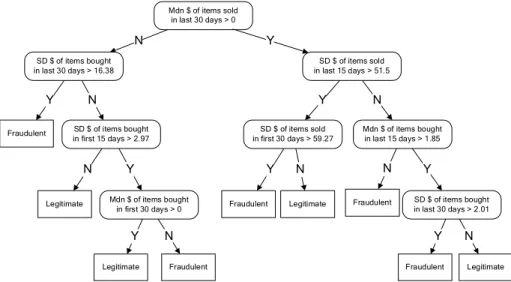
The set of features are then passed into the C5.0 classification system as training dataset. C5.0 uses the C4.5 classification algorithm, to produce a decision tree based on the data. Fig. 1 shows a sample decision tree learned on some training data utilizing 16 features. With the decision tree constructed, we can use it to classify future test data.
Mdn $ of items sold in last 30 days > 0
SD $ of items bought in last 30 days > 2.01 Mdn $ of items bought
in first 30 days > 0 Fraudulent
Fraudulent Legitimate Fraudulent Legitimate Legitimate Fraudulent Legitimate N N N Y Y Y N Y Y N Y N N Y Y N SD $ of items sold in last 15 days > 51.5 SD $ of items bought in last 30 days > 16.38 SD $ of items sold in first 30 days > 59.27 Mdn $ of items bought in last 15 days > 1.85 SD $ of items bought in first 15 days > 2.97 Fraudulent
Fig. 1. Sample decision tree utilizing 16 features
4
Experiments
4.1 Tasks and Selected Features
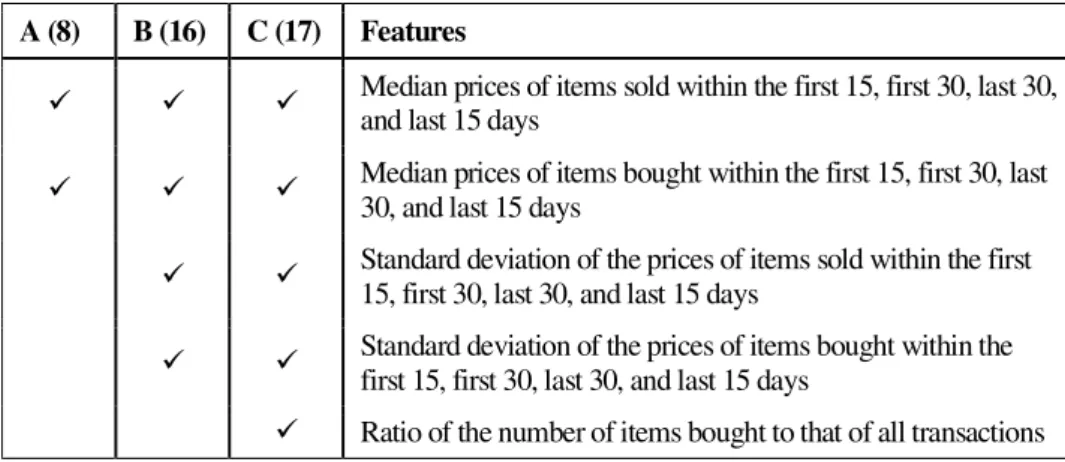
The goal of this experiment is to evaluate the effectiveness of our proposed method in detecting fraudsters. We have drawn the profiles and transaction information of 43 fraudsters and 72 legitimate users from eBay (www.ebay.com). We created three setups for the experiment. Setup A uses 8 features; setup B uses 16 features and setup C uses 17 features.
Table 4. Features used in setups A, B and C
A (8) B (16) C (17) Features
ü ü ü Median prices of items sold within the first 15, first 30, last 30, and last 15 days ü ü ü Median prices of items bought within the first 15, first 30, last 30, and last 15 days
ü ü Standard deviation of the prices of items sold within the first 15, first 30, last 30, and last 15 days ü ü Standard deviation of the prices of items bought within the first 15, first 30, last 30, and last 15 days
ü Ratio of the number of items bought to that of all transactions We have considered many features that might differentiate fraudsters from legitimate us-ers, and among all of them we decided that the trends (medians), and fluctuation (standard deviations) of prices of past traded items over time (first 15 days, first 30 days, etc) are some of the important ones that we should include, as they have direct relevance to fraudsters’ investment costs and profits.
4.2 Results and Discussion
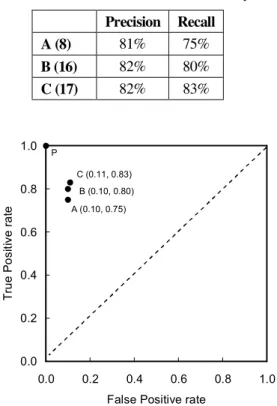
We evaluated the accuracy of the decision tree generated in the three setups by run-ning 2-fold cross-validations which divides the trairun-ning data into 2 blocks of the same size and class distribution. For each block, decision trees are constructed from the other block and tested against the current block. For every setup, we ran the experi-ment 20 times, each with different folds, and averaged the error rates. Table 5, Table 6, and Table 7 show the confusion matrixes of the three setups, while Table 8 shows their precisions and recalls, and Fig. 2 shows their corresponding ROC graph. As the ROC graph is insensitive to changes in the class distribution of the training/test data [2], it provides good depiction and comparison for the relative performance of three experiment setups.
Table 5. Confusion matrix A (8)
Predicted
Actual Legit Fraud
Legit 64.55 7.45 Fraud 10.6 32.4
Table 6. Confusion matrix B (16)
Predicted
Actual Legit Fraud
Legit 64.55 7.45
Fraud 8.5 34.5
Table 7. Confusion matrix C (17)
Predicted
Actual Legit Fraud
Legit 64.4 7.6
Table 8. Precision and recall of the three setups Precision Recall A (8) 81% 75% B (16) 82% 80% C (17) 82% 83% A (0.10, 0.75) B (0.10, 0.80) C (0.11, 0.83) P 0.0 0.2 0.4 0.6 0.8 1.0 0.0 0.2 0.4 0.6 0.8 1.0
False Positive rate
T ru e P o si tiv e r a te Fig. 2. ROC graph of setups A (8), B (16), and C (17)
In Fig. 2, the point P(0, 1) represents perfect classification, and any points along the dotted line represent random classification, which our method performs significantly better than. Setup C has a recall (true positive rate) of 83%, while that of setup B and A are 80% and 75 % respectively. Since the auction fraud problem has not been systematically dealt with before, no comparison can be made with other approaches. However, we believe our ap-proach and the accuracy that it has achieved is significantly better than the heuristic apap-proach practiced by average eBay users who want to identify suspicious dealers, which involves manual inspection of all the dealers’ transaction history and profile information.
5
Working Prototype
We have built a working prototype that uses our proposed method to detect fraudsters on eBay. It is a Java application that can run on Windows, Macintosh, and Linux. Our development platform is Windows XP Professional edition.
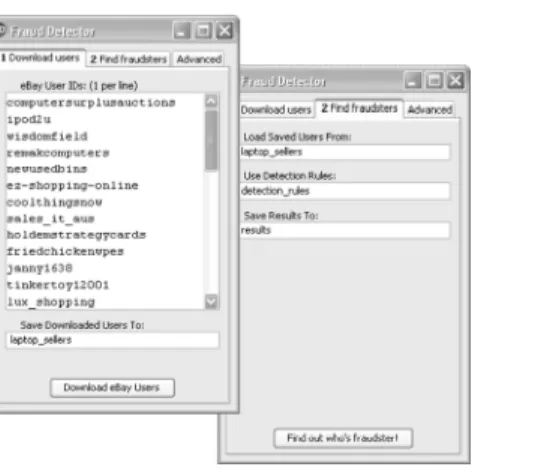
Our system has a complex core that is responsible for retrieving and analyzing data from eBay, representing 5578 lines of code. However, we have encapsulated the complexities into a streamlined graphical user interface to promote good usability (Fig. 3).
Fig. 3. Screenshots of our system Fig. 4. Sample results of our system
Fig. 5 illustrates the system flow. Our system allows the user to input multiple eBay us-ers’ IDs to query if they are fraudulent or legitimate (Fig. 3). It then retrieves the relevant data about the identities from eBay, and extracts the pre-defined features from the data. The ex-tracted feature sets are then run against the pre-generated decision rules which classify the identities into “fraudster” or “innocent” (Fig. 3). The results are saved to a text file (Fig. 4).
Fig. 5. How our system works
6
Discussion and Future Research Directions
The experiment results indicate that we have already achieved good accuracy with the current sets of features. However, we believe there are still more interesting features that can help boost the performance further. Currently, we focus on the dollar amount of items being bought and sold, their fluctuation, and the frequencies of transactions; some of the features that we might include in the future are the users’ registration dates, times, locations, and their frequent transaction categories, etc. We believe that studying more closely and understanding better about how typical fraudsters create
and manage fraudulent activities will provide us with much insight in suggesting more effective features.
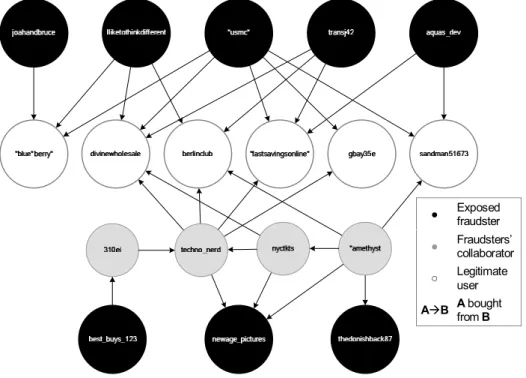
Another major improvement that we anticipant is the inclusion of graph pattern detection, which tries to detect the fraudulent patterns that might exist among the interactions between eBay users. In fact, we have already started to explore the efficacy of this method. We have constructed the visualization of some transaction graphs on eBay, which illustrate the trans-action trail among users. We have observed an alarming pattern that exists among some of the fraudsters, their possible collaborators and some other legitimate users. Fig. 6 shows the pattern.
The observations from the graph are:
1. Fraudsters might exist within a few “hops” from each other.
2. Fraudsters might choose some legitimate users (usually with high feedback score) as the regular sources to gain reputation.
3. Clusters of fraudsters might be very close to each other (the top and the bottom). The possible formation of fraud networks as shown in the figure shows that frauds might indeed be carefully planned and managed, and that a perpetrator may be controlling several identities at the same time.
We believe that if we exploit this kind of interactions during our classification process, not only could we increase the accuracy in detecting fraudsters and strengthen the proof of claims, but also discover the complete fraudster communities – which include both the fraud-sters and their possible collaborators. This will significantly increase the effectiveness of the whole fraud detection process.
Fig. 6. Transaction graph of some eBay users
● Exposed fraudster ● Fraudsters’ collaborator ○ Legitimate
user AàB Afrom bought B
7
Conclusion
In this paper, we have presented the first method that analyzes and detects electronic auction fraudsters, as well as a working system that implements the method. We have the following three contributions:
1. We formalized the auction fraud problem and proposed a method to systematically detect auction fraudsters;
2. We suggested characteristic features that distinguish fraudsters from legitimate us-ers, where the features are extractable from the graph describing users’ past trans-actions;
3. We evaluated our proposed method on real data from eBay and showed that it can reach a precision of 82% and a recall of 83%, representing a significant lift over random classification.
In our future research, we are going to explore the possibility of including more features and incorporating the graph pattern detection method, both of which could greatly improve the effectiveness of the whole detection process.
Reference
1. Chua, C., Wareham, J.: Fighting Internet Auction Fraud: An Assessment and Proposal, Computer, vol. 37, no. 10, October (2004) 31-37
2. Fawcett, T.: ROC Graphs: Notes and Practical Considerations for Data Mining Research-ers. Technical Report HPL-2003-4, HP Labs (2003)
3. Gy¨ongyi, Z., Garcia-Molina, H., Pedersen, J.: Combating web spam with TrustRank. In Proceedings of the 30th International Conference on Very Large Databases (VLDB) (2004) 4. Melnik, M. I., Alm, J.: Does a Seller's Ecommerce Reputation Matter? Evidence from
eBay Auctions. Journal of Industrial Economics, Vol. 50 (2002) 337-49
5. Neville, J., Jensen, D.: Collective classification with relational dependency networks. Proceedings of the 2nd Multi-Relational Data Mining Workshop, 9th ACM SIGKDD In-ternational Conference on Knowledge Discovery and Data Mining. (2003)
6. Page, L., Brin, S., Motwani, R., Winograd, T.: The PageRank Citation Ranking: Bringing Order to the Web. Technical report, Stanford Digital Library Technologies Project (1998) 7. Resnick, P., Zeckhauser, R., Friedman, E., Kuwabara, K.: Reputation Systems.
Communi-cations of the ACM, 43, December (2000) 45-48
8. Resnick, P., Zeckhauser, R., Swanson, J. and Lockwood, K.: The Value of Reputation on eBay: A Controlled Experiment. Working Paper (2002)
9. Zacharia, G., Moukas, A., and Maes, P.: Collaborative reputation mechanisms in elec-tronic marketplaces. In Proceedings of the HICSS-99 Conference, Elecelec-tronic Commerce Minitrack (Maui, Hawaii, Jan. 5–9). IEEE Computer Society (1999)
10. CNN: eBay posts higher profits, April (2005)
http://money.cnn.com/2005/04/20/news/fortune500/ebay_analysis/
11. Federal Trade Commission: Internet Auctions: A Guide for Buyers and Sellers (2004) http://www.ftc.gov/bcp/conline/pubs/online/auctions.htm
12. Internet Fraud Complaint Center: IC3 2004 Internet Fraud - Crime Report (2005) http://www.ifccfbi.gov/strategy/statistics.asp
13. USA Today: How to avoid online auction fraud (2002)
Appendix: Annotated eBay Screenshots
A: User profile
1: User ID 2: Feedback score 3: Registration status
4: Registration date 5: Registration location B: Past transactions
6: Rating 7: Type of dealer 8: Dealer’s user ID
9: Dealer’s feedback score 10: Feedback date 11: ID of traded item
12: Item ID 13: Item price 14: Auction start and end dates
15: Seller information 1 2 3 5 4 A B 6 7 8 9 10 11 12 13 14 15