As capability of the enamel surface to micro-mechanical adhesion with adhesives is not good enough to provide sufficient bond strength, enam-el preparation is considered a necessary step be-fore bonding [1]. With the development of the ac-id etching by Buonocore, enamel preparation by phosphoric acid is considered the most popu-lar used method among orthodontists. Although this technique provides sufficient bond strength to resist orthodontic and masticatory forces [2], it
is a multi-stage method and has many disadvan-tages, including enamel loss through etching [3], the need to dry the field during bonding [4] and the difficulty in removing the remnant resin after debonding [5].
In the attempt to reduce phosphoric acid dis-advantages and to simplify bonding procedure, different alternatives have been tested [6]. Self-etching primer SEP as a new system was intro-duced in order to move away from acid etching
ORIGINAL PAPERS
Mohamad Ghassan Dandachli
Bond Failure Rate of MBT Brackets Bonded
with either Self-Etching Primer or Resin Modified
Glass Ionomer
vs
Conventional Method – an
in Vivo
Study
Odsetek niepowodzeń utrzymania się zamków ortodontycznych MBT
za pomocą samowytrawiającego się primeru lub szklano-jonomeru
modyfikowanego żywicą w porównaniu do metody tradycyjnej
w badaniu
in vivo
Kalamoon University in Damascus, Damasus, Syria
Abstract
Background. Self-etching primer and resin modified glass ionomer has been introduced to counter phosphoric
etching disadvantages.
Objectives. Evaluation of the bond failure rate of MBT stainless steel brackets bonded with either self etching
primer SEP or resin modified glass ionomer RMGI in comparison with conventional methods CM.
Material and Methods. 46 patients with complete permanent dentition were involved in this study. A total of 920
Gemini MBT® brackets (3M Unitek, Monrovia, Calif) were bonded using a split-mouth design. For each patient,
four adhesives systems were used: self etching primer SEP (Transbond Plus®, 3M, Unitek, USA), resin-modified
glass ionomer RMGI (Fuji Ortho® LC, GC Corp, Japan), light cure LC (Transpond XT®, 3M, Unitek, USA) and
chemical cure CC (Unite®, 3M, Unitek, USA). All brackets were bonded by the same clinician. Only first-time
bracket failures with tooth number and the remnant adhesive on the enamel were recorded through to 12th month
of treatment and observation. Significant differences in bracket failure rate with regard to bonding procedure, patient sex, arch site, and tooth type were determined using the chi-square. The adhesive remnant index was used to determine the bond failure interface.
Results. The bond failure rates were 7%, 15.7%, 7% and 6.5% for the SEP, RMGI, LC, CC respectively. Significant
differences in failure rates were found between the groups. The maximum bond failure sites were at the enamel-adhesive interface in SEP and RMGI groups.
Conclusions. The clinical study showed that Transbond Plus can be used effectively for bonding brackets, whereas
using Fuji Ortho LC is not effective in clinical practice (Dent. Med. Probl. 2015, 52, 4, 440–446).
Key words: self-etching primer, resin modified glass inomer, adhesive remnant index, failure rate.
Słowa kluczowe: samowytrawiający się primer, szklano-jonomer modyfikowany żywicą, wskaźnik oceny ilości
pozostałości kleju, odsetek niepowodzeń.
Dent. Med. Probl. 2015, 52, 4, 440–446
or to merge it chemically in the other convention-al bonding stages [7]. SEP is a single solution that combines etching and priming stages [8], allow-ing them to take place at the same time and create the chance for the primer to penetrate the whole etched surface depth [9], achieving good mechan-ical adhesion [10]. This method has many advan-tages of decreasing bonding sadvan-tages, simplifying bonding procedures, shortening bonding time re-quired [11, 12], and minimizing the probability of contamination by moisture and saliva [1, 13] with-out affecting brackets bonding strength [14].
Resin modified glass ionomer (RMGI) (Fuji Ortho® LC; GC America®, Alsip®, Ill) is a hybrid
cement [15] that was developed to counteract resin sensitivity to moisture [16–18] and at the same time to improve clinical performance of conventional glass ionomer cement [19] while retaining its good properties like chemical adhesion with enamel sur-face in wet conditions [20–22] without the need for acid etching5, in addition to reducing enamel
de-mineralization by fluoride release [23, 24].
The aim of this clinical study was to deter-mine the effect of using either self-etching primer SEP with light cure composite or a resin modified glass ionomer RMGI (Fuji Ortho LC; GC Ameri-ca, Alsip, Ill) in wet conditions without etching on the mean bond failure rate and the bracket/adhe-sive failure mode in comparison with convention-al bonding systems.
Material and Methods
Forty-six patients (33 girls and 13 boys) were selected. The selection criteria are: complete per-manent dentition, nonextraction class I malocclu-sion cases with absence of buccal enamel defects, restorations, veneer or crowns. The characteristics of the sample are shown in Table 1.
A total of 920 Gemini® MBT Bracket (3M
Uni-tek) were bonded. Bonding involved a split mouth design and, for every patient, the quadrants as-signed to each adhesive were consequently alter-nated so that these were distributed equally. Pa-tients did not inform which adhesive had been ap-plied on each quadrant. All buccal teeth surfaces were cleaned, rinsed, and dried with compressed air free of oil. All brackets were bonded following manufactures instructions by the same clinician to exclude the clinician variable on bond perfor-mance.
1 – In SEP quadrants, buccal surface was wet-ted with water, and dried incompletely by com-pressed air. Self-etching primer Transbond Plus®
(3M,Unitek, USA) was applied on the enamel, rubbed for 3–5 seconds and gently dried by
com-pressed air for 1–2 seconds. Transbond XT® (3M,
Unitek, USA) was then applied on brackets before placement on the enamel. Excess adhesive was re-moved from the brackets bases margins, then the adhesive was light cured for 20 second from two directions using a visible light-curing unit (Crom-alux-E®; Mega Physik Dental).
2 – In RMGI quadrants, buccal surface was wetted with water. Fuji Ortho LC (GC Crop, Japan) was mixed and applied on brackets before being
Table 1. Sample characteristics
Number %
Number of patients 46 Distribution of patients by patient sex Female
Male 3313 71.738.3 Distribution of patients by age
15–16 y 16–17 y 18–19 y 19–20 y 7 14 19 6 15.2 30.3 41.3 13.1 Number of brackets 920 100 Distribution of brackets by bonding
Procedure Unite Transbond XT Transbond Plus Fuji Ortho LC
230 230 230 230 25 25 25 25 Distribution of brackets by patient sex
Female
Male 660260 71.728.3 Distribution of brackets by arch site
Unite Upper
Lower 120110 52.247.8 Transbond XT
Upper
Lower 125105 54.345.7 Transbond Plus
Upper
Lower 105125 45.754.3 Fuji Ortho LC
Upper
Lower 110120
47.8 52.2 Distribution of brackets by tooth type
Unite Anterior
Posterior 132 92 6040 Transbond XT
Anterior
Posterior 138 92 6040 Transbond Plus Anterior Posterior 138 92 60 40 Fuji Ortho LC
Anterior Posterior 138 92 60 40
placed on the enamel. Excess adhesive was removed from the brackets bases margins; then, the adhesive was light cured for 40 seconds from two sides using a visible light-curing unit as in SEP group.
3 – In LC quadrants, buccal surface was etched with 37% phosphoric acid (3M Scotchbond™
Etchant, 3M Dental Products, St Paul, Minneso-ta, USA) for 20 seconds, rinsed for 10 seconds, and dried for 5 seconds. Transbond XT primer was ap-plied to the etched surface. Light cure resin Trans-bond XT (3M,Unitek, USA) was applied on brack-ets before placement on the enamel. Excess adhe-sive was removed from the brackets bases margins; then, the adhesive was light cured as in SEP group.
4 – In CC quadrants, buccal surface was pre-pared as in the LC group. Adhesive primer (3M Unitek®) was applied to the etched surface and
to the bracket base. Chemical cure resin Unite (3M,Unitek, USA) was applied on brackets before being placed on the enamel.
After 5 minutes of bonding, no presence of any occlusal interference was verified. The initial wires placed were 0.014 nitinol (3M Unitek), followed by different sizes of nitinol and stainless steel wires (3M Unitek) as every case required. Strict instruc-tions about appliance keeping and types of foods that patients can eat were given. Observation pe-riod during treatment was 12 months for all pa-tients with an appointment every 4 weeks. Only first time brackets failures were registered with the tooth number and the remnant adhesive amount on the enamel surface according to adhesive rem-nant index [25] (ARI). Second time failures af-ter replacement of the failed brackets were not in-cluded in the study to exclude rebonding effect on bond strength.
Significant differences in bracket failure rate with regard to bonding procedure, patient sex, arch site, and tooth type were determined using the chi-square (c2), with the level of significance
set at (p < 0.05). The Kruskal-Wallis test and Mann-Whitney U were used to determine signifi-cant differences in the ARI scores between bond-ing procedures (p < 0.05).
Results
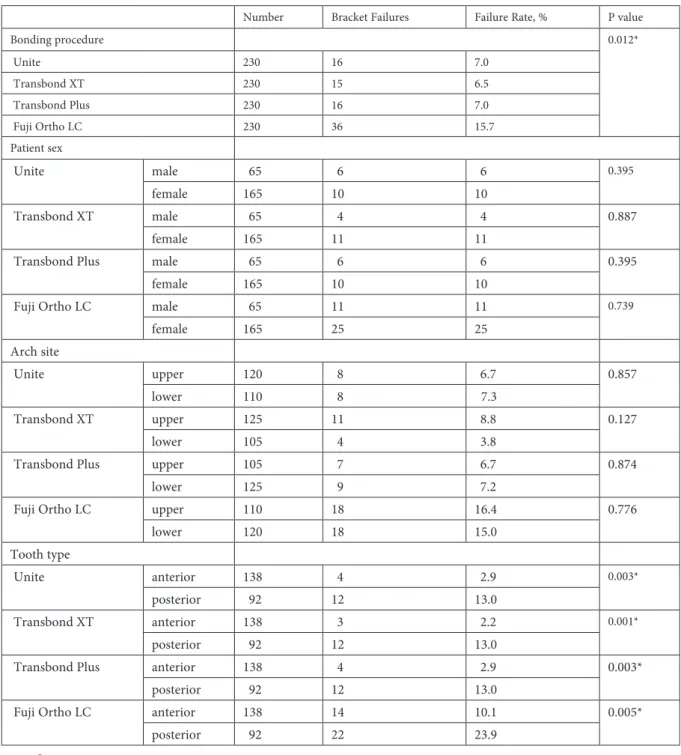
The overall failure rate was 9.02%. 83 bracket were failed in the four bonding through 12 month of treatment. The higher failure rate 36 (15.7%) were found with RMGI group followed by SEP and CC groups 16 (7%) for each, where as LC group showed the lowest 15 (6.5%) (Table 2). The c2 test
showed significant differences in failure rate be-tween the bonding groups (P = 0.012). No signif-icant differences were found in the bracket
fail-ure rate between males and females and between upper and lower arch in each of the four bonding groups whereas significant differences were found between the anterior and posterior teeth in each of the four bonding groups.
The frequency distribution and result of the Kruskal-Wallis and Mann-Whitney U test of the ARI scores are presented in (Table 3, 4). Most fail-ure was found at the adhesive enamel interface in each of SEP and RMGI groups, whereas the failure was at the adhesive bracket and in the adhesive in the CC and LC groups respectively. A significant difference was found between the bonding proce-dures (P = 0.000). Mann-Whitney U test showed significant difference between CC group and each of SEP and RMGI, and also between RMGI and each of LC and SEP.
Discussion
Self-etching primers (SEP) as a new bonding system that combines both etching and priming stages in one stage has a benefit of shorting and simplifying bonding procedures. Resin modified glass ionomer cements (RMGI) were introduced as an adhesive that can be used in wet conditions without etching, which also minimizes bonding steps and has the benefit of releasing fluoride, thus minimizing the potential risk of enamel decalcifi-cation around the brackets.
In this study, bond strength of brackets bond-ed with each of SEP and RMGI were evaluat-ed clinically and comparevaluat-ed with the use of CM. Bond failure rate is an acceptable index that can be used to evaluate bond strength clinically, and to make comparisons with the results of preceding studies [26]. In general, conducting precise com-parisons with another study is not easy as many variables might affect bond failure rates, such as sample size, clinicians number, adhesives type, treatment duration [27]. The effect of many vari-ables on brackets failure rates was investigated in this study, such as bonding procedures, patients sex, arch site, and tooth type.
With regard to the bonding procedures, bond failure rates were 7% for SEP and 15.7% for RMGI in comparison with CM (6.5%, 7% for LC and CC respectively). No significant difference was found between SEP and CM, while significant differenc-es were found between RMGI and each of SEP and CM. Mavropoulos et al. [28] recommended that the accepted clinical bond failure rate is under 10%, so using SEP and CM in brackets bonding is considered clinically acceptable unlike RMGI. These findings can be explained by the difference in the mechanism of adhesion, which is a chemical
Table 2. Bracket failure rates for bonding procedures, patients sex, arch site, tooth type
Number Bracket Failures Failure Rate, % P value
Bonding procedure 0.012*
Unite 230 16 7.0
Transbond XT 230 15 6.5
Transbond Plus 230 16 7.0
Fuji Ortho LC 230 36 15.7
Patient sex
Unite male 65 6 6 0.395
female 165 10 10
Transbond XT male 65 4 4 0.887
female 165 11 11
Transbond Plus male 65 6 6 0.395
female 165 10 10
Fuji Ortho LC male 65 11 11 0.739
female 165 25 25
Arch site
Unite upper 120 8 6.7 0.857
lower 110 8 7.3
Transbond XT upper 125 11 8.8 0.127
lower 105 4 3.8
Transbond Plus upper 105 7 6.7 0.874
lower 125 9 7.2
Fuji Ortho LC upper 110 18 16.4 0.776
lower 120 18 15.0
Tooth type
Unite anterior 138 4 2.9 0.003*
posterior 92 12 13.0
Transbond XT anterior 138 3 2.2 0.001*
posterior 92 12 13.0
Transbond Plus anterior 138 4 2.9 0.003*
posterior 92 12 13.0
Fuji Ortho LC anterior 138 14 10.1 0.005*
posterior 92 22 23.9
* significant.
Table 3. Frequency distribution and the result of the
Kruskal-Wallis test of the adhesive remnant index (ARI)a
0 1 2 3 x2 P value
Unite 3 2 1 10 23.182 0.000* Transbond XT 5 1 5 4
Transbond Plus 7 3 2 4 Fuji Ortho LC 28 4 2 2
a ARI: 0, no composite left on enamel surface; 1, less than half of composite left; 2, more than half of composite left; and 3, all of composite left. * significant.
Table 4. Result of Mann-Whitney U test
U value P value Unite Transbond XT 83.0 0.120
Transbond plus 77.5 0.043* Fuji Ortho LC 91.0 0.000* Transbond XT Transbond plus 103.0 0.482
Fuji Ortho LC 135.0 0.001* Transbond
Plus Fuji Ortho LC 182.0 0.011* * significant.
one with RMGI while its micromechanical with the other groups [29].
The failure rate for the Transbond Plus (SEP) coincides with the preceding studies. Oz-er et al. [30] and Cal-Neto et al. [31] have found no significant differences in bond failure rate be-tween SEP (2.18%, 6.88%) and Transbond XT (2.97%, 4.78%) respectively. In contrast, Murfitt et al. [32] and Ireland et al. [33] have found signif-icant differences in failure rate as they recorded failure rate for Transbond Plus (11.2% and 10.99% respectively) more than in our study. Pettemeri-des et al. [34] have found significant difference be-tween RMGI (11.4%) in wet conditions without etching and CM (3.41). The lower failure rate in this study in comparison with our study (15.7%) may be related to the small sample (20 patient) and to the shorter treatment period (6 months). Ga-worski et al. [35] also have found significant dif-ferences between RMGI and CM in 16 patients. The failure rate they recorded (24.9%) was about twice what we have found. In contrast, Silver-man et al. [36] have recorded acceptable failure rate 3.2% without etching in the presence of saliva for 8 months of treatment. Summer et al. [5] and Choo et al. [37] have shown no significant differ-ences in failure rate between Fuji Ortho LC (5.9%) and Transbond XT (7.2%). However, conditioner was used before bonding.
With regard to the patient sex, failure rate were higher in males but the differences were not statically significant and that may be related to the strict instructions that were given after bonding. These findings coincide with preceding studies [5, 30, 31, 38–40], whereas Murfitt et al. [32] have found the failure rate at males 2.4 times more than at females.
With regard to the dental arch, no significant differences were found between upper and lower arch in each of the four groups, which coincides with preceding studies [5, 30, 31, 38–40], whereas Lovius et al. [41] have found more failures on the mandible with conventional bonding.
With regard to the tooth type, premolars have shown significantly higher failure rate in com-parison with the anterior teeth in each of the four groups. This may be related to the more prismatic enamel on premolars [42], the inability to provide complete dry field in posterior region [43], and to the more masticatory forces in this region [40]. These findings coincide with preceding stud-ies [26, 27, 30, 31, 40].
According to the adhesive remnant index, the SEP and RMGI groups have shown failure at the enamel adhesive interface, whereas most failure was at the adhesive bracket in CC group, and in the adhesive in LC group. This may be related to the less micro pores that SEP produces in compar-ison with phosphoric acid [32] and to difference in adhesion mechanism between RMGI and the other groups. This mode of failure is clinically ad-vantageous for both clinician and patient because less adhesive to remove from the enamel is needed which will decrease patient discomfort. These re-sults coincide with those of other studies [30–32], whereas Miguel et al. and Hegarty and MacFari-ane [44] have recorded failure at cement-bracket for RMGI and that may be due to using etching before bonding.
Transbond pluls SEP has shown acceptable failure rate with a favorable mode of an enamel adhesive failure while Fuji Ortho LC (RMGI) has shown unacceptable failure rate. SEP can be used effectively in boding orthodontic brackets.
References
[1] Delport A., Grobler S.R.: Laboratory evaluation of tensile bond strength of resins to enamel. Am. J. Orthod. Dentofacial. Orthop. 1988, 93, 133–137.
[2] Rogelio J.S., Hotta Y., Yamamoto K.: Examination of enamel-adhesive interface with focused ion beam and scanning electron microscopy. Am. J. Orthod. Dentofacial. Orthop. 2007, 131, 646–650.
[3] Thampson R.E., Way D.C.: Enamel loss due to prophylaxis and multiple bonding and debonding orthodontics at-tachments. Am. J. Orthod. Dentofacial. Orthop. 1981, 79, 282–295.
[4] Kula K., Nash T.D.: Shear-peel bond strength of orthodontic primers in wet conditions. Orthod. Craniofacial. Res. 2003, 6, 96–100.
[5] Summers A., Kao E., Glomre J., Gunel E., Ngan P.: Comparison of bond strength between a conventional resin adhesive and a resin-modified glass ionomer adhesive: An in vitro and in vivo study. Am. J. Orthod. Dentofacial. Orthop. 2004,126, 200–206.
[6] Shammaa I., Ngan P., Kim H., Kao E., Gladwin M., Gunel E., Brown C.:Comparison of bracket debond-ing force between two conventional resin adhesives and a resin-reinforced glass ionomer cement: An in vitro and
in vivo study. Angle. Orthod. 1999, 69, 463–469.
[7] Singh C.: Text book of Orthodontics, Second edition. Jaypee Brothers, 2007.
[8] Aljubouri Y.D., Millet D.T., Gilmour W.H.: Six and 12 month evolution of a self-etching primer versus to stag-es etch and primer for orthodontic bonding: a randomized clinical trial. Eur. J. Orthod. 2004, 26, 565–571. [9] Dorminey J.C., Dunn W.J., Taloumis L.J.: Shear bond strength of orthodontics brackets bonded with a modified
[10] Buyukyllmaz T., Usumez S., Karamen A.: Effect of self-etching primers on shear bond strength – are the reli-able? Angle Orthod. 2003, 73, 64–70.
[11] Ghiza M.A., Nganb P., Kaoc E., Martind C., Gunele E.: Effects of sealant and self-etching primer on enamel decalcification. Part II: An in-vivo study. Am. J. Orthod. Dentofacial. Othop. 2009, 235, 206–213.
[12] Pithon M.M., Antonio Ruellas A.O., Sant’Anna E.F., de Oliveira M.V., Luiz Bernardes A.A.: Shear bond strength of brackets bonded to enamel with a self-etching primer. Angle Orthod. 2009, 79, 133–137.
[13] Rajagopal R., Padmanabhan S., Gnanamani J.: A comparison of shear bond strength and debonding charac-teristics of conventional, moisture-Insensitive, and self-etching primers in vitro. Angle Orthod. 2004, 74, 264–268. [14] Grubisae H.S., Heo G., Raboud D., Glover K.E., Major P.W.: An evaluation and comparison of orthodontic
brackets bond strength achieved with self-etching primer. Am. J. Orthod. Dentofacial. Orthop. 2004, 126, 213–219. [15] Millett D.T., Letters S., Roger E., Cummings A., Love J.: Bonded molar tubes, an in vitro evaluation. Angle
Orthod. 2001, 71, 380–385.
[16] Cacciafesta V., Sfondrini M.F., Blaga L., Scribante A., Klersy C.: Use of a self-etching primer in compar-ison with a resin-modified glass ionemer: effect of water and saliva contamination on shear bond strength. Am. J. Orthod. Dentofacial. Orthop. 2003, 124, 420–426.
[17] Cacciafesta V., Francesca M.S., Klersy C., Giuseppe S.: Polymerization with micro-xenon light of resin-mod-ified glass ionomer: a shear bond strength study in 15 minutes after bonding. Eur. J. Orthod. 2002, 24, 689–697. [18] Owens J.R., Miller B.H.: A comparison of shear bond strength of three visible light-cured orthodontic adhesives.
Angle Orthod. 2000, 70, 352–356.
[19] Dunn D.W.: Shear bond strength of an amorphous calcium-phosphate-containing orthodontic resin cement. Am. J. Orthod. Dentofacial. Orthop. 2007, 131, 243–247.
[20] Chung C.H., Cuozzo P.T., Mante F.K.: Shear bond strength of resin-reinforced glass ionomer cement: An in vi-tro comparative study. Am. J. Orthod. Dentofacial. Orthop. 1999, 115, 52–54.
[21] Hotz P., McClean J.W., Sced I., Wilson A.D.: The bonding of glass ionomer cements to metal and tooth sub-strates. Br. Dent. J. 1977, 142, 41–47.
[22] Cook P.A., Youngson C.C.: An in vitro study of the bond strength of a glass ionomer cement in the direct bond-ing of orthodontic brackets. Br. J. Orthod. 1988, 15, 247–253.
[23] Paschosa E., Kleinschrodtb T., Tatiana CL., Huthd K.C., Hickele R., Kunzelmannf K., Jansong I.R.: Effect of different bonding agents on prevention of enamel demineralization around orthodontic brackets. Am. J. Orthod. Dentofacial. Othop. 2009, 135, 613–620.
[24] Sudjalima T.R., Woodsb M.G., Mantonc D.J., Reynoldsd E.C.: Prevention of demineralization around orth-odontic brackets in vitro. Am. J. Orthod. Dentofacial. Othop. 2007, 131, 705.e1–705.e9.
[25] Artun J., Bergland S.: Clinical trials with crystal growth conditioning as an alternative to acid-etch enamel pre-treatment. Am. J. Orthod. Dentofacial. Orthop. 1984, 85, 333–340.
[26] Hitmi L., Muller C., Mujajic M., Attal J.P.: An 18-month clinical study of bond failures with resin-modified glass-ionomer cement in orthodontic practice. Am. J. Orthod. Dentofacial. Orthop. 2001, 120, 406–415
[27] O’Brien K.D., Read M.J., Sandison R.J., Roberts C.T.: A visible light-activated direct-bonding material:
An in vivo comparative study. Am. J. Orthod. Dentofacial. Orthop. 1989, 95, 348–351.
[28] Mavropoulos A., Karamouzos A., Kolokithas G., Athanasiou A.E.: In vivo evaluation of two new moisture-resistant orthodontic adhesive systems: a comparative clinical trial. J. Orthodont. 2003, 30, 139–147.
[29] Tolendo M., Osorio R., Osorio E., Romeo A., Blance Dela Higuera D.B., Garcia G.F.: Bond strength of orthodontic brackets using different light and self-curing cements. Angle Orthod. 2003, 73, 56–63.
[30] Ozer M., Bayram M., Dincyurek C., Tokalak F.: Clinical bond failure rates of adhesive precoated self-ligating brackets using a self-etching primer. Angle Orthod. 2014, 84, 155–160.
[31] Cal-Neto J.P., Quintãob C.A., Almeidac M.A., Miguel J.A.: Bond failure rates with self-etching primer: A ran-domized controlled trial. Am. J. Orthod. Dentofacial. Orthop. 2009, 135, 782–786.
[32] Murfitt P., Quick A.N., Swain M.V., Herbison G.P.: A randomized clinical trial to investigated bond failure rates using a self-etching primer. Eur. J. Orthod. 2006, 28, 444–449.
[33] Ireland A.J., Knight H., Sherriff M.: An in vivo investigation into bond failure rates with a new self-etching primer system. Am. J. Orthod. Dentofacial. Orthop. 2003, 124, 323–326.
[34] Pettemerides A.P., Sherriff M., Ireland A.J.: An in vivo study to compare a plasma arc light a conventional quartz halogen curing light in orthodontic bonding. Eur. J. 2004, 26, 573–579.
[35] Gaworski M., Weinsten M., Borislow A.J., Braitman L.E.: Decalcification and bond failure: A comparison of a glass ionomer and a composite resin bonding system in vivo. Am. J. Orthod. Dentofacial. Orthop. 1999, 116, 518–521.
[36] Silverman E., Cohen M., Demke R.S., Silverman M.: A new light-cured glass ionomer cement that bonds brack-ets to teeth without etching in the presence of saliva. Am. J. Orthod. Dentofacial. Orthop. 1995, 108, 231–236. [37] Choo S.C., Ireland A.J., Sherriff M.: An in vivo investigation in to the use of resin-modified glass poly
(alkeno-ate) cements as orthodontic bonding agents. Eur. J. Orthod. 2001, 123, 403–409.
[38] Turk S.E., Cakmak F., Isci D., Turk T.: 12-Month self-legating bracket failure rate with a self-etching primer. Angle Orthod. 2008, 78,1095–1100.
[39] Pandis N., Eliades T.: A comparative in vivo assessment of the long-term failure rate of 2 self-etching primers. Am. J. Orthod. Dentofacial. Orthop. 2005, 128, 96–98.
[40] Sunna S., Rock W.P.: Clinical performance of orthodontic brackets and adhesive systems: a randomized clinical trial. Br. J. Orthodont. 1998, 25, 283–287.
[41] Lovius B.B.J., Pender N., Hewage S.: A clinical trial of a light activated bonding material over an 18 month pe-riod. Br. J. Orthodont. 1987,14,11–20.
[42] Whittaker D.K.: Structural variations in the surface zone of human tooth enamel observed by scanning electron microscopy. Arch. Oral Biol. 1982, 27, 383–392 (cited by Hobson et al., 2002).
[43] Trimpeneers L.M., Dermaut L.R.: A clinical trial comparing the failure rates of two orthodontic bonding sys-tems. Am. J. Orthod. Dentofacial. Orthop. 1996, 110, 547–550.
[44] Hegarty D.G, Macfariane T.: In vivo bracket retention comparison of a resin-modified glass ionomer cement and a resin-based bracket adhesive system after a year. Am. J. Orthod. Dentofacial. Orthop. 2002, 121, 496–501.
Address for correspondence:
Mohamad Ghassan Dandachli University of Kalamoon Deir Atiyah
Syria
E-mail: [email protected] Conflict of Interest: None declared Received: 17.07.2015
Revised: 13.09.2015 Accepted: 15.09.2015