
The further spread of Elminius modestus in the British Isles to 1959
9
0
0
Full text
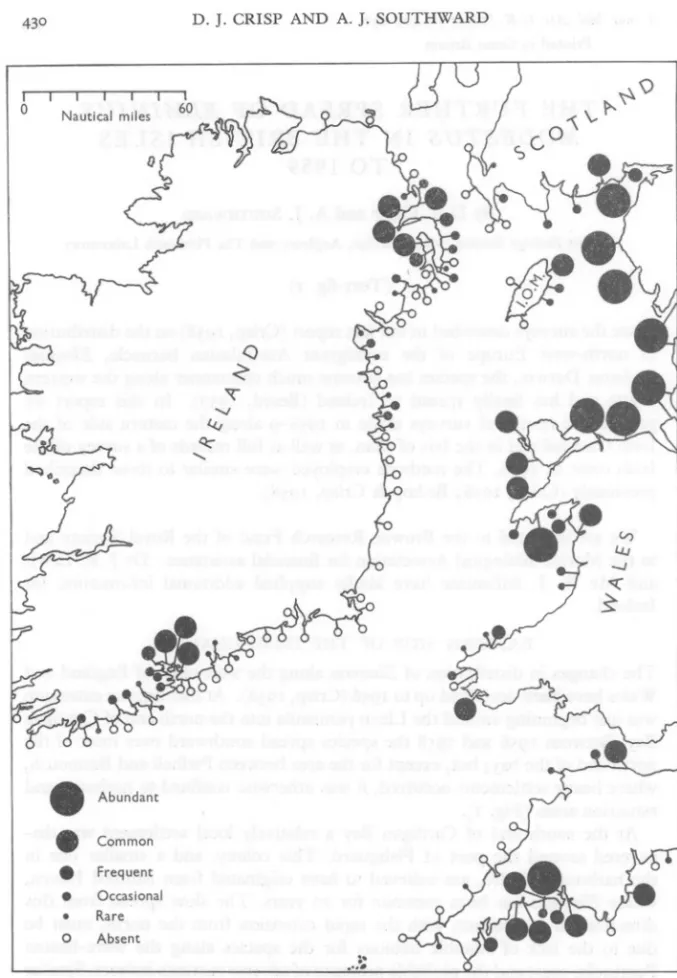
(2) D. J. CRISP AND A. J. SOUTHWARD. 430. ,. ~. o. Nautical miles. •e •• 0•. • el.. Rare Occasional Absent Frequent Common Abundant. ;.. Fig. 1. The distribution of EZminius modestus in 1958-9. Stations visited in Ireland in 1958 are shown in full only for the east and south coasts. Isle of Man records made in 1959, those on west coast of Britain in 1958 or 1959. In localities where the species is common or abundant not all stations can be shown. For quantitative meaning of symbols refer to Table 1..
(3) ELMINIUS. MODESTUS. IN THE BRITISH ISLES TO 1959. 431. Outside the Bristol Channel, Elminius has, so far, failed to establish itself on the exposed coasts of north Devon and Cornwall, or even in Mounts Bay. Along the south Devon and Cornish coasts, from the Exe to the Relford estuaries, Elminius is present, and often abundant, in most of the harbours, and since our last report has been slowly increasing on the wave-beaten open coast. West of the Lizard, however, the previously reported settlement at Penzance appears to have failed: only a few old specimens could be found there in 1959, and the filling in of the inner harbour appears to have removed the only suitable habitat for Elminius at that end of Mounts Bay. The earlier record (rare) for St Ives in 1955 (Crisp, 1958) has not been confirmed, in spite of extensive searches, and since the specimen was not kept, we cannot now be sure whether this was a true sporadic settlement or a mis-identification of a distorted example of Balanus balanoides. Genuine sporadic settlements seem to have occurred in the Newquay area in 1958, when one individual was seen on the open coast, and in 1959, when another was found in the harbour. The species was not seen elsewhere along this coast, and it would be an idle speculation to discuss the probable origin of such few specimens. Along the northern part of the Irish Channel there has been little further extension of range. Elminius is, as in 1956, abundant in the Solway Firth and common in Wigtown Bay. It is now present on wave-beaten promontories such as Burrow Read and Meikle Ross, but is still relatively rare in Luce Bay and has not yet passed the Mull of Galloway. Similarly, there has been little change in the isolated and sparse colony in Lough Ryan at the entrance to the Clyde Sea. ISLE OF MAN Except at Ramsey, where the species has become more common, there has been little change in the distribution and abundance of Elminius in the Isle of Man (Fig. I). It is present in small numbers in the harbour at Laxey, south of Ramsey, and one specimen was found at Douglas after more than 1 h searching of suitable habitats, but is absent from the west and south coasts of the Island. The apparent failure of Elminius to spread southward from Ramsey must be due to the local hydrography. The residual flow through the Irish Sea is northward, and the set of the tidal currents is such that there is little chance of larvae being carried direct from the north end of the island to the south. IRELAND An earlier survey of the entire coast of Ireland was made in 1952, and further observation in 1953 between Lough Foyle and Dublin showed that Elminius had not then been able to colonize Ireland (Crisp & Southward, 1953; Southward & Crisp, 1954). Its failure to reach Ireland was attributed to the isolation of the coast from the mainland of Britain by the wide channel of deep water, which prevented normal dissemination of the planktonic larvae 28-2.
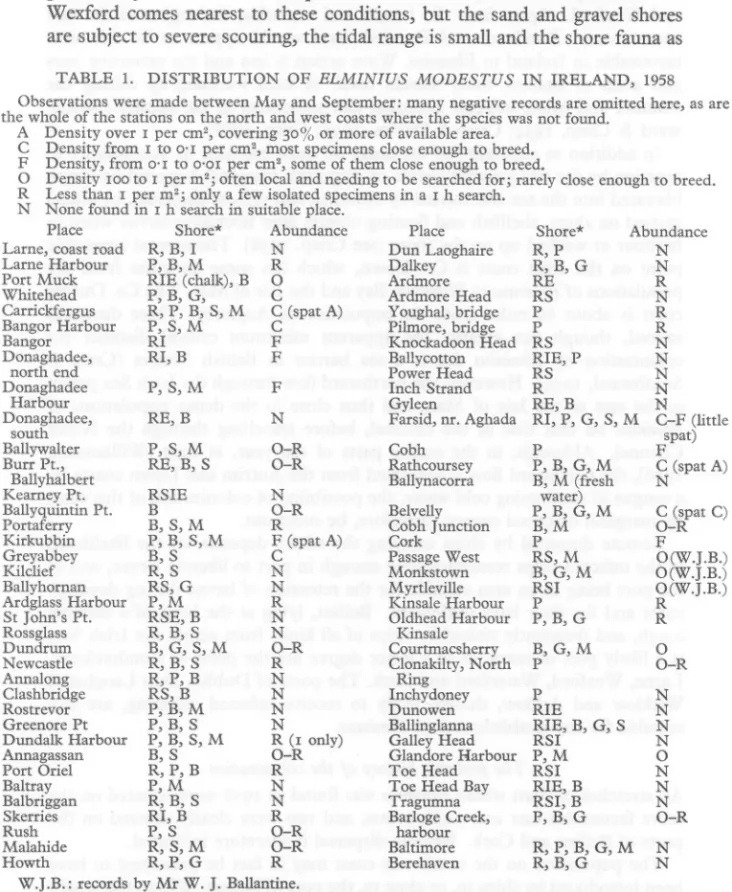
(4) 432. D. J. CRISP AND A. J. SOUTHWARD. by water-currents. In 1957, however, Elminius was reported to be present in small numbers outside Lough Ine, Co. Cork (Beard, 1957), while we were planning another survey. The new survey was made over the whole coast, as well as in the neighbourhood of this record, particular attention being paid to the eastern coast which might be vulnerable to direct infection from the stronger populations now present on the opposite side of the Irish Channel (see p. 429). Full details of localities where Elminius was found in Ireland in 1958 are given in Table I; the distribution on both sides of the Irish Channel is shown in Fig. 1. The whole of the north and west coast, from Glenarm to Bantry Bay, was apparently free of Elminius, even in the vicinity of the ports of Londonderry and Galway. On the south and east coasts there were several distinct regions where Elminius was found. The most northerly colonization extended from Larne Harbour to Newcastle, Co. Down; dense populations were found in Belfast Lough and Strangford Lough, and in places reached one individual per cm2 of surface. South of this strong entrenchment there were two thinly settled patches, one from Dundalk to Port Oriel, another from Skerries to Howth. These settlements nowhere exceeded 100 per m2 and the density was often much less. Farther south along the east coast we did not find any more specimens of Elminius, not even in the busy harbours at Dun Laoghaire, Wicklow, Arklow and Wexford, nor in the estuary at Waterford. The remaining area in which Elminius was found corresponded to that first reported by Beard (1957). The settlement apparently extended from Ardmore to Lough Ine, but the species was common only in the sheltered bays and channels of Cork harbour. Here, in favourable places such as Rathcoursey, populations up to one individual per cm2were sometimes found, with spat settling at the rate of3 per cm2, but over most of this large enclosed area the density did not exceed 0'1 per cm2• No specimens were found at any of the wave-beaten open coast stations in this region. The origin of the Elminius colonization of Ireland Before discussing the way Elminius spread to Ireland it is worth while considering how suitable the Irish coast is for the establishment of the species. By analogy with the known distribution of Elminius in other parts of Europe (see Den Hartog, 1953; Crisp, 1958; Bishop & Crisp, 1958), most of the north and west coasts would be expected to be as unfavourable for the species as are the equally wave-beaten coasts of Cornwall and Brittany. The larger estuaries and bays, such as Lough Foyle, the River Shannon and Bantry Bay should eventually support isolated populations similar to those of the drowned valley systems of Cornwall and Brittany. The south-east and east coasts of Ireland, which are sheltered from swell and the prevailing south-westerly winds might be expected to be more favourable to Elminius, but these shores.
(5) ELMINIUS. MODESTUS. IN THE BRITISH ISLES TO 1959. 433. have nowhere the drowned alluvial coast, termed 'cotes a estuaires' by de Martonne (1935), which in south-east England and the Netherlands is so particularly favourable to the species. The stretch of coast from Wicklow to Wexford comes nearest to these conditions, but the sand and gravel shores are subject to severe scouring, the tidal range is small and the shore fauna as TABLE 1. DISTRIBUTION OF ELMINIUS MODESTUS IN IRELAND, 1958 Observations were made between May and September: many negative records are omitted here, as are the whole of the stations on the north and west coasts where the specieswas not found. A Density over I per em", covering 30% or more of availablearea. C Density from I to 0'1 per ern",most specimens close enough to breed. F Density, from 0'1 to 0'01 per em", some of them close enough to breed. o Density roo to I per m"; often local and needing to be searchedfor; rarely close enough to breed. R Less than I per m"; only a few isolated specimens in a I h search. N None found in I h search in suitable place. Place Shore* Abundance Place Shore* Abundance N Larne, coast road R, B, I N R,P Dun Laoghaire N Lame Harbour P, B, M R R,B,G Dalkey RE R Ardmore Port Muck RIB (chalk), B 0 N Ardmore Head RS Whitehead P, B, G, C R P Carrickfergus R, P, B, S, M C (spat A) Youghal, bridge R P Bangor Harbour P, S, M C Pilmore, bridge N Knockadoon Head RS Bangor RI F N Donaghadee, RI, B F RIB, P Ballycotton north end RS N Power Head F R N Inch Strand P,S,M Donaghadee Harbour N RE,B Gyleen N RE,B Donaghadee, Farsid, nr. Aghada RI, P, G, S, M C-F (little south spat) O-R F Cobh P P,S,M Ballywalter O-R Burr Pt., RE,B,S P,B,G,M C (spat A) Rathcoursey N Ballyhalbert Ballynacorra B, M (fresh Kearney Pt. RSIB N water) Ballyquintin Pt. B O-R C (spat C) P,B,G,M Belvelly O-R Portaferry B, S, M R B,M Cobh Junction P F Cork Kirkubbin P, B, S, M F (spat A) RS,M Greyabbey B, S C o (W.J.B.) Passage West Monkstown Ki1clief R, S N B,G,M O(W.J.B.) RSI Ballyhornan RS, G N O(W.J.B.) Myrtleville P R Kinsale Harbour Ardglass Harbour P, M R R Oldhead Harbour P,B,G St John's Pt. RSE, B N Kinsale Rossglass R, B, S N o Dundrurn B, G, S, M O-R B,G,M Courtmacsherry O-R Newcastle R, B, S R Clonakilty, North P Annalong R, P, B N Ring P N Clashbridge RS, B N Inchydoney RIB N Dunowen Rostrevor P, B, M N N RIE, B, G, S Greenore Pt P, B, S N Ballinglanna RSI N Dundalk Harbour P, B, S, M R (I only) Galley Head Glandore Harbour P,M o Annagassan B, S O-R N RSI Toe Head Port Oriel R, P, B R N RIB,B Baltray P, M N Toe Head Bay N RSI, B Balbriggan R, B, S N Tragumna O-R Skerries RI, B R P,B,G Barloge Creek, harbour Rush P, S O-R N Malahide R, S, M O-R Baltimore R,P,B, G,M N Berehaven R,B,G Howth R, P, G R W.J.B.: records by Mr W. J. Ballantine. * R, rocks (S, steep; I, irregular; E, extensive); B, boulders; G, gravel; S, sand; M, mud; P, artificial substrata..
(6) 434. D. J. CRISP AND A. J. SOUTHWARD. a whole is impoverished (Southward & Crisp, 1954). Under such conditions it is unlikely that Elminius would be common on the open coast, although it would be expected to be present in areas of sheltered water such as at Rosslare and Wexford. Apart from the loughs and estuaries, the region of the east coast around Dundrum and Dundalk bays would appear to be the most favourable in Ireland to Elminius. Wave action is less and the extensive bays and areas of shallow water should result in local warming-up during the summer and hence increase breeding and settlement of the species (Southward & Crisp, 1954; Crisp & Davies, 1955; Crisp, 1958). In addition to suitability of the coast we must consider its accessibility to invasion by the two possible means of dispersal: marginal dispersal by larvae liberated into the sea and carried by currents, and remote dispersal, by adults carried on ships, shellfish and floating objects later liberating larvae when in harbour or washed up on the shore (see Crisp. 1958). The nearest accessible point on the Irish coast is Co. Down, which lies some 40 miles from the populations of Elminius in Wigtown Bay and the Isle of Man. The Co. Dublin coast is about 60 miles from the population in Anglesey. These distances exceed, though not greatly, the apparent minimum critical distance for colonization by Elminius across a sea barrier in British Waters (Crisp & Southward, 1953). However, the northward flow through the Irish Sea passes to the east of the Isle of Man, and thus close to the dense populations of Elminius on that side of the channel, before travelling through the North Channel. Although, in the earlier parts of the year, at least (Williamson, 1956), the northward flow is separated from the Antrim and Down coasts by a tongue of southgoing cold water, the possibility of colonization of this coast by marginal dispersal cannot, therefore, be ruled out. Remote dispersal by ships carrying the adults depends on the likelihood of the infected ships remaining long enough in port to liberate larvae, and of the port being in an area suitable for the retention of larvae during development and for their later settlement. Belfast, lying at the head of a suitable lough, and frequently visited by ships of all kinds from across the Irish Sea, is a likely port of entry, as to a lesser degree are the ports of Londonderry, Lame, Wexford, Waterford and Cork. The ports of Dublin, Dun Laoghaire, Wicklow and Arklow, though likely to receive infected shipping, are less suitable for the establishment of Elminius. The pr~bable history of the colonization. All stretches of coast where Elminius was found in 1958 were situated on the more favourable east and south coasts, and two were clearly centred on the ports of Belfast and Cork. Remote dispersal is therefore indicated. The population on the north-east coast may in fact be presumed to have been introduced by ships in, or c~oseto, the port of Belfast. Within the lough, the size-groups of adult barnacles indicated an initial settlement prior to 1957..
(7) ELMINIUS. MODESTUS. IN THE BRITISH ISLES TO 1959. 435. The other dense population, in this region, in Strangford Lough, may be presumed to have been colonized by marginal dispersal from Belfast, and subsequently increased within the lough. If we assume that the open coast and the other loughs were also settled by marginal dispersal from Belfast Lough, the maximum spread northwards has been little more than 10 miles, whereas to the south it has extended to Newcastle, some 40 miles down the coast. This relative failure of the species to extend northwards may be ascribed to the presence of the south-going current along the Antrim and Down coasts. In addition, the region north of Belfast Lough experiences lower sea temperatures which would discourage an animal such as EZminius which depends on high summer temperatures for rapid breeding (Crisp & Davies, 1955). In contrast, conditions south of Strangford Lough would appear much more suitable for EZminius, as for the several southern forms that occur there in some abundance (Southward & Crisp, 1954). In general, the whole of the Antrim coast north of Belfast Lough seems unsuitable for barnacles; the native species are often sparse, and may rarely be present at all on the predominantly chalk rocks. It is worth noting that similar factors to these, viz. south-going currents, lower temperatures and less favourable substrata, are believed to have prevented the extension of EZminius north of the Humber on the east coast of England since 1950 (Crisp, 1958). The areas of colonization lying between the Belfast settlement and Dublin Bay are smaller and more thinly populated than the other Irish populations. The main reason for regarding them as distinct from Belfast centre is that no trace of settlement was found in Carlingford Lough. This lough appears to offer as suitable an environment as Belfast Lough or Strangford Lough, and it is difficult to believe that marginal dispersal along the coast could have reached Dundalk without some larvae entering Carlingford Lough and establishing themselves there. Similar, but less cogent, arguments can be applied to the gap separating the two minor settlements, for the mouth of the River Boyne and the port of Balbriggan would seem to be no less suitable than the settled harbours of Port Oriel and Skerries on either side. In both areas of settlement the population density was so low that few, if any, individuals could have been capable of breeding. It is therefore difficult to account for these settlements unless there exists one or more centres of dispersal not discovered during the survey, containing individuals close enough to breed. There is a distinct possibility that these sparse settlements might have been derived from numbers of small craft which had become infected in other ports, and one such vessel, carrying many adult specimens was indeed observed at the quayside in Howth, where EZminius was scarce. The difficulty in accepting this possibility of multiple dissemination is that EZminius was entirely absent south of Howth. The harbours at Dun Laoghaire, Bray, Wicklow and Arklow would be expected to receive as many infected craft as.
(8) D. J. CRISP AND A. J. SOUTHWARD. the smaller and more exposed harbours of Port Oriel and Skerries. Further investigations after the passage of time may allow the correct interpretation to be chosen from these alternatives. The most widespread settlement of Elminius in Ireland, that in the southwest, shows every sign of having arisen from an initial introduction somewhere in the sheltered channels and inlets of Cork harbour. From this area it has extended over 40 miles to the west but little more than 20 miles eastward: here again we have the possibility of a coastal current, this time from the east, influencing the dispersal of larvae. On account of the exposed nature of the coast, the spread has been confined to enclosed bays and harbours, as on the Cornish coast. In the case of the Cork settlement, we are fortunate in having two means of estimating, albeit very approximately, the probable date of introduction of Elminius. The rate of spread along a coast of similar type, that of south Devon and Cornwall, is of the order of 10-IS miles a year (Crisp, 1958). Measuring from the Lough Ine and Glandore settlements, this would place the original entry some time in 1955. Further evidence was obtained from settlements present on piles which had been removed from the estuary just downstream of Cork, and were lying on the bank. According to local workmen the piles had been removed at various times, some that year, some in 1957, and some as early as 1956, but unfortunately they had not been kept separate. The oldest looking piles had lost all growth, but others had a mixed population of Balanus improvisus and Elminius modestus still attached, the latter at densities of up to 0'03 per cm2• Many of the Elminius measured 9-10 mm diameter, and must therefore have settled in 1957, probably quite early in the season, and certainly in considerable numbers. This evidence suggests that the original settlement must have been present as long ago as 1956, and possibly earlier. Elminius was absent (or present in numbers too small to be revealed by survey) in 1952 when we inspected several stations in Cork harbour, and in 1953 when Dr J. R. Lewis examined the same area. From the two independent estimates, and the negative records, it seems reasonably probable that Elminius was established between 1954 and 1956. This original population must have been introduced by remote dispersal, since Cork harbour is far removed from any other locality where Elminius is plentiful. SUMMARY. Since 1956, Elminius modestus, the immigrant Australasian barnacle, has increased its range and abundance along the west coast of Britain. At the same time it has established itself in Ireland, and is now common in two areas, centred on Belfast and Cork, respectively. Both areas have been independently colonized since 1953, the former probably and the latter certainly by remote dispersal on ships. Two further sparse settlements were discovered on.
(9) ELMINIUS. MODESTUS. IN THE BRITISH ISLES TO 1959. 437. the east coast of Ireland from Dundalk to Howth, but further evidence is needed to determine whether these finds represent a southerly extension of the Belfast population, or independent invasions. REFERENCES BEARD, D. M., 1957. Occurrence of Elminius modestus Darwin in Ireland. Nature, Lond., Vol. 180, p. 1145. BISHOP, M. W. H. & CRISP, D. J., 1958. The distribution of Elminius modestus Darwin in France. Proc. zool. Soc. Lond., Vol. 131, pp. 109-34. CRISP, D. J., 1958. The spread of Elminius modestus Darwin in north-west Europe. J. mar. bioI. Ass. U.K., Vol. 37, pp. 483-520. CRISP, D. J. & DAVIES, P. A., 1955. Observations in vivo on the breeding of Elminius modestus grown on glass slides. J. mar. bioI. Ass. U.K., Vol. 34, pp. 357-80. CRISP, D. J. & SOUTHWARD,A. J., 1953. Isolation of intertidal animals by sea barriers. Nature, Lond., Vol. 172, p. 208. DEN HARTOG, C., 1953. Immigration, dissemination, and ecology of Elminius modestus Darwin in the North Sea, especially along the Dutch coast. Beaufortia, Vol. 4,. PP·9-20. MARTONNE, E. DE, 1935. Traiti de Giographie Physique. Paris. SOUTHWARD,A. J. & CRISP, D. J., 1954. The distribution of certain intertidal animals around the Irish Coast. Proc. R. Irish Acad., Vol. 57, Sect. B, No. 1,29 pp.. Note added in proof One of us (D.J.C.) was able to re-examine part of the north and east coasts of Ireland during a brief visit in July 1959, and Elminius was found at the following stations (to be added to Table I): Londonderry, main channel in L. Foyle Dublin, North Wall. R, P, M P, M. R O-F. The species seemed well-established at Dublin, with a fresh spatfall of 2-3 per cm2; this confirms the existence of a separate invasion of the Co. Dublin area. The record for L. Foyle cannot be regarded as establishing the species in that area. Only three old specimens of Elminius were found, all on piles marking the channel, while none were present on the rocks along the shore. This clearly represents a sporadic settlement, probably derived from infected ships..
(10)
Figure
Related documents
This essay asserts that to effectively degrade and ultimately destroy the Islamic State of Iraq and Syria (ISIS), and to topple the Bashar al-Assad’s regime, the international
This conclusion is further supported by the following observations: (i) constitutive expression of stdE and stdF in a Dam + background represses SPI-1 expression (Figure 5); (ii)
After successfully supporting the development of the wind power technology, an approach is needed to include the owners of wind turbines in the task of realizing other ways, other
19% serve a county. Fourteen per cent of the centers provide service for adjoining states in addition to the states in which they are located; usually these adjoining states have
Assessing the Impact of Biodiversity Conservation in the Management of Maize Stalk Borer (Busseola f
Field experiments were conducted at Ebonyi State University Research Farm during 2009 and 2010 farming seasons to evaluate the effect of intercropping maize with
Para realizar la aproximación propuesta se han empleado los datos eXistentes en el observatorio de la zona de trabajo únicamente temperaturas y una expresión de cálculo que
Half of the participants also stated that the search feature for locating photos is never used as they lack trust and confidence in search and they are sure that using search
We next examined the effect of PIP silencing on the proliferation of breast cancer cells using MTT (3-[4,5-dimethylthiazol-2-yl]-2,5 diphenyl tetrazolium bromide) assay and observed
