Why Do Authors
Use Text Features?
B. Burke 2
Text Features Sticker Lesson
Use this lesson as an introduction or review of what text features are and why authors use them.
IRA/NCTE Standard
Students apply a wide range of strategies to comprehend, interpret, evaluate, and appreciate texts. They draw on their prior experience, their interactions with other readers and writers, their knowledge of word meaning and of other texts, their word identification strategies, and their understanding of textual features (e.g., sound-letter correspondence, sentence structure, context, graphics).
Student Objective
Students will analyze nonfiction text in order to determine why authors use a variety of text features.
Materials
Blank “Text Feature Sticker Chart” per group One column of text features stickers per group
Several texts which feature a variety of text features (text books, magazines, etc.)
Activity
1. Activate prior knowledge by asking students what they know about text features. Students will probably list the text features they know.
2. Tell students that today they are going to look at different kinds of text features to find out why authors use them when they are creating stories and other texts.
3. Assign students to work together in cooperative teams of 2-4. Distribute column of stickers and blank Text Feature Sticker Chart to each group. Model selecting the first sticker and use a think-aloud to determine which column is the best fit for it. (SAY: the first sticker is large bold print. Let me see… I don’t’ think it helps readers visualize, because it’s letters, not pictures. It doesn’t really help organize either. And while something in bold print can explain or define something, it doesn’t have to, so I don’t think it goes under “Informational Aids.” Bold print does help you find the words in bold quickly, so I’m going to put it under “Print Aids.”)
4.
Groups sort the text feature stickers according to their purpose. They may use the texts to help them decide where to place the text features.Assessment
Review the charts and discuss why stickers were placed in each category. (See the answer key on page 5.)
Extensions
Post the “Text Features” poster in your room for students to refer to.
Use the stickers to label the text features in a copy of a text. Students can decide how well the author used text features, which text feature is most helpful, what other text features could be included, etc.
B. Burke 3
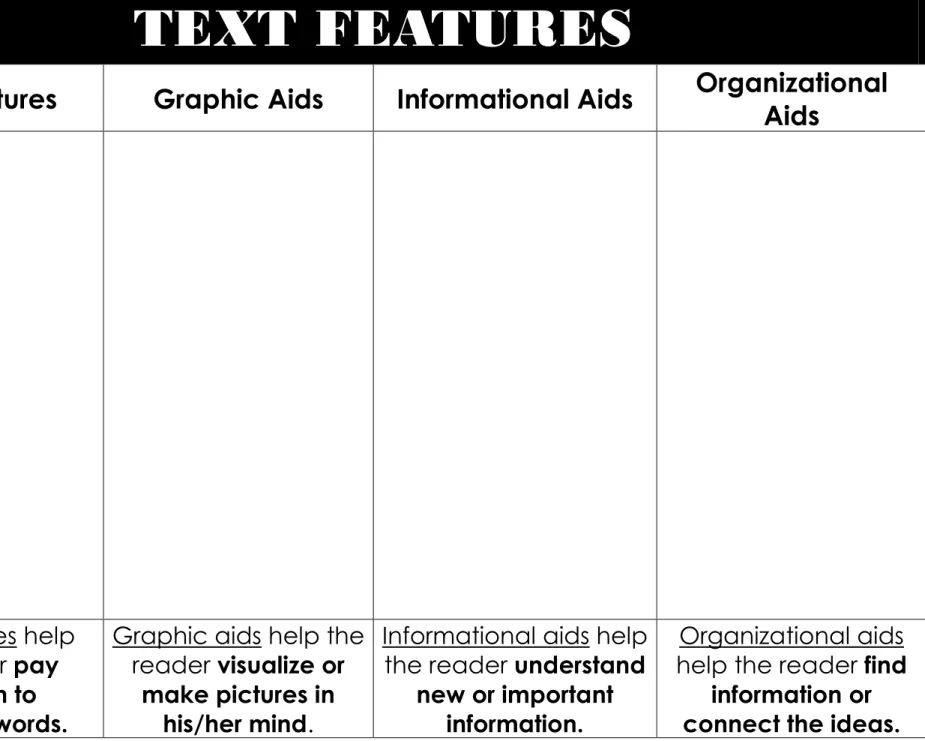
TEXT FEATURES
Print Features
Graphic Aids
Informational Aids
Organizational
Aids
Print features help
the reader
pay
attention to
important words.
Graphic aids help the
reader
visualize or
make pictures in
his/her mind
.
Informational aids help
the reader
understand
new or important
information.
Organizational aids
help the reader
find
information or
connect the ideas.
B. Burke 4
Avery 8167 labels—one column per group or student
large bold print
large bold print
large bold print
large bold print
illustrations/
pictures
illustrations/
pictures
illustrations/
pictures
illustrations/
pictures
materials list
materials list
materials list
materials list
titles
titles
titles
titles
font size/type
font size/type
font size/type
font size/type
photographs
photographs
photographs
photographs
labels/
captions
captions
labels/
captions
labels/
captions
labels/
headings/
subheadings
subheadings
headings/
subheadings
headings/
subheadings
headings/
numbered steps
numbered steps
numbered steps
numbered steps
italics
italics
italics
italics
maps
maps
maps
maps
timelines
timelines
timelines
timelines
table of contents
table of contents
table of contents
table of contents
transition words
transition words
transition words
transition words
underlining
underlining
underlining
underlining
charts or tables
charts or tables
charts or tables
charts or tables
introductions
introductions
introductions
introductions
glossary
glossary
glossary
glossary
graphs
graphs
graphs
graphs
boxed text
boxed text
boxed text
boxed text
B. Burke 5
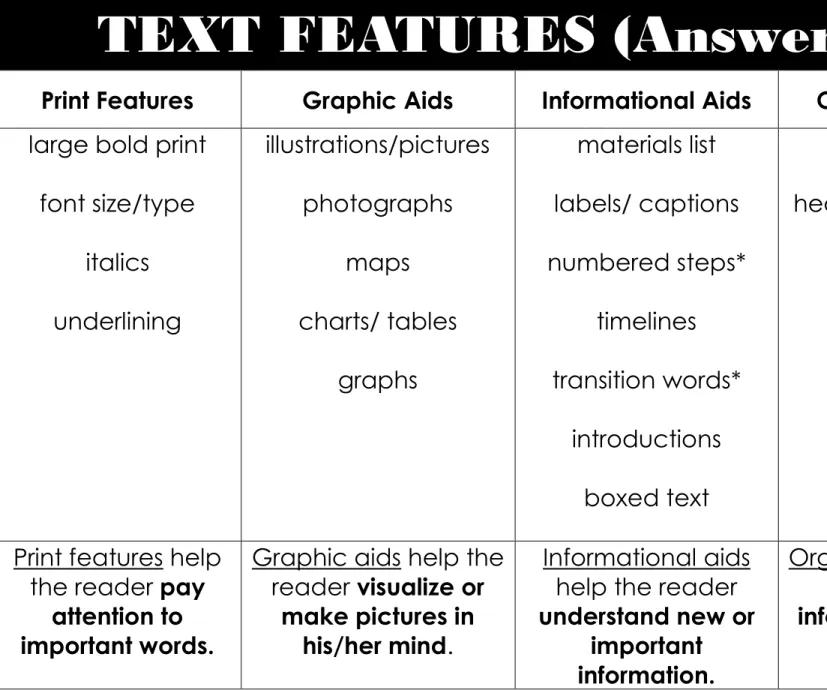
TEXT FEATURES (Answer Key)
Print Features
Graphic Aids
Informational Aids
Organizational Aids
large bold print
font size/type
italics
underlining
illustrations/pictures
photographs
maps
charts/ tables
graphs
materials list
labels/ captions
numbered steps*
timelines
transition words*
introductions
boxed text
titles
headings/ subheadings
numbered steps*
table of contents
glossary
transition words*
Print features help
the reader
pay
attention to
important words.
Graphic aids help the
reader
visualize or
make pictures in
his/her mind
.
Informational aids
help the reader
understand new or
important
information.
Organizational aids help
the reader
find
information or connect
the ideas.
B. Burke 6
TEXT FEATURES
Features
Graphic
Aids
Informational
Aids
Organizational
Aids
Features
Online
large
bold
font
size
/
type
italics
quotation
marks
underlining
punctuation
illustrations
photographs
drawings
sketches
cartoons
maps (key,
scale, legend)
graphs
charts/tables
diagrams
introductions
overviews
materials list
timelines
captions
labels
numbered steps
bulleted lists
footnoted
words
pronunciation
key
transition words
boxed text
end notes
works cited
titles
chapter titles
headings
subheadings
tables of
contents
numbered
steps
glossary
index
transition
words
URL’s
hypertext
links
sidebars
dropdown
menus
home pages
site maps
B. Burke 7
Name
Date
Written Response to Reading: Text Features
Identify one text feature in this set of directions. Explain how this text feature
makes the information easier to understand. Use details from the set of
directions in your explanation.
Reading Response Rubric
Scorepoint: 3
To achieve a 3, a response must:
Identify one text feature
Explain how this text feature makes the information
easier to understand
B. Burke 8