? ?
?
? ?
?
Your
Community-Based
Program
Putting Your Evaluation Plan to Work
Part II
A publication of the American Academy of Pediatrics
A Cooperative Agreement Program of the Federal Maternal and Child Health Bureau and the American Academy of Pediatrics
its support and leadership in implementing the Healthy Tomorrows Partnership for Children Program. We would like to acknowledge the District Community Access to Child Health Facilitators for their ongoing oversight of the program and for reviewing the manual. We would also like to thank the additional reviewers: Karla Palmer, Lynn Olson, Burke Eilers, Jim Tehan, Alina Bueno Nadsady, and Richard Wilson. Lastly, we would like to give special thanks to the authors of this guide: Holly Ruch-Ross, Nita Patel, and Nicole Miller.
Copyright © 2008
This publication was supported by the American Academy of Pediatrics (AAP) Healthy Tomorrows Partnership for Children Program/Cooperative Agreement # U50MC07618 from the Maternal and Child Health Bureau (MCHB). Its contents do not necessarily represent the official views of the MCHB or AAP. Permission is granted to reprint information contained in this publication as long as it is properly attributed to the American Academy of Pediatrics.
Introduction
. . . . 3A Quick Review of Part I: Evaluating Your Community-Based
Program: Designing Your Evaluation
. . . . 5What Is Evaluation? . . . . 6
Why Evaluate? . . . . 7
The Evaluation Plan: Goals, Objectives, and Outcomes . . . . 7
The Logic Model . . . . 8
What’s Next? . . . . 8
After the Logic Model: Gathering Information
. . . . 11Deciding What Information You Need to Gather . . . . 11
Source: Gathering Information on Your Outcomes . . . . 19
Selecting the Right Tools
. . . . 23Using an Existing Tool . . . . 24
Finding Existing Tools . . . . 24
Designing Your Own Tools . . . . 27
Planning Data Collection
. . . . 31Follow-up and Tracking . . . . 35
Managing Your Data
. . . . 37Data Handling and Storage . . . . 37
Analyzing Your Data
. . . . 39Quality of Data . . . . 39
Data Analysis . . . . 40
Descriptive Analysis . . . . 43
Comparing Groups . . . . 44
Change over Time . . . . 45
Comparison Information . . . . 46
Analyzing Qualitative Data . . . . 47
Using Your Findings
. . . . 49Making Decisions with Your Data . . . . 49
Presenting Your Findings . . . . 51
Conclusion
. . . . 53Glossary
. . . . 55Appendix A: Evaluation Resources
. . . . 59Introduction
Community-based programs and their community partners are increasingly interested in evaluating the work that they do in their communities . The interest may be externally driven, such as funders’ requirements or the need to prove “value” to community leaders, or it may be internally motivated, such as the need to obtain new funding to expand or sustain services or simply the desire to explore program effectiveness and improve quality . There is growing evidence that program sustainability is supported by carefully planned and well-implemented program evaluation . However, few
community-based programs begin with the resources or expertise to conduct a good program evaluation . This publication is the second of a two-part guide to program evaluation developed by the American Academy of Pediatrics (AAP) for Healthy Tomorrows Partnership for Children Program grantees and applicants . It is also intended to be useful to pediatricians and others implementing community-based programs . The purpose of the guide is to provide quick overviews of major issues in program evaluation and to point you toward the broad array of resources for high-quality program evaluation that are available . After reading Evaluating Your Community-Based Program—Part II: Putting Your Evaluation Plan to Work, you will be able to:
1
Identify ways to measure progress on your goals and objectives .2
Select tools and strategies for collecting information you need to evaluate your program .3
Analyze and present your information in a meaningful and useful way .4
Know where to go for additional information on these topics .Part I of this guide, Designing Your Evaluation, focused on understanding and planning a good evaluation . Part II emphasizes effective documentation to evaluate your program . It is also intended to help you decide how to measure progress on your objectives and collect, analyze, and present the resulting data meaningfully and efficiently .
The guide is structured in a workbook format, so there is space to apply each concept to your project as you go along . Each section also includes a case study example to demonstrate how evaluation ideas within a single program will develop over time .
We have included a glossary and appendix of additional resources at the end of this installment . Terms that appear in bold italics throughout this guide are defined in the glossary . We’ve also included Jargon Alerts in relevant sections to help you understand unfamiliar terms .
A Quick Review of Part I
Evaluating Your Community-Based Program:
Designing Your Evaluation
Part I of this guide is titled Evaluating Your Community-Based Program: Designing Your Evaluation . In this first volume, readers learned to:
1
Understand the roles evaluation plays in program design and improvement .2
Understand the importance of stakeholder input and involvement in evaluation design .3
Define the outcome(s) a program plans to accomplish .4
Complete a logic model for a program .5
Know where to go for additional information on these topics .We recommend reviewing Part I of Evaluating Your Community-Based Program guide as a foundation for the information in Part II . It is available on the Web site of the American Academy of Pediatrics, www .aap .org/EvalResources or by either calling the AAP Division of Community-based Initiatives at 847/434-7085 or e-mailing healthyt@aap .org .
What Is Evaluation?
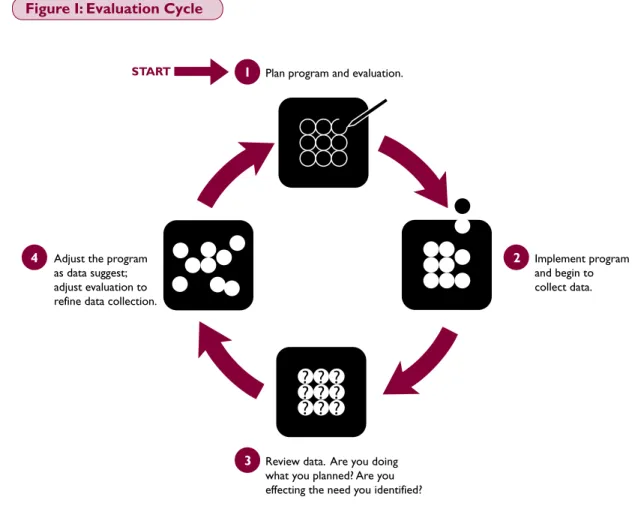
For purposes of this guide, evaluation is defined as an ongoing process of systematic assessment of your program to provide information needed for making decisions . Evaluation is distinct from other forms of research in that it is action-oriented, seeking to provide information that is useful for decision making relevant to program development and improvement . We see evaluation as a cycle:
You will often see a distinction drawn between process evaluation and outcome evaluation . Process evaluation answers the question, “Are we completing the activities or providing the services that we
believe lead to the changes we desire?” In other words, is your program proceeding as planned? Process evaluation examines the implementation of your program . Outcome evaluation seeks to answer the
question, “Is my project making a difference?” Outcomes try to describe the impact of a program on
a community beyond the point of service . In our view, both aspects of evaluation are integral to good program management .
Plan program and evaluation.
START
? ?
?
? ?
?
? ?
?
1Review data. Are you doing what you planned? Are you effecting the need you identified?
3
Implement program and begin to collect data.
2
Adjust the program as data suggest; adjust evaluation to refine data collection.
4
Why Evaluate?
Although programs vary in their need for information and the decisions that program managers must make, most programs will have the following evaluation needs:
1
Check Your Process: Confirm that you are doing what you said you would do .2
Determine Your Impact: Check that you are having the desired effect in the target population .3
Build Your Base of Support: Generate information and evidence to share with funders and other stakeholders .4
Justify Replication: Find evidence to support the expansion or replication of this program . Almost everyone who has a vision for your project and is interested in finding out whether it “works” should be involved in planning your evaluation .The Evaluation Plan: Goals, Objectives, and Outcomes
A good evaluation plan begins with clear goals that describe what you want to achieve . Your goal
statement articulates what your program would like to accomplish in relation to a specific problem and target population . Once you are clear about the goal or goals of your program, you can define your
objectives, or the steps you will take in your efforts to achieve your goal . Good objectives are SMART:
Specific, Measurable, Achievable, Realistic, and Time specific .
Clear goals are essential for both program implementation and evaluation, but tracking your progress requires identification of outcomes . Outcomes are measurable changes that occur beyond the point of service or intervention that reflect the logical and desired result of your services .
The Logic Model
The logic model is a tool that has been adapted from a business model developed to explain the logical
relationship from strategy to return on investment . It is widely used in social service fields and by some government agencies to facilitate program planning, implementation, and evaluation . Your logic model provides a snapshot of your program and serves as a single-page summary of your program that is easily shared with staff, boards, and funders . The development of a logic model is in itself often a valuable consensus-building process.
What’s Next?
This second part of Evaluating Your Community-Based Program is intended to take you from your logic model and evaluation plan through the process of identifying measures, selecting strategies for collecting and analyzing information, and presenting your results .
Target Population
The characteristics of people or communities you work with and the needs they present
Age, gender, socioeconomic status, ethnicity, language, geographic location, low health care use, high cancer incidence, lack of mental health information, etc.
Inputs
The resources required for this program to operate
Money, staff, volunteers, facilities, etc.
Activities
Strategies you use or services you provide to try to achieve your goal
Provide training, counseling, education, screenings, referrals, develop materials, etc.
Outputs
Basic data on program participation
Number of participants attending training, number of counseling sessions, etc.
Outcomes
Desired changes in the target population as a result of program activities
Changes in knowledge, attitude, behavior, health status, health care use, incidence, prevalence, etc.
EXAMPLES
C
ASE STUD
Y
In Designing Your Evaluation, we met Sarah, the director of the Prevention First Program . Sarah and her program went through the same process you need to go through to specify your program and develop your evaluation plan .1
Sarah is the program director of the Prevention First Program, located at a large multiagency collaborative in an immigrant community. The community experiences high mobility, is very low income, speaks limited or no English, and has low rates of utilization of preventive health care services. Residents have come to this country from a variety of cultures. Sarah’s program intends to bring together the variety of resources and expertise present in the collaborative to try to facilitate the use of preventive health care by this community and to increase public awareness of the many free, nonemergency health and dental services available in the community.
In Part I of this guide, we followed Sarah and her staff as they developed the goals and objectives of the Prevention First Program.
Prevention First Program Goals:
1
Immigrant families will understand the importance of prevention.2
Immigrant families will use preventive health services. Prevention First Objectives:1
Within the first 6 months of the project, we will conduct a focus group with immigrant parents to explore possible barriers to the use of prevention services.2
By the end of year 1, we will have made presentations to staff of at least four agencies serving immigrant families to promote preventive health services and encourage referrals.3
By the end of year 1, participating immigrant families will schedule and complete an increased number of well-child visits over baseline.Based on these goals and objectives, Sarah and her staff developed a logic model for the Prevention First Program. The logic model summarizes the program by specifying the target population and identified needs, the inputs and activities of project staff, and both program outputs and anticipated outcomes for the target population. This logic model serves as the foundation for evaluation planning for the Prevention First Program.
1 This case study represents a hybrid of common experiences among many projects, but it is fictional . Any similarity to an actual project is
C
ASE STUD
Y
Prevention First Logic Model
We will continue to follow Sarah in Putting Your Evaluation Plan to Work, as she and her staff make decisions about measurement, data collection, analysis, and presentation of information about her program .
Target Population and Needs
• Low-income, limited English-speaking immigrant community, with Spanish, Polish, Portuguese, and French as the primary languages • Low use of health
care coverage • Low use of
preventive health services
• Living primarily within the same 4 square mile area known as “First Stop” • Mostly employed
in temporary and/or part-time labor positions • Mostly from cultures
without preventive medicine or health care practices
Inputs
• Coalition members, director, and two interns
• Funding (foundation, local, and state) • Computers and
software
• Prevention education curriculum and volunteer health educators • Prevention media • Verbal and written
translation
Activities
• Health care use intake, collected verbally and language appropriate: brief format in nontraditional settings or full intake in traditional settings • Complete
registration for health care coverage in community settings for new and lapsed families • Prevention education
sessions held in community settings • Preventive health
services offered regularly in nontraditional community locations • Conduct focus
groups
• Regular tracking of health care coverage and preventive service use
Outputs
• Number of new families signed up for health care coverage monthly
• Number of lapsed coverage renewed monthly
• Number who attended prevention education monthly • Number of
preventive health care services contacts in nontraditional settings • Number of
preventive health services contacts in traditional (clinic) settings
• Number of focus groups conducted
Outcomes
• Immigrant families will understand the importance of preventive health care services. • Participating
immigrant families will schedule and complete an increased number of well-child visits. • Immunization rates
will increase among children in the target population.
• The number of workdays or school days missed due to illness will decrease.
After the Logic Model: Gathering Information
Deciding What Information You Need to GatherVirtually all programs need to gather information to be able to serve their target populations and their communities . If your logic model reflects your program well, it already lists much of the information you need to collect . You will need information to serve two broad purposes: documenting process and assessing outcomes .
Documenting process. Keeping track of what comprises the program is fundamental to program evaluation . Process evaluation allows you to describe your program, which makes outcome evaluation meaningful and replication of the program possible . Usually, program staff know that they need to keep track of the services they are delivering . This is the beginning of documenting program process . Process documentation will help you answer questions such as:
• Is program implementation going as planned? • How many people are receiving services? • Who is receiving services?
• What services are people receiving?
• How many people are we referring to other providers?
Process documentation helps you describe what you are doing and with whom you are doing it . It is also essential for fine-tuning your program . The most useful process documentation is collected in a consistent manner using a well-planned system of data collection . If your logic model reflects your program well, much of the information you will want to collect for your process evaluation will be listed in the third and fourth columns as activities and outputs .
C
ASE STUD
Y
Sarah and the Prevention First Program staff knew that process evaluation would be critical to understanding the results of their interventions. They used their logic model to list the activities and outputs they needed to document and their plan for documenting each. As they developed the record-keeping system and forms they would use, the staff ensured that each of these items was included.
Activities
Health care use intake, collected verbally and language appropriate: brief format in nontraditional settings or full intake in traditional settings Complete registration for health care coverage in community settings for new and lapsed families
Prevention education sessions held in community settings
Preventive health services offered regularly in nontraditional community locations
Focus groups
Regular tracking of health care coverage and preventive service use
Outputs
Number of completed intake forms
Number of new families signed up for health care coverage monthly; number of lapsed coverage renewed monthly
Number who attended prevention education monthly
Number of preventive health care services contacts in nontraditional settings
Number of focus groups conducted Number with access to services and use of services
Documentation Plan
Count number of forms completed
Case notes; count coverage applications
Group participation logs (sign in) Case notes; contact forms
Count focus groups
Tracking system—family health care coverage; use of preventive services
Now it’s your turn to identify the process information that you must collect in order to document your program . You can fill in your activities and outputs from your logic model, and then think about what you have or need to collect for each .
Activities Outputs Documentation Plan
W
ORKSP
A
So You Thought You Were Done with Needs Assessment?
Documenting your program may involve additional or even ongoing community assessment . When you wrote a grant proposal to fund your project, you presented information about your community to establish the need for the services you were proposing . But this is not the end of our need for community assessment . As your program evolves, you will find yourself asking questions such as these:
• How do I let my target population know about the services we offer? • How can I develop trust with the people in my target population?
• What strengths (assets) in the families in this community will facilitate use of our services? • Are there language, transportation, or other barriers that, unaddressed, will limit our target
population’s use of our services?
These and other questions related to what services are needed and how to get needed services to the right people require ongoing community assessment . This may take the form of finding existing information compiled by someone else (such as your health department or local school district) and will also likely include informal information gathering (such as reading the local newspaper or talking to community leaders) . It may also require structured data collection by your program (such as household surveys, focus groups, and observations at community gatherings) . Most of this kind
of information will bear directly on the first column of your logic model, where you identified your target population and its needs .
SIDEB
Assessing outcomes. You are trying to effect a change in your community; this is the reason you designed your program in the first place . In the fifth column of your logic model, you have listed your outcomes, or the desired changes in the target population . To see whether your program is succeeding, you will need to know whether these outcomes are being achieved . This means that you will need a way to measure the changes that you hope are occurring . This is the focus of your outcome evaluation . For some common problems there are standards in the field for what is considered a positive outcome . For example, in a program to reduce the incidence of childhood lead poisoning, a reduction in blood
lead levels in your program participants to within acceptable standards would be a certain indicator of success . If your program is working to address this type of issue, then your measure of success has already been defined for you . Your measurement challenges will involve ensuring that measures are timely and appropriately administered, but you will not have to struggle with the question of what to measure . Unfortunately, outcomes are not always easy to measure directly . Desired outcomes are often longer term than the project itself or involve concepts that are not directly observable . It may be simply unrealistic, within the context of a given program and the resources available, to measure the desired outcomes . In these circumstances, we often have to settle for measurement of an indicator of progress toward the achievement of our desired outcome . Indicators are approximations of desired outcomes
that can be measured when the outcome cannot . Like good objectives, indicators need to be SMART (specific, measurable, achievable, realistic, and time specific) . An indicator may represent an intermediate step toward the achievement of an outcome, such as school attendance as an indicator of progress toward high school graduation . Often, an indicator is an effort to capture a construct that is not directly observable, such as self-esteem or anxiety .
JARGON
ALER
T Indicator
Indicatoris a measurable intermediate
step or other approximation of an outcome. An indicator is used when the outcome itself is difficult to measure directly and/or difficult to measure during the time frame of the project.
C
ASE STUD
Y
Sarah and the Prevention First Program staff included four outcomes in their logic model. Sarah examined the literature and talked to both colleagues and people in her community. Using the information available in their field, the Prevention First Program staff identified an indicator for each of the outcomes.
Prevention First Program Outcomes and Indicators
Now it’s your turn to think about indicators for your program outcomes . Can you identify a measurable indicator for each of the outcomes your program seeks to accomplish?
Outcomes and Indicators Outcome
Immigrant families will understand the importance of preventive health care services.
Participating immigrant families will schedule and complete an increased number of well-child visits.
Immunization rates will increase among children in the target population.
The number of workdays or school days missed due to illness will decrease.
Indicator
Family rating of the importance of preventive health care after 6 months of program participation
Number of well-child visits among children from participating families in the first and second years of the program
Change in immunization rate 2 years after program is implemented
Participant report of missed days after 1 and after 2 years of program participation
Outcome Indicator
W
ORKSP
A
Comparison information. Another area in which programs are frequently challenged is in identifying good comparison information. If you are hoping to
document change in an indicator, you may need to collect baseline information on participants upon their
entry into the program . This baseline information provides something against which you can compare participant outcomes after they have participated in the program . Although not generally regarded as conclusive proof, participant change in the desired direction provides some evidence for your program’s effectiveness . The “gold standard” for comparison is the randomized clinical trial, which controls for many of the factors
that undermine your ability to make the case for the effectiveness of your intervention .
JARGON ALER T JARGON ALER T Comparison information
Comparison information is
information against which program information can be compared, usually to assess whether program participants are in some way different from other populations or to assess their status after program participation. Participants might be compared based on their characteristics or on some indicator of progress or outcome.
Baseline
Baseline refers to information about
the target population or community collected before the intervention begins. Baseline information on indicators and outcomes is useful in examining whether there has been a change in the target population.
!
!
Are you having trouble keeping your outputs, outcomes, and indicators straight?
Output
Direct products of program activities
Reflect program implementation Example: Parents attend an oral hygiene training session.
Outcome
Changes in the target population that result from the program Reflect program impacts Example: Young children are free of dental caries.
Indicator
Intermediate step or approximation of an outcome Reflect steps toward program impacts or proxy measures Example: Parents have knowledge of oral hygiene practices.
SIDEB
But randomly assigning participants to treatment (your program) and no treatment conditions is challenging in most service delivery settings, and following a control group is simply beyond the resources of most program budgets . Although none meet the standard of the randomized clinical trials, programs may have other options for obtaining some comparison information: • Pretesting and posttesting, which usually test for
changes among program participants in knowledge, attitude, or self-reported behavior (Each program participant serves as his or her own control .)
• A convenience sample, which uses another group in the
community on whom data are or can be collected to compare with program participants • National, state, or local data
• A benchmark, or absolute standard, against which program results can be compared
The great benefit of having comparison information is that it controls for some of the factors that may affect your results . Of particular salience in the case of a community-based program are:
• History, or things that happen in your community outside of your project . For example, if a new state law makes it more difficult for families to prove eligibility for a service you provide, that will almost certainly affect your program and its participants .
• Passage of time, or the natural maturation process that occurs over time . Natural maturation is almost always an issue for programs that provide services to children . In a perhaps slightly silly example, rarely will anyone be surprised or impressed if your program is able to prove that children’s height increases after a year of program participation!
• Selection bias, the bias introduced based on who is missed in your service delivery or data collection . A brief telephone follow-up survey of program participants, for example, will miss anyone who does not have a telephone or who has recently changed his or her phone number . It is not always immediately obvious when selection is occurring, but it is often the explanation for findings that are odd or difficult to explain .
JARGON
ALER
T Randomized clinical
A randomized clinical trial is a
research study that utilizes a pool of subjects from a population of interest who are randomly assigned to treatment and control (no treatment) conditions.
Source: Gathering Information on Your Outcomes
When you start to think about the information you need to collect, it’s a good idea to think first about what you already have .
Information you already have. If your program already exists, or if you are a part of a larger organization, there is a good chance that, like the Prevention First Program staff, you have program records that already collect some of the information you will need . Think about any charting, summaries, or reporting that you already do that document information such as number of contacts with the project . Maybe you already have much of your process data collection set up! You may need to tweak some of your forms and protocols to meet your program’s needs, and this could be a good opportunity to simplify or streamline your data systems . In addition, if your program is an expansion or enhancement of existing services, your organization may already have collected information about some of the people who will be participants in the program . Can you access existing information such as family background and medical history rather than collecting it again? You may also already have information about your community, and you may even have data that can be used as a baseline or comparison on an outcome of interest .
Existing data in your community. Many organizations collect data, particularly on a community level . For example, your local, county, or state public health department or the local organization you collaborate with may have community data that provide baseline or comparison information about your outcomes . For the Prevention First Program, Sarah and her staff realized that the community-level immunization data collected by their county would be useful in assessing their program outcomes . Sharing individual-level information is more problematic, because organizations carry a heavy responsibility to protect the privacy of the people with whom they work . The US government has established legal requirements related to privacy and protection of human subjects (see Appendix B for information on the Health Insurance Portability and Accountability Act [HIPAA] and Institutional Review Boards [IRB]) . Information you will need to gather. You will almost certainly discover some need for additional data collection . In addition to knowing what information you need, you will also need to make some decisions about who has the information, from whom you will collect it, and the time frame in which it will be collected . Your information gathering system needs to target the best source of information needed for your program, and it has to be organized in a way that allows that source to easily share what he or she knows . Next, think about how you will best be able to get the information . Many strategies for collecting information can be used, including individual and group approaches; face-to-face, telephone, mail, e-mail, and Internet approaches . Each strategy has its advantages and disadvantages, and some fit better within a given program setting than others . Moreover, if program staff will conduct much of the data collection, some strategies will be more appropriate than others . For example, an interview that asks directly about the effectiveness of services cannot be credibly conducted by the individual who has delivered those services . A staff person who has worked with and grown to know a family cannot realistically be expected to conduct objective observations of interactions within that family .
If it is feasible, using more than one strategy can strengthen the overall findings, as one method may help compensate for the limitations of another . Some of the more familiar methods are described in the following table .
Data Collection Methods Interview Questionnaire or survey Knowledge assessment Biometric test Observation Chart review Focus group Description
The interviewer asks a series of questions of the subject and records responses. Interviews vary in the level of structure. A single interview may include assessment of multiple domains. Data may be quantitative, qualitative, or a mix of the two. It consists of a series of written questions to which the subject responds. Questions may include open-ended, short answer, and forced choice questions. Like an interview, a questionnaire may include many different scales within one instrument. If resources permit, a questionnaire may also be administered electronically. Data may be quantitative, qualitative, or a mix of the two.
A knowledge assessment is a test of knowledge, commonly seen as a pretest before an intervention and a posttest afterward. Data are usually quantitative.
A biometric test is a physiologic measurement, such as body mass index (BMI), blood lead level, or bone density. Tools such as a pedometer or accelerometer also measure a physiologic function. Data are usually quantitative.
A trained individual (or individuals) observes an environment or process using a specific protocol for recording or rating incidents of interest. Data may be quantitative, qualitative, or a mix of the two.
Information is systematically extracted from existing patient or client records. Data may be quantitative, qualitative, or a mix of the two.
A focus group is a professionally facilitated, focused discussion among a group of people to help understand a topic of interest. Usually, individual focus group participants are selected based on specific characteristics relevant to the topic. Data are usually qualitative.
Uses
Interviews are good for obtaining individual-level information not easily collected on a written questionnaire. They are appropriate for individuals unable to complete a questionnaire. Interviewing also allows for in-depth probing and follow-up questions. Questionnaires allow for anonymous response. They are generally cost-effective.
Pretests and posttests are commonly used as quick, inexpensive indicators of program progress.
Usually, biometric indicators are highly reliable and well established for certain conditions.
Observation can be useful for assessing change in an environment or for understanding a process.
Information has already been gathered, so data can be extracted without concern for subject scheduling, etc. Any sampling method can be used, including a random sample. Focus groups can be excellent for identifying concerns, needs, and barriers, as well as for providing richer understanding of what goes on in the target population.
Limitations
Interviewing is labor-intensive. An interview requires that the subject be comfortable with and able to trust the interviewer; he or she may feel some loss of privacy.
A questionnaire can be burdensome for certain categories of respondents and may yield problematic data if respondents do not understand the questions in the same way as the question designer does. A questionnaire is not useful when categories of response cannot be anticipated, and it is not as well suited to “why” or “how” kinds of questions.
Questions must be well chosen to sample the content of the intervention and must be appropriate for the culture and literacy level of the target population. For most programs, knowledge gains are necessary but not sufficient outcomes.
Biometric indicators are often relatively expensive to collect.
Observation is dependent on the expertise, objectivity, and consistency of the observer(s).
Chart review is somewhat labor-intensive, and missing information can be a particular problem.
Focus groups do not necessarily represent the dominant experience of the population. Meeting the standards for a true focus group can be somewhat challenging for programs. Language barriers are particularly salient for focus groups; the facilitator must be fluent in the participants’ language, and participants who speak different languages cannot be combined.
C
ASE STUD
Y
Sarah and the Prevention First Program staff identified an indicator for each of the four outcomes in their logic model. Now they need to determine a potential source of information for each of the indicators selected.
Prevention First Program Sources Outcome
Immigrant families will understand the importance of preventive health care services.
Participating immigrant families will schedule and complete an increased number of well-child visits.
Immunization rates will increase among children in the target population.
The number of workdays or school days missed due to illness will decrease.
Indicator
Family rating of the importance of preventive health care after 6 months of program participation
Number of well-child visits among children from participating families in the first and second years of the program
Change in immunization rate 2 years after program is implemented Participant report of missed days after 1 and after 2 years of program participation
Source
Participating parents—possible survey
Program records—family case records, visit logs
Community-level immunization data from the county
Participating parents—possible survey, school records
A Note about Online Surveys
The use of the Internet for data collection is a relatively recent phenomenon . In an online survey, members of the target group receive an e-mail message asking them to go to a Web address (usually, by clicking a link) and complete an electronic questionnaire . There are some great advantages to this method; however, the disadvantages are also substantial .
Advantages of Online Surveys
• Fast • Inexpensive
• Automated process, including compilation of data
Disadvantages of Online Surveys
• Limitations on questions and formats • Requirement of reliable Internet access for
target group
• Potentially poor response rate
SIDEB
W
ORKSP
A
CE
Now it’s your turn to think about sources for your program indicators . Can you identify a source for each of the indicators of your program?
Outcomes and Indicators
Remember that timing is everything. Other than basic demographics, most of the information you will collect will have some time sensitivity . Be sure to pay attention to this in scheduling data collection . In addition, information that is being collected from program participants should ideally be tied to the sequence of program activities .
Selecting the Right Tools
You have identified the information you will need to gather and identified from whom you will gather it . The next step is to determine which data collection tools are appropriate . This is a process that may take some time, so the project timeline needs to take into consideration the possibility that tools will need to be created or adapted . In the selection process, a tool has to provide the proper information needed, the source of the information, and the person (usually, a staff member) who will collect it . You may be able to use a tool that someone else has
already created, or you may decide that you need to develop a tool that is specific to the needs of your program . For much of your process data collection, for example, you may use tools provided by your organization or developed for related programs to document program activities and outputs . You may need to develop or adapt some tools or forms to meet the specific needs of your program . In any case, there are some important considerations in selecting the tool or tools that you will use to collect information . A good tool should be:
Simple. Record-keeping that feels burdensome to either
staff or program participants is less likely to be kept current or completed at all . Collect only what is needed, and minimize the requirement for narrative .
Realistic. Think twice about including information on standard forms that is difficult to obtain or very sensitive for program participants . If information is spotty, it will be hard to interpret and use later . Used consistently. Everyone who is going to use a tool or form needs to understand what information is being gathered, when it is gathered, and what its intended use is . Ideally, your entire program staff will be involved in designing a tool; at a minimum, they will need to be trained together to ensure that everyone has the same understanding of the questions being asked and the possible responses .
In a useful form. Questions that can be answered by checking a box or filling in a number are simpler both to answer and to compile later . Short answer questions are much easier to handle than a long narrative .
A measure of the right construct. Even a very good instrument isn’t useful if it measures the wrong thing . This is a particular issue in selecting measures of outcome . Be firm with yourself (and those who advise you!) about your outcomes and appropriate indicators .
JARGON
ALER
T Tool
A tool, in evaluation and research, is
a specific mechanism used to collect information; it is also sometimes known as an instrument or a measure. Examples of types of tools include questionnaires, clinical checklists, computer programs, and observational rating scales.
Appropriate for the target population. Factors related to age, culture, language, and other issues will affect how well you are able to collect data . If you would like program participants to complete a questionnaire, for example, the language spoken and the level of literacy in your target population must be considered . Tools developed for adolescents may not be well suited to assessing the same construct in younger children . Some groups may not be able to complete a self-administered questionnaire in a reliable or consistent manner .
Easy to administer. Much of your data collection will likely occur during program activities . Information will need to be gathered in the places in which the program takes place, such as a home or an office, or in a group setting . Time constraints and factors such as the presence of young children need to be considered .
Using an Existing Tool
There are many advantages to finding an existing tool that addresses these issues and meets your program’s needs . It gives you some security about what you are measuring and lends credibility to your findings . It may provide the opportunity to compare your results to existing data on similar or different populations and programs . A well-established tool is particularly valuable when you want to assess a construct that is not directly observable, such as self-esteem . One caution, however: even the most elegant tool is not useful if it does not measure the outcome or indicator of interest .
Finding Existing Tools
Program managers often find themselves overwhelmed by the task of finding relevant tools that already exist . This can, indeed, be a daunting undertaking, particularly as measurement is its own separate area of inquiry, with its own experts and distinctive literature and jargon . However, it is not necessary to be a measurement expert to find a useful tool (although some detective skills might be helpful) . Consider tools being used by programs that are similar to yours or that have similar goals and objectives . You may learn about these tools in the professional literature or through contact with other programs and professionals . These tools will be doubly valuable, because they have already been tested in a service delivery setting .
Published measures of specific disciplines. Before the Internet, these usually thick books were worth their weight in gold, offering basic information and reviews of collections of tools . The books are still being published because, even with the availability of information on the Internet, a book with the right focus sitting on your shelf can save you many hours of searching . See, for example, Measuring Health, by Ian McDowell and Claire Newell2; Measures for Clinical Practice, Volumes 1 & 2, by Joel Fischer and Kevin Corcoran3; or one of the resources published by the American Psychological Association . In some cases, a compendium of measures comes from a single project or set of related projects .
2McDowell I, Newell C . Measuring Health: A Guide to Rating Scales and Questionnaires . 3rd ed . Oxford: Oxford University Press, 2006 . 3Fischer J, Corcoran K . Measures for Clinical Practice: A Sourcebook . 4th ed . New York, NY: The Free Press, 2006 .
Tools on the Internet. Many resources for identifying tools have moved to the Internet . To some extent, success in finding tools on the Internet is contingent on good search skills, but measures are more likely to turn up on certain kinds of Web sites than on others . One very fruitful area to pursue is sites operated by organizations or institutions that develop and utilize the tools . Often, these are university-affiliated groups who use the tools as a part of their professional work . One example is the Community Toolbox Web site operated by the University of Kansas; it includes measures of community change among its tools to promote community health and development . Sites operated by organizations that support research and evaluation (often foundations or federal agencies) can be particularly helpful . Another potential source is sites operated by interest or advocacy groups, such as the American Diabetes Association, which sometimes include measures or links to relevant research sites . Often, once you find one relevant site or tool, you are on your way to finding others .
Appendix A to this guide includes full references for the resources mentioned and additional examples of resources for finding tools .
If you are using an existing tool, you will also want to be sure that it is readily available, affordable, and, preferably, supported by the author . If the author supports the tool, he or she may be able to offer additional information and advice in using it in your target population . Some tools are proprietary, meaning that you must have the author’s permission to use them . This can be an advantage in that it means the author continues to support the tool and wants to know how it is being used and how it works in diverse populations and settings . However, it may also constrain your ability to use a part of an instrument or to adapt it to your population . You may be unable to select a particular tool simply because it is too costly for your program budget .
Assessing the Quality of Published Measurement Tools
Tools that are reported in the professional literature have usually been tested on several dimensions used to assess the quality of measures . When you have identified potential tools, information about their validity, reliability, and standardization may be available to help you assess their quality . Validity. Validity is a representation that a tool really measures what it is intended to measure .
Validity is assessed in many ways, including something as simple as expert opinion . Another very common way to assess validity is to compare the results of a new tool with those obtained using a standard tool to see how closely the results align (for example, a new paper-and-pencil test compared with a clinical assessment of a psychiatric condition) . Validity is also frequently examined by testing whether a new measure behaves as we would expect in relation to other things that are known about the group of people on whom it is being tested .
Reliability. The reliability of a tool refers to both its consistency across multiple administrations
and to the internal consistency of the items that comprise the measure . A tool that is reliable is one that includes items that are related to one another and that give a consistent estimate of the construct being measured . For example, in measuring depression, if three questions all point to depression, then the measures report consistent findings .
Standardization. Standardization means that a tool has been tested in one or more populations
and the results are consistent across the groups . When a tool is standardized, you can get information that helps you understand what scores mean and how to compare your participants’ results to those of other groups . A standardized measure generally provides some security and credibility to your findings; it lends more rigor and is of particular value if you are interested in replicating your program or publishing your results .
SIDEB
Designing Your Own Tools
It is not the ideal, but many programs find that they need to develop their own measurement tools . Few programs have the resources needed to adequately test a new measure for validity, reliability, or other properties, but they are nevertheless able to create a tool that meets their needs . There are a few steps to be sure you include when you are developing a tool for use in your program .
Adapt an existing tool. You may have found something that seems almost appropriate . Perhaps it is a tool that measures the right concept and will fit into the context of your program, but it has not been translated into the language you need . Or, perhaps, it is almost right, but it is intended for an age group older than your target population . In these types of cases, your simplest course is probably to translate, adjust the language, or make other changes that address the barriers to using the tool in your program . When you change a tool, you lose advantages such as established validity and reliability, as well as the existence of comparison standards . However, you have the benefit that someone else has already done most of the work of figuring out what to ask . Be sure to talk to the author before adapting a tool . It is possible that someone else has already adapted the tool in a way that is better suited to your target population . You will also need to be sure that you have appropriate permission before you make any changes .
Review the literature. Even when you do not find an established tool in the literature in your field, it is helpful to know what is being written about in terms of both your intervention and the issue you are trying to address . You may also find information about what other programs like yours have tried to measure and whether anyone else has tried to look at the outcome or indicator of interest .
Talk to other programs. People who work in programs that are similar to yours, or who work with a similar target population, may have tools that will be useful to you . Their experience with data collection may provide some guidance, even when the programs are quite different . If you are a part of a network of programs, like the Healthy Tomorrows Partnership for Children Program, there is a good chance that someone else is dealing with the same issues that you are facing .4 A Listserv in which you participate may also be a good place to get feedback or ideas on how to handle issues from your peers . Talk to those with expertise or experience. National and local experts on the issue you are addressing, the population you are serving, and your community may have ideas about how to measure the
outcomes your program seeks to achieve . Be sure to involve your program “experts”—your staff and recipients of your services—in identifying items to include in your tool .
Pilot test tools. Pilot testing refers to trying your tool with a few representatives of the group with whom the tool will be used . When the information is collected, you can check for issues such as difficulties in responding to particular items, incompleteness, and misunderstanding of directions or questions . You can see whether responses on your pilot tool make sense in relation to other information you may have or collect from your pilot test group .
4 The AAP maintains a grants database that includes all Healthy Tomorrows grants as well as other grants administered by the AAP; this
C
ASE STUD
Y
Sarah and the Prevention First Program staff realized that, for most of the information they needed to gather, there were no existing tools available to them. Staff would need to develop data collection tools for the Prevention First Program. Sarah expanded her chart to keep track of the tools they would need to use.
Prevention First Program Tools Outcome
Immigrant families will understand the importance of preventive health care services.
Participating immigrant families will schedule and complete an increased number of well-child visits. Immunization rates will increase among children in the target population. The number of workdays or school days missed due to illness will decrease.
Indicator
Family rating of the importance of preventive health care after 6 months of program participation Number of well-child visits among children from participating families in the first and second years of the program
Change in immunization rate 2 years after program is implemented
Participant report of missed days after 1 and after 2 years of program participation
Source
Participating parents— possible survey
Program records—family case records, visit logs
Community-level immunization data from the county
Participating parents— possible survey, school records
Tool
Family intake, participant survey
Contact sheet
(Collected by county)
W
ORKSP
A
CE
It’s your turn again! Have you been able to identify existing tools to measure one or more of your indicators? What tools will you need to develop for your program?
Remember that you do not want to overwhelm your staff or your program participants with data gathering . If you identify multiple tools, you may need to make choices about which tools will work best with your target population and within the context of your program . You will also need to remain flexible if it becomes apparent that you are not getting the information you need from the tools you have chosen .
JARGON
ALER
T
Quantitative data
Quantitative data are data in a
numerical format.
!
Using Qualitative Data in Evaluation
Qualitative data, simply defined, involve the collection of data in the form of words rather than
numbers . The collection of qualitative data may be an appropriate part of your evaluation strategy . Some types of information cannot easily be obtained through other means, for example, answers to questions such as “Why?” and “How?” Often, qualitative information is used to supplement or help in the interpretation of quantitative data. Although a number of data collection methods can be
used to gather qualitative data, those most commonly used in evaluation are in-depth interviews and focus/discussion groups . This type of data collection can allow you to:
• Develop insight into feelings, attitudes, opinions, and motivations. • Preserve the chronological sequence of events or developments. • Understand and describe the local context of your program. • Study selected issues in depth and detail.
• Obtain the broadest possible response to a question or issue. • Gather rich information about a small number of cases. • Put a human face on the program.
• Get information about the language and terminology used by the target population and others in your community .
• Better describe the target population of the program, including challenges and strengths as well as needs .
SIDEB
Planning Data Collection
Like so many other things in life, effective information gathering requires good planning . Data collection works well when it is integrated with service delivery . All program staff must know who is collecting what information in what time frame . If data collection is at all complicated, or separate from service delivery, you may want to set up a tickler, or reminder, system to help staff keep track of what is due when . Your data collection plan must also be clear about where data will be collected and stored, particularly if there is some need for privacy or access to other resources; in addition, you need to know
how much time data collection is likely to take .
Are You Going to Need Help?
You may decide that you need outside help for all or a part of your evaluation; in some cases this may be a requirement of your grant . Some things you might look for in an evaluator include: • Specific evaluation training
• Applied research experience
• Experience in a human service setting
• Professional perspective and methodological orientation that match program needs • Interpersonal style that fits into the program
• Self-interest (ie, the ability to put yours first!)
If you decide to hire outside help, be sure that you agree up front about who will do which tasks, the cost, and the timeline . Should you be sufficiently fortunate to have a university nearby with appropriately trained professionals, you may be able to find limited or low-cost help from a new researcher or well-supervised graduate student who is eager to find data to work with and possibly publish . In these cases, the same standards should apply, particularly in terms of meeting the information needs of the program first .
SIDEB
C
ASE STUD
Y
Sarah realized that she was becoming a little overwhelmed with all of the information she and her staff were talking about needing to collect. She sat down and created an overview of all of the tools they were planning to use to ensure that everyone was clear on the purpose of each. The staff reviewed the list together and selected the tools that were most important for their program implementation and evaluation. They decided to include the focus group they planned to conduct because it involved information gathering by the program. Sarah found her chart very helpful both in working with her staff and in talking to others in her organization. The overview was also potentially useful in setting up schedules and checklists for managing the collection of information by project staff.
Prevention First Program Data Collection Overview Tool
Process
Focus group with immigrant parents Family intake Contact sheet Group participation log Outcome Participant survey Information
Barriers to use of prevention services Participant
characteristics, health care history, status, resources, identified needs
Date, type of contact, location, result Date, topic, attendees Participant status update, program experience Timing
Once in first 6 months
Entry into services
Each individual family contact
Each session
Every 6 months during program participation
Completed By
Focus group facilitator Staff, with family
Staff
Staff
Parent
Purpose
• Service planning • Description
of participant population • Examination
of variations in program effects • Service planning • Description of
service delivery and immediate results • Documentation
of outputs (health care coverage) • Description of service delivery
• Documentation of outcomes (importance of prevention, missed days)
W
ORKSP
A
CE
If you will be using a number of tools for various purposes, you may find it helpful to create a chart similar to Sarah’s using the form below .
Data Collection Overview
Assuming the schedule for collecting information is clear, you will want to keep in mind a few other guidelines that will make your life easier when you are setting up your system .
Keep your data collection:
Simple. The sophistication of your evaluation and, therefore of your data collection, should be appropriate for the scale of your program .
Focused. Do not collect any information you will not use, no matter how interesting it seems . Ethical. Protect the privacy and dignity of your program participants and other respondents . In fact, you may find that you have very specific requirements with which you must comply if your organization has an Institutional Review Board (see Appendix B for more information on IRB) . Consistent. Information should be collected in the same manner for each person at each time point . Collecting data can be a substantial effort for a program,
especially if staff are already stretched thin . If resources are limited, consider collecting information from a
random sample of your target population or other
group that you are trying to represent in your data . Use the resources you have to do as thorough a job as possible, and you will have very good information on a representative sample rather than sketchy information on a self-selected group .
JARGON
ALER
T
Random sample
A random sample is a group of
subjects selected from a population of interest such that each member of the population has an equal chance of being included in the study group. Some familiar methods of simple random sampling include choosing names from a hat or flipping a coin for each case to determine inclusion.
Follow-up and Tracking
Sometimes, programs believe that they need to follow people over time to determine whether changes have occurred . Following people who are not receiving services can be very challenging and costly . Keeping track of people and collecting information from them incurs costs in terms of both dollars and staff time . Moreover, community-based programs often target individuals who face particular difficulties in terms of employment, housing, transportation, and other basic necessities . They may not have reliable telephone service or a long-term address . These vulnerable populations may be especially challenging to follow over time . For these reasons, it is probably best not to attempt what amounts to a follow-up study on a small program budget . One helpful option might be to collect exit information from program participants as they leave the program; this will allow you to gain the participants’ perspective on how the program is working . This also may be a good time to use qualitative methods to explore the reasons people are not coming in or are hard to reach .
If you decide that you must follow people over time, tie information gathering as closely as possible to service delivery . If the program has any ongoing contact with people, those contacts are the best opportunity to find out how things are going . During the intake process, ask participants to provide contact information for someone “who will always know where you are .” Try to maintain current contact information by periodically mailing out newsletters or other program materials . You can also maintain some contact by sending birthday cards or other appropriate messages to individuals even (or especially) when they are not receiving services from the program .
Managing Your Data
Data Handling and StorageBy this point, you should have a plan in place for collecting good information in a consistent manner . Sad to say, even excellent data collection is not sufficient . Very good data stacked in the corner of your office are not of much value to anyone . You need to keep the information organized and accessible for use in answering questions about your program and reporting to funders and other stakeholders . Be clear about whose responsibility it is to manage data. If no one is assigned, chances are it won’t get done . In most community-based programs, staff are focused on serving the needs of the target population, not on performing the evaluation activities . This is usually true even when staff are fully engaged and supportive of the evaluation .
Set up your system for storing information before you begin to collect it. If your information is relatively simple and straightforward, you can probably manage it all in a spreadsheet . This can be either a paper system or a computer software program such as Excel . The clear advantage of the latter is ease and flexibility when you compile your information . In addition, simple formats can usually be imported into data analytic software by a data analyst, should that become necessary or desirable . If your information is more complicated, involving multiple forms and time points, you will need to
consider a relational database, such as Access, to keep it
all organized .
Protect confidentiality. Individual case records should always be protected, starting with storage in locked files in the program office . To the extent possible, avoid entering identifying information into the same document record that includes sensitive information about an individual or family . Use passwords to restrict access to participants’ private information . There may also be specific HIPAA or IRB requirements with which you must comply . (See Appendix B for specific information about HIPAA and IRB .)
Begin data entry immediately. Whatever system you are using, keep the information up to date . Enter data into the computer program or onto the paper log that is being used to store it . If it seems like too much to handle now, think about how overwhelming it will be if you need to produce a report from that stack in the corner!
JARGON
ALER
T
Rectangular databases
Rectangular databases require that
each record include all variables (even if blank); an Excel spreadsheet is an example of this type of database.
Relational database
A relational database is one, such as
Access, in which data are organized as a set of tables with defined relationships to one another. Information can be accessed or reorganized in many different ways. In contrast to rectangular databases, a table may include only the subset of cases for which the items it contains are relevant. For example, information about women may be held in one table and linked to a second table that includes child information only for those who are mothers.
C
ASE STUD
Y
Sarah planned to hire a data analyst when the time came, as neither she nor her staff members felt comfortable working with the data. However, Sarah knew from past experience that she should not wait to begin entering the information the program was collecting into a computer database. She had some familiarity with Excel and was able to set up a spreadsheet to organize the data. She labeled the columns for each of the variables being collected and used a numbering system for the individual families to protect their privacy. Following is a small sample of her database.
Family 1 2 3 4 5 6 7 8 9 10
N Kids
3 1 5 2 4 4 2 1 3 4 Country USA Mexico Mexico Honduras Senegal USA Mexico Serbia Honduras Peru English yes yes limited no limited yes no no limited yes Health Coverage yes yes no yes yes no yes no no yes