
Note on the temperature tolerances of some intertidal animals in relation to environmental temperatures and geographical distribution
18
0
0
Full text
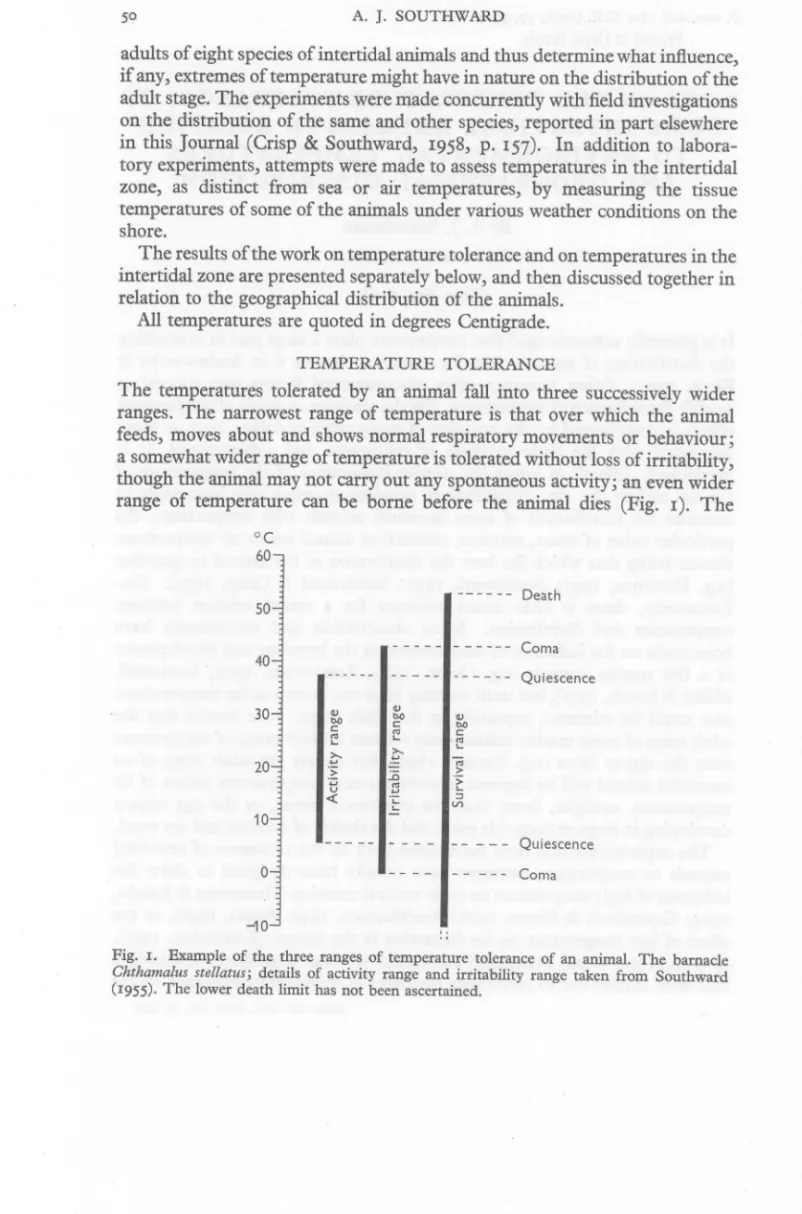
(2) A. J. SOUTHWARD. 50. adults of eight species of intertidal animals and thus determine what influence, if any, extremes of temperature might have in nature on the distribution of the adult stage. The experiments were made concurrently with field investigations on the distribution of the same and other species, reported in part elsewhere in this Journal (Crisp & Southward, 1958, p. 157). In addition to laboratory experiments, attempts were made to assess temperatures in the intertidal zone, as distinct from sea or air temperatures, by measuring the tissue temperatures of some of the animals under various weather conditions on the shore. The results of the work on temperature tolerance and on temperatures in the intertidal zone are presented separately below, and then discussed together in relation to the geographical distribution of the animals. All temperatures are quoted in degrees Centigrade. TEMPERATURE TOLERANCE The temperatures tolerated by an animal fall into three successively wider ranges. The narrowest range of temperature is that over which the animal feeds, moves about and shows normal respiratory movements or behaviour; a somewhat wider range of temperature is tolerated without loss of irritability, though the animal may not carry out any spontaneous activity; an even wider range of temperature can be borne before the animal dies (Fig. I). The °C 60. - - -- --. Death. 50 Coma 40. Quiescence 30. «~'-'':;c'u" OJ. bO. ':;;:. '-. 20. 11 10 Quiescence o. Coma. -10 Fig. 1. Example of the three ranges of temperature tolerance of an animal. The barnacle Chthamalus stellatus; details of activity range and irritability range taken from Southward (1955)· The lower death limit has not been ascertained..
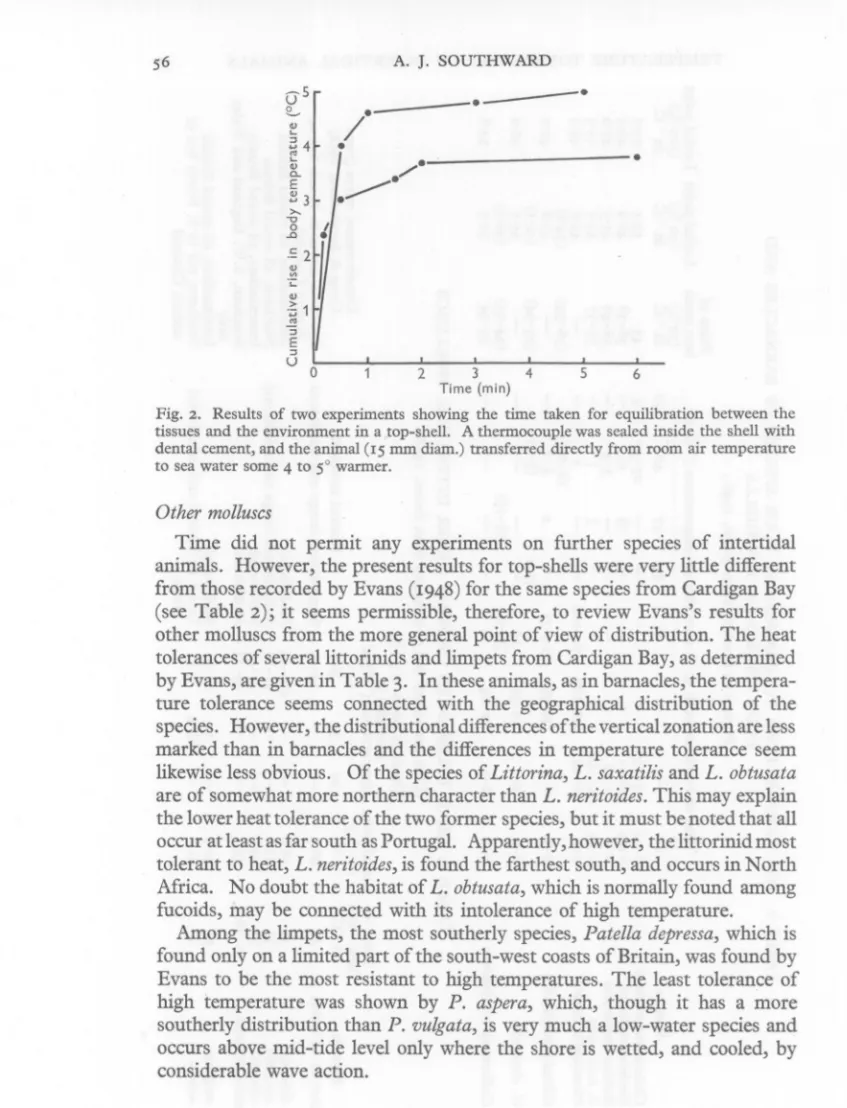
(3) TEMPERATURE TOLERANCES OF INTERTIDAL ANIMALS. 51. temperature at which normal activity ceases may be termed the quiescence point, while the temperature at which irritability is temporarily lost is usually termed the point of coma. For the present purposes emphasis was placed on survival rather than ability to carryon normal activities, and the widest range of temperature tolerated has been determined. Some observations were made on the temperature limits for normal activity in a few species, but the results have been reported elsewhere (Southward, 1955, 1957). There is no general agreement on the criteria used to determine lethal temperatures. I have followed Evans (1948) in using the same criterion for each species, namely the failure to respond to pricking with a needle within 12 h of return to normal temperature. Some investigators have used different criteria for each species (Orr, 1955), a procedure which may be justified where animals of very different habitat or habit are being compared. There is further disagreement over the proportion of a sample that need be killed to provide an estimate of the lethal point of the species or population. It has sometimes been said that total mortality of the sample has most biological meaning (cf. Edwards, 1946). If, however, a normal distribution of varying individual resistance to temperature is assumed it might be expected that a large sample would give a relatively wide range of tolerance before 100% mortality was reached, and it is more logical to take 50 % mortality as an estimate of the population resistance. This criterion was used in the present work, but it was found that with the samples taken there was little difference between the 50 and 100% points (see Table 2, p. 55). When the influence of duration on the resistance of an animal to extreme temperatures is being considered it is difficult to decide on the procedure to be adopted. Heilbrunn (1943) favours the construction of time-temperature curves showing the time taken to die at various temperatures, and Orr (1955; has worked on these lines. The latter, however, removed the animals directly from normal temperatures to high temperatures, without allowing time for conduction of heat to the internal organs. It is probably for this reason that the curves given (Orr, 1955) flatten out near the upper limits of temperature tolerance, the region between 0 and 10 min on the graph representing the time taken for equilibration between the tissues and the environment (compare Fig. 2 of this paper). The time taken to reach equilibrium must vary with each species. I have followed Huntsman & Sparks (1924), Broekhuysen (1940) and Evans (1948) in taking the animals in water at their normal temperature and heating them slowly. Apparatus limitations prevented a satisfactorily controlled slow cooling in the low-temperature experiments. METHODS. The species of barnacles and molluscs used in the experiments are listed in Table I, together with details of their normal zonation on the shore and their geographical distribution. As far as possible the animals were collected from 4-2.
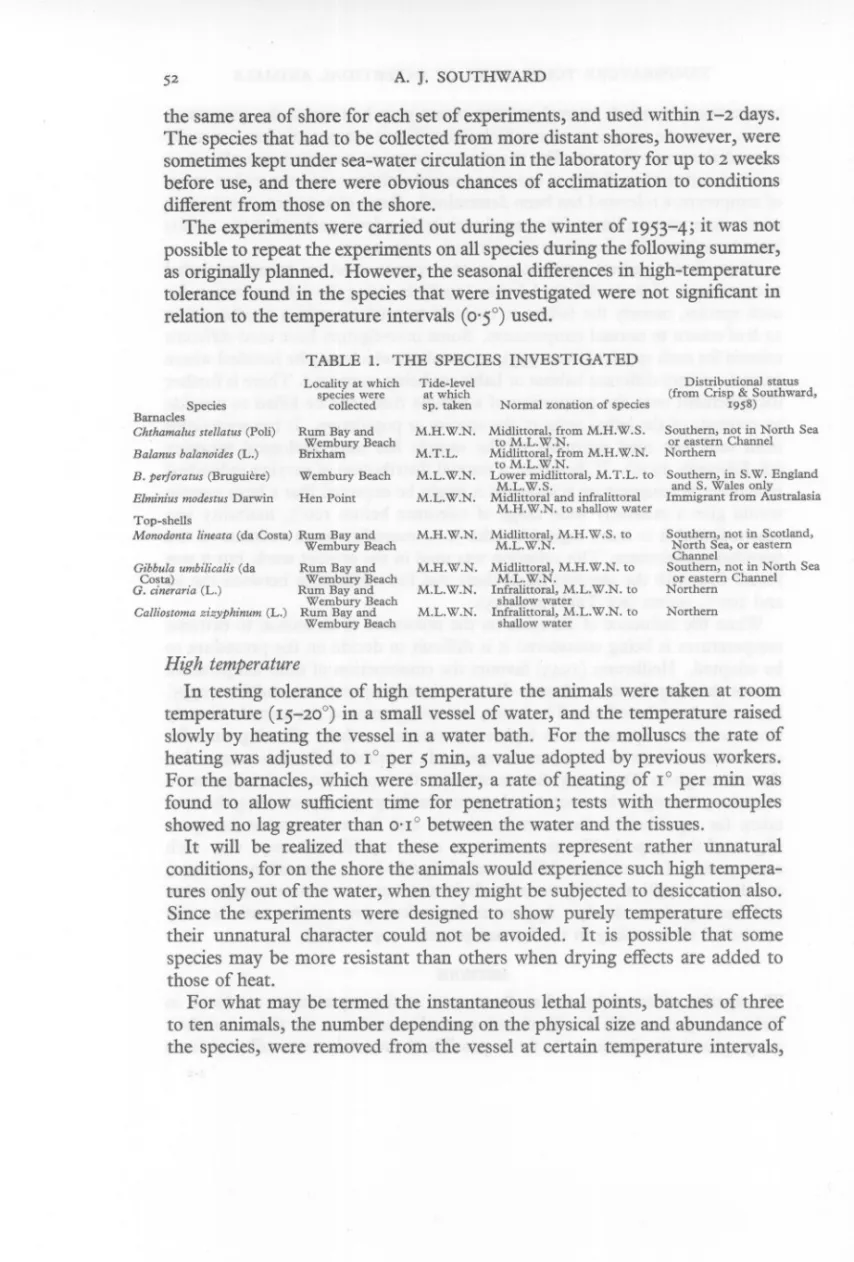
(4) yphinum (L.) ach (Bruguii:re) ach. 52. A. J. SOUTHWARD. the same area of shore for each set of experiments, and used within 1-2 days. The species that had to be collected from more distant shores, however, were sometimes kept under sea-water circulation in the laboratory for up to 2 weeks before use, and there were obvious chances of acclimatization to conditions different from those on the shore. The experiments were carried out during the winter of 1953-4; it was not possible to repeat the experiments on all species during the following summer, as originally planned. However, the seasonal differences in high-temperature tolerance found in the species that were investigated were not significant in relation to the temperature intervals (0' 5°) used. TABLE 1. THE SPECIES INVESTIGATED toM.L.W.N. M.L.W.S. M.H.W.N. to shallow water. M.H.W.N. M.L.W.N. M.L.W.N. collected shallow water M.H.W.N. M.H.W.N. Tide-level M.T.L. Hen Brixham or Northern or eastern shallow eastern Point Channel Channel water Distributional status toM.L.W.N. and S.to only Midlittoral and infralittoral which (from Crisp & Southward, M.L.W.N. Midlittoral, Lower midlittoral, M.H.W.N. Wembury Rum Southern, M.T.L. Bay to and Beach Beach to in not S.W. in North England Sea Infralittoral, M.L.W.N. Southern, North toWales Sea, not or in eastern Scotland, from M.H.W.S. Bay and M.H.W.S. M.H.W.N. Rum Normal sp.attaken zonation of speciesr958) Immigrant from Australasia Locality at which Channel Chthamalus stellatus (da (Poli) Monodonta lineata Costa) Rum Bay and. lligh te~perature. In testing tolerance of high temperature the animals were taken at room temperature (15-200) in a small vessel of water, and the temperature raised slowly by heating the vessel in a water bath. For the molluscs the rate of heating was adjusted to 10 per 5 min, a value adopted by previous workers. For the barnacles, which were smaller, a rate of heating of 1° per min was found to allow sufficient time for penetration; tests with thermocouples showed no lag greater than 0'1° between the water and the tissues. It will be realized that these experiments represent rather unnatural conditions, for on the shore the animals would experience such high temperatures only out of the water, when they might be subjected to desiccation also. Since the experiments were designed to show purely temperature effects their unnatural character could not be avoided. It is possible that some species may be more resistant than others when drying effects are added to those of heat. For what may be termed the instantaneous lethal points, batches of three to ten animals, the number depending on the physical size and abundance of the species, were removed from the vessel at certain temperature intervals,.
(5) TEMPERATURE TOLERANCES OF INTERTIDAL ANIMALS. 53. which were narrowed down to 0'5° in successive experiments, and allowed to recover in water at room temperature. The temperature at which more than half a batch failed to recover later within 12 h, and respond to pricking with a needle (by movement of the foot or valves), was regarded as the lethal temperature. When the instantaneous lethal point had been determined the effect of duration of high temperatures was studied. The temperature was raised as before and batches of animals removed at fixed temperatures (30°, 37°, 40° and 50°) to vessels of water maintained at the same temperature (plus or minus 1°) in an incubator; the fixed temperatures chosen for each species depending on the position of its instantaneous lethal point. Batches of animals were removed from the incubator at fixed intervals of time, allowed to recover in sea water at room temperature, and tested for recovery as before. For experiments of more than I day's duration the sea water in the incubators was made up with glass-distilled water to replace losses due to evaporation. In all experiments the water was aerated, and kept stirred, with compressed air. Low temperature. The experiments on low temperature tolerance were hindered by difficulties over temperature control, and it was not possible to measure the instantaneous lethals. The animals were taken from water at room temperature, mopped dry on the outside of the shell with a clean cloth and placed in a dry finger-bowl covered by a sheet of glass. The finger-bowls were stacked in a small ice-cream conservator, set to 0°, - 5° or - 10° by means of a thermostat that was normally capable of controlling the temperature to plus or minus 1°. It was considered that under these circumstances heat transfer would be slow enough to prevent differences of tissue temperature between large and small animals, though the rate of change might be greater than that used for molluscs at high temperature.! Batches of animals were removed from the freezer at fixed intervals, and allowed to recover in sea water at room temperature. Those that failed to recover within 12 h and respond to pricking with a needle were considered dead. Some experiments were tried with the animals in sea water, but there were discrepancies between different sets, probably owing to the insulating properties of the ice that formed. RESULTS. The results of the temperature tolerance experiments are given in Table 2. Clearly there was a much greater tolerance among the sessile barnacles than among the mobile top-shells, and the results for the two groups must be considered separately. 1 Relative humidity was approx. 50 %..
(6) 54. A.. J.. SOUTHWARD. Barnacles. Tolerance of high temperature in barnacles seems related both to the distribution of the species and to the normal habitat on the shore. Thus of the two southern forms, Chthamalus stellatus, which can occur at much higher levels on the shore, was more resistant at all temperatures, and was the only animal tested to show an instantaneous lethal temperature above soo. The other southern species, Balanus perforatus, is not normally found above midtide level, and its temperature tolerance was little better than the northern species, B. balanoides, which can live at higher levels on the shore. The immigrant Australasian species, Elminius modestus, was more resistant to high temperatures than either native species of Balanus; it can sometimes occur at higher levels on the shore than either. The barnacles were remarkably tolerant of low temperatures. All four species recovered after several weeks at zero, even though they experienced chill coma after an hour's exposure: it was not possible to determine the So % lethal point in the time available. At lower temperatures, - SO and - 10°, B. perforatus was much less tolerant than the others. There was little difference in resistance of the other species at - 10°, but at - SO the immigrant species Elminius was least tolerant, while the northern form Balanus balanoides was nearly twice as resistant as Chthamalus stellatus. Most of these differences are in accord with the natural distribution of the species. The relatively low resistance of Elminius is surprising in view of its present abundance on the cold east coast of England, where the southern species do not occur. It is interesting to record that in another series of experiments a specimen of Monodonta lineata was found dead after 72 h exposure at - So, with a dead Elminius and a living Chthamalus on its shell. Top-shells. In the molluscs tested temperature tolerance was more clearly related to vertical distribution on the shore than to geographical distribution. Thus, the two southern forms, Monodonta lineata and Gibbula umbilicalis, which occur higher up the shore, were more tolerant of both high and low temperatures than the two northern forms, G. cineraria and Calliostoma zizyphinum, which occur only at low water. In fact, for all four species the temperature tolerances increased in proportion to the relative capacity to withstand exposure out of the water. At - 10° little difference in resistance was found; the value of 2-3 h given in the table is probably the time required for equilibration between the tissues and the air at this low temperature. The relatively low resistance of the low-water species to temperatures below 0° and above 30° is interesting, but in view of the normal habitat of the species may not be very important..
(7) --t-I377!22-tt9-3° --5!°72-100 -30-79 -2-3 -3120-19° --43 8-40 41'8 <22 in ° Lethal C 3-5 36-38 35-37 16 3-34 45'0 35'5 44'3 47'0 35 4° 5° 3° 72-120 in in °°C C(38-39) 34'8 45"3 34'5 12-24 24-72 45'3 (5°%) 12-30 3t 53'7 52'5 6-24 48-72 3! 36'0 12-24 point-10Lethal point 42"0 45'5 48'3 138-179 12-24 (100 (5° %) TABLE 2.(34-35) THE 51 49'5 (34"8) 2-3 <3TEMPERATURE (It-I!) (36'2) 2-3 (42'1) (t-I) (33-34) 0000 0000. at temperatures. usata aatilis depressa Species pera na neritoides gata orea. (0 C) of. FOUR (Figures in brackets from Evans, 1948.). SPECIES. coma TOLERANCESheatOF FOUR OF Point TOP-SHELLS of. SPECIES. OF BARNACLES. AND. >-l tI1. ~ tI1. ~. d Gl >-l. o t""'. tI1. ~ () tI1. en. TABLE 3. HEAT TOLERANCES. heat coma. 41'7 °C in ° C 46'0 42'8 Point 45'0 46'3 44'3 37-38 39 36 of 37 Lethal (50 point %), 43"3 38. OF SOME OTHER. INTERTIDAL. (Data condensed and re-arranged from Evans, 1948.) Times in hours to 50 % mortality at temperatures (0 C) of. ,. 30. 35. 4° 14-15 II!-I2 9!-IO 4!-4! 3!-3t. 10 8!-9. 21-3. t-I. Normal zonation Supralittoral fringe and midlittoral Midlittoral Supralittoral fringe and midlittoral Midlittoral Midlittoral Midlittoral Lower midlittoral and infralittoral fringe. MOLLUSCS. o "Ij. Z >-l tI1. ::0 >-l. Distributional status (from Crisp & Southward, 1958) Southern, not in S. North Sea or eastern Channel Intermediate, all round Britain Northern, all round Britain Intermediate, all round Britain Southern, S.W. England and Wales only Intermediate, all round Britain Southern, not in S. North Sea or eastern Channel. 8 ;J> t""'. ~ ~ ;J>. t""'. en. Vt Vt.
(8) A. J. SOUTHWARD. .-. •. 0123456 Time (min). Fig. 2. Results of two experiments showing the time taken for equilibration between the tissues and the environment in a top-shell. A thermocouple was sealed inside the shell with dental cement, and the animal (IS mm diarn.) transferred directly from room air temperature to sea water some 4 to SO warmer.. Other molluscs Time did not permit any experiments on further species of intertidal animals. However, the present results for top-shells were very little different from those recorded by Evans (1948) for the same species from Cardigan Bay (see Table 2); it seems permissible, therefore, to review Evans's results for other molluscs from the more general point of view of distribution. The heat tolerances of severallittorinids and limpets from Cardigan Bay, as determined by Evans, are given in Table 3. In these animals, as in barnacles, the temperature tolerance seems connected with the geographical distribution of the species. However, the distributional differences of the vertical zonation are less marked than in barnacles and the differences in temperature tolerance seem likewise less obvious. Of the species of Littorina, L. saxatilis and L. obtusata are of somewhat more northern character than L. neritoides. This may explain the lower heat tolerance of the two former species, but it must be noted that all occur at least as far south as Portugal. Apparently, however, the littorinid most tolerant to heat, L. neritoides, is found the farthest south, and occurs in North Africa. No doubt the habitat of L. obtusata, which is normally found among fucoids, may be connected with its intolerance of high temperature. Among the limpets, the most southerly species, Patella depressa, which is found only on a limited part of the south-west coasts of Britain, was found by Evans to be the most resistant to high temperatures. The least tolerance of high temperature was shown by P. aspera, which, though it has a more southerly distribution than P. vulgata, is very much a low-water species and occurs above mid-tide level only where the shore is wetted, and cooled, by considerable wave action..
(9) TEMPERATURE TOLERANCES OF INTERTIDAL ANIMALS. 57. Some of the above species oflittorinids are found in northern Russia, where their tolerance of low temperature has been noted by Gurjanova, Sachs & Uschakov (1930). The most northern of them, Littorina saxatilis, was most tolerant of low temperature, and survived more than 27 h in air at -9'4°, compared with about 4 h by L. obtusata; L. littorea was killed in 3 h at - 8,8°. The same workers found that Balanus balanoides survived 48 h at - 9"40; compared with the present results this suggests the species may possess greater tolerance in more northerly latitudes. TEMPERATURES IN THE INTERTIDAL ZONE The most important temperatures on the shore, from a biological point of view, are those experienced by the animals themselves. Even though the normal inhabitants of the zone are all poikilothermic, it cannot be assumed that they adopt the temperature of the sea or the temperature of the air directly they are exposed to these media. In air, when the animals are exposed to fluctuating humidity and heating up by sunlight, it cannot be assumed that their tissue temperatures ever agree with meteorological values of air temperature. With terrestrial arthropods the effects of sunlight on body temperature are remarkable (Parry, 1951; Edney, 1953). As measurements of the animal's body temperature cannot be made very often, it is necessary to try to relate them in a general way to meteorological values of sea and air temperature and to sunlight and humidity, before any conclusions can be made regarding temperature trends in the intertidal zone. In the present work, observations were made on 13 days over a period of 10 months in 1953-4. No very hot weather occurred during this period, and it was not possible to use the apparatus in rain, but a variety of other weather conditions was observed. METHODS. The apparatus was planned after making some preliminary measurements at Port Erin, Isle of Man. The temperatures of the animals, of tide pools and of the air close to the ground were obtained with fine-wire thermocouples. Copper / constantan couples were finally chosen because of their ease of manipulation, even though the e.m.f. provided is lower than with chromium alloys. The measuring parts of the couples were made of 10 cm of 36 B & S gauge, insulated with thinned cellulose lacquer, and were connected to the galvanometer by flexible leads, 0'5 m long, of 50 strands 36 B & S insulated with PVC sleeving. The e.m.f. was measured against a reference junction in a Thermos-flask of ice and water (temperature 0'1-0'2° by mercury thermometer), and calibrated empirically against a certificated mercury thermometer. A galvanometer of taut suspension reflecting type1 was used with an arrange1 Tinsley type 5195 temperature indicator..
(10) A. J. SOUTHWARD. ment of copper switches that enabled any of 18 couples to be compared with the reference junction or one another. Under these conditions a deflexion of up to 18 mm per degree Centigrade was achieved, and ranges ofless sensitivity up to 50° f.s.d. could be obtained by use of switched shunts. An apparatus of this type was more portable and stable than valve voltmeters or a.c. bridges. Humidity close to the ground was measured with Edney paper hygrometers, checked occasionally against a wet and dry bulb instrument. Sea temperatures close to the shore were taken with a mercury thermometer of the standard meteorological pattern for the purpose. In the absence of a solar radiation meter, an approximate index of sunlight intensity was given by an incident light exposure meter1 calibrated roughly in kilolux by reference to a photocell light recorder belonging to Dr W. R. G. Atkins, F.R.S. The meter was pointed at the sun, and recorded both sunlight and general skylight from the same direction. Screen air temperatures for Mount Batten, Plymouth, have been extracted from The Daily Weather Report (Air Ministry, 1953-4) and converted to the nearest O· 5°. All but one series of measurements were made on the rocks below the Plymouth Laboratory, at a level just below M.H.W.N. The procedure was as follows: (i) galvanometer placed on level surface and reference junction plugged into flask of ice and water; (ii) hygrometer put down; (iii) two thermocouples placed inside two barnacles through holes pierced in the shells; two more placed into limpets in the same way; two inanimate bodies, consisting of dead barnacle shells filled with plaster of Paris and each containing a couple, set up close to live barnacles but not quite touching rock surface; (iv) one thermocouple set up I cm from rock surface in shade of galvanometer; other couples, if available, inserted into top-shells or tide-pools ; (v) sea temperature and sunlight measured while couples reached equilibrium; (vi) finally each couple switched in turn to reference junction and reading noted. In all cases several readings were taken, while with the air close to the ground, the temperature of which fluctuated continually, the maximum and minimum during I min were noted and the average taken. In one series of observations at Wembury the above procedure was followed, but readings were made at several tide levels. RESULTS. The results of the observations of temperature, humidity and sunlight on the shore at or near Plymouth are presented in Table 4, where possible to the nearest 0'1°. Some earlier observations at Port Erin, under weather conditions that were not studied at Plymouth, are given in Table 5; in this case the pointer galvanometer used allowed readings to the nearest 0'5° only. 1 Weston Master II, with Invercone attachment..
(11) Shade Meteorology '9·v·54 '9. v. 54. air. ------ --,. --. -'" 16'2 18'2 1 18'0 12'2 2'2 8'6 6'1 12'2 12"2 12'4 19'6 7'4 12 20'2 816'4-17'2 10'2 No inshore water 12·8 16'7 15'1 12'5 1'5'0 22'4 II'4 12'4 10'7 20'9 '7'4 17"4 '7"9 '3'7 18'5 II'7 13'2 '5'5 sun: 793 6,6 5'8 49 7"2 7"9 9'6 6'4 44'6 5'0 "7 '0 '9 rocks wet 10 Weak sun: 2·8 thin cloud As above but in shade 76757'8-8'2 13'1 in relative II'9 15 59 After 88 an hour with full sun 19'6-22'2 22'2-23'0 9'2-11'2 14'0 '17'7 13'6 18'4 '3'1 30 15'5 4'2 6'4 5'4 22'6 21'5 18·6 Remarks on weather 65Range 15'5 12·8 91'2-2'6 75 20'6-22'2 50 9'4 16'2 57 24'2 Cool: 6,8 arocks 10 little sun at first after temp. 9'4--<)'9 17'8 7'5 26·8 Cool, with 11 16 hazy sun 25'5-27"3 23'0-23'9 20'6 17'1 27'1 23'4 10 As Hazy Strong 21'4-22'5 25'2-27"4 r----"-----; Sea 7"6 12'5 above, kilolux above, G.M.T. 35 47 20'2 cloud 26'7 21'0 21'9 but animals after passing animals warm in over shade in day shade 12'0 Cold 12'3-13'2 15'3-15'7 6'6-7"5 6'3 spell: 10 12 16·8 818'9 28'0 IO '0 sunny Wembury: '3 15 L.W.N.; stronger II '4'3 14'3 45 Sunny II 4'4-5'3 H.W.N.; sheltered 3'9 24'8 7,6 25 85 64 air 9'6 ,animals ,.---.A----., .------'----, ,.---.A----., 46 13'6 Cold 20'1-20'4 13'6-13'9 9'8-II'2 5'6--<)'4 20'7 spell, sun after sunny: to warm close barnacles ice day on noon pools 10'0 12'0 Screen 07'0 27'6-28'4 20'6-21'4 24'9 spring day 14'6-14'9 '4'6-'4'9 14'3-14·8 47'5 '9 16'8 58 18'5-19'4 17'4 710 24'1-24'4 17'2-20'6 6'0-6'7 14'9 Becoming Average cloudy 14'8-15'0 '4'9 8'8--<)'3 Light '3'0-'3'3 sun 13'7 After An 21'4-21'7 inanimate hour's an hour 1'9 hour further in body stronger in hazy exposure sun sun 14'5 high 27'9-28'9 26'5-27'1 14'6 75 28'4 Temp. of 26'3-28'7 27'4 16'5 28'4-31'4 '3'7 29'9 Sunlight Percentage 30 '4'5 7sun 19'6-20'6 21'4 24'7-24'9 613 '3 Average Range humidity 9'0 4'5 16'5 limpets Average '5 TABLE tide-pools 4. temp. temp., 13'4-13'8 13'6 Wembury: 20'9 H.W.N.; sun andof-2'0 10'5 '3'7 -0'5-4'0 24'4-25'5 15'4-17'2 14'0 14'7 '4'5 Tissue Tissue Temp. temp. temp. of of OBSERVATIONS OF TEMPERATURES. on the shore IN Conditions THE INTERTIDAL. (For further explanation refer to text.). ZONE AT OR NEAR PLYMOUTH.
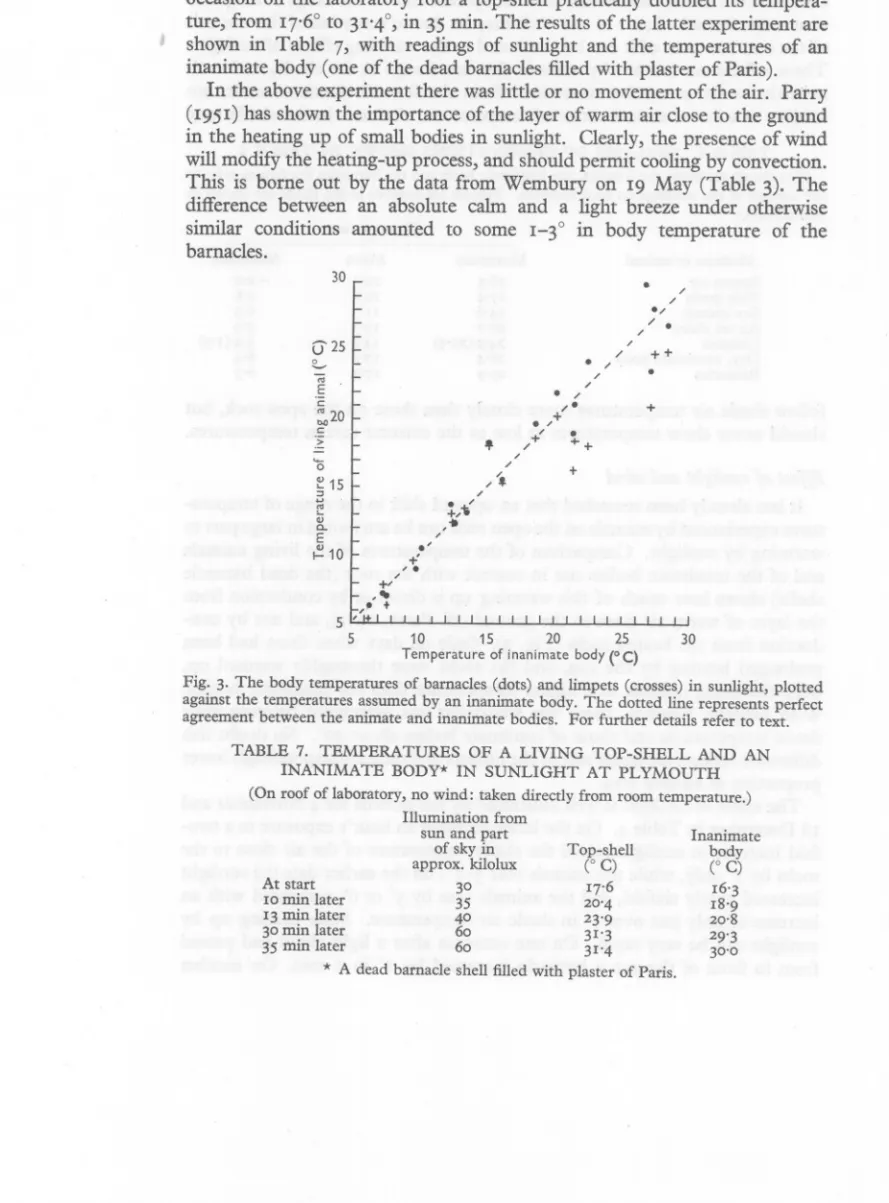
(12) 60. A. J. SOUTHWARD. General inferences. Some generalizations can be made, from Tables 4 and 5, regarding temperatures in the intertidal zone. Clearly, screen air temperature, even when read at a nearby site, may have very little reference to conditions on the shore. Thus in the colder months when the sea is usually warmer than the land, and in cloudy weather when the humidity is high, the air temperature close to the rocks and the body temperature of the animals may be higher than screen air temperature even 7-8 h after being uncovered by the sea. No doubt, heat storage by the rocks may assist in maintaining temperatures. Again in the colder months, but in sunny weather, when the humidity is less, evaporative cooling on exposure to the air is counterbalanced by radiant heating from the sun, and the air temperature close to the rocks and the body temperature of the animals are usually much higher than either screen air temperature or sea TABLE 5. OBSERVATIONS OF TEMPERATURE IN THE INTERTIDAL ZONE AT OR NEAR PORT ERIN Meteorology. '3. xii. 50. --A. -,.---A.--, - ,---~-. 8'0 2'0 ---"water 77'0 3'5 '0 weather oftemp. Cloudy 786inshore 16barnacles relative Mean 8'0-8'5 8'0 10 G.M.T. after Sea Screen close 9'0 67 Remarks on air 9'0 7'0 87 85 06'5temp. Low 8'0-8'5 9'5 Range cloud, rain Percentage temp. Tissue temp. temp. Cold 1'5 spell, cloudy high of at limpets Tissue humidity to Range rocks. airShade (For further explanation Conditions on shore. refer to text.). temperature. No doubt at night in cold clear weather, evaporative cooling may produce temperatures below that of the sea; but although measurements have not been possible in the dark, it has been noticed that the rocks remain quite wet, hence evaporative cooling cannot be very marked. In the warmer months of the year, and in sunny weather, temperatures on the shore after the tide has fallen are well above sea temperature and usually higher than screen air temperature. Again at night evaporative cooling may take place, but again the shore has been observed to remain wet. In cloudy weather in that part of the year when air temperatures exceed sea temperature during the day there may be closer agreement between screen air temperature, the air temperature close to the rocks and the temperatures of the animals themselves, but even the slightest amount of sunlight filtering through the clouds causes warming up of the shore. To sum up, it seems that, in daylight, intertidal animals exposed to the air will often have higher body temperatures than would be expected from sea and air temperatures. This is clearly brought out if we compare the maximum, minimum and mean temperatures of the observation period (Table 6). The minimum temperatures of the animals may be below the minimum sea temperature, but both means and maxima are well above the corresponding values of sea and air. Compared with the temperature of the tide pools or.
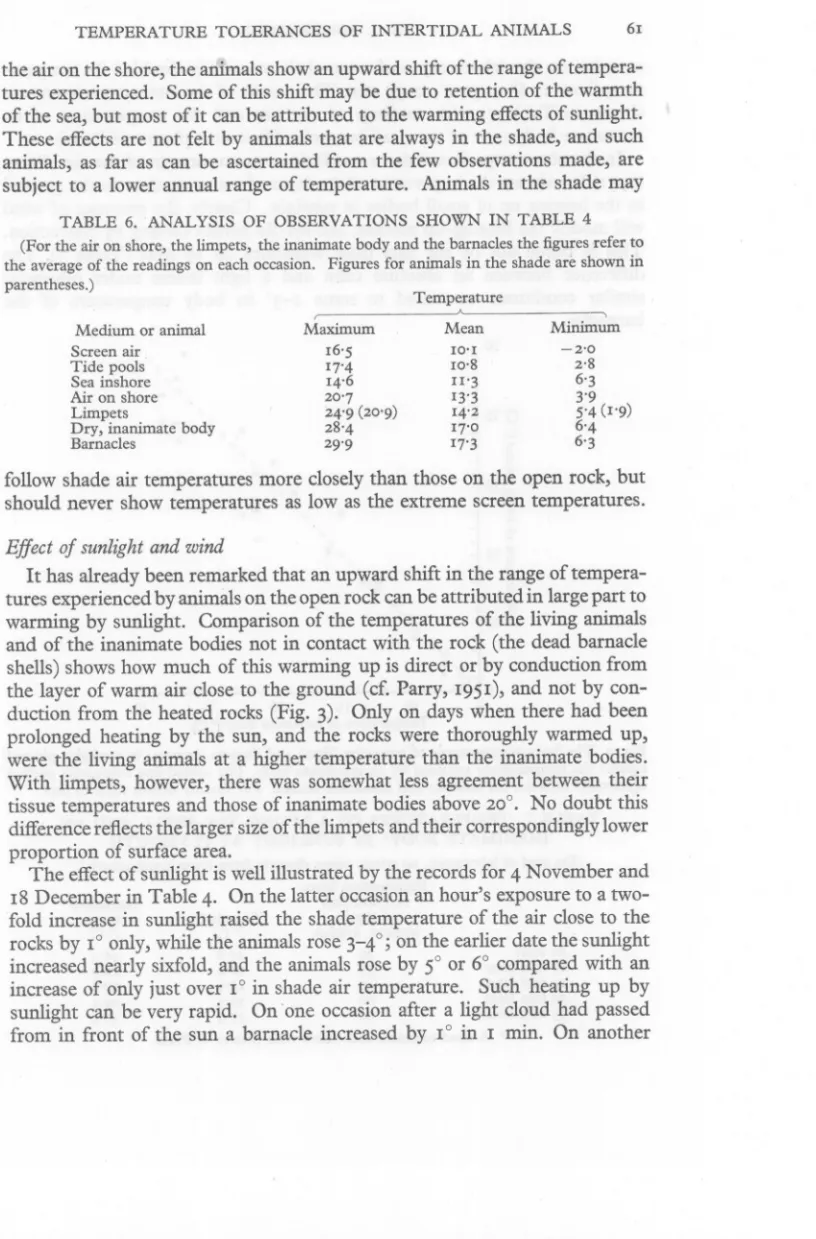
(13) TEMPERATURE. TOLERANCES. OF INTERTIDAL. ANIMALS. 61. the air on the shore, the animals show an upward shift of the range of temperatures experienced. Some of this shift may be due to retention of the warmth of the sea, but most of it can be attributed to the warming effects of sunlight. These effects are not felt by animals that are always in the shade, and such animals, as far as can be ascertained from the few observations made, are subject to a lower annual range of temperature. Animals in the shade may TABLE. 6. ANALYSIS. OF OBSERVATIONS. SHOWN. IN TABLE. 4. (For the air on shore, the limpets, the inanimate body and the barnacles the figures refer to the average of the readings on each occasion, Figures for animals in the shade are shown in parentheses,) Temperature A. (. Medium or animal Screen air Tide pools Sea inshore Air on shore Limpets Dry, inanimate body Barnacles. Maximum. 16'5 17'4 14'6 20'7 24'9 (20'9) 28'4 29'9. ---,. Mean. Minimum. 10'1 10,8 II'3 13'3 14'2 17'0 17'3. -2'0 2,8. 6'3 3'9 5'4 (1'9) 6'4 6'3. follow shade air temperatures more closely than those on the open rock, but should never show temperatures as low as the extreme screen temperatures. Effect of sunlight and wind. It has already been remarked that an upward shift in the range of temperatures experienced by animals on the open rock can be attributed in large part to warming by sunlight. Comparison of the temperatures of the living animals and of the inanimate bodies not in contact with the rock (the dead barnacle shells) shows how much of this warming up is direct or by conduction from the layer of warm air close to the ground (cf. Parry, 1951), and not by conduction from the heated rocks (Fig. 3). Only on days when there had been prolonged heating by the sun, and the rocks were thoroughly warmed up, were the living animals at a higher temperature than the inanimate bodies. With limpets, however, there was somewhat less agreement between their tissue temperatures and those of inanimate bodies above 20°. No doubt this difference reflects the larger size of the limpets and their correspondingly lower proportion of surface area. The effect of sunlight is well illustrated by the records for 4 November and 18 December in Table 4. On the latter occasion an hour's exposure to a twofold increase in sunlight raised the shade temperature of the air close to the rocks by 1° only, while the animals rose 3-4°; on the earlier date the sunlight increased nearly sixfold, and the animals rose by 5° or 6° compared with an increase of only just over 1° in shade air temperature. Such heating up by sunlight can be very rapid. On 'one occasion after a light cloud had passed from in front of the sun a barnacle increased by 1° in I min. On another.
(14) 62. A. J. SOUTHWARD. occasion on the laboratory roof a top-shell practiclllly doubled its temperature, from 17.6° to 31'4°, in 35 min. The results of the latter experiment are shown in Table 7, with readings of sunlight and the temperatures of an inanimate body (one of the dead barnacles filled with plaster of Paris). In the above experiment there was little or no movement of the air. Parry (1951) has shown the importance of the layer of warm air close to the ground in the heating up of small bodies in sunlight. Clearly, the presence of wind will modify the heating-up process, and should permit cooling by convection. This is borne out by the data from Wembury on 19 May (Table 3). The difference between an absolute calm and a light breeze under otherwise similar conditions amounted to some I-3° in body temperature of the barnacles.. •. 30. ej'25. • +. •. (;. +. ~ 15. 3'". •.. ., Cl... E. ~ 10. 10. 15. 20. 25. 30. Temperature of inanimate bodyeC). Fig. 3. The body temperatures of barnacles (dots) and limpets (crosses) in sunlight, plotted against the temperatures assumed by an inanimate body, The dotted line represents perfect agreement between the animate and inanimate bodies. For further details refer to text. TABLE. 7. TEMPERATURES OF A LIVING TOP-SHELL AND AN INANIMATE BODY* IN SUNLIGHT AT PLYMOUTH. (On roof of laboratory, no wind: taken directly from room temperature.) Illumination from sun and part Inanimate of sky in Top-shell body (0 C) approx. kilolux COC) At start 30 17.6 16'3 10 min later 35 20'4 18'9 20'8 13 min later 40 23'9 30 min later 60 31'3 29'3 31'4 35 min later 60 30'0 * A dead barnacle shell filled with plaster of Paris..
(15) TEMPERATURE TOLERANCES OF INTERTIDAL. ANIMALS. 63. DISCUSSION The experiments and field measurements that have been described above were carried out in support of work on distribution. For this reason they were not continued when it became clear that actual temperatures experienced on the shore were, in most cases, well inside the tolerance limits of the animals. This might have been expected, for all the animals live successfully at the places where the temperatures were measured. It must be remembered that more extreme conditions occasionally experienced, even if only for a short period, might have lethal effects. This is particularly so with the northern species, such as Balanus balanoides, which is near the limits of its tolerance of high temperature. On one occasion in the Isle of Man temperatures up to 38° were measured in barnacles (Chthamalus) above M.B.W.N., while Moore (1935) records a temperature of 36'5° in a barnacle at Plymouth. Temperatures of this order can produce coma in Balanus balanoides, and cause over 50 % mortality if experienced for more than 45 min. Thus the detrimental effects of heating up in the sun may contribute to the geographical limit of Eo balanoides, and may help to restrict it to low tide levels or shaded habitats near its southern boundary. The remaining species, however, appear capable of withstanding even the exceptional conditions, and there is no evidence for limitation of their habitat. There is little possibility of directly lethal effects of occasional lowtemperature extremes, even if we consider temperature conditions at a locality where the less tolerant species are absent. For example, from Table 2 it can be seen that exposure of the midlittoral species B. perforatus, Monodonta lineata and Gibbula umbilicalis to temperatures lower than - 5° might cause heavy mortality within one tidal period (6-12 h). During the course of the work there was a fairly long cold spell with consistently subzero temperatures; Table 8 shows the values of screen air temperature at 6-hourly intervals for 10 days of this cold spell at Plymouth and at a coastal station in the eastern Channel, where these animals are absent. Only on one occasion at Plymouth did temperatures fall below - S°, and although this low temperature was maintained for more than 6 h it coincided with a rising tide and the intertidal zone was exposed for only a few hours. At the other station temperatures fell below - 5° on five occasions, several times for more than 6 h and once for over 18 h (nearly two tidal cycles). The significance of this difference between the two stations is reduced if we consider the evidence of the field measurements of the animals' temperature. The species in question have body masses more comparable to limpets than to the barnacles (Chthamalus) used in the field work; nevertheless, even limpets in the shade had temperatures well above zero at Plymouth on the coldest day of the cold spell, while animals in the sun were as much as 8-10° warmer than the screen air at midday. There is thus little likelihood that lethal temperatures were experienced on the shore at Plymouth during this cold spell, though the.
(16) A. J, SOUTHWARD. ,. Meanat-3'56 rature hours:. presence of ice on the tide pools shows that temperatures on the shore were sometimes below - 20• If the temperature differentials between the animals and the screen air temperature can be applied also to Lympne, the more easterly station, there is little possibility that directly lethal temperatures were experienced there either, even if allowance is made for the much lower values of air temperature recorded. It is clear that during a cold spell the rocks and the animals on the shore retain the warmth of the sea while out of water long enough to maintain temperatures above zero during the period of exposure, while the smallest Hours , 0-8'0 06,6 0-1'0 0-4'5 -1'0 6'6 -2'0 18 -2'0 1'0 2'2 0-5'5 6,8 -6'0 6-5'5 -4'5 4'5 0'3 3'3 -0'5 -4'0 -3'0 7'3 -5'0 68'3 0'5 -1'0 '9 TABLE OF SCREEN TEMPERATURES AT -3'5 -0'5 -1'5 -5'5 -3'0 -1'5 sun 12 -1'5 -3'5 0'5 5'0 77'0 55'7 1'9 1'5 '2 0'5 -2'0 -6'0 00, 8. COMPARISON -6'5 -7'0 -4'0 -3'5 Temperature at hours: Plymouth -5'0 -3'5 Mean -1'55 AIR -5'0 -4'5. , , (Readings at 6-hourly intervals PLYMOUTH AND LYMPNE F to spell nearest 0'50 C,)From Air Converted froma cold during inLympne 1954, Ministry, 1954, v. v. 0. amount of sunshine should immediately warm them up. The only circumstances that can be envisaged as having directly lethal effects are those existing during the exceptional cold spells that occur in certain years, when the sea temperatures inshore may be below zero and there is little sunshine (see Orton, 1931). Such circumstances are not experienced very often, and are hardly regular environmental factors, even in eastern England; moreover, they can kill other animals apart from any strictly southern species. In a more severe climate than that of Western Europe it is possible that direct lethal effects of low temperature may be a normal occurrence and may influence the distribution of the less hardy forms (see Kanwisher, 1955). In Western Europe, at any rate, evidence for a causal relationship between temperature and distribution must be sought in non-lethal terms such as debilitating effects at some stagein the life history. Dr D. J. Crisp informs me that some preliminary experiments he has made show that among the barnacles the southern forms may take longer to recover from chill coma than the northern species, and may thus lay themselves open to selective attack by predators. Other effects of temperature may be found in combination with.
(17) TEMPERATURE TOLERANCES OF INTERTIDAL ANIMALS. 65. other factors or indirectly through competition between species (Southward & Crisp, 1956; Crisp and Southward, 1958). This work was carried out during the tenure of a D.S.I.R. Senior Research Award. Prof. J. F. Teago, Dr L. Jacob and Dr D. A. Parry kindly advised me on apparatus, which was purchased with a grant from the Royal Society. I am indebted to the Micanite and Insulators Co. for samples of insulating sleeving and to H. Tinsley and Co. for their readiness to modify their galvanometers to my needs. The manuscript has been criticized by Dr D. J. Crisp to whom I am grateful for many useful suggestions. SUMMARY. In experiments on four species of barnacles and four species of top-shells, the barnacles were found to be more resistant to high 9r low temperatures than the top-shells. Among each group of animals the degree of tolerance was related to the geographical distribution of the species and their zonation on the shore. Thus most tolerance of high temperature was shown by species of southern distribution, especially by those occurring at the upper limit of the midlittoral zone, and most tolerance of low temperature by species of northern distribution. Least tolerance of high and low temperatures was shown by species found only in the infralittoral fringe or below low water. Field measurements of the body temperatures of barnacles and limpets while exposed to the air were made with thermocouples. Under many weather conditions the body temperatures were higher than would be expected from local meteorological values of air temperature. This difference was due to retention of sea temperature by the animals and the rocks and to the heating effects of sunlight. The results of the laboratory experiments and of the field measurements are discussed together in relation to weather and geographical distribution. It is clear that the temperatures experienced on the shore are well within the tolerance limits of most of the animals, and even exceptional extremes of temperature may have little direct influence on the distribution of adult intertidal animals. Evidence for a causal relation between temperature and distribution must be sought in non-lethal terms such as debilitating effects, or indirectly through competition between species, or in combination with other factors. REFERENCES AIR MINISTRY, 1953-4. The Daily Weather Report. London: Meteorological Office. ANDREWARTHA,H. G. & BIRCH, L. C., 1954. The Distribution and Abundance of Animals. Chicago: University Press. BROEKHUYSEN,C. J., 1940. A preliminary investigation of the importance of desiccation, temperature and salinity as factors controlling the vertical distribution of certain marine gastropods in False Bay, South Africa. Trans. ray. Soc. S. Afr., Vol. 28, pp. 255-92. JOURN. MAR. RIOL. ASSOC. VOL. 37, 1958.
(18) 66. A. J. SOUTHWARD. CRISP, D. J. & SOUTHWARD,A. J., 1958. The distribution of intertidal organisms along the coasts of the English Channel. J. mar. bioi. Ass. U.K., Vol. 37, pp. 157-208. EDNEY, E. B., 1953. The temperature of woodlice in the sun. J. expo Bioi., Vol. 30,. pp. 331-49. EDWARDS,G. A., 1946. The influence of temperature upon the oxygen consumption of several arthropods. J. cell. compoPhysiol., Vol. 27, pp. 53-64. EVANS,R. G., 1948. The lethal temperatures of some common British littoral molluscs. J. Anim. Bcol., Vol. 17, pp. 165-73. to the study of marine GOWANLOCH, J. N. & HAYES, F. R., 1926. Contributions gastropods. I. The physical factors, behaviour and intertidal life of Littorina. Gontr. Ganad. Bioi., N.S., Vol. 3, pp. 133-66. GURJANOVA,E., SACHS, I. & USCHAKOV,P., 1930. Das littoral des Kola Fjords. III. Trav. Soc. Nat. Leningrad, Vol. 60, pp. 17-I07. (In Russian, German summary.) HEILBRUNN, L. V., 1943. An Outline of General Physiology, 3rd ed. Philadelphia and London: Saunders. HUNTSMAN, A. G. & SPARKS, M. I., 1924. Limiting factors for marine animals. Gontr. Ganad. Bioi., N.S., Vol. 2, III. Relative resistance to high temperatures. PP·95-114· HUTCHINS, L. W., 1947. The bases for temperature zonation in geographical distribution. Bcol. Monogr., Vol. 17, pp. 325-35. KANWISHER, J. W., 1955. Freezing in intertidal animals. BioZ..Bull., Woods Hole, Vol. I09, pp. 56-63. LOOSANOFF, V. L., MILLER, W. S. & SMITH, P. B., 1951. Growth and setting of larvae of Venus mercenaria in relation to temperature. J. mar. Res., Vol. la, PP·59-81. MOORE, H. B., 1935. The biology of Balanus balanoides. IV. Relation to environmental factors. J. mar. bioi. Ass. U.K., Vol. 20, pp. 279-307. ORR, P. R., 1955. Heat death. I. Time-temperature relationships in marine animals. Physiol. Zool., Vol. 28, pp. 290-4. ORTON, J. H., 1920. Sea temperatures, breeding and distribution in marine animals. J. mar. bioi. Ass. U.K., Vol. 12, pp. 339-66. --, assisted by LEWIS, H. M., 1931. On the effect ofthe severe winter of 1928-1929 on the oyster drills of the Blackwater Estuary. J. mar. bioi. Ass. U.K., Vol. 17, pp·301-13· PARRY, D. A., 1951. Factors determining the temperature of terrestrial arthropods in sunlight. J. expo Bioi., Vol. 28, pp. 445-62. RUNNSTROM, S., 1929. Weitere Studien tiber die Temperaturanpassung der Fortpflanzung und Entwicklung mariner Tiere. Bergens Mus. Aarb., 1929, No. 10, 33 pp. SOUTHWARD,A. J., 1950. Occurrence of Ghthamalus stellatus in the Isle of Man. Nature, Lond., Vol. 165, p. 408. -1955· On the behaviour of barnacles. I. The relation of drral and other activities to temperature. J. mar. bioi. Ass. U.K., Vol. 34, pp. 403-22. -1957· On the behaviour of barnacles. III. Further observations on the influence of temperature and age on drral activity. J. mar. bioi. Ass. U.K., Vol. 36, 323-34. SOUTHWARD,A. J. & CRISP, D. J., 1954. The distribution of certain intertidal animals around the Irish coast. Proc. R. Irish Acad., Vol. 57 (B), No. I, 29 pp. --1956. Fluctuations in the distribution and abundance of intertidal barnacles. J. mar. bioi. Ass. U.K., Vol. 35, pp. 2II-29. J. VERNON, H. M., 1899. The death temperature of certain marine organisms. Physiol., Vol. 25, pp. 131-6..
(19)
Figure

+4

Related documents
Based on the literature review, we tested for the effects of birth order (first or second born), zygosity (MZ or DZ), sex (boys or girls), GA, birth weight, mother ’ s and father ’
Given that the station uses different presenters who may be non-native speakers of some of the target languages of the listeners of Mulembe FM newscasts, the
Conclusions In this paper a new method for numerical solution of ordi- nary differential equations based on pseudo differential operators and Haar wavelets is proposed.. Its
In the present study, we developed a simple and rapid method for the simultaneous measurement of plasma concentrations of four first-line drugs (pyrazinamide,
There are infinitely many principles of justice (conclusion). 24 “These, Socrates, said Parmenides, are a few, and only a few of the difficulties in which we are involved if
19% serve a county. Fourteen per cent of the centers provide service for adjoining states in addition to the states in which they are located; usually these adjoining states have
Хат уу буудай нъ ТгШсит ёигит зүйлд хамаарагддаг нэг настай ихэечлэн зусах хэлбэртэй үет ургамал бөгөөд уураг ихтэй, шилэрхэг үртэй, натур жин их байдгаараа
The solution that we propose to the issue of Roaming in wireless community networks is done in two parts: (1) the proposal of a Protocol (RRP) enabling an LDAP server to behave as
