Sharif University of Technology
Scientia IranicaTransactions A: Civil Engineering www.scientiairanica.com
Lattice Boltzmann method for simulating impulsive
water waves generated by landslides
A. Pak
and M. Sarfaraz
Department of Civil Engineering, Sharif University of Technology, Tehran, P.O. Box 11155-9313, Iran. Received 6 April 2013; received in revised form 6 July 2013; accepted 27 July 2013
KEYWORDS Lattice Boltzmann method;
Impulsive water waves;
Landslides; Free surface ow; Numerical modeling.
Abstract. Impulsive water waves generated by landslides impose severe damage on coastal areas. Very large mass ows in the ocean can generate catastrophic tsunamis. Preventing damage to dams and coastal structures, and saving the lives of local people against landslide-generated waves, has become an increasingly important issue in recent years. Numerical modeling of landslide-generated waves is a challenging subject in CFD. The reason lies in the diculty of determining the interaction between the moving solids and sea water, which causes complicated turbulent regimes around the moving mass and at the water surface. Submarine or aerial types of landslide can further complicate the problem. Up to now, a number of numerical approaches have been proposed for predicting the behavior of ow during and after mass movement. In this study, a Lattice Boltzmann Method (LBM) based-code is employed for analyzing and simulating the impulsive water waves generated by landslides. Four experimental cases of submerged and aerial landslides have been modeled to investigate the eciency and accuracy of the LBM code, and the obtained results are veried against experimental observations. The results indicate the capability of LBM in simulating complicated ow elds and demonstrate its superiority over numerical methods used so far, such as SPH and RANS.
c
2014 Sharif University of Technology. All rights reserved.
1. Introduction
Impulsive water waves generated by aerial or sub-merged landslides can exert considerable damage on coastal areas. These landslides frequently occur in dam reservoirs, lakes, and oceans. Saving the lives of local people and reinforcing the structures in these areas, because of the detrimental eects of impulsive waves, has turned into a major issue for coastal authorities.
A number of laboratory tests have been conducted to study aerial and submerged landslides, e.g. Hein-rich [1], Walder et al. [2], Fritz et al. [3], Grilli and Watts [4], Panizzo et al. [5], and Ataie and Naja [6].
*. Corresponding author. Tel.: +98 21 6616 4225 E-mail addresses: [email protected] (A. Pak); [email protected] (M. Sarfaraz)
Studies show that a complex nonlinear interaction occurs between the surface waves and the motion of the sliding body.
Until now, two major numerical schemes have been utilized to model impulsive waves generated by landslides. The rst class contains the conventional CFD method, founded on solving Navier-Stokes and VOF equations, which is an Eulerian and macroscopic approach. Rzadkiewicz et al. [7], Titov [8], Imran et al. [9], and Pak and Sarfaraz [10] are some examples of applying this method.
This method has some drawbacks when it is used to simulate the severe interaction between water and sliding material. The VOF scheme adds an additional transport equation and an articial diusion to the interface prole [11]. Coupling uid ow with the moving boundaries of the sliding block is challenging and dicult using the Eulerian method [12]. Also,
this method suers from instability, extensive compu-tational time and poor scalability [13].
In the second approach, SPH, a macroscopic scheme, is employed to model the motion of the landslides in water. Due to its Lagrangian scheme, it has been used vastly by researchers in studying landslides, e.g. Monaghan and Kos [14], Gotoh et al. [15], Lo and Shao [16], Shao and Lo [17], Shao and Gotoh [18], Ataie and Shobeyri [19], and Mansour-Rezaei and Ataie [20].
The stability, accuracy, and speed of SPH depend on its smoothing kernel, which should be chosen care-fully for each specic problem [13,21]. In particular, a unique kernel function has not been proposed as suitable for all landslide problems, including dierent geometrical and physical parameters [19]. Incompress-ibility cannot be strictly assured in commonly used SPH codes, because, in these codes, a relation between pressure and density is assumed [13]. Boundaries are not modeled well in SPH. The particles at the edge of the objects have no neighbors outside, so, their densities are less than those of internal particles [22]. In most of the developed codes, e.g. [19,20,23], SPH was not used to model the landslide motion through a fully-coupled interaction with water, i.e. a prescribed relation obtained by physical tests was implemented for the velocity of the solid. Yim et al. [23] reported that the accuracy of SPH was less than that of the Eulerian approach.
Apart from the Eulerian and SPH approaches, the Lattice Boltzmann Method (LBM) has become procient in solving a variety of complex and dicult uid dynamic problems over the last 15 years. The fundamental idea of the LBM is to construct sim-plied kinetic models that incorporate the essential physics of microscopic or mesoscopic processes, so that the microscopic averaged properties obey the desired macroscopic equations [24].
In LBM, the spatial space is discretized in such a way that it is consistent with the kinetic equa-tion. LBM is a mesoscopic model simulating ow phenomenon through tracking uid particle packs that move and collide in space under the rules in which collision does not result in mass and momentum changes [25]. Space is divided into regular lattices and, at each lattice site, a particle distribution function, f,
is dened, which is equal to the expected number of particles of uid in the direction of . During each discrete time step of the simulation (t), uid particles move to the nearest lattice site along their direction of motion, with dierent velocities of e, where they
\collide" with other uid particles that arrive at the same site. The outcome of the collision is determined by solving the kinetic (Boltzmann) equation for the new particle distribution function at that site, and the particle distribution function is updated [24].
LBM has been employed to model complicated ow, such as turbulent and free surface ows, ac-curately [26,27]. The parallelism of the algorithm, simplicity of programming and possibility of modeling complex geometrical ow problems are remarkable advantages of LBM [27]. A single LB time-step is signicantly faster than a single step of an Eulerian solver [13]. Hence, time dependent ow modeling is straightforward, especially in 3D, whereas it is costly in the Eulerian approach [25]. Also, LBM exhibits good stability for unsteady problems [27].
This paper aims to simulate impulsive waves generated by aerial and submarine landslides, using LBM to exhibit its accuracy and eciency in modeling this complicated free-surface problems. According to the authors' knowledge, this is the rst research that uses LBM to simulate the impulsive waves generated by landslides.
2. Numerical formulation
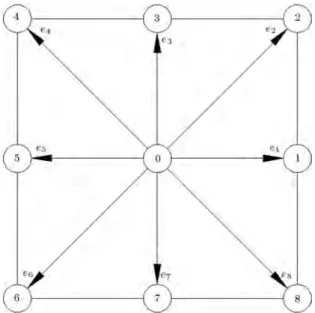
In this paper, the Single Relaxation Time (SRT) ap-proximation with the Bhantager-Gross-Krook (BGK) collusion rule is adopted to discretize the Boltzmann equation. For the D2Q9 model (Figure 1), it is given by [28]:
f(~xi+ ~et; t + t) f(~xi; t) =
f(~xi; t) feq(~xi; t)
+ F; (1)
where xi, e, t, f, feq and F are the position of
the point in the discretized space, the discrete particle velocity, the time step, the distribution function, the corresponding equilibrium distribution function and the body force (e.g. gravity) function, respectively.
To satisfy the incompressible ow limit, according to the Navier-Stokes equation, by adopting the Chapman-Enskog expansion, the relaxation time () is related to the uid viscosity (), as [29]:
= 13 12t: (2) The equilibrium distribution is of the form [29]:
feq = !
1 + 3 ~e:~u + 4:5( ~e:~u)2 1:5~u:~u
; (3)
where u is the uid velocity, and !is dened as:
!= 8 > < > :
16=36 = 0 4=36 = 1; 3; 5; 7 1=36 = 2; 4; 6; 8
(4)
Gravity vector (g) for free surface modeling is consid-ered as [30]:
F= 3![( ~e ~u) + ( ~e:~u) ~e]:~g: (5)
Density () and momentum uxes (u) are evaluated by:
=
8
X
=0
f= 8
X
=0
feq
; (6)
~u =X8
=0
~ ef=
8
X
=0
~efeq: (7)
For three-dimensional problems in this study, the D3Q19 model was implemented. The reader is referred to [11] for related formulation.
Due to the highly turbulent nature of the ow eld generated by landslides, it is necessary to use a turbulence model. The role of this procedure is to parameterize the turbulent energy dissipation, where larger eddies extract energy from the mean ow and transfer some of it to smaller eddies [31]. In this paper, the Wall-Adapting Local Eddy-viscosity (WALE), an LES category, is adopted. This model has good properties both near to and far from the wall, with laminar and turbulent ows. This model recovers the asymptotic behavior of the turbulent boundary layer when this layer can be directly solved, and it does not add articial turbulent viscosity in the shear regions out of the wake. The WALE model is formulated as [32]:
= 3
+ C2 t2
+0:5; (8)
where Ct is equal to 0:5 and denotes the lter
width, which is set to lattice spacing (resolution). is described as:
=(S (gi;jgi;j)1:5
i;jSi;j)2:5(gi;jgi;j)1:25; (9)
gi;j= Si;kSk;j+ i;kSk;j 13i;j(S2 2): (10)
The shear stress tensor (S) and rotational stress tensor () are described as:
Si;j=
@ui
@xj +
@uj @xi ; (11) i;j= @ui @xj @uj @xi ; (12)
where u is the spatially-ltered velocity calculated by [33]:
u(x) = Z
u(x)G(x; x0)dx0; (13)
G(x; x0) =
(
1; jx x0j 0:5
0; otherwise (14) In this work, a central dierence scheme is implemented to compute S and , as proposed by Weickert et al. [32].
There are dierent proposed ways to model free surface ows in LBM [34-36]. In this study, the model presented by Korner et al. [36] is used, in which, the movement of the uid interface is tracked by calculation of the mass contained in each lattice. This requires two additional values to be stored for each lattice: mass, m, and uid fraction, ". The uid fraction is computed with lattice mass and density:
" = m=: (15)
As the particle distribution functions correspond to a certain number of particles, the change of mass is directly computed from the values that are streamed between two adjacent lattices for each of the directions in the model. For an interface lattice (partially lled) and a uid lattice at (x + t e), this is given by:
m(~x; t + t) = ~f(~x + t ~e; t) f(~x; t): (16)
The rst particle distribution function is the amount of uid entering this lattice in the current time step, and the second one is the amount leaving the lattice.
The mass exchange for two interface lattices has to take into account the area of the uid interface between the two lattices. It is approximated by averaging the uid fraction values of the two lattices.
Thus, Eq. (16) becomes:
m(~x; t + t) =f ~f(x + t ~e; t) f(~x; t)g
"(~x + t ~e; t) + "(~x; t)
2 : (17) For interface lattices with neighboring uid lattices, the mass change has to conform to the particle distribution functions exchanged during streaming, as uid lattices do not require additional computation. Their uid fraction is always equal to one, and their mass equals their current density. The mass change values for all directions are added to the current mass for interface lattices, resulting in the mass for the next time step:
m(~x; t + t) = m(~x; t) +X
m(~x; t + t): (18)
For more details, see [36,37].
For all cases in this work, the no-slip boundary condition (so-called the bounce-back rule) is used. The basic idea is that the incoming distribution functions at a wall node are reected back, and rotated by radians. The improvement suggested by Ziegler [38] was employed, considering the wall-uid interface to be located halfway between the wall and uid nodes, which has second-order accuracy for straight walls [29]. By using this rule, during the streaming step, the distribution functions are reected at the obstacle surface. The stream step can be written as Eq. (19) for lattices where the neighbor at x + e is located as an
obstacle:
f(~x; t + t)0= f~(~x; t); (19)
where f~ denotes the distribution function along the
inverse velocity vector of f, therefore e~= e.
For moving obstacles (landslide blocks), the mo-mentum of the movement should be transferred to the uid. For this purpose, an additional forcing term is added to Eq. (19) during streaming:
f(~x; t + t)0= f~(~x; t) + 6! ~e: ~u0; (20)
where u0 is the obstacle velocity at the obstacle
boundary.
The momentum exchange method was utilized to compute the exerted uid-forces to the landslide block. The total force is computed by [29]:
~F = X
all xb
X
=1
~e
~
f( ~xb; t) + ~f( ~xb+ ~et; t)
(1 Wb
f)x=t; (21)
where xb denotes lattice nodes on the solid side and
e is the bounce-back particle velocity. ~f stands for
post-collision distribution function. Wb
fis an indicator,
which is 0 at lattice nodes on the uid side next to the solid boundary and is 1 at xb.
By using Eq. (20), uid to obstacle coupling is computed, while its combination with Eq. (21) enables full two-way coupled uid simulations that can be applied to study the landslide movement inside water. It is noted that the applied force to the obstacle, by applying Eq. (21), is used in Newton's second law to compute the obstacle velocity (u0) in Eq. (20).
The aforementioned formulae are coded in the software, XFlow [39], that is used in this study.
3. Validation test cases
In this part, four physical tests are simulated by the LBM code. The experimental work includes both aerial and submerged rigid landslides. The tests were also numerically modeled using the Eulerian or SPH methods by other researchers, and are compared with the results of LBM.
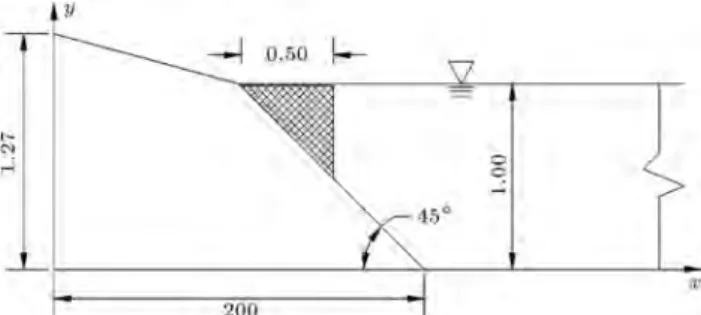
3.1. 2D Submerged landslide (Heinrich [1]) The work was done in a ume of 20 m long and 0:5 m wide. A triangular rigid wedge with a density of 2036:4 kg/m3and a cross section area equal to 0:125 m2
was allowed to slide freely on an inclined frictionless shoreline of 45 to horizontal. Water depth was 1:0 m
and the wedge was initially 1:0 cm below the water surface. Figure 2 demonstrates the initial physical model conguration. The computational domain was the same as the physical model and a resolution (lattice dimension) of 0:03 m was used.
Pak and Sarfaraz [10] numerically modeled this case using FLOW-3D software. They applied three turbulence models of standard k ", RNG k ", and LES, and reported that LES results were more accurate.
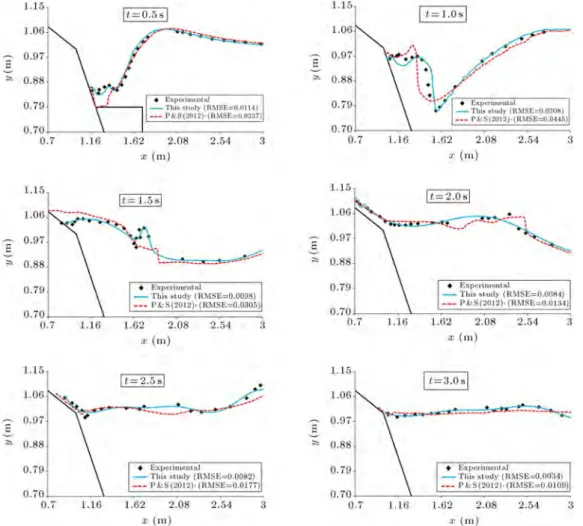
In Figure 3, experimental surface wave proles are demonstrated and compared with LBM results. Also, the numerical results of this problem, using the Eulerian approach by Pak and Sarfaraz [10], and applying the LES turbulence model, are included and compared. The gure shows that the LBM-based code
Figure 2. Initial conguration of the experimental work, case 1 (in meters).
Figure 3. Experimental and numerical wave proles at dierent times, case 1.
is successful and capable of tracking wave generation, due to the movement of the solid wedge, and is more accurate than the Eulerian results, according to its lower RMSE (Root Mean Square Error) values. Also, LBM proves its accuracy in capturing the conguration of highly turbulent ow near the beach.
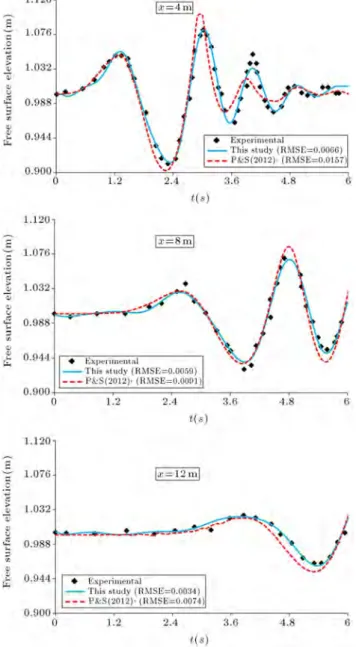
Figure 4 displays and compares experimental and numerical wave amplitudes at x = 4, 8, 12 m over time. It is understood that LBM is well capable of predicting wave propagation due to the movement of the solid wedge in water. RMSE values indicate that the LBM-based code is more accurate than the Eulerian approach for computing the time history of free surface elevation due to wave propagation.
As indicated in the introduction section, equa-tions within the Eulerian approach are complex and consist of high-order derivation terms, whose dis-cretization will generate numerical errors. LBM can overcome these issues, as it contains a simple formu-lation and is straightforward in coupling the ow eld with moving obstacles. Furthermore, LBM does not suer from numerical issues such as instability. So, in this validation case, LBM provides more accurate results than the Eulerian technique.
In Figure 5, the velocity eld and assigned vectors are presented at dierent times, showing the stability of the model in simulating the problem after the time at which the wedge has reached the bottom. As the wave propagates towards the right, a clockwise vortex is generated above the wedge, which resists coming down the run-up water. Also, the maximum velocity magnitude of these vortexes decreases over time. 3.2. 2D Partially submerged landslide (Yim et
al. [23])
In this section, a solitary wave generated by the vertical falling of a partially submerged block into water (so-called Scott Russell's wave generator) is considered, and was carried out both physically and numerically (RANS and SPH) by Yim et al. [23]. The experi-ment was performed in a 12 m long ume, with a rectangular rigid block weighted 13:3 kg per width, having dimensions of 0:1 m. The ume contained 0:1 m depth of water and the bottom of the block was initially 3 cm below the still water level (Figure 6). The computational domain was the same as the physical model and a resolution of 4 mm was selected for lattices. The dynamic coecient of friction between
Figure 4. Experimental and numerical time history of wave amplitudes at dierent locations, case 1.
the block and vertical walls of the ume was equal to d= 0:66, as proposed in [23].
Figure 7 displays the experimental and computa-tional position of the block mass center (yCG). The
RANS simulation by Yim et al. [23] was not stable after the block reached the bottom of the ume. Also, experimental values of yCG were used in their SPH
code for tracking the motion of the block. This gure indicates very good agreement between the LBM results and experimental data. The gure displays that the block does not meet the bottom of the ume for a time less than 1 s, which may be due to selecting a large friction coecient.
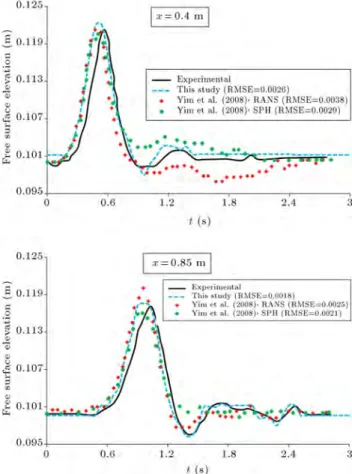
The computational and experimental time history of free surface elevation at x = 0:4 and 0:85 m are shown in Figure 8. This gure shows that the wave
Figure 5. Velocity eld with vectors at dierent times, case 1.
Figure 6. Initial conguration of experimental work, case 2 (in meters).
propagates like a solitary wave, and RMSE values show that LBM is more accurate than SPH and RANS in predicting both the amplitude and phase of the wave. However, because of assuming a smooth surface for the ume bed, the simulated wave propagates slightly faster with slightly higher amplitude.
Figure 7. Experimental and computational time history of mass center position of block, case 2.
Figure 8. Experimental and computational time history of free surface elevation, case 2.
usually modeled well in SPH. Also, in common SPH codes, ow incompressibility cannot be guaranteed. Selecting an appropriate smoothing kernel is essential for the accuracy and stability of this method and is not unique for all landslide problems. Unlike the SPH method, boundaries are modeled in a logical way in LBM. Moreover, it does not need user-dependent parameters, e.g. smoothing kernel functions, and, therefore, LBM provides more accurate results in comparison with SPH.
The location of the falling block, with the velocity
Figure 9. Velocity eld with vectors at dierent times, case 2.
eld and vectors, are presented in Figure 9 for dierent times. While the block is falling, a counterclockwise vortex develops near the right face of the block and is advected downstream with a slower speed than the phase speed of the generated wave. When the block reaches the bottom, the velocity magnitude tends to decrease and some small vortexes appear, caused by interaction between the propagated wave and run-up water near the block.
3.3. 2D Aerial landslide (Yim et al. [23]) The same materials and method as in the previous case are used in this case, except that the block was kept 3 cm initially above the still water with a depth of 0:18 m in the ume. Figure 10 shows the experimental and computed mass center position of the block, which exhibits good agreement between LBM results and experimental data. Before the block meets water, no friction was assumed in the code; hence, it compensates the large d selected in the previous case.
The amplitudes and phase of the generated wave are well computed by LBM at x = 0:4 and 0:85 m
Figure 10. Experimental and computational time history of mass center position of block, case 3.
Figure 11. Experimental and computational time history of free surface elevation, case 3.
(see Figure 11). It is worth noting that since the still water depth is more than in the previous case, bed friction has less eect on the propagated wave; the phase dierence between LBM and experimental data is negligible. There exists noticeable disagreement between the experimental and computed results by RANS and SPH after t = 1:5 s.
Figure 12 depicts the block location at dierent times, together with the velocity eld and vectors. In view of the fact that the still water depth is more than the block height, water overtops the block, and then reects back towards the ume. Since the block
accel-Figure 12. Velocity eld with vectors at dierent times, case 3.
erates before going through the water, ow separation is observed near the right end of the block at t = 0:2 s. Similar to the previous case, a counterclockwise vortex appears and is advected with wave propagation, but is more stretched along the ume direction.
3.4. 3D Submerged landslide (Ataie and Naja [6])
This part discusses the applicability and eciency of the LBM method for modeling 3D landslide problems. A rigid rectangular block, with a weight of 14:82 kg, 0:3 m in length, 0:2 m in width and 0:13 m in height, was submerged initially on a 30 sloping beach with
a 0:5 m depth of still water (see Figure 13). All surfaces were lubricated to eliminate friction and the test was repeated two times. The ume width was 2:5 m; therefore, it simulates a 3D landslide, as happens in the real world. In this experimental work, water elevation towards the centerline of the ume (along the x axis) was measured at dierent positions [6].
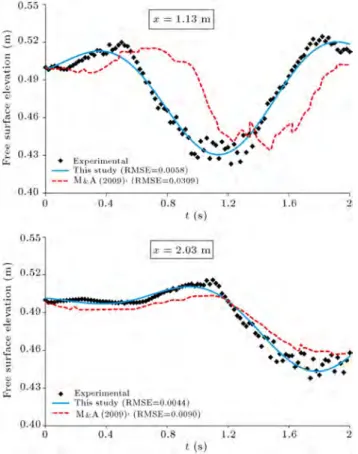
The computational domain was the same as the physical model, and a resolution of 8 mm was selected. Mansour-Rezaei and Ataie [20] simulated the same problem using SPH in the 3D space using dierent kernel functions. Experimental and computational values of free surface elevation at x = 1:13 and 2:03 m are shown in Figure 14. It is proved that LBM
success-Figure 13. Initial conguration of experimental work, case 4 (in meters).
Figure 14. Experimental and computational time history of free surface elevation, case 4.
fully overcomes the problems encountered to model the propagated wave in both amplitude and speed.
The predicted wave by LBM has slightly more speed, which may be due to existing friction between the block and surface of the beach. The amplitude of the rst trailing is a little under-predicted, which is possibly caused by using a coarse resolution of lattices. The gure points out that the calculated wave by SPH has a considerable phase lag and smaller amplitudes, exhibiting a dissipative manner.
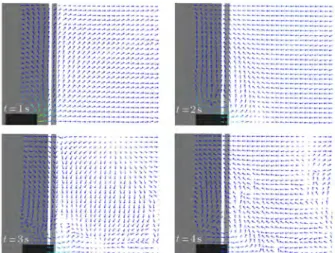
Velocity elds with vectors along the x-axis at dierent times are shown in Figure 15. While the block slides down, water overtops and pushes the block to the right side. Also a counterclockwise vortex is observed on top of the block, which moves upwards and dissipates during the course of sliding.
Figure 16 presents the velocity eld and vectors over a plane cutting the y-axis at y = 0:43 m. Half the
Figure 15. Velocity eld with vectors along x-axis at dierent times, case 4.
Figure 16. Velocity eld with vectors at y = 0:43 m for dierent times, case 4.
domain is shown due to its symmetry. It is observed that a strong 3D wave generation and propagation pattern exists. By sliding the block, counterclockwise vortexes appear near the top side of the block, which are advected towards the ume walls. The gure exhibits a very complex ow eld in the 3D case, which needs further investigations.
4. Conclusion
In this work, a novel approach, based on the Lattice Boltzmann Method (LBM), incorporated with the WALE turbulence model, was introduced to simulate impulsive waves generated by landslides, which is a complex problem regarding the free surface. The proposed LBM code takes the coupling between the motion of the landslide and variation of the ow eld into account to predict the propagated impulsive waves. Validation of the LBM code was carried out by simulating a 2D submerged aerial, and a 3D submerged rigid landslide. The predicted results showed good agreement with recorded data. The LBM results were more accurate, in comparison with the Eulerian and SPH schemes, in predicting the amplitude and phase of the generated impulsive wave. The benecial char-acteristics of LBM coding (simple formulation, easy coupling interaction, and stable and non-challenging numerical discretization) can overcome and eliminate Eulerian and SPH diculties for accurate modeling of complex and non-linear interaction between the generated wave and the sliding obstacle. Extension of this work would be advantageous to wave-structure in-teraction problems in oshore and coastal frameworks which is currently in the authors' research program.
References
1. Heinrich, P. \Nonlinear water waves generated by sub-marine and aerial landslides", Journal of Waterways,
Ports, Coastal and Ocean Engineering, 118(3), pp. 249-266 (1992).
2. Walder, J.S., Watts, P., Sorensen, O.E. and Janssen, K. \Tsunami generated by subaerial mass ows", Jour-nal of Geophysical Research, 28, pp. 397-400 (2001).
3. Fritz, H.M., Hager, W.H. and Minor H.E. \Near eld
characteristics of landslide generated impulse waves", Journal of Waterways, Ports, Coastal and Ocean En-gineering, 130(6), pp. 287-302 (2004).
4. Grilli, S.T. and Watts, P. \Tsunami generation by
submarine mass failure; Part I: Modeling, experimen-tal validation and sensitivity analysis", Journal of Waterways, Ports, Coastal and Ocean Engineering, 131(6), pp. 283-297 (2005).
5. Panizzo, A., Girolamo, P.D., Di Risio, M., Maistria, A. and Petaccia, A. \Great landslide events in Italian articial reservoirs", Journal of Natural Hazards and Earth System Sciences, 5, pp. 733-740 (2005).
6. Ataie, B. and Naja, A. \Laboratory investigations
on impulsive waves caused by underwater landslide", Coastal Engineering, 55, pp. 989-1004 (2008).
7. Rzadkiewicz, S., Mariotti, C. and Heinrich, P. \Numer-ical simulation of submarine landslides and their hy-draulic eects", Journal of Waterways, Ports, Coastal and Ocean Engineering, 123(4), pp. 149-157 (1997).
8. Titov, V.V. \Numerical modeling of long wave
run-up", Ph.D. Thesis, University of Southern California, (1997).
9. Imran, J., Parker, G., Lacat, J. and Lee, H. \1D
numerical model of muddy sub-aqueous and subaerial debris ows", Journal of Hydraulic Engineering, pp. 959-968 (2001).
10. Pak, A. and Sarfaraz, M. \Numerical study of the
characteristics of surface waves generated by subma-rine landslides", 9th International Congress on Civil Engineering, Isfahan, Iran (2012).
11. Janssen, C. and Krafczyk, M. \A Lattice Boltzmann
approach for free-surface-ow simulations on non-uniform block-structured grids", Journal of Computers and Mathematics with Applications, 59, pp. 2215-2235 (2010).
12. Sarfaraz, M. \Numerical analysis of concrete armor
layers' stability in rubble-mound breakwaters", M.Sc. thesis, Sharif University of Technology, Tehran, Iran (2012).
13. Jie, T. and Xubo, Y. \Physically-based uid
anima-tion: a survey", Journal of Science in China Series F: Information Sciences, 52(1), pp. 1-17 (2009).
14. Monaghan, J.J. and Kos, A. \Scott Russell's wave
generator", Journal of Physics of Fluids, 12(3), pp. 622-630 (2000).
15. Gotoh, H., Sakai, T. and Hayashi, M. \Lagrangian two-phase ow model for the wave generation process due to large-scale landslides", Asian and Pacic Coastal Engineering, pp. 176-185 (2001).
16. Lo, E.Y.M. and Shao, S. \Simulation of near-shore solitary wave mechanics by an incompressible SPH method", Journal of Applied Ocean Research, 24, pp. 275-286 (2002).
17. Shao, S.D. and Lo, E.Y.M. \Incompressible SPH
method for simulating Newtonian and non-Newtonian ows with a free surface", Journal of Advances in Water Resources, 26(7), pp. 787-800 (2003).
18. Shao, S.D. and Gotho, H. \Turbulence particle models for tracking free surfaces", Journal of Hydraulic Re-search, 43(3), pp. 276-289 (2005).
19. Ataie, B. and Shobeyri, G. \Numerical simulation of
landslide impulsive waves by incompressible smoothed particle hydrodynamics", International Journal of Nu-merical Methods in Fluids, 56, pp. 209-232 (2008).
20. Mansour-Rezaei, S. and Ataie, B. \Compressible
smoothed particle hydrodynamics for numerical simu-lation of impulsive waves", (in Farsi), Iranian Journal of Hydraulics, 4(1), pp. 63-73 (2009).
21. Muller, M., Charypar, D. and Gross, M.
\Particle-based uid simulation for interactive applications", Proceeding of the ACM SIGGRAPH/Eurographics Symposium on Computer Animation, Switzerland, pp. 154-159 (2003).
22. Crespo, A.J.C. \Application of the smoothed particle hydrodynamics model SPHysics to free-surface hydro-dynamics", Ph.D. Thesis, University of De Vigo, Italy (2008).
23. Yim., S.C., Yuk, D., Panizzo, A., Di Risio, M. and
Liu, P.L.F. \Numerical simulation of wave generation by a vertical plunger using RANS and SPH models", Journal of Waterways, Ports, Coastal, and Ocean Engineering, 134(3), pp. 1-17 (2008).
24. Ghassemi, A. and Pak, A. \Numerical study of factors inuencing relative permeabilities of two immiscible uids owing through porous media using lattice Boltzmann method", Journal of Petroleum Science and Engineering, 72, pp. 135-145 (2013).
25. Chen, C. and Doolen, G.D. \Lattice Boltzmann
method for uid ows", Journal of Annual Review of Fluid Mechanics, 30, pp. 329-364 (1998).
26. Strumolo, G. and Viswanathan, B. \New directions in
computational aerodynamics", Journal of Physics and World, 10, pp. 45-49 (1997).
27. Liao, Q. and Jen, T.C. \Application of lattice Boltz-mann method in uid ow and heat transfer", Com-putational Fluid Dynamics Technologies and Appli-cations, Edited by Minin, I.V. and Minin, O.V., Published by Intech, pp. 29-68 (2011).
28. Succi, S., The lattice Boltzmann Equation for Fluid
Dynamics and Beyond, Clarendon Press, Oxford (2001).
29. Dazhi, Y., Mei, R., Luo, L.S. and Shyy, W. \Viscous
ow computations with the method of lattice Boltz-mann equation", Journal of Progress in Aerospace Sciences, 39, pp. 329-367 (2003).
30. Lou, L.S. \Theory of the lattice Boltzmann method:
Lattice Boltzmann models for non-ideal gases", Jour-nal of Physical Review, E62, pp. 4982-4996 (2000).
31. Garnier, E., Adams, N. and Sagaut, P., Large Eddy
Simulation for Compressible Flows, Springer (2009).
32. Weickert, M., Teike, G., Schmidt, O. and Sommerfeld, M. \Investigation of the LES WALE turbulence model within the lattice Boltzmann framework", Journal of Computes and Mathematics with Applications, 59, pp. 2200-2214 (2010).
33. Hou, S., Sterling, J., Chen, S. and Doolen, G.D. \A
lattice Boltzmann subgrid model for high Reynolds number ows", Fields Institute Communications, 6, pp. 151-165 (1996).
34. Gunstensen, A.K., Rothman, D.H., Zaleski, S. and
Zanetti, G. \Lattice Boltzmann model of immiscible uids", Journal of Physical Review, 43(8), pp. 4320-4327 (1991).
35. Ginzburg, I. and Steiner, K. \A free-surface
lat-tice Boltzmann method for modelling the lling of expanding cavities by Bingham uids", Journal of Philosophical Transactions: Mathematical, Physical and Engineering Sciences, 360, pp. 453-466 (2002).
36. Korner, C., Thies, M., Hofmann, T., Thurey, N. and Rude, U. \Lattice Boltzmann model for free surface ow for modeling foaming", Journal of Statistical Physics, 121, pp. 179-196 (2005).
37. Thurey, N. \Physically based animation of free surface ows with the lattice Boltzmann method", Ph.D. Thesis, University of Erlangen-Nurnberg, Bavaira, Germany (2007).
38. Ziegler, D.P. \Boundary conditions for lattice Boltz-mann simulations", Journal of Statistical Physics, 71, pp. 1171-1177 (1993).
39. Next Limit Inc. \XFlow user's manual", Madrid, Spain (2012).
Biographies
Ali Pak is Professor of Civil Engineering at Sharif University of Technology, Tehran, Iran. He has exten-sive publications in various elds of engineering, such as numerical modeling of soil structures, petroleum geomechanics, environmental geotechnics, liquefaction modeling, and hydraulic fracturing.
Mohammad Sarfaraz obtained a BS degree in Civil Engineering from the Power and Water University of Technology, Iran, in 2010, and an MS degree in Geotechnical Engineering from Sharif University of Technology, Tehran, Iran, in 2012. He ranked rst among all students both in BS and MS programs. His main research interests include: wave-structure interaction, coastal and oshore structures, geotechni-cal earthquake engineering, lattice Boltzmann Method, and impulsive water waves generated by landslides.