Address for correspondence
Dr. PV Bhagwat, Associate Professor, Department of Skin & STD,
Karnataka Institute of Medical Sciences, Hubli, Karnataka
Original Article
Efficacy and safety of 2% kojic acid containing
formulation versus modified Kligman’s formula in
melasma - a comparative study
Introduction
Skin color is an important visible socio-cultural characteristic of an individual. Hence, any
deviation from the normal pattern of pigmentation results in significant concerns in the affected individual.1Melasma is a common
disorder of noninflammatory hyperpigmentation. Melasma is important because it involves face in cosmetically conscious age group and significantly affects a person's psychological and social well-being, contributing to lower productivity, social functioning and self-Pradeep Vittal Bhagwat, Soumya Manangi, Abhilash Dani, Chandramohan Kudligi
Department of Skin & STD, Karnataka Institute of Medical Sciences, Hubli, Karnataka
Abstract Objective To compare therapeutic efficacy of modified Kligman’s formula containing 2%
hydroquinone, 0.025% tretinoin, 0.01% fluocinolone acetonide (group A), and 2% kojic acid + octinoxate + allantoin (group B) in treatment of melasma.
Methods 30 patients each, men and nonpregnant women > 18 years and < 45 years of age with epidermal melasma, were included in each group for the clinical study. Group A was given modified Kligman’s formula (MKF) containing 2% hydroquinone, 0.025% tretinoin, 0.01% fluocinolone acetonide cream and group B was prescribed 2% kojic acid + octinoxate + allantoin containing gel daily at night. Patients were followed-up monthly for 3 months.
Results Patients in group A had a mean baseline MASI (MASI0) score 7.93±4.62 compared to patients in group B, who had mean baseline (MASI0) MASI score 10.02.±5.81. After completion of treatment i.e. after 3 follow-ups (MASI3), the mean MASI score was 5.85 ±3.96 in group A compared to 3.35±4.25 in group B. The mean reduction in MASI score was 2.08 (26.22%), 6.67 (66.5%) at the end of treatment in group A and group B, respectively. In both the groups the reduction in MASI was statistically highly significant. In group A, there was a significant decrease in MASI score at the end of 3 months (P < 0.001) but, there was no significant change at the end of one month (P = 0.759). In group B, there was a significant decrease in MASI at the end of 3 months (P ≤ 0.0001). However unlike group A, there was a significant decrease in MASI one month and 2 months (P < 0.0001). In comparison between the two groups, at the end of first month, second month and third month, group A showed better effect (P <0.0001 HS) compared to group B. So, at the end of study period, group A showed statistically better efficacy than group B.
Conclusion For initial induction of remission in melasma, modified Kligman’s formula is recommended and subsequent long-term maintenance can be achieved with 2% kojic acid containing formulations. Long-term follow-up of the patients could not be done in our study to see for relapse after stopping treatment.
Key words
esteem.2,3 Melasma is a relatively common,
acquired symmetric hypermelanosis characterized by irregular, light to gray brown macules and patches involving the sun exposed areas of the skin.4 Multiple factors have been
postulated to be involved in the etiology and pathogenesis of melasma including pregnancy, oral contraceptives, genetics, sun exposure, cosmetics and race.5Based on the distribution of
the facial lesions, melasma can be classified into three types,6 namely malar, centrofacial, and
mandibular patterns. Based on Wood’s lamp examination, it can be classified as epidermal, dermal, mixed, and indeterminate variants.7
In recognition of the importance to patients and physicians of treating the condition, several current treatments have been used to combat melasma. These treatments include hypopigmenting agents, chemical peels, dermabrasion, lasers and various cosmeceutical agents. With this background, this study had been undertaken to compare the therapeutic efficacy of modified Kligman’s regimen containing 2% hydroquinone, 0.025% tretinoin, 0.01% fluocinolone acetonide with 2% kojic acid + octinoxate + allantoin in treatment of melasma.
Methods
All patients, both men and nonpregnant women more than 18 years and less than 45 years of age with melasma attending skin OPD were screened. Patients who were already on drug treatment and those not willing to come for follow-up, melasma on parts of the skin other than facial skin and patients with dermal melasma were excluded. After obtaining an informed written consent, detailed history was recorded and clinical examination of all patients was done. All patients were examined under Wood’s lamp and classified into epidermal, dermal, mixed and indeterminate. 60 patients
with epidermal melasma were enrolled for the study and 30 patients in each group (group A and group B) were randomly distributed. Patients with melasma other than epidermal melasma were discarded. The Melasma Area And Severity Index (MASI) score was calculated and color photographs were taken of all patients under standard conditions in natural light.
Group A was given modified Kligman’s formula (MKF) containing 2% hydroquinone, 0.025% tretinoin, 0.01% fluocinolone acetonide cream and group B was prescribed 2% kojic acid + octinoxate + allantoin containing gel. Patients were asked to apply each formulation topically once daily at night (from 9 pm to 9 am) and wash it in the next morning. All patients were given sunscreens with same ingredients, same brand, with same sun protection factor (SPF) for daily application after treatment and patients were followed up every month for 3 months. During treatment period, patients were advised to avoid any oral or topical medications (e.g. oral contraceptive pills, cosmetics), which were known to influence the outcome of the study. Patients were also desired to use same brand of soap throughout the study period and avoid soaps containing hydroquinone, glycolic acid, vitamin E, benzoyl peroxide were avoided.
During follow-up, patients with melasma were assessed with the help of MASI score for their improvement monthly for three months. Color photographs were taken before treatment and every month for 3 months during the follow-up period. Patients were advised to report immediately to OPD in case of any untoward effects during the course of treatment.
Melasma Area and Severity Index (MASI) was developed by Kimbrough-Green et al.8The face
respectively to 30%, 30%, 30%, and 10% of total face area. The melasma in each of these areas was graded on three variables: percentage of total area involved on a scale from 0 (no involvement) to 6 (90% to 100% involvement); darkness on a scale from 0 (absent) to 4 (severe); homogeneity on a scale of 0 (minimal) to 4 (maximum).
The MASI was then calculated by the following equation:
MASI=0.3 (DF+HF) AF+0.3 (DMR+HMR) AMR+0.3(DML + HML) AML + 0.1 (DC + HC) AC where D is darkness, H is homogeneity, A is area, F is forehead, MR is right malar, ML is left malar, C is chin, and the values 0.3, 0.3, 0.3, and 0.1 = respective percentages of total facial area. This grading for each patient was done clinically at every visit.
Data collected were imported into Microsoft Excel 2007 and analyzed using IBM SPSS 20.0. Chi square test, repeated measures ANOVA followed by posthoc test using Bonferroni correction for comparison within each treatment groups and independent 't' test for comparison between two treatment groups were used for statistical analysis.
Results
Patients in both the groups were matched according to age and sex (Table 1, 2). The mean age of patients receiving 2% KA was 36.10 years and 37.20 years for patients receiving MKF. Other demographic characteristics are shown in. Family history was present in 8 cases in group A (2% KA) and 7 cases in group B (MKF). The duration of melasma ranged from 2 months to 3 years. The distribution of the various clinical types and skin types among the
Table 1 Age distribution in treatment groups, group A (2% kojic acid) and group B (modified Kligman formula).
Age group (years)
Group A N (%)
Group B N (%)
Total 26-30 4 (13.3) 5 (16.7) 9 31-35 10 (33.3) 7 (23.3) 17 36-40 11 (36.7) 8 (26.6) 19 41-45yrs 5 (16.7) 10 (33.3) 15 30 (100 30 (100) 60 x2 =2.77, p=0.249
Table 2 Gender distribution in treatment groups, group A (2% kojic acid) and group B (modified Kligman formula).
Gender Group A N (%)
Group B N (%)
Total N (%) Female 27 (90) 26 (86.7) 53 (88.3) Male 3 (10) 4 (13.3) 7 (11.7) x2 =0.16, p=0.687
Table 3 Clinical type in treatment groups group A (2% kojic acid) and group B (modified Kligman formula).
Clinical Type Group A (%)
Group B N (%) Centrofacial 17 (56.7) 20 (66.7)
Malar 13 (43.3) 10 (33.3)
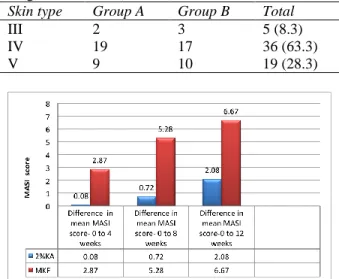
Table 4 Fitzpatrick skin types in treatment groups, group A (2% kojic acid) and group B (modified Kligman’s formula).
Skin type Group A Group B Total
III 2 3 5 (8.3)
IV 19 17 36 (63.3)
V 9 10 19 (28.3)
Figure 1 Comparison of reduction in MASI in two different treatment groups.
two groups were uniform statistically (Table 3 and 4).
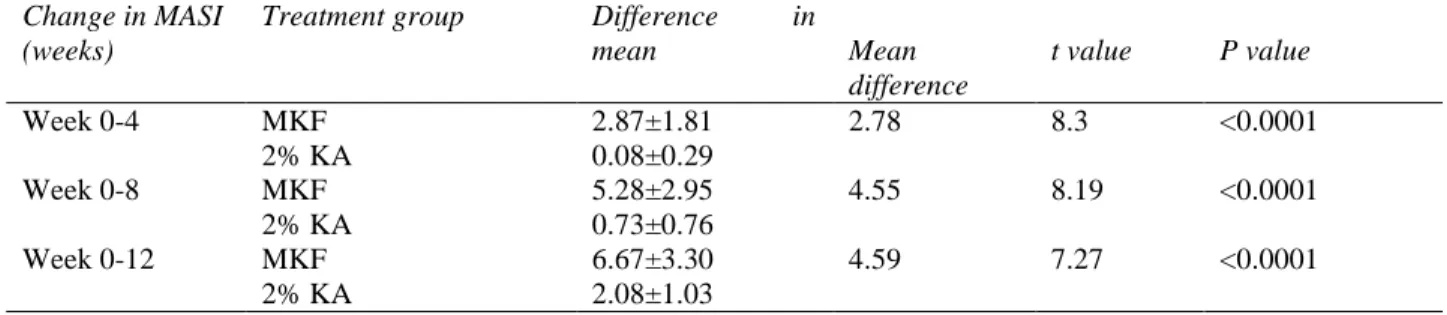
Change in MASI (weeks)
Treatment group Difference in
mean Mean
difference
t value P value
Week 0-4 MKF 2.87±1.81 2.78 8.3 <0.0001
2% KA 0.08±0.29
Week 0-8 MKF 5.28±2.95 4.55 8.19 <0.0001
2% KA 0.73±0.76
Week 0-12 MKF 6.67±3.30 4.59 7.27 <0.0001
2% KA 2.08±1.03
KA=kojic acid, MKF= modified Kligman’s formula.
Table 6 Pair-wise comparison (Post hoc test using Bonferroni correction) in 2% KA group (n=30).
Pair-wise comparison Mean difference Std. error P value
At first visit vs at 4 weeks 0.08 0.05 0.759 (Insignificant)
At first visit vs at 8 weeks 0.73 0.14 <0.0001 (Significant)
At first visit vs at 12 weeks 2.08 0.19 <0.0001 (Significant)
At 4 weeks vs at 8 weeks 0.64 0.13 <0.0001 (Significant)
At 4 weeks vs at 12 weeks 2.00 0.18 <0.0001 (Significant)
At 8 weeks vs at 12 weeks 1.35 0.20 <0.0001 (Significant)
Table 7 Pair-wise comparison (Post hoc test using Bonferroni correction) in modified Kligman’s formula group (n=30).
Pair-wise comparison Mean difference Std. error P Value
At first visit vs at 4 weeks 2.87 0.33 <0.0001 (Significant)
At first visit vs at 8 weeks 5.28 0.53 <0.0001 (Significant)
At first visit vs at 12 weeks 6.67 0.60 <0.0001 (Significant)
At 4 weeks vs at 8 weeks 2.41 0.39 <0.0001 (Significant)
At 4 weeks vs at 12 weeks 3.80 0.49 <0.0001 (Significant)
At 8 weeks vs at 12 weeks 1.39 0.25 <0.0001 (Significant)
Comparison between different treatment
regimens
Group A had a mean baseline (MASI0) MASI score 7.93±4.62 and in group B 10.02.±5.81. After completion of treatment i.e. after 3 follow-ups (MASI3), the mean MASI score was 5.85 ±3.96 in group A, 3.35±4.25 in group B. The mean reduction in MASI score was 2.08 (26.2%), 6.67 (66.5%) at the end of treatment in group A (2% KA) and group B (MKF), respectively. In both the groups the reduction in MASI was statistically highly significant (P<0.0001), Figure 1 and Table 5.
Using repeated measures ANOVA with a Greenhouse-Geisser correction, the mean reduction in MASI scores were statistically significant (F = 75.38, P <0.0001).
Post hoc tests using the Bonferroni correction revealed that 2% KA therapy elicited slight reduction in MASI scores from first visit to 4 weeks (7.93 + 4.62 vs 7.85 + 4.62, p=0.759) which was not statistically significant. However, MASI scores reduced significantly at subsequent visits. 2 % KA therapy at 12 weeks elicited a statistically significant reduction in MASI scores, but not after 4 weeks of therapy.
week 0 to week 4 and week 0 to week 8 (P < 0.0001). On comparison between the two drugs, at the 4th, 8th and also 12th week, MKF showed better effect (P <0.0001 HS) compared to 2% KA . So, at the end of treatment MKF showed statistically better efficacy than 2% KA. No complications were observed in patients who received 2% KA. Only 4 (10%) patients treated with MKF experienced slight burning sensation (1 case), erythema (1 case), mild irritation (2 cases). None discontinued the treatment nor suffered the worsening of melasma on treatment.
Discussion
In a multicentre open label community based study by Grimes et al.9 where the efficacy of
triple formulation containing 4% hydroquinone, 0.05% tretinoin, 0.01% fluocinolone acetonide were studied in 1290 patients of melasma for 8 weeks. Results showed that mean reduction in MASI score was significantly high at both 4 and 8 weeks compared to baseline (7.38 and 3.64 vs. 14.68, respectively; P <0.0001 for both time points). There was 50% reduction of MASI score at 4 weeks and 75% reduction at 8 weeks. In present study, triple formulation containing 2% hydroquinone, 0.025% tretinoin, 0.01% fluocinolone acetonide were used for 12 weeks. Mean MASI score decreased significantly at both 4 and 8 weeks compared to baseline (7.15 and 4.74 vs. 10.02, respectively; p <0.001). There was 28.6% reduction of MASI score at 4 weeks and 52.6% reduction at 8 weeks contrast to 50% and 75% reduction in above study probably due to 2% formulation of hydroquinone and 0.025% tretinoin used in our study.
In a study by Rochelle et al.10 where they
compared the efficacy of 0.75% KA and 4% hydroquinone. In patients who received 0.75% hydroquinone, there was a significant decrease in MASI at both week 8 and week 12 when
compared to baseline (9.52 and 8.77 vs 11.17, respectively; P ≤0.001) which was not significant at 4 weeks (p=0.121). This study was comparable to our study with 2% KA containing formulation where there was significant decrease in MASI score at both week 8 and week 12 (7.20 and 5.85 vs 7.93 respectively; P<0.001) and without significance at 4 weeks (P=0.759).
In spite of extensive literature search in various search engines (pubmed, google, medknow) no study which has attempted to compare the efficacy of 2% kojic acid + octinoxate + allantoin containing gel with Modified Kligman’s formula (MKF) containing 2% hydroquinone, 0.025% tretinoin, 0.01% fluocinolone acetonide cream in treatment of melasma could be found.
No complications were observed in patients who received 2% KA containing gel. Only 4 (10%) patients treated with MKF experienced slight burning sensation, erythema, mild irritation. None discontinued the treatment nor suffered the worsening of melasma on treatment. In a study by Taylor11 where he used 4% hydroquinone+
tretinoin 0.05%+ fluocinolone acetonide 0.01%, erythema and desquamation occurred in about half of treated patients. The reduced incidence of side effects in our study could be attributed to 2% hydroquinone and 0.025% tretinoin used in our study
Conclusion
long-term follow-up is needed to know the chances of relapse with both the formulations after discontinuation of the treatment. No single agent has proved to be effective for all patients, a combination of two or three agents is required to achieve optimum results. In spite of this, the treatment of melasma remains a challenge, and a mild-moderate improvement is all that is achieved in a majority of patients with higher chances of recurrences, hence, additional research in developing new and effective treatments for melasma is required.
References
1. Sori T, Nath AK, Thappa DM, Jaisankar TJ. Hypopigmentary disorders in children in South India. Indian J Dermatol. 2011;56:546-9.
2. Pawaskar MD, Parikh P, Markowski T, McMichael AJ, Feldman SR, Balkrishnan R. Melasma and its impact on health-related quality of life in Hispanic women. J Dermatolog Treat. 2007;18:5-9.
3. Anderson RT, Rajagopalan R. Development and validation of a quality of life instrument for cutaneous diseases. J Am Acad Dermatol. 1997;37:41-50
4. Deo KS, Dash KN, Sharma YK, Virmani NC, Oberai C. KA vis-a-vis its combinations with HQ and betamethasone valerate in melasma: a randomized, single blind,
comparative study of efficacy and safety. Indian J Dermatol. 2013;58:281-5.
5. B.C. Dwari, S. Palaian, A. Poudel, S. Prabhu: Clinical profile and management pattern of melasma patients in Western Nepal: A Hospital Based Study. Internet J Dermatol. 2009;7.
6. Sanchez NP, Pathak MA, Sato S, Fitzpatrick TB, Sanchez JL, Mihm MC Jr. Melasma: A clinical, light microscopic, ultrastructural and immunofluorescence study. J Am Acad Dermatol. 1981;4:698-710.
7. Aswanonda P, Tyalo CR. Woods light in dermatology. Int J Dermatol. 1999;38:801-7.
8. Kimbrough-Green CK, Griffiths CE, Finkel LJ, Hamilton TA, Bulengo-Ransby SM, Ellis CN et al. Topical retinoic acid (tretinoin) for melasma in black patients. Arch Dermatol. 1994;130:727-33.
9. Grimes P, Kelly AP, Torok H, Willis I. Community-based trial of a triple combination agent for the treatment of facial melasma. Cutis. 2006;77:177-84.
10. Monteiro RC, Kishore BN, Bhat RM, Sukumar D, Martis J, Ganesh HK. A comparative study of the efficacy of 4% HQ vs 0.75% KA cream in the treatment of facial melasma. Indian J Dermatol. 2013;58:157.