Australian Journal of Basic and Applied Sciences
ISSN:1991-8178Journal home page: www.ajbasweb.com
Corresponding Author: Muhammad Nasir Ibrahim, Universiti Teknologi Malaysia, Faculty of Electrical Engineering, 81310 UTM Johor Bahru, Malaysia.
Phone: (+607) 5535260; E-mail: [email protected]
Arabic Dictionary Application for Android Devices
1Muhammad Nasir Ibrahim, 2Siti Noormaya Bilmas, 3Mariani Idroas
1Universiti Teknologi Malaysia, Faculty of Electrical Engineering,81310 UTM Johor Bharu. Malaysia. 2Universiti Teknologi Malaysia, Faculty of Electrical Engineering,81310 UTM Johor Bharu. Malaysia.
3Universiti Teknologi Malaysia, Faculty of Petroleum and Renewable Energy,81310 UTM Johor Bharu. Malaysia.
A R T I C L E I N F O A B S T R A C T Article history:
Received 30 September 2014 Received in revised form 17 November 2014 Accepted 25 November 2014 Available online 13 December 2014
Keywords:
Android; Arabic dictionary; Masdar; language learner;
Android is the popular operating system (OS) for mobile devices. It is an easy platform to be manipulated for creating a new application. Due to this reason and along with current mobile device usage trend, this Arabic dictionary application is developed. The main purpose of this application is to make it easy to be used and accessed. Other than interactive interface, this dictionary database is designed with a new approach; the Arabic word is arranged in alphabetical order according to its masdar (root word). Masdar information is important in Arabic language for the construction pattern for each word to result derivation words. Besides, this database use actual dictionary approach which is give the full meaning of the word that will help in such a way on how to use the word. Besides meaning, form and example, this database also consist of grammatical information such as fi’il madi, fi’il mudhari’ and fi’il ammar. Basically, this dictionary available in Arabic to English and Arabic to Malay which is suitable for student and language learner.
© 2014 AENSI Publisher All rights reserved. To Cite This Article: Muhammad Nasir Ibrahim, Siti Noormaya Bilmas, Mariani Idroas, Arabic Dictionary Application for Android Devices. Aust. J. Basic & Appl. Sci., 8(24): 184-190, 2014
INTRODUCTION
Dictionaries can thus be used in various ways in language teaching and language learning but also consulted as tools in "non- learning" activities, for example in reading comprehension, text production and in professional translation (Varantola, 2002). Previously, dictionary is only available in printed form. As the technological changes, electronic dictionaries are invented. Due to the easy access and portability, an electronic dictionary becomes highly demand by the user rather than printed dictionary (Aladdin et al.,2004); (Midlane,2005).
Therefore, nowadays dictionary has been developed as an application for mobile devices because it has been widely used and being one of a must device that is from statistic 80% of the world’s population has own a mobile devices (www.Go-Gurf.com). Hand phone, smart phone and tablets are the examples of the mobile devices. These devices are supported by many OS such as Android, iPhone, RIM, Windows mobile and Symbian, From, these type of platform the mostly used is Android which is 46.9% of the market share of smart phone until year 2011.
As for this Arabic dictionary application, it is being designed in two languages Arabic to English and Arabic to Malay. This dictionary is designed especially for language learner as references which is not only consist with meaning but also other grammatical information such as root word, form, derivation words, fi’il madi, fi’il ammar and fi’il mudhari’.
Android:
Android is actually altered version of the Linux Kernel which is prominent free and open source software. Android is a software stack for mobile devices that includes an operating system, middleware and key applications. It has been used hundreds of millions of mobile devices in more than 190 countries around the world (Di Marzio, 2008).
capabilities, a realistic emulator that run native ARM code and in-field error reports from users to developers of Android Market application (Steele and To, 2011).
For third party developer the common platform that offers by android to create our own application is Android Software Development Kit (ASDK) which is comprised of the platform, tools, sample code and documentation. It is built as an add-on to the Java Development Kit and has integrated plug-in for the Eclipse Integrated Development Environment therefore, a developer at least need a basic familiarity with these.
In this project, the platform that used is Basic4Android (B4A) that offers by Anywhere Software. This is a comprehensive, feature-rich Rapid Application Development toolbox that enables both novices and experts to develop high-performance native Android applications without time-consuming Java/Eclipse programming. These are the features of B4A platform (www.basic4ppc.com);
i) Complete Integrated Development Environment (IDE) and programming language 100% focused on Android development.
ii) Compiles to native byte code. No runtime libraries are required. Android Package (APK) files are exactly same as APK files created with Java/Eclipse.
iii) Performance is similar to applications written with Java.
iv) Object oriented programming language (syntax similar to MS Visual Basic) v) No need for XML programming
vi) Highly extensible with support for custom Java libraries
vii) The only true WYSIWYG visual editor for Android. The visual editor supports multiple screens and resolutions.
viii)Powerful designer scripts feature that easily created sophisticated layouts. ix) B4A UI cloud service. Test layouts on a cloud of real phones and tablets. x) Supports all Android phones and tablets from Android 1.6 and up to Android 4.x
xi) Modern IDE with auto complete, built-in documentation, internal index and other advanced features. xii) Powerful step by step debugger
xiii)Large set of documentation with a custom online search engine and offline search engine tools. xiv)Built in code obfuscation
xv) Supports all Android core features.
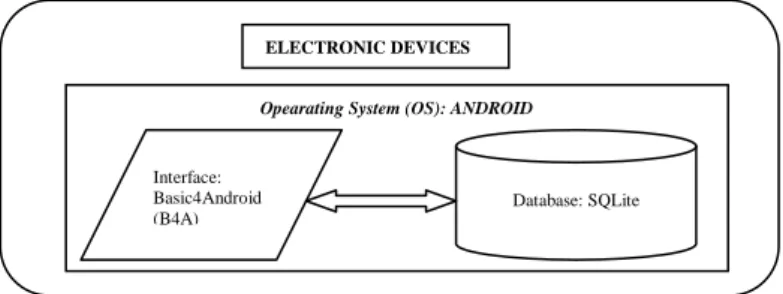
For the database, this platform use SQLite as database engine. SQLite is known as compact database that popular to be used in handheld electronic devices. It is an embedded database engine library that implements a self-contained, server less, zero-configuration, transactional SQL database engine (SQLite.org). In summary, the whole system can be visualized as in Figure 1.
Fig. 1: The whole system
Arabic Language:
Generally, Arabic words classified into three main categories; noun (مسا – Ism), Verb (لعف – Fi’il) and Particle (فرح – harf). Noun is a word that indicates a meaning that is not associated with time. Next is verb, a word indicating a meaning that is associated with one of the 3 dimensions of time (past, present and future). The verb for past tense is called as fi’il madi, present tense is called as fi’il mudhari’ and the future tense that called as fi’il mudhari’ mustaqbal. The examples are He did…., He does…., He will do……. . From fi'il mudhari’, fi’il ammar will be form. Fi'il ammar is command verb that will be varied according to the root word.
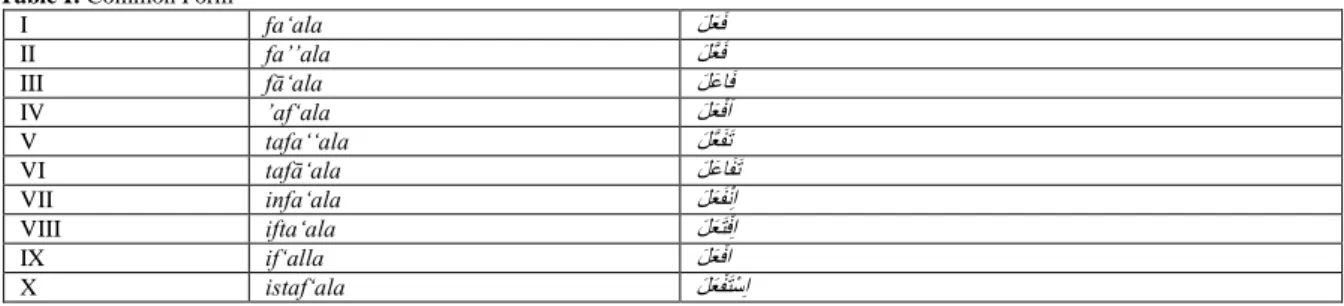
Arabic verb is based on root – pattern system (Wightwick et al.,2008). Masdar or root word is usually consisting of three (3) consonants. Verb is expansion of the root word. Some expansions are lexical derivations which will result "new words". But others are variation of the verb's conjugation. Western scholars have assigned Roman numerals to the various patterns of derivation, which are called "forms". Also, the root is designated "Form I". A particular form does not have a consistent meaning across verbs, although it has a "usual" meaning. In addition, no root verb has all the derivations. The forms numbered beyond Roman numeral
ELECTRONIC DEVICES
Opearating System (OS): ANDROID
Interface: Basic4Android (B4A)
word has much similar meaning to the root word meaning. As for particle, it indicates a meaning in other than itself or can be called as preposition. Examples of particle are in, who, if and when.
Table I: Common Form
I faʻala فَلفَعفَف
II fa’’ala فَلعَّعفَف
III fāʻala فَلفَا فَف
IV ʼafʻala فَلفَعفْففَا
V tafaʻʻala فَلعَّعفَ فَ
VI tafāʻala فَلفَا فَ فَ
VII infaʻala فَلفَعفَ فْ اِا
VIII iftaʻala فَلفَعفَ فْفاِا
IX ifʻalla فَلفَعفْفا
X istafʻala فَلفَعفْ فَ فْساِا
Existing Arabic Dictionary Application:
There are many applications available on online store for Arabic dictionary for Android devices such as Al-Mawrid dictionary from Paragon Software Group and Arabic dictionary by Xung Le (http://play.google.com). But as usual the available dictionaries are basically just show the meaning of the words.
As for research study, there are several research that really involve the development of Arabic dictionary development. In 2010, Abd. Rahman et. al. introduced a project on online multimedia Malay – Arabic dictionary (OMMAr) for beginner. Besides the meaning of a word, this dictionary is completed with visual such as picture or video and pronunciation voice. This application used client server technology. A mobile device (Smart phone) is the client and a web server is facilitating to lookup into the database. Basically, this project is the improvement from the previous project. Therefore, the softwares that have been used are the same. The experiments have been done on Symbian (Nokia E63), iPhone (using Safari) and Windows mobile (mobile IE on HTC Touch) as the execution platform. There are positive results for the experimented platform, except for the iPhone where the pronunciation function is become a problem due to the Flash format is used. IPhone cannot support Flash application and this problem is still not resolved.
Then, Halperm in 2011 from CJKI (Chinese Japanese Korean Institute) has introduced a printed Arabic-English dictionary called CJKI Arabic Learner’s Dictionary (CALD). This Arabic-Arabic-English dictionary has been made into electronic version for the mobile format by name iCALD. iCALD is designed along with the Arabic verb conjugator (CAVE) application and phonemic transcription system name as CJKI Arabic Romanization System (CARS). This electronic Arabic dictionary is for the smart phones that use iOS and Android platform. CAVE provides exhaustive coverage of 170 conjugation paradigms for over 1600 common verbs. There are multiple search mode available for this system; Full Form Search allows the user to input any inflected form of the verb, Verb Search enables searching from the canonical form, Root Search allows the user to input the root to find the canonical forms of all the corresponding verbs and English Search allows the user to quickly find a verb from any of its English meaning, including partial and included matches. CARS is developed to helped learners to pronounce Arabic accurately and with ease. These features are designed to full fill learners need by providing richness of content and functional user interface that give the learner rapid access to detail information on all inflected form.
Arabic Dictionary Application Design:
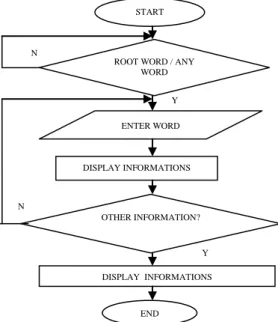
Fig. 2: Flowchart of searching word process
The main element of this application is the database. Generally, the database is divided into three part; Arabic data, English data and Malay data. The main element of this database is the arrangement of Arabic data is based on root word. Therefore, the system flow is basically based on root word unique assigned value which is called RootID. The general database structure can be seen from Figure 3.
Fig. 3: General database structure
The RootID format is designed for the unique indication in this database. The first two digits are referred to the character sequence that has been assigned according to the 28 Arabic characters. It starts with the alphabet (ا), the sequence number is 1 and end with alphabet ( ي ), the sequence number is 28. The complete alphabet sequence is shown in Table 2. It is make the data are listed according to the Arabic alphabet sequence. Then, after the two (2) digits, the alphabet ‘R’ is added as indication for root word data. After that the numbers are referring to the root word entries for each character sequence. A root word entry is referring to the entering number in the database. This RootID is designed to make the process of sorting the data according to the alphabet and for entering data process easier. This format make the accumulation process of data is easier.
Table 3: Arabic character sequence
Char. Seq. Char Seq. Char. Seq.
ا 1 ز 11 ق 21
ب 2 س 12 ك 22
ت 3 ش 13 ل 23
ث 4 ص 14 م 24
Y N
N
START
ENTER WORD ROOT WORD / ANY
WORD
DISPLAY INFORMATIONS
OTHER INFORMATION?
END
DISPLAY INFORMATIONS Y
Arabic Data
English Data
Malay Data RootID
ح 6 ط 16 ه 26
خ 7 ظ 17 و 27
د 8 ع 18 ي 28
ذ 9 غ 19
ر 10 ف 20
For more understanding, an example for the root word ب ك . It is start with letter ‘ك’, if refer to Table 3, the sequence number is 22. As for entry number, the word belongs to entry number ‘63’ when it is entered into the database system. Therefore, the RootID become 22R63.
Other then RootID, FormID, DeriveID and ExampleID is created to make a relation to the multilingual data. These ID format is much similar to RootID. These IDs are actually RootID plus the indication for each ID. The format and the example of each IDs are given in Table 4.
Table 4: IDs example and format
2 2 R 6 3 F 1 FormID
2 2 R 6 3 D 1 DeriveID
2 2 R 6 3 C 1 ExampleID
RootID Indication :
F: form D: derivation C: example
Entry number
The data is connected through the RootID to identify that the data is belong to the same root word. The RootID is the primary key (PK) for this database. The meaning for each Arabic word and the other information will be stored in English data and Malay data part. The multilingual data is separated for the future purposes. If any information or data want to be added later; it will affect either for English, Arabic or Malay data part only. It will not affect the whole database. Then, if the other language want to be added, the new table and additional of relationship will be designed and added. This will not affect the existing part database.
RESULT AND DISCUSSION
The interface of this application is designed to be attractive and user friendly. Other than that the most important is the information offer by the application and the accessibility. Basically, when user chooses to find by root word, they need to enter the root word. Once the ‘SEARCH’ button is click, the related information will be displayed. The frame with the example of the information display of root word searching mode is as shown in Figure 4.
Root Word ب ك Fi’il Madi kataba
Fi’il Mudhari’ Yaktubu
Fi’il Ammar Uktub
Meaning To write, pen, write down, put in writing, note down, inscribe, enter; record,book,register.
Derivation Words
Form Examples
Fig. 4: Frame of information display for root word searching mode
If one the navigation button is click, further information will be displayed. When user first click in the textbox of List of the derivation words, Forms and Examples; the list of the item will be displayed. Next, when users click on one of the item, the information will be displayed. The frame of the display is shown in Figure 5.
(A) (B) (C)
Derivation Words Form Examples
List of derivation words List of form List of examples Click on the
textbox to display the list of item
ب ك II هب ك ب ك
Click on one of the item
يب ك III ىميلع ب ك
ب ك IV
ب ك II ىميلع ب ك
Information displayed Word
Categ ory
noun
Meani ng
To accuse of heresy
Sound Kitab
ta’limi
Soun d
kitab
Meaning textbook
Femal e/Mal e
male
Mean ing
Piece of writing, record, paper; letter, note, message;
document; deed; contract; book;
Fig. 5: Frame of the information display for root word
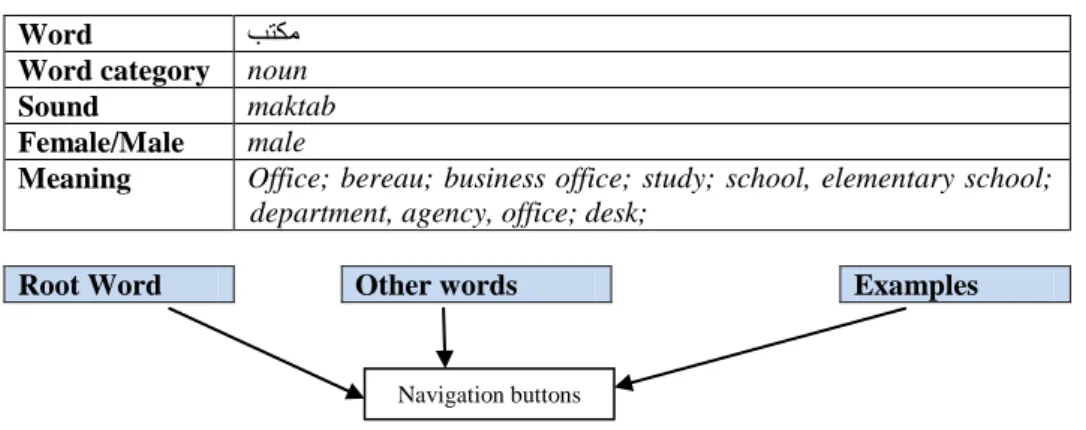
It is similar with searching any word mode. Users just need to enter the word they need, then the information will be displayed. If the word that user enter belong to root word, the display format as in Figure 4 will be displayed. The interface for derivation words will be displayed as shown in Figure 6. The format is similar to root word but the information given are differs.
When navigation button of ‘Root Word’ is click the information display is same to Figure 4 except the navigation provided only left ‘Form’ button. Once ‘Other Word’ button is click, the display format will be same as Figure 5(A). Same to ‘Example’ button, the format will be same as Figure 5(C).
Word ب كم
Word category noun
Sound maktab
Female/Male male
Meaning Office; bereau; business office; study; school, elementary school; department, agency, office; desk;
Root Word Other words Examples
Discussion And Conclusion:
This Arabic dictionary application is developed for Android devices. It is an offline system which is the user just need one time download and it can be used. This dictionary offer two type of dictionary; Arabic to English and Arabic to Malay dictionary. The unique about this application is the database.
Database for this application is arranged according to the root word. It is important in order to know the pattern of each Arabic word structure. Besides, this database also keeps track the total entry of each root word which is a good reference to developer. This database structure is designed for multilingual target language. If there are more other languages need to be added into the database, they only need to add other language table with similar existing table format without affected the other old language data. This database is the first step to other application. In future this database can be use to link to other application such as Al-Quran dictionary and language learning application. As the purpose of public sharing this database can also be a reference for other related Arabic research such as natural language and pattern recognition.
As for the interface, it is designed to be interactive and user friendly. The information displayed in arrangement manner which is easy to understand and neat. Color effect is also used to create an attractive display.
This dictionary is suitable to be use for all language learners because of its compact information. Besides it is really help user to learn and do reference easily because it can be installed in any Android devices.
REFERENCES
Abd. Rahman, K., A. Abd Aziz, S.M. Amirrudin, J. Ghazali, C.W. Shamsul Bahri, C.W. Ahmad and M.H. Husaini, 2011. The Design and Implementation of the Malay – Arabic Online Multimedia Dictionary on Smart Phones, Proceeding of Regional Conference on Knowledge Integration in ICT 2010, pp: 179 -188.
About SQLite. Viewed 7 March 2014.<http://www.sqlite.org>
Aladdin, A., A. Hamat and M.S. Yusof, 2004. Penggunaan PBBK(Pembelajaran Bahasa Berbantukan Komputer) dalam pengajaran dan pembelajaran Bahasa Arab sebagai bahasa asing: Satu tinjauan awal. GEMA Online Journal of Language Studies, Vol. 4(1).
Di Marzio, J.F., 2008. Android: A Programmer’s Guide, US: Mc Graw Hill.
Genaral Features. Anywhere Software. Israel. Viewed 5 April 2013.<http:// www.basic4ppc.com> Google . viewed 2 Mac 2013 <http://play.google.com>
Halpern, J., 2011. Pedagogical Lexicography Applied to Arabic Dictionaries and Smartphone Applications,
ALTIC -2011, Eqypt.
(Imam Mahdi Association of Marjaeya). I.M.A.M., 2009. Arabic Grammar for the Holy Quran. Unpublished Notes. Al-Qaem Institute.
Midlane, V., 2005. Students’ Use of Portable Electronic Dictionaries in the EFL/ESL Classsroom; A
Survey of Teacher Attitudes. Master Thesis. University of Manchester.
Smartphone Users Araound the World (Infographic). 2 Jan 2012. Web Design Company. Dubai. Viewed 7 Ogos 2013. <http:// www.go-gurf.com/blog/smartphone>
Steele, J and N. To, 2011. The Android Developer’s Cookbook: Building Applications with Android SDK. US: Addison Wesley.
Varantola, K., 2002. Use and Usability of Dictionaries: Common Sense and Context Sensibility?. In M.-H. Correard (ed.) Lexicography and Natural LanguageProcessing: A Festschrift in Honour of B. T. S. Atkins. Grenoble, France: EURALEX, 2002.