International Journal of Innovative Computing 6(1) 9-15
International Journal
of
Innovative Computing
Journal Homepage: http://se.fsksm.utm.my/ijic/index.php/ijicDeep Learning Methods and Optimization
Algorithms in Bioinformatics Field: A Review
Siti Noorain Mohmad Yousoff1, ‘Amirah Baharin, Syazwani Itri Amran, Nor Erne Nazira Bazin2 Synthetic Biology Research Group,
Health and Wellness Research Alliance, Universiti Teknologi Malaysia, 81310 UTM Johor Bahru, Johor, Malaysia
1[email protected], 2[email protected]
Abstract— Bioinformatics is a multidisciplinary field which
combines computer science, mathematics, statistics and also engineering to analyze, simulate and manipulate the biological data. However, researchers in bioinformatics field often suffer from the difficulties to encode the knowledge contain in biological data. It is not easy to analyze and manipulate biological data due to its hard nature. Furthermore, experimental in wet laboratory setting always required highly cost and took longer time to get the results. In this fast growing era, various computational methods have been developed in order to solve these problems as well as give better finding results with their fast performance. Deep learning is one of the computational methods that has been in spotlight and widely used in bioinformatics field due to its capability in predicting protein properties, gene ontology annotation and many more. Other than deep learning, optimization algorithms also can be considered as mostly used algorithms nowadays in bioinformatics field to assists deep learning in getting the best output from biological data. This paper will review several deep learning methods as well as optimization algorithms and their involvement in bioinformatics field. Summarization of advantages and drawbacks for both deep learning methods and optimization algorithms also will be visualized in the table forms at the end of every section.
Keywords — Deep neural network, particle swarm optimization, genetic algorithm, differential search algorithm, synthetic biology
I.INTRODUCTION
Bioinformatics is a field with many multidisciplinary that usually develop methods and software tools used for better understanding of biological data. It combines computer science, mathematics, statistics and also engineering to interpret and analyze biological data. Main aim of bioinformatics field is to gain better understanding of knowledge and relationship in biology [1]. In order to achieve
this aim, advanced computational technologies, tools and algorithms are needed to extract all this knowledge that has been encoded in biological data. Common problems faced in bioinformatics such as protein structure prediction and multiple sequence alignment inherently hard in nature. With the help of advanced computational technologies, tools and algorithms, it is hoped to be able to solve these kinds of problems.
Artificial intelligence (AI) methods such as deep learning offer an efficient and powerful approach to solve problems that occur in bioinformatics field. There are several types of deep learning such as deep neural network, deep belief network, deep convolutional neural network and deep autoencoder. All these methods will be reviewed further in the next section.
Despite the successfulness gained by deep learning, it is often suffer from the overfitting problem, slow convergence rate and it is always trapped at the local optima. Due to these drawbacks, advantages of optimization algorithms can be used to assist deep learning in order to achieve better finding results. Several optimization algorithms such as particle swarm optimization, enhanced binary particle swarm optimization, genetic algorithm and differential search algorithm will be reviewed in this paper for better understanding as well as their involvement in bioinformatics field.
II.DEEP LEARNING METHOD
It is based on a set of algorithms that attempt to model high-level abstractions in data by using model architecture and composed of multiple non-linear modules [3-6]. What can be said about deep learning is that, it works really well and has already making major advances in solving problems that haunt artificial intelligence community for many years.
In this section, several deep learning methods such as deep neural networks, deep belief networks, deep convolutional neural networks and deep autoencoder will be discussed in further. Review on previous works that used all of these methods in bioinformatics field will be summarized in the next section.
A.Deep Neural Network (DNN)
According to [7], deep neural network is a model structured by multiple hidden layers with non-linear activation functions. It has two main strengths if compared to linear models which are (1) the capability to learn high-level representation of features and it is also capable to (2) model complex systems with non-linear structures [7].
A deep neural network is a feed-forward, artificial neural network that usually has more than one layer of hidden units between the input and output layers [8]. It can be discriminatively trained by backpropagating the derivatives of a cost function that measures the discrepancy between the actual outputs and target outputs produced for each training case [8].
B.Deep Belief Networks (DBN)
Deep belief network is also one of the extension methods from deep learning. Deep belief network can be considered as a composition of simple learning modules that make up each layer [9]. Introduced by Hinton et al., deep belief network are generative neural network models with many layers of hidden explanatory factors [10] which composed of a stack of Restricted Boltzmann Machines (RBM).
Main component in the deep belief network is actually a greedy, layer-by-layer learning algorithm which optimized deep belief networks weights at the time complexity linear to the depth and size of the networks.
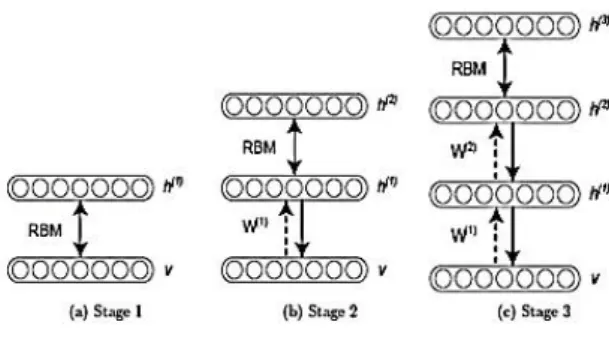
Fig. 1. Greedy learning of an RBM in DNN [10].
Figure 1 shows how the greedy training procedure of deep belief networks happened. It starts with stage 1 where one layer is added on the top of the network at each stage and only the
top layer is trained (as an RBM) as shown in stage 2 and stage 3 in Figure 1 above.
C.Deep Convolutional Neural Network (DCNN)
Deep convolutional neural networks are an alternative type of neural network [11] and a type of deep models in which local neighborhood pooling operations and trainable filters are applied and resulting in a hierarchy of increasingly complex features [12]. Furthermore, deep convolutional neural networks also have much fewer parameters and connections which then make them easier to be trained [11].
Fig. 2. Typical deep convolutional neural network architecture [11].
Figure 2 above shows the architecture of deep convolutional neural network. It worked by multiplying a small local inputs (v1,v2,v3,v4,v5) against the weights, W. The weights, W then will be shared to the entire input space as shown in figure above. After that, max pooling layer will helps to remove the variability in the hidden units (convolution layer bands).
D.Deep Autoencoder (DAE)
An autoencoder is a feed-forward artificial neural network with the same input and target output with usually fewer units in each hidden layers as shown in Figure 3 below. Small hidden layer in an autoencoder network creates an information bottleneck that forced the network to compress data into a low-dimensional representation [13].
Basically, an autoencoder is an approach that used to compare the reconstructed input to the original and try to minimize the error to make the reconstructed values as close as possible to the original.
III.APPLICATION OF DEEP LEARNING METHODS IN BIOINFORMATICS FIELD
In this section, previous works in bioinformatics field that have been done by numerous researchers which applied deep learning methods in their works will be reviewed. This section also will visualize and summarize the previous works in the table form for better understanding.
A.DNN for Predicting Local Protein Properties and Protein
Contact Map Prediction
Protein properties and its various functionalities always play an important role in predicting the behaviour and characteristics of an organisms including humankind. Panoply of approaches have been developed to predict such properties, unfortunately, most of the approaches only focus on solving a single task at a time. Therefore, Qi et al. in their work [14] has been implemented DNN in order to solve the problem above.
According to [14], prediction of primary amino acid sequence is one of the core projects in computational biology field. Therefore, they proposed an approach which is multitask learning and apply deep neural network (DNN) in this approach to exploits the dependencies among these various labeling tasks by train a single, joint model.
In different case, residue-residue contact prediction also plays an important role in protein structure prediction and other applications. However, limitation occurs when the accuracy of current contact predictors can only barely exceeds 20% on long range contacts [15].
Motivated by this, Lena et al., [15] used deep neural network architecture to progressively refine and organize the integrating information over both space and time and prediction of the contacts.
B.DBN to Predict Protein Residue-Residue Contacts and for
Discrimination of Attention Deficit Hyperactive Disorder (ADHD)
Motivated by the slow performance of sequence-based contact predictors, Eickholt and Cheng in their work [16], proposed new sequence-based residue-residue contact predictor using deep network and applied deep belief network (DBN) to train the data. As mentioned before, RBMs was practically used in DBN architecture. In this work [16], general framework used for classifying residue-residue contacts was a combination of RBMs which trained to form deep networks (DNs).
C.DCNN for Multi-Modality Isointense Infant Brain Image
Segmentation and Lymph Nodes Detection
In the isointense stage, the most challenging part is the making of tissue segmentation. Therefore, Deng et al., [12] proposed to use DCNN for segmenting the isointense stage brain tissues using multi-modality MR image. As mentioned in [12], DCNN is a type of deep models in which local
neighborhood pooling operations and trainable filters are applied alternatively on the raw data input images. This will result in a hierarchy of increasingly complex features.
D.DAE for Gene Ontology Annotation Predictions
In biology and bioinformatics field, major challenge that researchers need to face off is the annotation of genomic information. Not only that, current databases for gene functions are prone to errors and usually incomplete and in order to improve this, bimolecular experiments conducted are slow and costly.
Due to this, Chicco et al., in their work [13] solved main challenges in biology and bioinformatics which is the annotation genomic information problems by using deep autoencoder networks. They developed an algorithm that achieves the goals to solve the problems by using DCNN. They show that DCNN achieved better performance than other standard machine learning methods when they do the experiments on gene annotation data from the Gene Ontology project.
IV.COMPARISON OF DEEP LEARNING METHODS
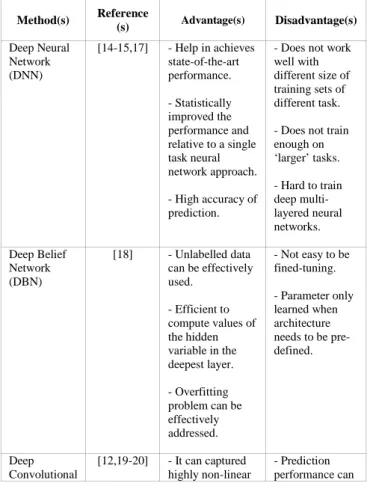
Based on the review of previous works using deep learning methods in bioinformatics field above, Table 1 below summarizes all the advantages and limitations that contain in each of the deep learning methods.
TABLE I SUMMARIZE OF ADVANTAGES AND DISADVANTAGES OCCUR IN SEVERAL DEEP LEARNING METHODS
Method(s) Reference
(s) Advantage(s) Disadvantage(s) Deep Neural
Network (DNN)
[14-15,17] - Help in achieves state-of-the-art performance.
- Statistically improved the performance and relative to a single task neural network approach.
- High accuracy of prediction.
- Does not work well with different size of training sets of different task.
- Does not train enough on ‘larger’ tasks.
- Hard to train deep multi-layered neural networks.
Deep Belief Network (DBN)
[18] - Unlabelled data can be effectively used.
- Efficient to compute values of the hidden variable in the deepest layer.
- Overfitting problem can be effectively addressed.
- Not easy to be fined-tuning.
- Parameter only learned when architecture needs to be pre-defined.
Deep Convolutional
[12,19-20] - It can captured highly non-linear
Method(s) Reference
(s) Advantage(s) Disadvantage(s) Neural
Network (DCNN)
mapping between inputs and also outputs.
be easily affected if number of patches is not balanced. Deep
Autoencoder (DAE)
[13] - Large datasets can be trained online and can be trained faster.
- Size and number of the hidden layers can provides easiest way to control complexity of the model.
- Small hidden layer in an autoencoder network can create an information bottleneck which then forcing the network to compress the data into low dimensional representation.
V.OPTIMIZATION ALGORITHMS
Optimization is not a new method or concept in biology. It was already gained wide attention in bioinformatics, biotechnology and computational biology research field. The behaviors and movements of an animal, their structures and their life histories have been shaped and identified by the optimizing processes of learning or evolution by trial and error [21-22].
Banga [23], defined optimization as an algorithm with the aim to find best compromise and best solution among several conflicting demands subject to predefined requirements. Not only that, optimization also aim to make a design or system as effective or functional as possible. In bioinformatics field, optimization methods can be seen have been widely used to help researchers to encoded, analyze, enhance and optimize biological data.
Besides that, optimization algorithms also can be used to support and assist deep learning methods for better result and finding. By using advantages in optimization algorithms, it can be a greatest helped to cover up the limitations occur in deep learning. Not only that, optimization also important in training large layer of the network and reduce the computational burden and provide great flexibility of algorithms [24].
There are several optimization algorithms such as particle swarm optimization, enhanced binary particle swarm optimization, genetic algorithm and differential search algorithm. All of these algorithms will be discuss further in the next section.
A.Particle Swarm Optimization (PSO)
Particle swarm optimization widely known as PSO is an optimization algorithm which achieved remarkable attentions due to their ability to solve diverse global optimization problems. It is a stochastic population-based optimization method [25] which generally inspired based on natural behavior of animal foraging activity. PSO promotes the movement of possible solutions called particles, around the search space where each particle travel in specific dimensional
space based on the previous experiences of finding local best solutions [20].
B.Enhanced Binary Particle Swarm Optimization (EPSO)
Enhanced binary particle swarm optimization (EPSO), basically is an enhancement algorithm version made from binary particle swarm optimization (BPSO). BPSO basically extended the basic concept of the original PSO by using sigmoid function to transform the value of velocity from continuous space into binary space [26]. However, BPSO suffers from several limitations which led to the introduction of new algorithm called EPSO. Tseng et al. [26], stated that EPSO has been proposed in order to solve structural topology optimization problems. The equation for EPSO is illustrated as below;
( )
(
)
2(( )
)1 ) 1
(t C P, X t C G, X t
Xi + = ibest⊕ i + ibest⊕ i (1)
In EPSO, particles will be represented by a bit string. Initial population of EPSO is generated by random number with either 1 or 0. After that, objective function will be calculated to generate new particles. If the value of objective functions of the new particle is better than the original particles, the position of the new particle will be selected for the next generation. Otherwise, the new particle for the next iteration is replaced by the original particle. In short, formula (1) already represents how EPSO works.
C.Genetic Algorithm (GA)
Genetic algorithm usually used to generate useful solutions to optimization and search problems. It has greater freedom of movement between different configurations compared to simpler algorithm which making them a valuable tool for the discovery of optimal motifs.
According to [27], in genetic algorithm, genes are the basic building blocks while chromosomes in a computer algorithm are an array of genes. In each chromosome, it has an associated cost function, assigning a relative merit to that chromosome. For better understanding on how this algorithm works, Figure 4 visualized the flowchart of a genetic algorithm.
The algorithm begins with a large list of random chromosomes. It defines a chromosome as an array of parameter values to be optimized. It will then evaluates the cost function for each of the chromosomes. After calculation has been made, the chromosomes are then will be ranked from the fit to the least fit according to their respective cost functions. If there are any unacceptable chromosomes, it will be discarded which then leave a superior species-subset of the original list. The remaining chromosomes will mate and become parents which later will reproduce enough to produce two new offspring. If mutation happened, the process is repeated and stop after a set number of iterations.
D.Differential Search Algorithm (DSA)
Differential search algorithm (DSA) is an advance swarm based evolutionary search algorithm [28]. DSA has its own unique crossover and mutation operators where the structure of crossover operator is different from other structure used in differential evolution (DE) algorithm. While for the mutation operator, it contains just one direction pattern apart from the target pattern [28].
DSA begins with the algorithm simulates the Brownian-like random-walk movement carried out by an organism to migrates in which the migrating species of living beings constitute a superorganism. The superorganism then will start to change its position towards more fruitful areas [29].
According to Liu et. al. [29], DSA originally proposed to solve the box constrained global optimization problems. According to Liu et. al., several comparison studies have been carried out in [30] for continuous unconstrained optimization problems between DSA, PSO, ABC, DE and Gravitational Search Algorithm (GSA). By the end, the results in [28-29] proved that DSA is more powerful tools compared to PSO, ABC, DE and Gravitational Search Algorithm (GSA).
VI.APPLICATION OF OPTIMIZATION ALGORITHM IN BIOINFORMATICS FIELD
In this section, previous works in bioinformatics field that have been done by numerous researchers which applied optimization algorithms in their works will be reviewed. This section also will visualize and summarize the previous works in the table form for better understanding.
A.PSO for Medical Diagnosis and Protein-Ligand Docking
Medical datasets are often classified by a relatively small number of patient records and a large number of disease measurements. These might be harmful especially in the case of relatively small training sets, where the redundancy and irrelevancy is harder to evaluate.
Therefore, Inbarani et al. in their work [31] proposed new supervised feature selection methods based on PSO which used for the disease diagnosis in this case. Inbarani et al. stated that PSO is highly consider in their work because PSO can make a few assumptions about the problem being optimized and it can be used to search very large spaces of candidate solutions. Besides that, PSO also useful in disease diagnosis problems as
it can be used on an optimization problems that are partially irregular, change over time and noisy.
B.EPSO for Gene Selection in Classifying Cancer Classes
To observe progress of proficient cancer diagnoses and classification platforms, gene expression data plays a very important role. Therefore, many researchers take an initiative to analyze gene expression data by using computational intelligence methods to select small subset of informative genes for cancer classification purpose. Unfortunately, many computational methods have to face difficulties in selecting small subsets of informative genes due to the small number of samples.
Motivated by this, Mohamad et al. [32], proposed enhanced binary particle swarm optimization (EPSO) to make the selection of small subsets genes that are related for cancer classification. Furthermore, they also make a result comparison between the proposed methods which is EPSO with previous method which is binary particle swarm optimization (BPSO). The comparison shows that proposed method which is EPSO give better result compared to BPSO in the classification of cancer data. They also stated that EPSO requires lower computational time if compared to BPSO.
C.GA for Recombination Detection and Optimization Method
for Metabolic Pathway
Screening for recombination is an essential component of every comparative study for phylogenetic and evolutionary inference to avoid the misled.
To avoid and solve this problem, Kosakovsky et al. [33], proposed likelihood-based model selection procedure that used genetic algorithm (GA) which used to search multiple sequence alignments for evidence of identity putative recombinant sequences and recombination breakpoints. The proposed method then shows better results and outperforms other available tools both in term of accuracy and power.
D.DSA to Improve Proteomic Analysis
Electron transfer dissociation (ETD) is very complementary activation method and useful for peptide fragmentation in mass spectrometry. Unfortunately, ETD spectra usually receive a relatively low score in the identification of 2+ ions.
Therefore, benefits in combining both ion charge enhancing methods and differential search algorithm (DSA) has been proposed by Xie et al. in their work [34] to overcome the problem stated above. What they observed when used the proposed method is that, the complementary identification results shows great improvement in ETD identification.
VII.COMPARISON OF OPTIMIZATION ALGORITHMS
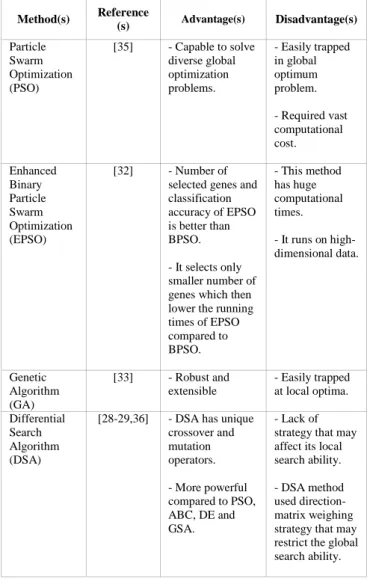
TABLE 2 SUMMARIZE OF ADVANTAGES AND DISADVANTAGES OCCUR IN SEVERAL OPTIMIZATION METHODS
Method(s) Reference (s) Advantage(s) Disadvantage(s)
Particle Swarm Optimization (PSO)
[35] - Capable to solve diverse global optimization problems.
- Easily trapped in global optimum problem.
- Required vast computational cost.
Enhanced Binary Particle Swarm Optimization (EPSO)
[32] - Number of selected genes and classification accuracy of EPSO is better than BPSO.
- It selects only smaller number of genes which then lower the running times of EPSO compared to BPSO.
- This method has huge computational times.
- It runs on high-dimensional data.
Genetic Algorithm (GA)
[33] - Robust and extensible
- Easily trapped at local optima.
Differential Search Algorithm (DSA)
[28-29,36] - DSA has unique crossover and mutation operators.
- More powerful compared to PSO, ABC, DE and GSA.
- Lack of strategy that may affect its local search ability.
- DSA method used direction-matrix weighing strategy that may restrict the global search ability.
VIII.CONCLUSION
In this review, several deep learning methods such as deep neural network, deep belief network, deep convolutional neural network and deep autoencoder has been reviewed, as well as their involvement in bioinformatics field. Table 1 has summarized all advantages and disadvantages for each of the deep learning methods mentioned above. As the era changes and modernization take place, people tend to use computational methods to ease their daily routine and jobs. With many projects and researches in bioinformatics field which require researchers to use biological data, deep learning seems to be a very promising method in helping to analyze, simulate and manipulate all knowledge encoded in biological data.
Despite the successfulness of deep learning methods, it seems like deep learning still suffer from several limitations that led to an undesirable finding results. Common problems that occur in deep learning methods are overfitting problem and it always trapped in local optima. Therefore, advantages of
optimization algorithms can be used to assist deep learning methods in order to get better finding results. Several optimization methods such as particle swarm optimization, enhanced binary particle swarm optimization, genetic algorithm and differential search algorithm have been reviewed as well as their involvement in bioinformatics field. Just like Table 1, Table 2 also has summarized all advantages and disadvantages occur in optimization algorithms and have been visualize in a table form for easy and better understanding.
For future works involving deep learning and optimization in bioinformatics field, it is hoped that researchers or computational biologist can proposed more hybrid methods between deep learning and optimization algorithms in order to get best finding data and results. As mentioned by Mohamad et al. [32], to produce better result, the hybrid methods are highly recommended compared to the filter methods.
ACKNOWLEDGMENT
We would like to express our appreciation to Malaysia Ministry of Higher Education for supporting this project under Fundamental Research Grant Scheme (Project Vot No. 4F481). We also would like to thank to Research Management Center, Universiti Teknologi Malaysia for managing this project.
REFERENCES
[1] Hapudeniya M. 2010. Artificial neural networks in
bioinformatics. Sri Lanka Journal of Bio-Medical
Informatics, 1(2).
[2] Lecun, Y., Bengio, Y., & Hinton, G. 2015. Deep learning. Nature, 521, 436-444.Brettel, H. and Vienot, F. 2001. Color Display for Dichromats, Proceeding of SPIE on Color Imaging.
4300:199–207.
[3] Deng, L.; Yu, D. 2014. Deep Learning: Methods and
Applications. Foundations and Trends in Signal Processing 7, 3–4.
[4] Bengio, Yoshua 2009. Learning Deep Architectures for AI.
Foundations and Trends in Machine Learning 2 (1), 1–127. [5] Bengio, Y.; Courville, A.; Vincent, P. 2013. Representation
Learning: A Review and New Perspectives. IEEE Transactions on Pattern Analysis and Machine Intelligence 35 (8), 1798– 1828.
[6] Schmidhuber, J. 2014. Deep Learning in Neural Networks: An Overview. Neural Networks 61, 85–117.
[7] Li, Y., Chen, C. Y., & Wasserman, W. W. 2015. Deep Feature Selection: Theory and Application to Identify Enhancers and Promoters. In Research in Computational Molecular Biology
(pp. 205-217). Springer International Publishing.
[8] Hinton, G., Deng, L., Yu, D., Dahl, G. E., Mohamed, A. R., Jaitly, N., ... & Kingsbury, B. 2012. Deep neural networks for acoustic modeling in speech recognition: The shared views of four research groups. Signal Processing Magazine, IEEE, 29(6), 82-97.
[9] Hinton, G.E. "Deep belief networks". Scholarpedia 4 (5): 5947. doi:10.4249/scholarpedia.5947
[10]Le Roux, N., & Bengio, Y. 2008. Representational power of restricted Boltzmann machines and deep belief networks. Neural computation, 20(6), 1631-1649
[11]Sainath, T. N., Mohamed, A. R., Kingsbury, B., &
LVCSR. In Acoustics, Speech and Signal Processing (ICASSP),
2013 IEEE International Conference on (pp. 8614-8618). IEEE. [12]Zhang, W., Li, R., Deng, H., Wang, L., Lin, W., Ji, S., & Shen,
D. 2015. Deep convolutional neural networks for multi-modality isointense infant brain image segmentation. NeuroImage, 108, 214-224.
[13]Chicco, D., Sadowski, P., & Baldi, P. 2014. Deep autoencoder neural networks for gene ontology annotation predictions.
InProceedings of the 5th ACM Conference on Bioinformatics,
Computational Biology, and Health Informatics, 533-540.
[14]Qi, Y., Oja, M., Weston, J., & Noble, W. S. 2012. A unified multitask architecture for predicting local protein properties. PloS one, 7(3), e32235.
[15]Di Lena, P., Nagata, K., & Baldi, P. 2012. Deep architectures for protein contact map prediction.Bioinformatics, 28(19), 2449-2457.
[16]Eickholt, J., & Cheng, J. 2012. Predicting protein residue– residue contacts using deep networks and boosting.
Bioinformatics, 28(23),
[17]Deng, L. 2012. Three classes of deep learning architectures and their applications: a tutorial survey. APSIPA transactions on signal and information processing.
[18]Larochelle,H., Bengio,J., Louradour,J., Lamblin,P. 2009
Exploring Strategies for Training Deep Neural Networks
Journal of Machine Learning Research, 10, 1-40.
[19]LeCun, Y., Bottou, L., Bengio, Y., Haffner, P., 1998. Gradient-based learning applied to document recognition. Proc. IEEE 86 (11), 2278–2324.
[20]Krizhevsky, A., Sutskever, I., Hinton, G., 2012. Imagenet classification with deep convolutional neural networks. In: Bartlett, P., Pereira, F., Burges, C., Bottou, L., Weinberger, K. (Eds.), Advances in Neural Information Processing Systems. 25,1106–1114.
[21]Alexander RM: Optima for animals. London: E. Arnold; 1982. [22]Sutherland WJ, 2005. The best solution. Nature.
[23]Banga, J. R. 2008. Optimization in computational systems
biology. BMC systems biology, 2(1), 1.
[24]Lamos-Sweeney, J. 2012. Deep learning using genetic
algorithms. 3066-3072.
[25]J. Kennedy and R.C. Eberhart, “Particle swarm optimization”
Proceeding of IEEE Int. Conf. Neur. Netw.,vol. 4, 1995, pp.1942-1948.
[26]Tseng, K. Y., Zhang, C. B., & Wu, C. Y. 2010. An enhanced binary particle swarm optimization for structural topology optimization. Proceedings of the Institution of Mechanical Engineers, Part C: Journal of Mechanical Engineering Science, 224(10), 2271-2287.
[27]Haupt, R. L. 1995. An introduction to genetic algorithms for electromagnetics. Antennas and Propagation Magazine, IEEE, 37(2), 7-15.
[28]Civicioglu P., Transforming geocentric cartesian coordinates to geodetic coordinates by using differential search algorithm,
Computers & Geosciences, 46, 2012, 229–247.
[29]Liu, J., Wu, C., Wu, G., & Wang, X. 2015. A novel differential search algorithm and applications for structure design. Applied Mathematics and Computation, 268, 246-269.
[30]J. Liu, K. Teo, X. Wang, C. Wu, (2015). An exact penalty
function-based differential search algorithm for constrained global optimization, Soft Comput. 1–9.
[31]Inbarani, H. H., Azar, A. T., & Jothi, G. 2014. Supervised hybrid feature selection based on PSO and rough sets for
medical diagnosis. Computer methods and programs in
biomedicine, 113(1), 175-185.
[32]Mohamad, M. S., Omatu, S., Deris, S., Yoshioka, M., Abdullah, A., & Ibrahim, Z. 2013. An enhancement of binary particle swarm optimization for gene selection in classifying cancer classes.Algorithms for Molecular Biology, 8(1), 1.
[33]Pond, S. L. K., Posada, D., Gravenor, M. B., Woelk, C. H., & Frost, S. D. 2006. GARD: a genetic algorithm for recombination detection. Bioinformatics, 22(24), 3096-3098.
[34]Xie, L. Q., Shen, C. P., Liu, M. B., Chen, Z. D., Du, R. Y., Yan, G. Q., ... & Yang, P. Y. 2012. Improved proteomic analysis pipeline for LC-ETD-MS/MS using charge enhancing methods.
Molecular BioSystems, 8(10), 2692-2698.
[35]Abdullah, A., Deris, S., Hashim, S. Z. M., Mohamad, M. S., & Arjunan, S. N. V. 2011. An improved local best searching in particle swarm optimization using differential evolution. In Hybrid Intelligent Systems (HIS), 2011 11th International Conference, 115-120.
![Fig. 4 Genetic algorithm flowchart [27 ].](https://thumb-us.123doks.com/thumbv2/123dok_us/8004131.2121693/4.892.55.426.82.377/fig-genetic-algorithm-flowchart.webp)