hypoxia: a preliminary report. Journal of Maternal and Fetal Medicine 1999; 8: 208-12.
12. Lin CC, Vassallo B, Mitten dorf R. Is intrapartum vibroacoustic stimulation an effective predictor of fetal acidosis? Journal of Perinatal Medicine 2001; 29: 506-12.
13. Gibb D, Arulkumaran S. The role of scalp pH. In: Fetal Monitoring in Practice. 3rd ed Butterworth Heinemann, Elsevier, London 2008: 198-202.
14. Fisk NM, Nicolaidis PK, Arulkumaran S, Weg MW, Tannirandom Y, Nicolini U, Parkes MJ, Rodeck CH. Vibroacoustic stimulation is not associated with sudden fetal catecholamine release. Early Human Development 1991; 25: 11-7.
15. Arulkumaran S, Skurr B, Tong H, Kek LP, Yeoh KH, Ratnam SS. No evidence of hearing loss due to fetal acoustic stimulation test. Obstetrics and Gynaecology 1991; 78: 283-5.
16. Spencer JA, Deans A, Nicolaidis P, Arulkumaran S. Fetal heart rate response to vibroacoustic stimulation during low and high fetal heart rate variability episodes in late pregnancy. American Journal of Obstetrics and Gynaecology 1991; 165: 86-90.
17. East CE, Smyth RMD, Leader LR, Henshall NE, Colditz PB, Tan KH. Vibro acoustic stimulation for fetal assessment in labour in the presence of a non reassuring fetal heart rate
trace. The Cochrane Database of Systematic Reviews 2005, issue (2): Article No: CD004664. DOI: 10.1002/14651858. pub 2.In: Cochrane Library 2009, Issue 1.
18. Batcha TM, Goonewardene IMR. The fetal acoustic stimulation test: a reliable and cost effective method of antepartum fetal monitoring. The Ceylon Medical Journal 2005; 50: 156-9.
19. Arulkumaran S, Symonds EM. Intrapartum fetal monitoring basic knowledge. The Obstetrician and Gynaecologist 1999; 1: 12-4.
20. Schiff E, Lipitz S, Sivan E, Barkai G, Mashiach S. Acoustic stimulation as a diagnostic test: comparison with oxytocin challenge test. Journal of Perinatal Medicine 1992; 20: 275-9.
21. Devoe LD. Antennal assessment; contraction stress test, non stress test, vibro acoustic stimulation, amniotic fluid volume, biophysical profile and modified biophysical profile – an overview. Seminars on Perinatology 2008; 32: 247-52.
22. Irion O, Stuckelberger P, Moutquin JM, Morabia A, Extermann P, Beguin F. Is intrapartum vibratory acoustic stimulation a valid alternative to fetal scalp pH deter-mination? British Journal of Obstetrics and Gynaecology 1996; 103: 642-7.
23. Skupski DW, Rosenberg CR, Eglinton GS. Intrapartum fetal stimulation tests: a meta analysis. Ob stetrics a nd Gynaecology 2002; 99: 129-34.
Abstract
Introduction The effect of dermatological disease on patients' quality of life is a minimally addressed issue in Sri Lanka. One reason is the unavailability of a standardised measuring tool. This study was done to produc e and validate a Sinhala version of the Dermatology Life Quality Index (DLQI), which is an internationally acc epted quality of life measuring instrument.
Methods The English version of the DLQI was translated according to standard procedures and the translated version was validated among 200 outpatients attending the dermatology clinics at the National Hospital of Sri Lanka and 30 healthy volunteers. The SF-36 was administered simultaneously to a random subsample
Validation study of Sinhala version of the dermatology life quality index
(DLQI)
N P Madarasingha1, P de Silva2, K Satgurunathan1
(Index words: quality of life, dermatological disease, validation)
1Dermatology Unit, National Hospital of Sri Lanka and2National Institute of Health Sciences, Kalutara, Sri Lanka.
Correspondence: NPM, e-mail <[email protected]>. Received 15 February and revised version accepted 9 October 2010. Competing interests: none declared.
of 125 participants to test for criterion validity. Internal consistency and the test-retest reliability were assessed separately for the translated DLQI.
Conclusions The DLQI (Sinhala) version is a simple, acceptable and reliable tool to measure the effect of dermatological diseases on quality of life.
Ceylon Medical Journal 2011; 56: 18-22
Introduction
Skin diseases and their treatment cause psychological distress to patients and impair their quality of life [1,2]. Although addressed in developed countries the Quality of Life (QoL) aspect is often overlooked in Sri Lanka [3,4]. One of the main drawbacks we have is the unavailability of a standardised measuring tool for assessing the quality of life among patients.
The Dermatology Life Quality Index (DLQI) questionnaire was first described in 1994 [5]. At present it is being used for 33 different skin conditions in 32 countries and is available in 55 languages including Tamil. DLQI is the most frequently used instrument in studies of randomised controlled trials, for assessing the outcome [6]. Therefore the translation of DLQI to Sinhala and a validation study to assess its cultural acceptability, reliability and validity was done.
Methods
Consent for the translation process was obtained from the copyright holders of DLQI. Two independent translators translated the DLQI from English to Sinhala. The final combined translation was backtranslated to English by a bilingual person. This backtranslated version was sent to the original authors and modifications were done with the discussion of the two parties.
The DLQI consists of 10 questions covering various aspects of quality of life. The DLQI was calculated by simple summation of the score of each question resulting in a maximum of 30 and a minimum of 0. The scoring and interpretation of incorrectly marked questions were done according to the standards given by the original authors. Approval for the study was obtained from the Ethical Review Committee of the National Hospital of Sri Lanka.
Sinhala-literate outpatients over 16 years, who were attending the dermatology clinics of the National Hospital of Sri Lanka were included in the study. The patients were given a brief introduction of the pur pose of the questionnaire and verbal consent was taken prior to the commencement of the DLQI administration.
The validity was assessed employing several methods. Face and content validity had already been established for the DLQI by its original author and the validity of the translated version was assessed by a panel of experts. Each item in the instrument was assessed for its r elevance in assessing quality of life among dermatological patients, appropriateness of the wording and acceptability in the local context.
Reliability of the DLQI was assessed by means of internal consistency within the domains and assessing test-retest reliability. Internal consistency is the extent to which items within a domain are correlated with each other to give the same result. This was assessed by calculating the Cronbach's alpha coefficient. Estimates of a magnitude of 0.70 or greater was considered as satisfactory [8].
Test-retest reliability measures the ability to generate stable results which are reproducible [9]. This was assessed by re-administering the DLQI after two weeks to a sub sample of 20 patients selected randomly. A correlation coefficient (Cohen's Kappa) of 0.60 or above was considered a good level of agreement between scores [9]. Acceptability was assessed by the response rate, percentage of incorrectly completed questionnaires, the time required to complete the questionnaire and details of items considered upsetting, confusing or difficult by the respondents.
DLQI scores were compared among healthy and diseased groups as well as among groups with varied severity of the disease to assess the discriminant validity. Criterion validity was assessed by comparison with selected components of the translated and validated version of the SF-36 instrument (regarding role-physical, role-emotional, social functioning, mental health, and vitality). A few questions from SF-36 which were thought to be most relevant to patients with skin diseases were selected and was used in a randomly selected sub sample of 125 patients. A moderate correlation (Pearson r=0.40 -0.70) between the DLQI and the SF-36 components was considered to be adequate [7].
Results
The backtranslated version of DLQI (Sinhala) was accepted by the original authors except for question 8. The back translation denoted the term 'spouse' to the word which appeared as 'partner' in the original English version. As the word partner in its meaning in the western culture is not familiar to the local context ultimately it was decided to go ahead with the same word which is more relevant for the local community and the translated version was accepted for the validation.
This translated Sinhala version of the DLQI is available with the copyright owners at http://www. dermatology.org.uk/quality/quality-dlqi.html under different language versions. This can be downloaded for any future use in Sri Lanka with the permission of the original authors.
The DLQI (Sinhala) was tested on 200 outpatients with various dermatological problems. The mean age of the study population was 40.3 years with nearly equal sex distribution.
In assessing the content validity, colloquialization of few words were required. Additionally, the appropriateness of question number 6 in the local context, which was regarding sports, was questioned.
Reliability of the translated DLQI as assessed by measuring the internal consistency (Cronbach's alpha) is presented in Table 2, separately for the healthy volunteers and the patients attending the clinics.
Disease No. Percentage
Eczema 49 24.5
Psoriasis 46 23.0
Acne 20 10.0
Vitiligo 29 14.5
Infections 21 10.5
Other 35 17.5
Table 1. Distribution of the study sample based on the disease
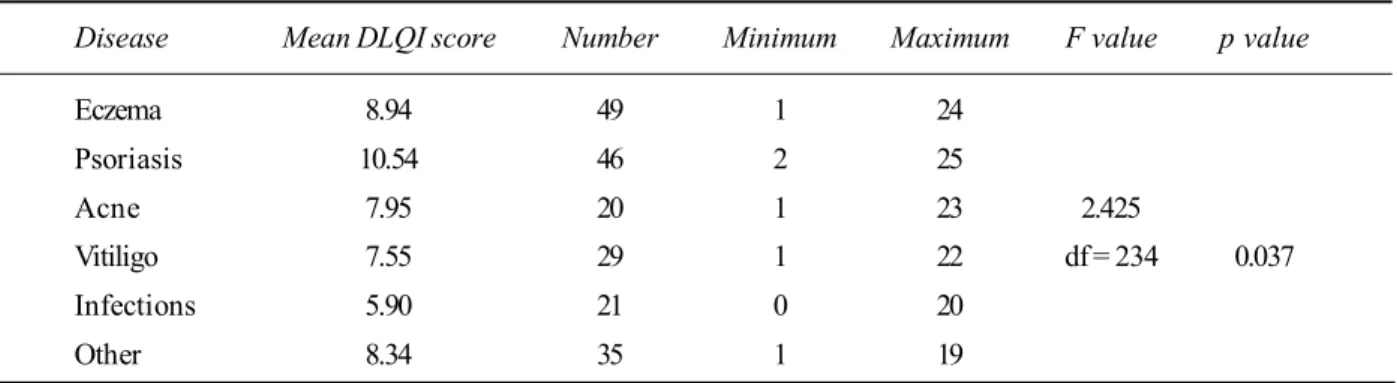
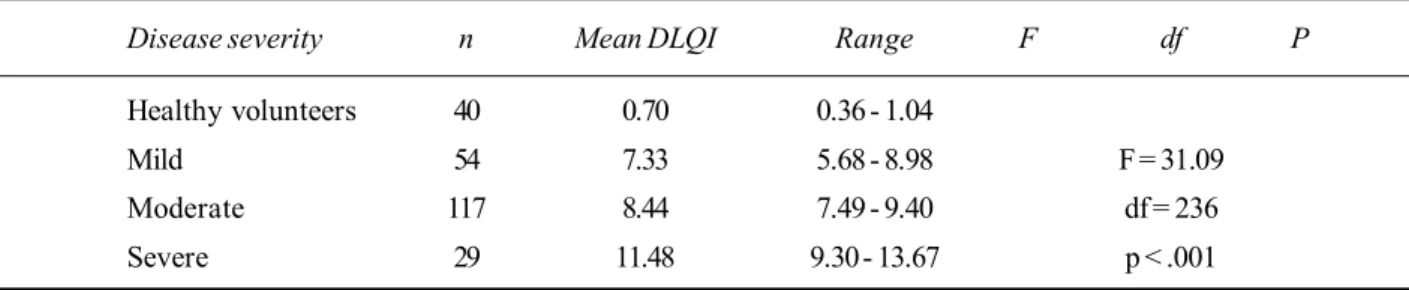
Work and school domains and the treatment domain had only one question and were excluded in assessing internal consistency. Except for the personal relationship domain, all other domains indicate a satisfactory level of internal consistency with Cronbach's alpha values ranging from 0.561 to 0.741. Although quality of life is a variable phenomenon, re-administering the DLQI after two weeks to a subsample of 20 patients selected randomly showed a test-retest reliability coefficient of 0.83, where any correlation greater than 0.70 was considered as satisfactory. The comparison of the DLQI scores among the healthy and diseased groups was used to assess the discriminant validity. Healthy and diseased groups as well as severity of the disease within the diseased groups were compared separately. The statistical significance of the observed differences was assessed using the ANOVA test (see Tables 3 and 4).
DLQI domain No. of Healthy Patients
items volunteers (n=200)
(n=40)
Symptoms and feelings 2 .598 .561
Daily activities 2 .654 .741
Leisure 2 .569 .687
Personal relationships 2 .498 .442
Table 2. Distribution of coefficient alphas for the domains of the DLQI (Sinhala)
Disease Mean DLQI score Number Minimum Maximum F value p value
Eczema 8.94 49 1 24
Psoriasis 10.54 46 2 25
Acne 7.95 20 1 23 2.425
Vitiligo 7.55 29 1 22 df = 234 0.037
Infections 5.90 21 0 20
Other 8.34 35 1 19
Overall, th ese fin dings suggest satisfactor y discriminant validity for the translated Sinhala version of the DLQI. Results pertaining to the criterion validity assessed for the Sinhala version of the DLQI in relation to the relevant components of the validated Sinhalese version of SF-36, are presented in table 5.
If a moderate correlation of above 0.4 was considered is satisfactory, the item correlations demonstrated by the DLQI (Sinhala) can be considered satisfactory and having good criterion validity.
The response rate for the DLQI was around 98%. The rate of successful completion of scale items was in excess of 95% in all items other than item 7. This question was misunderstood by 12%. The time taken to complete the DLQI ranged from 3-5 minutes in 90% and no upsetting, confusing or difficult questions were identified by the study group. Although the suitability of question number 6 in the local context was raised in assessing the content validity only 22% of the sample had marked it as irrelevant.
Discussion
Health related quality of life measures have been used in parallel to clinical outcome measures in the field of Dermatology in the recent past. This necessitates a validated disease specific quality of life measuring instrument in the language used by a majority of the population.
During the translational process which ensured consistency with the original English version of the DLQI, only question 8 regarding the word "partner" showed a
discrepancy. This question had given rise to difficulties in translation with its original English meaning even in other cultural settings [10, 11].
Although the suitability of question number 6 in the local context was raised in assessing the content validity, only 22% of the sample marked it as irrelevant. Therefore the authors feel the content of the DLQI should not be altered.
When compared with the SF-36, all domain correlations were above 0.4 which was sufficient for a moderate correlation. The results in this study showed better correlations with SF-36 than some other validation studies [10,11]. Physical and social functioning domains indicated better criterion validity compared to the vitality domain.
The DLQI (Sinhala) appear to discriminate well between the healthy and disease groups similar to its original version [5]. Furthermore, it discriminates quality of life changes in different diseases and within the disease groups according to their severity.
As the time taken to complete the DLQI (Sinhala) ranged from 3-5 minutes in the majority of the sample and the response rate was 98%, it was proved to be a simple, practical, and acceptable quality of life instrument that can be used in the busy clinics in Sri Lanka. The rate of incorrectly marked questions was not significant except in question 7. This question was misunderstood by 22% but as the standard interpretation of incorrectly marked questions was used this did not affect the data adversely. The mean DLQI score of the study population was 8.58. Most ethnic groups have a DLQI score of 6-10
[5,10-Disease severity n Mean DLQI Range F df P
Healthy volunteers 40 0.70 0.36 - 1.04
Mild 54 7.33 5.68 - 8.98 F = 31.09
Moderate 117 8.44 7.49 - 9.40 df = 236
Severe 29 11.48 9.30 - 13.67 p < .001
Table 4. Distribution of DLQI in relation to disease status and severity of disease
SF 36 Domains DLQI (Sinhala) N P
Role - physical -0.639 125 < 0.01
Vitality -0.499 125 < 0.01
Mental health -0.579 125 < 0.01
Social functioning -0.645 125 < 0.01
Role-emotional -0.541 125 < 0.01
12]. Therefore the mean DLQI score of this study is consistent with the other ethnic groups.
Conclusion
The validated DLQI (Sinhala) questionnaire appears to be a reliable, practical and culturally acceptable quality of life measuring tool.
Acknowledgements
The authors would like to acknowledge Professor Andrew Finlay of Department of Dermatology, Cardiff University, Wales, United Kingdom for his valuable assistance in carrying out this study.
References
1. Ryan TJ. Disability in dermatology. British Journal of Hospital Medicine 1991; 46: 33-6.
2. Jowett S, Ryan TJ. Skin disease and handicap: an analysis of the impact of skin conditions. Social Sciences and Medicine 1985; 20:425-9.
3. Girishery IH, Link BG. Feeling of stigmatization in patients with psoriasis. Journal of the American Academy of Dermatology 1989; 20: 53-63.
4. Motley RJ, Finlay AY. How much disability is caused by Acne? Clinical and Experimental Dermatology 1989; 14: 194-8.
5. Finlay AY, Khan GK. Dermatology Life Quality Index (DLQI): a simple practical measure for routine clinical use. Clinical and Experimental Dermatology 1994; 19: 210-6.
6. Lewis VL, Finlay AY. Ten years experience of the Dermatology Life Quality Index (DLQI). Journal of Investigative Dermatology Symposium Proceedings 2004; 9: 169-80.
7. Pete V, Jenkinson C, Fitzpatrick R. PDQ-39: a review of the development, validation and application of Parkinson's disease quality of life questionnaire and its associated measures. Journal of Neurology 1998; 245: 10-4.
8. Cronbach LJ, Meehl PE. Construct validity in psychological tests. Psychological Bulletin 1955; 52: 281-302.
9. Testa MA, Simonson DC. Assesment of quality of life outcomes. New England Journal of Medicine 1996; 334: 833-40.
10. Takahashi N, Suzukamo Y, Nakamura M, et al. Japanese version of the Dermatology Life Quality Index: validity and reliability in patients with acne. Health and Quality of Life Outcomes 2006; 4: 46.
11. Ozturkcan S, Ermertcan AT, Eser E, Sahin MT. Cross validation of the Turkish version of Dermatology Life Quality Index. International Journal of Dermatology 2006; 45: 1300-7.
12. Hahn HB, Melfi CA, Chuang TS, et al. Use of the Dermatology Life Quality Index (DLQI) in a Midwestern US urban clinic. Journal of the American Academy of Dermatology 2001; 45: 44-8.
Abstract
Objective To examine the validity of selected entry level characteristics in relation to the GCE A/L examination as independent predictors of performance of students in medical school.
Methods A retrospective, analytical study was done at the Faculty of Medicine, University of Kelaniya. Student characteristics at entry were described by sex, the average z-score, General English grade and attempt at GCE A/L examination, and average mark obtained at the English placement test on registration to medical school. Average marks at three summative examinations were
Selection of medical students in Sri Lanka: time to re-think criteria?
S N Hewage1, L S S Salgado2, G M O Fernando1, P L C K Liyanage1, A Pathmeswaran3, N R de Silva1
(Index words: medical students, selection criteria)
1Medical Education Centre, 2Department of Anatomy and 3Department of Public Health, Faculty of Medicine,
University of Kelaniya, Sri Lanka.
Correspondence: NRdeS, e-mail <[email protected]>. Received 24 March and revised version accepted 3 July 2010. Competing interests: none declared.
used as indicators of performance in medical school. Multivariate analysis using multiple linear regression was carried out using these three outcome measures in relation to four entry point variables as predictors of performance in medical school. Causal path diagrams were construc ted using standardised regression coefficients for the whole group and for male and female students separately.