Conditional Betas: Asymmetric Responses to Good and Bad
News
Fernando Daniel Chague
A dissertation submitted to the faculty of the University of North Carolina at Chapel Hill in partial fulfillment of the requirements for the degree of Doctor of Philosophy in the Department of Economics.
Chapel Hill 2012
Approved by:
Eric Ghysels
Eric Renault
Saraswata Chaudhuri
Jonathan Hill
Abstract
FERNANDO DANIEL CHAGUE: Conditional Betas: Asymmetric Responses to Good and Bad News.
(Under the direction of Eric Ghysels.)
In this dissertation we propose a theoretical model for conditional betas. Within a rational
expectation equilibrium model, we provide a precise characterization of the dynamics of betas
and the price of beta risk in terms of the model’s primitive parameters and state variables.
The expressions reveal that during periods of higher uncertainty, the investor requires a higher
market premium. Likewise, the conditional betas also respond to levels of uncertainty;
de-pending on the cash-flow properties of the asset, the asset’s beta can increase or decrease on
higher uncertainty. Because of the connection with uncertainty, conditional betas derive the
stochastic properties from investor beliefs. One of such properties is the asymmetric response
to positive and negative news.
We also provide empirical evidence of the model’s predictions about the dynamics of betas.
For this empirical investigation, we propose an econometric specification that provides
time-varying estimates of betas and relates them, non-linearly, to investor beliefs. As a by-product,
we suggest proxies for investor beliefs and uncertainty that can be extracted from stock returns.
The dynamics implied by the estimated parameters confirms the model’s prediction that value
Acknowledgments
First and foremost, I thank my advisor Eric Ghysels for all the valuable guidance and help
during the development of this dissertation. It was a privilege and a great opportunity working
with him.
I also deeply thank Eric Renault, from whom I learned a lot on the many great courses
he taught us. I wish to express my sincere gratitude to Saraswata Chaudhuri for sharing
his experiences with me, helping me during the very busy times, and giving me very useful
feedbacks.
I thank Jonathan Hill, Michael Aguilar and Christian Lundblad, for contributing with
helpful comments and ideas concerning my work. I also would like to express my gratitude
to Helen Tauchen and all the faculty of the University of North Carolina at Chapel Hill for
allowing me to pursue my academic ambitions.
Special thanks to my colleagues, Racha Moussa, Guansong Wang, Kenneth Reddix and
Justin Contat for the academic and non-academic discussions, and particularly to David
Fragoso Gonzalez, who also helped me a lot in the important stages of this work.
Finally, I would like to express my heartfelt thanks to my beloved wife and family for the
Contents
Abstract . . . ii
List of Tables. . . vi
List of Figures . . . vii
1 Introduction . . . 1
2 Theoretical Model . . . 5
2.1 Introduction . . . 5
2.2 The Model . . . 7
2.2.1 The Economy . . . 8
2.2.2 Asset Prices and Returns . . . 10
2.2.3 The Risk-Neutral Case . . . 14
2.3 Simulated Economy . . . 16
2.3.1 Calibration . . . 17
2.3.2 Conditional Betas . . . 20
2.3.2.1 Cross-Section Asymmetries . . . 20
2.3.2.2 Time-Series Asymmetries . . . 22
2.4 Conclusion . . . 28
2.5 Graphs and Tables . . . 30
3 Empirical Analysis . . . 37
3.1 Introduction . . . 37
3.2 Asset Pricing Formulas . . . 41
3.3 Cross-Section Asymmetries . . . 43
3.3.1 Investor Beliefs . . . 43
3.3.3 Estimation of Price of Market Risk . . . 50
3.4 Time-Series Asymmetries . . . 53
3.5 Conclusion . . . 58
3.6 Graphs and Tables . . . 60
4 Decomposing Betas . . . 79
4.1 Introduction . . . 79
4.2 Decomposing Market Betas . . . 81
4.3 Empirical Results . . . 83
4.4 Conclusion . . . 87
4.5 Graphs and Tables . . . 89
5 Appendix to Chapter 2 . . . 96
List of Tables
2.1 NBER Business Cycles and Book-to-Market Portfolios Log-Dividend Growth . . . . 30
2.2 Calibration Parameters, Model and Sample Moments . . . 31
2.3 Time Series Simulations . . . 32
2.4 Asymmetric Volatility . . . 33
2.5 Asymmetric Covariance. . . 34
3.1 Markov-Switching Model . . . 60
3.2 Descriptive Statistics of Beliefs and Uncertainty Proxies . . . 61
3.3 5 Book-to-Market Portfolios Conditional Betas . . . 62
3.4 Book-to-Market, Size, Momentum and Industry Portfolios Betas (Beliefs) . . . 63
3.5 Book-to-Market, Size, Momentum and Industry Portfolios Betas (Uncertainty) . . . 64
3.6 Conditional Price of Risk – Beliefs . . . 65
3.7 Conditional Price of Risk – Uncertainty . . . 66
3.8 Asymmetric Betas –β++(c) andβ−−(c) . . . 67
3.9 Asymmetric Betas –β+(c) and β−(c) . . . 68
3.10 Asymmetric Betas –β+(c) andβ−(c) . . . 69
4.1 Beta Decomposition – Descriptive Statistics . . . 89
4.2 Cross Section Sorting – NYSE, Amex and Nasdaq (1963-2009) . . . 90
4.3 Fama-Macbeth Regressions – NYSE (1963-2009) . . . 91
4.4 Determinants ofβ+− – NYSE (1963-2009) . . . 92
List of Figures
2.1 Theoretical Expressions Conditional onπt . . . 35
2.2 Impulse Response Functions . . . 36
3.1 Markov-Switching Implied Beliefsπˆt . . . 70
3.2 Estimates of Model (M1) of Conditional Betas (1956-2010). . . 71
3.3 Estimates of Model (M1) of Conditional Betas (1956-2010 excl. years 1997-2001) . . 71
3.4 Joint Confidence Region for Model (M2) withU Ct=V XIt . . . 72
3.5 Conditional Market Betas of Book-to-Market Sorted Portfolios . . . 73
3.6 Conditional Market Betas of Size Sorted Portfolios . . . 74
3.7 Conditional Market Betas of Momentum Sorted Portfolios . . . 75
3.8 Conditional Market Betas of Industry Portfolios . . . 76
3.9 Upside and Downside Betas of Size, Book-to-Market and Momentum Portfolios . . . 77
3.10 Upside and Downside Betas of Industry Portfolios. . . 78
4.1 Four-Fold decomposition – Equally-Weighted . . . 94
Chapter 1
Introduction
It has long been acknowledged that the systematic risk of stocks, as measured by the market
beta, is time-varying. In empirical applications as early as Fama and MacBeth (1973), betas
were already computed from rolling-sample moments. However, the conditional Capital Asset
Pricing Model (CAPM), that usually motivates time-varying betas, does not provide any hint
on how betas ought to be estimated. In fact, not much is known about what makes betas
vary over time and across assets. An evidence of this is that rolling betas are still used in
empirical applications. Indeed, based on such rolling betas, Lewellen and Nagel (2006) have
condemned the conditional CAPM, by claiming it cannot explain the returns on momentum
and book-to-market portfolios. In order to give the conditional CAPM a fair trial, and also to
improve the measurement of systematic risk, a better understanding of the dynamics of market
betas is urged. The goal of this dissertation is to provide a step in this direction.
In Chapter 2, we derive new theoretical expressions for market betas based on a rational
expectation equilibrium model. The central assumption of the model is the uncertainty faced
by the investor about the true profitability of the assets, which can take on two forms,
depend-ing on the state of the economy. Usdepend-ing the available information, the investor learns about the
state of the economy, and optimally allocates wealth across the assets. In the rational
expecta-tion equilibrium that results, expected returns derive their stochastic properties from investor
beliefs, and can be decomposed into exposures to market risk and hedging risk. The market
risk of an asset is derived from its comovement with the market portfolio, and the hedging risk,
The two peculiarities of this factor decomposition are the following. First, it says what the
hedging risk is. The Intertemporal Capital Asset Pricing model (ICAPM) of Merton (1973)
does not specify it and, as a result, empirical applications of the ICAPM, and of multifactor
models in general, typically justify risk factors from empirical considerations1. Second, it
provides a functional form for conditional betas and prices of risk. Since the model solves asset
prices in closed-form formulas2, the covariance of returns and prices of risk are also obtainable
in closed-form formulas. As a result, conditional betas and prices of risk are linked to the
model’s primitive parameters and to the stochastic properties of investor beliefs. This, again,
contrasts with the lack of characterization of the dynamics of beta risk in the ICAPM and also
in the conditional CAPM.
In Chapter 2 we also verify the model’s pricing predictions by means of a simulation. We
calibrate an economy with five assets, each set to resemble one of the five book-to-market
sorted portfolios. For a reasonable choice of the primitive parameters, which include the
risk-aversion parameter, the assets cash-flow parameters, and the probabilities driving the states
of the economy, the model can reproduce the unconditional excess returns and, to a certain
degree, the variance of excess returns of the actual data. Given the difficulties in reconciling,
within an equilibrium framework, the equity premium puzzle — that forces a large risk aversion
parameter — and the excess volatility puzzle — that results in incompatible volatility of returns
and dividends — the fact that the model matches the (unconditional) equity premia of a
cross-section of assets with reasonable parameters is remarkable.
The following empirical implications arise from this calibration. First, a conditional CAPM,
with the defined beta dynamics, provides an appropriate representation of expected returns.
Some empirical studies on the conditional CAPM have assumed away the hedging factors, such
as Jagannathan and Wang (1996), but here this approximation is based within a formal model.
Second, conditional market betas are time-varying and non-linearly related to investor beliefs.
1For example, the variables from the predictability literature, such as the price-dividend ratio and the term
spread, are usually taken as the proxies driving the investment opportunity set. Also, the cross-section anomalies summarized by Fama and French (1993) motivate the size- and value-related factors of risk that now constitute the Fama-French three factor model.
This non-linearity can be approximated by a monotonic relation of betas with uncertainty,
where by uncertainty we mean the distance of investor beliefs probabilities from the high
certainty cases. Third, the conditional betas of value and growth portfolios have opposing
dynamics; value betas arehigher during high uncertainty periods while growth betas arelower
during high uncertainty periods.
Our model also suggests a different interpretation3 for the relevance of return asymmetries
to risk and to asset pricing. The particular sign of returns matters because it can signal a
potential change in the economic conditions. In particular, the average negative news, weighted
by a signal-to-noise ratio, increases uncertainty, whereas the average positive news decreases
uncertainty. Since betas and prices of risk depend on the level of uncertainty, asymmetries
also arise in expected returns. One of the extra features of this interpretation is that it also
identifies which assets are more susceptible to pricing asymmetries — those with cash-flows
that are very sensitive to shifts in the economic conditions.
The last two chapters of this dissertation are devoted to the investigation of the model’s
main empirical implications using data from U.S. stock markets.
In Chapter 3 we explore two aspects of the dynamics of betas: i) how betas relate to different
levels of investor beliefs, and ii) how betas relate tochanges in investor beliefs, where changes in
beliefs are proxied by shocks in return. The results reveal different asymmetric patterns across
portfolios, particularly across those associated with the pricing anomalies. For instance, among
book-to-market portfolios, value betas are higher during high uncertainty periods, while growth
betas are lower during high uncertainty periods. This empirical finding, albeit marginally
significant, corroborates the calibration results in Chapter 2. Among momentum portfolios,
a clear pattern emerges that distinguishes the risk dynamics of past-winners and past-losers
portfolios. Past-winners betas tend to be lower during periods of high uncertainty, while
past-losers betas tend to be higher during periods of high uncertainty.
3The usual justification for the relevance of return asymmetries to asset pricing resides on investor asymmetric
The asymmetric patterns with respect to changes in beliefs are also different across
portfo-lios. Among size portfolios, small firms are particularly riskier during negative news markets
than during positive news markets. Among book-to-market portfolios, value firms also display
higher betas during negative news markets, and this asymmetry further increases with the
relevance of negative news. Interestingly, the asymmetric patterns on the industry portfolios
are less clear, which indicates that the size, book-to-market and momentum anomalies may be,
at least partially, related to misspecified beta asymmetries.
In Chapter 4 we dissect betas according to the signs of market and asset returns, and
further unveil the asymmetries in betas. The suggested decomposition of betas into signed
betas holds, as a special case, the upside and downside betas of Ang, Chen, and Xing (2006).
For this exploratory task, we consider all common stocks on the Center for Research in Security
Prices (CRSP) dataset, that were listed on the NYSE, Nasdaq and Amex markets. The results
point to a potential asymmetry related to the beta computed on positive market and negative
asset returns that cannot be explained by the measures of risk commonly considered by the
Chapter 2
Theoretical Model
2.1
Introduction
The conditional Capital Asset Pricing Model (CAPM) does not impose any structure on how
be-tas should vary. This has largely been tackled from an empirical perspective. Early parametrical
approaches include the multivariate GARCH framework (Bollerslev, Engle, and Wooldridge,
1988) and the instrumental variables betas (Harvey (1989), Harvey and Kirby (1996)). Recent
parametric models suggest treating conditional betas as latent variables: Adrian and Franzoni
(2009) suggest using the Kalman filter while Ang and Chen (2007) apply Markov-chain
Monte-Carlo and Gibbs sampling to obtain time varying betas. Non-parametric approaches have been
suggested by Andersen, Bollerslev, Diebold, and Wu (2006), who use high-frequency data to
estimate betas and Ang, Chen, and Xing (2006), who point out how asymmetries in betas may
be important.
As the econometric literature indicates, there is still an ongoing debate as to how conditional
betas should be estimated. Ghysels (1998) points out that misspecified conditional betas can
result in higher pricing errors than static betas. This is one of the reasons why many empirical
works still use the rolling betas of Fama and MacBeth (1973) to avoid taking a stand on an
econometric model (Lewellen and Nagel, 2006).
In this chapter we contribute to this debate from an economic theoretical perspective. We
investigate the dynamics of conditional betas implied by a rational expectations equilibrium.
model of Veronesi (1999) first suggested by Ribeiro and Veronesi (2002). In this model, the
investor is uncertain about the true distribution of each asset’s cash-flow stream. In particular,
the investor does not observe the drift of the continuous process that characterizes cash-flows,
which can take on two values according to a Markov-chain process. As a result of this
uncer-tainty, investor decisions, and pricing formulas, are affected by a learning process. Expected
returns are decomposed by the asset’s exposures to common sources of risk and a similar
expres-sion to Merton’s (1973) ICAPM is obtained. The extra structure imposed on asset’s cash-flows,
however, allows for closed-form formulas of conditional market betas and prices of market risk
that are not possible with the standard assumptions in the ICAPM.
The main implications to the dynamics of conditional betas are the following. First, at
given levels of investor beliefs, conditional betas differ across assets that have distinct
cash-flows properties. Assets that are very sensitive to changes in the economic conditions have
higher betas during high uncertainty periods. As we show in a calibration exercise, an example
of such assets is the value portfolio. The empirical evidence in Petkova and Zhang (2005), who
show that value betas tend to be larger during recessions and growth betas tend to be smaller,
is supported by our model’s predictions.
Second, conditional betas respond asymmetrically changes in beliefs. This result is an
extension of the asymmetric response of volatility and covariance to news. These two
asym-metries are well known empirical properties of stocks returns, but the empirical evidence of
similar asymmetries to news in betas is not as clear (Braun, Nelson, and Sunier, 1995).
How-ever, recent empirical evidence by Ang, Chen, and Xing (2006), that points to the relevance of
downside betas1 for the risk premium, relates to our model’s predictions about the asymmetric
response of betas to news.
This chapter is related to Santos and Veronesi (2004), who derive implications to market
betas within a general equilibrium model. In their model, it is assumed that the investor has
habit-persistent preferences and that the dividends in the economy are random shares of the
total endowment process of the economy. They find that betas can be decomposed into a
cash-flow and a discount risk components and that the dynamics of conditional betas is determined
by the component that is relatively most important.
This chapter proceeds as follows: in Section 2.2 we solve the model and discuss the resulting
asset pricing formulas. Then, in Section 2.3 we simulate an economy and investigate the model’s
predictions. First, we calibrate the model with U.S. data and discuss the pricing implications
that arise. Then, we simulate time-series of returns and estimate univariate and multivariate
GARCH models to assess the dynamics of covariance and market betas. We conclude the
chapter in Section 2.4 with a summary of the results and some final remarks.
2.2
The Model
The model is a multiple asset version of the rational expectations equilibrium model of Veronesi
(1999), and that was also derived by Ribeiro and Veronesi (2002). The authors show how
uncertainty about the state of the world economy can result in the observed excess covariation
in international stock markets during downturns. However, they do not address the factor
structure of expected returns that arises in that model. In contrast, here we investigate the
dynamics of the different components of the risk premia and, in particular, how good and bad
news are incorporated into market betas.
The key assumption of the model is the uncertainty the investor faces about the true
distribution of the asset’s cash-flows. More specifically, the drifts of the continuous stochastic
processes that describe cash-flows can on take two values according to an unobserved two state
Markov-switching process. It is further assumed that the investor optimally infers the true
drifts from cash-flows realizations. This generates a learning process that results in asset prices
that bear many of the empirical properties observed in real data.
Apart from the ability to replicate many of the stylized facts about stock returns, the model
is appealing for it provides a tractable framework to incorporate a learning dynamic into pricing
formulas. For instance, it allows us to assess how news about the economy can change the risk
of assets. As we will see below, different cash-flow structures can result in opposite responses
2.2.1 The Economy
The economy has one representative investor that maximizes expected utility subject to a
budget constraint. There aren+1financial assets: a risk-free asset that is inelastically supplied
with a known rate of return rdt and n risky assets that pay continuous stream of cash-flows
given by:
dDit =θitdt+σidξt i= 1, ..., n (2.1)
where dξt is a (n×1) vector of Brownian motions and σi a (1×n) vector of diffusion co-efficients. The n expressions presented above can be written in matrix notation as dDt =
θtdt+ Φdξt, where θt is the (n×1)vector of drift terms θit, and Φis the (n×n)matrix that stacks the diffusion termsσi. Denote byΣ = ΦΦ′ the cash-flow covariance matrix. The market portfolio cash-flow is defined as the sum of all cash-flows times the available shares of each
asset,Dmt≡Pni=1ωiDit, whereω= [ω1, ..., ωn]′ are the available shares.
The investor does not observe the random vector {θt} but knows it can take two values:
θG = [θ1G, ..., θnG]′ in the good state and θB = [θ1B, ..., θnB]′ in the bad state. This random vector switches between the two states with conditional probabilities that follow a two-state
Markov-chain process with parameters µ, the probability of going to a good state from a bad
state, and λ, the probability of shifting from the good state to the bad state. Note that
the same Markov-switching process governs the shifts of all drifts and thus can be naturally
associated with the business cycles shifts. We label asset icyclical if ∆θi ≡θG−θB >0 and countercyclical otherwise.
The investor optimally infers the true drifts of cash-flows from past observations. That is,
he conditions his beliefs about the true drifts on the information set Ft = σ(Dτ, τ < t). As was shown by Veronesi (1999), the optimal prediction is conveniently described by a stochastic
process. The following lemma is an extension of the univariate case for multiple assets.
Lemma 1. The investor’s belief that the economy is in the good state, πt≡P rob(θt=θG|Ft),
evolves according to the stochastic process:
where πs = λ+µµ is the unconditional probability of πt, ∆θ′ = [θ1G−θ1B, ..., θnG−θnB], and
dvt≡Φ−1(dDt−E[dDt|Ft]) is a(n×1)vector of standard Brownian motions with respect to
the filtration Ft, with E[dDit|Ft] =θiGπt+θiB(1−πt) for i= 1, ..., n.
Proof. It follows from theorem 9.3 in Lipster and Shiryaev (2001).
Note that πt mean reverts towards its unconditional mean, πs, at a rate ofλ+µ. Shocks to dvt are weighted by a signal to noise ratio, ∆θ′Φ′−1, and by the uncertainty level about the state of the economy, h(πt) ≡ πt(1−πt). The closer πt is to 0.50, the more uncertain the investor is about the true state, and the larger the revisions to the conditional probability are.
For ease of notation, let απ ≡(λ+µ) (πs−πt) and σπ2 ≡π2t(1−πt)2∆θ′Σ−1∆θ. We will also denote the(1×n) vector byσπ ≡πt(1−πt) ∆θ′Φ′−1.
As we will see below, the second moments of asset returns will be non-linear functions of
uncertainty, h(πt). In order to study the dynamics of these moments, it will be instructive to assess how uncertainty evolves by differentiating h(πt). We define the market at timet as good if πt≥0.5 and as bad otherwise. The following corollary gives the conditional dynamics of uncertainty.
Corollary 2. Define uncertainty as h(πt)≡πt(1−πt). Then the following process describes
the evolution of conditional uncertainty over time
dht =
αh−(µ−λ)√hmax−htdt−σhdvt if the market is good, πt≥0.5
αh+ (µ−λ)√hmax−ht
dt+σhdvt if the market is bad, πt<0.5
(2.3)
where αh ≡ 2 (λ+µ) (hmax−ht)−h2t∆θ′Σ−1∆θ, σh ≡ 2ht√hmax−ht∆θ′Φ′−1 is a (1×n)
row vector and hmax = 14. dvt is the same (n×1) vector of standard Brownian motions with
respect toFt=σ(Dτ, τ < t) defined in proposition (1).
Proof. The result follows from the application of Ito’s lemma toh(πt).
Note that the sign on the term σh in equation (2.3) shows that positive news in a bad market and negative news in a good market increase uncertainty2.
2In what follows, we refer to news as shocks todv
ttimes the signal to noise ratio∆θ′Φ′−1. This normalization
Whenever expansions last longer than recessions,λ < µ, the unconditional meanπswill be greater than0.50, that is, the market will be good more often than not3. As a result, it follows
from corollary (2) that increases in uncertainty are more likely to arise after bad news than
after good news. We will see below that this asymmetric response of uncertainty to news will
also induce asymmetries in sample moments of asset returns, volatility and covariances.
In this economy investor preferences are represented by a constant absolute risk aversion
utility function:
U(c, t) =−exp[−ρt−γc]
whereγ is the coefficient of absolute risk aversion and ρ the time preference parameter.
Under the incomplete information set,Ft, cash-flows can be written asdDt=αDtdt+Φdvt, where αDt = [α1D,t, ..., αnD,t]′ and αiD,t ≡ θiGπt+θiB(1−πt). The investor’s optimization problem is solved by expressing dDt in terms of the Brownian motiondvtand including πt as a state variable. Pricing formulas are obtained by imposing a market clearing condition on the
available shares of the risky assets.
2.2.2 Asset Prices and Returns
The following proposition shows that asset prices that solve the investor problem and clear the
market are non-linear functions of the investor beliefs and cash-flows.
Proposition 3. [Ribeiro and Veronesi (2002)] The following asset prices solve the investor
problem and clear the market:
Pit = p0i+
Dit
r +pπiπt+p1i+Si(πt) (2.4)
stable cash-flows. Also, a positive shock to an countercyclical asset is actually bad news about the state of the economy. Thus, by considering news as ∆θ′Φ′−1dv
t, we do not need to be more specific about the cash-flow
structure of the assets.
where Si isthe solution to a differential equation given in the Appendix and
p0i = θiB
r2 +
(θiG−θiB)
r2(r+λ+µ)µ
pπi =
(θiG−θiB)
r(r+λ+µ)
p1i = −
γσi,m
r2
for i= 1, ..., n. The market portfolio is the aggregate portfolio Pmt=Pni=1ωiPit.
Proof. See Appendix.
TheSifunction in equation (2.4) discounts cyclical assets and inflates countercyclical assets, generating a premium for holding risky assets. This discount (inflation) reaches a minimum
(maximum) in the interior of πt∈(0,1)if the asset is cyclical (countercyclical).
From asset prices, excess returns, variances and covariances can be obtained by direct
application of Ito’s lemma, as the following proposition shows.
Proposition 4. Define excess return asReit≡ dPit
Pit +
Dit
Pitdt−rdt. Then the following continuous
process describes excess returns in terms of the model’s parameters:
Reit = αiR,tdt+σiR,tdvt (2.5)
αiR =
1
Pit
γ re
′
iΣω−rSi(πt) +Si′(πt)απ+
1 2S
′′
i (πt)σπ2
σiR =
1
Pit
e′
iΦ
r +
Si′(πt) +pπiπt(1−πt)∆θ′Φ′−1
fori= 1, ..., nassets, whereeiis a(n×1)vector of zeros and one at theithrow. For the market
portfolio, set i =m and em ≡ ω. Expected excess returns are then given by Et[Reit] = αiRdt
and covariance between assets iand j, where i, j= 1, ..., n, m, by:
σij,R =
1
PitPjt
h
(Aij +Mij(πt))πt2(1−πt)2+ (Bij+Nij(πt))πt(1−πt) +Cij
where
Aij = ∆θi∆θj
r2(r+λ+µ)2∆θ
′Σ−1∆θ
Bij = 2
∆θi∆θj
r2(r+λ+µ)
Cij = 1
r2covt(dDit, dDjt)
Mij(πt) = ∆θ′Σ−1∆θ
Si′(πt)Sj′(πt) +
S′
i(πt)∆θj+Sj′(πt)∆θi
r(λ+µ+r)
Nij(πt) =
h
Si′(πt)∆θj+Sj′(πt)∆θj
i
r
The excess return variance of asset ifollows by setting both subscripts above to i.
Proof. It follows by applying Ito’s lemma to the definition of excess returns.
If the investor is risk-neutral, the discounting function S is zero and expected returns are
proportional to the cash-flow covariance of the asset with the market portfolio, normalized by
prices. If we instead assume the investor is risk averse, expected returns will also depend on
the conditional probability πt through the S function. Increases in the discounting of prices,
−rSi(πt), and in their sensitivity toπt,Si′(πt)απ, imply higher expected returns. Also, higher uncertainty will command higher expected returns through the term 12Si′′(πt)σπ2. In addition to time-varying expected returns, the model also implies that return covariance and volatility
are stochastic.
Expected returns can also be expressed in terms of the exposure of the asset to the common
sources of risk, or risk factors. In this representation, the risk premium of an asset should equal
its quantity of risk, the conditional beta, times the price of such risk. This decomposition
is convenient as it splits the difficult task of estimating returns into two separate ones, the
estimation of conditional betas and the price of risk. The price of risk is the same for all assets;
conditional betas are functions of second moments, potentially easier to estimate (Merton,
1980).
Proposition 5. Expected returns have the following factor representation:
where the prices of risk are given by:
λmt = rγPmtσmR,t2
λπt = f′(πt)−rγSm′ (πt)
and conditional betas, defined as βim,t≡ σσim,R2
m,R and βiπ,t≡σiπ,R, are given by:
βim,t = Pmt
Pit ×
(Aim+Mim(πt))h(πt)2+ (Bim+Nim(πt))h(πt) +Cim
(Amm+Mmm(πt))h(πt)2+ (Bmm+Nmm(πt))h(πt) +Cmm
(2.7)
βiπ,t =
1
Pit
!
piπ+Si′(πt)
h(πt)2+
h(πt) ∆θi
r
(2.8)
where A, B, C, M and N are given in proposition (4). The functions f and S are solutions
to differential equations given in the Appendix.
Proof. The expression for expected returns (2.5) follows by rewriting the optimal demand for
shares, equation (5.3) in Appendix, in terms of expected returns and substituting for the market
clearing condition,Xt∗ =ω. After scaling by the market variance,σm,R2 , we obtain market betas and prices of market risk. The expressions of betas in terms of the primitive parameters of the
model follow after substituting for the covariances and variances given in (4).
The first component of expression (2.6) is the usual conditional CAPM term, with variable
beta and price of risk. The conditional market beta is defined as the ratio of the conditional
covariance of asset and market excess returns normalized by the conditional variance of the
market excess returns, βim,t =σim,R/σm,R2 . This measure of risk captures the responsiveness of asset returns to changes in market returns. An asset with a high market beta will be riskier
as it amplifies the volatility, or risk, of the investor’s portfolio. Indeed, the price of market risk
is positive as all elements inλmt are greater than zero, and assets with high betas reward the investor with higher returns.
As expressions for returns are available (see proposition (4)), we substitute covariances
and variances of returns and link market betas to the parameters of the model and the state
investigate betas by solving the model for calibrated parameters and computing theS function
numerically. Before we proceed with the calibration, the case of a risk-neutral investor is
discussed as this obviates the numerical computation of the S function.
The second term of the expected returns expression (2.6) results from the time-varying
nature of the investment opportunity set (Merton, 1973). Note that the drift and diffusion
terms of stock returns in equation (2.5) are functions of the random variable πt and are thus stochastic. Assets that can help the investor hedge against future changes in profitability should
be more expensive, i.e. have lower expected returns. The exposure of an asset to this source
of risk is measured by its factor loading, defined asβiπ,t ≡σiπ,R, and is also equal to (2.8). We observe that assets that are very sensitive to changes in πt, and have a large state shift risk, i.e. a large∆θi, also have large betas.
The price of a unit of such risk is given by λπt and it can be positive or negative, depending on the function f and the market discount Sm function. For the parameters selected in the next section, the price of risk is negative at lower values of πt and positive for higher values. 2.2.3 The Risk-Neutral Case
The risk-neutral investor does not require a premium for uncertainty, the function S is zero
and the analytical expressions of returns are simpler to interpret. The risk-neutral expressions
still retain some interesting characteristics, e.g. time-variation and nonlinearity in πt, as the investor is still uncertain and has to predict cash-flows.
Consider first the dynamics of the risk-neutral return volatility. Setting S equal to zero in
(4), the risk-neutral variance of assetiis given by:
σiRN2 =
1
PRN it
2 h
Aiih(πt)2+Biih(πt) +Cii
i
where PRN
it = p0i+Dit/r+pπiπt denotes risk-neutral prices and the constants Aii, Bii and
Cii are the same ones defined in proposition (4). Note that these constants are positive for both cyclical and countercyclical assets and so variance is increasing on uncertainty.
Further-more, return volatility of assets with a higher state shift risk is more responsive to changes on
From corollary (2) we argued that: i) good markets are more frequent than bad markets and
ii) in good markets, negative news is followed by an increase on uncertainty whereas positive
news implies a decrease on uncertainty. Both aspects of the learning process combined with the
monotonic relation of volatility and uncertainty results in an asymmetric response of volatility
to news. On average, bad news will be followed by a larger increase in volatility than good news.
This predicted volatility asymmetry has long been observed in stock returns and was originally
attributed to a leverage effect (Black, 1976) – negative stock returns reduce the equity value of
the firm and increase the debt-to-equity ratio and the riskiness of the firm, which ultimately
increase variance. Here, the mechanism behind is closer to the volatility feedback hypothesis
of Campbell and Hentschel (1992) – negative shocks increase the required risk premium which
further depreciate price to compensate the increase in the expected return.
As above, risk-neutral covariance of an asset iwith the market simplifies to:
σim,RN =
1
PRN it PmtRN
h
Aimh(πt)2+Bimh(πt) +Cim
i
If the asset is cyclical, ∆θi > 0, the constants Aim and Bim are positive, since ∆θm > 0 as the market is by definition cyclical. On the other hand, these constants are negative for
countercyclical assets. For simplicity, assume thatCim, the covariance of the asset and market cash-flows, is positive. Then, the covariance of asset and market returns increase with
uncer-tainty if the asset is cyclical but decrease if the asset is countercyclical. Since the economy
is in the good state most of the time, covariances will also respond asymmetrically to shocks:
negative news has a stronger, upwards, effect upon covariances of cyclical assets than positive
news. The opposite is true for countercyclical assets.
Finally, we consider how risk-neutral conditional betas respond to news. With S equal to
zero, the market betas from equation (2.7) are simplified to:
βim,tRN = P
RN m,t
PRN it
× Aimh(πt)
2+B
imh(πt) +Cim
Ammh(πt)2+Bmmh(πt) +Cmm
As discussed above, for cyclical assets and assuming Cimpositive, both numerator and denom-inator are increasing functions of uncertainty. Depending upon which term responds more to
uncertainty, the asset’s beta will be either increasing or decreasing on uncertainty. An
inspec-tion of the constants Aim, Amm, Bim and Bmm indicates that assets with smaller ∆θi than that of the market’s,∆θm, have a decreasing beta on uncertainty and vice-versa. This pattern is maintained after scaling equation (2.9) by the ratio of prices. For the countercyclical asset,
the market covariance is declining in uncertainty and, as a result, conditional betas decline
as uncertainty increases. As with the other moments, conditional betas are also expected to
respond asymmetrically to news. For assets with large state shift risk,∆θi >∆θm, conditional betas, on average, increase more after negative news than after positive news. However, for
countercyclical assets,∆θi<0, or assets with low state shift risk,0<∆θi<∆θm, conditional betas increase, on average, more after positive news than after negative news.
We summarize the findings about risk-neutral moments as follows: first, conditional
vari-ance increases on uncertainty, irrespective of the asset’s cash flow structure. Second, the
conditional covariance of asset returns and market returns increases on uncertainty if the asset
is cyclical and decreases if it is countercyclical. Finally, conditional betas of assets with a
larger state shift risk than the market’s will increase on uncertainty and decrease otherwise.
Since these moments are monotonic functions of uncertainty and uncertainty responds
asym-metrically to news, risk-neutral variance, covariance and betas also respond asymasym-metrically to
news.
As we will see in the next section, similar patterns are observed when the investor is
risk averse. These expressions of returns are also monotonic functions of a “risk adjusted”
uncertainty, that attains a maximum point slightly to the right of πt= 0.5.
2.3
Simulated Economy
To further investigate the model’s predictions, we calibrate an economy with five assets, each
following one of the five book-to-market sorted portfolios, with parameters drawn from the
U.S. economy. The cash-flow parameters implied by such portfolios varies substantially across
quintiles is in line with the perception that low book-to-market firms (growth firms) derive
most of their profitabiliy from future cash-flows as opposed to value firms, that derive most of
their profitability from current cash-flows and assets and that, as a result, are more susceptible
to the current economic conditions. Indeed, general equilibrium models that explain the value
premium anomaly4often explore the differences in the investment and cash-flow characteristics
of those firms (Berk, Green, and Naik (1999), Gomes, Kogan, and Zhang (2003) and Zhang
(2005)).
In the Subsection 2.3.1, we perform the calibration and show that the model is able to
match reasonably well the unconditional mean and variance of excess returns of the five
book-to-market portfolios. Then, in Subsection 2.3.2, we investigate how conditional book-to-market betas varies
across portfolios with distinct risk characteristics and how news about economic conditions
relates to the dynamics of betas.
2.3.1 Calibration
For this calibration, we will set the risk aversion parameter equal to one,γ = 1, as in Veronesi
(2004). The other free parameters of the model will be calibrated from the U.S. economy. The
risk-free instantaneous rate is set at r= 0.045, a relatively high value but close to the average
one month treasury bill rate on the same period (4.9%).
The free parameters of the cash-flow processes are: the drift vectorsθG= [θ1G, ..., θ5G]′ and
θB= [θ1B, ..., θ5B]′, the diffusion matrixΦ, and the scalars of the Markov-switching transition matrixµandλ, that characterize the random switches of the drifts. For the transition matrix,
we select the parameters implied by the NBER cycles data5 from 1956 to 2010. As shown in
Panel A of Table 2.1, the NBER cycles data indicate 83.3% of the months are expansionary,
with an average duration of a recession of11months and of an expansion of 62months. These
numbers imply6 the following monthly transition matrix parameters: λ= 0.016, the probability
4The discrepancy of high and low book-to-market portfolios expected returns relative to the static CAPM
predictions.
5http://www.nber.org/cycles.html
6From the NBER average length of an expansion we obtainλ≡prob(S
of going from the good state to the bad state, and µ= 0.080, the probability of switching to
the good state from the bad state.
The drifts of the cash-flows θG and θB are calibrated7 using the moments implied by the log-dividend growth of the five book-to-market portfolios data8, from 1956 to 2010. The
log-dividend growth series are constructed from the difference in the monthly returns with and
without dividend payouts as in Bansal, Dittmar, and Lundblad (2005). In order to avoid
seasonal variations typical to dividend payouts, monthly log-dividend growth are aggregated at
the annual frequency. Panel B of Table 2.1 shows the sample means and the standard deviations
of log-dividend growth for the five book-to-market portfolios on the full sample as well as the
means and standard deviations conditional on recessionary and expansionary years9. The
log-dividend growth average of the value portfolio varies the most across the two sub-samples,
from −0.130during recessionary years to 0.109during expansionary years. The difference in
the conditional averages is 0.239. On the other hand, the log-dividend growth averages of the
growth portfolios change the least, 0.058and 0.046 in recessions and expansions respectively.
The difference in the conditional averages is−0.011.
It should be noted the log-dividend series are very volatile and the distinctive pattern
between value and growth portfolios may not be supported on statistical grounds. However,
this pattern is roughly monotonic across quintiles, particularly the average log-dividend growth
during recessions, indicating this to be an economically meaningful pattern related to the
book-to-market ratio. Furthermore, it has been argued that value firms are particularly susceptible
to economic downturns, which is in line with our empirical findings. For instance, Fama and
French (1993) conjectured that value firms are riskier than growth firms because a higher
book-to-market ratio associates most often with distressed firms. Also, Zhang (2005) characterizes
value firms as those with costly-to-adjust investments (e.g. asset’s in place type of investment)
7Because of the assumption that cash-flows follow arithmetic Brownian motions and that the data actually
show exponential growth of dividends, the parameters used for calibration, based on log-differences, are only valid as approximations, and particularly around cash-flow levels close to one.
8The data was obtained from the website of Kenneth French.
9A year is considered a recessionary year if five or more months are recessionary months according to the
and thus those with cash-flow more susceptible to adverse shocks, i.e. recessions, whereas
growth firms as those with more flexible investments scales (e.g. growth options type of
in-vestment) and thus those with cash-flow less sensitive to fluctuations in economic conditions.
The empirical findings above combined with the economic theory indicates that a reasonable
calibration for the changes in the cash-flow drift, ∆θi = θiG−θiB, to be larger for the value portfolio and smaller for the growth portfolio.
The numbers chosen for the drifts θG and θB, and diffusion matrix Φ follow the patterns observed by the data but also are such that the model’s implied unconditional excess return are
similar to real data sample averages. Because the model cannot excludea priorinegative prices,
this calibration strategy ensures that prices, and therefore returns, are within a reasonable
range.
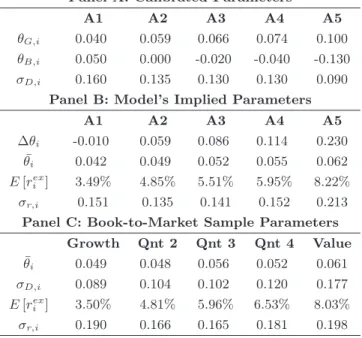
Table 2.2 shows the parameters chosen for assets 1 to 5, that respectively mimic the lowest
to highest book-to-market quintile portfolios. Asset 1 (A1), that resembles the growth portfolio,
has the lowest state-shift risk among the assets, ∆θ1 =−0.01, the lowest unconditional drift,
¯
θ1 = 0.04, and the largest volatility σ1 = 0.16. On the other side is asset 5 (A5), that resembles the value portfolio. It has the highest state-shift risk, ∆θ5 = 0.23, but also the highest unconditional drift θ¯5 = 0.062 and the lowest volatility, σ5 = 0.09. Note that this diffusion term is smaller than the one implied by the data. This was needed to match sample
and theoretical returns, a result of our calibration strategy discussed above10. The correlation
parameters, ρij, were set equal to 0.25, 0.15, 0.10 and 0.05 for |i−j| equal to 1, 2, 3 and
4, respectively, and sets a higher correlation to portfolios with similar book-to-market values.
Table 2.2 also shows the expected excess returns and deviations at πt = πs implied by the model, i.e. the unconditional moments, as well as the sample counterparts of the five
book-to-market portfolios11. A comparison of the values on Panel B and Panel C shows that the model
reproduces the cross-section dispersion on expected returns of the book-to-market portfolios
10If we imposed a higher variance for A5 cash-flow and kept the state-risk spread, this would have resulted in
a very risky asset with an incompatible high expected returns. We preferred to keep the state-risk spread but reduce the diffusion risk.
11Cash-flow levels are set at 1. At this point, the drift parameters better approximate the log-dividend changes
for reasonable parameters.
2.3.2 Conditional Betas
Given the parameters that calibrated the model, functions f and S can be computed
numeri-cally and the pricing formulas in equation (4) follows. Next, we discuss the properties of these
formulas. First, we discuss how conditional betas differ across asset for given levels of beliefs.
Then, we discuss how conditional betas differ across assets given changes in investor beliefs,
that is, following the arrival of news.
2.3.2.1 Cross-Section Asymmetries
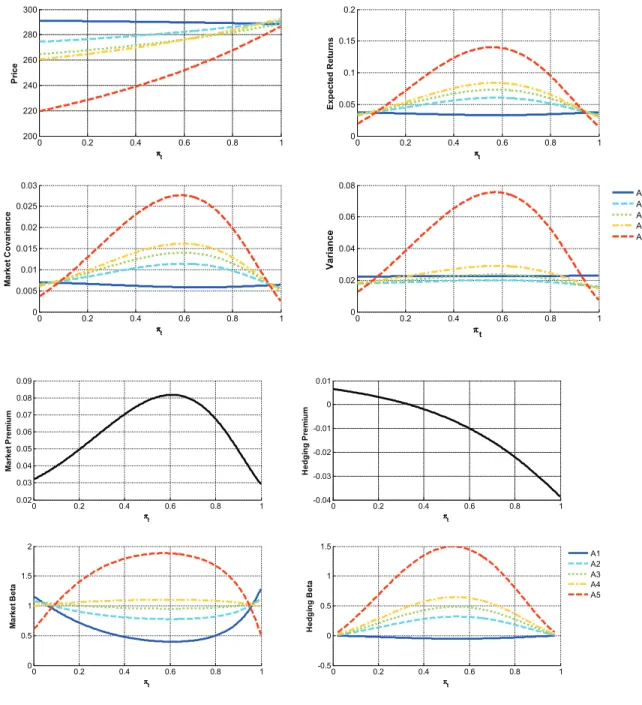
Figure 2.1 shows the model’s main expressions for all possible values ofπtand fixed cash-flows at Dt= 1. On the top-left plot, we see that A1 has the highest price on almost all the domain of πt. This asset is the least profitable, as it has the lowest unconditional drift among all cash-flows, but also the least susceptible to changes in the economic conditions and so less
risky. At the other extreme is asset A5, which is the most profitable one, but also the most
risky and discounted one, with the lowest price on almost all the domain ofπt. In the top-right plot we see that expected returns for asset A5 is the most sensitive to πt, changing from 3%, whenπtis close to one, to almost15%, when uncertainty is higher. All the other cyclical assets also have increasing expected returns on uncertainty, but the change is less substantial. The
expected return on the countercyclical asset A1 slightly declines on uncertainty. The second
row in Figure 2.1 shows covariances of the assets with the market as well as the variances of
asset returns. The shapes are similar to the ones implied by the risk-neutral case, but peaking
slightly to the right of the maximum uncertainty point, aroundπt= 0.6.
The last four plots in Figure 2.1 show all the elements in the factor decomposition of excess
returns (5), the market betas, βim,t, hedging betas,βiπ,t, and their corresponding prices, λm,t and λπ,t, as functions of all possible values of πt and given cash-flows. First, we observe that the premium for exposure to market risk is more important than the premium for exposure
to hedging risk. The most sensitive asset to the hedging factor, A5, has the highest absolute
that the market portfolio is likely the most important factor determining expected returns and
justifies the assumption made by Jagannathan and Wang (1996) of hedging motives not being
sufficiently important.
Second, as we previously noted analytically for the risk-neutral case, market beta of assets
with a high and positive ∆θi, such as A5, increases as uncertainty about the state of the economy increases. Since the investor is now risk-averse, the market beta of asset A5 peaks
slightly above12 the point of maximum uncertainty, taking its maximum value ofβ5m,t = 1.80 at around πt= 0.60. On the other hand, the beta of asset A1, declines as πt moves away from
0 and 1, reaching a minimum of β1m,t = 0.40 also aroundπt= 0.60. We note also that there is enough variation in betas to make A1 riskier than A5. In periods of low uncertainty, e.g.
whenπt>0.95, the beta of A1 is higher than that of A5.
Third, the price of market risk, or the market premium, is positive and also increasing
on uncertainty. It reaches a maximum of about λmt = 8% at πt = 0.60 and a minimum of
λmt= 3%atπt= 1. Atπs= 0.83, the unconditional or long run mean of the random variable
πt, the price of market risk is6.5% and close to its historical sample mean13.
Finally, time-variation of market betas is relevant to some assets but less important to
others. Figure 2.1 indicates that for A1 and A5, both the conditional market beta and price
of market risk are equally important for the asset’s risk premium. Consider a shift to investor
beliefs from π1 = 0.90 to π2 = 0.50. The price of market risk, λmt, increases from 4.93% to
7.81%, a change of 58%. Likewise, asset A5 beta also change significantly, from 1.33 to 1.87,
an increase of 41%. The change in the asset A1 beta is also important but to the opposite
direction, from 0.72 to 0.42, a decrease of 42%. The variation in the betas is less important
than the variation in the price of market risk for the other assets, as we clearly observe from
the plots.
The above expressions are for all possible values of πt ∈ [0,1], but not all are equally likely. For the chosen parametrization, in particularly λandµthat matches the U.S. business
12This rightward shift resulting from increases in risk aversion was also observed, in the single asset case, by
Veronesi (1999).
cycles, most of the mass of theπtdistribution is above0.50, since the economy is most often in expansionary periods. Thus, on average, negative news about the economic conditions increases
uncertainty while positive news decreases it. Consequently, the response of market betas14 to
news is asymmetric due its (approximately) monotonic relation to uncertainty.
Another aspect of the πt distribution under this parametrization is that periods of higher uncertainty most often occur during the bad state. The persistence of learning process coupled
with its shorter duration results in a higher proportion of uncertainty periods during the bad
state. Therefore, volatility of asset returns, the covariance of cyclical asset with the market
returns and the price of market risk, will tend to be higher during the bad state, as these
vari-ables typically increase on uncertainty. The model thus provides theoretical justification to the
empirical findings that such variables tend to increase during recessions. Another implication
of the model is that the value premium should be higher during the bad state, as the difference
in market betas of value and growth portfolios is also higher during high-uncertainty periods.
This countercyclicality of the value premium predicted by the model has also been observed
empirically (Petkova and Zhang, 2005).
2.3.2.2 Time-Series Asymmetries
To assess the relevant portion of the pricing formulas, we generate time-series of the variables
in our model using the same parameters discussed in the calibration. Once cash-flows are
gen-erated according to (2.1), beliefs are computed as indicated by the optimal filtration equation
(1). These state variables,πtandDt, are then used to determine the model’s pricing formulas. The length of the generated series is equivalent to a sample of six years of daily data. We avoid
a sample larger than 6 years because of our assumption that cash-flows follow an arithmetic
Brownian motion. As the cash-flow level moves away from its starting value, D0 = 1, the drift of the stochastic process becomes a worse approximation of percentage changes, the scale
used for the calibration. On the other hand, we do not select a smaller sample because of the
duration of recessions and expansions implied by the transition matrix parameters. The six
year time frame allows an expansionary period lasting five years and a recession lasting one
year, which implies average durations and proportions of good and bad months that are similar
to the ones imposed by the calibration of λand µ.
In order to assess how the proportion of good and bad states can have an impact, we
consider three different combinations of good and bad states. First, we consider the case of
no bad state and six years of good state. We will refer this case as the bull market case. In
the second scenario the economic conditions are average, with five years of the good state and
one year of the bad state. In the third scenario, two out of the six years the economy is in
the bad state. We refer this as the bear market case. For all three scenarios, the bull, bear
and regular markets, 500 histories are generated, each with 1584 observation (six years of daily
observations).
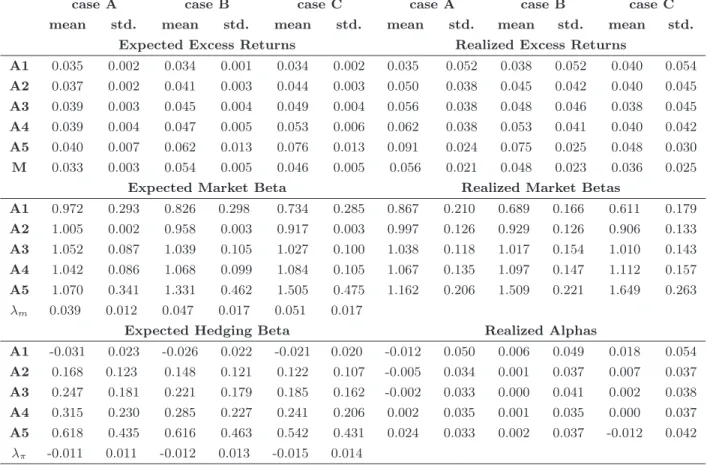
The top two panels in Table 2.3 show the averages and standard deviations across the 500
histories of the expected and realized excess returns. We observe that for the bull and bear
markets, expected excess returns do not coincide with realized excess returns. In the bull
market case, asset A5, that resembles the value portfolio, outperforms and has higher realized
returns than would be expected; the annual average realized return of asset A5 is around 9%
and the average annual expected returns is 4%. On the other hand, in the bear market, A5
underperforms, with an annual average realized return of 4.8% against an average expected
return of7.6%. The opposite holds for asset A1, the asset that resembles the growth portfolio.
It underperforms in the bull market but overperforms in bear market. When the economic
conditions are the ones implied by the calibration, the second scenario, expected returns are
similar to the realized ones. The values do not coincide because of sample variation and
of the approximation imposed by the assumption that cash-flows follow arithmetic Brownian
motions15.
Since expected excess returns also have a factor characterization in our model, such
dis-crepancies or anomalies observed above for expected returns are also observed in the factor
regression. The pricing errors captured by the intercepts of static CAPM regressions, the
real-ized alphas in the lower-left panel of Table 2.3, indicates the existence of a value premium when
15Veronesi (2004), that investigates the properties of the univariate version of our model, also faces similar
sample are generated by bull markets. The average intercept across all histories is negative for
asset A1 and positive for asset A5. The opposite is observed for bear markets, where a growth
premium arises. We have deliberately ignored the hedging factor in the regressions of the static
CAPM, as its contribution to risk premium is much smaller than the exposure to market risk.
As Table 2.3 shows, the average price of the hedging risk is aroundλπ =−1%and the average quantity of hedging risk is 0.6 for the asset A5, resulting in an average hedging premium of
about −0.6%, less than a tenth of the market risk premium,6.5%.
These results point to an interpretation of the forces behind the value premium related to
biased sampling. A similar argument has been employed by Veronesi (2004) to explain the
equity premium puzzle. The author, using the univariate version of our model, attributes the
apparent puzzle that market average returns are too high relatively to its observed (realized)
riskiness, to a rational premium required by the investor to account for a peso-problem type of
event – a very unfavorable event, which the investor is aware of, that has never happened, at
least in the particular sample considered.
The importance of the sample to the value premium was also observed by Ang and Chen
(2007). They argue that most studies that find a value premium on the U.S. stock market
generally consider only the post-1963 period, mainly due to the ready availability of data, and
that the omission of previous years is key to finding a value premium. In fact, they show
that the alphas in the static CAPM regressions turn out to be insignificant when the sample
is extended to include the months from 1926 to 1962. Since our objective is to explore the
dynamics of market betas implied by our theory and not to propose a solution to the value
premium, we restrict our analysis to the unbiased histories generated under the second scenario.
For the task of unveiling the dynamics of market betas, we first fit an univariate asymmetric
GARCH(1,1) model to the simulated returns to discuss the dynamics of volatility. The
specifi-cation of conditional volatility, also referred to as GJR-GARCH model (Glosten, Jagannathan,
and Runkle, 1993), is the following:
rit = αi+uit
where uit = σitǫit, ǫit iid∼ N(0,1), and 1[.] the indicator function. This specification is ap-propriate here as it allows past shocks to influence future volatility, in line with the model
assumption that investor beliefs are based on past information, and also because the sign of
shocks, consistent with the learning feature of the model, can be informative about shifts in
the economic conditions.
We use mean-adjusted past excess returns as proxies for cash-flows news, which is what
actually drives beliefs. This can be justified by the following. From equations (1) and (4) we
observe that both beliefs and excess returns are driven by same the standard Brownian motion,
dvt. Furthermore, both diffusion terms in those equation, σπ and σiR, indicate that shocks to returns will be positively related to shocks to beliefs when the term Si′(πt) +pπi is positive, which is the case for all cyclical assets on most values of πt (the term Si′(πt) can be negative and offset pπi for lower values ofπt, which only seldom occur).
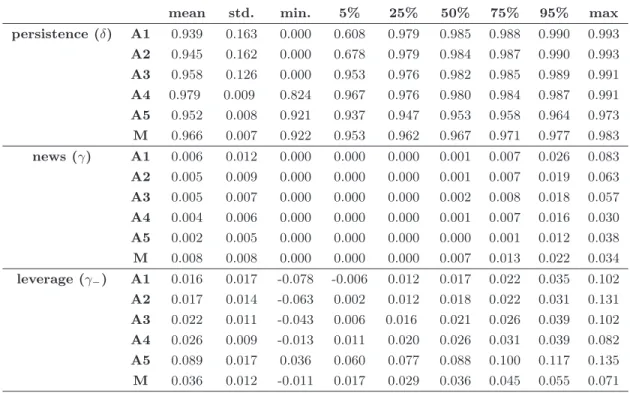
Table 2.4 shows the averages, standard deviations and quantiles of the estimated parameters
of (2.10) across the500histories for each asset. First, we observe that conditional volatilities are
very persistent, theδ’s are high and close to one, a well known stylized fact about stock returns.
Second, negative shocks to returns are more important to future volatility than positive shocks,
as for all assets the coefficient γ− is positive. This asymmetric response of volatility to past
shocks has long been observed empirically and referred to as the leverage effect (Black, 1976).
Finally, assets with cash-flows that are more exposed to shifts have stronger asymmetries. The
average coefficient γ− across the 500 histories for asset A5 is 0.089 while for asset A1 it is
only0.016. This was expected, as A5’s expected returns is the most responsive one to changes
in uncertainty. Furthermore, shocks to A5 are also the most informative ones, as it has the
highest signal to noise ratio among all cash-flows.
We now turn to the question of how the covariances respond to past shocks. In order to do
so, we fit an asymmetric multivariate GARCH model to the simulated data. More precisely,
we follow the BEKK specification of Engle and Kroner (1995) but also introduce asymmetric
terms as in Hafner and Herwartz (1998). For computational convenience, we focus on bivariate
models of asset excess returns and market excess returns.
portfolio, the vector as ut = [uit, umt]′ and let Gt be the information set at time t. The conditional joint distribution is assumed to beut|Gt−1∼!0,Σt|t−1
with conditional covariance
given by
Σt|t−1 = C′C+A′Σt−1|t−2A+B′ut−1u′t−1B (2.11)
+1[uit−1<0]D′1ut−1u′t−1D1+ 1[umt−1<0]D
′
2ut−1u′t−1D2
whereA,B,D1 andD2 are 2×2matrices and C an upper triangular2×2 matrix. Matrices
D1andD2 are new to the original BEKK formulation and add the needed flexibility to capture asymmetric responses of the covariance matrix to shocks. Assuming that the joint distribution
is normal, parameters are estimated by maximizing the log-likelihood function.
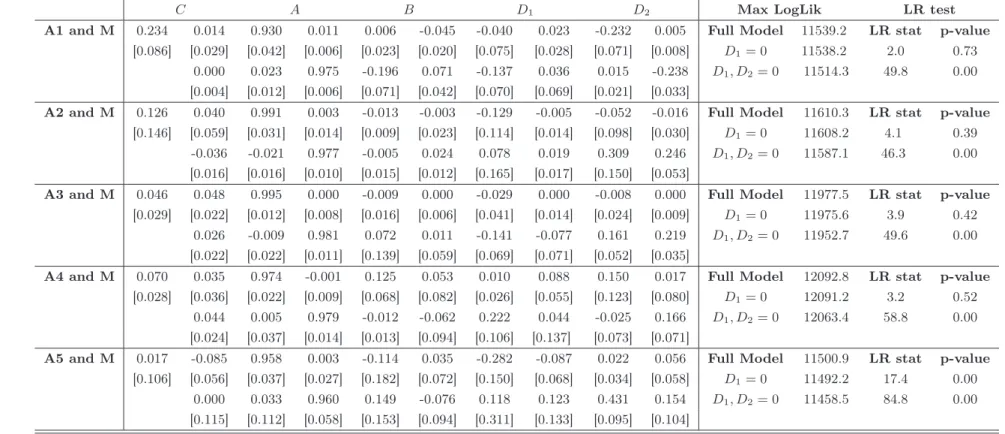
The estimated parameters16of equation (2.11) for a simulated17history are shown in Table
2.5. We also show the log-likelihood ratio (LR) statistics that compares the full model (2.11)
with an specification with just one asymmetric matrix, D2, and another with no asymmetric matrices. The LR-test p-values indicates that the difference in the likelihoods of the symmetric
BEKK and the asymmetric BEKK, with matricesD1 andD2, are statistically significant. The LR-test also shows that asymmetries at the asset level are not statistically relevant, except for
asset A5. This was expected, as A5 is the most informative asset about the state of the nature
and so its returns shocks relate more closely to changes in aggregate returns.
We can also see that asymmetries are relevant by noting that the parameters on matricesD1 andD2 are significant and relatively large. However, in order to make sense of these numbers, we compute impulse response functions (IRFs). First, we need to rewrite the matrices of
parameters in vector form using the vec operator that stacks columns:
vec(Σt) = C+Avec(Σt−1) +Bvec
! utu′t
+D11[uit−1<0]vec !
utu′t
+D21[umt−1<0]vec
! utu′t
16The asymptotic distribution of the estimates is generally unknown and the results can only provide a
description of the dataset (Herwartz and Lutkepohl, 2000).
17The precise results can vary, depending on the particular history chosen. We have selected the history
whereC= (C⊗C)′vec(I2),A= (A⊗A)′,B = (B⊗B)′,D1= (D1⊗D1)′,D2 = (D2⊗D2)′ andI2is a(2×2)identity matrix. Here,vec(Σt)will then be a(4×1)vector, with the first ele-ment being the asset return conditional variance, the second and third eleele-ments the conditional
covariance of the asset return with the market return and the last term the market return
con-ditional variance. Hafner and Herwartz (1998) define the IRF as Vt(ξ0) =E[vec(Σt)|ξ0,Σ0], which can be computed by starting the above auto-regression at the long run value of the
covariance matrix,Σ, and perturbing it with standardized shocks,ξ0. Att= 1 we have
V1(ξ0) = C+
B+ 1[ξ0,i<0]D1+ 1[ξ0,m<0]D2
vecΣ1/2ξ0ξ′0Σ1/2
+Avec(Σ)
and for t≥2
Vt(ξ0) = C+
A+B+D1
2 +
D2
2
Vt−1(ξ0)
Impulse response functions for betas easily follow from the ratio of the covariance and
market variance IRFs:
βit(ξ0) =
Vim,t(ξ0)
Vm,t(ξ0)
whereVim,t(ξ0) and Vm,t(ξ0) are the second and fourth elements of the vectorVt(ξ0).
Figure 2.2 shows the IRFs of assets A1 and A5 22 days after the initial shock. The first
column shows the variances IRFs. The upper plot shows the responses to shocks in the market
portfolio, leaving asset return unperturbed, and the lower plot responses to shocks in the assets,
leaving market return unperturbed. The asymmetric response to shocks is clear, particularly to
A5, as was noted in the univariate estimation above. We observe that negative shocks to both
market and the assets returns result in a larger change in the volatility than positive shocks.
The second column in Figure 2.2 shows the IRFs of the covariance of assets A1 and A5
with the market portfolio, where we have written the y-axis in terms of percentage changes
to the initial position. The upper plot shows how shocks to the market portfolio changes
the covariance of A5 with the market portfolio substantially. On the other hand, when the
shocks are positive, the covariance declines slightly. This shape is in line with our previous
discussion on the relation of covariances with uncertainty and how uncertainty changes with
news. The covariance of A1 with the market portfolio is relatively stable, and slightly increases
with negative shocks and slightly decreases after positive shocks in the market portfolio. The
lower plot on the second column, shows a similar response of the covariance of A5 to shocks on
its own returns, but with changes of smaller magnitude.
Finally, the last column in Figure 2.2 shows the betas IRF for both assets A1 and A5. In
the top plot we see how betas respond to shocks in the market. As discussed analytically, we
have that negative shocks to market returns result in an increase in the market beta of the
asset A5 but a decrease in the market betas of A1. A5 beta increases by about 30% on large
negative news, while A1 beta decreases by about 30% on large negative news. On the other
hand, positive news have a much smaller impact on betas.
2.4
Conclusion
The implications of the model for the variance, covariance and conditional market betas of
asset returns confirm many empirical facts and also suggests new results. First, as pointed by
Veronesi (1999) for the market portfolio in the univariate model, excess returns display the
predicted volatility asymmetry so pervasive in real data. This has been originally attributed
by Black (1976) to a leverage effect, but in our model the justification is closer to the volatility
feedback hypothesis of Campbell and Hentschel (1992). A novel implication for the dynamics
of volatility is that assets that are very sensitive to the economic conditions should also display
stronger asymmetric responses to news.
Second, the covariance of asset returns with the market portfolio also responds
asymmet-rically to the arrival of news, a result also verified empiasymmet-rically, for instance, in the contagion
literature of international markets (Ribeiro and Veronesi, 2002). Our model shows that
neg-ative news increases the covariance of cyclical assets with the market portfolio by a larger
magnitude than positive news. Again, this asymmetry will be larger the more sensitive the
predicts an opposite asymmetric response of covariances to news.
Third, the conditional market betas respond asymmetrically to news. Market betas of assets
that are very sensitive to changes in the economic conditions increase during high uncertainty
cases as opposed to less sensitive assets. A concrete example of assets with such opposing risk
dynamics, as shown in the calibration exercise, are the value and growth portfolios.
The empirical evidence regarding the asymmetric response of market betas to news is
unclear (Braun, Nelson, and Sunier, 1995). Nonetheless, the difficulty of assessing the opposite
response of betas to news from realized returns in a multivariate GARCH framework was also
present in our investigation under the controlled environment of simulated returns. Despite the
analytical equations indicating that asymmetries are relevant, the parameters estimated from
an asymmetric GARCH model did show such asymmetries but for some histories only. Since
the forces behind the beta asymmetry are the same ones behind the asymmetry of variance and
covariances, which are two well known empirical facts about stock returns, the lack of empirical
evidence of beta asymmetry could be a result of econometric misspecification as opposed to