BELIEF AND COGNITIVE AGENCY:
MAKING ROOM FOR EPISTEMIC NORMATIVITY
John Phillips
A dissertation submitted to the faculty of the University of North Carolina at Chapel Hill in partial fulfillment of the requirements for the degree of Doctor of Philosophy in the
Department of Philosophy.
Chapel Hill 2020
Approved by: Ram Neta Matthew Kotzen
ABSTRACT
John Phillips: Belief and Cognitive Agency: Making Room for Epistemic Normativity (Under the direction of Ram Neta)
Some events in our lives are things that we do, what philosophers call exercises of agency. Other events are things that simply happen to us. Distinct forms of normative assessment are appropriate to each of these categories; if something good happens to me I am fortunate, for instance, while if I do something good I may as a result be worthy of praise.
Into which of these categories does the mental attitude of belief fall? Much of our everyday practice of epistemic evaluation, as well as the philosophical literature, treat beliefs implicitly or explicitly as exercises of agency. On the other hand, beliefs seemingly fail to meet widely accepted criteria for identifying exercises of agency developed with cases of ordinary physical action in mind. For instance, a belief is not (it seems) under the believer’s direct voluntary control; one cannot simply adopt a belief at will. The result is a mismatch between theory and application, one that threatens both our understanding of the nature of agency and the propriety of our epistemic assessments.
ACKNOWLEDGMENTS
I have benefited greatly throughout this project from the guidance of my dissertation advisory committee: Ram Neta, Matt Kotzen, and Geoff Sayre-McCord. They have been unfailingly kind and supportive when I struggled, held my work to a high standard, and worked selflessly to help me meet it. My natural tendency is to think and write in isolation, but this dissertation has been vastly improved on every occasion when I’ve shared and discussed it with them; I have no doubt that it would be far better if I’d done so more often. To a great extent, what I’ve written amounts to my attempt to answer questions that would probably never have occurred to me had Ram not challenged me with them, so I owe him a particular debt for broadening the scope of my thinking over and over again these past few years.
I would not have made it through a dissertation without the friendship, mentorship, and philosophical insights of many other individuals at UNC: students, faculty, and staff. I will not try to list everyone them by name, although they deserve it, since I am sure that I would leave someone out and regret it later. Know that I am deeply grateful.
didn’t yet.
Portions of this work were supported by generous funding from the Andrew W. Mellon Foundation and the American Council of Learned Societies. Thanks to them providing me with the time to do the best work I could.
TABLE OF CONTENTS
LIST OF FIGURES ... ix
INTRODUCTION ... 1
CHAPTER 1: EPISTEMIC CONSTITUTIVISM AND THE PROBLEM OF DISCERNING ATTITUDES ... 10
I. The Problem of Epistemic Constitutivism ... 13
II. The Shmagency Objection ... 17
III. The Problem of Discerning Attitudes ... 22
a. Introducing the Problem ... 22
b. Case Studies ... 26
c. The Significance of the Problem ... 28
IV. Avoiding the New Problem ... 36
V. Conclusion ... 43
CHAPTER 2: BELIEF AS VOLUNTARY ACTION... 45
I. Developing the Challenge ... 48
II. Existing Responses ... 61
III. Belief as Basic Action ... 66
IV. Acts and Actions ... 72
V. Setting Ends ... 77
CHAPTER 3: BELIEVING SKILLFULLY AND BELIEVING
FOR GOOD REASON ... 88
I. Reliabilist Virtue Epistemology and Rationality as Skill ... 92
II. Believing Rationally as Believing for Good Reason ... 98
III. Problem: Φ-ing Skillfully Is Not Φ-ing for Good Reason ... 101
IV. The Structure of Skill ... 105
a. Regress and Basic Performance ... 111
b. Internal and Contributory Skill Evaluation ... 113
V. Planning Skill ... 116
VI. Believing Skillfully ... 119
CHAPTER 4: INSTRUMENTALISM ABOUT EPISTEMIC RATIONALITY: THREE OBJECTIONS ... 124
I. Kelly’s Indifference Objection ... 125
II. The Pragmatic Reasons Objection ... 129
III. Trade-offs Among Beliefs ... 132
LIST OF FIGURES
INTRODUCTION
Some events in human life are things that we do: in philosophical terminology, they are exercises of our agency. Other events are things that simply happen to us: we are the passive objects of forces outside ourselves. Paradigmatic examples of the first sort include simple, voluntary physical actions. I exercise my agency when I cook dinner, tell a joke, shoot a basketball. I am passive when I am given an award, or fired from a job, or contract an illness.
Exercises of agency have in common several philosophically important normative features. We can carry them on the basis of reasons. We can perform them in a manner that displays skill or competence. We are generally (in the absence of excusing conditions) responsible for them: if I tell a joke or shoot a basketball when I shouldn’t, I can
appropriately be held to account for doing so. We can be subject to ethical obligations to perform them (or refrain from doing so) under specific circumstances. According to a prominent tradition due in large part to the influence of G.E.M. Anscombe, when we engage in such actions we can have practical knowledge of what we are doing without any need for observation.
possess, it is far more difficult to pin down precisely in what the difference between an exercise of my agency and an event in which I am passive consists, or what it is about exercises of agency that makes them the bearers of these normative features.
This difficulty becomes pressing when we move from the sphere of paradigmatic, easily recognizable exercises of agency to more difficult cases. For instance, how is the distinction between agency and passivity to be applied within the confines of the human mind? Which if any of my thoughts, my attitudes, my states of mind are properly considered things that I do? An overly grudging answer here deems us to be mere passive observers in our own mental lives, but to too readily attribute agency in our mental lives is to disregard the striking differences between the contents of the mind, and the simple physical actions that provide our paradigmatic examples of agency on the other.
Many epistemologists and philosophers of mind have found it useful to attribute some or all of the normative features of agency to what I’ll term doxastic phenomena within the mind, a term meant to pick out a class of mental states and events including at least belief, inference, and judgment. In doing so, they take themselves both to be reflecting ordinary, everyday practices of epistemic assessment, and engaging in philosophical theory-building with rich theoretical payoff. Such philosophers have, for instance, presumed or argued that we are responsible for some doxastic phenomena,1 that we can engage in doxastic
phenomena for reasons,2 that we can do so more or less skillfully,3 that our doxastic
1 Pettit & Smith (2006), Burge (2000), Hieronymi (2008, 2009), McHugh (2013).
2 Scanlon (1998), Moser (1989), Longino (1978), Leite (2004), Lord (2018).
phenomena are subject to obligations akin to those of ethics,4 and that we can know our own doxastic phenomena without any need for observation. 5 In short: they have found it useful to treat doxastic phenomena like actions. My purpose in this dissertation is to defend the idea that they have, by and large, been right in doing so.
The project of treating doxastic phenomena like actions is worth defending because, despite its considerable payoff, it is – on its face – dubious. For one thing, a widely-held view holds that what exercises of agency have in common, what makes them the bearers of the various normative features mentioned above, is that they are in a particular way under the agent’s control. Pre-theoretically, it is simply up to the agent whether or not to shoot the basketball, whether or not to tell the joke. Doxastic phenomena rarely, if ever, seem to be subject to this sort of control. I can’t believe, or judge, or infer something simply because I want to. If a billionaire offers me a fortune in exchange for coming to believe that seven is not a prime number, I can try all kinds of measures to try to earn the reward: I can seek out hypnotists, say, or radical mathematicians. What I can’t do is simply decide to believe in order to earn the cash, in the way that I could simply decide to shoot the basketball if offered a reward for doing so.
Rather, it often seems that my doxastic phenomena are forced on me. I see the rain, and immediately find myself believing that it is raining. I consider whether the suspect committed the crime, notice that all the testimony has gone against him, and immediately infer that he did. As a result, doxastic phenomena may seem more closely to resemble events in which my role is passive – being fired, contracting an illness – or at least functions of my
4 Descartes (1985), Locke (1979), Chisholm (1966a, 1966b).
mind and body that fall below the threshold of agency – growth of my hair, the experience of terror as the roller-coaster I’m riding picks up speed – than they do actions.
If, then, we are to hold onto the idea that doxastic phenomena are exercises of agency, that our practices of assessing them in the same manner as we assess exercises of agency are not misguided, we need a deeper understanding of the doxastic phenomena, on the one hand, and of what makes something an exercise of agency, on the other. And we need these understandings to reveal that the gulf between action and the doxastic is at least
narrower than it seems, if not altogether illusory. I will proceed in the chapters that follow by attempting to arrive at just such understandings.
As a way into the project, I’ll begin in Chapter 1, “Epistemic Constitutivism and the Problem of Discerning Attitudes,” by investigating epistemic constitutivism, an approach that explicitly borrows from the constitutivist literature in metaethics to attempt to account for the normative features of doxastic phenomena, by treating engaging in such phenomena as akin to ordinary actions like playing games. Epistemic constitutivism holds, at a first
epistemic norms. Epistemic constitutivists, though, need not be in the business of explaining why, in an unrestricted sense, we have reason to conform to the epistemic norms; they may limit themselves to explaining why we have reason to conform to these norms when we are believing.
I then argue that a related problem, what I call the problem of discerning attitudes, is more pressing in the epistemic case. Ordinary agents are in a position to attain a considerable degree of knowledge concerning the content of the epistemic norms to which they are subject. Indeed, some epistemic norms are such that they can apply to our beliefs only when we are in a position to know that they apply. But if epistemic constitutivism is correct that the epistemic norms apply in virtue of the essence of belief, and if the shmagency challenge is correct that there could be other states much like beliefs that we might adopt instead but that are not essentially subject to the same norms, this raises the question of how we could possess the degree of knowledge that we do of the norms to which our own states are subject.
I offer a roadmap to answering that question by suggesting that a satisfactory version of epistemic constitutivism will be one on which any essential features of doxastic attitudes that ground their normative characteristics, are also features to which agents have sufficient access to make use of them in telling different sorts of attitudes apart.
– then we can account for how an agent may be in a position to know that a state of hers is a belief rather than a state of some other sort. She need only be aware of what she is trying to do.
In Chapter 3, “Believing Skillfully and Believing for Good Reason,” I apply the account of belief developed in the previous chapters to investigate the nature of the normative constraints to which beliefs in particular are subject. I argue that epistemic rationality is a particular form of skill, and that to believe rationally just is to believe skillfully. Once we come to regard believing as acting, this is a natural suggestion, and one that builds on virtue theoretic accounts of knowledge, such as that of Ernest Sosa, that crucially appeal to the notion of skillful belief. The identification of rationality with skill is both parsimonious and demystifying, suggesting that rather than positing a distinct category of rational standards we can understand these as instances of the commonplace phenomenon of standards of skill. However, the suggestion that rationality is skill faces a significant prima facie challenge: it is widely and plausibly held that believing rationally is, at least often, a matter of believing for good reason. And yet, in general, doing things skillfully and doing them for good reason are quite distinct – one can, for instance, run for president skillfully without running for good reason, and vice versa. Such cases raise the worry that skill and rationality are orthogonal, with the latter but not the former having to do with the reasons for which one acts. In order to maintain, in a non-ad hoc manner, my identification of rational belief with skillful belief, I must explain why believing skillfully should just be a matter of believing for good reason, even though the two come apart in many other cases.
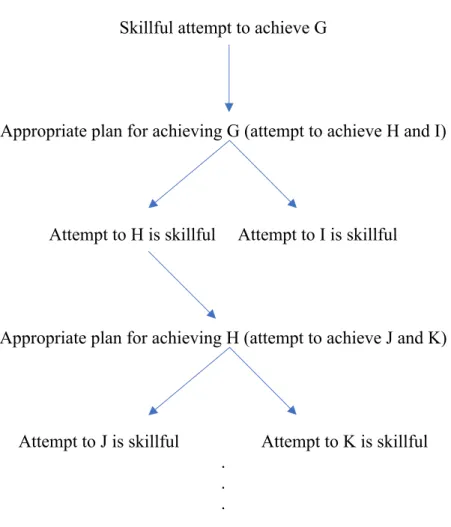
but not be limited to, selecting means for good reason (for instance, running for president skillfully will involve, but not be limited to, selecting one’s campaign strategy on the basis of good reasons). In the special case of basic actions, however – actions that are not carried out by means of any further actions – the skill of the action clearly cannot depend either on how one selects means by which to carry it out (since there are none) or on the skillfulness of those means (likewise). Instead, I argue, the skillfulness of basic actions turns out to be just a matter of their standing as appropriate means to further ends, which is to say the goodness of the reasons for which they were settled on as means to those ends. I then argue that belief is an example of such a basic action: when we believe, we simply believe, rather than believing by means of doing anything else. And so this general account of skill yields the verdict that to believe – or carry out any other basic action – skillfully is simply to do so for good reason, good reason being reason which renders the belief an appropriate means of pursuing the goal of knowledge. In this way, the standards for rational belief fall out of the constitutive goal of belief, as suggested in my discussion of epistemic constitutivism. As a result, there is no conflict between treating rationality as skill, as I do, and holding that to believe rationally is to believe for good reason. Chapters 2 and 3 together make up the core argument of the dissertation.
Finally, in Chapter 4 I consider and reply to three objections arising from my treatment of epistemic rationality as a form of instrumental rationality. The first objection states that epistemic rationality cannot be instrumental because we possess epistemic reasons even in the absence of epistemic goals. The second objections states that such
reason to trade off our beliefs against each other, sacrificing knowledge of some propositions in order to gain greater knowledge elsewhere. I argue that, given my account of the structure of belief and the nature of epistemic goals, this objections misfire against my particular form of instrumentalism.
CHAPTER 1: EPISTEMIC CONSTITUTIVISM AND THE PROBLEM OF DISCERNING ATTITUDES
Q: Why are beliefs subject to the epistemic norms?
A: Because being subject to the epistemic norms is (part of) what makes an attitude a belief.
When confronted with Q, it is tempting to respond with something like A. This is a temptation that a number of epistemologists have indulged.6 In this chapter, I consider how good of a response A is to Q. More precisely, I consider what else must be said in order to make A into a good response. For it is my view that while A has much to be said for it, many ways of filling out the story at which it gestures fail to deliver on its promise. In particular, I will argue 1) that many elaborations of A threaten to undermine the ability of ordinary agents to know that they believe, and 2) that such knowledge is an essential presupposition of the epistemic norms that A aims to explain and vindicate.
Let’s take a step back, and consider how Q arises in the first place. Epistemologists attempt to elucidate the conditions that beliefs must satisfy in order to be successful qua
6 For particularly explicit defenses of this sort of strategy, see Nolfi (2015), Shah & Velleman (2005),
beliefs, and that we must satisfy in order to be successful qua believers, by proposing an defending putative epistemic norms.7 They may argue, for instance, that one should always believe the truth, or that one should accept the testimony of trustworthy experts, or that one should never believe contradictions. (For present purposes I remain neutral about which such norms are correct.) In addition to asking which such norms are true, we can also ask why those norms are true; that is, we can ask Q. Suppose we agree (say) that agents should always attempt to believe the truth, and that success relative to this aim is the appropriate standard for judging how one is doing as a believer. What makes this standard an appropriate one, rather than some other standard or no standard at all?
I will call the strategy for answering this question that is roughly captured in A above epistemic constitutivism (EC), in recognition of its resemblance to constitutivist views in metaethics.8 EC claims that some normative feature or features makes up part of the very essence of belief, and that the epistemic norms posited by the correct normative
epistemological theory either are identical to, or derive from, those features. So, for instance, an advocate of EC might claim that beliefs essentially have the feature of aiming at the truth, and that substantive epistemic norms derive from this aim. Or instead they might claim that
7 I do not mean to suggest that beliefs are the only states to which epistemic norms apply. Plausibly
such norms also apply to states of disbelief, of suspension of judgment, and of partial belief or credence, among others. In what follows I will focus on belief for simplicity’s sake, but I intend the argument to apply to these other doxastic attitudes as well.
8 A similar view is sometimes referred to as ‘normativism’ about belief (e.g., Wedgwood 2002,
McHugh & Whiting 2014, Nolfi 2015). I find the terminology of ‘epistemic constitutivism’ helpful for emphasizing, first, that I am not discussing the mere claim that the essence of belief includes normative features, but rather the use of that claim as part of a strategy for responding to Q, and second, that the same issues can arise for (putative) doxastic attitudes other than belief.
beliefs are essentially and directly subject to epistemic norms: for example, that part of what makes a state a belief is that it ought only to be held on the basis of adequate evidence.
Part of the appeal of EC is that it holds out a promise of an account of epistemic normativity that is itself epistemically mundane. By that I mean that it promises to explain why the epistemic norms hold, in a way that demystifies how we could have as much
knowledge as we do of the content of those norms. In fact, I argue, EC’s ability to make good on this promise is far from obvious. Below, I will try to clarify both the promise and the difficulties facing it, but the short version is this. It is relatively easy for an EC-er to make sense of either the fact that we know that beliefs by their very nature are subject to the epistemic norms, or the fact that we know that particular mental states of ours are beliefs rather than states of some other sort. It is much more difficult for the EC-er to explain both these facts at once. By adopting EC and so securing knowledge of the former sort, the EC-er thereby places in jeopardy our claim to knowledge of the latter sort. And only with both together can the EC-er explain how we could know of the norms governing our actual mental states. I will call this threat to EC’s epistemic promise the ‘problem of discerning attitudes.’
In my view, it is possible to offer a version of EC that avoids this problem. I hope below to go some way towards showing what such an account must look like.
I will proceed as follows. In Section I, I clarify the EC strategy and its principle advantages. In Section II, I discuss the relationship between EC and metaethical
are subject, and that such an ability is a crucial presupposition of our actual epistemic assessments. In Section IV I describe what EC must do in order to avoid that problem and deliver on its promise: to preview that conclusion, I will argue that the epistemic norms must drive from the constitutive ends or goals of doxastic attitudes, to which (as I will argue in Chapter 2) agents possess privileged access.
I. The Promise of Epistemic Constitutivism
It is more common for epistemologists and philosophers to attribute essential normative features to belief than for them to give explicit arguments in defense of those attributions or of the EC strategy in particular. While I don’t want to suggest that all those philosophers have shared precisely the same reasons for doing so, I think it is fair to ask: what’s the point of making such attributions?What’s the philosophical pay-off for doing so? And to those questions, EC provides a compelling answer.9
Any attempt to explain why some putative norms apply to us – and to thereby vindicate those norms – must address two questions. I will distinguish these as the metaphysical question and the epistemic question. Each plays an important role in the motivation for EC, though the latter will be particularly pertinent here.
The metaphysicalquestion asks what metaphysics we must posit in order to explain the norms in question. A good answer is one that posits only highly plausible pieces of metaphysics; a worse answer is one that posits implausible metaphysics, such as the
9 For a survey of some other possible motivations for the attribution of essential normative features,
existence of highly unusual types of entities to which we are not otherwise committed. There is of course a great deal to be said about what makes a piece of metaphysics plausible or implausible, and much of it lies beyond the scope of this paper. Still, I will indicate below why EC might be taken to do well by this metric.
The epistemicquestion asks, of the norms in question, how we could have such knowledge of them as we do, were our explanation of their basis correct. Recall that we are considering an attempt to explain, and thereby vindicate, some norms that we do take to apply to us. Such an explanation comes at high cost if it renders mysterious how we could be sufficiently aware of those norms to demand an explanation in the first place. A barely adequate answer to the epistemic question allows at least that our knowledge of the norms is possible, while a better answer renders that knowledge plausible and comprehensible.
Note that the epistemic question does not presuppose that we have perfect, or even very extensive, knowledge of the norms; it supposes only that we know something, and asks how such knowledge as we have might come about. In the case of the epistemic norms, then, we can happily grant that our knowledge of those norms allows for many contentious cases and unclear details. It is reasonable, however, to suppose that we have some idea of what the epistemic norms demand. It would be quite surprising (if not flat-out incoherent) were it to turn out that the real epistemic norms required us to aim to hold as many false beliefs as possible, frequently contradict ourselves, reason according to counter-induction, and so forth. Given that we know enough of the content of the epistemic norms to render those
We can put ourselves in a good position to answer the metaphysical and epistemic questions by locating the grounds of epistemic norms in phenomena with which typical agents are well-acquainted, such as the medium-sized physical objects that make up much of our environment; the difficulty, of course, is to say how such objects can explain the
epistemic norms in the first place. On the other hand, we can provide an easy explanation of the norms by appealing to something like Platonic normative facts. If such facts existed, they would seem good candidates to explain why we are subject to epistemic norms, but appealing to them puts us in a difficult position for addressing the metaphysical and epistemic
questions, for rendering the existence of such facts plausible and accounting for our knowledge of them. One strand of Mackie’s ‘argument from queerness’ can be read as arguing that no one account of morality can both adequately explain the basis for the moral norms, and also address the metaphysical and epistemic questions; as a result, Mackie argues, moral claims must be given up as false.10 Of course, in the epistemic case, it is open to us to follow in Mackie’s footsteps and become epistemic error theorists. Such a conclusion would be radically revisionary of our ordinary understanding of our epistemic position. Assuming we wish to avoid such revision, assuming that we are committed to the existence of epistemic norms of which we have some degree of knowledge, then it is a criterion of adequacy on an account of the epistemic norms that it leaves room for viable answers to both questions, and a particular advantage of an account if actually provides such answers.
Epistemic constitutivism seeks to explain the epistemic norms in a way that provides strong answers to both questions. A representative EC-er, recall, claims that part of what it is
for a state to be a belief that p is for it to be the case that the state is subject to some norm: say, that one ought to hold it only if p is true. There is then no mystery as to why, given that one is a believer, one is subject to the norm of believing only the truth. This norm, the EC-er takes it, comes with the territory of belief; it is one of the rules of the believing game. If a believer asks why she should believe the truth, we simply remind her that what she is doing is believing, just as we would remind a chess player who asks why she shouldn’t move her rook diagonally that she is playing chess. (Note that an EC-er need not claim that all epistemic norms are part of the essence of belief, any more than all chess-norms are to be found in the rulebook. Some norms may instead derive from the essential norms: for
instance, a norm of believing on the basis of evidence might derive from an essential norm of aiming to believe the truth.)
Once the EC-er draws this analogy between belief and commonplace games, they can appeal to the same analogy to address the metaphysical and epistemic questions. Once we allow that the norm against moving rooks diagonally is built into the essence of chess, is part of what makes it the game that it is, and that there is nothing particularly troubling or
metaphysically extraordinary about this fact, then we address the metaphysical question for EC by simply saying that the same goes for belief. Since the same form of explanation is used in each case, we may reasonably suppose that the two are on equal metaphysical footing.
mysterious (the EC-er claims) how people familiar with belief come to know belief-norms. Of course, working out the epistemic norms may sometimes be difficult, and we may sometimes be ignorant of the particulars, as a chess player may fail to know the precise conditions under which a game results in stalemate. The claim is not that our knowledge of the epistemic norms is perfect or comes easily. What is supposed to come easily is the explanation of how such knowledge of the epistemic norms as we do have is possible; and here, the EC-er says, we find no challenge akin to explaining knowledge of, for instance, a Platonic realm of moral facts.
EC is appealing, then, because it purports to domesticate epistemic normativity. Despite the surface-level abstruseness of attributing essential normative features to mental states, the goal is to be able to offer replies to the epistemic and metaphysical questions that are utterly mundane. We turn next to the question of how well EC succeeds. First, I will consider a well-known challenge to EC’s ability to explain the epistemic norms at all;
afterwards, I will consider a novel problem for EC’s ability to answer the epistemic question.
II. The Shmagency Objection
EC bears obvious similarities to constitutivist views in metaethics, which attempt to answer questions about moral norms in manners similar to those described in the previous section, typically by appeal to the nature of agency or of action.11 Metaethical constitutivism,
11 For some prominent developments of metaethical constitutivism, see Korsgaard (1996, 2009),
however, is subject to an influential criticism forcefully presented by David Enoch.12 I cannot hope here to resolve the important debate between metaethical constitutivists and their
critics, but I do hope to show that at least some forms of EC can escape Enoch-style challenges.
Enoch aims to cut across the diversity of constitutivist views and reveal a shortcoming common to all. Constitutivism cannot, he claims, settle on its own the
fundamental question of what we have reason to do; put another way, despite appearances it cannot offer a complete answer to the normative question. At most, studying the nature of agency will reveal what it takes to be a successful agent, and so what we have reason to do if we have reason to be agents at all. But features of agency cannot, on their own, settle whether or not we have reason to be agents in the first place. Why not instead be shmagents, where a shmagent is much like an agent but subject to different norms? By analogy: features of chess may reveal what it takes to play chess correctly, but will never suffice to settle the question of whether we have reason to play chess rather than some other game, shmess.13 Thus if constitutivists hope to derive all of normativity from the constitutive features of agency, Enoch contends, they are doomed to failure.
Although my focus here is on epistemic constitutivism, the challenge remains salient.
12 Enoch (2006, 2011). Related challenges have more recently been raised concerning epistemic
norms in particular; see Papineau (2013) and Coté-Bouchard (2016).
13 Enoch takes the example from Velleman (1996), where it is used instead to make a point in support
For one thing, constitutivists often take belief to be an essential part of agency. 14 If that is correct, then one way of being a shmagent is to shmelieve rather than believe, where a shmelief is much like a belief, but not subject to exactly the same set of norms. So, the
argument might go, if we have no reason to be agents rather than shmagents, then we have no reason to believe rather than shmelieve, and so no reason to follow the belief norms rather than the shmelief norms. Furthermore, as the example of shmess above demonstrates, shmagency-style objections can be raised concerning our reasons for engaging in any
activity, once a constitutivist account of the norms ‘internal’ to the activity has been offered; Enoch’s focus is on agency not because his challenge is uniquely applicable there, but rather because that is where it has the greatest force against metaethical constitutivists. So in particular, we can raise a shmagency-style objection against any attempt to derive epistemic normativity from the features constitutive of belief. Whatever progress the epistemic
constitutivist may make in showing that 𝜑-ing is the correct way to believe, the Enochian objector can always demand reasons for believing rather than shmelieving, and insist that the EC-er cannot answer the demand.15 If Enoch’s strategy succeeds, then any total account of why one ought to 𝜑 cannot be a purely constitutivist account.
Unsurprisingly, Enoch’s challenge has met with significant resistance from
14 See, e.g., Smith (2015).
15 Of course, the question of whether we have reason to believe may not be entirely distinct from that
of whether we have reason to be agents. One might think that belief is in fact partly constitutive of agency, in which case the question of why one ought to believe just is the question of why one ought to be an agent. Or, one might take agency and belief to be wholly distinct, but still hope that reasons
constitutivists. Typical responses claim that the demand for reasons to be an agent misfires, whether because the question (‘What reasons do we have for being an agent rather than a shmagent?’) is unintelligible, because there could not be anything that is remotely similar to agency and yet subject to different norms, or because agency is inescapable, and so we do not need positive reasons for being agents.16 While I sympathize with this resistance, my present purpose is not to assess its success. Instead, I want to point out that Enoch’s objection, even if correct, leaves significant room for broadly constitutivist work on epistemic normativity. Even if Enoch is right that constitutivism cannot deliver all of normativity, this does not show that it delivers none of normativity. (Enoch, to his credit, is explicit on this point, though it has perhaps been underappreciated in reception of his work.17) Consider again Enoch’s example of chess. Granting for the moment that constitutive features of chess do not suffice to give us reason to play chess rather than shmess, study of such features may still reveal many interesting truths concerning what it takes to play chess well, or correctly, or successfully. The possibility of playing shmess threatens the attempt to derive ultima facie reasons to sacrifice one’s pawn from the nature of chess alone, but does not threaten the possibility of deriving the fact that in certain circumstances sacrificing a pawn is an excellent chess move.
16 See, e.g., Ferrero (2009), Korsgaard (2009), Silverstein (2015), Velleman (2009).
17 Enoch (2006), p. 192: “Perhaps a case can be made that some desires, capacities, or aims are
Without a rebuttal to Enoch’s shmagency problem in hand, therefore, EC-ers lack the ability to give a certain kind of account of epistemic norms: one that explains fully not only why we are subject to being evaluated as believing well or badly on the basis of the epistemic norms, but also why we should care about believing well. This is sometimes termed the question of why the epistemic norms are ‘genuinely normative’ for us. We can call the attempt to give such an account by drawing on the essence of belief the ambitious project of EC. However, there remains room for a more modest EC. The modest project is the project of appealing to the essence of belief to explain why these epistemic norms rather than others apply to us, why they are the standards for evaluating our beliefs qua beliefs.
that project. And finally, we may hold out hope that a rebuttal to the shmagency challenge is still in the offing, and that ambitious EC will ultimately succeed: that either the constitutive features of belief can deliver reasons for believing rather than shmelieving, or that it can be shown that no such reasons are needed. In that case again modest EC will provide an important part of the ultimate story of ambitious EC. 18
In sum, Enoch’s ‘shmagency’ problem is a real challenge that must be confronted by any view that seeks to derive, purely from premises concerning the constitutive features of phenomena such as agency or belief, conclusions about what we have reason to do. But not all constitutivist projects have such ambitions, and so not all are threatened by the problem. We should not respond to the admitted power of Enoch’s argument by abandoning projects that are merely in the vicinity of his target.
III. The Problem of Discerning Attitudes a. Introducing the problem
EC, at least of the modest variety, can avoid Enoch’s shmagency objection. However, there is a distinct challenge confronting the ability of even modest EC’s to handle the
epistemic question. (Recall, the epistemic question asks for an explanation of the extent to which we are aware of the content of epistemic norms.) Although this challenge need not be
18 Could one also defend modest metaethical constitutivism directly against the shmagency objection?
framed in Enoch’s terms, doing so can allow us to more easily grasp the new problem and its relation to the old. Enoch’s problem, as applied to epistemology, asks: why should we be believers rather than shmelievers? He thinks constitutivists lack an answer to this question, and so fail to adequately explain the basis of moral norms. The new problem I wish to consider asks instead: if EC is right, how could we know we’re believers, and not already shmelievers? How can we tell the difference between these attitudes, from the inside? If EC-ers can’t answer this question, I suggest, then they also cannot answer the epistemic question, and EC loses much of its appeal.
According to an EC-er, normative properties make up part of the essence of belief, so any mental state lacking some of those normative properties would not be a belief at all. At best, it would be a shmelief, an attitude that 1) bears considerable (at least superficial) similarities to belief but 2) the essence of which differs from that of belief in at least one normative respect. (Presumably any such state will also differ from belief in some non-normative respect, but I leave open whether that difference can always be found in the essences of the states.) If epistemic norms are built directly into the essence of belief, then shmeliefs are propositional attitudes that are not subject to precisely the same norms as beliefs. If the norms are instead derived from a constitutive aim of belief, then shmeliefs are propositional attitudes that lack that constitutive aim (or that have additional essential normative features not shared by belief).
at all. But this on its own does not explain our knowledge of the content of the norms governing our actual doxastic attitudes. For what if some types of shmelief are sufficiently similar to beliefs that ordinary believers lack the ability to tell the difference between the two – sufficiently similar that things seem the same from the agent’s point of view whether they are believing that p or shmelieving that p? (Note that I am not assuming that any shmeliefs actually are, or could be, so similar to beliefs! I will argue below that they are not; for the moment, I am trying to show why that point is in need of argument.) Were that the case, then plausibly there would be many situations in which, despite in fact believing rather than shmelieving, we would not know that we believed, since we could not rule out a relevant alternative.19 Then EC alone could not account for our knowledge, imperfect though it is, that our attitudes are subject to the belief-norms; that conclusion follows only on the assumption that those attitudes are beliefs, an assumption that we are not entitled to if for all we can tell we might have shmeliefs, subject to their (by definition) different norms, instead.20 Compare: the fact that I am playing chess explains why I am subject to chess rules, but it only explains my knowledge that I am subject to those rules on the assumption that I know I am playing
19 Of course, there are at least some circumstances in which we might still know that we believe; for
instance, when we have access to extraordinary testimony concerning the natures of one’s attitudes. While it is an interesting question precisely how often knowledge that we believe could survive the sort of inability to distinguish that I discuss here, my main argument in III.c below will turn not on the claim that this inability prevents us from knowing that we believe, but that it renders permissible a failure to believe that we believe. The permissibility of not believing that p is at least arguably compatible with it’s being the case that, if one were to believe that p, that belief would constitute knowledge.
20 We might try to dodge the problem by taking the reference of ‘belief’ to be fixed such that it picks
chess rather than some other game. If I can’t tell the difference between playing chess and playing checkers, then the fact that I am playing chess can’t explain how I know that my goal is to achieve checkmate.
The difficulty is that, in order to increase the explanatory power of the fact that some attitude is a belief, EC imposes a thick notion of beliefhood, thereby introducing more challenging criteria for confirming that a given state is a belief. This imposes no particular difficulty when we’re in search of knowledge de dicto concerning beliefs. But the knowledge that the EC-er must account for in order to answer the epistemic question is instead
knowledge de re about our beliefs; it is knowledge about the norms that apply to these very states. Once the shmelief hypothesis has been raised, more needs to be said to explain how we could have normative knowledge of the right sort.21
To formalize ever so slightly, EC appears to answer the epistemic question by inviting inferences like the following:
(1) My attitude towards p is belief
(2) If my attitude towards p is a belief, then it is (essentially) subject to belief-norms (EC)
(C)My attitude towards p is subject to belief-norms
21 Dretske (2003) makes an analogous point regarding the question of how one can know that one is
Assuming that EC is correct, then given (1), (C) follows. But of course, (2) supports the inference to (C) only if one is entitled to adopt (1) as a premise; and we can imagine a skeptic about the application of the belief-norms choosing to apply modus tollens in place of ponens, using (2) to reject (1). For all EC says my attitude could fail to be subject to belief-norms, so long as it also fails to be a belief. If I am to know whether the belief-norms in fact apply to my attitude, I must know which direction to run the inference.
b. Case studies
Before deepening the discussion of the problem of discerning attitudes as an objection to EC in general, I want to briefly illustrate the problem by considering how it applies to three recent implementations of EC, due to Ralph Wedgwood, Nick Zangwill, and Kate Nolfi. The point here is not to demonstrate conclusively that these authors lack the resources ultimately to respond to the problem, but simply to show the prima facie difficulties that call for such a response.
Wedgwood argues that all epistemic norms either are or derive from ‘primitive’ truths about the nature of belief “that cannot be any further explained.”22 On this view, there are no further facts about beliefs to which one can point to explain why they are subject to the epistemic norms; anything that is not subject simply does not count as a belief. The new problem of shmagency then asks: are we to think that ordinary believers have some way of picking up on these primitive normative facts about their attitudes? If so, we are owed an account of how such insight is possible. If not, then we are owed an alternative story of how
believers could know that they believe, rather than holding shmeliefs to which the primitive normative truths of belief do not apply. Without this, Wedgwood’s view does not answer the epistemic question.
Zangwill declines to offer any particular account of the essence of belief. Instead, he simply insists that it is a constraint on the adequacy of such an account that “whatever is proposed can explain how normative properties essentially flow from it.”23 I suggest that the problem of discerning attitudes imposes an additional constraint on the adequacy of such an account: it must explain how the normative properties are, to an extent, knowable by ordinary believers. The challenge for EC is to offer an account that can satisfy both criteria at once; that is, that can explain the epistemic norms while adequately answering the epistemic question. Zangwill has not yet done this, and so his defense of EC is (as he would surely acknowledge) incomplete.
Nolfi argues that “what makes belief the kind of mental attitude that it is, is just that beliefs are supposed to fulfill a distinctive proper function.”24 It is in the essence of belief to have this function and the epistemic norms derive from the function of belief. Thus, if she is to respond to the problem of discerning attitudes, Nolfi bears the burden of explaining how ordinary believers could know what the function of their attitudes is: how, that is, such believers can tell that they don’t have shmeliefs, with different essential functions, instead. If such functions are determined by evolutionary forces, then she must explain how ordinary
23 Zangwill (2005), p. 7.
believers know what those evolutionary forces have determined; if by the will of a conscious designer, then she must explain how ordinary believers could know that designer’s intent.25
c. The significance of the problem
Let us return to considering the problem of discerning attitudes as an objection to EC generally. In response to the problem, EC-ers should of course insist that we do know that we have beliefs rather than shmeliefs, and can use that knowledge to explain our knowledge of the epistemic norms. In fact, this is exactly what I myself want to insist on. But the right to take this line does not come for free. The price of earning it is the topic that I will take up in Section IV below. But first I want to consider the significance of the problem. If we were not able to hit on a compelling reply to the problem of discerning attitudes, if EC entailed that we were not able to know whether our attitudes are subject to belief-norms or shmelief-norms, would this count decisively against EC?
For a start, the result would certainly be a disturbing one. If we accepted EC then, no matter how much progress epistemologists might make in understanding the norms applying to beliefs, that knowledge would do little to reassure us that we are, in our cognitive lives, getting things right; for after all, if we were unknowing shmelievers all along, then living up to the standards of belief would be no particular mark of success and often a mark of failure independent of any Enoch-style worries about our reasons to believe. (Whether we have
25 Importantly, it would not suffice to explain how, on such a view, knowledge of the function of
belief is in principle attainable. The epistemic question asks for an explanation of widespread knowledge that has already in fact been obtained; an account on which epistemologists or
reason to play chess or play shmess, it would be a bad result to learn that all this time we’ve been playing shmess by chess rules.) What’s more, all the difficult philosophical work devoted to discovering the normative requirements on belief would turn out to be remarkably arbitrary. If we might, for all we know, be shmelievers rather than believers, why have we not devoted equal energy to working out the normative requirements on shmeliefs?
Granted, EC-ers are by no means alone in facing challenges when it comes to explaining the possibility of our knowledge of the epistemic norms, for EC is not alone in facing the burden of answering the epistemic question. That question confronts accounts of epistemic normativity generally, and difficulties in answering it are endemic to many flavors of realism. However, one of the apparent selling points of EC is its ability to dodge such worries. Just as Enoch’s original shmagency objection calls into question constitutivism’s apparent strength in explaining why we are subject to the norms we are, the new problem calls into question constitutivism’s apparent strength in accounting for our knowledge of those norms; that is, its strength in answering the epistemic question. If this epistemic question turned out to be just as daunting for constitutivism as for non-naturalist realism (for instance), the motivation for adopting EC would suffer a significant blow.
remove my recycling barrel from the curb no later than 6 pm on collection days. My previous ignorance of that norm did not prevent me from being subject to it. So, might we not deny that EC is criticizable for failing to explain our knowledge of the epistemic norms, on the grounds that there is no such knowledge to be explained?
I want to argue that we are not in that predicament; that we do know that we believe rather than shmelieve, and so do know (to some extent) the content of the epistemic norms. And I will argue that this follows from facts about the actual epistemic norms to which we are subject. The dialectic is tricky here, so before launching into the argument it’s worth clarifying what the argument is and is not meant to show. I am not going to try to prove, starting from the assumption that we are subject to epistemic norms of a particular sort, that we are subject to those very norms; that would be viciously circular. Rather, I’m going to try to prove, starting from the assumption that we are subject to epistemic norms of a particular sort, that we can tell the difference between belief and shmelief, and so have some
knowledge of the content of the norms. This won’t amount to a conclusive argument that we do have such knowledge, for it doesn’t rule out the skeptical scenario in which we shmelieve rather than believe. What it does show is that only in the skeptical scenario do we lack knowledge of the norms. The EC-er can’t give up on our knowledge of the norms without giving up the norms themselves. And so, the only way for EC to vindicate the epistemic norms to which we take ourselves to be subject is to explain how, in the face of the problem of discerning attitudes, we can tell the difference between beliefs and shmeliefs.
The argument turns on the claim, which I will defend below, that among the
be elaborated below. In brief, although we may often be ignorant of these requirements, any such ignorance constitutes a failure to engage in sufficiently skillful reasoning.26 This is in contrast to legal requirements governing my recycling bins, which I can be ignorant of without any failure to reason or failure in reasoning.
The overall argument goes as follows. Let S pick out some agent who believes that p, let c pick out S’s circumstances, including her evidence, and let Φ pick out something that, according to EC, S is rationally required to do in c if she believes that p but not if she shmelieves that p. (That is, the rational requirement to Φ derives from the essence of belief but not that of shmelief.) I adopt the assumption from standard deontic logic that S is required to Φ iff S is not permitted not to Φ.
(1) If in c S can’t tell the difference between beliefs and shmeliefs, then in c S is
rationally permitted upon consideration not to believe, of her attitude towards p, that it is a belief rather than a shmelief
(2) If in c S is rationally permitted upon consideration not to believe, of her attitude
towards p, that it is a belief rather than a shmelief, then it is not the case that sufficiently skillful reasoning by S in c would result in a belief that S ought to Φ27
26 In my thinking about this claim, I owe a considerable debt to Titelbaum (2015). Titelbaum argues
persuasively that we may never be rationally mistaken about the rational requirements to which we are subject. However, in two respects my claim is stronger than anything Titelbaum is committed to. First, Titelbaum leaves open the possibility of a rational lack of true belief(as opposed to rational false belief) about the rational requirements; second, he is wary of applying his arguments to cases of the sort, at issue here, where one is uncertain of whether one’s attitudes satisfy normatively relevant descriptions.
27 By ‘sufficiently skillful reasoning’ here I mean, roughly, reasoning skillful to such a degree that no
further increase in skill would have resulted in a different verdict. More precisely: S engages in sufficiently skillful reasoning about whether p iff S’s attitude(s) about p resulting from that reasoning are identical to the of attitudes about p that would result if S were to reason about whether in the most skillful way possible in c. So it is possible to engage in sufficiently skillful reasoning about whether p
(3) If S is rationally required to Φ in c, then sufficiently skillful reasoning by S in c would result in a belief that S ought to Φ
(4) If in c S can’t tell the difference between beliefs and shmeliefs, then in c S is not rationally required to Φ [from 1, 2, and 3]
(5) If in c S believes that p, then in c S is rationally required to Φ (6) S believes that p in c
(7) S is rationally required to Φ in c [from 5 and 6]
(C) S can tell the difference between beliefs and shmeliefs in c [from 4 and 7]
From (4) onwards, each line is either a premise stipulated in the description of the case, or obtained by sentential logic; I hope these will be uncontroversial. The thought behind (1) is that, in general, it is at least rationally permissible not to believe in a manner that goes beyond one’s evidence, and that (in many circumstances), to believe that one believes rather than shmelieves without being able to tell the difference would be to go beyond one’s evidence. (For instance, one might rationally suspend judgment instead.) Granted, the fact that one need not believe beyond one’s evidence does not establish that (1) is true for every set of circumstances c; I don’t want to rule out the possibility of agents who can’t tell the difference between beliefs and shmeliefs but who have independent evidence (e.g.,
testimonial evidence) decisively supporting the conclusion that they believe. But such cases
are not ordinary. I think it is highly plausible that (1) is true of the circumstances of most actual human beings. And if it turned out that the only circumstances in which rational requirements apply are those in which (1) is false, that would not amount to a vindication of our ordinary understanding of the epistemic norms, barring a compelling case that a great many of us have such sources of evidence about the natures of our attitudes. So the argument given here does not establish its conclusion for all circumstances c, but need not do so to support the broader point that an inability to tell the difference between beliefs and shmeliefs undermines the existence of rational requirements as we ordinarily understand them.
Much the same restriction applies to (2); there are surely possible circumstances in which it is false (for instance, cases in which one has received reliable testimony about what one ought to do) but I see no reason to suppose that nearly enough such cases are actual to threaten the force of the argument. In ordinary circumstances, if one’s evidence (at least) permits suspending judgment about whether one believes or shmelieves, and if one ought to Φ only if one believes rather than shmelieves, then failing to come to believe that one ought to Φ does not amount to any failure that could be avoided through more skillful reasoning. On the contrary, some ways of reasoning that result in suspending judgment about whether one ought to Φ manifest at least as much skill as any alternatives. If this conclusion were false, the mistake would be attributable to poor evidence rather than poor reasoning.
The main point in need of defense, then, is (3). Why think that belief really does impose a rational requirements of a sort that wound render (3) correct?
requirements, it is, in principle, possible to figure out via sufficiently good reasoning what it is that one ought to do. (I do not claim that these are the only requirements that the term ‘rational requirement’ is ever reasonably used to refer to, though I hope to persuade you that I am picking up on one important use of that term. If you prefer, you are free to treat this as a stipulative definition.) The result is that, although we often fail to satisfy rational
requirements (for instance, because we fail to consider how we ought to respond to our situation, or because we fail to reason well enough to figure out what is required of us, or because although we do come to a correct belief about what is required of us we lack the motivation to follow through), we cannot be in a position in which we are condemned to rational failure simply because we have insufficient or misleading evidence – that is, because we are in a situation where reasoning, no matter how skillful, can’t help. The requirements of rationality are in that way sensitive to our evidential situations.
Consider a case in which you must decide between placing bet 1 or bet 2. You desire to win, and bet 1 will in fact win, while bet 2 will lose; hence it would objectively be in your interests to place bet 1. However, you lack any particular evidence supporting the claim that bet 1 will win. In that case, although you would benefit greatly from placing bet 1, you are not rationally required to do so. This is because there is no path by which you could figure out through sufficiently skilled reasoning, from the evidence you have, that placing bet 1 is the thing to do. Failing to place bet 1 is a failure of a sort, but it is not a failure to conform to a rational requirement on you.
calculations involved, perhaps because you suffer from something like the gambler’s fallacy, perhaps because you simply make an impulsive choice without considering which bet is in your best interest – to correctly reason your way to the belief that bet 3 will win. In this case, your failure to place bet 3 is a rational failure, a failure to satisfy a rational requirement to which you were subject. That’s because there was a path, through sufficiently good reasoning, from your evidential situation to the true belief that you ought to place bet 3.
These two cases share an important feature: in each case, you fail to reason your way to a true belief about which bet you should place. What, then, explains the crucial difference between the two cases, the fact that only in the latter are you under a rational requirement to place a particular bet? The explanation is that in the latter case you could have worked out what to do if you had only managed to reason more skillfully, while in the former case reason alone could not have helped you; you were not in a position to work out that bet 1 was the thing to do, short of the world cooperating by providing you with additional evidence. The moral I draw from these cases is that such susceptibility to reasoning is a necessary condition on rational requirements.28 More precisely, in any situation where you are rationally required to Φ, reasoning sufficiently well about your situation would result in belief that you ought to Φ; if you fail to believe that you are required to Φ, then you have either not considered the question, or reasoned in an insufficiently skillful manner. When the fact that you ought to Φ is not susceptible to reasoning in this way, when even the most skillful reasoning possible might result in suspending judgment about whether you ought to Φ, or even in the belief that you ought not Φ, then you are not rationally required to Φ (whatever else may be said in
28 But only a necessary condition; I am not claiming that there is always a rational requirement to do
favor of Φ-ing). But this is just what (3) says.
Let me reiterate that I am not arguing that all epistemic norms are rational requirements! I am happy to allow that there are plenty of epistemic norms that do not behave in the manner I’ve just described. What’s crucial is that at least some of the epistemic norms to which we ordinarily take ourselves to be subject work like this, and that EC – in the absence of a response to the problem of discerning attitudes – implies that there could not be any such norms. If you agree with me about the plausibility of the existence of some such epistemic norms, then you should agree that EC as developed so far is highly revisionary. It cannot play the role of a purely metanormative theory, limiting itself to explaining the grounds of the epistemic norms, for it is forced into making positive and surprising
pronouncements about the content of those norms. If you are not persuaded that some of our epistemic norms are rational requirements, then you may set aside this particular problem, though I hope you will still concede that EC would be better off if it could explain the knowledge we have of the contents of the epistemic norms. In the next section, I turn to the question of how EC can do just that.
IV. Avoiding the New Problem
All our difficulties with EC have stemmed from the suggestion that perhaps believers cannot tell whether they believe or shmelieve. The solution, predictably, begins with denying that suggestion, and insisting that believers can tell that they believe rather than shmelieve. The challenging part will be to explain how EC-ers can earn the right to that denial, rather than merely clinging to it as dogma.
belief-norms or shmelief-norms; instead, I suggested that we would be threatened by such a possibility if there were a sort of shmelief sufficiently similar to belief. Sufficiently similar in what way? Armed with a particular account of the means by which rational agents gain knowledge of their own mental states, we might hope to give a precise answer of what sorts of similarities could defeat those means. As it is, remaining neutral for the moment between such accounts, I think the best we can say is: sufficiently similar in that they do not differ in any regard that rational agents could make use of in order to distinguish them.
A natural response to the problem of discerning attitudes is to object: “But don’t rational agents, in fact, typically have access to many of the facts about what they believe? Regardless of what mechanisms we appeal to in accounting for that knowledge, once we grant that such knowledge exists, it rules out the worry about shmeliefs. After all, a particular attitude cannot be both a belief and a shmelief, so if you know that you believe that p, then you can easily determine that this attitude of yours is not a shmelief.” Skepticism averted? Not yet. Let us grant that typical rational agents do have considerable access to facts about their own attitudes, including their beliefs. Clearly such access has its limits; I do not have access to all of the facts about any belief of mine. Suppose I do know that my attitude towards p is a belief; still, I probably do not know, about that attitude, whether it’s the same attitude towards p as Amulya’s, whether it’s held in a universe containing an even number of stars, whether its instantiation depends on the firing of this very collection of neurons.
attitudes such that attitude A and attitude B are of distinct types iff a suitably specified rational agent can discern a difference between having A towards p and having B towards p. Call this way of individuating the attitudes Access Individuation. With respect to other ways of individuating attitude-types, rational agents clearly often lack the capacity to determine the type of a given attitude. While I could intelligibly ask about the features of just those
attitudes that I share with Amulya, clearly I couldn’t determine which of my attitudes are of this sort just by using whatever means I employ to come by my knowledge of what it is that I believe; nor is my inability to do so a rational failing on my part.
A particularly relevant way of individuating, for present purposes, is the way that divides up attitude-types on the basis of the norms to which they are subject. Call this way of individuating Norm Individuation. Norm Individuation will always sort belief and any shmelief-like attitude into different types; indeed, this is the individuation that both Enoch’s shmagency objection and my problem of discerning attitudes implicitly adopt when they use ‘shmelief’ to pick out attitudes subject to different norms than beliefs despite non-normative similarities, implying that being subject to different norms suffices for two attitudes to be of different types.
The question behind the problem of discerning attitudes, the question of whether believers can tell beliefs and shmeliefs apart, really amounts to this: is Norm Individuation a way of individuating on which rational agents have the capacity to determine the type of a given attitude that they hold, or not? If attitudes A and B are of distinct types by the lights of Norm Individuation, can a rational agent tell the difference between having A towards p and having B towards p? If the answer is yes, then the threat of the problem of discerning
have a belief or a shmelief, we are in a position to correct that mistake by applying our relevant capacities. If the answer is no, then while we may still have access to considerable information about our attitudes, we do not really have access to what we believe (so long as, as is supposed by the shmelief objection, belief is an attitude type that results from Norm Individuation). Instead, we may have access to such facts as that we [either believe or shmelieve that p], which, if we have never considered the possibility of shmelief, we might naturally report by saying that we believe that p.
I suggest, then, that the best way for epistemic constitutivists to avert the problem of discerning attitudes is to insist that, wherever Norm Individuation draws a boundary between attitude types, so also does Access Individuation. That is, if two attitudes are subject to different norms, then the constitutivist had better say we can tell them apart; if two attitudes are such that we can’t tell them apart, the constitutivist had better say that they’re subject to the same norms.29
Expressed in such a general form, this is closer to a solution-schema for the problem of discerning attitudes than an actual solution. For without a story about which boundaries Access Individuation actually draws, nothing I have said settles the question of where Norm Individuation may draw its boundaries. When coupled with a substantial account of agents’ knowledge of their own mental states, however, my suggestion takes on a new character as a
29 This suggestion might be developed into the claim that Norm Individuation coincides exactly with
substantial constraint on acceptable constitutivist accounts of belief; it serves as a function from accounts of such knowledge to viable accounts of the nature of belief. (Even in the absence of a substantial general account of self-knowledge, we may of course be confident about the verdict that the correct such account would yield in particular cases.)
A second caveat: it may be that believers cannot tell the difference between belief and every sort of shmelief. I have argued 1) that to maintain EC’s dialectical advantages, EC-ers must insist that believers have some knowledge of the content of the epistemic norms, which they would not if they could unknowingly instead have shmeliefs that are subject to very different norms, and 2) that believers must be able to tell that their attitudes are of types subject to the rational requirements on belief. As far as I can tell, EC is not threatened by the possibility that there are some forms of shmelief that believers cannot distinguish, as long as the norms on such shmeliefs differ only slightly from those on belief, and only in regards other than the rational requirements to which they are subject.30 The likelihood of this possibility depends on one’s preferred form of EC; it is more likely if one thinks that all epistemic norms are primitive components of the essence of belief than if one thinks that the norms derive from a small number of essential normative features.
Note, finally, that it is not enough for an EC-er to argue that epistemic norms derive from features that could in principle be used by agents to tell the difference between beliefs and shmeliefs. EC must explain how is that we do have knowledge of the epistemic norms, not just how we could. An account that ties the epistemic norms to features of belief that (say) we could detect only with the aid of an MRI machine, or of a nuanced understanding of human evolutionary history, could account for the fact that we might someday learn to distinguish beliefs from shmeliefs, but could not account for the fact that we have evidently been doing so all along.
The moral of our story can cut two ways depending on how one comes to it. For
30 One might choose to categorize such minor differences as distinguishing among types of belief,
epistemic constitutivists, the lesson is: whatever facts about beliefs you think we can make use of in determining that we believe, those had better be the facts from which you attempt to derive the norms to which beliefs are subject. For those who think that our self-knowledge is too limited for the facts on which it draws to do the work needed, the lesson is instead that constitutivism cannot escape the problem of discerning attitudes: if epistemic norms derived from the nature of belief, then we would have to resign ourselves to skepticism about, and revision of, the epistemic norms. I am of the former view, but the threat of the latter is one that EC-ers must confront clear-eyed.
To conclude, I want to go a bit beyond the solution-schema that I’ve indicated so far by briefly sketching a story an EC-er might give of the grounds of epistemic norms that fits the schema and, on many of the most plausible accounts of self-knowledge, avoids problem of discerning attitudes. I will build on this sketch in the following chapters, and for the moment my goal is not to persuade you that this particular view is correct or comes at acceptable theoretical costs.For now it is meant as a proof of concept, to establish that EC can be developed in ways that avoids the problem of discerning attitudes, and to advertise what will come later.