Management of
Patients With
Crohn
’
s Disease
and Ulcerative
Colitis During the
Coronavirus
Disease-2019
Pandemic:
Results of an
International
Meeting
T
he International Organization
for the Study of In
fl
ammatory
that the exposure may have been a live
food market in that province of China.
SARS-CoV-2 can result in a mild or
severe
respiratory
illness
called
COVID-19. COVID-19 rapidly spread
throughout the world and on March
11, 2020, the World Health
Organiza-tion declared it a pandemic.
1At the
time of this writing, it has affected
>
800,000
people
worldwide,
and
accounted for
>
38,700 deaths, and
these
numbers
continue
to
rise
sharply.
2COVID-19 has now been
re-ported to affect individuals of all ages,
with a slight predominance in men.
Mortality from COVID-19 is estimated
variably from 1.5% to as high as 3.0%,
with identi
fi
ed risk factors of older age
and comorbid illnesses including
hy-pertension, diabetes, and other
car-diovascular
diseases.
The
risk
of
COVID-19 or death from COVID-19 in
patients treated for immune-mediated
diseases is unknown at this time, but
it has been presumed that patients
who are immunosuppressed are at
higher risk for infection with
SARS-CoV-2 and may be at increased risk
for COVID-19.
IBD and COVID-19
Treatment of IBD is aimed at
con-trolling
an
overactive
immune
response, and currently involves use of
a number of well-studied classes of
immune
modifying
therapies
(
Supplementary Table 1
). Many of
these treatments are associated with
known increased risks of infections, so
the IBD population has been
consid-ered an at-risk population for infection
with SARS-CoV-2. However, the actual
risks of infection or of development of
COVID-19 in patients with IBD are not
known, nor are the appropriate
ad-justments to treatments to mitigate
such risks or reduce complications
from the disease.
The IOIBD Meeting on
COVID-19
The 2020 annual meeting for IOIBD
was scheduled to occur in March, but
was cancelled owing to the emergence
of COVID-19. Given how this disease
might affect patients with IBD and the
absence of data, members of the
orga-nization recognized the need for rapid
international collaboration and held 2
IBD-COVID-19 webinars, the details of
which
are
summarized
in
this
Commentary.
The overall goal of these webinars
was to develop a number of key
statements that could be used to guide
the management of patients with IBD
during this pandemic. Using RAND
panel methodology all IOIBD members
and selected content experts were
asked to participate in a survey before
the
fi
rst webinar that included
state-ments related to risks of SARS-CoV-2
and COVID-19 in patients with IBD, as
well as statements related to disease
management under a variety of clinical
scenarios.
During the
fi
rst webinar, held on
March 20, 2020, IOIBD members
shared their direct experiences with
COVID-19 in the epicenters of China
and Italy (Zhihua Ran and Silvio
Danese, respectively), followed by
information
about
the
successful
population-wide response in Hong
Kong (Siew Ng). Also discussed was
the organization of international
reg-istries.
3,4At the time of this
fi
rst
webinar, there were only 15 cases of
IBD and COVID-19 reported. Also
presented and discussed at length
were the possible effects of
immuno-therapies on infection in patients with
IBD (Maria Abreu, Markus Neurath),
which is summarize elsewhere in this
article. Next, the results from the
fi
rst
round of voting were reviewed and
the group focused on statements in
which there was disagreement or
uncertainty.
Subsequent to this
fi
rst webinar, as
per RAND panel protocol, a second
round of voting with modi
fi
ed
state-ments was sent to the participants.
These results led to the statements
summarized below and presented in
their entirety in
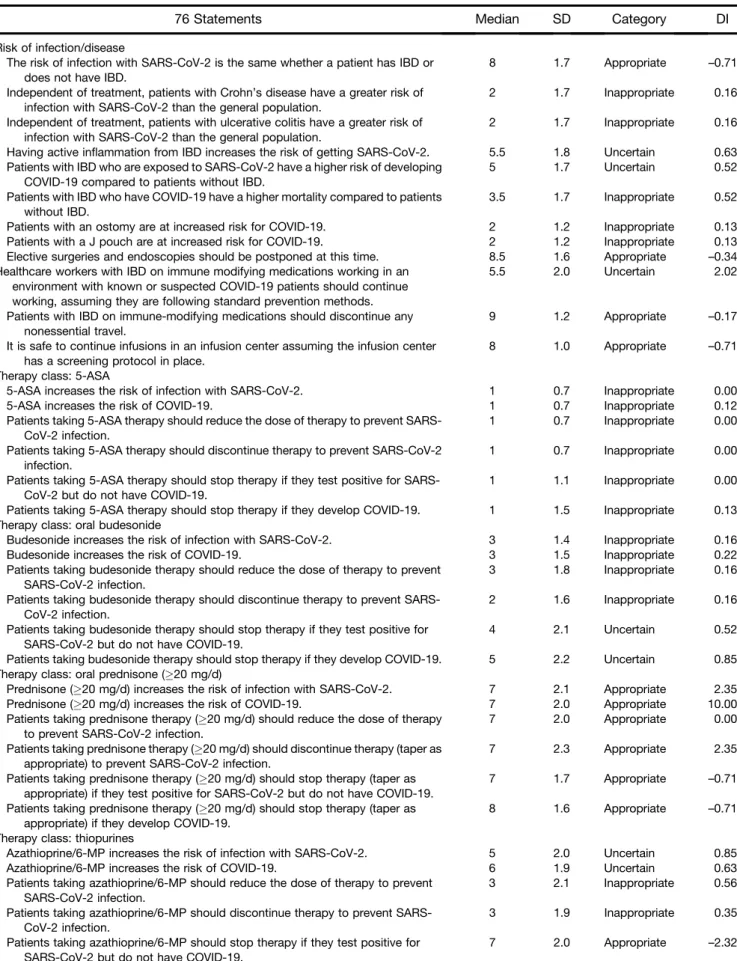
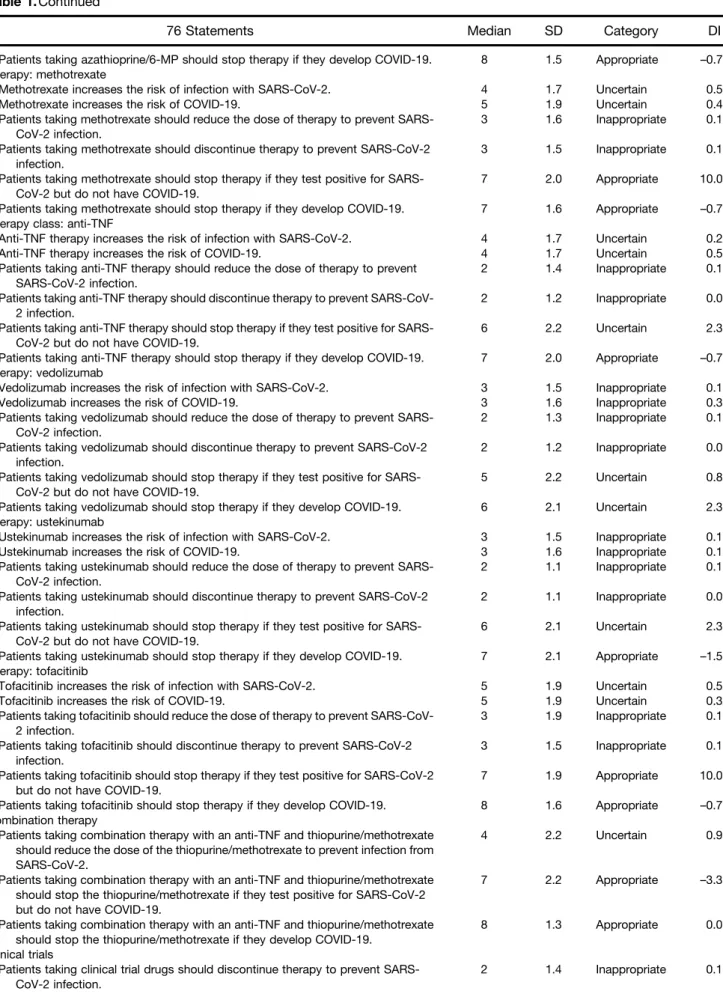
Table 1
. A second
webinar occurred on March 27, 2020,
to review results and to continue
dis-cussions for ongoing efforts to provide
guidance.
Bowel
Diseases
(IOIBD)
is
the
only
global
organization
devoted
to
the
study
of
and
management
of
the
in-fl
ammatory
bowel
diseases
(IBDs),
namely,
Crohn
’
s
disease
and
ulcerative
colitis.
Membership
is
composed
of
physician-scientists
who
have
estab-lished
expertise
in
these
diseases.
The
organization
hosts
an
annual
meeting
and
a
number
of
working
groups
addressing
issues
of
the
epidemiology
of
IBD,
diet
and
nutrition,
and
the
development
and
use
of
treatments
for
IBD.
There
are
currently
89
members
of
IOIBD
representing
26
different
countries.
The
organization
has
taken
particular
interest
in
the
coronavirus
disease-2019
(COVID-19)
pandemic
and
how
it
may
affect
the
IBD
patient
population.
This
document
summa-rizes
the
results
of
2
recent
virtual
meetings
of
the
group
and
subsequent
expert
guidance
for
patients
and
providers.
Severe
Acute
Respiratory
Syndrome
Coronavirus-2
and
COVID-19
Methodology for
Developing the IOIBD
Statements on COVID-19
and IBD
IOIBD used the established RAND/
UCLA method, which uses a Delphi panel
approach to address the appropriateness
of speci
fi
c medical interventions or
medical decisions.
5We used a modi
fi
ed
RAND panel to allow for a rapid cycle of
2 rounds of voting by the expert panel.
The panel was presented a web-based
questionnaire that included clinical
sce-narios speci
fi
c to patients with IBD
dur-ing
the
COVID-19
pandemic.
The
questionnaire was created and iteratively
improved by 3 of the authors (DTR, MTA,
CAS) and then distributed electronically
to
the
respondents.
The
panelists
included the membership of IOIBD in
addition to other invited specialists in
IBD. Respondents rated each of the
pa-tient scenarios on a scale of 1
–
9, such
that statements rated 1
–
3 are considered
inappropriate, 4
–
6 are uncertain, and
7
–
9 are appropriate. After the
fi
rst round
of anonymous voting, the
fi
rst webinar
occurred
and
related
content
was
reviewed as summarized and the results
of the
fi
rst round of voting were
reviewed. The subsequent discussion
focused on scenarios that had a median
in the uncertainty range and those with a
high standard deviation. The goal of the
discussion was to understand views of
the panel in preparation for a second
round of voting, not necessarily to
ach-ieve consensus. The second round
ques-tionnaire was nearly identical to the
fi
rst,
except for clarifying a few of the original
scenarios and adding 2 additional
sec-tions that were not covered in round 1
(how to manage patients in IBD clinical
trials and when to restart medications if
they were being held for active
COVID-19 infection).
Table 1
lists the
state-ments from the second round of voting.
The
fi
nal appropriateness category is
based on the second round voting
me-dian. The mean, standard deviation, and
disagreement index (DI) were also
calculated.
The DI expresses the spread of
re-sponses and is calculated using a
previ-ously
described
approach
5and
the
following formula:
Using this formula, agreement is
de
fi
ned
as
a
DI
of
<
1,
whereas
disagreement is de
fi
ned as a DI of
1.
5Summary of RAND Panel
and Development of
Guidance Statements
Of the 76 statements in the
second-round
survey,
26
were
rated
as
appropriate, 19 as uncertain, and 31 as
inappropriate. Although agreement is
not required, there was agreement (DI
of
<
1) in 64 of 76 scenarios (84%).
The panel agreed that having IBD
(either Crohn
’
s disease or
ulcera-tive colitis) did not increase the
risk of becoming infected with
SARS-CoV-2 or developing
COVID-19 and having an ostomy or
J-pouch did not increase the risk for
COVID-19.
The panel agreed that it is safe to
continue to receive infusions in an
infusion center, assuming that the
infusion center has a SARS-CoV-2
screening protocol in place.
The group was in agreement that it
is appropriate to reduce the dose
or discontinue prednisone to
pre-vent infection from SARS-CoV-2,
but voted that it was
inappro-priate to reduce the dose or stop
other IBD therapies to prevent
infection from SARS-CoV-2.
There
were
mixed
responses
related to the other clinical
sce-narios and therapies. The key
fi
ndings regarding the
manage-ment of medical therapy for IBD in
the
setting
of
the
COVID-19
pandemic
are
summarized
in
Figure 1
.
In regards to the scenario of a
patient
receiving
combination
therapy of an anti-tumor necrosis
factor (TNF) and immune
modu-lator, the group was uncertain if
the immune modulator should be
dose reduced to potentially modify
the risk of infection with
SARS-CoV-2, but was in agreement and
did vote that it is appropriate to
discontinue the immune
modu-lator in a patient who is known to
be infected with SARS-CoV-2 or
when a patient develops
COVID-19.
In the scenario of a patient who
stopped IBD medications because
either they tested positive for
SARS-CoV-2
infection
or
had
COVID-19, the group voted that it
is appropriate to restart their
medications if they do not develop
symptoms after 2 weeks, or when
symptoms
have
completely
resolved.
The group was in agreement and
voted it was appropriate to
post-pone
nonessential
endoscopic
procedures.
Furthermore, the panel voted that
patients in clinical trials should
continue those therapies unless
they become infected by
SARS-CoV-2 or develop COVID-19.
The group voted that it was
appropriate to discontinue the
clinical trial drug if a patient tests
positive for SARS-CoV-2 or
de-velops COVID-19, but there was
some
disagreement
in
the
responses.
The full results of the
fi
rst survey
(before the webinar) and second
sur-vey are available in
Supplementary
Table 2
.
Summary of the
Discussion about
Immune Activity in
COVID-19 Infections and
Possible Effects of IBD
Therapies
It is now known that similar to the
2002 SARS-CoV, the 2019 SARS-CoV-2
requires
the
angiotensin-converting
enzyme 2 (ACE-2) receptor to enter
DI
¼
66 %ile
33 %ile
2
:
35
þ
1
:
5
5
66 %ileþ33 %ile 2
Table 1.
Final Assessment of Statements Related to Risk of Infection with SARS-CoV-2 or development of COVID-19 in
Patients with IBD by the IOIBD Panel (n
¼
66 participants)
76 Statements
Median
SD
Category
DI
Risk of infection/disease
The risk of infection with SARS-CoV-2 is the same whether a patient has IBD or does not have IBD.
8 1.7 Appropriate –0.71
Independent of treatment, patients with Crohn’s disease have a greater risk of
infection with SARS-CoV-2 than the general population.
2 1.7 Inappropriate 0.16
Independent of treatment, patients with ulcerative colitis have a greater risk of infection with SARS-CoV-2 than the general population.
2 1.7 Inappropriate 0.16
Having active inflammation from IBD increases the risk of getting SARS-CoV-2. 5.5 1.8 Uncertain 0.63
Patients with IBD who are exposed to SARS-CoV-2 have a higher risk of developing COVID-19 compared to patients without IBD.
5 1.7 Uncertain 0.52
Patients with IBD who have COVID-19 have a higher mortality compared to patients without IBD.
3.5 1.7 Inappropriate 0.52
Patients with an ostomy are at increased risk for COVID-19. 2 1.2 Inappropriate 0.13
Patients with a J pouch are at increased risk for COVID-19. 2 1.2 Inappropriate 0.13
Elective surgeries and endoscopies should be postponed at this time. 8.5 1.6 Appropriate –0.34
Healthcare workers with IBD on immune modifying medications working in an environment with known or suspected COVID-19 patients should continue working, assuming they are following standard prevention methods.
5.5 2.0 Uncertain 2.02
Patients with IBD on immune-modifying medications should discontinue any nonessential travel.
9 1.2 Appropriate –0.17
It is safe to continue infusions in an infusion center assuming the infusion center has a screening protocol in place.
8 1.0 Appropriate –0.71
Therapy class: 5-ASA
5-ASA increases the risk of infection with SARS-CoV-2. 1 0.7 Inappropriate 0.00
5-ASA increases the risk of COVID-19. 1 0.7 Inappropriate 0.12
Patients taking 5-ASA therapy should reduce the dose of therapy to prevent SARS-CoV-2 infection.
1 0.7 Inappropriate 0.00
Patients taking 5-ASA therapy should discontinue therapy to prevent SARS-CoV-2 infection.
1 0.7 Inappropriate 0.00
Patients taking 5-ASA therapy should stop therapy if they test positive for SARS-CoV-2 but do not have COVID-19.
1 1.1 Inappropriate 0.00
Patients taking 5-ASA therapy should stop therapy if they develop COVID-19. 1 1.5 Inappropriate 0.13
Therapy class: oral budesonide
Budesonide increases the risk of infection with SARS-CoV-2. 3 1.4 Inappropriate 0.16
Budesonide increases the risk of COVID-19. 3 1.5 Inappropriate 0.22
Patients taking budesonide therapy should reduce the dose of therapy to prevent SARS-CoV-2 infection.
3 1.8 Inappropriate 0.16
Patients taking budesonide therapy should discontinue therapy to prevent SARS-CoV-2 infection.
2 1.6 Inappropriate 0.16
Patients taking budesonide therapy should stop therapy if they test positive for SARS-CoV-2 but do not have COVID-19.
4 2.1 Uncertain 0.52
Patients taking budesonide therapy should stop therapy if they develop COVID-19. 5 2.2 Uncertain 0.85
Therapy class: oral prednisone (20 mg/d)
Prednisone (20 mg/d) increases the risk of infection with SARS-CoV-2. 7 2.1 Appropriate 2.35
Prednisone (20 mg/d) increases the risk of COVID-19. 7 2.0 Appropriate 10.00
Patients taking prednisone therapy (20 mg/d) should reduce the dose of therapy
to prevent SARS-CoV-2 infection.
7 2.0 Appropriate 0.00
Patients taking prednisone therapy (20 mg/d) should discontinue therapy (taper as
appropriate) to prevent SARS-CoV-2 infection.
7 2.3 Appropriate 2.35
Patients taking prednisone therapy (20 mg/d) should stop therapy (taper as
appropriate) if they test positive for SARS-CoV-2 but do not have COVID-19.
7 1.7 Appropriate –0.71
Patients taking prednisone therapy (20 mg/d) should stop therapy (taper as
appropriate) if they develop COVID-19.
8 1.6 Appropriate –0.71
Therapy class: thiopurines
Azathioprine/6-MP increases the risk of infection with SARS-CoV-2. 5 2.0 Uncertain 0.85
Azathioprine/6-MP increases the risk of COVID-19. 6 1.9 Uncertain 0.63
Patients taking azathioprine/6-MP should reduce the dose of therapy to prevent SARS-CoV-2 infection.
3 2.1 Inappropriate 0.56
Patients taking azathioprine/6-MP should discontinue therapy to prevent SARS-CoV-2 infection.
3 1.9 Inappropriate 0.35
Patients taking azathioprine/6-MP should stop therapy if they test positive for SARS-CoV-2 but do not have COVID-19.
Table 1.
Continued
76 Statements
Median
SD
Category
DI
Patients taking azathioprine/6-MP should stop therapy if they develop COVID-19. 8 1.5 Appropriate –0.71
Therapy: methotrexate
Methotrexate increases the risk of infection with SARS-CoV-2. 4 1.7 Uncertain 0.52
Methotrexate increases the risk of COVID-19. 5 1.9 Uncertain 0.44
Patients taking methotrexate should reduce the dose of therapy to prevent SARS-CoV-2 infection.
3 1.6 Inappropriate 0.16
Patients taking methotrexate should discontinue therapy to prevent SARS-CoV-2 infection.
3 1.5 Inappropriate 0.16
Patients taking methotrexate should stop therapy if they test positive for SARS-CoV-2 but do not have COVID-19.
7 2.0 Appropriate 10.00
Patients taking methotrexate should stop therapy if they develop COVID-19. 7 1.6 Appropriate –0.71
Therapy class: anti-TNF
Anti-TNF therapy increases the risk of infection with SARS-CoV-2. 4 1.7 Uncertain 0.22
Anti-TNF therapy increases the risk of COVID-19. 4 1.7 Uncertain 0.52
Patients taking anti-TNF therapy should reduce the dose of therapy to prevent SARS-CoV-2 infection.
2 1.4 Inappropriate 0.16
Patients taking anti-TNF therapy should discontinue therapy to prevent SARS-CoV-2 infection.
2 1.2 Inappropriate 0.00
Patients taking anti-TNF therapy should stop therapy if they test positive for SARS-CoV-2 but do not have COVID-19.
6 2.2 Uncertain 2.35
Patients taking anti-TNF therapy should stop therapy if they develop COVID-19. 7 2.0 Appropriate –0.71
Therapy: vedolizumab
Vedolizumab increases the risk of infection with SARS-CoV-2. 3 1.5 Inappropriate 0.16
Vedolizumab increases the risk of COVID-19. 3 1.6 Inappropriate 0.37
Patients taking vedolizumab should reduce the dose of therapy to prevent SARS-CoV-2 infection.
2 1.3 Inappropriate 0.15
Patients taking vedolizumab should discontinue therapy to prevent SARS-CoV-2 infection.
2 1.2 Inappropriate 0.00
Patients taking vedolizumab should stop therapy if they test positive for SARS-CoV-2 but do not have COVID-19.
5 2.2 Uncertain 0.85
Patients taking vedolizumab should stop therapy if they develop COVID-19. 6 2.1 Uncertain 2.35
Therapy: ustekinumab
Ustekinumab increases the risk of infection with SARS-CoV-2. 3 1.5 Inappropriate 0.16
Ustekinumab increases the risk of COVID-19. 3 1.6 Inappropriate 0.16
Patients taking ustekinumab should reduce the dose of therapy to prevent SARS-CoV-2 infection.
2 1.1 Inappropriate 0.16
Patients taking ustekinumab should discontinue therapy to prevent SARS-CoV-2 infection.
2 1.1 Inappropriate 0.00
Patients taking ustekinumab should stop therapy if they test positive for SARS-CoV-2 but do not have COVID-19.
6 2.1 Uncertain 2.35
Patients taking ustekinumab should stop therapy if they develop COVID-19. 7 2.1 Appropriate –1.57
Therapy: tofacitinib
Tofacitinib increases the risk of infection with SARS-CoV-2. 5 1.9 Uncertain 0.52
Tofacitinib increases the risk of COVID-19. 5 1.9 Uncertain 0.32
Patients taking tofacitinib should reduce the dose of therapy to prevent SARS-CoV-2 infection.
3 1.9 Inappropriate 0.19
Patients taking tofacitinib should discontinue therapy to prevent SARS-CoV-2 infection.
3 1.5 Inappropriate 0.16
Patients taking tofacitinib should stop therapy if they test positive for SARS-CoV-2 but do not have COVID-19.
7 1.9 Appropriate 10.00
Patients taking tofacitinib should stop therapy if they develop COVID-19. 8 1.6 Appropriate –0.71
Combination therapy
Patients taking combination therapy with an anti-TNF and thiopurine/methotrexate should reduce the dose of the thiopurine/methotrexate to prevent infection from SARS-CoV-2.
4 2.2 Uncertain 0.91
Patients taking combination therapy with an anti-TNF and thiopurine/methotrexate should stop the thiopurine/methotrexate if they test positive for SARS-CoV-2 but do not have COVID-19.
7 2.2 Appropriate –3.30
Patients taking combination therapy with an anti-TNF and thiopurine/methotrexate should stop the thiopurine/methotrexate if they develop COVID-19.
8 1.3 Appropriate 0.00
Clinical trials
Patients taking clinical trial drugs should discontinue therapy to prevent SARS-CoV-2 infection.
the cell as well as TMPRSS2, a serine
protease that cleaves the viral spike to
permit viral entry.
6The ACE-2
recep-tor is found at high levels in alveolar
type-2 cells in the lung. However,
important for IBD, the small intestine
is also known to express ACE-2; in a
patient who was infected with
SARS-CoV-2, ACE-2 and the virus were
found in stomach, duodenal, and rectal
biopsies.
7Moreover, single cell
tran-scriptomics of the gut corroborate that
ACE-2 is expressed in the
gastrointes-tinal tract.
8The virus has also been
found in the stool of infected patients
for longer periods of time than in
sputum, although in smaller amounts.
9ACE-2 can be up-regulated after
infection with SARS-CoV and Middle
Eastern
Respiratory
Syndrome
(MERS)-CoV
–
related viruses,
suggest-ing there is a positive feed forward
loop once patients are infected with
virus. In vitro, IFN-
g
can induce ACE-2
and the promoter region of ACE-2
contains several immune and cytokine
responsive transcription factor binding
sites, suggesting that in
fl
ammation
may increase expression of ACE-2.
8The other important factor for viral
entry is endocytosis. Baricitinib is a
JAK1,
JAK2
and
TYK2
inhibitor
currently
available for
rheumatoid
arthritis and in clinical development
for IBD and it may inhibit
endocy-tosis.
10This effect does not occur with
the
less
selective
JAK
inhibitor,
tofacitinib.
Early in the disease course for
SARS-CoV and MERS-CoV, the innate
immune response to the virus through
interferon and interferon-stimulated
genes may limit viral replication, but
is also subverted by the virus itself.
11In later stages, the cytokine release
syndrome, characterized by high levels
of proin
fl
ammatory cytokines such as
IL-6, has been suggested to trigger
acute respiratory distress syndrome in
SARS-CoV-2 infections and lead to fatal
outcomes. In terms of the therapies we
use for IBD and the potential effect on
SARS-CoV2, previous experience with
high-dose steroids as a treatment for
SARS-CoV
or
MERS-CoV
was
not
effective and delayed viral clearance.
12Therefore, steroids are not
recom-mended as a treatment for
SARS-CoV-2, but the doses that were used in
these studies are much higher than the
doses that are used in IBD.
12With
respect to thiopurines, mercaptopurine
and 6-thioguanine have potential
anti-viral activity against MERS and SARS,
at least in vitro.
13There are no
publi-cations, however, showing that this
fi
nding was tested in patients. The
other issue that has to be considered in
the context of thiopurines is
lympho-penia, because patients on thiopurines
may develop lymphopenia from the
drug.
Unfortunately,
patients
with
lymphopenia caused by SARS-CoV-2
have a worse prognosis and have an
increased risk of death associated with
the virus.
14,15At the current time,
there are no speci
fi
c data available on
methotrexate and COVID-19, but in
theory
the
pulmonary
toxicity
of
methotrexate may be of interest in the
setting of a virus that involves the
respiratory tract.
Many patients with IBD are using
monotherapy with biologics or the
novel small molecule Janus kinase
in-hibitor, tofacitinib. Anti-TNF therapy
may impact viral immunity given that
there is a small increased risk of
her-pes zoster and hepatitis B virus
reac-tivation. Although high IL-2R and IL-6
serum levels have been associated with
severe COVID-19 cases, no effect on
TNF levels was noted.
16IFN-
g
and TNF
production by CD4
þT cells have been
associated with severe SARS-CoV and,
therefore, inhibition of TNF has been
proposed as a treatment of the
cyto-kine release syndrome that can occur
in some of these patients.
17,18Vedolizumab primarily inhibits
a
-4,
b
-7 lymphocyte homing of Th17 and
Th9 cells as well as regulatory T cells
to the intestine. Viral infections are
rare with vedolizumab therapy.
19In
patients who had concurrent hepatitis
B or C virus infection, there was no
viral reactivation and there was
sus-tained virologic control in simian
Table 1.
Continued
76 Statements
Median
SD
Category
DI
Patients taking clinical trial drugs should stop therapy if they test positive for SARS-CoV-2 but do not have COVID-19.
7 1.9 Appropriate 10.00
Patients taking clinical trial drugs should stop therapy if they develop COVID-19. 8 1.6 Appropriate –0.32
Approach to active disease
A patient with moderately to severely active Crohn’s disease or ulcerative colitis (new diagnosis or relapsing disease) should be treated with the same therapies you would choose in the pre-COVID-19 era.
7 2.1 Appropriate 10.00
Treatment of IBD after SARS-coV-2 infection or COVID-19
In an IBD patient who tests positive for SARS-CoV-2 and whose IBD meds have been stopped because of this, IBD meds can be restarted after 14 days (provided they have not developed COVID-19).
7 1.5 Appropriate –0.71
In an IBD patient who develops COVID-19 and whose IBD meds have been stopped, IBD meds can be restarted after COVID-19 symptoms resolve.
7 1.9 Appropriate 10.00
In an IBD patient who develops COVID-19 and whose IBD meds have been stopped, IBD meds can be restarted after 2 nasopharyngeal PCR tests are negative.
8 1.6 Appropriate –0.71
immunode
fi
ciency
–
infected macaques
after antiretroviral and vedolizumab
therapy.
20Vedolizumab has been used
for clinical therapy in patients with
IBD and early clinical trials in HIV have
not shown effects on viral load.
21With
respect to ustekinumab, this agent can
prevent Th1
þT-cell priming and IFN-
g
production by CD4
þT cells and
sup-press Th17
þT-cell activation and
cytokine production. There has been
no increase in viral infections in IBD or
psoriasis patients receiving
ustekinu-mab in large postmarketing
regis-tries.
22Tocilizumab,
an
anti
–
IL-6R
antibody, is currently being tested in
patients with severe COVID-19 and
may decrease the severity of acute
respiratory
distress
syndrome.
23,24Finally, tofacitinib has been associated
with a clear increase in reactivation of
herpes zoster. Thus, tofacitinib might
inhibit viral immunity; in contrast, it
might help with the severe in
fl
amma-tory response that ultimately leads to
death. In certain studies, tofacitinib can
inhibit interferon secretion.
When considering the management
of IBD medications, one must also take
into account the half-life of the drugs.
In general, 5.5 half-lives are required
to achieve very low levels of drug.
Corticosteroids have a half-life of about
24 hours, but it is dose dependent and
the higher the dose, the longer the
biological
effect.
Thiopurines
have
been studied in patients with IBD and
the median 6-thioguanine elimination
half-life is 6.8 days with very low levels
of 6-thioguanine present by 40 days.
25Studies of vaccine responses in
pa-tients on thiopurines demonstrate that
patients were able to mount normal
immune responses.
26Methotrexate has
a 6-hour half-life and takes
<
3 days to
eliminate. Tofacitinib has a half-life of
between 3 and 6 hours, depending on
whether
it
is
an
immediate-
or
extended-release
formulation.
27Studies in normal volunteers treated
with tofacitinib, however, found
de-fects in immune function for 1 month
after drug withdrawal.
28For the
sub-cutaneous and IV-based biologics, the
half-life is much longer. The half-life of
adalimumab is between 10 and 20
days and the half-life of in
fl
iximab is
between is 7 and 12 days. The median
half-life for ustekinumab is
approxi-mately 19 days in patients with
Crohn
’
s disease, and the serum half-life
of vedolizumab is 25 days. Thus, even
after cessation of these immune
ther-apies, there may be continued effects
on the patient and implications for the
infection.
Summary and Next Steps
This meeting was convened by an
international group of IBD
physician-scientists to develop guidance for the
management of patients with IBD
during the COVID-19 pandemic. Using
a
RAND
panel
methodology,
the
group developed a series of
state-ments regarding the risk of infection
and management of therapies that
will assist patients and healthcare
providers during this uncertain time.
These statements are based on expert
opinion in the absence of de
fi
nitive
data or, in some cases, any data. They
are meant to help inform clinical
de-cision making, but should not replace
individualized
management
de-cisions. The IOIBD and the invited
experts are participating in weekly
updates of this rapidly evolving
situ-ation and will update this
informa-tion for patients and colleagues as
appropriate.
DAVID T. RUBIN
University of Chicago Medicine
In
fl
ammatory Bowel Disease Center
Chicago, Illinois
MARIA T. ABREU
University of Miami Miller School of
Medicine
Division of Gastroenterology
Department of Medicine
Miami, Florida
VICTORIA RAI
University of Chicago Medicine
In
fl
ammatory Bowel Disease Center
Chicago, Illinois
COREY A. SIEGEL
Dartmouth-Hitchcock Medical Center
Section of Gastroenterology and
Hepatology
Lebanon, New Hampshire
on behalf of the
International Organization
for the Study of In
fl
ammatory
Bowel Disease
Supplementary Material
Note: To access the supplementary
material accompanying this article,
visit the online version of
Gastroen-terology
at
www.gastrojournal.org
, and
at
https://doi.org/10.1053/j.gastro.
2020.04.002
.
References
1. Ghebreyesus T. WHO
Director-General
’
s opening remarks at the
media brie
fi
ng on COVID-19 - 11
March 2020. Available:
www.who.
int/dg/speeches/detail/who-director-
general-s-opening-remarks-at-the-media-brie
fi
ng-on-covid-19
—
11-march-2020
.
Accessed
June,
2020.
2. Johns
Hopkins
Center
for
Systems Science and Engineering.
Coronavirus
COVID-19
Global
Cases by Johns Hopkins CSSE.
Available:
https://coronavirus.jhu.
edu/
. Accessed March 29, 2020.
3. Secure-IBD Database. Available:
https://covidibd.org/
.
Accessed
March 29, 2020.
4. ESPGHAN: Porto and IBD Interest
Group.
ESPGHAN.
Available:
www.espghan.org/about-espghan/
committees/gastroenterology/work
ing-groups/porto-and-ibd-interest-group/
. Accessed March 29, 2020.
5.
Fitch K, ed. The Rand/UCLA
appro-priateness method user
’
s manual.
Santa Monica: RAND, 2001
.
6.
Hoffmann
M,
Kleine-Weber
H,
Schroeder S, et al. SARS-CoV-2
cell entry depends on ace2 and
tmprss2 and is blocked by a
clini-cally proven protease inhibitor. Cell
2020;181:271
–
280
.
7.
Xiao F, Tang M, Zheng X, et al.
Evidence for gastrointestinal
infec-tion of SARS-CoV-2.
Gastroenter-ology 2020;158:1831
–
1833
.
8.
Wang P-H, Cheng Y. Increasing
host cellular receptor
—
angiotensin-converting
enzyme
2
(ACE2)
expression
by
coronavirus
may
facilitate 2019-nCoV infection.
bio-Rxiv 2020. 2020.02.24.963348
.
9.
Ianiro G, Mullish BH, Kelly CR, et al.
Screening
of
faecal
microbiota
transplant
donors
during
the
COVID-19 outbreak: suggestions
for urgent updates from an
inter-national
expert
panel.
Lancet
Gastroenterol
Hepatol
2020;
5:430
–
432
.
10.
Richardson P, Grif
fi
n I, Tucker C,
et al. Baricitinib as potential
treat-ment for 2019-nCoV acute
respi-ratory
disease.
Lancet
2020;
395:e30
–
e31
.
11.
Channappanavar R, Perlman S.
Pathogenic human coronavirus
in-fections:
causes
and
conse-quences of cytokine storm and
immunopathology. Semin
Immu-nopathol 2017;39:529
–
539
.
12.
Russell CD, Millar JE, Baillie JK.
Clinical evidence does not support
corticosteroid treatment for
2019-nCoV lung injury. Lancet 2020;
395:473
–
475
.
13.
Cheng K-W, Cheng S-C, Chen
W-Y, et al. Thiopurine analogs and
mycophenolic acid synergistically
inhibit the papain-like protease of
Middle East respiratory syndrome
coronavirus. Antiviral Res 2015;
115:9
–
16
.
14.
Wu C, Chen X, Cai Y, et al.
Risk factors associated with acute
respiratory
distress
syndrome
and death in patients with
corona-virus
disease
2019
pneumonia
in Wuhan, China. JAMA Intern
Med 2020 Mar 13 [Epub ahead of
print]
.
15.
Wang D, Hu B, Hu C, et al. Clinical
characteristics of 138 hospitalized
patients
with
2019
novel
coronavirus
–
infected pneumonia in
Wuhan,
China.
JAMA
2020;
323:1061
–
1069
.
16.
Chen L, Liu HG, Liu W, et al.
[Analysis of clinical features of 29
patients with 2019 novel
coronavi-rus pneumonia]. Zhonghua Jie He
He Hu Xi Za Zhi 2020;43:E005
.
17.
Li CK, Wu H, Yan H, et al. T cell
responses to whole SARS
corona-virus in humans. J Immunol 2008;
181:5490
–
5500
.
18. A clinical study for the ef
fi
cacy and
safety of Adalimumab Injection in
the treatment of patients with
se-vere novel coronavirus pneumonia
(COVID-19). Chinese Clinical Trial
Register
(ChiCTR).
Available:
www.chictr.org.cn/showprojen.aspx?
proj
¼
49889
. Accessed March 29,
2020.
19.
Ng SC, Hilmi IN, Blake A, et al. Low
frequency
of
opportunistic
in-fections
in
patients
receiving
vedolizumab in clinical trials and
post-marketing
setting.
In
fl
amm
Bowel Dis 2018;24:2431
–
2441
.
20.
Byrareddy
SN,
Arthos
J,
Cicala C, et al. Sustained
viro-logic control in SIVþ
macaques
after
antiretroviral
and
a
4
b
7
antibody therapy. Science 2016;
354:197
–
202
.
21.
Uzzan
M,
Tokuyama
M,
Rosenstein AK, et al. Anti-
a
4
b
7
therapy targets lymphoid
aggre-gates in the gastrointestinal tract of
HIV-1-infected
individuals.
Sci
Transl Med 2018;10
.
22.
Ghosh S, Gensler LS, Yang Z, et al.
Ustekinumab safety in psoriasis,
psoriatic arthritis, and Crohn
’
s
dis-ease: an integrated analysis of
phase II/III clinical development
pro-grams. Drug Saf 2019;42:751
–
768
.
23.
Xu X, Han M, Li T, et al. Effective
treatment of severe COVID-19
pa-tients with tocilizumab. ChinaXiv
2020:12
.
24. Roche to start phase III trial of
Actemra
in
Covid-19
patients.
Clinical
Trials
Arena.
Available:
www.clinicaltrialsarena.com/news/
roche-actemra-covid-19-trial/
.
Accessed March 29, 2020.
25.
Ben-Horin
S,
Van
Assche
G,
Chowers Y, et al. Pharmacokinetics
and
immune
reconstitution
following discontinuation of
thio-purine analogues: implications for
drug
withdrawal
strategies.
J
Crohns
Colitis
2018;
12:1410
–
1417
.
26.
Dotan I, Werner L, Vigodman S,
et al. Normal response to vaccines
in in
fl
ammatory bowel disease
pa-tients
treated
with
thiopurines.
In
fl
amm
Bowel
Dis
2012;
18:261
–
268
.
27.
Lamba M, Wang R, Fletcher T,
et al. Extended-release once-daily
formulation of tofacitinib:
evalua-tion
of
pharmacokinetics
compared with immediate-release
tofacitinib and impact of food.
J
Clin
Pharmacol
2016;
56:1362
–
1371
.
28.
Weinhold
KJ,
Bukowski
JF,
Brennan TV, et al. Reversibility of
peripheral blood leukocyte
pheno-typic and functional changes after
exposure to and withdrawal from
tofacitinib, a Janus kinase inhibitor,
in healthy volunteers. Clin Immunol
2018;191:10
–
20
.
Acknowledgments
The authors thank all the participants of the RAND panel.
The authors acknowledge Cindy Traboulsi, Amarachi I. Erondu, and Seth R. Shaffer for their assistance in data management and Raymond Kulig and Marischka Konings for invaluable help in logistical coordination.
Geert D’Haens, Andre D’Hoore, Axel Dignass, Iris Dotan, Marla C. Dubinsky, Anders Ekbom, Phillip R. Fleshner, Miquel A. Gassull, Richard B. Gearry, Subrata Ghosh, Anne M. Griffiths, Jonas Halfvarson, Stephen B. Hanauer, Noam Harpaz, Ailsa Hart, Michael A. Kamm, Gil G. Kaplan, Ioannis Koutroubakis, Peter L. Lakatos, Arie Levine, James D. Lewis, James O. Lindsay, Edward V. Loftus Jr., Edouard Louis, Milan Lukas, Fernando Magro, Uma Mahadevan, Gerasimos J. Mantzaris, Dermot P. McGovern, Bjørn A. Moum, Pia Munkholm, Markus F. Neurath, Siew C. Ng, Colm O’Morain, Remo Panaccione, Julian Panes, Laurent Peyrin-Biroulet, Cosimo Prantera, Zhihua Ran, Walter Reinisch, Feza H. Remzi, David B. Sachar, William J. Sandborn, R. Balfour Sartor, Jürgen Schölmerich, Stefan Schreiber, Britta Siegmund, Mark S. Silverberg, Johan D. Söderholm, Eduard F. Stange, Flavio Steinwurz, Dan Turner, Morten H. Vatn, and Severine
Vermeire. Additional Invited Participants: Erica J. Brenner, Britt Christensen, Ferdinando D’Amico, Chris M. Griffiths, Peter D. Higgins, Michael D. Kappelman, Charlie Lees, Miguel D. Regueiro, Joel R. Rosh, Ryan Ungaro
Conflicts of interest
The authors have made the following disclosures: David Rubin, Maria Abreu, and Corey Siegel are members of IOIBD. In addition, they have the following disclosures. David T. Rubin has received grant support from Takeda; has served as a consultant for Abbvie, Abgenomics, Allergan Inc., Boehringer Ingelheim Ltd., Bristol-Myers Squibb, Celgene Corp/Syneos, Dizal Pharmaceuticals, GalenPharma/Atlantica, Genentech/Roche, Gilead Sciences, Ichnos Sciences S.A., GlaxoSmithKline Services, Janssen Pharmaceuticals, Eli Lilly, Pfizer, Prometheus Laboratories, Reistone, Shire, Takeda, and
Supplementary Table 1.
Types of IBD Therapies Assessed by the IOIBD Panel
Therapy type
Also known as
5-Aminosalicylic acid (5-ASA) Asacol, Apriso, balsalazide, Dezicol, Lialda, mesalamine, mesalazine, Pentasa
Oral budesonide Entocort, Uceris
Steroids (the dose discussed is
oral prednisone and20 mg/d)
Prednisone, Medrol, Hydrocortisone
Thiopurines 6-Mercaptopurine, azathioprine, Azasan, Purinethol
Methotrexate Trexal, Rheumatrex
JAK inhibitor Tofacitinib (Xeljanz)
Anti-TNF Adalimumab (Humira, Abrilada, Ajevita, Cyltezo, Hyrimoz, Hadlima), certolizumab pegol (Cimzia),
golimumab (Simponi), infliximab (Remicade, Avsola, Inflectra, IxifiRemsima, Renflexis)
Anti-IL12/23 Ustekinumab (Stelara)
Anti-integrin Vedolizumab (Entyvio), (the panel did not discuss natalizumab (Tysabri)
Supplementary Table 2.
Full Results of Assessment of Statements Related to Risk of Infection with SARS-CoV-2 or
Development of COVID-19 in Patients with IBD by the IOIBD Panel
Statements
First RAND Panel Voting
Second RAND Panel Voting After
20 March 2020 Webinar
(n
¼
64 participants, 69 statements)
(n
¼
66 participants, 76 statements)
Median
SD
Category
DI
Median
SD
Category
DI
Risk of infection/disease
The risk of infection with SARS-CoV-2 is the same whether a patient has IBD or does not have IBD.
7 1.9 Appropriate 2.35 8 1.7 Appropriate –0.71
Independent of treatment, patients
with Crohn’s disease have a
greater risk of infection with SARS-CoV-2 than the general population.
3 1.8 Inappropriate 0.55 2 1.7 Inappropriate 0.16
Independent of treatment, patients with ulcerative colitis have a greater risk of infection with SARS-CoV-2 than the general population.
3 1.8 Inappropriate 0.65 2 1.7 Inappropriate 0.16
Having active inflammation from IBD
increases the risk of getting SARS-CoV-2.
5 1.9 Uncertain 0.69 5.5 1.8 Uncertain 0.63
Patients with IBD who are exposed to SARS-CoV-2 have a higher risk of developing COVID-19 compared to patients without IBD.
5 1.9 Uncertain 0.37 5 1.7 Uncertain 0.52
Patients with IBD who have COVID-19 have a higher mortality compared to patients without IBD.
4 1.7 Uncertain 0.52 3.5 1.7 Inappropriate 0.52
Patients with an ostomy are at increased risk for COVID-19.
3 1.8 Inappropriate 0.16 2 1.2 Inappropriate 0.13
Patients with a J pouch are at increased risk for COVID-19.
3 1.8 Inappropriate 0.16 2 1.2 Inappropriate 0.13
Elective surgeries and endoscopies should be postponed at this time.
8 2.0 Appropriate -0.44 8.5 1.6 Appropriate –0.34
Healthcare workers with IBD on immune modifying medications working in an environment with known or
suspected COVID-19 patients should continue working, assuming they are following standard prevention methods.
6 2.2 Uncertain 2.35 5.5 2.0 Uncertain 2.02
Patients with IBD on immune-modifying medications should discontinue any nonessential travel.
9 1.5 Appropriate 0.00 9 1.2 Appropriate –0.17
It is safe to continue infusions in an infusion center assuming the infusion center has a screening protocol in place.
8 1.3 Appropriate -0.71 8 1.0 Appropriate –0.71
Therapy class: 5-ASA
5-ASA increases the risk of infection with SARS-CoV-2.
1 1.2 Inappropriate 0.13 1 0.7 Inappropriate 0.00
5-ASA increases the risk of COVID-19. 1 1.2 Inappropriate 0.13 1 0.7 Inappropriate 0.12
Patients taking 5-ASA therapy should reduce the dose of therapy to prevent SARS-CoV-2 infection.
1 0.8 Inappropriate 0.13 1 0.7 Inappropriate 0.00
Patients taking 5-ASA therapy should discontinue therapy to prevent SARS-CoV-2 infection.
1 0.9 Inappropriate 0.00 1 0.7 Inappropriate 0.00
Patients taking 5-ASA therapy should stop therapy if they test positive for SARS-CoV-2 but do not have COVID-19.
Supplementary Table 2.
Continued
Statements
First RAND Panel Voting
Second RAND Panel Voting After
20 March 2020 Webinar
(n
¼
64 participants, 69 statements)
(n
¼
66 participants, 76 statements)
Median
SD
Category
DI
Median
SD
Category
DI
Patients taking 5-ASA therapy should stop therapy if they develop COVID-19.
1 1.4 Inappropriate 0.13 1 1.5 Inappropriate 0.13
Therapy class: oral budesonide Budesonide increases the risk of
infection with SARS-CoV-2.
3 1.8 Inappropriate 0.63 3 1.4 Inappropriate 0.16
Budesonide increases the risk of COVID-19.
4 1.7 Uncertain 0.52 3 1.5 Inappropriate 0.22
Patients taking budesonide therapy should reduce the dose of therapy to prevent SARS-CoV-2 infection.
3 2.0 Inappropriate 0.52 3 1.8 Inappropriate 0.16
Patients taking budesonide therapy should discontinue therapy to prevent SARS-CoV-2 infection.
3 1.7 Inappropriate 0.31 2 1.6 Inappropriate 0.16
Patients taking budesonide therapy should stop therapy if they test positive for SARS-CoV-2 but do not have COVID-19.
4 2.1 Uncertain 0.52 4 2.1 Uncertain 0.52
Patients taking budesonide therapy should stop therapy if they develop COVID-19.
5 2.4 Uncertain 1.76 5 2.2 Uncertain 0.85
Therapy class: oral prednisone (20 mg/d)
Prednisone (20 mg/d) increases the
risk of infection with SARS-CoV-2.
7 1.9 Appropriate 10.00 7 2.1 Appropriate 2.35
Prednisone (20 mg/d) increases the
risk of COVID-19.
7 1.4 Appropriate 0.00 7 2.0 Appropriate 10.00
Patients taking prednisone therapy
(20 mg/d) should reduce the dose
of therapy to prevent SARS-CoV-2 infection.
7 2.0 Appropriate 10.00 7 2.0 Appropriate 0.00
Patients taking prednisone therapy
(20 mg/d) should discontinue
therapy (taper as appropriate) to prevent SARS-CoV-2 infection.
5 2.0 Uncertain 0.85 7 2.3 Appropriate 2.35
Patients taking prednisone therapy
(20 mg/d) should stop therapy
(taper as appropriate) if they test positive for SARS-CoV-2 but do not have COVID-19.
6 2.1 Uncertain 2.35 7 1.7 Appropriate –0.71
Patients taking prednisone therapy
(20 mg/d) should stop therapy
(taper as appropriate) if they develop COVID-19.
7 2.3 Appropriate -4.49 8 1.6 Appropriate –0.71
Therapy class: thiopurines
Azathioprine/6-MP increases the risk of infection with SARS-CoV-2.
6 1.9 Uncertain 0.63 5 2.0 Uncertain 0.85
Azathioprine/6-MP increases the risk of COVID-19.
6 1.7 Uncertain 2.35 6 1.9 Uncertain 0.63
Patients taking azathioprine/6-MP should reduce the dose of therapy to prevent SARS-CoV-2 infection.
3 1.9 Inappropriate 0.52 3 2.1 Inappropriate 0.56
Patients taking azathioprine/6-MP should discontinue therapy to prevent SARS-CoV-2 infection.
Supplementary Table 2.
Continued
Statements
First RAND Panel Voting
Second RAND Panel Voting After
20 March 2020 Webinar
(n
¼
64 participants, 69 statements)
(n
¼
66 participants, 76 statements)
Median
SD
Category
DI
Median
SD
Category
DI
Patients taking azathioprine/6-MP should stop therapy if they test positive for SARS-CoV-2 but do not have COVID-19.
7 2.3 Appropriate 2.35 7 2.0 Appropriate –2.32
Patients taking azathioprine/6-MP should stop therapy if they develop COVID-19.
8 2.0 Appropriate -0.71 8 1.5 Appropriate –0.71
Therapy: methotrexate
Methotrexate increases the risk of infection with SARS-CoV-2.
5 1.9 Uncertain 0.92 4 1.7 Uncertain 0.52
Methotrexate increases the risk of COVID-19.
5 1.7 Uncertain 0.85 5 1.9 Uncertain 0.44
Patients taking methotrexate should reduce the dose of therapy to prevent SARS-CoV-2 infection.
3 1.9 Inappropriate 0.52 3 1.6 Inappropriate 0.16
Patients taking methotrexate should discontinue therapy to prevent SARS-CoV-2 infection.
3 2.1 Inappropriate 0.57 3 1.5 Inappropriate 0.16
Patients taking methotrexate should stop therapy if they test positive for SARS-CoV-2 but do not have COVID-19.
6.5 2.2 Appropriate 2.35 7 2.0 Appropriate 10.00
Patients taking methotrexate should stop therapy if they develop COVID-19.
7 2.2 Appropriate -0.71 7 1.6 Appropriate –0.71
Therapy class: anti-TNFs
Anti-TNF therapy increases the risk of infection with SARS-CoV-2.
3 1.9 Inappropriate 0.52 4 1.7 Uncertain 0.22
Anti-TNF therapy increases the risk of COVID-19.
5 2.1 Uncertain 0.52 4 1.7 Uncertain 0.52
Patients taking anti-TNF therapy should reduce the dose of therapy to prevent SARS-CoV-2 infection.
3 1.6 Inappropriate 0.16 2 1.4 Inappropriate 0.16
Patients taking anti-TNF therapy should discontinue therapy to prevent SARS-CoV-2 infection.
2 1.8 Inappropriate 0.16 2 1.2 Inappropriate 0.00
Patients taking anti-TNF therapy should stop therapy if they test positive for SARS-CoV-2 but do not have COVID-19.
5 2.4 Uncertain 0.85 6 2.2 Uncertain 2.35
Patients taking anti-TNF therapy should stop therapy if they develop COVID-19.
7 2.5 Appropriate 30.00 7 2.0 Appropriate –0.71
Therapy: vedolizumab
Vedolizumab increases the risk of infection with SARS-CoV-2.
3 2.0 Inappropriate 0.65 3 1.5 Inappropriate 0.16
Vedolizumab increases the risk of COVID-19.
4 2.0 Uncertain 0.65 3 1.6 Inappropriate 0.37
Patients taking vedolizumab should reduce the dose of therapy to prevent SARS-CoV-2 infection.
2 1.7 Inappropriate 0.22 2 1.3 Inappropriate 0.15
Patients taking vedolizumab should discontinue therapy to prevent SARS-CoV-2 infection.
Supplementary Table 2.
Continued
Statements
First RAND Panel Voting
Second RAND Panel Voting After
20 March 2020 Webinar
(n
¼
64 participants, 69 statements)
(n
¼
66 participants, 76 statements)
Median
SD
Category
DI
Median
SD
Category
DI
Patients taking vedolizumab should stop therapy if they test positive for SARS-CoV-2 but do not have COVID-19.
4 2.4 Uncertain 0.92 5 2.2 Uncertain 0.85
Patients taking vedolizumab should stop therapy if they develop COVID-19.
5 2.6 Uncertain 1.77 6 2.1 Uncertain 2.35
Therapy: ustekinumab
Ustekinumab increases the risk of infection with SARS-CoV-2.
3 1.7 Inappropriate 0.22 3 1.5 Inappropriate 0.16
Ustekinumab increases the risk of COVID-19.
3 1.9 Inappropriate 0.52 3 1.6 Inappropriate 0.16
Patients taking ustekinumab should reduce the dose of therapy to prevent SARS-CoV-2 infection.
2 1.6 Inappropriate 0.16 2 1.1 Inappropriate 0.16
Patients taking ustekinumab should discontinue therapy to prevent SARS-CoV-2 infection.
2 1.6 Inappropriate 0.16 2 1.1 Inappropriate 0.00
Patients taking ustekinumab should stop therapy if they test positive for SARS-CoV-2 but do not have COVID-19.
5 2.2 Uncertain 0.92 6 2.1 Uncertain 2.35
Patients taking ustekinumab should stop therapy if they develop COVID-19.
6 2.4 Uncertain 18.25 7 2.1 Appropriate –1.57
Therapy: tofacitinib
Tofacitinib increases the risk of infection with SARS-CoV-2.
6 2.2 Uncertain 0.63 5 1.9 Uncertain 0.52
Tofacitinib increases the risk of COVID-19.
6 2.1 Uncertain 2.35 5 1.9 Uncertain 0.32
Patients taking tofacitinib should reduce the dose of therapy to prevent SARS-CoV-2 infection.
3 2.4 Inappropriate 0.52 3 1.9 Inappropriate 0.19
Patients taking tofacitinib should discontinue therapy to prevent SARS-CoV-2 infection.
3 2.1 Inappropriate 0.60 3 1.5 Inappropriate 0.16
Patients taking tofacitinib should stop therapy if they test positive for SARS-CoV-2 but do not have COVID-19.
6 2.4 Uncertain 2.35 7 1.9 Appropriate 10.00
Patients taking tofacitinib should stop therapy if they develop COVID-19.
7 2.3 Appropriate -3.08 8 1.6 Appropriate –0.71
Combination therapy of anti-TNF and immunomodulator Patients taking combination therapy
with an anti-TNF and thiopurine/ methotrexate should reduce the dose of the thiopurine/
methotrexate to prevent infection from SARS-CoV-2.
5 2.4 Uncertain 0.97 4 2.2 Uncertain 0.91
Patients taking combination therapy with an anti-TNF and thiopurine/ methotrexate should stop the thiopurine/methotrexate if they test positive for SARS-CoV-2 but do not have COVID-19.
Supplementary Table 2.
Continued
Statements
First RAND Panel Voting
Second RAND Panel Voting After
20 March 2020 Webinar
(n
¼
64 participants, 69 statements)
(n
¼
66 participants, 76 statements)
Median
SD
Category
DI
Median
SD
Category
DI
Patients taking combination therapy with an anti-TNF and thiopurine/ methotrexate should stop the thiopurine/methotrexate if they develop COVID-19.
8 2.2 Appropriate -0.93 8 1.3 Appropriate 0.00
Clinical trials
Patients taking clinical trial drugs should discontinue therapy to prevent SARS-CoV-2 infection.
2 1.4 Inappropriate 0.16
Patients taking clinical trial drugs should stop therapy if they test positive for SARS-CoV-2 but do not have COVID-19.
7 1.9 Appropriate 10.00
Patients taking clinical trial drugs should stop therapy if they develop COVID-19.
8 1.6 Appropriate –0.32
Approach to active disease
A patient with moderately to severely active Crohn’s disease or ulcerative colitis (new diagnosis or relapsing disease) should be treated with the same therapies you would choose in the pre-COVID-19 era.
7 2.1 Appropriate 10.00
Treatment of IBD after SARS-CoV-2 infection or COVID-19 In an IBD patient who tests positive for
SARS-CoV-2 and whose IBD meds have been stopped because of this, IBD meds can be restarted after 14 days (provided they have not developed COVID-19).
7 1.5 Appropriate –0.71
In an IBD patient who develops COVID-19 and whose IBD meds have been stopped, IBD meds can be restarted after COVID-19 symptoms resolve.
7 1.9 Appropriate 10.00
In an IBD patient who develops COVID-19 and whose IBD meds have been stopped, IBD meds can be restarted after 2
nasopharyngeal PCR tests are negative.
8 1.6 Appropriate –0.71