Miscommunication in Pilot-controller Interaction
HARYANI HAMZAH
Universiti Kebangsaan Malaysia [email protected]
WONG FOOK FEI
formerly with the School of Language Studies and Linguistics, Universiti Kebangsaan Malaysia
ABSTRACT
English is the preferred language for communication in the aviation industry. Pilots and air traffic controllers of different nationalities and proficiency levels interact with each other using a specialized form of English termed aviation English that comprises of aviation phraseology and “plain English”. Here, miscommunication could have disastrous consequences. This paper presents the findings of a study that explored instances of miscommunication in the interaction between pilots and controllers. Miscommunication is defined as a lack of understanding (or misunderstanding), non-understanding or misinterpretation of messages in communication. The corpus consists of 30 hours of actual pilot-controller audio communication collected from the Malaysian airspace. Data were collected from three different frequencies (Alpha, Bravo and Charlie) representing different phases of the flight. They were analysed qualitatively using conversation analysis techniques. The study found that miscommunication in pilot-controller communication is due mainly to two main factors, procedural deviation and problematic instruction or request. The paper concludes by suggesting that pilots and controllers should adhere to standard phraseology and avoid code-switching from aviation phraseology to plain English except when it is inadequate for the situation. It also suggests that proper radio discipline should be maintained.
Keywords: aviation English; miscommunication; non-native speakers; pilot-controller communication; ESP
INTRODUCTION
English was formally endorsed by The International Civil of Aviation Organization (ICAO), a United Nations agency that regulates the development of international air transport, as the default language of aviation in 1944. This means that English would be used as the language of communication between pilots and ground staff in all countries. Even before its formal endorsement, English was already used quite widely when pilots communicated with air-controllers internationally, regardless of their nationality and language background (Mitsutomi & O’Brien 2003). In 2008, ICAO further decreed that pilots and controllers have to be proficient in English to improve pilot-controller communication (Krasnicka 2016). According to Breul (2013), English is most often used as a lingua franca among members of an international cockpit crew whereas a semi-artificial sublanguage based on English serves as the standard means of verbal communication between pilots and air traffic controllers. As English language is widely used within the international aviation industry, therefore there is a variety of Englishes that are spoken and at diverse levels of proficiency (Ragan 1997, Tajima 2004).
and Douglas (2014) have found that even amongst native speakers, pilot-controller communication is challenging.
Early research studies in aviation discourse were largely carried out in the native speaker (NS) setting (e.g. Cushing 1994 &1995 Barshi 1997, Morrow et al.1993, Burki-Cohen 1995a). Some of these studies focused on the effects of variables like human and task on pilot-controller communication (e.g. Prinzo et al. 2010, Cookson 2009, Farris 2007). Others (Tajima 2004, Cookson 2009, Boschen & Jones 2004) analysed transmission of accident or incident to gain insights into its cause. Although, there were studies on NNS pilot controller discourse, these were usually in the NS setting. They examined issues such as the impact of message length, L2 proficiency and cognitive workload on performance, and the causes of miscommunication between L2 pilots and NS air traffic controllers (Molesworth & Estival 2015, Estival & Molesworth 2009 and Farris 2007). A recent study by Trippe and Baese-Berk (2019) examined the prosodic differences between American English and aviation English.
Since the implementation of the ICAO’s English language proficiency requirement in 2008, there has been more studies in the NNS setting (e.g. Carey et al. 2011, Tiewtrakul& Fletcher 2010, Huhta 2009, Kim & Elder 2015 & 2009). However, quite a number of these studies are devoted to issues related to the development of an English test for aviation (e.g. Alderson 2009) as well as development of materials for aviation English (e.g. Er & Kirkgoz 2018, Paramasivan 2013). Until today, there are not many research studies done in the NNS setting. Furthermore, there is a lack of aviation studies that examined routine communication between pilots and air traffic controllers. As mentioned earlier, studies using authentic aviation conversation in this setting tend to examine conversations that led to incidents. Studying miscommunications that occurred in routine conversation could provide insights on the challenges and difficulties faced by pilots and air traffic controllers in this setting that might be different from NS. This gap prompted the researchers of this study to embark on an investigation of miscommunications in routine pilot-controller discourse in a NNS setting. This paper will focus on the factors that lead to the breakdown.
AVIATION ENGLISH
Aviation English is a registered language that is only used in the aviation circle. The language makes sense only if one understands the context in which it is spoken. In other words, aviation English is context dependent. In pilot-controller communication, pilots and air controllers should maintain professionalism at all times during the transmission. They should always remain calm and keep their emotions at bay even during an emergency situation (Barshi 1997).
Trippe and Baese-Berk (2019) examined the prosodic profile of aviation English versus American English. They found differences in three aspects of articulation and concluded that these unique characteristics made aviation English difficult to learn.
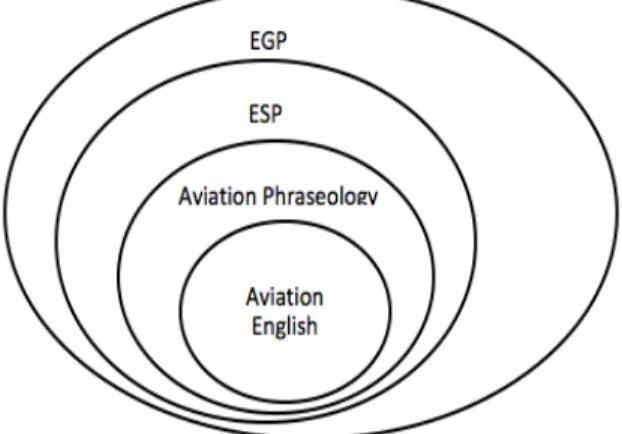
FIGURE 1. Areas of language use in aviation language
DEFINITIONS OF MISCOMMUNICATION
Since this study examines miscommunication in aviation discourse, an understanding of the term is necessary at the outset. To Bremer (1996), a misunderstanding in a conversation refers to any instances during the communication when the listener achieves an interpretation which makes sense to him/her but is not the message intended by the speaker. Mauranen (2006, p. 128) defines misunderstanding simply as “a potential breakdown point in conversation”. She further adds that misunderstanding can occur even without a conversational breakdown. It could be any “communicative turbulence”. According to Simmons (1974), miscommunication in the aviation context refers specifically to any misinterpretation of the instruction by the pilot or controller that is indicated by the absence of readback, or incomplete instruction or readback.
For this study, the term, miscommunication encompasses ideas from the definitions discussed. Miscommunication here is defined as any indication of a misunderstanding in a conversation due to a misinterpretation or non-understanding of the message. This is indicated by verbal or non-verbal clues (such as inappropriate response, request for repeat, absent, wrong or incomplete readback, hesitation and silence) by the responder.
STUDIES ON MISCOMMUNICATION IN PILOT CONTROLLER COMMUNICATION
In the aviation industry, effective communication is vital to ensure expeditious flight operations and safe takeoff and landing. Miscommunication or misunderstanding in pilot-controller communication can lead to loss of human lives. The nature of language and the ways it is interpreted by individual could lead to misunderstanding, even when both pilot and air traffic controller speak English fluently.
saying “I think we need priority” instead of using the standard phraseology for emergency, the first officer of the aircraft thought that the air traffic controller understood the dire situation they were in. This miscommunication led to fatalities (Flight Safety Foundation 2006).
The safety of air travel is often dependent on the efficiency of pilot controller communication as their ability to perform complex tasks without any glitches is pivotal to accident free travel. Although aviation English is described as a simplified language that is free from any ambiguities and vagueness (Morrow et al. 1993, Seiler, 2009), in truth the complexity of aviation English and English itself often pose a challenge for pilots and controllers. Burki-Cohen (1995a)’s study found that an increase in message complexity reduces pilot recall especially when the grouped format was uttered rapidly. Additionally, Morrow et al. (1993) posits that inaccuracies and vague instructions are attributed to various other causes, and not just because of the controller’s message length and complexity. The task characteristics that affect the complexity of the instruction given by the controller is another factor that can contribute to error in read back or even no read back at by the pilot. Cushing (1994) explains the types of communication problems that frequently threaten aviation safety. The three categories are problem of reference, problem of inference and problem of repetition. Barshi (1997) found that human error attributed to communication problem can lead to accidents in aviation. He found that message length affects comprehension, particularly when more components are added into the transmissions but understanding can be improved with practice. Barshi suggests that the controller transmit not more than three aviation topics to native speakers of English to avoid misunderstandings. Through an analysis of errors in pilot readback, Prinzo (1998) discovered that the most common communication problem in aviation occur when the controller’s instruction exceeded the capability of the pilot to memorize all the instructions in one cycle of communication. Also, the most frequent problems with pilot deviation is when pilots fail to follow standard phraseology and communication procedure, and also when they give only partial acknowledgement (Morrow et al. 1993, Prinzo & Morrow 2002).
Cookson (2009), Tajima (2004), Boschen and Jones (2004) and Jones (2003) posit that there is a high occurrence of miscommunication during emergency situations. To Seiler (2009), this suggests that being equipped with aviation English alone is not adequate for successful communication. He believes that plain English is also required as aviation English is insufficient to cater for all eventualities (Seiler 2009). English plays a significant role in pilot-controller communication. Thus, airmen are required to possess a certain proficiency level in English as dictated by ICAO (Krasnicka 2016).
To conclude, the factors in pilot controller transmission that could create problems in understanding are irregularities in the use of aviation English, deviation from standard procedure (such as incomplete readback or no readback), and instructions or requests that are vague or too dense informationally.
METHODOLOGY
SAMPLE POPULATION
be NS or NNS. Since the research used a random selection of pilot controller communication, the controller and pilot for every conversation weres not identified specifically.
DATA COLLECTION
The research data consists of 30 hours of recorded communication from three different frequencies, Alpha, Bravo and Charlie, at two air traffic control centers, KLIA and Subang. Dissimilar frequencies were chosen so that the different phases of the aircraft progression for departure and arrival could be represented. The centers were chosen to capture a wide sample of aviation English. The data had a mix of local and foreign pilots.
RESEARCH PROCEDURE
Approval from Department of Civil Aviation (DCA) had to be obtained before data collection could commence. Due to security concerns, all audio data were selected and transcribed at the centers. The procedure was tedious as the researcher and the DCA officer assigned to the task, listened to the conversation continuously in order to select data that were free from delicate and sensitive content. Once the data were identified, the researcher extracted all related conversations and the transcribing process began. The transcription procedure took several months as it had to be done manually. Transcription softwares available in the market then were unable to transcribe aviation language as it consists of a lot of jargons, bearing, numbers and other abbreviation that cannot be correctly identified by the softwares. The communication was transcribed verbatim using the transcription conventions in Table 1.
TABLE 1. Transcription Convention adapted from Sacks, Schegloff & Jefferson, G. (1998)
(.) A micro pause of less than one second. (2.0) Pause indicated length in seconds.
[ ] Across two or several overlapping turns by different speakers. The bracket indicates beginning and end points of overlap.
] [ Across two turns by different speakers, indicating 2nd turn latched onto the 1st turn without perceptible pause.
: Lengthened sound.
Stress Underlining indicating emphasized syllable or word. ? Question or rising intonation.
(( )) Unclear utterance, transcriber’s best guess. ….. Section of transcript omitted.
Table 2 shows an excerpt of a transcript for this study. For each misunderstanding or non-understanding identified in the transcript, the alphabetical number in the left column represents the frequency (A for frequency Alpha, B for Bravo and C for Charlie) and the number represents the line. The second column identified the speaker, either a pilot or controller. The recording time of the audio data is not included since it unnecessary for the study.
TABLE 2. An excerpt from the transcript
B (66) Controller Red Cap 723(.) taxi holding point runway 33 Uniform 3(.) Uniform 3 Charlie Uniform 4 hold short of Zulu
DATA ANALYSIS
In this study, as explained earlier, misunderstanding refers to any point of breakdown or “communicative turbulence” in a communication indicated by a misunderstanding, or non-understanding of the message. The data analysis started with the identification of these breakdown points which were then categorised into the categories and subcategories presented in Table 3. The table explains each of these categories and an example is provided from the transcript. The categories represent the conceptual framework of the study.
After the categorisation, the frequency of each category was counted manually, tabulated and percentages calculated.
TABLE 3. Types of Communication Problems in Pilot-controller Interaction
Type /Category and sub-category
Definition/Explanation and Example Study
Procedural
Deviation Pilot or controller does not follow recommended communication procedures, He may drop callsign to minimize readback, fail to provide readback acknowledgement or omit the direction of turn.
Example of a pilot dropping callsign
Controller: Malaysian One Two Four turn left heading three two zero
Pilot: Malaysian One Two Four heading three two zero
Prinzo et al. (1995) Morrow, Lee & Rodvold (1993)
Barshi (1997), Howard (2008) Problematic Instruction/Request (Complex, Vague, Incomplete, Inaccurate)
Instruction or request that is incomplete or ambiguous and/or delivered using the wrong intonation. Therefore, the message is not understood.
Problematic instruction/request is often due to message length,message composition, non-routine transaction,
communication medium and/or task factors. The intonation of the message is important to determine the message speech act. .
Example of problem with understanding a request made by the pilot:
Pilot: Malaysian seven one one (.)request orbit, right hand orbit present position
Controller: are you not trying Pilot: Say again?
Cardozi et.al (1998) Burki-Cohen (1995a), Barshi (1997), Howard (2008) Others misarticulation or unclear speech mishearing Bad English
The message is spoken in a manner that makes it unclear possibly due to heavy accent, speech rate (too fast or slow), wrong intonation or pronunciation
Example of instruction with misarticulation:
Controller : thai asia 394, resume own navigation now, direct ((RIGTO))
Pilot : confirm direct to DANDO? Thai asia 394? Controller : thai asia 394, negative direct RIGTO
The real message has not been understood because of issue with listening.
Example of incorrect readback due to mishearing:
Controller : cathay 708, descend fl 270, and for sequencing fly on heading 300
Pilot : turn left heading 300 and descend level 260? Say again cleared level?
Controller : descend fl 270
pilot : descend fl 270, heading 300, cathay 708
Lack of comprehension of the message due to poor English language skills.
Tajima (2004), Cushing (1994), Prinzo, Campbell, Hendrix (2010)
Example of bad English
Pilot : mas 711, request orbit, right hand orbit present position Controller : are you not trying
Pilot : say again?
Controller :are you coming for: , do you want to continue orbit or you want to make a try for 32L?
FINDINGS AND DISCUSSION
The frequency distribution of miscommunications will be presented first for an overview. The causes will be discussed next by examining specific examples.
OVERALL FREQUENCY DISTRIBUTION OF THE CAUSES OF MISCOMMUNICATION
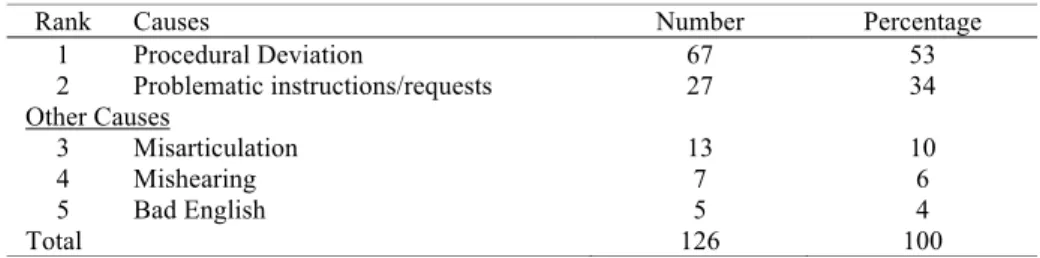
Overall, there are three categories of communication errors that occurred in all the three frequencies (Alpha, Bravo and Charlie) as presented in Table 4. There are a total of 126 instances of miscommunications recorded in the 30 hours’ audio data. 53% (n = 67) of the miscommunications are due to procedural deviation, which ranked the highest, while problematic instructions/requests represent 27% (n = 34) of the errors. 20% (n = 25) of the miscommunications are caused by other factors (13(10%) are due to misarticulation and hesitation, 7 (6%) mishearing and 5 (4%) bad English).
TABLE 4. Frequency distribution of factors that cause miscommunication (Overall)
Rank Causes Number Percentage
1 Procedural Deviation 67 53
2 Problematic instructions/requests 27 34
Other Causes
3 Misarticulation 13 10
4 Mishearing 7 6
5 Bad English 5 4
Total 126 100
FREQUENCY DISTRIBUTION OF CAUSES OF MISCOMMUNICATION FOR ALPHA, BRAVO AND CHARLIE
In this subsection, the causes of miscommunication in the three different frequencies are discussed individually and then compared across frequencies and with the overall figures.
Frequency Alpha is used by high altitude aircrafts for intentions such as aircraft on climb after departure, aircraft on descend for landing and overfly aircraft (aircraft that is temporarily passing the airspace). The distribution of communication errors for frequency Alpha is shown in Table 5. A total of 72 miscommunication errors are recorded and 54% (n = 39) of the errors are caused by procedural deviation, 25% (n = 18) problematic instruction/request and 21% (n =15) other errors respectively.
TABLE 5. Frequency Distribution of Communication Errors for Frequency Alpha
Rank Causes Total %
1. Procedural Deviation 39 54
2. Problematic instruction/ request 18 25
3. Others 15 21
Total 72 100
for frequency Bravo is shown in Table 6. Out of a total number of 45 miscommunications (100%), procedural deviation ranked the highest at 49% (n = 22), followed by problematic instruction /request (31%, n = 14) and others (20%, n = 9).
TABLE 6. Frequency Distribution of Causes of Miscommunication for Frequency Bravo
Rank Causes Total %
1. Procedural Deviation 22 49
2. Problematic instruction/ request 14 31
3. Others 9 20
Total 45 100
Frequency Charlie is used by aircrafts during the phase of landing and during take-off before changing to a different frequency. The number of communication errors in Charlie is shown in Table 7. 67% (n = 6) of the errors were caused by problematic instruction /request followed by procedural deviation (22%, n = 2) and others.
TABLE 7. Frequency Distribution of Causes of Miscommunication for Frequency Charlie
Rank Causes Total %
2 Procedural Deviation 2 22
1 Problematic instruction/ request 6 67
3 Others 1 11
Total 9 100
When compared across the frequencies, the frequency distributions of Alpha and Bravo are quite similar. The ranking of the causes are the same. Most miscommunications are attributed to procedural deviation followed by problematic instruction or request. The other factors are ranked at the bottom. This ranking is the same as the overall ranking. The percentage of miscommunications due to procedural deviation is slightly more for Alpha at 54% than for Bravo at 49%. There is a higher percentage of miscommunication due to problematic instruction or request for Bravo (31%) compared to Alpha (25%) whereas for both frequencies, other factors account for almost similar percentage of miscommunications, 21% (Alpha) and 20% (Bravo).
The ranking of the frequency distribution for Charlie, however, differs from Alpha and Bravo. For Charlie, t most instances of miscommunication relate to problematic instruction or request at 67%, the highest percentage across the frequencies. Unlike Alpha and Bravo, procedural deviation is at a relative low 22% while there is only one instance of misunderstanding due to other causes.
EXAMPLES OF CAUSES OF MISCOMMUNICATION
This sectionwill discuss each cause of miscommunications qualitatively by drawing from a few examples from the pilot-controller interactions.
PROCEDURAL DEVIATION
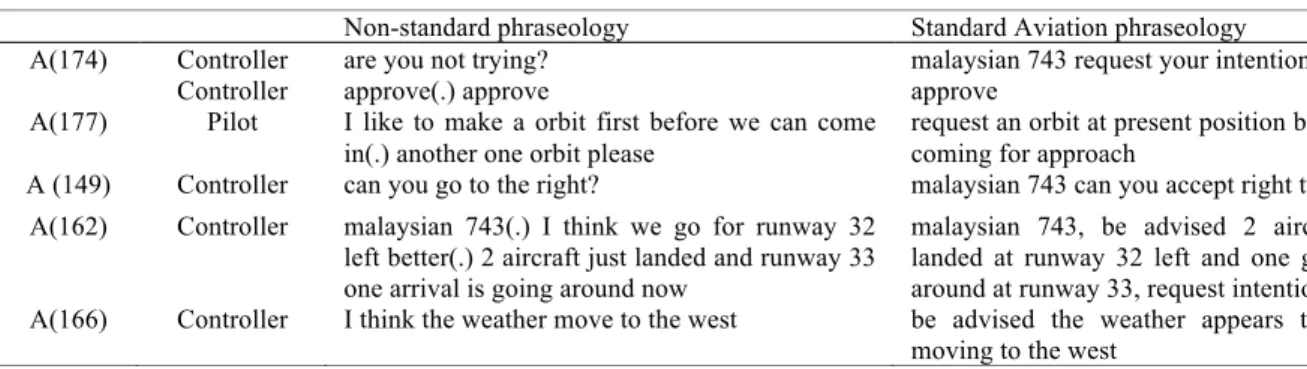
As the largest number of miscommunications are caused by procedural deviation, this suggests that pilots and controllers have difficulties keeping to standard phraseology and protocol when engaging in routine interaction. There is a tendency to revert to plain English. Table 8 below presents a few examples of non-standard phraseology from frequency Alpha and the standard phraseology that should have been used. For example, the controller from A(174) asks the pilot, “are you not trying?” when he should have said “malaysian 743 request your intention”. Similarly, in A149, the controller asks “can you go to the right?” instead of “malaysian 743 can you accept right turn?” It is possible both controllers are not comfortable using the standard phraseology, therefore they lapse into the non-standard question.
In A159, the controller gives clearance by saying, “approve (.) approve” when he only has to say “approve” once. He repeats the word twice, probability for emphasis, but the standard use is just to say ‘approve” once for clearance. By saying it twice, the controller might momentarily throw off the pilot making him wonder as to the implied meaning behind the repetition.
The controller (A162) uses “I think …. we go for runway 32 left better(.)” when giving instruction instead of the standard manner. This could create confusion as it seems to suggest that the controller is just giving his opinion and that what he says is not definitive. Also in the message, the controller gives his option first before informing about the situation on the runway. By right, the situation should be relayed first before suggesting action.
The controller in A(166) uses poor English to relay information about the weather. What he says, “I think the weather move to the west” is non-standard English. Instead, he should say, “be advised the weather appears to be moving to the west.”
The examples that have been discussed are uttered by controllers. Example A(177) is uttered by a pilot. Here, the pilot makes a request in a colloquial manner by saying, “I like to make …” when he should state emphatically “request ….”. He also repeats his request by saying casually, “another one orbit please”.
These errors illustrated are made possibly due to the lack of familiarity with the standard aviation phraseology which might sound awkward and pretentious to these aviation officials since it is more formal. They lapse into speaking the local variety of English as the controllers are all local and NNSs. It is therefore unsurprisingly that there should be regresses in the use of aviation English.
TABLE 8. Examples of Procedural Deviation by Pilot and Controller
Non-standard phraseology Standard Aviation phraseology A(174) Controller are you not trying? malaysian 743 request your intention
A(157)
Controller approve(.) approve approve
A(177) Pilot I like to make a orbit first before we can come in(.) another one orbit please
request an orbit at present position before coming for approach
A (149) Controller can you go to the right? malaysian 743 can you accept right turn? A(162) Controller malaysian 743(.) I think we go for runway 32
left better(.) 2 aircraft just landed and runway 33 one arrival is going around now
malaysian 743, be advised 2 aircrafts landed at runway 32 left and one going around at runway 33, request intention? A(166) Controller I think the weather move to the west be advised the weather appears to be
PROBLEMATIC INSTRUCTION/ REQUEST
The second source of miscommunications is problematic instruction or request. In the current data, most problematic instruction or request is incomplete, meaning that aviation detail is missing. Three excerpts will be used to illustrate this.
In excerpt 1 below, an aircraft is requesting for a specific heading to avoid bad weather condition.
Excerpt 1
A(119) pilot fireflies 3556 request to maintain heading due weather A(120) Controller fireflies 3556 say again?
A(121) pilot request to maintain heading 290 to avoid weather A(122) controller heading approve
A(123) pilot fireflies 3556
In line A(119), the pilot requests to maintain his current heading. However, the absence of specific heading in the request prompted the controller to request the pilot to repeat his request (line A(120)). In line A(121), the pilot drops the aircraft call sign and included the “heading 290” in the request. The controller drops call sign in the instruction in line A(122). Here, the controller assumes that the instruction is sufficient. Obviously, both are of the opinion that it is unnecessary to repeat the call sign as the conversation is continuous, without any interruption from other aircrafts. In this case, the transmission could be concluded swiftly if complete information is provided in the request from the pilot atthe beginning.
In excerpt 2, an aircraft is on descend for landing.
Excerpt 2
A(134) controller malaysian 367(.) continue descend 9,000 feet QNH 1007(.) expedite through flight level 130
A(135) pilot 9,000 feet(.) expedite malaysian 367 A(136) controller affirm(.) expedite through fl130(.) thanks A(137) pilot expedite flight level 130(.) wildo malaysian 367
In line A (134), the controller provides a descent clearance to “9000 feet” and a requirement for the aircraft to expedite on passing “flight level 130”. However, the pilot delivers only partial readback in A(135) which raised doubt as to whether the requirement to expedite passing on flight level 130 has been understood by the pilot. Hence, in line A(136), the controller emphasizes the requirements followed by “thanks”. In final response, the pilot’s readback in A137 is correct. This illustrates incomplete readback creating a glitch in the exchange.
Excerpt 3 is a communication between a pilot and controller during strong gusting wind that requires the aircraft to hold at approach position.
Excerpt 3
A(173) Pilot malaysian 711(.)request orbit, right hand orbit present position A(174) Controller are you not trying
A(175) Pilot say again?
A(176) Controller are you coming for: (.) do you want to continue orbit or you want to make a try for 32 left?
A(177) Pilot gusting wind is 32 knots(.) I like to make a orbit first before we can come in(.) another one orbit please
A(178) Controller ok(.) ok(.) continue
“are you not trying”. This question clearly baffles the pilot who asks for a repeat of the controller’s transmission. This could be considered as a misunderstanding of the pilot’s request. However, in line A(176), the controller realises that the pilot might want to orbit first rather than to attempt an approach and therefore asks him what he wants to do. In his answer in line A(177), the pilot feels compelled to explain why the aircraft will continue holding (gusting wind) rather than to attempt a landing. The controller closes with a non-standard phraseology and incomplete instruction.
Problem arising from instructions and requests here appear to be attributed mostly to incomplete detail or vague instruction/request than to other reasons. Aside from this it was observed that some controllers have poor intonation and speech pattern when delivering instructions. This often leads to ambiguity, and pilots become uncertain of the intended speech act. Furthermore, it was found that there are more problematic instructions and requests under non-routine condition (such as unpredictable traffic condition due to bad weather or equipment failure) which concurs with findings by Howard (2008) and Corradini and Cacciari (2002).
OTHER CAUSES
Besides the two main causes of miscommunication, there are other causes such as mishearing, mispronunciation, prosody and misarticulation (mumbling/unclear) which distort the instructions or request made. A distinction need to be made between the causes here and problematic instruction/request. Instruction or request are categorised as problematic if there is sometime inherently wrong with the instruction or request. External factors that distort the instruction or request are all categorised under Others, and subclassified accordingly.
Excerpt 4 illustrates a miscommunication due to misunderstanding of the instruction. The conversation is regarding the direction of the aircraft.
Excerpt 4
A(103) Controller singapore 319(.)request your heading to bobag? A(104) Pilot present position direct bobag confirm? A(105) Controller singapore 319(.)requestyour heading to bobag? A(106) Pilot singapore 319?
A(107) Controller your heading to bobag sir
A(108) Pilot I don’t understand your question(.)singapore 319 A(109) Controller singapore 319(.)request heading to bobag? A(110) Pilot Heading 200(.)singapore 319
A(111) Controller singapore 319(.)roger(.)direct to bobag
In line A (103) the controller requests for the aircraft’s heading for “bobag”. The pilot misunderstands the controller’s request and assumes that the aircraft has been instructed to track for “bobag” and request a confirmation from the controller (A104). Subsequently, in line A(105), the controller repeats the request but he stresses on the phrase, “your heading to bobag?”. Finally, the pilot understands the request. In line A (106), the pilot uses a rising intonation to indicate that he wants to confirm the callsign and the controller again in line A (107) repeats the same request as in line A (103) and A(105). However, the pilot still fails to understand the request as indicated in A(108). The controller continues to ask for the same information but he now drops “your” and just says, “request heading to bobag?”. The pilot finally understands and provides the heading number and replies accordingly. Line A(111) the controller clears the aircraft direct to “bobag”. The pilot is unable to understand the controller request due to the mismatchin the schema in the instruction. The pilot is unfamiliar with the term “your heading” as the standard phraseology is “request heading”.
on the part of the pilot who cannot comprehend non-standard aviation usage no matter how minor.
In the next example, excerpt 5, the controller and the pilot both have misunderstood the taxi clearance and taxi instruction.
Excerpt 5
B(135) Pilot Ground(.)malindo 223 B(136) Controller malindo 223(.)go ahead
B(137) Pilot Go ahead with the taxi clearance again B(138) Controller Confirm you are not ready for taxi? B(139) Controller malindo 223(.)are you ready for taxi out? B(140) Pilot That is affirmative(.)malindo 223
B(141) Controller malindo 223(.)taxi holding point runway 33 and taxi clearance has been issued earlier, continue
B(142) Pilot Via ((Zulu)) (.)standard route malindo 223 B(143) Controller malindo 223(.)contact tower 118.9: 119.8
In B(137), the pilot requests for a taxi clearance and uses the word “again” which indicates the pilot is aware that clearance has been given previously and perhaps the pilot has failed to copy the clearance and asks for taxi clearance again (B137). In B(138), the controller requests for a confirmation whether the pilot is not ready for taxi, misunderstanding his request. Instead, he asks again in B (139) if the pilot is ready for taxi. The pilot confirms in B(140). In line B(141) the controller gives taxi instruction and remarks that the taxi clearance has been given earlier. In line B(142), the unintelligible “zulu’ is followed by readback standard route for taxi clearance after which the controller transfers the communication to a different frequency (B143).
In sum, the pilot’s requests for a taxi clearance again after it has been already been given. He obviously has failed to catch it the first time. Clearance is crucial in pilot-controller communication and the controller is obliged to give the requested information. The miscommunication here could be seen as the controller’s inability to understand that the pilot is actually requesting for a repeat of the clearance. This miscommunication could be said to stem from misinterpretation of the request from the pilot in line B(137).
Other factors that occurred occasionally are mispronunciation of words, unique intonation pattern, addition of pronoun in instruction and poor radio discipline. Often unfamiliar words are mispronounced or pronounced based on Malay phonetics and could be problematic to the receiver of the message. Unfamiliar intonation pattern could create momentary non-understanding. Also, there is a tendency to use pronouns when instructing aircraft such as “your”, “I”, “we”, “you” which only exist rarely in standard phraseology. This additional word in instruction or request, causes confusion and makes the receiver thinks that he might have misheard the message. Nevertheless, such hitches are easily negotiated and rarely repaired as both could understand the intention of the other due to their shared context.
CONCLUSION & RECOMMENDATIONS
Another factor leading to miscommunication is unclear instructions (usually from the controller) or unclear requests (usually from the pilot). One of the reasons for this is again the insistence on using plain English instead of the standard phraseology even in cases where there is no necessity to do so. In situation, when longer or more complex structures are involved, pilots and controllers also tend to use non-standard forms that are often influenced by the local variety of English, as well as their first language. It is also found there were more problematic instructions during heavy traffic and bad weather conditions where tension is high in the control tower. This finding supports Corradini and Cacciari (2002), and Estival and Molesworth (2011)’s results. Under these conditions, there is more likelihood to backslide to plain English.
An analysis of the causes of misunderstanding revealed that although most controllers and pilots are competent at relaying information and taking instruction, their language proficiency could be further enhanced so that they could better cope with the linguistic demands of their job particularly during extenuating circumstances as this is when more lapses occurred. Interestingly, Tajima (2004), Bochen and Jones (2004) and Jones (2003) also found that NNS pilots and controllers who are less proficient often cause misunderstandings due to their limited lexicon and comprehension under these situations. Standard aviation phraseology should be used at all times during transmission, and this has to be repeatedly impressed upon. Prinzo et al (2010) make a similar exertion. They too believe that NNS pilot and controllers should limit their use of plain English to minimize miscommunications. Those who regularly revert to plain English should be sent for refresher course.
Similarly, good radio practice should also be mandatory. Practices like providing full readback from pilot is often overlooked by the controller and regarded as unwieldy and unnecessary. The purpose of readback is to detect any miscommunications and failure to provide full readback displays poor radio discipline and could lead to safety issues.
With proper attention to these aspects in the training of air controllers and pilots, it is hoped that interaction would be more concise, precise and efficient.
FURTHER RESEARCH
The current study has provided some insights into aviation discourse in a NNS context. The researchers believe the data could be further explored. For further studies, it is recommended that an indepth look at each of the two main sources of misunderstandings uncovered in this study be carried out. The categories are too broad and could be further sub-categorised but it is not within the scope of the study to delve into this. Also, a study of procedural deviation in aviation discourse with the aim of coming up with a typology of deviations in aviation English could be useful for local trainers and material developers. Researchers could investigate the communication strategies (see methodology used by Manzano, 2018), and attitudes and motivation to study aviation English of controllers who regress into plain English (see Quinto (2015)’s study on attitude and motivation to study a working language).
ACKNOWLEDGEMENT
The authors would like to thank Civil Aviation Authority of Malaysia for its support and for providing the data for this research.
REFERENCES
Alderson, J. C. (2009). Air safety, language assessment policy and policy implementation: the case of aviation English, 168–187.
Barshi, I. (1997). Effects of linguistic properties and message length on misunderstandings in aviation communication (Doctoral dissertation). Available from ProQuest Dissertations & Theses Global. (Dissertation No. 9812849)
Boschen, A. C. & Jones, R. K. (2004). Aviation language problem: improving pilot-controller communication.
International Professional Communication Conference, 2004. IPCC 2004.Proceedings,291–299. Bremer, K. (1996). Causes of understanding problem. In Zhu Hua (Eds.). Exploring Intercultural
Communication. London & New York: Routledge.
Breul, C. (2013). Language in aviation : The relevance of linguistics and relevance theory. LSP Journal. 4(1), 71–86.
Bürki-Cohen, J. (1995a). Say again? How complexity and format of air traffic control instructions affect pilot recall. Proceedings from 40th Annual Air Traffic Control Association Conference. Las Vegas, NV. Burki-Cohen, J. (1995b). An analysis of tower ground) controller- pilot voice communications. Cambridge:
John A. Volpe National Transportation Systems Center.
Cardosi, K.M., Falzarano, P. & Han, S. (1998). Pilot-controller communication errors: An analysis of Aviation Safety Reporting System (ASRS) reports (DOT/FAA/AR-98/17). Washington, D.C.: FAA Office of Research and Development.
Carey, M. D., Mannell, R. H. & Dunn, P. K. (2011). Does a rater’s familiarity with a candidate’s pronunciation affect the rating in oral proficiency interviews? Language Testing. 28(2), 201–219.
Cookson, S. (2009). Zagreb and Tenerife: Airline accidents involving linguistic factors. Australian Review of Applied Linguistics. 32(3),22.1-22.14.
Corradini, P. & Cacciari, C. (2002). The Effect of Workload and Workshift on Air Traffic Control: A Taxonomy of Communicative Problems. Cognition, Technology & Work. 4, 229-239.
Cushing, S.(1994). Fatal words: communication clashes and aircraft crashes. Chicago : University of Chicago Press.
Cushing, S.(1995). Pilot – Air Traffic Control Communications : It’s Not (Only) What You Say, It’s How You Say It. Flight Safety Digest. 14(7),1-10.
Douglas, D. (2014). Nobody seems to speak English here today: Enhancing assessment and training in aviation English. Iranian Journal of Language Teaching Research. 2(2), 1-12.Retrieved from www.urmia.ac.ir/ijltr
Er, M. & Kırkgöz, Y. (2018). Introducing innovation into an ESP Program: Aviation English for cadets. In Y. Kırkgöz, K. Dikilitaş (Eds.). Key Issues in English for Specific Purposes in Higher Education (pp.179-199). English Language Education, vol 11. Cham: Springer.
Estival, D. & Molesworth, B. (2011). Radio Miscommunication: EL2 Pilots in the Australian General Aviation Environment. Linguistics and the Human Sciences. 5, 351-379.
Estival, D. & Molesworth, B. (2009).A study of EL2 pilots’ radio communication in the General Aviation environment. Australian Review of Applied Linguistics. 32(3), 24.1-24.16.
Farris, C. (2007). The Effects of Message Length, L2 Proficiency and Cognitive Workload on Performance Accuracy and Speech Production in a Simulated Pilot Navigation Task.(Master thesis). Concordia University, Montreal, retrieved from Spectrum.
Flight Safety Foundation. (2006). Flight Safety Digest January-February 2006. Retrieved January 24, 2016 from https://flightsafety.org/fsd/fsd_jan-feb06.pdf
Howard, J. W. (2008). Tower, am I cleared to land?: Problematic communication in aviation discourse. Human Communication Research. 34(1991),370-391.
Huhta, A. (2009). An analysis of the quality of English testing for aviation purposes in Finland. Australian Review of Applied Linguistics. 32(3), 26.1-26.14.
Jones, R.K. (2003). Miscommunication between pilots and air traffic control. Language Problems & Language Planning. 27(3), 233-248.
Kraśnicka, I. (2016). English with Flying Colors: The Aviation English and the International Civil Aviation Organization. Studies in Logic, Grammar and Rhetoric. 45(1), 111-124.
Kim, H. & Elder, C. (2009).Understanding aviation English as a lingua franca. Australian Review of Applied Linguistics. 32(3), 23.1-23.17.
Kim, H. & Elder, C. (2015).Interrogating the construct of aviation English: Feedback from test takers in Korea.
Language Testing. 32(2), 129-149.
Mauranen, A. (2006). Signaling and preventing misunderstanding in English as lingua franca communication.
International Journal of The Sociology of Language. 123-150.
Mitsutomi, M. & O’Brien, K. (2003).The critical components of aviation English. International Journal of Applied Aviation Studies. 3(1),117-129.
Molesworth, B. R. C. & Estival, D. (2015). Miscommunication in general aviation: The influence of external factors on communication errors. Safety Science. 73, 73-79.
Morrow, D., Lee, A. & Rodvold, M. (1993). Analysis of Problems in Routine Controller-Pilot Communication.The International Journal of Aviation Psychology. 3(4),285–302.
Morrow, D. G. & Prinzo, O. V. (1999). Improving pilot/ATC voice communication in general aviation. Washington, D.C.: FAA Office of Aviation Medicine. (NITS No.DOT/FAA/AM-99/21).
Paramasivam, S. (2013). Materials development for speaking skills in Aviation English for Malaysian air traffic controllers: Theory and practice. Journal of Teaching English for Specific and Academic Purposes. 1(2), 97-122.
Prinzo, O. V. (1998). An analysis of voice communication in a simulated approach control environment. Oklahoma City, OK: FAA Civil Aeromedical Institute (NITS No. DOT/FAA/AM-97/17). Prinzo, O. V., Britton, T. W. & Hendrix , A. M. (1995). Development of a Coding Form for Approach Control Pilot Voice Communications. Office of Aviation Medicine Washington, D.C.: Federal Aviation Administration.
Prinzo, O. V. & Morrow, D. G. (2002). Improving pilot/air traffic control voice communication in general aviation. International Journal of Aviation Psychology. 12(4), 341-357.
Prinzo, O.V., Campbell, A., Hendrix, A.M. & Hendrix, R. (2010). U.S. Airline Transport Pilot International Flight Language Experiences, Report 4: Non-Native English-Speaking Controllers Communicating With Native English-Speaking Pilots .DOT/FAA/AM-06/25.
Quinto, E.J.M. (2015). Attitude and Motivation towards a Working Language: Case of East Timorese Students in the Philippines. 3L: The Southeast Asian Journal of English Language Studies. 21(1),1-12.
Ragan, P. (1997). Aviation English: an introduction. Journal of Aviation/Aerospace Education & Research. 7(2), 25-36.
Seiler, W. (2009). English as a lingua franca in aviation. English Today. 25, 43-48.
Simmons, J. L. (1974). Efficient Conversation: The Talk between Pilots and Air Traffic Controllers. Retrieved January 24, 2016 from https://files.eric.ed.gov/fulltext/ED088296.pdf
Tajima, A. (2004). Fatal miscommunication: English in aviation safety. World Englishes. 23(3), 451-470. Tiewtrakul, T. & Fletcher, S. R. (2010). The challenge of regional accents for aviation English language
proficiency standards: a study of difficulties in understanding in air traffic control-pilot communications. Ergonomics. 53(2), 229-239.