Corresponding Author: Syed Azuan Syed Ahmad, IPN EDUCATION GROUP, 40300, Shah Alam,Malaysia, 018-2189487
International Journal of Business and Management 1 (1): 01-05, 2017 e-ISSN 2590-3721
© RMP Publications, 2017
Culture and Lean Manufacturing: Towards a Holistic Framework
Syed Azuan Syed Ahmad
IPN Education Group, 40300 Shah Alam, Selangor, Malaysia
Abstract: Lean manufacturing is management approach that developed with a strong focus on the reducing waste. The awareness that lean manufacturing requires a holistic approach especially since culture is often considered a key element in lean manufacturing practice. Currently too much attention is focused wrongly on the technical aspects and tools and techniques rather than the ability to create a right culture to support the lean transformation. Therefore, the purpose of this paper is to provide an overview of existing research on culture in lean manufacturing. Review of the literature provides evidence that culture is still widely researched in lean manufacturing. A framework on the role of culture in lean manufacturing is also provided in this paper.
Key words: Lean manufacturing, culture, lean culture
INTRODUCTION
In this current business world where is no boundary and challenging, lean manufacturing has brought changes in management practices to enhance customer satisfaction and organizational effectiveness and efficiency [1]. Industry is now more concerned about customer satisfaction because they are now more options than ever before. Customers are demanding choice of goods at lower cost but with a quick delivery. They also expect more innovative products at competitive prices, where the customer has more opportunities to choose from a variety of options.The main purpose of the use of lean manufacturing is to increase productivity, improve product quality and manufacturing cycle time, reduce inventory, reduce lead time and eliminate manufacturing waste. In a lean system, an attempt is made to eliminate waste through continuous improvement processes across the value chain within the organization. Once adopted lean manufacturing mindset among employees, it facilitates achievement of continuous product flow through the restructuring of the physical and control mechanisms.
However, in reality, many organizations are unable to change themselves toward lean manufacturing. Transformation towards the lean manufacturing is full with challenges and obstacle. Transformations are not easily accomplished and there is evidence that not all companies are successful in their lean manufacturing transformation. In fact, according to some estimates, this rate is as low as 2 percent [2]. Lean manufacturing should be implemented in a
comprehensive and holistic in scope and content [3]. Many researchers have argued that the transition from traditional to lean manufacturing requires a cultural change within the organization rather change the manufacturing or technical issues [4][5]. Lean manufacturing transformation usually involves a radical change in terms of structure, strategy and technical organizations [6]. Understanding in dealing with these changes needed to ensure the successful of lean manufacturing. Organizations have little chance to implement lean manufacturing unless they have paid at least the same attention to creating the right culture, and the terms and conditions that may become the basis for implementing the change.
Therefore, it is reasonable to suggest that the implementation of lean manufacturing will completely change the culture of organization [7]. In fact, it may be that the difficulty in implementing lean is not in the techniques but in the cultural changes. If true, this assumption would mean the success of any other organization pursuing lean transformation depends not merely on applying the tools and techniques; to derive the sustained benefits from these tools and techniques the required culture that supports lean must be established [8][9][10]. However, no empirical studies have investigated the role of culture in the success with lean transformation [11].
regarding its role in lean manufacturing implementation.
LITERATURE REVIEW
Organizational can invest a lot of time and money in lean efforts but if people eventually go back to their old ways the gain won’t be sustained over time, and improvement fails. To truly transform into lean manufacturing the company culture must be addressed. Culture is not an ambiguous term it is a key for improvement. Lean manufacturing is rooted in the Japanese culture so that implementation of lean manufacturing involves organizational culture change. To implement lean in other countries is difficult because the societal culture differences make the organizational culture change more extreme. All societal cultures are unique. Therefore, issues in organizational culture change will be unique among each country [6]. According to Lacksonen [6], a search of the Science Direct Academic electronic database yielded surprisingly no studies relating societal culture to lean production between 1990 and 2009. A study made by [12] suggest that each of these regions has unique societal and organizational cultures, and successful implementation of lean will require a unique blend of Japanese corporate culture with their societal and organizational culture. In this point of view, understanding societal cultural differences is crucial.
Organizational culture and national culture cannot be kept separate in lean transformation. During implementation of lean manufacturing, there is the need for cultural adaptation [3]. That why during the process of being lean due to their different national or organizational cultures, enterprises of nations who intend to put through a lean manufacturing system in their organizations appear to have various culturally adaptive mechanisms [13]. Wong [3] in her research found that national culture has a significant impact during the process of lean manufacturing system implementation in Taiwanese enterprises.
Philip [4] mentioned that lean cannot exist in an organization where the culture against it, and the organizational culture determines the success of lean or any other change initiative. It is therefore reasonable to suggest that the implementation of lean manufacturing will be transformative and completely change the culture of an organization [7]. Actually the transformation towards lean manufacturing is filled with formidable challenges, most particularly to understand the real essence of lean manufacturing concept and philosophy, and also to deal with the cultural differences issues either national or organisational [14]. Some researcher identified the reason of this misunderstanding is due to cultural differences that
occurs during transition or translation of lean manufacturing [15].
Lean is about people in the organization so that the culture must reside in hands, hearts, and minds of the staff of the business. In order to transform from non-lean to lean change want to be made is not just a technical –rational process. It is a behavioral, emotional and political process need to be concern [4]. Dahlgaard [5] suggest that to have success with TQM, six sigma quality and lean production requires a company culture where everybody is proactively working in reducing waste and in helping each partner. Everybody must understand that his/her contribution is essential for the team in which he/she is a member and for the customer. The most difficult part in managing organization is the human factor. Current situation is where too little focus on understanding the human factor. Attention should be given on how to build the right company culture – a culture where people’s basic needs are both understood and respected. It should also balance up mental, spiritual and balancing people core value and core competencies.
Mann [16] suggested that it is acceptable to start with the physical changes to production, but management systems and cultural dynamics must be changed at the same time. The best way to allow for this on-going transformation is to build a complete lean culture. This can be done by identify current cultural model and close the gap in order to create ideal future cultural state. The organizational must build the process improvement culture by establish a practice leadership involvement and continually engage rapid improvement events.
A lean manufacturing philosophy requires that respect for people, continuous improvement, a long-term view, a level of patience, a focus on process, and ability to understand where the individual is in his or her development, concepts, which seem alien to Western culture [8]. Liker [8] has spent twenty years understanding Toyota Production system, and has identified two pillars and 14 principles of Toyota Production system. The two pillars of Toyota Production system are continuous improvements (Kaizen) and respect for people. The famous tools of the Toyota Production System are all designed around making it easy to see problems, easy to solve problems, and easy to learn from mistakes. To make it easy to learn from mistakes means changing our attitude towards them. That is lean cultural shift.
finding stated that the difficulty in implementing lean is not in the techniques but in the cultural changes. Thus, studying the nature of true lean culture is a complex and time-consuming process. In addition culture is the main pillar when implementing lean manufacturing. A supportive culture that brings the employees to work, communicate and grow together is essential to make the initiative successful [17]
Knowledge of the role of Toyota’s history and practices is important to understand the role of organizational culture for successful lean transformations [11]. Toyota believes they have the obligation to teach, train, nurture, guide and mentor people. Toyota’s culture can also be described as a mutual understanding between people and the work they perform. The experiences of many companies engaged in lean transformations reveal that they are not successful in sustaining the improvements. One possible reason is the excessive emphasis on the hard-side – the tools and techniques – without focusing as much on the cultural changes needed.
An examination of the Toyota Way (2001) philosophy of Toyota, the benchmark company for lean implementation, shows the continued and equal emphasis on both the hard- and soft-sides. It was difficult to establish if there was a set of values that must be benchmarked by companies as “ideal” to ensure success with their lean transformations. The Toyota Way being the underlying fabric (“soft-side”) and the Toyota Production System being the operational tools and techniques (“hard-side”) that the company practices religiously, it is plausible to assume that success has come from applying both of these aspects concurrently and cohesively [9].
Culture is the way we automatically think and act every day. This culture has become second nature to those of us who have spent decades with Toyota, but it is a mystery to most outsiders [9]. Another distinguishing feature of Toyota’s culture is emphasis on entrusting workers with greater responsibility and authority to make changes in their work [18]. Thus, Toyota’s human system is the most complicated, most powerful, most resourceful and the most difficult element in Toyota Production System. Although it is popular to share the view that people are the most important asset of a company and what differentiates Toyota from its rivals is its view of the factory worker as a knowledge worker” [9].
METHODOLOGY AND FRAMEWORK
The critical element of lean manufacturing discussed by many recent literatures is the culture that supports the lean manufacturing [19][20]. Based on the above literatures' most research linking culture with Japanese culture, organizational culture, adaptive culture, behaviour,
mindset, understanding human role, cultural change, respect the people, continuous improvement, team work, long-term view, the Toyota Way and the Toyota Production System. None of them discussed Toyota culture and Lean culture in depth. Most of the industry that turns into a lean manufacturing tends to the use of lean tools and technique rather than concentrate human factor aspect. Understanding of the Toyota culture and the lean culture must be understood first as the use of the tool and technique is not enough. Toyota culture is about human systems in Toyota. The famous Toyota Way is basically about culture. The cause of the failure of many industries during lean transformation even using the proposed technique in the model Toyota Way 2001 is because they were leaving of the people aspects. From the time Toyota first started its operation, the leaders believed that the key to success was investment in people. People are the heart and soul of the Toyota way. The Toyota culture has evolved since the company founding and is the core competence of the company. In Toyota Way 2001, at the top level are the two pillars, continuous improvement and respect for people. Respect for people is a broad commitment. In means respect for all people touched by Toyota including the employees, customers, investors, suppliers, dealers, the communities in which Toyota has operations and society at large. Another pillar is continuous improvement is defined as, “we are never satisfied with where we are and always improve our business by putting forth our best ideas and efforts”.
Developing and sustaining a lean manufacturing is 20% technical and 80% cultural [9]. A lean culture is where all employee participating in activities to reduce business waste. The definition of a lean culture probably varies by company and is dependent upon how they define lean. A lean culture should consists of the beliefs and behaviours characteristic of employees that understand their company goal and objective are, why they are important, understand the purposes of lean improvements, have had the necessary lean tools and techniques and are then given reasonably free hand to do so an on-going basis. Companies that have successfully create a lean culture consistently realize: more innovative, team-directed solutions , lower employee turnover, better success at sustaining improvements and greater numbers of improvement actions.
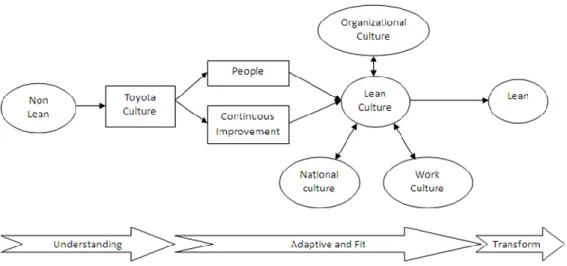
human factor, continuous improvement is also important element and cannot be ignored. Under this framework, the general assumption is that lean culture play the important role in the successful implementing lean manufacturing. Hence, there are at least three possibilities will occur in this framework: by having a lean culture it will make lean manufacturing transformation successfully,
will make lean manufacturing transformation not successfully and by not having a lean culture the lean manufacturing can successfully transform.
Fig. 1: Lean Culture Framework
From figure 1, before any industry wants to implement lean manufacturing the first thing they should do is to understand Toyota Culture. Why Toyota Culture? Toyota has successfully implemented this manufacturing philosophy and the word lean basically create based on the Toyota Production system. Toyota achievement can be used as a benchmark and reference. This doesn’t mean that industry needs to copy and used it without any adjustment toward their company need. Toyota achievement toward lean is their commitment to the people and continuous achievement. People is very important because at the end of the day they are the one move this manufacturing philosophy. The word respect for people is something touch the motivation to make this implementing on the right track. Lean is not just a tool, is more than that. Besides people factor, continuous improvement must be applied in day to day operation.
Without this mindset, it won’t move the lean manufacturing across the industry. This two-element need to be an important factor or two-element in creating lean culture. Besides that the industry must put in or specified other elements based on the current situation in their industry.
Organizational culture, national culture and work culture need to fit with lean culture so that only one culture drive the lean transformation.
CONCLUSION
Many manufacturing companies when implementing lean manufacturing, they only emphasize lean tools and techniques. They ignored the human factor or more specific failed to build the right culture. Hence, these companies could not obtain the full benefits of lean manufacturing implementation, and in fact, they are having difficulties sustaining the success attained. This paper provides a theoretical framework for lean culture. This framework builds on the literature review that involves major sources of lean manufacturing community, journals and conferences. The literature review mostly dealt with the qualitative research considering the importance of culture in lean manufacturing. This research confirmed the need for further study to prove the validity of cultural role in influencing lean transformation. This paper also calls for more awareness of culture in lean manufacturing research.
REFERENCES
[1] Karim, S., 2009. The Impact of Just-in-Time Production Practices on Organizational Performance in the Garmentsand Textiles
[2] Ransom, C.F., 2001. Lean manufacturing: fat cash flow. Target, 17(4): 6-7.
[3] Wong, M., 2007. The role of culture in implementing lean production system. In J. Olhager& F. Persson (Eds.), IFIP International Federation for Information Processing, 246 : 413-422. Boston: Springer.
[4] Philip, A., 2010. Lean is a Cultural Issue. Management Services, 54 (2): 35.
[5] Dahlgaard, J. J and S. M. Park, 2006. Lean production, six sigma quality, TQM and company culture. The TQM Magazine, 18(3) : 263-281.
[6] Lacksonen, T., B. Rathinam, F. Pakdil and D. Gülel, 2010. Cultural Issues in Implementing Lean Production. Proceedings of the Industrial Engineering Research Conference.
[7] Bhasin, S. and P. Burcher, 2006. Lean viewed as a philosophy. Journal of Manufacturing Technology Management, 17 (1/2) : 56-73.
[8] Liker, J.K. 2004.Toyota Way, McGraw-Hill, New York, NY.
[9] Liker, J.K. and M. Hoseus, 2008. Toyota Culture. McGraw-Hill, NY.
[10] Badurdeen, F., P. Marksberry, A. Hall and B. Gregory, 2009. No instant prairie: planting lean to grow innovation. International Journal of Collaborative Enterprise, 1(1) : 22-38.
[11] Badurdeen, F., P. Marksberry and K. Wijekoon, 2011. An analytical hierarchyprocess-based tool to evaluatevalue systems for leantransformations. Journal of Manufacturing Technology Management, 22 (1): 46-65.
[12] Kagitcibasi, C. and J.W. Berry, 1989. Cross-cultural Psychology: Current Research and
Trends. Annual Review of Psychology, 40 : 493-532.
[13] Wilson, J.R. and S.M. Grey-Taylor, 1995. Simultaneous Engineering for Self directed Work Teams Implementation: A Case Study in the Electronics Industry. InternationalJournal of Industrial Ergonomics, 16 : 353-365.
[14] Fairris, D. And H. Tohyama, 2002. Productive efficiency and the lean production system in Japan and the United States. Economic and Industrial Democracy, 23(4) : 529-554. [15] James, T., 2006. Wholeness as well leanness. IET Manufacturing Engineer, : 14-17. [16] Mann, D., 2005. Creating a lean culture. Productivity Press, NY.
[17] Little, D. and A. McKinna, 2005. A lean manufacturing assessments tool for use in SMEs. Proceedings of the Seventh SMESME International Conference: Stimulating ManufacturingExcellence in Small & Medium Enterprise, United Kingdom.
[18] Sugimori, Y., K. Kusunoki, F. Cho and S. Uchikaw, 1977. Toyota production system and Kanban system materialization of just-in-time and respect-for-human system. International Journal of Production Research, 5 (6) : 553-654. [19] Achanga, P., E. Shehab, R. Roy and G. Nelder, 2006. Critical success factors for lean implementation within SMEs. Journal of Manufacturing Technology Management, 17(4) : 460-471.